Shape Memory
Alloys
(SMA)
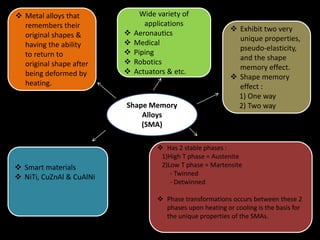
 Metal alloys that
remembers their
original shapes &
having the ability
to return to
original shape after
being deformed by
heating.
Wide variety of
applications
 Aeronautics
 Medical
 Piping
 Robotics
 Actuators & etc.
 Smart materials
 NiTi, CuZnAl & CuAlNi
 Exhibit two very
unique properties,
pseudo-elasticity,
and the shape
memory effect.
 Shape memory
effect :
1) One way
2) Two way
 Has 2 stable phases :
1)High T phase = Austenite
2)Low T phase = Martensite
- Twinned
- Detwinned
 Phase transformations occurs between these 2
phases upon heating or cooling is the basis for
the unique properties of the SMAs.
How Shape Memory Alloys Work??
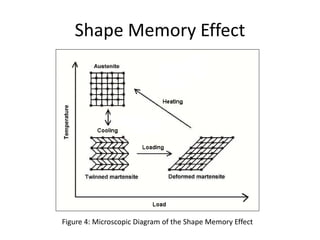
• Martensite, is the relatively soft and easily deformed phase of shape memory alloys, which
exists at lower temperatures. The molecular structure in this phase is twinned which is the
configuration shown in the middle of Figure 2. Upon deformation this phase takes on the
second form shown in Figure 2, on the right. Austenite, the stronger phase of shape memory
alloys, occurs at higher temperatures. The shape of the Austenite structure is cubic, the
structure shown on the left side of Figure 2. The un-deformed Martensite phase is the same
size and shape as the cubic Austenite phase on a macroscopic scale, so that no change in size
or shape is visible in shape memory alloys until the Martensite is deformed.
Figure 2: Microscopic and Macroscopic Views of the Two Phases of Shape Memory Alloys
Shape Memory Effect
Figure 4: Microscopic Diagram of the Shape Memory Effect
Shape Memory Effect
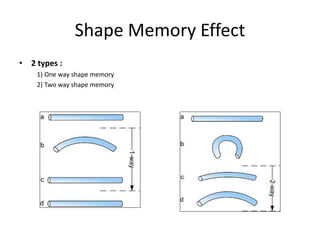
• 2 types :
1) One way shape memory
2) Two way shape memory
Shape Memory Effect
One way
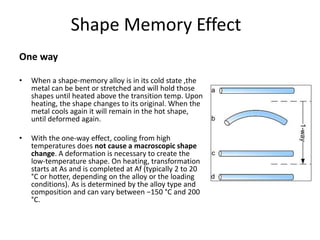
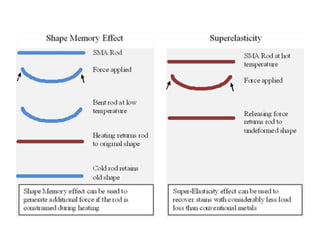
• When a shape-memory alloy is in its cold state ,the
metal can be bent or stretched and will hold those
shapes until heated above the transition temp. Upon
heating, the shape changes to its original. When the
metal cools again it will remain in the hot shape,
until deformed again.
• With the one-way effect, cooling from high
temperatures does not cause a macroscopic shape
change. A deformation is necessary to create the
low-temperature shape. On heating, transformation
starts at As and is completed at Af (typically 2 to 20
°C or hotter, depending on the alloy or the loading
conditions). As is determined by the alloy type and
composition and can vary between −150 °C and 200
°C.
Shape Memory Effect
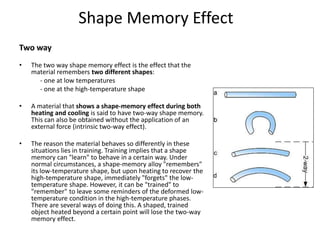
Two way
• The two way shape memory effect is the effect that the
material remembers two different shapes:
- one at low temperatures
- one at the high-temperature shape
• A material that shows a shape-memory effect during both
heating and cooling is said to have two-way shape memory.
This can also be obtained without the application of an
external force (intrinsic two-way effect).
• The reason the material behaves so differently in these
situations lies in training. Training implies that a shape
memory can "learn" to behave in a certain way. Under
normal circumstances, a shape-memory alloy "remembers"
its low-temperature shape, but upon heating to recover the
high-temperature shape, immediately "forgets" the low-
temperature shape. However, it can be "trained" to
"remember" to leave some reminders of the deformed low-
temperature condition in the high-temperature phases.
There are several ways of doing this. A shaped, trained
object heated beyond a certain point will lose the two-way
memory effect.
Pseudo-elasticity
• Unlike the shape memory effect, pseudo-elasticity occurs without a change in
temperature.
• Occurs when an alloy is completely in the Austenite phase
• Not dependent on temperature
• When the load is increased to a point, the alloy transitionss from the Austenite
phase to the detwinned Martensite phase.
• Once the load is removed, the alloy returns to it original Austenite shape.
• Rubber like effect.
Advantages and Disadvantages of Shape
Memory Alloys
Some of the main advantages of shape memory alloys include:
• Bio-compatibility
• Diverse Fields of Application
• Good Mechanical Properties (strong, corrosion resistant)
• These alloys are still relatively expensive to manufacture and
machine compared to other materials such as steel and aluminum.
• Most SMA's have poor fatigue properties; this means that while
under the same loading conditions (i.e. twisting, bending,
compressing) a steel component may survive for more than one
hundred times more cycles than an SMA element.
Application 1 : The Smart Wing
• The smart is a new tech that uses SMA
(Nitinol wires) to change the shape of
the wings of a plane to make it more
maneuverable.
• This done by simply sending electric
current, throw the part of the plane to
heat it to the desired temperature.
• This changes the shapes of the wing
making the plane more maneuverable.
• This was previously done with heavy
hydraulic system, thus significantly
reducing the weight of the plane.
• Nitinol wires can be used in
applications such as the actuators for
planes. Many use bulky hydraulic
systems which are expensive and need
a lot of maintenance.
The wires in the picture are used to replace the
actuator. Electric pulses sent through the wires
allow for precise movement of the wings, as
would be needed in an aircraft. This reduces the
need for maintenance, weighs less, and is less
costly.
Application 2 : Pipe Coupling
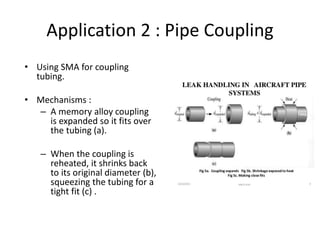
• Using SMA for coupling
tubing.
• Mechanisms :
– A memory alloy coupling
is expanded so it fits over
the tubing (a).
– When the coupling is
reheated, it shrinks back
to its original diameter (b),
squeezing the tubing for a
tight fit (c) .
SMA vs Traditional Fittings
• Lighter than traditional tube fittings
• Compact structure
• High sealing performance
• Cheaper
• TiNi aniti corrosion
• Strong adaptability & suitable for connection
among dissimilar materials which cannot be
welded.
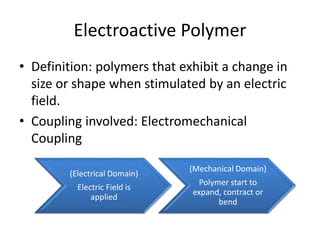
Electroactive Polymer
• Definition: polymers that exhibit a change in
size or shape when stimulated by an electric
field.
• Coupling involved: Electromechanical
Coupling
(Electrical Domain)
Electric Field is
applied
(Mechanical Domain)
Polymer start to
expand, contract or
bend
• Small stress but large strain
• Low Young’s Modulus (modulus of elasticity)
Classification of
Electroactive Polymer
Dielectric
Ferroelectric
Polymer
Electrostrictive
Graft Polymer
Liquid
Crystalline
Polymer
Ionic
Electrorheological
fluid Ionic
Polymer-
metal
composite
Stimuli
Responsive Gel
Dielectric VS Ionic
Dielectric Ionic
Actuation caused by electrostatic forces
between two electrodes
Actuation caused by the displacement of
ions inside the polymers
Require high activation fields ( >10V/μm ) Require low activation field ( only 1-
2V/μm )
Require no power to keep the actuator at
a given position
Require energy to keep the actuator at a
given position
Can be operated in air Need to maintain wetness (must always
have electrolyte for ionic reaction)
Artificial Muscle
• Dielectric elastomer have large elongation strain (120–
380%), large stress (3.2MPa) ,high speed of response
(10−3s), and high specific elastic energy density (3.4 J/g)
• Transform electrical energy directly into mechanical work
and produce large strain
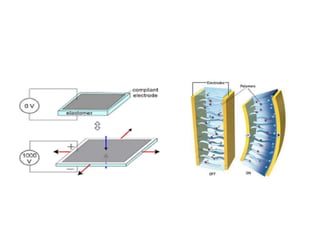
• Actuators are composed primarily of thin passive elastomer
film with two compliant electrodes on the surface
• When electrical voltage is applied to the electrodes, an
electrostatic force is generated between the electrodes.
• Application: Robotic
Heart E-Gel
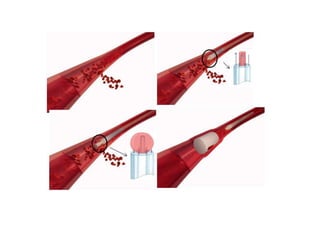
• Used to stop the bleeding in an artery/vein.
• Mechanism: a delivery device with
electroactive gel which has been electrically
shrunk is introduced until it is at the target
location.
• Once at the target location, the electrical bias
is removed to allow the gel to swell to a fully
swollen gel enough to stop the bleeding.
• Application: medical
Advantages Limitations
Easily processed, cheap,
lightweight, can conform to
complicated shapes and
surfaces.
maximum actuation
capabilities are restricted by
the dielectric strength
(breakdown voltage) of
elastomer film
Large strain
High mechanical energy
density

Smart Materials: SMA & EAP

  • 1.
    Shape Memory Alloys (SMA)  Metalalloys that remembers their original shapes & having the ability to return to original shape after being deformed by heating. Wide variety of applications  Aeronautics  Medical  Piping  Robotics  Actuators & etc.  Smart materials  NiTi, CuZnAl & CuAlNi  Exhibit two very unique properties, pseudo-elasticity, and the shape memory effect.  Shape memory effect : 1) One way 2) Two way  Has 2 stable phases : 1)High T phase = Austenite 2)Low T phase = Martensite - Twinned - Detwinned  Phase transformations occurs between these 2 phases upon heating or cooling is the basis for the unique properties of the SMAs.
  • 2.
    How Shape MemoryAlloys Work?? • Martensite, is the relatively soft and easily deformed phase of shape memory alloys, which exists at lower temperatures. The molecular structure in this phase is twinned which is the configuration shown in the middle of Figure 2. Upon deformation this phase takes on the second form shown in Figure 2, on the right. Austenite, the stronger phase of shape memory alloys, occurs at higher temperatures. The shape of the Austenite structure is cubic, the structure shown on the left side of Figure 2. The un-deformed Martensite phase is the same size and shape as the cubic Austenite phase on a macroscopic scale, so that no change in size or shape is visible in shape memory alloys until the Martensite is deformed. Figure 2: Microscopic and Macroscopic Views of the Two Phases of Shape Memory Alloys
  • 3.
    Shape Memory Effect Figure4: Microscopic Diagram of the Shape Memory Effect
  • 4.
    Shape Memory Effect •2 types : 1) One way shape memory 2) Two way shape memory
  • 5.
    Shape Memory Effect Oneway • When a shape-memory alloy is in its cold state ,the metal can be bent or stretched and will hold those shapes until heated above the transition temp. Upon heating, the shape changes to its original. When the metal cools again it will remain in the hot shape, until deformed again. • With the one-way effect, cooling from high temperatures does not cause a macroscopic shape change. A deformation is necessary to create the low-temperature shape. On heating, transformation starts at As and is completed at Af (typically 2 to 20 °C or hotter, depending on the alloy or the loading conditions). As is determined by the alloy type and composition and can vary between −150 °C and 200 °C.
  • 6.
    Shape Memory Effect Twoway • The two way shape memory effect is the effect that the material remembers two different shapes: - one at low temperatures - one at the high-temperature shape • A material that shows a shape-memory effect during both heating and cooling is said to have two-way shape memory. This can also be obtained without the application of an external force (intrinsic two-way effect). • The reason the material behaves so differently in these situations lies in training. Training implies that a shape memory can "learn" to behave in a certain way. Under normal circumstances, a shape-memory alloy "remembers" its low-temperature shape, but upon heating to recover the high-temperature shape, immediately "forgets" the low- temperature shape. However, it can be "trained" to "remember" to leave some reminders of the deformed low- temperature condition in the high-temperature phases. There are several ways of doing this. A shaped, trained object heated beyond a certain point will lose the two-way memory effect.
  • 7.
    Pseudo-elasticity • Unlike theshape memory effect, pseudo-elasticity occurs without a change in temperature. • Occurs when an alloy is completely in the Austenite phase • Not dependent on temperature • When the load is increased to a point, the alloy transitionss from the Austenite phase to the detwinned Martensite phase. • Once the load is removed, the alloy returns to it original Austenite shape. • Rubber like effect.
  • 9.
    Advantages and Disadvantagesof Shape Memory Alloys Some of the main advantages of shape memory alloys include: • Bio-compatibility • Diverse Fields of Application • Good Mechanical Properties (strong, corrosion resistant) • These alloys are still relatively expensive to manufacture and machine compared to other materials such as steel and aluminum. • Most SMA's have poor fatigue properties; this means that while under the same loading conditions (i.e. twisting, bending, compressing) a steel component may survive for more than one hundred times more cycles than an SMA element.
  • 10.
    Application 1 :The Smart Wing • The smart is a new tech that uses SMA (Nitinol wires) to change the shape of the wings of a plane to make it more maneuverable. • This done by simply sending electric current, throw the part of the plane to heat it to the desired temperature. • This changes the shapes of the wing making the plane more maneuverable. • This was previously done with heavy hydraulic system, thus significantly reducing the weight of the plane. • Nitinol wires can be used in applications such as the actuators for planes. Many use bulky hydraulic systems which are expensive and need a lot of maintenance.
  • 11.
    The wires inthe picture are used to replace the actuator. Electric pulses sent through the wires allow for precise movement of the wings, as would be needed in an aircraft. This reduces the need for maintenance, weighs less, and is less costly.
  • 12.
    Application 2 :Pipe Coupling • Using SMA for coupling tubing. • Mechanisms : – A memory alloy coupling is expanded so it fits over the tubing (a). – When the coupling is reheated, it shrinks back to its original diameter (b), squeezing the tubing for a tight fit (c) .
  • 13.
    SMA vs TraditionalFittings • Lighter than traditional tube fittings • Compact structure • High sealing performance • Cheaper • TiNi aniti corrosion • Strong adaptability & suitable for connection among dissimilar materials which cannot be welded.
  • 14.
    Electroactive Polymer • Definition:polymers that exhibit a change in size or shape when stimulated by an electric field. • Coupling involved: Electromechanical Coupling (Electrical Domain) Electric Field is applied (Mechanical Domain) Polymer start to expand, contract or bend
  • 15.
    • Small stressbut large strain • Low Young’s Modulus (modulus of elasticity)
  • 16.
    Classification of Electroactive Polymer Dielectric Ferroelectric Polymer Electrostrictive GraftPolymer Liquid Crystalline Polymer Ionic Electrorheological fluid Ionic Polymer- metal composite Stimuli Responsive Gel
  • 17.
    Dielectric VS Ionic DielectricIonic Actuation caused by electrostatic forces between two electrodes Actuation caused by the displacement of ions inside the polymers Require high activation fields ( >10V/μm ) Require low activation field ( only 1- 2V/μm ) Require no power to keep the actuator at a given position Require energy to keep the actuator at a given position Can be operated in air Need to maintain wetness (must always have electrolyte for ionic reaction)
  • 18.
    Artificial Muscle • Dielectricelastomer have large elongation strain (120– 380%), large stress (3.2MPa) ,high speed of response (10−3s), and high specific elastic energy density (3.4 J/g) • Transform electrical energy directly into mechanical work and produce large strain • Actuators are composed primarily of thin passive elastomer film with two compliant electrodes on the surface • When electrical voltage is applied to the electrodes, an electrostatic force is generated between the electrodes. • Application: Robotic
  • 20.
    Heart E-Gel • Usedto stop the bleeding in an artery/vein. • Mechanism: a delivery device with electroactive gel which has been electrically shrunk is introduced until it is at the target location. • Once at the target location, the electrical bias is removed to allow the gel to swell to a fully swollen gel enough to stop the bleeding. • Application: medical
  • 22.
    Advantages Limitations Easily processed,cheap, lightweight, can conform to complicated shapes and surfaces. maximum actuation capabilities are restricted by the dielectric strength (breakdown voltage) of elastomer film Large strain High mechanical energy density