FOUNDATION - DEFINATION
A foundation in construction is the lower portion of a building
structure that transmits its gravity loads and other forces to the
underlying soil or rock in a way that ensures stability, safety, and
durability.
 Key Characterstics:
• Load Distribution: It distributes the weight of the building evenly
to the soil or rock below, preventing excessive settlement or
failure.
• Stability: It anchors the structure against lateral forces such as
wind, earthquakes, or flooding.
• Prevention of Settlement: It minimizes uneven settling, which
could lead to cracks or structural damage.
• Protection from Environmental Factors: It creates a barrier
against moisture, frost, and soil movement.
FOUNDATION - TYPES
• SPREAD FOOTING
• COMBINED FOOTING
• STRAP FOOTING
• MAT FOUNDATION OR RAFT FOUNDATION
SHALLOW
• PILE FOUNDATION
• PIER FOUNDATION
DEEP
SHALLOW FOUNDATION
 A shallow foundation is a type of foundation where the
structural loads are transferred to the ground close to the
surface, typically at a depth less than the foundation's
width.
 Used for lighter structures where the soil has good load-
bearing capacity near the surface.
 TYPES :
• Spread footing
• Combined footing
• Strap footing
• Mat foundation or raft foundation
SHALLOW FOUNDATION - SPREAD FOOTING
 A spread footing is a type of shallow foundation designed to
support an individual structural load, such as a column, by
spreading the load over a larger area of the soil to prevent excessive
settlement or shear failure.
 Key characteristics:
• Load Distribution: Spreads the load of the structure evenly to the
soil below.
• Shape: Typically square, rectangular, or circular, depending on the
column or load it supports.
• Depth: The depth of a spread footing is relatively shallow, often
placed just below the frost line or where soil has adequate bearing
capacity.
• Construction Material: Usually made of reinforced concrete.
SHALLOW FOUNDATION - SPREAD FOOTING
 Advantages:
• Simple to design and construct.
• Cost-effective for smaller structures with favorable soil conditions.
 Disadvantage:
• Limited to strong surface soils; unsuitable for weak or compressible soils.
• Cannot handle very heavy loads or concentrated forces.
• Prone to differential settlement on uneven soil.
• Unsuitable for waterlogged or high groundwater areas.
• Vulnerable to frost heave in cold climates.
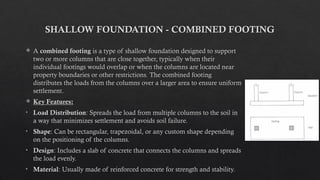
SHALLOW FOUNDATION - COMBINED FOOTING
 A combined footing is a type of shallow foundation designed to support
two or more columns that are close together, typically when their
individual footings would overlap or when the columns are located near
property boundaries or other restrictions. The combined footing
distributes the loads from the columns over a larger area to ensure uniform
settlement.
 Key Features:
• Load Distribution: Spreads the load from multiple columns to the soil in
a way that minimizes settlement and avoids soil failure.
• Shape: Can be rectangular, trapezoidal, or any custom shape depending
on the positioning of the columns.
• Design: Includes a slab of concrete that connects the columns and spreads
the load evenly.
• Material: Usually made of reinforced concrete for strength and stability.
SHALLOW FOUNDATION - COMBINED FOOTING
 Advantages:
• Efficient Load Distribution: Spreads the load from multiple columns, reducing stress on
the soil.
• Space Optimization: Ideal for situations with limited space, such as near property
boundaries.
• Reduced Settlement: Helps minimize differential settlement by distributing loads evenly.
 Disadvantages:
• Complex Design: More complicated to design and construct compared to individual
footings.
• Higher Cost: Requires more materials and labor, making it costlier than individual
footings.
• Limited to Close Columns: Only effective when columns are positioned close together.
SHALLOW FOUNDATION - STRAP FOOTING
 A strap footing is a type of shallow foundation used to support two or
more columns that are not aligned and are located at a distance from
each other. It consists of two or more individual footings connected by
a beam, known as the strap, which helps distribute the loads evenly
between the columns.
 Key Features:
• Load Distribution: The strap transfers the load between the individual
footings, ensuring that the loads from both columns are balanced.
• Shape: Typically includes two or more isolated footings connected by
a reinforced concrete strap (beam).
• Application: Used when columns are spaced apart, and placing
individual footings would not be efficient due to space constraints or
other factors like property boundaries.
SHALLOW FOUNDATION - STRAP FOOTING
 Advantages :
• Load Balancing: Distributes loads evenly between columns, reducing differential
settlement.
• Space Optimization: Useful when columns are spaced apart or near boundaries.
• Cost-Effective for Spaced Columns: More efficient than using multiple individual
footings in certain cases.
 Disadvantages :
• Complex Design: More complicated and requires precise calculation and construction.
• Higher Material Cost: The connecting beam (strap) adds to the material and labor costs.
• Not Suitable for Large Loads: Limited in use for very heavy or high-load structures.
SHALLOW FOUNDATION – MAT /RAFT FOUNDATION
 A mat foundation (also known as a raft foundation) is a type of
shallow foundation that consists of a large, continuous concrete slab
that supports the entire structure. It distributes the load of the
building evenly across a large area of soil, which helps prevent
excessive settlement, especially in areas with weak or compressible
soils.
 Key Features:
• Large Slab: The foundation is a thick concrete slab that covers the
entire area of the building's footprint.
• Load Distribution: Spreads the load from the entire structure to the
soil beneath, reducing the risk of differential settlement.
• Suitable for Weak Soils: Often used when the soil has low bearing
capacity, as it provides better stability than individual footings.
SHALLOW FOUNDATION – MAT /RAFT FOUNDATION
Advantages :
• Load Distribution: Effectively spreads the load of the building over a large area, reducing
settlement.
• Ideal for Weak Soils: Suitable for poor or compressible soils where individual footings would
not be effective.
• Reduces Differential Settlement: Minimizes uneven settling by distributing the weight evenly.
• Space Efficient: Suitable for large, heavy buildings with multiple columns.
Disadvantages :
• High Cost: Requires a large amount of concrete and reinforcement, making it more expensive.
• Complex Design: Needs careful design to ensure the slab thickness and reinforcement are
adequate.
• Construction Time: Takes longer to construct compared to simpler foundation types.
DEEP FOUNDATION
 A deep foundation is a type of foundation that
transfers structural loads to a deeper layer of soil or
rock that has sufficient load-bearing capacity, typically
at depths much greater than the foundation's width.
 Used when the soil near the surface is weak, and loads
must be transferred to deeper, more stable strata.
 TYPES :
• Pile foundation
• Pier foundation
DEEP FOUNDATION - PILE FOUNDATION
 A pile foundation is a type of deep foundation used to transfer heavy loads
from a structure to deeper, more stable layers of soil or rock. It consists of
long, slender columns (piles) that are driven, drilled, or cast into the ground,
extending through weak or compressible soil to reach stronger layers below.
 Key Features:
• Depth: Extends deep into the ground, beyond surface soil layers, to transfer
loads to stronger strata.
• Load Transfer: Can transfer loads through end bearing (at the pile tip) or
skin friction (along the sides of the pile).
• Material: Piles can be made of wood, steel, concrete, or composite
materials.
• Installation: Piles can be driven into the ground, drilled, or cast-in-place
depending on the type and soil conditions.
DEEP FOUNDATION - PILE FOUNDATION
 Advantages :
• Suitable for Weak Soils: Transfers loads to deeper, stronger strata, making it ideal
for poor or compressible surface soils.
• High Load Capacity: Can support heavy loads, making it suitable for large
structures like high-rises and bridges.
• Prevents Differential Settlement: Minimizes uneven settlement by anchoring
deep into stable soil layers.
• Works in Waterlogged Areas: Effective in locations with high groundwater levels
or near bodies of water.
DEEP FOUNDATION - PILE FOUNDATION
 Disadvantages :
• High Cost: Expensive due to materials, labor, and specialized equipment for
installation.
• Complex Installation: Requires specialized machinery and expertise for driving or
drilling piles.
• Time-Consuming: Installation can be slow, especially for large projects or difficult
soil conditions.
• Disruptive: Pile installation can cause vibrations or noise, affecting surrounding
areas.
DEEP FOUNDATION – PIER FOUNDATION
 A pier foundation is a type of deep foundation that consists of large,
vertical cylindrical columns, typically made of reinforced concrete,
which are driven or drilled into the ground to support a structure. Piers
are generally used when the soil near the surface is weak or unstable and
cannot support the loads of the structure.
 Key Features:
 Depth: Piers extend deep into the ground, usually reaching stronger soil
or rock layers.
 Load Transfer: Transfers loads through end bearing (at the bottom of
the pier) or skin friction (along the sides of the pier).
 Shape: Piers are typically circular or cylindrical in shape and are larger
in diameter than piles.
 Material: Made of concrete, reinforced concrete, or masonry.
DEEP FOUNDATION – PIER FOUNDATION
 Advantages:
• Suitable for Weak or Unstable Soils: Reaches stable soil or rock layers, making it
ideal for poor surface soils.
• High Load Capacity: Can support heavy structures, including bridges and large
buildings.
• Reduced Settlement: Minimizes the risk of differential settlement by anchoring
deep into strong soil.
• Works in Waterlogged Areas: Effective in areas with high groundwater or near
water bodies.
DEEP FOUNDATION – PIER FOUNDATION
 Disadvantages :
• High Cost: Requires specialized equipment and materials, making it more
expensive than shallow foundations.
• Complex Installation: Installation can be challenging and time-consuming,
requiring skilled labor and heavy machinery.
• Space Constraints: Not suitable for sites with limited access for installation
equipment.
• Disruptive: The construction process can cause vibrations and noise, which may
impact surrounding areas.
THANK YOU

Foundation presentation ( Construction )

  • 1.
    FOUNDATION - DEFINATION Afoundation in construction is the lower portion of a building structure that transmits its gravity loads and other forces to the underlying soil or rock in a way that ensures stability, safety, and durability.  Key Characterstics: • Load Distribution: It distributes the weight of the building evenly to the soil or rock below, preventing excessive settlement or failure. • Stability: It anchors the structure against lateral forces such as wind, earthquakes, or flooding. • Prevention of Settlement: It minimizes uneven settling, which could lead to cracks or structural damage. • Protection from Environmental Factors: It creates a barrier against moisture, frost, and soil movement.
  • 2.
    FOUNDATION - TYPES •SPREAD FOOTING • COMBINED FOOTING • STRAP FOOTING • MAT FOUNDATION OR RAFT FOUNDATION SHALLOW • PILE FOUNDATION • PIER FOUNDATION DEEP
  • 3.
    SHALLOW FOUNDATION  Ashallow foundation is a type of foundation where the structural loads are transferred to the ground close to the surface, typically at a depth less than the foundation's width.  Used for lighter structures where the soil has good load- bearing capacity near the surface.  TYPES : • Spread footing • Combined footing • Strap footing • Mat foundation or raft foundation
  • 4.
    SHALLOW FOUNDATION -SPREAD FOOTING  A spread footing is a type of shallow foundation designed to support an individual structural load, such as a column, by spreading the load over a larger area of the soil to prevent excessive settlement or shear failure.  Key characteristics: • Load Distribution: Spreads the load of the structure evenly to the soil below. • Shape: Typically square, rectangular, or circular, depending on the column or load it supports. • Depth: The depth of a spread footing is relatively shallow, often placed just below the frost line or where soil has adequate bearing capacity. • Construction Material: Usually made of reinforced concrete.
  • 5.
    SHALLOW FOUNDATION -SPREAD FOOTING  Advantages: • Simple to design and construct. • Cost-effective for smaller structures with favorable soil conditions.  Disadvantage: • Limited to strong surface soils; unsuitable for weak or compressible soils. • Cannot handle very heavy loads or concentrated forces. • Prone to differential settlement on uneven soil. • Unsuitable for waterlogged or high groundwater areas. • Vulnerable to frost heave in cold climates.
  • 6.
    SHALLOW FOUNDATION -COMBINED FOOTING  A combined footing is a type of shallow foundation designed to support two or more columns that are close together, typically when their individual footings would overlap or when the columns are located near property boundaries or other restrictions. The combined footing distributes the loads from the columns over a larger area to ensure uniform settlement.  Key Features: • Load Distribution: Spreads the load from multiple columns to the soil in a way that minimizes settlement and avoids soil failure. • Shape: Can be rectangular, trapezoidal, or any custom shape depending on the positioning of the columns. • Design: Includes a slab of concrete that connects the columns and spreads the load evenly. • Material: Usually made of reinforced concrete for strength and stability.
  • 7.
    SHALLOW FOUNDATION -COMBINED FOOTING  Advantages: • Efficient Load Distribution: Spreads the load from multiple columns, reducing stress on the soil. • Space Optimization: Ideal for situations with limited space, such as near property boundaries. • Reduced Settlement: Helps minimize differential settlement by distributing loads evenly.  Disadvantages: • Complex Design: More complicated to design and construct compared to individual footings. • Higher Cost: Requires more materials and labor, making it costlier than individual footings. • Limited to Close Columns: Only effective when columns are positioned close together.
  • 8.
    SHALLOW FOUNDATION -STRAP FOOTING  A strap footing is a type of shallow foundation used to support two or more columns that are not aligned and are located at a distance from each other. It consists of two or more individual footings connected by a beam, known as the strap, which helps distribute the loads evenly between the columns.  Key Features: • Load Distribution: The strap transfers the load between the individual footings, ensuring that the loads from both columns are balanced. • Shape: Typically includes two or more isolated footings connected by a reinforced concrete strap (beam). • Application: Used when columns are spaced apart, and placing individual footings would not be efficient due to space constraints or other factors like property boundaries.
  • 9.
    SHALLOW FOUNDATION -STRAP FOOTING  Advantages : • Load Balancing: Distributes loads evenly between columns, reducing differential settlement. • Space Optimization: Useful when columns are spaced apart or near boundaries. • Cost-Effective for Spaced Columns: More efficient than using multiple individual footings in certain cases.  Disadvantages : • Complex Design: More complicated and requires precise calculation and construction. • Higher Material Cost: The connecting beam (strap) adds to the material and labor costs. • Not Suitable for Large Loads: Limited in use for very heavy or high-load structures.
  • 10.
    SHALLOW FOUNDATION –MAT /RAFT FOUNDATION  A mat foundation (also known as a raft foundation) is a type of shallow foundation that consists of a large, continuous concrete slab that supports the entire structure. It distributes the load of the building evenly across a large area of soil, which helps prevent excessive settlement, especially in areas with weak or compressible soils.  Key Features: • Large Slab: The foundation is a thick concrete slab that covers the entire area of the building's footprint. • Load Distribution: Spreads the load from the entire structure to the soil beneath, reducing the risk of differential settlement. • Suitable for Weak Soils: Often used when the soil has low bearing capacity, as it provides better stability than individual footings.
  • 11.
    SHALLOW FOUNDATION –MAT /RAFT FOUNDATION Advantages : • Load Distribution: Effectively spreads the load of the building over a large area, reducing settlement. • Ideal for Weak Soils: Suitable for poor or compressible soils where individual footings would not be effective. • Reduces Differential Settlement: Minimizes uneven settling by distributing the weight evenly. • Space Efficient: Suitable for large, heavy buildings with multiple columns. Disadvantages : • High Cost: Requires a large amount of concrete and reinforcement, making it more expensive. • Complex Design: Needs careful design to ensure the slab thickness and reinforcement are adequate. • Construction Time: Takes longer to construct compared to simpler foundation types.
  • 12.
    DEEP FOUNDATION  Adeep foundation is a type of foundation that transfers structural loads to a deeper layer of soil or rock that has sufficient load-bearing capacity, typically at depths much greater than the foundation's width.  Used when the soil near the surface is weak, and loads must be transferred to deeper, more stable strata.  TYPES : • Pile foundation • Pier foundation
  • 13.
    DEEP FOUNDATION -PILE FOUNDATION  A pile foundation is a type of deep foundation used to transfer heavy loads from a structure to deeper, more stable layers of soil or rock. It consists of long, slender columns (piles) that are driven, drilled, or cast into the ground, extending through weak or compressible soil to reach stronger layers below.  Key Features: • Depth: Extends deep into the ground, beyond surface soil layers, to transfer loads to stronger strata. • Load Transfer: Can transfer loads through end bearing (at the pile tip) or skin friction (along the sides of the pile). • Material: Piles can be made of wood, steel, concrete, or composite materials. • Installation: Piles can be driven into the ground, drilled, or cast-in-place depending on the type and soil conditions.
  • 14.
    DEEP FOUNDATION -PILE FOUNDATION  Advantages : • Suitable for Weak Soils: Transfers loads to deeper, stronger strata, making it ideal for poor or compressible surface soils. • High Load Capacity: Can support heavy loads, making it suitable for large structures like high-rises and bridges. • Prevents Differential Settlement: Minimizes uneven settlement by anchoring deep into stable soil layers. • Works in Waterlogged Areas: Effective in locations with high groundwater levels or near bodies of water.
  • 15.
    DEEP FOUNDATION -PILE FOUNDATION  Disadvantages : • High Cost: Expensive due to materials, labor, and specialized equipment for installation. • Complex Installation: Requires specialized machinery and expertise for driving or drilling piles. • Time-Consuming: Installation can be slow, especially for large projects or difficult soil conditions. • Disruptive: Pile installation can cause vibrations or noise, affecting surrounding areas.
  • 16.
    DEEP FOUNDATION –PIER FOUNDATION  A pier foundation is a type of deep foundation that consists of large, vertical cylindrical columns, typically made of reinforced concrete, which are driven or drilled into the ground to support a structure. Piers are generally used when the soil near the surface is weak or unstable and cannot support the loads of the structure.  Key Features:  Depth: Piers extend deep into the ground, usually reaching stronger soil or rock layers.  Load Transfer: Transfers loads through end bearing (at the bottom of the pier) or skin friction (along the sides of the pier).  Shape: Piers are typically circular or cylindrical in shape and are larger in diameter than piles.  Material: Made of concrete, reinforced concrete, or masonry.
  • 17.
    DEEP FOUNDATION –PIER FOUNDATION  Advantages: • Suitable for Weak or Unstable Soils: Reaches stable soil or rock layers, making it ideal for poor surface soils. • High Load Capacity: Can support heavy structures, including bridges and large buildings. • Reduced Settlement: Minimizes the risk of differential settlement by anchoring deep into strong soil. • Works in Waterlogged Areas: Effective in areas with high groundwater or near water bodies.
  • 18.
    DEEP FOUNDATION –PIER FOUNDATION  Disadvantages : • High Cost: Requires specialized equipment and materials, making it more expensive than shallow foundations. • Complex Installation: Installation can be challenging and time-consuming, requiring skilled labor and heavy machinery. • Space Constraints: Not suitable for sites with limited access for installation equipment. • Disruptive: The construction process can cause vibrations and noise, which may impact surrounding areas.
  • 19.