 Pile foundation is a special kind of deep foundation, where 
the depth of the foundation is much greater than the width 
of the foundation. 
 Today, pile foundation is much more common than any other type of deep 
foundation. 
 It is used; 
1.where the soil is compressible, 
2.where the soil is water logged and 
3.when stratum of required bearing capacity is at 
greater depth. 
The major uses of piles: 
 To carry vertical compression loads, 
 To resist uplift loads 
 To resist horizontal or inclined loads
 Based on the function; 
1. End bearing Pile 
2. Friction Pile 
3. Compaction Pile 
4. Tension Pile or Uplift Pile 
5. Anchor Pile 
6. Fender Pile and Dolphins 
7. Batter Pile 
8. Sheet Pile 
 Based on the material & composition; 
1. Concrete Pile 
2. Timber Pile 
3. Steel Pile 
4. Composite Pile: Concrete & Timber, Concrete & Steel 
 Based on the method of installation; 
1. Driven Pile 
2. Cast-in-situ Pile 
3.Driven and cast- in- situ Pile
 Piles are commonly driven by means of a hammer 
supported by a crane or a special device known as a 
Pile Driver. 
Hammers adopted for driving the pile are 
of the following types: 
1. Drop hammer 
2. Single acting hammer 
3. Double acting hammer 
4. Diesel hammer 
5. Vibratory hammer.
What is ultimate load bearing capacity? 
What is allowable load and how is it determined? 
 Ultimate load bearing capacity of a pile is defined as 
the maximum load which can be carried by a pile and 
at which the pile continues to sink without further 
increase of the load. 
 The allowable load is the safe load which the pile can 
carry safely, which can be determined from ultimate 
load bearing capacity dividing by suitable F.O.S.
The load carrying capacity of a pile can be determined by the 
following methods: 
1) Dynamic formulae 
2) Static formulae 
3) Pile load tests, and 
4) Penetration test 
1) Dynamic formulae: 
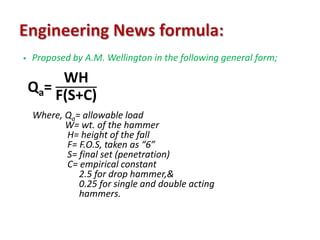
# Engineering News formula 
# Hiley’s formula
 Proposed by A.M. Wellington in the following general form; 
Qa= 
WH 
F(S+C) 
Where, Qa= allowable load 
W= wt. of the hammer 
H= height of the fall 
F= F.O.S, taken as “6” 
S= final set (penetration) 
C= empirical constant 
2.5 for drop hammer,& 
0.25 for single and double acting 
hammers.
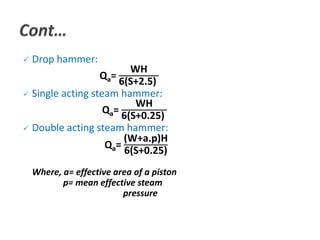
 Drop hammer: 
Qa= 
WH 
6(S+2.5) 
 Single acting steam hammer: 
Qa= 
WH 
6(S+0.25) 
 Double acting steam hammer: 
Qa= 
(W+a.p)H 
6(S+0.25) 
Where, a= effective area of a piston 
p= mean effective steam 
pressure
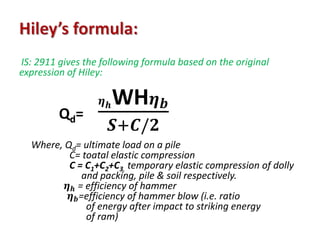
IS: 2911 gives the following formula based on the original 
expression of Hiley: 
Qd= 
휼풉WH휼풃 
푺+푪/ퟐ 
Where, Qd= ultimate load on a pile 
C= toatal elastic compression 
C = C1+C2+C3, temporary elastic compression of dolly 
and packing, pile & soil respectively. 
휼풉 = efficiency of hammer 
휼풃=efficiency of hammer blow (i.e. ratio 
of energy after impact to striking energy 
of ram)
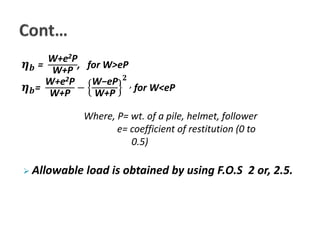
휼풃 = 
W+e2P 
W+P 
, for W>eP 
휼풃= 
W+e2P 
W+P 
− 
W−eP 
W+P 
ퟐ 
, for W<eP 
Where, P= wt. of a pile, helmet, follower 
e= coefficient of restitution (0 to 
0.5) 
 Allowable load is obtained by using F.O.S 2 or, 2.5.
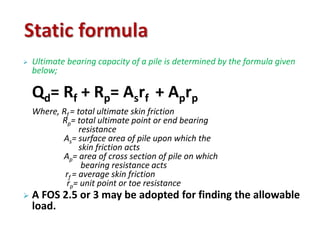
 Ultimate bearing capacity of a pile is determined by the formula given 
below; 
Qd= Rf + Rp= Asrf + Aprp 
Where, Rf = total ultimate skin friction 
Rp= total ultimate point or end bearing 
resistance 
As= surface area of pile upon which the 
skin friction acts 
Ap= area of cross section of pile on which 
bearing resistance acts 
rf = average skin friction 
rp= unit point or toe resistance 
 A FOS 2.5 or 3 may be adopted for finding the allowable 
load.
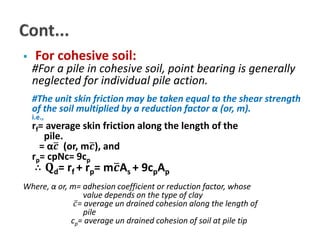
 For cohesive soil: 
#For a pile in cohesive soil, point bearing is generally 
neglected for individual pile action. 
#The unit skin friction may be taken equal to the shear strength 
of the soil multiplied by a reduction factor α (or, m). 
i.e., 
rf= average skin friction along the length of the 
pile. 
= α 풄 (or, m 풄), and 
rp= cpNc= 9cp 
∴ 퐐d= rf + rp= m 풄As + 9cpAp 
Where, α or, m= adhesion coefficient or reduction factor, whose 
value depends on the type of clay 
푐 = average un drained cohesion along the length of 
pile 
cp= average un drained cohesion of soil at pile tip
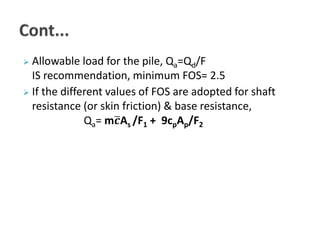
 Allowable load for the pile, Qa=Qd/F 
IS recommendation, minimum FOS= 2.5 
 If the different values of FOS are adopted for shaft 
resistance (or skin friction) & base resistance, 
Qa= m 풄As /F1 + 9cpAp/F2
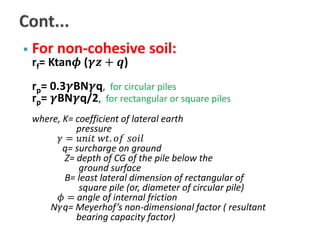
 For non-cohesive soil: 
rf= Ktan흓 (휸풛 + 풒) 
rp= 0.3휸BN휸q, for circular piles 
rp= 휸BN휸q/2, for rectangular or square piles 
where, K= coefficient of lateral earth 
pressure 
훾 = 푢푛푖푡 푤푡. 표푓 푠표푖푙 
q= surcharge on ground 
Z= depth of CG of the pile below the 
ground surface 
B= least lateral dimension of rectangular of 
square pile (or, diameter of circular pile) 
휙 = angle of internal friction 
N훾q= Meyerhof’s non-dimensional factor ( resultant 
bearing capacity factor)
 The result of Dutch Cone Penetration Test can be applied 
with sufficient accuracy to determine the ultimate bearing 
capacity of piles in cohesion-less soils. 
 The following relation may be adopted: 
rp= qc and, 
rf= 2fc 
where, qc= unit resistance of Dutch Cone 
Penetrometer 
fc= static skin friction on the shaft of the 
penetrometer
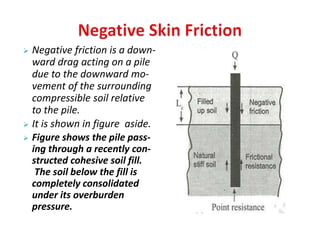
 Negative friction is a down-ward 
drag acting on a pile 
due to the downward mo-vement 
of the surrounding 
compressible soil relative 
to the pile. 
 It is shown in figure aside. 
 Figure shows the pile pass-ing 
through a recently con-structed 
cohesive soil fill. 
The soil below the fill is 
completely consolidated 
under its overburden 
pressure.
 Negative Skin Friction will occur due to the following 
reasons: 
 When the surrounding compressible soil 
has been recently filled. 
 If the fill material is loose cohesion less soil. 
 By lowering the ground water which increases the 
effective stress causing consolidation of the soil with 
resultant settlement and friction force being developed 
on the pile. 
 It also occurs when the fill is over the peat or a soft 
clay stratum.
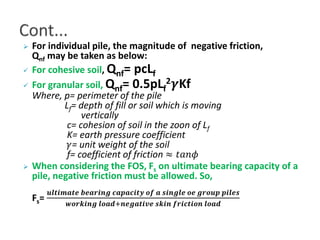
 For individual pile, the magnitude of negative friction, 
Qnf may be taken as below: 
 For cohesive soil, Qnf= pcLf 
2휸Kf 
 For granular soil, Qnf= 0.5pLf 
Where, p= perimeter of the pile 
Lf= depth of fill or soil which is moving 
vertically 
c= cohesion of soil in the zoon of Lf 
K= earth pressure coefficient 
훾= unit weight of the soil 
f= coefficient of friction ≈ 푡푎푛휙 
 When considering the FOS, Fs on ultimate bearing capacity of a 
pile, negative friction must be allowed. So, 
풖풍풕풊풎풂풕풆 풃풆풂풓풊풏품 풄풂풑풂풄풊풕풚 풐풇 풂 풔풊풏품풍풆 풐풆 품풓풐풖풑 풑풊풍풆풔 
Fs= 
풘풐풓풌풊풏품 풍풐풂풅+풏풆품풂풕풊풗풆 풔풌풊풏 풇풓풊풄풕풊풐풏 풍풐풂풅
 Factors governing the selection of 
piles 
They are: 
 Length of the pile in relation to the load and type of soil, 
 Characters of structure, 
 Availability of the materials, 
 Types of loading, 
 Factors causing deterioration, 
 Ease of maintenance, 
 Estimated cost of types of piles, taking into account the 
initial cost, life expectancy and cost of maintenance and, 
 Availability of funds.

Pile foundation

  • 2.
     Pile foundationis a special kind of deep foundation, where the depth of the foundation is much greater than the width of the foundation.  Today, pile foundation is much more common than any other type of deep foundation.  It is used; 1.where the soil is compressible, 2.where the soil is water logged and 3.when stratum of required bearing capacity is at greater depth. The major uses of piles:  To carry vertical compression loads,  To resist uplift loads  To resist horizontal or inclined loads
  • 3.
     Based onthe function; 1. End bearing Pile 2. Friction Pile 3. Compaction Pile 4. Tension Pile or Uplift Pile 5. Anchor Pile 6. Fender Pile and Dolphins 7. Batter Pile 8. Sheet Pile  Based on the material & composition; 1. Concrete Pile 2. Timber Pile 3. Steel Pile 4. Composite Pile: Concrete & Timber, Concrete & Steel  Based on the method of installation; 1. Driven Pile 2. Cast-in-situ Pile 3.Driven and cast- in- situ Pile
  • 4.
     Piles arecommonly driven by means of a hammer supported by a crane or a special device known as a Pile Driver. Hammers adopted for driving the pile are of the following types: 1. Drop hammer 2. Single acting hammer 3. Double acting hammer 4. Diesel hammer 5. Vibratory hammer.
  • 5.
    What is ultimateload bearing capacity? What is allowable load and how is it determined?  Ultimate load bearing capacity of a pile is defined as the maximum load which can be carried by a pile and at which the pile continues to sink without further increase of the load.  The allowable load is the safe load which the pile can carry safely, which can be determined from ultimate load bearing capacity dividing by suitable F.O.S.
  • 6.
    The load carryingcapacity of a pile can be determined by the following methods: 1) Dynamic formulae 2) Static formulae 3) Pile load tests, and 4) Penetration test 1) Dynamic formulae: # Engineering News formula # Hiley’s formula
  • 7.
     Proposed byA.M. Wellington in the following general form; Qa= WH F(S+C) Where, Qa= allowable load W= wt. of the hammer H= height of the fall F= F.O.S, taken as “6” S= final set (penetration) C= empirical constant 2.5 for drop hammer,& 0.25 for single and double acting hammers.
  • 8.
     Drop hammer: Qa= WH 6(S+2.5)  Single acting steam hammer: Qa= WH 6(S+0.25)  Double acting steam hammer: Qa= (W+a.p)H 6(S+0.25) Where, a= effective area of a piston p= mean effective steam pressure
  • 9.
    IS: 2911 givesthe following formula based on the original expression of Hiley: Qd= 휼풉WH휼풃 푺+푪/ퟐ Where, Qd= ultimate load on a pile C= toatal elastic compression C = C1+C2+C3, temporary elastic compression of dolly and packing, pile & soil respectively. 휼풉 = efficiency of hammer 휼풃=efficiency of hammer blow (i.e. ratio of energy after impact to striking energy of ram)
  • 10.
    휼풃 = W+e2P W+P , for W>eP 휼풃= W+e2P W+P − W−eP W+P ퟐ , for W<eP Where, P= wt. of a pile, helmet, follower e= coefficient of restitution (0 to 0.5)  Allowable load is obtained by using F.O.S 2 or, 2.5.
  • 11.
     Ultimate bearingcapacity of a pile is determined by the formula given below; Qd= Rf + Rp= Asrf + Aprp Where, Rf = total ultimate skin friction Rp= total ultimate point or end bearing resistance As= surface area of pile upon which the skin friction acts Ap= area of cross section of pile on which bearing resistance acts rf = average skin friction rp= unit point or toe resistance  A FOS 2.5 or 3 may be adopted for finding the allowable load.
  • 12.
     For cohesivesoil: #For a pile in cohesive soil, point bearing is generally neglected for individual pile action. #The unit skin friction may be taken equal to the shear strength of the soil multiplied by a reduction factor α (or, m). i.e., rf= average skin friction along the length of the pile. = α 풄 (or, m 풄), and rp= cpNc= 9cp ∴ 퐐d= rf + rp= m 풄As + 9cpAp Where, α or, m= adhesion coefficient or reduction factor, whose value depends on the type of clay 푐 = average un drained cohesion along the length of pile cp= average un drained cohesion of soil at pile tip
  • 13.
     Allowable loadfor the pile, Qa=Qd/F IS recommendation, minimum FOS= 2.5  If the different values of FOS are adopted for shaft resistance (or skin friction) & base resistance, Qa= m 풄As /F1 + 9cpAp/F2
  • 14.
     For non-cohesivesoil: rf= Ktan흓 (휸풛 + 풒) rp= 0.3휸BN휸q, for circular piles rp= 휸BN휸q/2, for rectangular or square piles where, K= coefficient of lateral earth pressure 훾 = 푢푛푖푡 푤푡. 표푓 푠표푖푙 q= surcharge on ground Z= depth of CG of the pile below the ground surface B= least lateral dimension of rectangular of square pile (or, diameter of circular pile) 휙 = angle of internal friction N훾q= Meyerhof’s non-dimensional factor ( resultant bearing capacity factor)
  • 15.
     The resultof Dutch Cone Penetration Test can be applied with sufficient accuracy to determine the ultimate bearing capacity of piles in cohesion-less soils.  The following relation may be adopted: rp= qc and, rf= 2fc where, qc= unit resistance of Dutch Cone Penetrometer fc= static skin friction on the shaft of the penetrometer
  • 16.
     Negative frictionis a down-ward drag acting on a pile due to the downward mo-vement of the surrounding compressible soil relative to the pile.  It is shown in figure aside.  Figure shows the pile pass-ing through a recently con-structed cohesive soil fill. The soil below the fill is completely consolidated under its overburden pressure.
  • 17.
     Negative SkinFriction will occur due to the following reasons:  When the surrounding compressible soil has been recently filled.  If the fill material is loose cohesion less soil.  By lowering the ground water which increases the effective stress causing consolidation of the soil with resultant settlement and friction force being developed on the pile.  It also occurs when the fill is over the peat or a soft clay stratum.
  • 18.
     For individualpile, the magnitude of negative friction, Qnf may be taken as below:  For cohesive soil, Qnf= pcLf 2휸Kf  For granular soil, Qnf= 0.5pLf Where, p= perimeter of the pile Lf= depth of fill or soil which is moving vertically c= cohesion of soil in the zoon of Lf K= earth pressure coefficient 훾= unit weight of the soil f= coefficient of friction ≈ 푡푎푛휙  When considering the FOS, Fs on ultimate bearing capacity of a pile, negative friction must be allowed. So, 풖풍풕풊풎풂풕풆 풃풆풂풓풊풏품 풄풂풑풂풄풊풕풚 풐풇 풂 풔풊풏품풍풆 풐풆 품풓풐풖풑 풑풊풍풆풔 Fs= 풘풐풓풌풊풏품 풍풐풂풅+풏풆품풂풕풊풗풆 풔풌풊풏 풇풓풊풄풕풊풐풏 풍풐풂풅
  • 19.
     Factors governingthe selection of piles They are:  Length of the pile in relation to the load and type of soil,  Characters of structure,  Availability of the materials,  Types of loading,  Factors causing deterioration,  Ease of maintenance,  Estimated cost of types of piles, taking into account the initial cost, life expectancy and cost of maintenance and,  Availability of funds.