BUILDING FOUNDATION
MADE BY – GUIDED BY -
POOJA SHARMA Ar. Sramana banerjee
Diya Aggrawal Ar. Mehfooz Akhtar
B. ARCH
1 ST YEAR
SUNDERDEEP COLLEGE OF ARCHITECTURE
INTRODUCTION
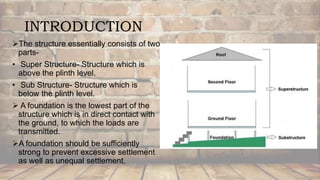
The structure essentially consists of two
parts-
• Super Structure- Structure which is
above the plinth level.
• Sub Structure- Structure which is
below the plinth level.
 A foundation is the lowest part of the
structure which is in direct contact with
the ground, to which the loads are
transmitted.
A foundation should be sufficiently
strong to prevent excessive settlement
as well as unequal settlement.
Purpose
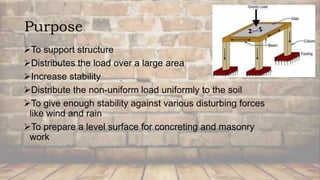
To support structure
Distributes the load over a large area
Increase stability
Distribute the non-uniform load uniformly to the soil
To give enough stability against various disturbing forces
like wind and rain
To prepare a level surface for concreting and masonry
work
Requirements of a good foundations
 Location –
It should be located that it is able to resist any unexpected future
influence .
Stability –
It should be stable or safe against any possible failure.
Settlement –
The foundation structure should not settle or deflect to such an
degree so as to damage its usefulness or the stability of building.
 Soil type -
Such as bed rock , limestone, sandstone and hard chalk have high
bearing capacity .
Selection criteria for foundation
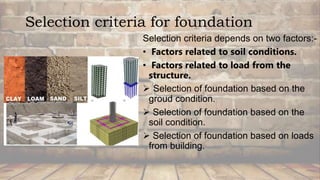
Selection criteria depends on two factors:-
• Factors related to soil conditions.
• Factors related to load from the
structure.
 Selection of foundation based on the
groud condition.
 Selection of foundation based on the
soil condition.
 Selection of foundation based on loads
from building.
Factors affecting foundation
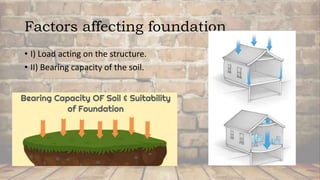
• I) Load acting on the structure.
• II) Bearing capacity of the soil.
Load acting on structure
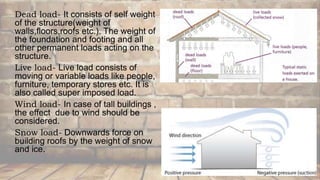
 Basically there are four types of loads –
i) Dead load
ii) Live load
iii) Wind load
iv) Snow load
Dead load- It consists of self weight
of the structure(weight of
walls,floors,roofs etc.). The weight of
the foundation and footing and all
other permanent loads acting on the
structure.
Live load- Live load consists of
moving or variable loads like people,
furniture, temporary stores etc. It is
also called super imposed load.
Wind load- In case of tall buildings ,
the effect due to wind should be
considered.
Snow load- Downwards force on
building roofs by the weight of snow
and ice.
Bearing capacity of soil
 The bearing capacity of soil is the
maximum pressure between the
foundation and the soil.
 Bearing capacity of soil depends upon
the shear strength of soil as well as
shape, size, depth and type of
foundation.
 failure occurs when the load on the
footing causes large movement which
extends away from the footing and up to
the soil surface.
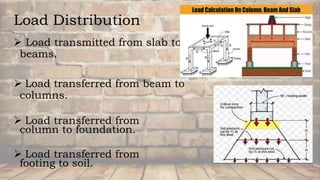
Load Distribution
 Load transmitted from slab to
beams.
 Load transferred from beam to
columns.
 Load transferred from
column to foundation.
 Load transferred from
footing to soil.
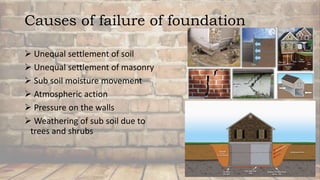
Causes of failure of foundation
 Unequal settlement of soil
 Unequal settlement of masonry
 Sub soil moisture movement
 Atmospheric action
 Pressure on the walls
 Weathering of sub soil due to
trees and shrubs
Classification of Foundation
There are two types foundation-
1- Shallow foundation
2- Deep foundation
SHALLOW
FOUNDATION
 A foundation is SHALLOW, if its
depth is equal to or less than its
width .
D<B / D=B
DEEP FOUNDATION
 In case of DEEP FOUNDATION,
the depth is equal or greater than
its width .
D>B / D=B
Shallow foundation
 It is suitable when bearing capacity of soil is
more
When ground water table is low
Top layer of soil are uniform and stable
Load on the structure is less
Cost is affordable
Simple construction procedure
Types of Shallow Foundation
 Shallow foundation may be the following types:
1- Spread footing
2- Combined footing
3- Strap footing
4- Eccentric foundation
5- Mat/ Raft foundation
Spread footing
 Spread footing are those which
spread the load of wall or column
over a larger area.
 Spread footing support either a
wall or column.
 Commonly used due to their
low cost
 It is not efficient for high rise
buildings
Spread footing are the following kinds:
i) Single footing for a column
ii) Stepped footing for a column
iii) Sloped footing for a column
iv) Wall footing without step
v) Stepped footing for wall
vi) Grillage foundation
Grillage foundation
 It is a type of foundation, used
at the base of a column.
 It consists of one, two or more
tiers.
 Grillage steel foundation for a
steel stanchion carrying heavy
load.
 It is used in waterlogged
areas, where the bearing of the
capacity is very low.
Combined footing
 A Spread footing which supports two or more columns is called
as Combined footing.
 Two columns are so close to each other that their individual
footings would overlap.
Combined footing are of two kinds:
i) Rectangular combined footing
ii) Trapezoidal combined footing
 Combined footing for columns will be rectangular in shape if
they carry equal load.
 Combined footing for columns will be trapezoidal in shape if
the carry unequal load.
Strap footing
 If two isolated footings of
columns are connected to a
beam, this is known as Strap
footing.
 That beam is termed as Strap.
 And connected in such a way
that they behave as a one unit.
 Strap footing is used where the
distance between two columns is
greater.
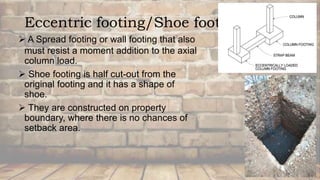
Eccentric footing/Shoe footing
 A Spread footing or wall footing that also
must resist a moment addition to the axial
column load.
 Shoe footing is half cut-out from the
original footing and it has a shape of
shoe.
 They are constructed on property
boundary, where there is no chances of
setback area.
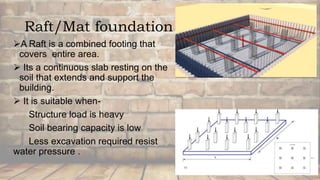
Raft/Mat foundation
A Raft is a combined footing that
covers entire area.
 Its a continuous slab resting on the
soil that extends and support the
building.
 It is suitable when-
Structure load is heavy
Soil bearing capacity is low
Less excavation required resist
water pressure .
Conclusion
As per today’s
presentation now we
can easily select the
right type of foundation
for any construction
work, As per bearing
capacity of soil and the
load coming to the
structure.
 Building Foundation

Building Foundation

  • 1.
    BUILDING FOUNDATION MADE BY– GUIDED BY - POOJA SHARMA Ar. Sramana banerjee Diya Aggrawal Ar. Mehfooz Akhtar B. ARCH 1 ST YEAR SUNDERDEEP COLLEGE OF ARCHITECTURE
  • 2.
    INTRODUCTION The structure essentiallyconsists of two parts- • Super Structure- Structure which is above the plinth level. • Sub Structure- Structure which is below the plinth level.  A foundation is the lowest part of the structure which is in direct contact with the ground, to which the loads are transmitted. A foundation should be sufficiently strong to prevent excessive settlement as well as unequal settlement.
  • 3.
    Purpose To support structure Distributesthe load over a large area Increase stability Distribute the non-uniform load uniformly to the soil To give enough stability against various disturbing forces like wind and rain To prepare a level surface for concreting and masonry work
  • 4.
    Requirements of agood foundations  Location – It should be located that it is able to resist any unexpected future influence . Stability – It should be stable or safe against any possible failure. Settlement – The foundation structure should not settle or deflect to such an degree so as to damage its usefulness or the stability of building.  Soil type - Such as bed rock , limestone, sandstone and hard chalk have high bearing capacity .
  • 5.
    Selection criteria forfoundation Selection criteria depends on two factors:- • Factors related to soil conditions. • Factors related to load from the structure.  Selection of foundation based on the groud condition.  Selection of foundation based on the soil condition.  Selection of foundation based on loads from building.
  • 6.
    Factors affecting foundation •I) Load acting on the structure. • II) Bearing capacity of the soil.
  • 7.
    Load acting onstructure  Basically there are four types of loads – i) Dead load ii) Live load iii) Wind load iv) Snow load
  • 8.
    Dead load- Itconsists of self weight of the structure(weight of walls,floors,roofs etc.). The weight of the foundation and footing and all other permanent loads acting on the structure. Live load- Live load consists of moving or variable loads like people, furniture, temporary stores etc. It is also called super imposed load. Wind load- In case of tall buildings , the effect due to wind should be considered. Snow load- Downwards force on building roofs by the weight of snow and ice.
  • 9.
    Bearing capacity ofsoil  The bearing capacity of soil is the maximum pressure between the foundation and the soil.  Bearing capacity of soil depends upon the shear strength of soil as well as shape, size, depth and type of foundation.  failure occurs when the load on the footing causes large movement which extends away from the footing and up to the soil surface.
  • 10.
    Load Distribution  Loadtransmitted from slab to beams.  Load transferred from beam to columns.  Load transferred from column to foundation.  Load transferred from footing to soil.
  • 11.
    Causes of failureof foundation  Unequal settlement of soil  Unequal settlement of masonry  Sub soil moisture movement  Atmospheric action  Pressure on the walls  Weathering of sub soil due to trees and shrubs
  • 12.
    Classification of Foundation Thereare two types foundation- 1- Shallow foundation 2- Deep foundation
  • 13.
    SHALLOW FOUNDATION  A foundationis SHALLOW, if its depth is equal to or less than its width . D<B / D=B DEEP FOUNDATION  In case of DEEP FOUNDATION, the depth is equal or greater than its width . D>B / D=B
  • 14.
    Shallow foundation  Itis suitable when bearing capacity of soil is more When ground water table is low Top layer of soil are uniform and stable Load on the structure is less Cost is affordable Simple construction procedure
  • 15.
    Types of ShallowFoundation  Shallow foundation may be the following types: 1- Spread footing 2- Combined footing 3- Strap footing 4- Eccentric foundation 5- Mat/ Raft foundation
  • 16.
    Spread footing  Spreadfooting are those which spread the load of wall or column over a larger area.  Spread footing support either a wall or column.  Commonly used due to their low cost  It is not efficient for high rise buildings
  • 17.
    Spread footing arethe following kinds: i) Single footing for a column ii) Stepped footing for a column iii) Sloped footing for a column iv) Wall footing without step v) Stepped footing for wall vi) Grillage foundation
  • 18.
    Grillage foundation  Itis a type of foundation, used at the base of a column.  It consists of one, two or more tiers.  Grillage steel foundation for a steel stanchion carrying heavy load.  It is used in waterlogged areas, where the bearing of the capacity is very low.
  • 19.
    Combined footing  ASpread footing which supports two or more columns is called as Combined footing.  Two columns are so close to each other that their individual footings would overlap.
  • 20.
    Combined footing areof two kinds: i) Rectangular combined footing ii) Trapezoidal combined footing  Combined footing for columns will be rectangular in shape if they carry equal load.  Combined footing for columns will be trapezoidal in shape if the carry unequal load.
  • 21.
    Strap footing  Iftwo isolated footings of columns are connected to a beam, this is known as Strap footing.  That beam is termed as Strap.  And connected in such a way that they behave as a one unit.  Strap footing is used where the distance between two columns is greater.
  • 22.
    Eccentric footing/Shoe footing A Spread footing or wall footing that also must resist a moment addition to the axial column load.  Shoe footing is half cut-out from the original footing and it has a shape of shoe.  They are constructed on property boundary, where there is no chances of setback area.
  • 23.
    Raft/Mat foundation A Raftis a combined footing that covers entire area.  Its a continuous slab resting on the soil that extends and support the building.  It is suitable when- Structure load is heavy Soil bearing capacity is low Less excavation required resist water pressure .
  • 24.
    Conclusion As per today’s presentationnow we can easily select the right type of foundation for any construction work, As per bearing capacity of soil and the load coming to the structure.