October 12© Draskovic 2012
RAFFLES October 2012
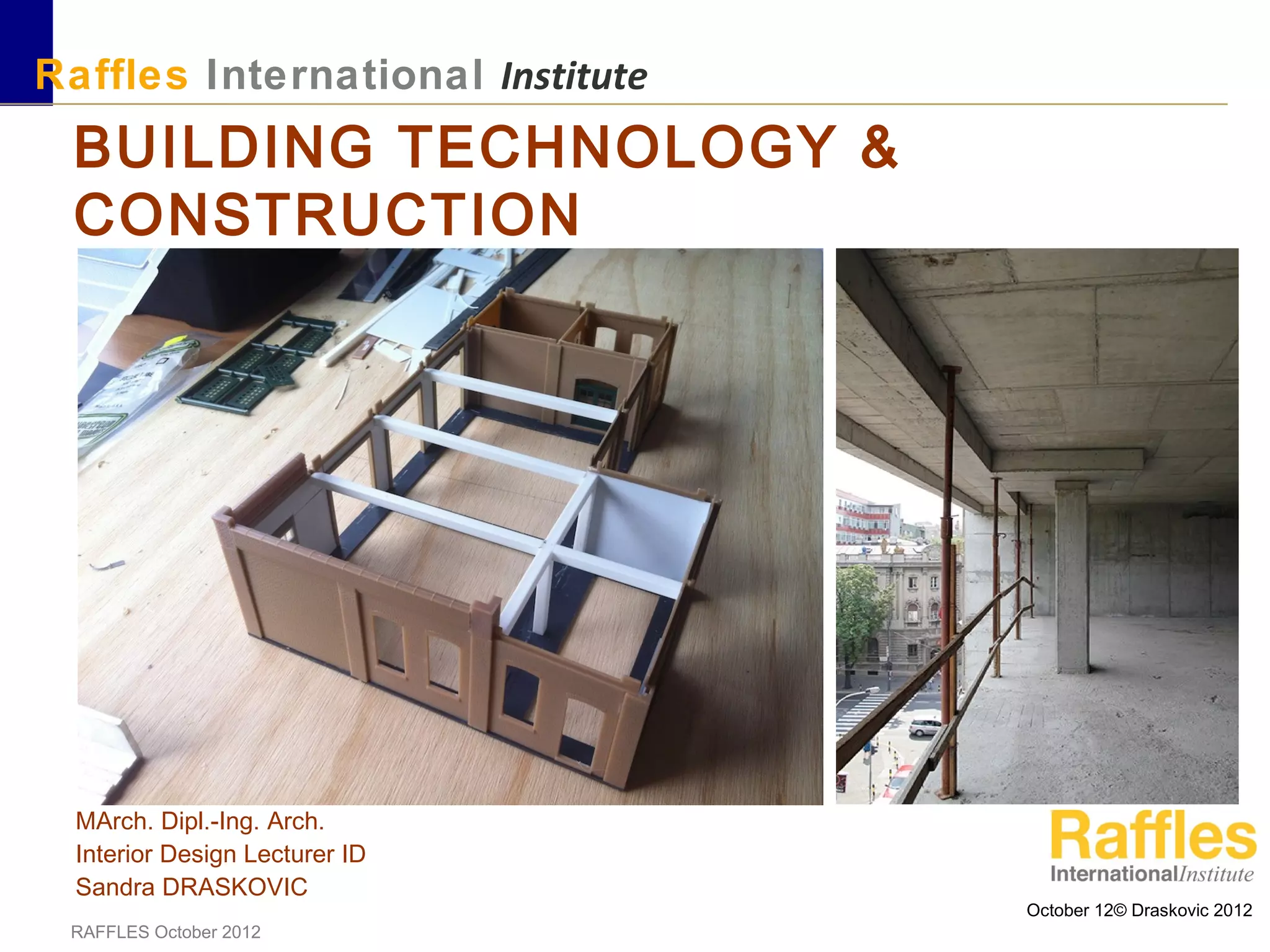
BUILDING TECHNOLOGY &
CONSTRUCTION
MArch. Dipl.-Ing. Arch.
Interior Design Lecturer ID
Sandra DRASKOVIC
Raffles International Institute
October 12© Draskovic 2012
RAFFLES October 2012
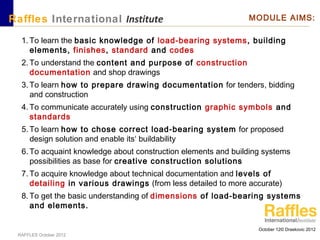
Raffles International Institute MODULE AIMS:
1. To learn the basic knowledge of load-bearing systems, building
elements, finishes, standard and codes
2. To understand the content and purpose of construction
documentation and shop drawings
3. To learn how to prepare drawing documentation for tenders, bidding
and construction
4. To communicate accurately using construction graphic symbols and
standards
5. To learn how to chose correct load-bearing system for proposed
design solution and enable its‘ buildability
6. To acquaint knowledge about construction elements and building systems
possibilities as base for creative construction solutions
7. To acquire knowledge about technical documentation and levels of
detailing in various drawings (from less detailed to more accurate)
8. To get the basic understanding of dimensions of load-bearing systems
and elements.
October 12© Draskovic 2012
RAFFLES October 2012
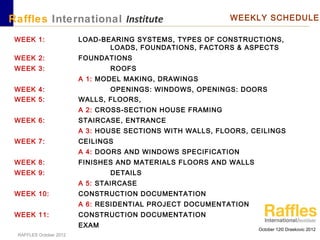
Raffles International Institute WEEKLY SCHEDULE
WEEK 1: LOAD-BEARING SYSTEMS, TYPES OF CONSTRUCTIONS,
LOADS, FOUNDATIONS, FACTORS & ASPECTS
WEEK 2: FOUNDATIONS
WEEK 3: ROOFS
A 1: MODEL MAKING, DRAWINGS
WEEK 4: OPENINGS: WINDOWS, OPENINGS: DOORS
WEEK 5: WALLS, FLOORS,
A 2: CROSS-SECTION HOUSE FRAMING
WEEK 6: STAIRCASE, ENTRANCE
A 3: HOUSE SECTIONS WITH WALLS, FLOORS, CEILINGS
WEEK 7: CEILINGS
A 4: DOORS AND WINDOWS SPECIFICATION
WEEK 8: FINISHES AND MATERIALS FLOORS AND WALLS
WEEK 9: DETAILS
A 5: STAIRCASE
WEEK 10: CONSTRUCTION DOCUMENTATION
A 6: RESIDENTIAL PROJECT DOCUMENTATION
WEEK 11: CONSTRUCTION DOCUMENTATION
EXAM
October 12© Draskovic 2012
RAFFLES October 2012
Raffles International Institute BUILDING ELEMENTS
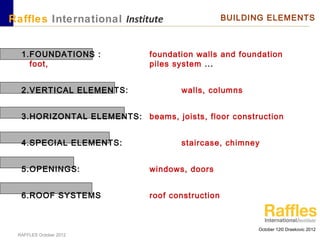
1.FOUNDATIONS : foundation walls and foundation
foot, piles system ...
2.VERTICAL ELEMENTS: walls, columns
3.HORIZONTAL ELEMENTS: beams, joists, floor construction
4.SPECIAL ELEMENTS: staircase, chimney
5.OPENINGS: windows, doors
6.ROOF SYSTEMS roof construction
October 12© Draskovic 2012
RAFFLES October 2012
Raffles International Institute SYSTEM
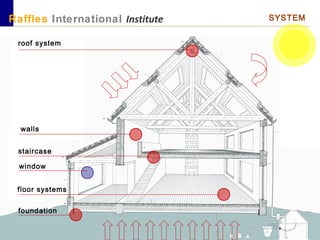
roof system
walls
staircase
window
floor systems
foundation
October 12© Draskovic 2012
RAFFLES October 2012
Raffles International Institute SYSTEM
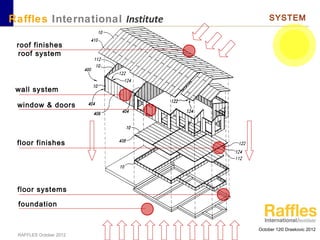
roof finishes
roof system
wall system
window & doors
floor systems
foundation
floor finishes
RAFFLES October 2012
Raffles International Institute LOADS
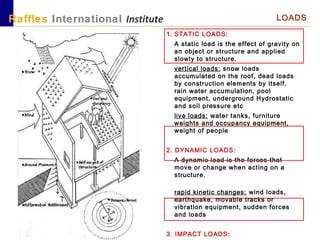
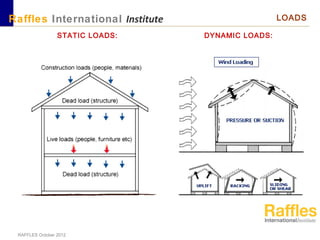
1. STATIC LOADS:
A static load is the effect of gravity on
an object or structure and applied
slowly to structure.
vertical loads: snow loads
accumulated on the roof, dead loads
by construction elements by itself,
rain water accumulation, pool
equipment, underground Hydrostatic
and soil pressure etc
live loads: water tanks, furniture
weights and occupancy equipment,
weight of people
2. DYNAMIC LOADS:
A dynamic load is the forces that
move or change when acting on a
structure.
rapid kinetic changes: wind loads,
earthquake, movable tracks or
vibration equipment, sudden forces
and loads
3. IMPACT LOADS:
RAFFLES October 2012
Raffles International Institute LOADS
STATIC LOADS: DYNAMIC LOADS:
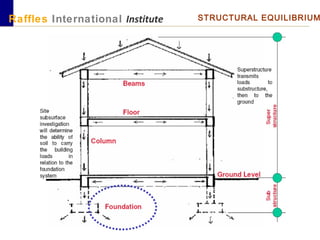
Raffles International Institute STRUCTURAL EQUILIBRIUM
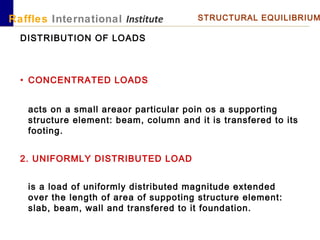
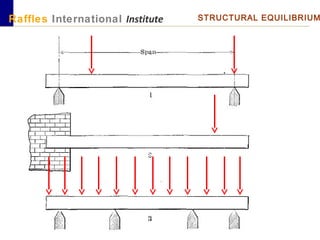
DISTRIBUTION OF LOADS
• CONCENTRATED LOADS
acts on a small areaor particular poin os a supporting
structure element: beam, column and it is transfered to its
footing.
2. UNIFORMLY DISTRIBUTED LOAD
is a load of uniformly distributed magnitude extended
over the length of area of suppoting structure element:
slab, beam, wall and transfered to it foundation.
Raffles International Institute STRUCTURAL EQUILIBRIUM
October 12© Draskovic 2012
RAFFLES October 2012
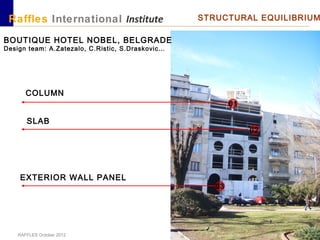
Raffles International Institute STRUCTURAL EQUILIBRIUM
01
02
03
COLUMN
SLAB
EXTERIOR WALL PANEL
BOUTIQUE HOTEL NOBEL, BELGRADE
Design team: A.Zatezalo, C.Ristic, S.Draskovic…
October 12© Draskovic 2012
RAFFLES October 2012
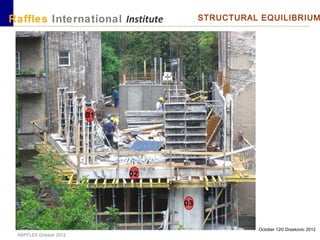
Raffles International Institute STRUCTURAL EQUILIBRIUM
01
02
03
October 12© Draskovic 2012
RAFFLES October 2012
Raffles International Institute MODULE AIMS:
October 12© Draskovic 2012
RAFFLES October 2012
Raffles International Institute MODULE AIMS:
RAFFLES October 2012
Raffles International Institute STRUCTURAL EQUILIBRIUM
01
03
02
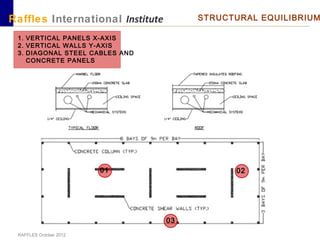
1. VERTICAL PANELS X-AXIS
2. VERTICAL WALLS Y-AXIS
3. DIAGONAL STEEL CABLES AND
CONCRETE PANELS
RAFFLES October 2012
Raffles International Institute STRUCTURAL EQUILIBRIUM
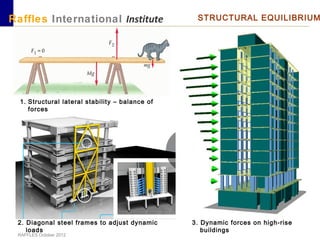
1. Structural lateral stability – balance of
forces
2. Diagonal steel frames to adjust dynamic
loads
3. Dynamic forces on high-rise
buildings
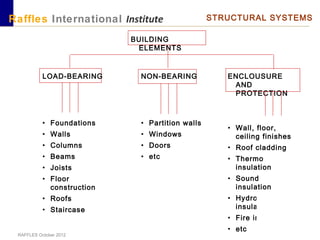
ENCLOUSURE
AND
PROTECTION
• Wall, floor,
ceiling finishes
• Roof cladding
• Thermo
insulation
• Sound
insulation
• Hydro
insulation
• Fire insulation
• etc
RAFFLES October 2012
Raffles International Institute STRUCTURAL SYSTEMS
BUILDING
ELEMENTS
LOAD-BEARING
• Foundations
• Walls
• Columns
• Beams
• Joists
• Floor
construction
• Roofs
• Staircase
NON-BEARING
• Partition walls
• Windows
• Doors
• etc
RAFFLES October 2012
Raffles International Institute STRUCTURAL SYSTEMS
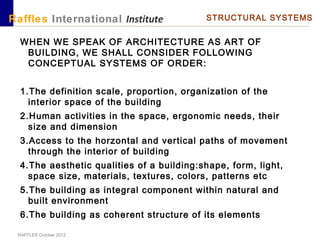
WHEN WE SPEAK OF ARCHITECTURE AS ART OF
BUILDING, WE SHALL CONSIDER FOLLOWING
CONCEPTUAL SYSTEMS OF ORDER:
1.The definition scale, proportion, organization of the
interior space of the building
2.Human activities in the space, ergonomic needs, their
size and dimension
3.Access to the horzontal and vertical paths of movement
through the interior of building
4.The aesthetic qualities of a building:shape, form, light,
space size, materials, textures, colors, patterns etc
5.The building as integral component within natural and
built environment
6.The building as coherent structure of its elements
RAFFLES October 2012
Raffles International Institute STRUCTURAL SYSTEMS
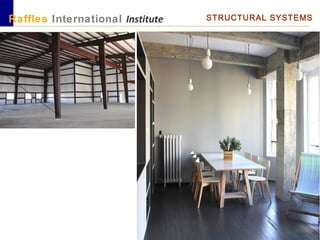
ELEMENTS OF BUILDINGS:
1.STRUCTURAL LOAD-BEARING SYSTEM:
substructure (foundations), superstructure (vertical
elements: walls, columns, pillars, diagonal earthquake
support), horizontal extensions (slabs, beams, rings),
roof structure
2.ENCLOSURE SYSTEM:
exterior walls, roof clading and covering,
doors,windows, interior walls and partitions to
subdivide interior space into spatial units
1.MECHANICAL, ELECTRICAL, HEATING, LIGHTING,
WATER SUPPLY, WATER SEWERAGE, VENTILATION,
COOLING, FIRE PROTECTION SYSTEMS
RAFFLES October 2012
Raffles International Institute STRUCTURAL SYSTEMS
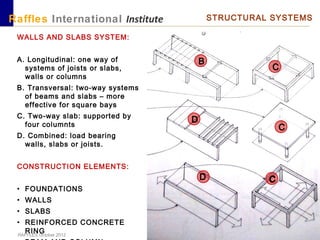
WALLS AND SLABS SYSTEM:
A. Longitudinal: one way of
systems of joists or slabs,
walls or columns
B. Transversal: two-way systems
of beams and slabs – more
effective for square bays
C. Two-way slab: supported by
four columnts
D. Combined: load bearing
walls, slabs or joists.
CONSTRUCTION ELEMENTS:
• FOUNDATIONS
• WALLS
• SLABS
• REINFORCED CONCRETE
RING
D
B
C
C
D
C
D
C
CC
RAFFLES October 2012
Raffles International Institute STRUCTURAL SYSTEMS
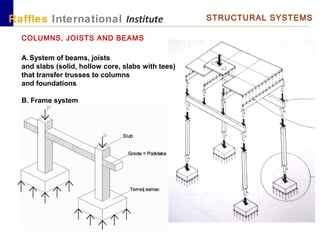
COLUMNS, JOISTS AND BEAMS
A.System of beams, joists
and slabs (solid, hollow core, slabs with tees)
that transfer trusses to columns
and foundations
B. Frame system
Raffles International Institute STRUCTURAL SYSTEMS
RAFFLES October 2012
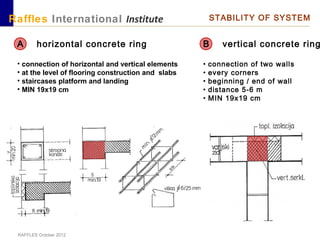
Raffles International Institute STABILITY OF SYSTEM
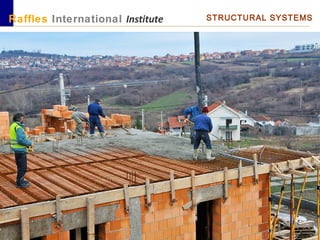
A horizontal concrete ring
• connection of horizontal and vertical elements
• at the level of flooring construction and slabs
• staircases platform and landing
• MIN 19x19 cm
B vertical concrete ring
• connection of two walls
• every corners
• beginning / end of wall
• distance 5-6 m
• MIN 19x19 cm
RAFFLES October 2012
Raffles International Institute STRUCTURAL SYSTEMS
B
B
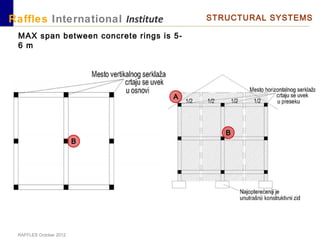
MAX span between concrete rings is 5-
6 m
A
RAFFLES October 2012
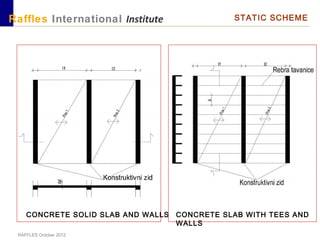
Raffles International Institute STATIC SCHEME
CONCRETE SOLID SLAB AND WALLS CONCRETE SLAB WITH TEES AND
WALLS
RAFFLES October 2012
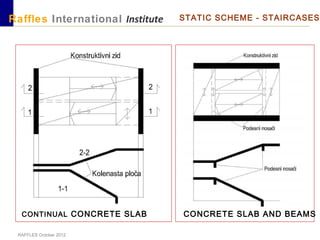
Raffles International Institute STATIC SCHEME - STAIRCASES
CONTINUAL CONCRETE SLAB CONCRETE SLAB AND BEAMS
RAFFLES October 2012
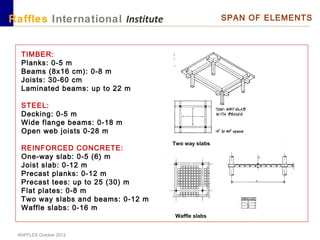
Raffles International Institute SPAN OF ELEMENTS
TIMBER:
Planks: 0-5 m
Beams (8x16 cm): 0-8 m
Joists: 30-60 cm
Laminated beams: up to 22 m
STEEL:
Decking: 0-5 m
Wide flange beams: 0-18 m
Open web joists 0-28 m
REINFORCED CONCRETE:
One-way slab: 0-5 (6) m
Joist slab: 0-12 m
Precast planks: 0-12 m
Precast tees: up to 25 (30) m
Flat plates: 0-8 m
Two way slabs and beams: 0-12 m
Waffle slabs: 0-16 m
Waffle slabs
Two way slabs

Raffles Institute_Building construction framing systems

  • 1.
    October 12© Draskovic2012 RAFFLES October 2012 BUILDING TECHNOLOGY & CONSTRUCTION MArch. Dipl.-Ing. Arch. Interior Design Lecturer ID Sandra DRASKOVIC Raffles International Institute
  • 2.
    October 12© Draskovic2012 RAFFLES October 2012 Raffles International Institute MODULE AIMS: 1. To learn the basic knowledge of load-bearing systems, building elements, finishes, standard and codes 2. To understand the content and purpose of construction documentation and shop drawings 3. To learn how to prepare drawing documentation for tenders, bidding and construction 4. To communicate accurately using construction graphic symbols and standards 5. To learn how to chose correct load-bearing system for proposed design solution and enable its‘ buildability 6. To acquaint knowledge about construction elements and building systems possibilities as base for creative construction solutions 7. To acquire knowledge about technical documentation and levels of detailing in various drawings (from less detailed to more accurate) 8. To get the basic understanding of dimensions of load-bearing systems and elements.
  • 3.
    October 12© Draskovic2012 RAFFLES October 2012 Raffles International Institute WEEKLY SCHEDULE WEEK 1: LOAD-BEARING SYSTEMS, TYPES OF CONSTRUCTIONS, LOADS, FOUNDATIONS, FACTORS & ASPECTS WEEK 2: FOUNDATIONS WEEK 3: ROOFS A 1: MODEL MAKING, DRAWINGS WEEK 4: OPENINGS: WINDOWS, OPENINGS: DOORS WEEK 5: WALLS, FLOORS, A 2: CROSS-SECTION HOUSE FRAMING WEEK 6: STAIRCASE, ENTRANCE A 3: HOUSE SECTIONS WITH WALLS, FLOORS, CEILINGS WEEK 7: CEILINGS A 4: DOORS AND WINDOWS SPECIFICATION WEEK 8: FINISHES AND MATERIALS FLOORS AND WALLS WEEK 9: DETAILS A 5: STAIRCASE WEEK 10: CONSTRUCTION DOCUMENTATION A 6: RESIDENTIAL PROJECT DOCUMENTATION WEEK 11: CONSTRUCTION DOCUMENTATION EXAM
  • 4.
    October 12© Draskovic2012 RAFFLES October 2012 Raffles International Institute BUILDING ELEMENTS 1.FOUNDATIONS : foundation walls and foundation foot, piles system ... 2.VERTICAL ELEMENTS: walls, columns 3.HORIZONTAL ELEMENTS: beams, joists, floor construction 4.SPECIAL ELEMENTS: staircase, chimney 5.OPENINGS: windows, doors 6.ROOF SYSTEMS roof construction
  • 5.
    October 12© Draskovic2012 RAFFLES October 2012 Raffles International Institute SYSTEM roof system walls staircase window floor systems foundation
  • 6.
    October 12© Draskovic2012 RAFFLES October 2012 Raffles International Institute SYSTEM roof finishes roof system wall system window & doors floor systems foundation floor finishes
  • 7.
    RAFFLES October 2012 RafflesInternational Institute LOADS 1. STATIC LOADS: A static load is the effect of gravity on an object or structure and applied slowly to structure. vertical loads: snow loads accumulated on the roof, dead loads by construction elements by itself, rain water accumulation, pool equipment, underground Hydrostatic and soil pressure etc live loads: water tanks, furniture weights and occupancy equipment, weight of people 2. DYNAMIC LOADS: A dynamic load is the forces that move or change when acting on a structure. rapid kinetic changes: wind loads, earthquake, movable tracks or vibration equipment, sudden forces and loads 3. IMPACT LOADS:
  • 8.
    RAFFLES October 2012 RafflesInternational Institute LOADS STATIC LOADS: DYNAMIC LOADS:
  • 9.
    Raffles International InstituteSTRUCTURAL EQUILIBRIUM
  • 10.
    Raffles International InstituteSTRUCTURAL EQUILIBRIUM DISTRIBUTION OF LOADS • CONCENTRATED LOADS acts on a small areaor particular poin os a supporting structure element: beam, column and it is transfered to its footing. 2. UNIFORMLY DISTRIBUTED LOAD is a load of uniformly distributed magnitude extended over the length of area of suppoting structure element: slab, beam, wall and transfered to it foundation.
  • 11.
    Raffles International InstituteSTRUCTURAL EQUILIBRIUM
  • 12.
    October 12© Draskovic2012 RAFFLES October 2012 Raffles International Institute STRUCTURAL EQUILIBRIUM 01 02 03 COLUMN SLAB EXTERIOR WALL PANEL BOUTIQUE HOTEL NOBEL, BELGRADE Design team: A.Zatezalo, C.Ristic, S.Draskovic…
  • 13.
    October 12© Draskovic2012 RAFFLES October 2012 Raffles International Institute STRUCTURAL EQUILIBRIUM 01 02 03
  • 14.
    October 12© Draskovic2012 RAFFLES October 2012 Raffles International Institute MODULE AIMS:
  • 15.
    October 12© Draskovic2012 RAFFLES October 2012 Raffles International Institute MODULE AIMS:
  • 16.
    RAFFLES October 2012 RafflesInternational Institute STRUCTURAL EQUILIBRIUM 01 03 02 1. VERTICAL PANELS X-AXIS 2. VERTICAL WALLS Y-AXIS 3. DIAGONAL STEEL CABLES AND CONCRETE PANELS
  • 17.
    RAFFLES October 2012 RafflesInternational Institute STRUCTURAL EQUILIBRIUM 1. Structural lateral stability – balance of forces 2. Diagonal steel frames to adjust dynamic loads 3. Dynamic forces on high-rise buildings
  • 18.
    ENCLOUSURE AND PROTECTION • Wall, floor, ceilingfinishes • Roof cladding • Thermo insulation • Sound insulation • Hydro insulation • Fire insulation • etc RAFFLES October 2012 Raffles International Institute STRUCTURAL SYSTEMS BUILDING ELEMENTS LOAD-BEARING • Foundations • Walls • Columns • Beams • Joists • Floor construction • Roofs • Staircase NON-BEARING • Partition walls • Windows • Doors • etc
  • 19.
    RAFFLES October 2012 RafflesInternational Institute STRUCTURAL SYSTEMS WHEN WE SPEAK OF ARCHITECTURE AS ART OF BUILDING, WE SHALL CONSIDER FOLLOWING CONCEPTUAL SYSTEMS OF ORDER: 1.The definition scale, proportion, organization of the interior space of the building 2.Human activities in the space, ergonomic needs, their size and dimension 3.Access to the horzontal and vertical paths of movement through the interior of building 4.The aesthetic qualities of a building:shape, form, light, space size, materials, textures, colors, patterns etc 5.The building as integral component within natural and built environment 6.The building as coherent structure of its elements
  • 20.
    RAFFLES October 2012 RafflesInternational Institute STRUCTURAL SYSTEMS ELEMENTS OF BUILDINGS: 1.STRUCTURAL LOAD-BEARING SYSTEM: substructure (foundations), superstructure (vertical elements: walls, columns, pillars, diagonal earthquake support), horizontal extensions (slabs, beams, rings), roof structure 2.ENCLOSURE SYSTEM: exterior walls, roof clading and covering, doors,windows, interior walls and partitions to subdivide interior space into spatial units 1.MECHANICAL, ELECTRICAL, HEATING, LIGHTING, WATER SUPPLY, WATER SEWERAGE, VENTILATION, COOLING, FIRE PROTECTION SYSTEMS
  • 21.
    RAFFLES October 2012 RafflesInternational Institute STRUCTURAL SYSTEMS WALLS AND SLABS SYSTEM: A. Longitudinal: one way of systems of joists or slabs, walls or columns B. Transversal: two-way systems of beams and slabs – more effective for square bays C. Two-way slab: supported by four columnts D. Combined: load bearing walls, slabs or joists. CONSTRUCTION ELEMENTS: • FOUNDATIONS • WALLS • SLABS • REINFORCED CONCRETE RING D B C C D C D C CC
  • 22.
    RAFFLES October 2012 RafflesInternational Institute STRUCTURAL SYSTEMS
  • 23.
    Raffles International InstituteSTRUCTURAL SYSTEMS COLUMNS, JOISTS AND BEAMS A.System of beams, joists and slabs (solid, hollow core, slabs with tees) that transfer trusses to columns and foundations B. Frame system
  • 24.
  • 25.
    RAFFLES October 2012 RafflesInternational Institute STABILITY OF SYSTEM A horizontal concrete ring • connection of horizontal and vertical elements • at the level of flooring construction and slabs • staircases platform and landing • MIN 19x19 cm B vertical concrete ring • connection of two walls • every corners • beginning / end of wall • distance 5-6 m • MIN 19x19 cm
  • 26.
    RAFFLES October 2012 RafflesInternational Institute STRUCTURAL SYSTEMS B B MAX span between concrete rings is 5- 6 m A
  • 27.
    RAFFLES October 2012 RafflesInternational Institute STATIC SCHEME CONCRETE SOLID SLAB AND WALLS CONCRETE SLAB WITH TEES AND WALLS
  • 28.
    RAFFLES October 2012 RafflesInternational Institute STATIC SCHEME - STAIRCASES CONTINUAL CONCRETE SLAB CONCRETE SLAB AND BEAMS
  • 29.
    RAFFLES October 2012 RafflesInternational Institute SPAN OF ELEMENTS TIMBER: Planks: 0-5 m Beams (8x16 cm): 0-8 m Joists: 30-60 cm Laminated beams: up to 22 m STEEL: Decking: 0-5 m Wide flange beams: 0-18 m Open web joists 0-28 m REINFORCED CONCRETE: One-way slab: 0-5 (6) m Joist slab: 0-12 m Precast planks: 0-12 m Precast tees: up to 25 (30) m Flat plates: 0-8 m Two way slabs and beams: 0-12 m Waffle slabs: 0-16 m Waffle slabs Two way slabs