WE THE GROUP MEMBERS:
• MD. BULBUL AHMED
•MD.SHARIFUL ISLAM
•MD.YOUSUF BIN AZIZ
•ABU SAYED MD.TARIN
•MD.FARHAN ABIR
•MD.SABBIR KARIM
•MD.YASIN
•MD.EZAZ AHMED
•S.M.RAHAT RAHMAN
•MD.ABU RAIHAN

10.01.03.003
10.01.03.008
10.01.03.018
10.01.03.020
10.01.03.026
10.01.03.037
10.01.03.038
10.01.03.041
10.01.03.044
10.01.03.049
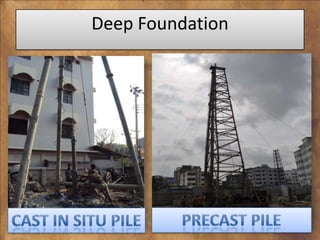
Deep Foundation
Foundation:
Foundation is the lowest and
supporting layer of a structure.
Geotechnical engineers design foundations based
on the load characteristics of the structure.
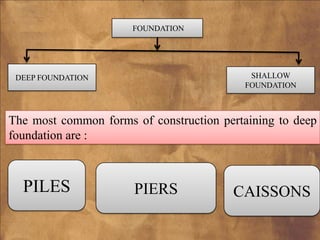
FOUNDATION

SHALLOW
FOUNDATION

DEEP FOUNDATION

The most common forms of construction pertaining to deep
foundation are :

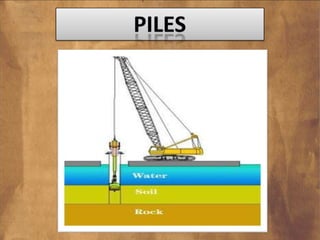
PILES

PIERS

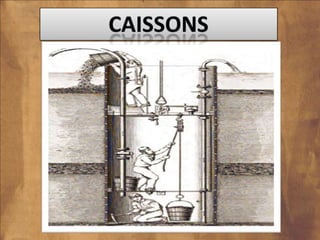
CAISSONS
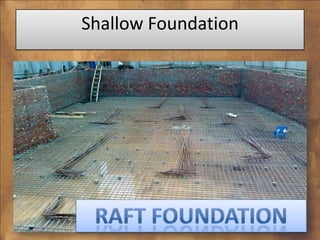
Shallow Foundation
Deep Foundation
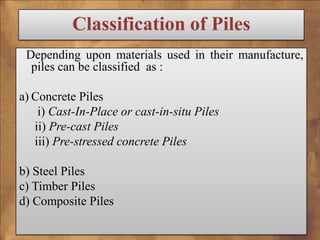
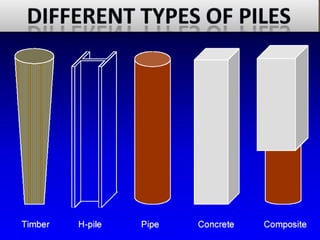
Classification of Piles
Depending upon materials used in their manufacture,
piles can be classified as :
a) Concrete Piles
i) Cast-In-Place or cast-in-situ Piles
ii) Pre-cast Piles
iii) Pre-stressed concrete Piles
b) Steel Piles
c) Timber Piles
d) Composite Piles
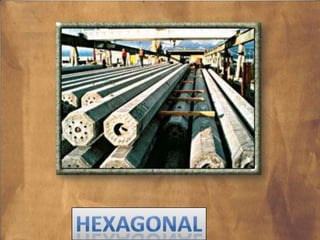
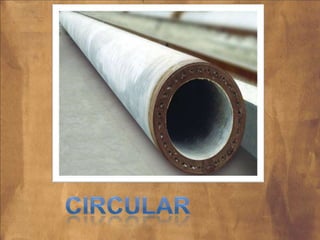
PRECAST PILE
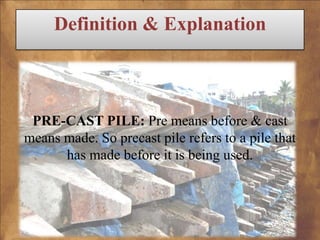
Definition & Explanation

PRE-CAST PILE: Pre means before & cast
means made. So precast pile refers to a pile that
has made before it is being used.
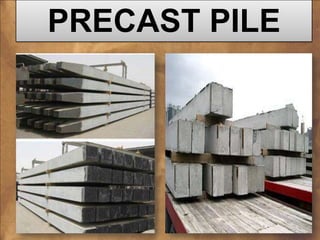
PRECAST PILE
Why and Where it is used?
• Pre cast pile is used for extra heavy weight
structure because it can ensure full strength by
proper maintaining.
• It can be used under water.
• There is no possibility of the reinforcements
getting displaced.
• There is no possibility of the voids being left.
• Not to attack by corrosive constituents in the
soil and the sub-soil water.
Structure of Precast pile & Related
Information
• By the soil test, we would be find the depth of penetrate.
• By which length of a pile can be determined.
• After determine the total weight of the building, we would find
the number of piles.
• The diameter of the pile normally varies from 35 cm to 65 cm
and their length varies from 20 ft to 30 ft.
• Besides bearing load for easy transportation & movement big
weir or reinforcement is used in the pre cast pile.
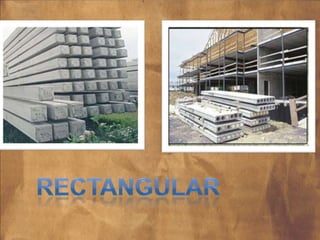
• For easy driven rectangular pile is often made.
• Longitudinal reinforcement usually consists of one bar 20 mm to
50mm in diameter at each angle of the section of the pile.
• The vertical rods are tied horizontally by bars 6mm to 10mm in
diameter.
• The horizontal bars may be provided in the form of stirrups
wound around the verticals.
• Pile shoe & pile stirrup is used in the lower part of the pile to
driven the pile easily.
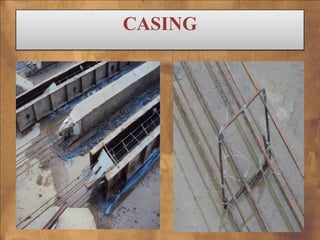
CASING
SOIL CONDITION
Soil suitability
• Suitable in a wide
range of soil conditions
• Working loads in excess
of 1000kN
• Useful for very deep
piling upto 40 m
• In soft ground or in
aggressive or
contaminated soils

Bearing Capacity
• High bearing capacity
• Concrete formations
around the contracted
sections increase the
capacity.
• Compact soil &
increase the bearing
capacity
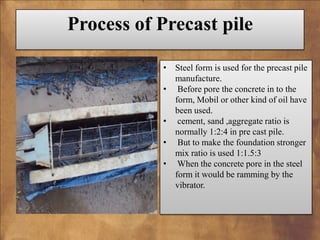
Process of Precast pile
• Steel form is used for the precast pile
manufacture.
• Before pore the concrete in to the
form, Mobil or other kind of oil have
been used.
• cement, sand ,aggregate ratio is
normally 1:2:4 in pre cast pile.
• But to make the foundation stronger
mix ratio is used 1:1.5:3
• When the concrete pore in the steel
form it would be ramming by the
vibrator.
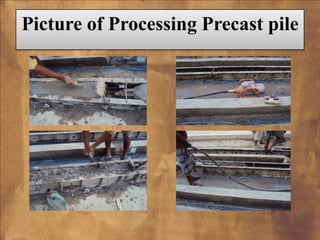
Picture of Processing Precast pile
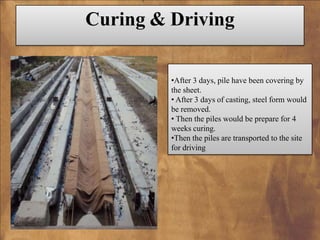
Curing & Driving
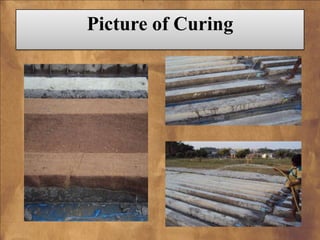
•After 3 days, pile have been covering by
the sheet.
• After 3 days of casting, steel form would
be removed.
• Then the piles would be prepare for 4
weeks curing.
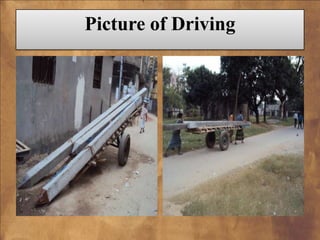
•Then the piles are transported to the site
for driving
Picture of Curing
Picture of Driving
Advantages of Precast Pile
•
•
•
•
•
•
•
•

Cast well before work.
Well supervised
Reinforcement remain in their proper position
Can be driven under water
After driven they can be loaded soon
We can get required strength
Detect the damage before use
Properly cured by water
Disadvantages of Precast Pile
•
•
•
•
•
•

Difficult to manufacture
Not economical
Subject to longitudinal and transverse cracking
Not aesthetic
Not appropriate for curved or flared structures
Complicated for skews
Reinforcement of the Site
•
•
•
•
•
•
•
•

Main rod 22 mm diameter
Stirrup 10 mm diameter 60 grade
Spacing on stirrup 4”~6”~4”
Some extra16 mm rod was provide in both two end
due to pressure
extra rod length is 3.5’
Clear cover 2’’ for subsurface
Stirrup hook bend at 135 degree & bending portion is
3’’ long Steel shuttering
Triangle pile shoe was set in the bottom of the pile
Difference of Theoretical & Practical
Theoretical
• We can joint two pile
together

Practical
• We use one pile to
drive.

• Maximum length 40 ft

• They use 50~55 ft pile

• All of the test have to

• They only do some test

done before use

in site
Cast In Situ Pile
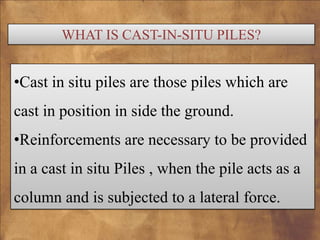
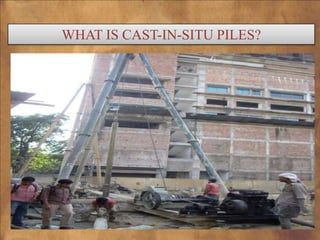
WHAT IS CAST-IN-SITU PILES?

•Cast in situ piles are those piles which are

cast in position in side the ground.
•Reinforcements are necessary to be provided

in a cast in situ Piles , when the pile acts as a
column and is subjected to a lateral force.
WHAT IS CAST-IN-SITU PILES?
PURPOSE OF CAST-IN-SITU PILE

• Load Transmission
• Load Resistance
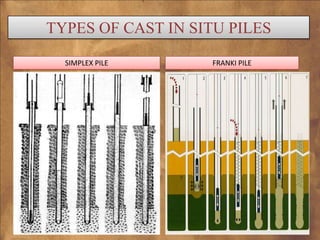
TYPES OF CAST IN SITU PILES
SIMPLEX PILE

FRANKI PILE
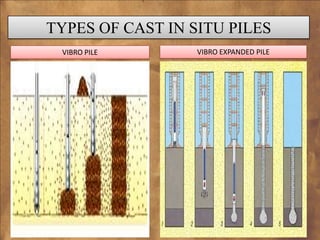
TYPES OF CAST IN SITU PILES
VIBRO PILE

VIBRO EXPANDED PILE
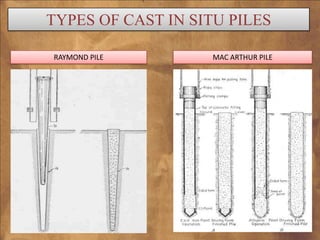
TYPES OF CAST IN SITU PILES
RAYMOND PILE

MAC ARTHUR PILE
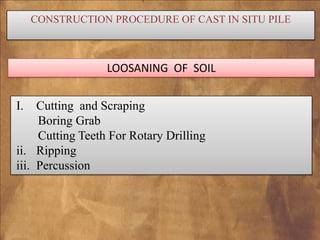
CONSTRUCTION PROCEDURE OF CAST IN SITU PILE

LOOSANING OF SOIL
I.

Cutting and Scraping
Boring Grab
Cutting Teeth For Rotary Drilling
ii. Ripping
iii. Percussion
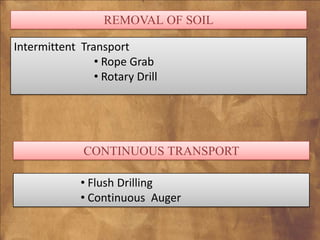
REMOVAL OF SOIL
Intermittent Transport
• Rope Grab
• Rotary Drill

CONTINUOUS TRANSPORT
• Flush Drilling
• Continuous Auger
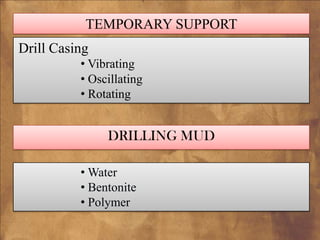
TEMPORARY SUPPORT
Drill Casing
• Vibrating
• Oscillating
• Rotating

DRILLING MUD
• Water
• Bentonite
• Polymer
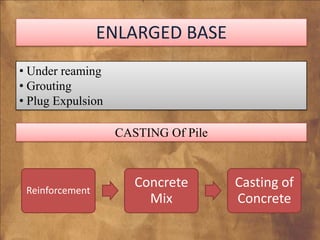
ENLARGED BASE
• Under reaming
• Grouting
• Plug Expulsion
CASTING Of Pile

Reinforcement

Concrete
Mix

Casting of
Concrete
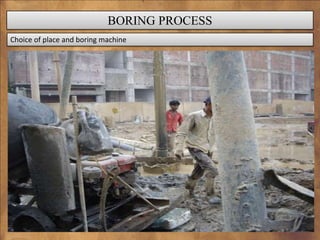
BORING PROCESS
Choice of place and boring machine
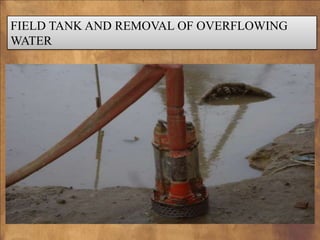
FIELD TANK AND REMOVAL OF OVERFLOWING
WATER
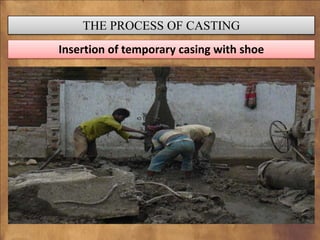
THE PROCESS OF CASTING
Insertion of temporary casing with shoe
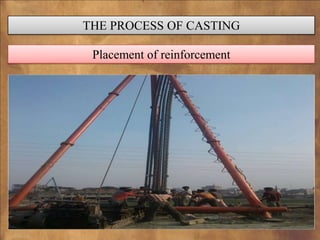
THE PROCESS OF CASTING
Placement of reinforcement
THE PROCESS OF CASTING
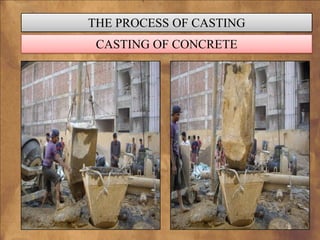
CASTING OF CONCRETE
THE PROCESS OF CASTING
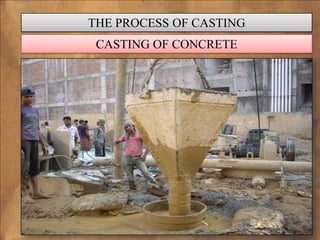
CASTING OF CONCRETE
THE PROCESS OF CASTING
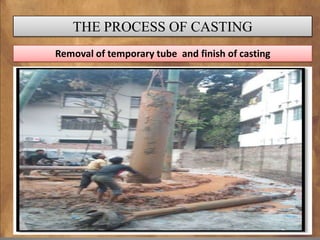
Removal of temporary tube and finish of casting
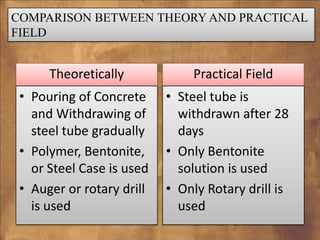
COMPARISON BETWEEN THEORY AND PRACTICAL
FIELD

Theoretically

• Pouring of Concrete
and Withdrawing of
steel tube gradually
• Polymer, Bentonite,
or Steel Case is used
• Auger or rotary drill
is used

Practical Field

• Steel tube is
withdrawn after 28
days
• Only Bentonite
solution is used
• Only Rotary drill is
used
DIFFICULTIES OF PILEING AND HOW TO
OVERCOME THIS

PROBLEM

• Rocky layer of soil
with stone
• Rising water from
the bottom of hole
• Corrosion can be
occurred

SOLUTION

• Abort drilling
• Pump the water.
Best, use precast pile
• Soil test is needed.
Corrosion resistant
cement
ADVANTAGES OF CAST-IN-SITU PILES
•
•
•
•
•
•
•

Cannot be used under water
Displacement of reinforced
Dumping of concrete from a great height
Inspection is not possible; voids may be left
Contact of water of concrete to the dry soil if uncased
Freshly laid concrete is susceptible to soil components
Driving of adjacent piles may rupture shell-less cast-insitu pile
DISADVANTAGES OF CAST-IN-SITU PILES
•
•
•
•
•
•
•

Cannot be used under water
Displacement of reinforced
Dumping of concrete from a great height
Inspection is not possible; voids may be left
Contact of water of concrete to the dry soil if uncased
Freshly laid concrete is susceptible to soil components
Driving of adjacent piles may rupture shell-less cast-insitu pile
Deep Foundation (Construction Engineering)

Deep Foundation (Construction Engineering)

  • 2.
    WE THE GROUPMEMBERS: • MD. BULBUL AHMED •MD.SHARIFUL ISLAM •MD.YOUSUF BIN AZIZ •ABU SAYED MD.TARIN •MD.FARHAN ABIR •MD.SABBIR KARIM •MD.YASIN •MD.EZAZ AHMED •S.M.RAHAT RAHMAN •MD.ABU RAIHAN 10.01.03.003 10.01.03.008 10.01.03.018 10.01.03.020 10.01.03.026 10.01.03.037 10.01.03.038 10.01.03.041 10.01.03.044 10.01.03.049
  • 4.
    Deep Foundation Foundation: Foundation isthe lowest and supporting layer of a structure. Geotechnical engineers design foundations based on the load characteristics of the structure.
  • 5.
    FOUNDATION SHALLOW FOUNDATION DEEP FOUNDATION The mostcommon forms of construction pertaining to deep foundation are : PILES PIERS CAISSONS
  • 6.
  • 7.
  • 11.
    Classification of Piles Dependingupon materials used in their manufacture, piles can be classified as : a) Concrete Piles i) Cast-In-Place or cast-in-situ Piles ii) Pre-cast Piles iii) Pre-stressed concrete Piles b) Steel Piles c) Timber Piles d) Composite Piles
  • 13.
  • 14.
    Definition & Explanation PRE-CASTPILE: Pre means before & cast means made. So precast pile refers to a pile that has made before it is being used.
  • 15.
  • 16.
    Why and Whereit is used? • Pre cast pile is used for extra heavy weight structure because it can ensure full strength by proper maintaining. • It can be used under water. • There is no possibility of the reinforcements getting displaced. • There is no possibility of the voids being left. • Not to attack by corrosive constituents in the soil and the sub-soil water.
  • 22.
    Structure of Precastpile & Related Information • By the soil test, we would be find the depth of penetrate. • By which length of a pile can be determined. • After determine the total weight of the building, we would find the number of piles. • The diameter of the pile normally varies from 35 cm to 65 cm and their length varies from 20 ft to 30 ft. • Besides bearing load for easy transportation & movement big weir or reinforcement is used in the pre cast pile. • For easy driven rectangular pile is often made.
  • 23.
    • Longitudinal reinforcementusually consists of one bar 20 mm to 50mm in diameter at each angle of the section of the pile. • The vertical rods are tied horizontally by bars 6mm to 10mm in diameter. • The horizontal bars may be provided in the form of stirrups wound around the verticals. • Pile shoe & pile stirrup is used in the lower part of the pile to driven the pile easily.
  • 24.
  • 25.
    SOIL CONDITION Soil suitability •Suitable in a wide range of soil conditions • Working loads in excess of 1000kN • Useful for very deep piling upto 40 m • In soft ground or in aggressive or contaminated soils Bearing Capacity • High bearing capacity • Concrete formations around the contracted sections increase the capacity. • Compact soil & increase the bearing capacity
  • 26.
    Process of Precastpile • Steel form is used for the precast pile manufacture. • Before pore the concrete in to the form, Mobil or other kind of oil have been used. • cement, sand ,aggregate ratio is normally 1:2:4 in pre cast pile. • But to make the foundation stronger mix ratio is used 1:1.5:3 • When the concrete pore in the steel form it would be ramming by the vibrator.
  • 27.
  • 28.
    Curing & Driving •After3 days, pile have been covering by the sheet. • After 3 days of casting, steel form would be removed. • Then the piles would be prepare for 4 weeks curing. •Then the piles are transported to the site for driving
  • 29.
  • 30.
  • 31.
    Advantages of PrecastPile • • • • • • • • Cast well before work. Well supervised Reinforcement remain in their proper position Can be driven under water After driven they can be loaded soon We can get required strength Detect the damage before use Properly cured by water
  • 32.
    Disadvantages of PrecastPile • • • • • • Difficult to manufacture Not economical Subject to longitudinal and transverse cracking Not aesthetic Not appropriate for curved or flared structures Complicated for skews
  • 33.
    Reinforcement of theSite • • • • • • • • Main rod 22 mm diameter Stirrup 10 mm diameter 60 grade Spacing on stirrup 4”~6”~4” Some extra16 mm rod was provide in both two end due to pressure extra rod length is 3.5’ Clear cover 2’’ for subsurface Stirrup hook bend at 135 degree & bending portion is 3’’ long Steel shuttering Triangle pile shoe was set in the bottom of the pile
  • 34.
    Difference of Theoretical& Practical Theoretical • We can joint two pile together Practical • We use one pile to drive. • Maximum length 40 ft • They use 50~55 ft pile • All of the test have to • They only do some test done before use in site
  • 35.
  • 36.
    WHAT IS CAST-IN-SITUPILES? •Cast in situ piles are those piles which are cast in position in side the ground. •Reinforcements are necessary to be provided in a cast in situ Piles , when the pile acts as a column and is subjected to a lateral force.
  • 37.
  • 38.
    PURPOSE OF CAST-IN-SITUPILE • Load Transmission • Load Resistance
  • 39.
    TYPES OF CASTIN SITU PILES SIMPLEX PILE FRANKI PILE
  • 40.
    TYPES OF CASTIN SITU PILES VIBRO PILE VIBRO EXPANDED PILE
  • 41.
    TYPES OF CASTIN SITU PILES RAYMOND PILE MAC ARTHUR PILE
  • 42.
    CONSTRUCTION PROCEDURE OFCAST IN SITU PILE LOOSANING OF SOIL I. Cutting and Scraping Boring Grab Cutting Teeth For Rotary Drilling ii. Ripping iii. Percussion
  • 43.
    REMOVAL OF SOIL IntermittentTransport • Rope Grab • Rotary Drill CONTINUOUS TRANSPORT • Flush Drilling • Continuous Auger
  • 44.
    TEMPORARY SUPPORT Drill Casing •Vibrating • Oscillating • Rotating DRILLING MUD • Water • Bentonite • Polymer
  • 45.
    ENLARGED BASE • Underreaming • Grouting • Plug Expulsion CASTING Of Pile Reinforcement Concrete Mix Casting of Concrete
  • 46.
    BORING PROCESS Choice ofplace and boring machine
  • 47.
    FIELD TANK ANDREMOVAL OF OVERFLOWING WATER
  • 48.
    THE PROCESS OFCASTING Insertion of temporary casing with shoe
  • 49.
    THE PROCESS OFCASTING Placement of reinforcement
  • 50.
    THE PROCESS OFCASTING CASTING OF CONCRETE
  • 51.
    THE PROCESS OFCASTING CASTING OF CONCRETE
  • 52.
    THE PROCESS OFCASTING Removal of temporary tube and finish of casting
  • 53.
    COMPARISON BETWEEN THEORYAND PRACTICAL FIELD Theoretically • Pouring of Concrete and Withdrawing of steel tube gradually • Polymer, Bentonite, or Steel Case is used • Auger or rotary drill is used Practical Field • Steel tube is withdrawn after 28 days • Only Bentonite solution is used • Only Rotary drill is used
  • 54.
    DIFFICULTIES OF PILEINGAND HOW TO OVERCOME THIS PROBLEM • Rocky layer of soil with stone • Rising water from the bottom of hole • Corrosion can be occurred SOLUTION • Abort drilling • Pump the water. Best, use precast pile • Soil test is needed. Corrosion resistant cement
  • 55.
    ADVANTAGES OF CAST-IN-SITUPILES • • • • • • • Cannot be used under water Displacement of reinforced Dumping of concrete from a great height Inspection is not possible; voids may be left Contact of water of concrete to the dry soil if uncased Freshly laid concrete is susceptible to soil components Driving of adjacent piles may rupture shell-less cast-insitu pile
  • 56.
    DISADVANTAGES OF CAST-IN-SITUPILES • • • • • • • Cannot be used under water Displacement of reinforced Dumping of concrete from a great height Inspection is not possible; voids may be left Contact of water of concrete to the dry soil if uncased Freshly laid concrete is susceptible to soil components Driving of adjacent piles may rupture shell-less cast-insitu pile