TECHNOLOGY AND STANDARDS OF 
DIGITAL TELEVISION TERRESTRIAL 
MULTIMEDIA BROADCASTING 
SHAJANA K BASHEER 
S7 ECEB 
46 
1
ANALOG TELEVISION 
• Conventional analog television begins with a video camera 
taking pictures of a frame. 
• TV camera processes these images in form of pixels. 
• Composite video is transmitted. 
• A television receiver uses a transmitting tower with an antenna 
to distribute signals in a circular pattern. 
• Line of sight propagation was only possible. 
• UHF and VHF frequencies were used. 
2
ANALOG TO DIGITAL 
• Integrated digital receivers - “set-top-boxes” replaces huge analog 
receivers including antennas, dishes, cabling…. 
• Performance of analog systems tends to deteriorate as the channel 
performance deteriorates while digital systems remain as defined. 
• Ability of digital systems to compress data into a smaller space 
• Use of compression coding techniques which allow relatively high 
sound and picture quality to be accommodated in a much smaller 
channel bandwidth. 
• Digital TV have ability to offer the viewer and listener more 
services, greater variety and higher technical quality. 
• Digital broadcasting techniques can offer credible “single 
frequency networks”. 
3
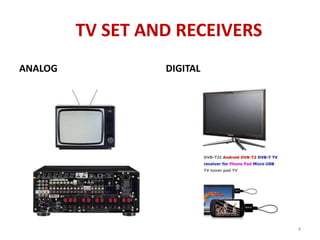
TV SET AND RECEIVERS 
ANALOG DIGITAL 
4
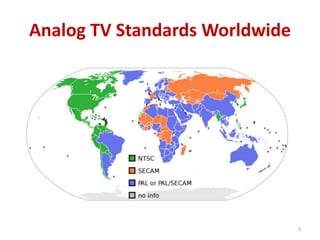
Analog TV Standards Worldwide 
5
DTTB- DIGITAL TELEVISION TERRESTRIAL 
BROADCASTING 
• Digital broadcasting is the practice of using digital data rather than 
analog waveforms to carry broadcasts over television channels or 
assigned radio frequency bands. 
• Digital television (DTV) is the transmission of audio and video by 
digitally processed and multiplexed signal, in contrast to the totally 
analog and channel separated signals used by analog television. 
• DTV can support more than one programme in the same channel BW 
• Digital broad casting technologies have indeed successfully brought 
millions of viewers the excellent watching experience never realized 
before from watching analog TV. 
• DTV services can be delivered by terrestrial, satellite, cable 
broadcasting, or over the internet, and therefore, several transmission 
standards exist. 
• Digital television terrestrial broadcasting (DTTB) standard which 
defines the air-interface of the DTV signals. 
6
• Three main DTV terrestrial standards existed in the world. 
• China started to develop its own DTTB standard in 1994. 
• DTMB (Digital Terrestrial Multimedia Broadcast) is the Tv 
standard for mobile and fixed terminals used in the china. 
• Although at first this standard was called DMB-T/H(Digital 
Multimedia Broadcast-Terrestrial/Handheld). 
• It decides Frame structure, channel coding and modulation for digital 
television terrestrial broadcasting system 
• Standard contains many combination of modes 
1. Single carrier modulation and Multi-carrier modulation 
2. Three frame header (FH) options 
3. Three FEC coding rates, 
4. Five constellation mappings…… 
• It results in hundreds of operation modes to support various multi-program 
SDTV/HDTV terrestrial broadcasting services. 
7
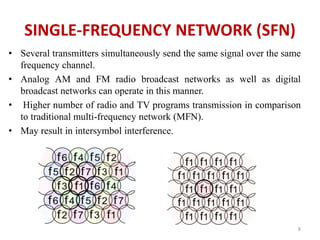
SINGLE-FREQUENCY NETWORK (SFN) 
• Several transmitters simultaneously send the same signal over the same 
frequency channel. 
• Analog AM and FM radio broadcast networks as well as digital 
broadcast networks can operate in this manner. 
• Higher number of radio and TV programs transmission in comparison 
to traditional multi-frequency network (MFN). 
• May result in intersymbol interference. 
8
COFDM AND OFDM 
• Self-interference cancellation is facilitated by the OFDM or COFDM 
modulation method. 
• Orthogonal frequency division multiplexing (OFDM) is a method of 
encoding digital data on multiple carrier frequencies. 
• A large number of closely spaced orthogonal subcarrier signals are 
used to carry data on several parallel data streams or channels. 
• Each subcarrier is modulated with a conventional modulation 
scheme(QAM/PSK) allow symbol rate, maintaining total data rates 
similar to conventional single carrier modulation schemes in same 
bandwidth. 
• OFDM uses a large number of slow low-bandwidth modulators 
instead of one fast wide-band modulator. 
• Since each modulator is very slow, we can afford to insert a guard 
interval between the symbols, and thus eliminate the ISI. 
• COFDM has ability to completely overcome multipath effects 
• It uses multiple carriers to transmit the same signal 8
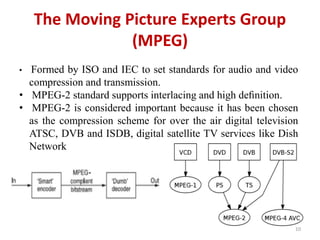
The Moving Picture Experts Group 
(MPEG) 
• Formed by ISO and IEC to set standards for audio and video 
compression and transmission. 
• MPEG-2 standard supports interlacing and high definition. 
• MPEG-2 is considered important because it has been chosen 
as the compression scheme for over the air digital television 
ATSC, DVB and ISDB, digital satellite TV services like Dish 
Network 
10
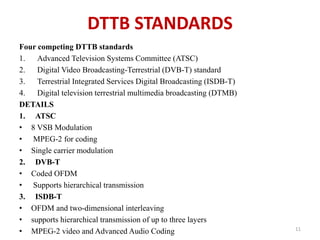
DTTB STANDARDS 
Four competing DTTB standards 
1. Advanced Television Systems Committee (ATSC) 
2. Digital Video Broadcasting-Terrestrial (DVB-T) standard 
3. Terrestrial Integrated Services Digital Broadcasting (ISDB-T) 
4. Digital television terrestrial multimedia broadcasting (DTMB) 
DETAILS 
1. ATSC 
• 8 VSB Modulation 
• MPEG-2 for coding 
• Single carrier modulation 
2. DVB-T 
• Coded OFDM 
• Supports hierarchical transmission 
3. ISDB-T 
• OFDM and two-dimensional interleaving 
• supports hierarchical transmission of up to three layers 
• MPEG-2 video and Advanced Audio Coding 11
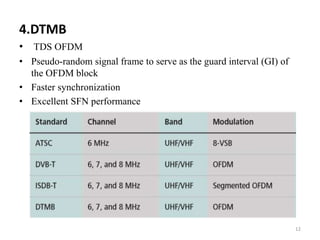
4.DTMB 
• TDS OFDM 
• Pseudo-random signal frame to serve as the guard interval (GI) of 
the OFDM block 
• Faster synchronization 
• Excellent SFN performance 
12
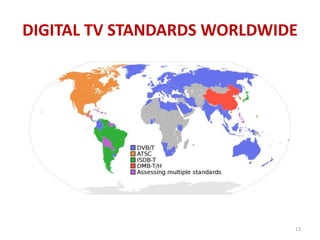
DIGITAL TV STANDARDS WORLDWIDE 
13
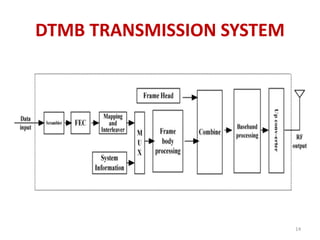
DTMB TRANSMISSION SYSTEM 
14
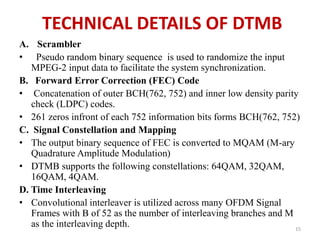
TECHNICAL DETAILS OF DTMB 
A. Scrambler 
• Pseudo random binary sequence is used to randomize the input 
MPEG-2 input data to facilitate the system synchronization. 
B. Forward Error Correction (FEC) Code 
• Concatenation of outer BCH(762, 752) and inner low density parity 
check (LDPC) codes. 
• 261 zeros infront of each 752 information bits forms BCH(762, 752) 
C. Signal Constellation and Mapping 
• The output binary sequence of FEC is converted to MQAM (M-ary 
Quadrature Amplitude Modulation) 
• DTMB supports the following constellations: 64QAM, 32QAM, 
16QAM, 4QAM. 
D. Time Interleaving 
• Convolutional interleaver is utilized across many OFDM Signal 
Frames with B of 52 as the number of interleaving branches and M 
as the interleaving depth. 
15
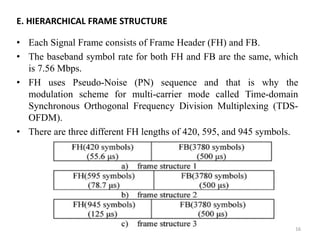
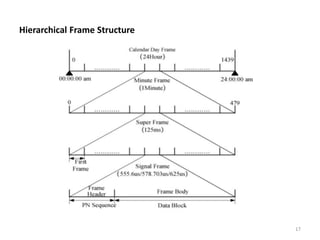
E. HIERARCHICAL FRAME STRUCTURE 
• Each Signal Frame consists of Frame Header (FH) and FB. 
• The baseband symbol rate for both FH and FB are the same, which 
is 7.56 Mbps. 
• FH uses Pseudo-Noise (PN) sequence and that is why the 
modulation scheme for multi-carrier mode called Time-domain 
Synchronous Orthogonal Frequency Division Multiplexing (TDS-OFDM). 
• There are three different FH lengths of 420, 595, and 945 symbols. 
16
Hierarchical Frame Structure 
17
F. System information 
• 6-bit physical layer system information in FB 
• Give receiver necessary demodulation/decoding information 
including : 
• Constellation mapping 
• LDPC rate 
• Interleaving mode 
• Carrier mode information 
• FH information. 
G. Post-Baseband Processing 
• Squared root raised cosine filter with roll-off factor α=0.05 
18
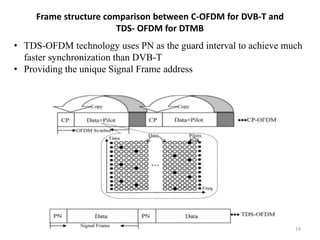
Frame structure comparison between C-OFDM for DVB-T and 
TDS- OFDM for DTMB 
• TDS-OFDM technology uses PN as the guard interval to achieve much 
19 
faster synchronization than DVB-T 
• Providing the unique Signal Frame address
NUMBER OF SUBCARRIERS 
• There are two options for the number of subcarriers in the 
frame body under the same system bandwidth: 
• C = 1 (for single-carrier) 
• C = 3780 (multicarrier; the subcarrier spacing is 2 kHz 
when radio frequency bandwidth is 8 MHz). 
20
DTV DEPLOYMENT IN HK 
• Conventional free-to-air analog television transmission has been used in 
Hong Kong since 1967 
• To verify the suitability of deploying DTMB in the local environment, 
field trial was conducted which covered reception under a variety of 
propagation conditions, such as line-of-sight, non-line-of-sight. 
• The field trial demonstrated the superiority of the DTMB standard over 
analog transmission. 
• The picture and sound quality delivered by DTMB was satisfactory 
under non-line-of-sight conditions, using only one-tenth of the 
transmitting power of its analog counterpart. 
• The DTMB standard supported spectrum-efficient operations including 
SFN deployment, multichannel programming, and conveyance of HDTV 
content. 
• As for mobile reception, a success rate of over 90 percent was recorded . 
21
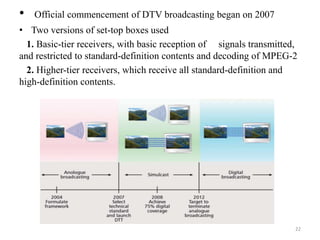
• Official commencement of DTV broadcasting began on 2007 
• Two versions of set-top boxes used 
1. Basic-tier receivers, with basic reception of signals transmitted, 
and restricted to standard-definition contents and decoding of MPEG-2 
2. Higher-tier receivers, which receive all standard-definition and 
high-definition contents. 
22
OTHER COUNTRIES USING DTMB 
• Two-thirds of all countries in the world have not decided their 
DTTB standards 
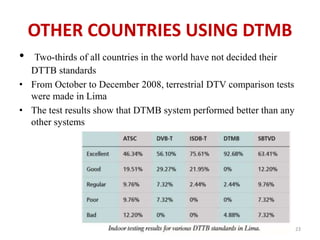
• From October to December 2008, terrestrial DTV comparison tests 
were made in Lima 
• The test results show that DTMB system performed better than any 
other systems 
23
ASTRI LABORATORY 
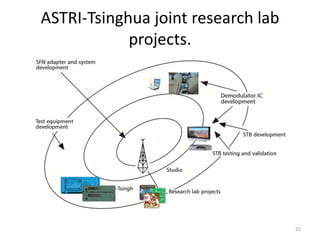
• Primary contributor to China’s DTMB standard and technology. 
• There are five projects under the MBC Joint Research Laboratory 
1. DTMB receiver STB and integrated TV development 
2. DTMB receiver testing and validation technology 
3. DTMB SFN adapter and system development 
4. DTMB test equipment development 
5. DTMB demodulator IC design 
24
ASTRI-Tsinghua joint research lab 
projects. 
25
CONCLUSION 
• Analog to digital transition had brought great changes in TV 
transmission technology. 
• 4 standards exists for DTV terrestrial transmission. 
• DTMB (Digital Terrestrial Multimedia Broadcast) is the Tv 
standard for mobile and fixed terminals used in the china. 
• DTMB system performed better than any other systems. 
26
REFERENCES 
• Chung-yen Ong, “Technology and Standards of Digital Television 
Terrestrial Multimedia Broadcasting”, IEEE Trans. Broadcasting, 
2011 
• J. Song et al., “Technical Review on Chinese Digital Terrestrial 
Television Broadcasting Standard and Measurement on Some 
Working Modes,” IEEE Trans. Broadcasting, vol. 53, no. 1, 2007, 
pp. 1–7. 
• W. Zhang et al., “An Introduction of the Chinese DTTB Standard 
and Analysis of the PN595 Working Modes,” IEEE Trans. 
Broadcasting, vol. 53, no. 1, 2007, pp. 8–15. 
• ITU-R Doc. 6A/82-E, “On Transition from Analogue to Digital 
Terrestrial Broadcasting,” Oct. 2008. 
• Z. Niu et al., “A New Paradigm for Mobile Multimedia 
Broadcasting Based on Integrated Communication and Broadcast 
Networks,” IEEE Commun. Mag., vol. 46, no. 7, 2008, pp. 126–32.27
28

digital tv DTMB

  • 1.
    TECHNOLOGY AND STANDARDSOF DIGITAL TELEVISION TERRESTRIAL MULTIMEDIA BROADCASTING SHAJANA K BASHEER S7 ECEB 46 1
  • 2.
    ANALOG TELEVISION •Conventional analog television begins with a video camera taking pictures of a frame. • TV camera processes these images in form of pixels. • Composite video is transmitted. • A television receiver uses a transmitting tower with an antenna to distribute signals in a circular pattern. • Line of sight propagation was only possible. • UHF and VHF frequencies were used. 2
  • 3.
    ANALOG TO DIGITAL • Integrated digital receivers - “set-top-boxes” replaces huge analog receivers including antennas, dishes, cabling…. • Performance of analog systems tends to deteriorate as the channel performance deteriorates while digital systems remain as defined. • Ability of digital systems to compress data into a smaller space • Use of compression coding techniques which allow relatively high sound and picture quality to be accommodated in a much smaller channel bandwidth. • Digital TV have ability to offer the viewer and listener more services, greater variety and higher technical quality. • Digital broadcasting techniques can offer credible “single frequency networks”. 3
  • 4.
    TV SET ANDRECEIVERS ANALOG DIGITAL 4
  • 5.
  • 6.
    DTTB- DIGITAL TELEVISIONTERRESTRIAL BROADCASTING • Digital broadcasting is the practice of using digital data rather than analog waveforms to carry broadcasts over television channels or assigned radio frequency bands. • Digital television (DTV) is the transmission of audio and video by digitally processed and multiplexed signal, in contrast to the totally analog and channel separated signals used by analog television. • DTV can support more than one programme in the same channel BW • Digital broad casting technologies have indeed successfully brought millions of viewers the excellent watching experience never realized before from watching analog TV. • DTV services can be delivered by terrestrial, satellite, cable broadcasting, or over the internet, and therefore, several transmission standards exist. • Digital television terrestrial broadcasting (DTTB) standard which defines the air-interface of the DTV signals. 6
  • 7.
    • Three mainDTV terrestrial standards existed in the world. • China started to develop its own DTTB standard in 1994. • DTMB (Digital Terrestrial Multimedia Broadcast) is the Tv standard for mobile and fixed terminals used in the china. • Although at first this standard was called DMB-T/H(Digital Multimedia Broadcast-Terrestrial/Handheld). • It decides Frame structure, channel coding and modulation for digital television terrestrial broadcasting system • Standard contains many combination of modes 1. Single carrier modulation and Multi-carrier modulation 2. Three frame header (FH) options 3. Three FEC coding rates, 4. Five constellation mappings…… • It results in hundreds of operation modes to support various multi-program SDTV/HDTV terrestrial broadcasting services. 7
  • 8.
    SINGLE-FREQUENCY NETWORK (SFN) • Several transmitters simultaneously send the same signal over the same frequency channel. • Analog AM and FM radio broadcast networks as well as digital broadcast networks can operate in this manner. • Higher number of radio and TV programs transmission in comparison to traditional multi-frequency network (MFN). • May result in intersymbol interference. 8
  • 9.
    COFDM AND OFDM • Self-interference cancellation is facilitated by the OFDM or COFDM modulation method. • Orthogonal frequency division multiplexing (OFDM) is a method of encoding digital data on multiple carrier frequencies. • A large number of closely spaced orthogonal subcarrier signals are used to carry data on several parallel data streams or channels. • Each subcarrier is modulated with a conventional modulation scheme(QAM/PSK) allow symbol rate, maintaining total data rates similar to conventional single carrier modulation schemes in same bandwidth. • OFDM uses a large number of slow low-bandwidth modulators instead of one fast wide-band modulator. • Since each modulator is very slow, we can afford to insert a guard interval between the symbols, and thus eliminate the ISI. • COFDM has ability to completely overcome multipath effects • It uses multiple carriers to transmit the same signal 8
  • 10.
    The Moving PictureExperts Group (MPEG) • Formed by ISO and IEC to set standards for audio and video compression and transmission. • MPEG-2 standard supports interlacing and high definition. • MPEG-2 is considered important because it has been chosen as the compression scheme for over the air digital television ATSC, DVB and ISDB, digital satellite TV services like Dish Network 10
  • 11.
    DTTB STANDARDS Fourcompeting DTTB standards 1. Advanced Television Systems Committee (ATSC) 2. Digital Video Broadcasting-Terrestrial (DVB-T) standard 3. Terrestrial Integrated Services Digital Broadcasting (ISDB-T) 4. Digital television terrestrial multimedia broadcasting (DTMB) DETAILS 1. ATSC • 8 VSB Modulation • MPEG-2 for coding • Single carrier modulation 2. DVB-T • Coded OFDM • Supports hierarchical transmission 3. ISDB-T • OFDM and two-dimensional interleaving • supports hierarchical transmission of up to three layers • MPEG-2 video and Advanced Audio Coding 11
  • 12.
    4.DTMB • TDSOFDM • Pseudo-random signal frame to serve as the guard interval (GI) of the OFDM block • Faster synchronization • Excellent SFN performance 12
  • 13.
  • 14.
  • 15.
    TECHNICAL DETAILS OFDTMB A. Scrambler • Pseudo random binary sequence is used to randomize the input MPEG-2 input data to facilitate the system synchronization. B. Forward Error Correction (FEC) Code • Concatenation of outer BCH(762, 752) and inner low density parity check (LDPC) codes. • 261 zeros infront of each 752 information bits forms BCH(762, 752) C. Signal Constellation and Mapping • The output binary sequence of FEC is converted to MQAM (M-ary Quadrature Amplitude Modulation) • DTMB supports the following constellations: 64QAM, 32QAM, 16QAM, 4QAM. D. Time Interleaving • Convolutional interleaver is utilized across many OFDM Signal Frames with B of 52 as the number of interleaving branches and M as the interleaving depth. 15
  • 16.
    E. HIERARCHICAL FRAMESTRUCTURE • Each Signal Frame consists of Frame Header (FH) and FB. • The baseband symbol rate for both FH and FB are the same, which is 7.56 Mbps. • FH uses Pseudo-Noise (PN) sequence and that is why the modulation scheme for multi-carrier mode called Time-domain Synchronous Orthogonal Frequency Division Multiplexing (TDS-OFDM). • There are three different FH lengths of 420, 595, and 945 symbols. 16
  • 17.
  • 18.
    F. System information • 6-bit physical layer system information in FB • Give receiver necessary demodulation/decoding information including : • Constellation mapping • LDPC rate • Interleaving mode • Carrier mode information • FH information. G. Post-Baseband Processing • Squared root raised cosine filter with roll-off factor α=0.05 18
  • 19.
    Frame structure comparisonbetween C-OFDM for DVB-T and TDS- OFDM for DTMB • TDS-OFDM technology uses PN as the guard interval to achieve much 19 faster synchronization than DVB-T • Providing the unique Signal Frame address
  • 20.
    NUMBER OF SUBCARRIERS • There are two options for the number of subcarriers in the frame body under the same system bandwidth: • C = 1 (for single-carrier) • C = 3780 (multicarrier; the subcarrier spacing is 2 kHz when radio frequency bandwidth is 8 MHz). 20
  • 21.
    DTV DEPLOYMENT INHK • Conventional free-to-air analog television transmission has been used in Hong Kong since 1967 • To verify the suitability of deploying DTMB in the local environment, field trial was conducted which covered reception under a variety of propagation conditions, such as line-of-sight, non-line-of-sight. • The field trial demonstrated the superiority of the DTMB standard over analog transmission. • The picture and sound quality delivered by DTMB was satisfactory under non-line-of-sight conditions, using only one-tenth of the transmitting power of its analog counterpart. • The DTMB standard supported spectrum-efficient operations including SFN deployment, multichannel programming, and conveyance of HDTV content. • As for mobile reception, a success rate of over 90 percent was recorded . 21
  • 22.
    • Official commencementof DTV broadcasting began on 2007 • Two versions of set-top boxes used 1. Basic-tier receivers, with basic reception of signals transmitted, and restricted to standard-definition contents and decoding of MPEG-2 2. Higher-tier receivers, which receive all standard-definition and high-definition contents. 22
  • 23.
    OTHER COUNTRIES USINGDTMB • Two-thirds of all countries in the world have not decided their DTTB standards • From October to December 2008, terrestrial DTV comparison tests were made in Lima • The test results show that DTMB system performed better than any other systems 23
  • 24.
    ASTRI LABORATORY •Primary contributor to China’s DTMB standard and technology. • There are five projects under the MBC Joint Research Laboratory 1. DTMB receiver STB and integrated TV development 2. DTMB receiver testing and validation technology 3. DTMB SFN adapter and system development 4. DTMB test equipment development 5. DTMB demodulator IC design 24
  • 25.
  • 26.
    CONCLUSION • Analogto digital transition had brought great changes in TV transmission technology. • 4 standards exists for DTV terrestrial transmission. • DTMB (Digital Terrestrial Multimedia Broadcast) is the Tv standard for mobile and fixed terminals used in the china. • DTMB system performed better than any other systems. 26
  • 27.
    REFERENCES • Chung-yenOng, “Technology and Standards of Digital Television Terrestrial Multimedia Broadcasting”, IEEE Trans. Broadcasting, 2011 • J. Song et al., “Technical Review on Chinese Digital Terrestrial Television Broadcasting Standard and Measurement on Some Working Modes,” IEEE Trans. Broadcasting, vol. 53, no. 1, 2007, pp. 1–7. • W. Zhang et al., “An Introduction of the Chinese DTTB Standard and Analysis of the PN595 Working Modes,” IEEE Trans. Broadcasting, vol. 53, no. 1, 2007, pp. 8–15. • ITU-R Doc. 6A/82-E, “On Transition from Analogue to Digital Terrestrial Broadcasting,” Oct. 2008. • Z. Niu et al., “A New Paradigm for Mobile Multimedia Broadcasting Based on Integrated Communication and Broadcast Networks,” IEEE Commun. Mag., vol. 46, no. 7, 2008, pp. 126–32.27
  • 28.