Timothy K. Shih
Selected Topics for e-
Learning Technologies
(Digital TV and MHP)
Digital TV technologies
• Outline
– Part1: Introduction to DTV
– Part2: DTV receivers
– Part3: MHP middleware
– Part4: Interactive TV
Introduction to DTV
Introduction to DTV
• Outline
– DTV overview
– Characteristic of DTV industry
– DTV standard overview
DTV overview
• What does DTV mean?
– Higher Picture Resolution
• High definition program
– Multicasting
• More programs at the same channel and bandwidth
– Better Picture Quality
• Less noise
– New Type of Broadcasting Service
• Interactions
DTV overview
• Digital receivers
– STB v.s. iDTV
– STB (Set-top box)
• standalone
• Two separate remote control
• Cheap products
– iDTV (Integrated DTV)
• Integrating STB to TV
• STB is a part of DTV
• Future trend
DTV overview
• Viewing Experience with DTV
– Basic Functions
• Channel Scanning
• Channel Organization
• Channel Change Banner
• Now/Next Information
• Parental Guidance
• PIP/POP
• Teletext, ClosedCaption
DTV overview
• Viewing Experience with DTV (cont’d)
– – Advanced Functions
• EPG (Electronic Program Guide)
• PVR (Personal Video Recording)
• SSU (System Software Update)
• PayTV(CA/CI)
• Interactive TV (MHP)
• Mobile TV
DTV overview
• DTV Basic Functions
– Channel Scanning
• Different settings for Satellite/Cable/Terrestrial DTV receivers
• Automatically/manually scan
– Channel Organization
• Channel list
• Channel edit
• Favorite list
• Sort, delete, hide, …
• Lock/unlock channels
DTV overview
• DTV Basic Functions
– Channel change banner
• Program name, description
• Date/time, duration
• HD/SD, Dolby, Aspect ratio,
• Parental rating, subtitling
– Now/Next information
DTV overview
• DTV Basic Functions
– Parental Guidance
• by program rating
• by channel
• by time
– PIP & POP
• Picture in picture
• Picture out picture
• One tuner v.s. twin tuners
DTV overview
• DTV Basic Functions
– Teletext (TT)
• The users can access text information on TV.
– Closed Caption (CC)
• The caption is separated with video frames.
• MPEG-II allows different caption streams.
DTV overview
• DTV Advanced Functions
– EPG (Electronic Program Guide)
• Displaying program information: name, start
time/duration, description.
• Present/Following (now/next) v.s. Scheduled (weekly)
EPG
• Display one dimensionally or two dimensionally
DTV overview
• DTV Advanced Functions
– PVR (Personal Video Recording)
• Recording
• Time-based, EPG-based
• One time, periodically
– Playback
• Normal, FF, FR, Repeat
– Time shifting
– Stream Editing
• DVB-SSU (System Software Update)
– Over-the-air software update
DTV overview
• DTV Advanced Functions
– PayTV
• The access to services inside TS is
• allowed only when subscription
– CA (Conditional Access)
• Smart card verification system
• Middleware porting is needed
• Different STB for different CA providers:
• Nagravision, Viaccess, Irdeto, etc.
• Cheap but not compatible
DTV overview
• DTV Advanced Functions
– CI (Common Interface)
• Common PCMCIA interface for different
• CA modules
• Same STB for different CA smart cards
• Expensive but compatible
DTV overview
• DTV Advanced Functions
– MHP (Multimedia Home Platform)
• A middleware
• More applications than audio/video
• Java-like applications
Characteristic of DTV
industry
• Characteristics of DTV Industry
– A lot of industries are involved.
• Major components of the DTV system
– Content/Service Provider
• TV program, Movie industry, Music industry, Game industry,
• information industry,etc.
• Digital studio, storage, broadcasting equipments.
– Transmission Channel
• Satellite, Cable, terrestrial, fixed/mobile network
• Communication equipments
– Terminal devices
• TV, Set-Top Box, PC/NB, cellular, PDA, vehicle device, etc.
• IC(tuner/decoder/display), Panel, Storage, software, OS, etc.
Characteristic of DTV
industry
• Huge difference among different DTV
markets
– 1. Different DTV standards
– 2. Different ecological dispersion
– 3. Different market demands
Characteristic of DTV
industry
• DTV Standards
– ATSC: USA, Canada, Mexico, South Korea
– DVB: Europe, Australia, New Zealand,
Taiwan, etc.
– ISDB: Japan
– DMB-TH: China (2006/8)
Characteristic of DTV
industry
• Ecological dispersion (Satellite、Cable、
Terrestrial)
– USA
• 85% users watching cable TV.
– Taiwan
• over 85% users watching cable TV
– India, Indonesia , middle of Asia:
• Satellite TV
– In Europe, Japan and China
• urban : Terrestrial TV
• Suburban : Satellite TV
Characteristic of DTV
industry
• DTV standards in the world wide
Characteristic of DTV
industry
• Market Demands
– Picture Quality
• HDTV markets
• SDTV markets
– TV Size
• Large size of TV
• TV smaller than 30”
– Functionality
• PayTV
– CA, CI
• interactive DTV
– (MHP, OpenCable, …)
• PVR
• Various customization
– Integration
• Integrated with other consumer products, like HDD, DVD.
• Popular in Japan, Korea.
DTV Standard Overview
• ATSC standard
– Video: MPEG-II MP@HL (main profile, high level)
– Audio: MPEG-I layer I,II, Dolby AC-3
– System layer: MPEG-ll TS + PSIP
– Modulation: 8-VSB (terrestrial), 16-VSB(cable)
– Interactive middleware: DASE(old) ACAP(new)
• Main Features
– HDTV
• ATSC system supports 18 formats with 6 HDTV, 9 EDTV, 3 SDTV.
– Dolby AC-3
• ATSC boasts “theater quality" audio because it uses the Dolby Digital AC3 format to provide
5.1-channel surround sound.
– Low transmission power
• VSB requires half transmission power compared with COFDM, so ATSC signal coverage is
larger than DVB-T with same power.
• Good for N. America where many places are rural with lower population density.
DTV Standard Overview
• DVB standard
– Video: MPEG-II MP@ML (main profile, main level)
– Audio: MPEG-I layer I, II
– System layer: MPEG-ll TS + SI
– Modulation: COFDM (DVB-T/H), QAM(DVB-C), QPSK(DVB-S)
– Channel Bandwidth: 6/7/8MHz (ATSC 6MHz with fixed 19.39bps)
– Interactive middleware: MHP (Multimedia Home Platform)
• Main Features (DVB-T)
– SFN (Single Frequency Network):
• Since it is better at handling multipath, same channel freq can be used for adjacent areas. The
spectrum allocation is efficient.
– Mobile Reception
• Due to Guard Band and the better multipath handling in COFDM, it is good for mobile
reception.
– Two-way communication support
• DVB has standardized return channels RCS/C/T to provide bidirectional communication
which is good for interactive DTV.
DTV Standard Overview
• ISDB standard
– Include ISDB-T, ISDB-C, ISDB-S
– Video: MPEG-II
– Audio: MPEG-II AAC (allows 5.1 audio output)
– System Layer: MPEG-ll TS + ARIB STD B-10
– Modulation: DPSK, QPSK, QAM, OFDM
– Channel Bandwidth: 6MHz (3.7 ~23.2Mbps )
• Main Features
– ISDB-S is 1.5 times more efficient than DVB-S. (ISDB-S could
transmit at 51 Mbps with a single transponder, while DVB-S allows
at about 34 Mbps)
– ISDB-T has the most flexibility and efficiency for mobile and
portable reception, compared with DVB-T and ATSC.
DTV Standard Overview
• Mobile TV standards
– DVB-H (digital video broadcasting-handheld )
• Derived from DVB-T with improvement on low power consumption, mobile
reception, IP data casting.
– T-DMB (digital multimedia broadcasting)
• Derived from DAB. Used by South Korea.
– MediaFLO (Media Forward Link Only)
• Qualcomm’s technology to broadcast data to portable devices.
• FLO means transmission path is one-way, from tower to device.
• Verizon Wireless (second-largest wireless network in the U.S.) and Cingular
(merged by AT&T Wireless and become the largest wireless carrier in the U.S. )
announced to deploy MediaFLO in US.
– DVB-SH (digital video broadcasting-Satellite handheld Feb. 2007)
• to deliver IP based media content and data to handheld terminals like mobile
phones and PDAs via satellite.
DTV Standard Overview
• Profile and level
DTV broadcasting applications
• DVB: MP@ML (main profile at main level).
• ATSC: MP@HL (main profile at high level).
DTV receivers
What does a DTV receiver
do?
• Receives digital TV programs from a cable, satellite
or terrestrial network
• Decodes transport streams
• Outputs signals to television
– More interactions can be done
– Ex. Running applications on STB
Block diagram of a typical
receiver
Tuner Front-end
Smart card /
CA Module
MPEG-2
decoder
CPU
Middleware
SDRAM
Flash memory
Graphics
processor
Descrambler
MPEG-2
demultiplexer
The Front End
• Receiver
– Converting analog signal to digital one.
– Including the tuner and the front end
• The tuner
– Receives frequency-specified signal
– Demodulates the signal
– Turns the analog signal into a digital bitstream
• The front-end
– Error correction
– Removing packetization in the stream
– Outputs an MPEG-2 transport stream
The Demultiplexer
• Decoding information in TS for STB
– Elements in the current channel
• Audio and video streams
• Broadcast data streams
• Service information
– Service information for the network
• Passing streams to corresponding components
– Service information and data streams to the CPU
– Audio and video to the MPEG decoder
The MPEG Decoder
• Decoding audio and video streams and displaying them on
the screen
• Supporting graphical overlays
– Cursor, graphics
– Some receivers support up to five graphics planes
• Background, video, two graphics planes, cursor
• Supporting scaling, clipping and repositioning video
– But this may be limited
The CPU
• Deal with other tasks in the system
– Decoding and handling service information
– Decoding broadcast data streams
– User interaction
– Running built-in or downloaded applications
• Often integrated with the MPEG-2 decoder and other components
• Typical CPUs
– STMicroelectronics 551x family
– NEC EMMA2
– ATI Xilleon
– Broadcom BCM3560
Conditional access (CA)
• Anti-piracy system for pay-TV
– Decrypts data from input streams
• Depending what was encrypted by the network operator
– Worked on specified devices
• integrating with the receiver
• Smart card or similar device
• Each STB usually has one CA system integrated
– This is enough for most pay-TV systems
– The box is tied with the subscription, so only used on one network
and one CA system
Conditional Access (CA)
• Some CA systems require special hardware support
• Some network operators are now using pure software CA systems
– May still use smart cards for authentication
• CA systems may do more than just encryption
– Pair a smart card to a single receiver
• Smart card can not be moved to other receivers
– Provide a way of uniquely identifying the receiver
• Smart card serial number
– Prevent STBs moving to other household
• Second STB
• Every household must have their own subscription
Conditional Access (CA)
• Integrated CA systems are unsuitable for some markets
• May use a pluggable CA module instead
– Entire decryption solution on a PCMCIA card
– Smart card plugs in to PCMCIA card
– Used on retail systems to allow use with any network
• This has several limitations
– More expensive (PCMCIA card)
– Few vertical markets will use pluggable CA modules
– Less secure, in the case of DVB-CI
• Not all CA systems will support pluggable modules
Return channel
• Communicating with the network operator or service operator
– Ordering pay-per-view services, home shopping, home banking
• May be used for general network access
– Web browsing, email, chat
• Many types in use
– PSTN modem (usually 56K)
– Cable modem and ADSL modem
– Exotic technologies such as GSM, DVB RCS (return channel via
satellite)
– Not every receiver will have a return channel
– The cost is relatively high.
– It’s not necessary for all services.
Middleware
• A common software platform for application development
– Usually in C or Java
– Basic features
• Graphics & video manipulation, return channel access, access to
service information, etc.
• Provided middleware platforms today
– OpenTV (OpenTV Core)
– NDS (NDS Core)
– Canal+ (MediaHighway)
– PowerTV (PowerTV)
– Microsoft (Microsoft TV)
– Nagravision-Kudelski (Tsunami)
• Open middleware platforms
– MHP, OCAP, ACAP, JavaTV, ARIB-B23
Integration
• Cost is a major factor in STB manufacture
– Lots of competition
– Typical cost is ~100 USD to the network operator for a standard STB
• Retail is more expensive
• Many components get integrated to save cost
– Tuner and front end
– Demultiplexer/MPEG decoder/CPU/graphics processor
• Most current STBs are one- or two-chip solutions
– Depends on features needed
Block diagram of a typical
receiver
Tuner
Smart card /
CA Module
MPEG-2
decoder
CPU
Middleware
SDRAM
Flash memory
Graphics
processor
Descrambler
MPEG-2
demultiplexer
Front-end
Standard STB with pay-TV
support (integrated)
BOM Cost: ~80 USD
Integrated into front-end
Integrated into CPU
Block diagram of a basic
receiver
μController
SDRAM
ROM
Free-to-Air ‘zapper’ box
BOM Cost: ~30-40 USD
MPEG-2
decoder
SDRAM
MPEG-2
demultiplexer
Tuner /
Front-end
MHP middleware
What Is MHP?
• An open standard for interactive digital television
• Defined by DVB
• Related open standards
– DVB, MPEG, JavaTV
• Providing interactive functionality to develop application
What Is MHP?
• MHP is:
– A platform definition
– A set of Java APIs
– A set of HTML document type definitions
– A set of compatibility tests
• It is also:
– Compatible with current DVB-based solutions
– Freely available (specification available on the web)
• MHP has been adopted in many countries
– Germany, Finland, Singapore, Korea, Australia and others
– Included in the US OpenCable standard
• Many other broadcasters & content developers working with MHP
What Is MHP?
• Three main standards are related to MHP
– MHP 1.0.x (1.0.0 – 1.0.3)
• The original MHP specification plus updates
• The most commonly deployed version of MHP
– MHP 1.1.x
• Adds some new elements
• HTML support, stored applications, Internet client APIs, smart
card APIs
• Still a work in progress
– Globally Executable MHP (GEM)
• A subset of MHP 1.0.2
• Designed to form the basis of other DTV middleware standards
• Currently used by OCAP, ACAP and ARIB B23
Types of MHP Application
• Information services
– super teletext, etc.
• Show-related interactivity
– online quiz show, online voting, etc.
• Games
• T-commerce and banking
• Internet access
Building MHP Services
• Applications are built in Java or HTML
– Most of products use Java only
• Transported in a DVB transport stream
– Transport stream with DVB tables
• Transported in IP connection
What Can An Application
Do?
• MHP application can be supported by follow APIs
– Most of standard Java APIs
– Extensions for TV-specific functionality
– APIs for accessing return channel
– APIs for controlling and communicating applications
• HTML application support for latest internet standards
– XHTML, CSS 2.0, ECMAScript
MHP deployment
• MHP 1.0.2 deployed in:
– Finland
– Germany
– Italy
– South Korea
• Other countries will follow soon
– Australia, USA (through OCAP)
• MHP 1.1 is not currently deployed
– Too many problems remaining
– Not enough need for the additional features
• Usually other ways to get what you need
Interactive TV
outline
• Research about interactive TV
• The requirements
• The proposed system or model
• The evaluation or results
• conclusion
Research about interactive
TV
• Four papers are presented here
– Interactive TV: VoD meets the Internet
– MiTV: rethinking interactive TV
– An integrated live interactive content insertion
system for digital TV commerce
– Open graphical framework for interactive TV
The introduction
• Interactive TV: VoD meets the Internet
– Shim, S.S.Y.; Yen-Jen Lee;
– Computer , Volume: 35 , Issue: 7 , July 2002
– Pages:108 - 109
What is interactive TV?
• Television commerce combines the
interactive power of the internet with
traditional TV programming.
• Two ways to deliver VoD services:
– Focus on TV
– Focus on PC
Generic architecture for
interactive VoD
• Back-end-service
– Video server platform
• Support unicast or multicast at broadband rates.
• Consist of a streaming server engine , real-time
streaming file system , etc.
– Security manager
• User profiles and usage histories
– Program scheduler
• Responding to user interaction
Generic architecture for
interactive VoD (cont’d)
• Database
– To store metadata and are used on video
retrieval.
• Service applications
– E-commerce transaction
– Messaging platform
Generic architecture for
interactive VoD (cont’d)
• Client platform
– There are various device to present multimedia
stream to client side.
– Web-based management and rendering
applications can reside in an STB , a PC or a
PDA.
– The details will be discussed in the next section.
Generic architecture for
interactive VoD (cont’d)
The generic interactive architecture
Combining other devices to
interactive TV
• MiTV: rethinking interactive TV
– Bing, J.; Dubreuil, J.; Espanol, J.; Julia, L.; Lee,
M.; Loyer, M.; Serghine, M.;
– Virtual Systems and Multimedia, 2001.
Proceedings. Seventh International Conference
on , 25-27 Oct. 2001
– Pages:365 - 369
Traditional interface for iTV
• The shortage of traditional iTV
– When Interactive event happened , the audience
can not carry on browsing the original program.
– Co-watchers
– Feedback
• Answering questions
– Entering data
• No suitable devices
A new interaction paradigm
• A natural device that comes with the TV is its
remote.
• The switch mode is efficient for TV with
100+ channel (change channels by forward
and back ).
• Using mobile devices like PDA or tablet to
replace remote control may be a better way.
The foundations
• The CAB (Collaobrative Architecture of
BravoBrava! )infrastructure.
• It’s used for established communications
between the mobile devices and interactive
TV.
• Based on Microsoft’s DCOM architectures.
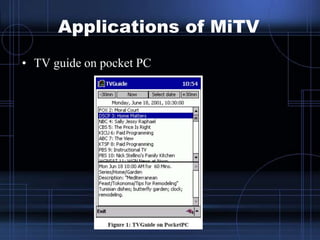
Applications of MiTV
• TV guide on pocket PC
Applications of MiTV
(cont’d)
• TV guide on a tablet
The pop-up information
• Showing logos on mobile devices instead of
on screen can keep the completeness of view
area.
Some examples of
interactive TV games
• The audience can join a interactive TV game by receiving
information and sending their answers by tablet or PDA.
Some examples of interactive
TV games (cont’d)
• Using hand-writing to answer quiz.
Example of an interactive
game meant for kids
Example of TV shopping
The third part
• An integrated live interactive content
insertion system for digital TV commerce
– Liang-Jie Zhang; Jen-Yao Chung; Lurng-Kuo
Liu; Lipscomb, J.S.; Qun Zhou;
– Multimedia Software Engineering, 2002.
Proceedings. Fourth International Symposium on
, 11-13 Dec. 2002
– Pages:286 - 293
introduction
• MPEG-2 is the video format used in digital TV. there are
three types of digital TV formats:
– ATSC
• Advanced television systems committee scheme
– DVB
• Digital video broadcast
– ARIB
• Association of radio industries an business
Introduction (cont’d)
• The problem of effectively organize the
interactive content and deliver its data in a
timely fashion to an mpeg-2 data injector.
• This paper proposed an improved method for
inserting interactive content into a live TV.
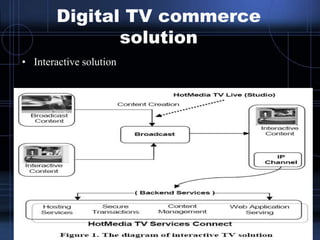
Digital TV commerce
solution
• Interactive solution
System architecture of the
integrated system for live data
insertion
• System architecture
Software based
implementation flow
• Dataflow diagram
The HotMedia TV Live
Interactive content
creation engine (ICCE)
• The authors provide an ICCE engine to
convert the online product list on the e-
commerce server.
• And combine some control (java script) to
the web part in interactive TV.
Interactive content
creation engine (cont’d)
• A sample of the
converted HTML
Scheduling
• Time-action mapping list
– 10/10/2000, 10:21:30, 3
– 10/10/2000, 10:40:30, 5
• Event-action mapping list
– PROGRAM_START, 5
– PROGRAM_END, 4
– COMMERCIAL_END, 3
– COMMERCIAL_START, 4
The final part
• Open graphical framework for interactive TV
– Cesar, P.; Vierinen, J.; Vuorimaa, P.;
– Multimedia Software Engineering, 2003.
Proceedings. Fifth International Symposium on ,
10-12 Dec. 2003
– Pages:21 - 28
introduction
• This paper focus on development of
framework and emphasize on cross platform
• So they choose JAVA for implementation
and Linux platform for performance.
System architecture
requirements
• User experience
• Developer experience
• Core architecture
• Adaptability
Classic architecture
• User Interface software components
Evaluation themes
• Here are some interesting terms they defined
to evaluate UI software tools.
– Focus
– threshold
– Ceiling
– Path of least resistance
The digital television
standard
• Various DVB , they are popular in Europe
– DVB-S (satellite)
– DVB-T (terrestrial)
– DVB-C (cable)
– DVB-MHP (multimedia home platform )
The architecture models
• Graphical architecture model and MHP setup
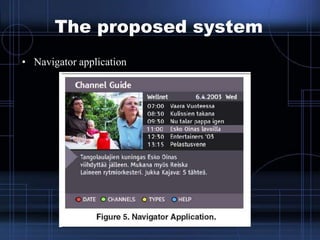
The proposed system
• Navigator application
The proposed system
(cont’d)
• Teletext application
The proposed system
(cont’d)
• SMIL television application
Summary

15 selected topics for e-learning technologies (dtv)

  • 1.
    Timothy K. Shih SelectedTopics for e- Learning Technologies (Digital TV and MHP)
  • 2.
    Digital TV technologies •Outline – Part1: Introduction to DTV – Part2: DTV receivers – Part3: MHP middleware – Part4: Interactive TV
  • 3.
  • 4.
    Introduction to DTV •Outline – DTV overview – Characteristic of DTV industry – DTV standard overview
  • 5.
    DTV overview • Whatdoes DTV mean? – Higher Picture Resolution • High definition program – Multicasting • More programs at the same channel and bandwidth – Better Picture Quality • Less noise – New Type of Broadcasting Service • Interactions
  • 6.
    DTV overview • Digitalreceivers – STB v.s. iDTV – STB (Set-top box) • standalone • Two separate remote control • Cheap products – iDTV (Integrated DTV) • Integrating STB to TV • STB is a part of DTV • Future trend
  • 7.
    DTV overview • ViewingExperience with DTV – Basic Functions • Channel Scanning • Channel Organization • Channel Change Banner • Now/Next Information • Parental Guidance • PIP/POP • Teletext, ClosedCaption
  • 8.
    DTV overview • ViewingExperience with DTV (cont’d) – – Advanced Functions • EPG (Electronic Program Guide) • PVR (Personal Video Recording) • SSU (System Software Update) • PayTV(CA/CI) • Interactive TV (MHP) • Mobile TV
  • 9.
    DTV overview • DTVBasic Functions – Channel Scanning • Different settings for Satellite/Cable/Terrestrial DTV receivers • Automatically/manually scan – Channel Organization • Channel list • Channel edit • Favorite list • Sort, delete, hide, … • Lock/unlock channels
  • 10.
    DTV overview • DTVBasic Functions – Channel change banner • Program name, description • Date/time, duration • HD/SD, Dolby, Aspect ratio, • Parental rating, subtitling – Now/Next information
  • 11.
    DTV overview • DTVBasic Functions – Parental Guidance • by program rating • by channel • by time – PIP & POP • Picture in picture • Picture out picture • One tuner v.s. twin tuners
  • 12.
    DTV overview • DTVBasic Functions – Teletext (TT) • The users can access text information on TV. – Closed Caption (CC) • The caption is separated with video frames. • MPEG-II allows different caption streams.
  • 13.
    DTV overview • DTVAdvanced Functions – EPG (Electronic Program Guide) • Displaying program information: name, start time/duration, description. • Present/Following (now/next) v.s. Scheduled (weekly) EPG • Display one dimensionally or two dimensionally
  • 14.
    DTV overview • DTVAdvanced Functions – PVR (Personal Video Recording) • Recording • Time-based, EPG-based • One time, periodically – Playback • Normal, FF, FR, Repeat – Time shifting – Stream Editing • DVB-SSU (System Software Update) – Over-the-air software update
  • 15.
    DTV overview • DTVAdvanced Functions – PayTV • The access to services inside TS is • allowed only when subscription – CA (Conditional Access) • Smart card verification system • Middleware porting is needed • Different STB for different CA providers: • Nagravision, Viaccess, Irdeto, etc. • Cheap but not compatible
  • 16.
    DTV overview • DTVAdvanced Functions – CI (Common Interface) • Common PCMCIA interface for different • CA modules • Same STB for different CA smart cards • Expensive but compatible
  • 17.
    DTV overview • DTVAdvanced Functions – MHP (Multimedia Home Platform) • A middleware • More applications than audio/video • Java-like applications
  • 18.
    Characteristic of DTV industry •Characteristics of DTV Industry – A lot of industries are involved. • Major components of the DTV system – Content/Service Provider • TV program, Movie industry, Music industry, Game industry, • information industry,etc. • Digital studio, storage, broadcasting equipments. – Transmission Channel • Satellite, Cable, terrestrial, fixed/mobile network • Communication equipments – Terminal devices • TV, Set-Top Box, PC/NB, cellular, PDA, vehicle device, etc. • IC(tuner/decoder/display), Panel, Storage, software, OS, etc.
  • 19.
    Characteristic of DTV industry •Huge difference among different DTV markets – 1. Different DTV standards – 2. Different ecological dispersion – 3. Different market demands
  • 20.
    Characteristic of DTV industry •DTV Standards – ATSC: USA, Canada, Mexico, South Korea – DVB: Europe, Australia, New Zealand, Taiwan, etc. – ISDB: Japan – DMB-TH: China (2006/8)
  • 21.
    Characteristic of DTV industry •Ecological dispersion (Satellite、Cable、 Terrestrial) – USA • 85% users watching cable TV. – Taiwan • over 85% users watching cable TV – India, Indonesia , middle of Asia: • Satellite TV – In Europe, Japan and China • urban : Terrestrial TV • Suburban : Satellite TV
  • 22.
    Characteristic of DTV industry •DTV standards in the world wide
  • 23.
    Characteristic of DTV industry •Market Demands – Picture Quality • HDTV markets • SDTV markets – TV Size • Large size of TV • TV smaller than 30” – Functionality • PayTV – CA, CI • interactive DTV – (MHP, OpenCable, …) • PVR • Various customization – Integration • Integrated with other consumer products, like HDD, DVD. • Popular in Japan, Korea.
  • 24.
    DTV Standard Overview •ATSC standard – Video: MPEG-II MP@HL (main profile, high level) – Audio: MPEG-I layer I,II, Dolby AC-3 – System layer: MPEG-ll TS + PSIP – Modulation: 8-VSB (terrestrial), 16-VSB(cable) – Interactive middleware: DASE(old) ACAP(new) • Main Features – HDTV • ATSC system supports 18 formats with 6 HDTV, 9 EDTV, 3 SDTV. – Dolby AC-3 • ATSC boasts “theater quality" audio because it uses the Dolby Digital AC3 format to provide 5.1-channel surround sound. – Low transmission power • VSB requires half transmission power compared with COFDM, so ATSC signal coverage is larger than DVB-T with same power. • Good for N. America where many places are rural with lower population density.
  • 25.
    DTV Standard Overview •DVB standard – Video: MPEG-II MP@ML (main profile, main level) – Audio: MPEG-I layer I, II – System layer: MPEG-ll TS + SI – Modulation: COFDM (DVB-T/H), QAM(DVB-C), QPSK(DVB-S) – Channel Bandwidth: 6/7/8MHz (ATSC 6MHz with fixed 19.39bps) – Interactive middleware: MHP (Multimedia Home Platform) • Main Features (DVB-T) – SFN (Single Frequency Network): • Since it is better at handling multipath, same channel freq can be used for adjacent areas. The spectrum allocation is efficient. – Mobile Reception • Due to Guard Band and the better multipath handling in COFDM, it is good for mobile reception. – Two-way communication support • DVB has standardized return channels RCS/C/T to provide bidirectional communication which is good for interactive DTV.
  • 26.
    DTV Standard Overview •ISDB standard – Include ISDB-T, ISDB-C, ISDB-S – Video: MPEG-II – Audio: MPEG-II AAC (allows 5.1 audio output) – System Layer: MPEG-ll TS + ARIB STD B-10 – Modulation: DPSK, QPSK, QAM, OFDM – Channel Bandwidth: 6MHz (3.7 ~23.2Mbps ) • Main Features – ISDB-S is 1.5 times more efficient than DVB-S. (ISDB-S could transmit at 51 Mbps with a single transponder, while DVB-S allows at about 34 Mbps) – ISDB-T has the most flexibility and efficiency for mobile and portable reception, compared with DVB-T and ATSC.
  • 27.
    DTV Standard Overview •Mobile TV standards – DVB-H (digital video broadcasting-handheld ) • Derived from DVB-T with improvement on low power consumption, mobile reception, IP data casting. – T-DMB (digital multimedia broadcasting) • Derived from DAB. Used by South Korea. – MediaFLO (Media Forward Link Only) • Qualcomm’s technology to broadcast data to portable devices. • FLO means transmission path is one-way, from tower to device. • Verizon Wireless (second-largest wireless network in the U.S.) and Cingular (merged by AT&T Wireless and become the largest wireless carrier in the U.S. ) announced to deploy MediaFLO in US. – DVB-SH (digital video broadcasting-Satellite handheld Feb. 2007) • to deliver IP based media content and data to handheld terminals like mobile phones and PDAs via satellite.
  • 28.
    DTV Standard Overview •Profile and level DTV broadcasting applications • DVB: MP@ML (main profile at main level). • ATSC: MP@HL (main profile at high level).
  • 29.
  • 30.
    What does aDTV receiver do? • Receives digital TV programs from a cable, satellite or terrestrial network • Decodes transport streams • Outputs signals to television – More interactions can be done – Ex. Running applications on STB
  • 31.
    Block diagram ofa typical receiver Tuner Front-end Smart card / CA Module MPEG-2 decoder CPU Middleware SDRAM Flash memory Graphics processor Descrambler MPEG-2 demultiplexer
  • 32.
    The Front End •Receiver – Converting analog signal to digital one. – Including the tuner and the front end • The tuner – Receives frequency-specified signal – Demodulates the signal – Turns the analog signal into a digital bitstream • The front-end – Error correction – Removing packetization in the stream – Outputs an MPEG-2 transport stream
  • 33.
    The Demultiplexer • Decodinginformation in TS for STB – Elements in the current channel • Audio and video streams • Broadcast data streams • Service information – Service information for the network • Passing streams to corresponding components – Service information and data streams to the CPU – Audio and video to the MPEG decoder
  • 34.
    The MPEG Decoder •Decoding audio and video streams and displaying them on the screen • Supporting graphical overlays – Cursor, graphics – Some receivers support up to five graphics planes • Background, video, two graphics planes, cursor • Supporting scaling, clipping and repositioning video – But this may be limited
  • 35.
    The CPU • Dealwith other tasks in the system – Decoding and handling service information – Decoding broadcast data streams – User interaction – Running built-in or downloaded applications • Often integrated with the MPEG-2 decoder and other components • Typical CPUs – STMicroelectronics 551x family – NEC EMMA2 – ATI Xilleon – Broadcom BCM3560
  • 36.
    Conditional access (CA) •Anti-piracy system for pay-TV – Decrypts data from input streams • Depending what was encrypted by the network operator – Worked on specified devices • integrating with the receiver • Smart card or similar device • Each STB usually has one CA system integrated – This is enough for most pay-TV systems – The box is tied with the subscription, so only used on one network and one CA system
  • 37.
    Conditional Access (CA) •Some CA systems require special hardware support • Some network operators are now using pure software CA systems – May still use smart cards for authentication • CA systems may do more than just encryption – Pair a smart card to a single receiver • Smart card can not be moved to other receivers – Provide a way of uniquely identifying the receiver • Smart card serial number – Prevent STBs moving to other household • Second STB • Every household must have their own subscription
  • 38.
    Conditional Access (CA) •Integrated CA systems are unsuitable for some markets • May use a pluggable CA module instead – Entire decryption solution on a PCMCIA card – Smart card plugs in to PCMCIA card – Used on retail systems to allow use with any network • This has several limitations – More expensive (PCMCIA card) – Few vertical markets will use pluggable CA modules – Less secure, in the case of DVB-CI • Not all CA systems will support pluggable modules
  • 39.
    Return channel • Communicatingwith the network operator or service operator – Ordering pay-per-view services, home shopping, home banking • May be used for general network access – Web browsing, email, chat • Many types in use – PSTN modem (usually 56K) – Cable modem and ADSL modem – Exotic technologies such as GSM, DVB RCS (return channel via satellite) – Not every receiver will have a return channel – The cost is relatively high. – It’s not necessary for all services.
  • 40.
    Middleware • A commonsoftware platform for application development – Usually in C or Java – Basic features • Graphics & video manipulation, return channel access, access to service information, etc. • Provided middleware platforms today – OpenTV (OpenTV Core) – NDS (NDS Core) – Canal+ (MediaHighway) – PowerTV (PowerTV) – Microsoft (Microsoft TV) – Nagravision-Kudelski (Tsunami) • Open middleware platforms – MHP, OCAP, ACAP, JavaTV, ARIB-B23
  • 41.
    Integration • Cost isa major factor in STB manufacture – Lots of competition – Typical cost is ~100 USD to the network operator for a standard STB • Retail is more expensive • Many components get integrated to save cost – Tuner and front end – Demultiplexer/MPEG decoder/CPU/graphics processor • Most current STBs are one- or two-chip solutions – Depends on features needed
  • 42.
    Block diagram ofa typical receiver Tuner Smart card / CA Module MPEG-2 decoder CPU Middleware SDRAM Flash memory Graphics processor Descrambler MPEG-2 demultiplexer Front-end Standard STB with pay-TV support (integrated) BOM Cost: ~80 USD Integrated into front-end Integrated into CPU
  • 43.
    Block diagram ofa basic receiver μController SDRAM ROM Free-to-Air ‘zapper’ box BOM Cost: ~30-40 USD MPEG-2 decoder SDRAM MPEG-2 demultiplexer Tuner / Front-end
  • 44.
  • 45.
    What Is MHP? •An open standard for interactive digital television • Defined by DVB • Related open standards – DVB, MPEG, JavaTV • Providing interactive functionality to develop application
  • 46.
    What Is MHP? •MHP is: – A platform definition – A set of Java APIs – A set of HTML document type definitions – A set of compatibility tests • It is also: – Compatible with current DVB-based solutions – Freely available (specification available on the web) • MHP has been adopted in many countries – Germany, Finland, Singapore, Korea, Australia and others – Included in the US OpenCable standard • Many other broadcasters & content developers working with MHP
  • 47.
    What Is MHP? •Three main standards are related to MHP – MHP 1.0.x (1.0.0 – 1.0.3) • The original MHP specification plus updates • The most commonly deployed version of MHP – MHP 1.1.x • Adds some new elements • HTML support, stored applications, Internet client APIs, smart card APIs • Still a work in progress – Globally Executable MHP (GEM) • A subset of MHP 1.0.2 • Designed to form the basis of other DTV middleware standards • Currently used by OCAP, ACAP and ARIB B23
  • 48.
    Types of MHPApplication • Information services – super teletext, etc. • Show-related interactivity – online quiz show, online voting, etc. • Games • T-commerce and banking • Internet access
  • 49.
    Building MHP Services •Applications are built in Java or HTML – Most of products use Java only • Transported in a DVB transport stream – Transport stream with DVB tables • Transported in IP connection
  • 50.
    What Can AnApplication Do? • MHP application can be supported by follow APIs – Most of standard Java APIs – Extensions for TV-specific functionality – APIs for accessing return channel – APIs for controlling and communicating applications • HTML application support for latest internet standards – XHTML, CSS 2.0, ECMAScript
  • 51.
    MHP deployment • MHP1.0.2 deployed in: – Finland – Germany – Italy – South Korea • Other countries will follow soon – Australia, USA (through OCAP) • MHP 1.1 is not currently deployed – Too many problems remaining – Not enough need for the additional features • Usually other ways to get what you need
  • 52.
  • 53.
    outline • Research aboutinteractive TV • The requirements • The proposed system or model • The evaluation or results • conclusion
  • 54.
    Research about interactive TV •Four papers are presented here – Interactive TV: VoD meets the Internet – MiTV: rethinking interactive TV – An integrated live interactive content insertion system for digital TV commerce – Open graphical framework for interactive TV
  • 55.
    The introduction • InteractiveTV: VoD meets the Internet – Shim, S.S.Y.; Yen-Jen Lee; – Computer , Volume: 35 , Issue: 7 , July 2002 – Pages:108 - 109
  • 56.
    What is interactiveTV? • Television commerce combines the interactive power of the internet with traditional TV programming. • Two ways to deliver VoD services: – Focus on TV – Focus on PC
  • 57.
    Generic architecture for interactiveVoD • Back-end-service – Video server platform • Support unicast or multicast at broadband rates. • Consist of a streaming server engine , real-time streaming file system , etc. – Security manager • User profiles and usage histories – Program scheduler • Responding to user interaction
  • 58.
    Generic architecture for interactiveVoD (cont’d) • Database – To store metadata and are used on video retrieval. • Service applications – E-commerce transaction – Messaging platform
  • 59.
    Generic architecture for interactiveVoD (cont’d) • Client platform – There are various device to present multimedia stream to client side. – Web-based management and rendering applications can reside in an STB , a PC or a PDA. – The details will be discussed in the next section.
  • 60.
    Generic architecture for interactiveVoD (cont’d) The generic interactive architecture
  • 61.
    Combining other devicesto interactive TV • MiTV: rethinking interactive TV – Bing, J.; Dubreuil, J.; Espanol, J.; Julia, L.; Lee, M.; Loyer, M.; Serghine, M.; – Virtual Systems and Multimedia, 2001. Proceedings. Seventh International Conference on , 25-27 Oct. 2001 – Pages:365 - 369
  • 62.
    Traditional interface foriTV • The shortage of traditional iTV – When Interactive event happened , the audience can not carry on browsing the original program. – Co-watchers – Feedback • Answering questions – Entering data • No suitable devices
  • 63.
    A new interactionparadigm • A natural device that comes with the TV is its remote. • The switch mode is efficient for TV with 100+ channel (change channels by forward and back ). • Using mobile devices like PDA or tablet to replace remote control may be a better way.
  • 64.
    The foundations • TheCAB (Collaobrative Architecture of BravoBrava! )infrastructure. • It’s used for established communications between the mobile devices and interactive TV. • Based on Microsoft’s DCOM architectures.
  • 65.
    Applications of MiTV •TV guide on pocket PC
  • 66.
  • 67.
    The pop-up information •Showing logos on mobile devices instead of on screen can keep the completeness of view area.
  • 68.
    Some examples of interactiveTV games • The audience can join a interactive TV game by receiving information and sending their answers by tablet or PDA.
  • 69.
    Some examples ofinteractive TV games (cont’d) • Using hand-writing to answer quiz.
  • 70.
    Example of aninteractive game meant for kids
  • 71.
    Example of TVshopping
  • 72.
    The third part •An integrated live interactive content insertion system for digital TV commerce – Liang-Jie Zhang; Jen-Yao Chung; Lurng-Kuo Liu; Lipscomb, J.S.; Qun Zhou; – Multimedia Software Engineering, 2002. Proceedings. Fourth International Symposium on , 11-13 Dec. 2002 – Pages:286 - 293
  • 73.
    introduction • MPEG-2 isthe video format used in digital TV. there are three types of digital TV formats: – ATSC • Advanced television systems committee scheme – DVB • Digital video broadcast – ARIB • Association of radio industries an business
  • 74.
    Introduction (cont’d) • Theproblem of effectively organize the interactive content and deliver its data in a timely fashion to an mpeg-2 data injector. • This paper proposed an improved method for inserting interactive content into a live TV.
  • 75.
  • 76.
    System architecture ofthe integrated system for live data insertion • System architecture
  • 77.
  • 78.
  • 79.
    Interactive content creation engine(ICCE) • The authors provide an ICCE engine to convert the online product list on the e- commerce server. • And combine some control (java script) to the web part in interactive TV.
  • 80.
    Interactive content creation engine(cont’d) • A sample of the converted HTML
  • 81.
    Scheduling • Time-action mappinglist – 10/10/2000, 10:21:30, 3 – 10/10/2000, 10:40:30, 5 • Event-action mapping list – PROGRAM_START, 5 – PROGRAM_END, 4 – COMMERCIAL_END, 3 – COMMERCIAL_START, 4
  • 82.
    The final part •Open graphical framework for interactive TV – Cesar, P.; Vierinen, J.; Vuorimaa, P.; – Multimedia Software Engineering, 2003. Proceedings. Fifth International Symposium on , 10-12 Dec. 2003 – Pages:21 - 28
  • 83.
    introduction • This paperfocus on development of framework and emphasize on cross platform • So they choose JAVA for implementation and Linux platform for performance.
  • 84.
    System architecture requirements • Userexperience • Developer experience • Core architecture • Adaptability
  • 85.
    Classic architecture • UserInterface software components
  • 86.
    Evaluation themes • Hereare some interesting terms they defined to evaluate UI software tools. – Focus – threshold – Ceiling – Path of least resistance
  • 87.
    The digital television standard •Various DVB , they are popular in Europe – DVB-S (satellite) – DVB-T (terrestrial) – DVB-C (cable) – DVB-MHP (multimedia home platform )
  • 88.
    The architecture models •Graphical architecture model and MHP setup
  • 89.
    The proposed system •Navigator application
  • 90.
  • 91.
    The proposed system (cont’d) •SMIL television application
  • 92.