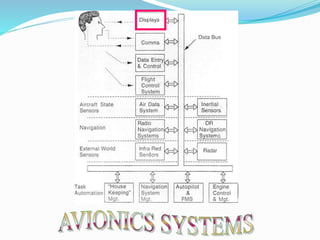
Combination of aviation and electronics
Avionics system or Avionics sub-system dependent on
electronics.
Avionics industry- a major multi-billion dollar industry
worldwide.
Avionics equipment on a modern military or civil aircraft
account for around
 30% of the total cost of the aircraft
 40% in the case of a maritime patrol/anti-submarine aircraft
(or helicopter)
 Over 75% of the total cost in the case of an airborne early
warning aircraft
To enable the flight crew to carry out the
aircraft mission safely and efficiently.
Intercepting a hostile aircraft, attacking a
ground target, reconnaissance or maritime patrol
(Military Aircraft).
VERY IMPORTANT DRIVERS FOR AVIONICS
SYSTEMS ARE
Increased safety
Air traffic control requirements
All weather operation
Reduction in fuel consumption
Improved aircraft performance and
control and handling and reduction in
maintenance costs
* In the military case, the avionics systems are
also being driven by a continuing increase in the
threats posed by the defensive and offensive
capabilities of potential aggressors.
AEROSPACE DESIGN INVOLVES
 Lot of Analyses
 Ground testing and simulation (e.g. wind tunnel tests
of model aircraft, flight simulation, drop tests, full
scale mock-up, fatigue tests)
 Flight tests
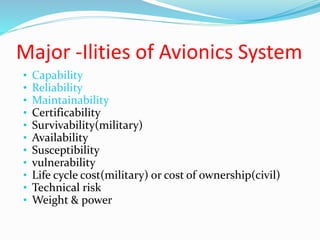
Major -Ilities of Avionics System
• Capability
• Reliability
• Maintainability
• Certificability
• Survivability(military)
• Availability
• Susceptibility
• vulnerability
• Life cycle cost(military) or cost of ownership(civil)
• Technical risk
• Weight & power
• Capability:
– How capable is avionics system?
– can they do the job and even more?
– Designer to maximize the capability of the system
within the constraints that are imposed.
• Reliability:
– Designer strives to make systems as reliable as possible.
– High reliability less maintenance costs.
– If less reliable customer will not buy it and in terms of
civil airlines the certificating agencies will not certify it.
• Maintainability:
– Closely related to reliability
– System must need preventive or corrective maintenance.
– System can be maintained through built in testing,
automated troubleshooting and easy access to hardware.
• Availability:
– Combination of reliability and maintainability
– Trade of between reliability and maintainability to
optimize availability.
– Availability translates into sorties for military aircraft
and into revenue flights for civil aircrafts.
 Certificability:
 Major area of concern for avionics in civil airlines.
 Certification conducted by the regulatory agencies
based on detailed, expert examination of all facets of
aircraft design and operation.
 The avionics architecture should be straight forward and
easily understandable.
 There should be no sneak circuits and no noobvious
modes of operation.
 Avionics certification focus on three analyses:
preliminary hazard, fault tree, and FMEA.
• Survivability:
– It is a function of susceptibility and vulnerability.
– Susceptibility: measure of probability that an aircraft
will be hit by a given threat.
– Vulnerability: measure of the probability that damage
will occur if there is a hit by the threat
• Life cycle cost(LCC)or Cost of ownership:
• It deals with economic measures need for evaluating avionics
architecture.
• It includes costs of varied items as spares acquisition,
transportation, storage and training (crew and Maintenance
personnel's),hardware development and test, depreciation and
interest.
• Risk:
– Amount of failures and drawbacks in the design and
implementation.
– Over come by using the latest technology and fail proof
technique to overcome both developmental and long
term technological risks.
• Weight and power:
– Minimize the weight and power requirements are two
fundamental concepts of avionics design.
– So the design must be light weight and power
consuming which is possible through the data bus and
latest advancement of electronics devices.
Integrated Avionics weapon
systems
 SONAR
 RADAR
 Military communications
 Electro optics (FLIR or PIDS)
 ECM OR ECCM
 ESM/DAS
 Tactical missile guidance
AVIONICS SYSTEM ARCHITECTURE
Establishing the basic architecture is the first and
the most fundamental challenge faced by the
designer
These architectures rely on the data buses for intra
and intersystem communications
The architecture must conform to the overall aircraft
mission and design while ensuring that the avionics
system meets its performance requirements
The optimum architecture can only be selected
after a series of exhaustive design tradeoffs that
address the evaluation factors
AVIONICS ARCHITECTURE
First Generation Architecture ( 1940’s –1950’s)
Disjoint or Independent Architecture ( MiG-21)
Centralized Architecture (F-111)
Second Generation Architecture ( 1960’s –1970’s)
Federated Architecture (F-16 A/B)
Distributed Architecture (DAIS)
Hierarchical Architecture (F-16 C/D, EAP)
Third Generation Architecture ( 1980’s –1990’s)
Pave Pillar Architecture ( F-22)
Fourth Generation Architecture (Post 2005)
Pave Pace Architecture- JSF
Open System Architecture
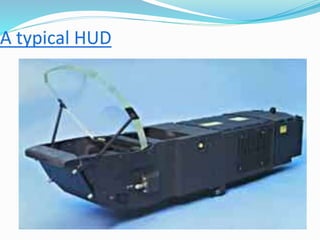
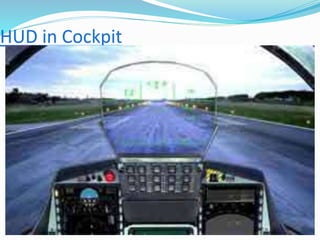
 HUD uses high brightness CRT
 HUD projects some of the information normally on the
primary flight displays and selected systems or weapons
data into the LOS of the pilot without substantially
dimming or obscuring the outer view
 HUD allows the pilot to simultaneously see critical aircraft
information while viewing the outside scene
 High performance aircraft HUDs use one of two basic
designs for the combiner:-
 Single element combiner HUD
 Three element combiner HUD
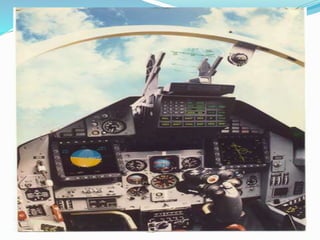
 HLDs are another option for cockpit displays
 HLD avoids physiological limitation on eye refocusing
time (as high as 200ms) by placing directly below the HUD
or top edge of the instrument panel display in which an
image and supplement alphanumeric information are
focused at a long distance, say about 50 m
 Thus the need for the pilot to refocus his eyes to scan at
least some information inside the cockpit is eliminated
 Normally HLD is used to display Radar or IR images or
digital map
 HLD uses high intensity lamp coupled with dichronic
filters to sort the white light into red, green and blue
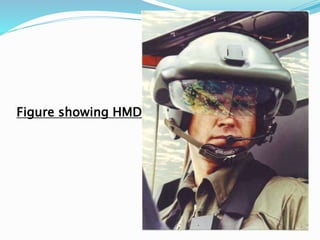
 HMD
 High brightness
 Excellent Resolution
 Lightweight
 Small size
 Monochrome
 HMD is advantageous over HUD
 Critical aircraft & stores information in in pilot’s
LOS at all times, not just when he is looking
straight ahead
 HMD display format are similar to HUD format
 Design of HMD, factors to be considered are
 Weight: Helmets are designed using light weight materials
 Helmet Aerodynamics: Helmets are not designed for aerodynamics
because during ejection, if designed for aerodynamics then it pulls the
pilot’s neck upwards
 HMD is also used by Maintenance Personnel to have hands free and
eyes fixed on the repair task at hand simultaneously viewing
maintenance drawings and procedures
Figure showing HMD
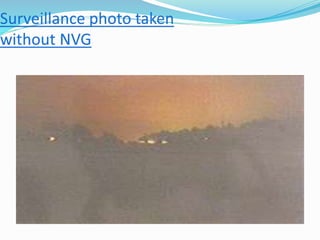
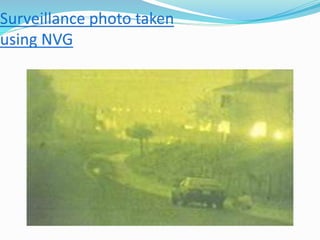
 Night-vision goggles are electronic widgets that allow
you to see things at night when it is too dark to see
things with just your eyes alone
 Two type of Night Vision Imaging System (NVIS)
 Type I
 Uses only Binocular goggle with phosphor screen image
 Used generally in rotorcraft
 Type II
 Have same goggle as Type I, but provision has been made to allow
the pilot to directly view the instruments through a combiner
positioned below the goggle
 Commonly used in fixed wing aircraft
AIRCRAFT’S MOTION SENSOR
 Rate gyroscopes : Rate of rotation about
roll,pitch and yaw axes.
 Linear accelerometers : Normal and Lateral
acceleration.
 Air data sensors : Height and Airspeed.
 Airstream sensors : Incidence angles in
longitudinal and lateral
planes.
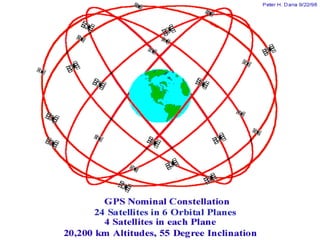
Why to go for satellite Navigation?
 Satisfy as large a range of users as possible, military
as well as civilian
 Relatively low user cost as well as ease-of-
operation
 Unrestricted access by all users
 Satisfy military positioning requirements
Inertial Navigation system
 It is a type of dead Reckoning system.
 It is the self contained , autonomous and unjammable.
 It measures linear motion and rotations using accelerometers and
gyroscopes.
 From the initial navigation data obtained from the other navigation
system or user, the navigation computer gives the attitude , position and
velocity.
 It is faster than the data given by the GPS.
 INS is very accurate over the short distance.
 It is of two different configuration based on the Inertial sensor placement.
They are
a. Stable or Gimballed platform.
b. Strap down platform
 Stable or Gimballed Platform system:
In which the Accelerometer and gyro are placed in the stable
platform which is maintained stable by the gimbal system. Then the
acceleration measured in the inertial coordinates
 Strap down Platform:
In this system the accelerometers are mounted on the vehicle
platform and are therefore fixed to the vehicle coordinate system. The
acceleration measured are then in vehicle coordinates
 Advantage and Disadvantage of Stable platform:-
 It is very reliable, accurate and value for the money.
 The mechanical gimbal arrangement is very complex.
 Expensive and replacing , rebuild are very lengthy process
 Calibrations are very lengthy process
THANK YOU
PRESENTED BY:-
SAI SHUBHANKAR

Avionics sai

  • 2.
    Combination of aviationand electronics Avionics system or Avionics sub-system dependent on electronics. Avionics industry- a major multi-billion dollar industry worldwide. Avionics equipment on a modern military or civil aircraft account for around  30% of the total cost of the aircraft  40% in the case of a maritime patrol/anti-submarine aircraft (or helicopter)  Over 75% of the total cost in the case of an airborne early warning aircraft
  • 3.
    To enable theflight crew to carry out the aircraft mission safely and efficiently. Intercepting a hostile aircraft, attacking a ground target, reconnaissance or maritime patrol (Military Aircraft).
  • 4.
    VERY IMPORTANT DRIVERSFOR AVIONICS SYSTEMS ARE Increased safety Air traffic control requirements All weather operation Reduction in fuel consumption Improved aircraft performance and control and handling and reduction in maintenance costs * In the military case, the avionics systems are also being driven by a continuing increase in the threats posed by the defensive and offensive capabilities of potential aggressors.
  • 6.
    AEROSPACE DESIGN INVOLVES Lot of Analyses  Ground testing and simulation (e.g. wind tunnel tests of model aircraft, flight simulation, drop tests, full scale mock-up, fatigue tests)  Flight tests
  • 7.
    Major -Ilities ofAvionics System • Capability • Reliability • Maintainability • Certificability • Survivability(military) • Availability • Susceptibility • vulnerability • Life cycle cost(military) or cost of ownership(civil) • Technical risk • Weight & power
  • 8.
    • Capability: – Howcapable is avionics system? – can they do the job and even more? – Designer to maximize the capability of the system within the constraints that are imposed. • Reliability: – Designer strives to make systems as reliable as possible. – High reliability less maintenance costs. – If less reliable customer will not buy it and in terms of civil airlines the certificating agencies will not certify it.
  • 9.
    • Maintainability: – Closelyrelated to reliability – System must need preventive or corrective maintenance. – System can be maintained through built in testing, automated troubleshooting and easy access to hardware. • Availability: – Combination of reliability and maintainability – Trade of between reliability and maintainability to optimize availability. – Availability translates into sorties for military aircraft and into revenue flights for civil aircrafts.
  • 10.
     Certificability:  Majorarea of concern for avionics in civil airlines.  Certification conducted by the regulatory agencies based on detailed, expert examination of all facets of aircraft design and operation.  The avionics architecture should be straight forward and easily understandable.  There should be no sneak circuits and no noobvious modes of operation.  Avionics certification focus on three analyses: preliminary hazard, fault tree, and FMEA.
  • 11.
    • Survivability: – Itis a function of susceptibility and vulnerability. – Susceptibility: measure of probability that an aircraft will be hit by a given threat. – Vulnerability: measure of the probability that damage will occur if there is a hit by the threat • Life cycle cost(LCC)or Cost of ownership: • It deals with economic measures need for evaluating avionics architecture. • It includes costs of varied items as spares acquisition, transportation, storage and training (crew and Maintenance personnel's),hardware development and test, depreciation and interest.
  • 12.
    • Risk: – Amountof failures and drawbacks in the design and implementation. – Over come by using the latest technology and fail proof technique to overcome both developmental and long term technological risks. • Weight and power: – Minimize the weight and power requirements are two fundamental concepts of avionics design. – So the design must be light weight and power consuming which is possible through the data bus and latest advancement of electronics devices.
  • 13.
    Integrated Avionics weapon systems SONAR  RADAR  Military communications  Electro optics (FLIR or PIDS)  ECM OR ECCM  ESM/DAS  Tactical missile guidance
  • 14.
    AVIONICS SYSTEM ARCHITECTURE Establishingthe basic architecture is the first and the most fundamental challenge faced by the designer These architectures rely on the data buses for intra and intersystem communications The architecture must conform to the overall aircraft mission and design while ensuring that the avionics system meets its performance requirements The optimum architecture can only be selected after a series of exhaustive design tradeoffs that address the evaluation factors
  • 15.
    AVIONICS ARCHITECTURE First GenerationArchitecture ( 1940’s –1950’s) Disjoint or Independent Architecture ( MiG-21) Centralized Architecture (F-111) Second Generation Architecture ( 1960’s –1970’s) Federated Architecture (F-16 A/B) Distributed Architecture (DAIS) Hierarchical Architecture (F-16 C/D, EAP) Third Generation Architecture ( 1980’s –1990’s) Pave Pillar Architecture ( F-22) Fourth Generation Architecture (Post 2005) Pave Pace Architecture- JSF Open System Architecture
  • 16.
     HUD useshigh brightness CRT  HUD projects some of the information normally on the primary flight displays and selected systems or weapons data into the LOS of the pilot without substantially dimming or obscuring the outer view  HUD allows the pilot to simultaneously see critical aircraft information while viewing the outside scene
  • 17.
     High performanceaircraft HUDs use one of two basic designs for the combiner:-  Single element combiner HUD  Three element combiner HUD
  • 21.
     HLDs areanother option for cockpit displays  HLD avoids physiological limitation on eye refocusing time (as high as 200ms) by placing directly below the HUD or top edge of the instrument panel display in which an image and supplement alphanumeric information are focused at a long distance, say about 50 m  Thus the need for the pilot to refocus his eyes to scan at least some information inside the cockpit is eliminated
  • 22.
     Normally HLDis used to display Radar or IR images or digital map  HLD uses high intensity lamp coupled with dichronic filters to sort the white light into red, green and blue
  • 23.
     HMD  Highbrightness  Excellent Resolution  Lightweight  Small size  Monochrome  HMD is advantageous over HUD  Critical aircraft & stores information in in pilot’s LOS at all times, not just when he is looking straight ahead
  • 24.
     HMD displayformat are similar to HUD format  Design of HMD, factors to be considered are  Weight: Helmets are designed using light weight materials  Helmet Aerodynamics: Helmets are not designed for aerodynamics because during ejection, if designed for aerodynamics then it pulls the pilot’s neck upwards  HMD is also used by Maintenance Personnel to have hands free and eyes fixed on the repair task at hand simultaneously viewing maintenance drawings and procedures
  • 25.
  • 26.
     Night-vision gogglesare electronic widgets that allow you to see things at night when it is too dark to see things with just your eyes alone  Two type of Night Vision Imaging System (NVIS)  Type I  Uses only Binocular goggle with phosphor screen image  Used generally in rotorcraft  Type II  Have same goggle as Type I, but provision has been made to allow the pilot to directly view the instruments through a combiner positioned below the goggle  Commonly used in fixed wing aircraft
  • 29.
    AIRCRAFT’S MOTION SENSOR Rate gyroscopes : Rate of rotation about roll,pitch and yaw axes.  Linear accelerometers : Normal and Lateral acceleration.  Air data sensors : Height and Airspeed.  Airstream sensors : Incidence angles in longitudinal and lateral planes.
  • 32.
    Why to gofor satellite Navigation?  Satisfy as large a range of users as possible, military as well as civilian  Relatively low user cost as well as ease-of- operation  Unrestricted access by all users  Satisfy military positioning requirements
  • 33.
    Inertial Navigation system It is a type of dead Reckoning system.  It is the self contained , autonomous and unjammable.  It measures linear motion and rotations using accelerometers and gyroscopes.  From the initial navigation data obtained from the other navigation system or user, the navigation computer gives the attitude , position and velocity.  It is faster than the data given by the GPS.  INS is very accurate over the short distance.  It is of two different configuration based on the Inertial sensor placement. They are a. Stable or Gimballed platform. b. Strap down platform
  • 34.
     Stable orGimballed Platform system: In which the Accelerometer and gyro are placed in the stable platform which is maintained stable by the gimbal system. Then the acceleration measured in the inertial coordinates  Strap down Platform: In this system the accelerometers are mounted on the vehicle platform and are therefore fixed to the vehicle coordinate system. The acceleration measured are then in vehicle coordinates  Advantage and Disadvantage of Stable platform:-  It is very reliable, accurate and value for the money.  The mechanical gimbal arrangement is very complex.  Expensive and replacing , rebuild are very lengthy process  Calibrations are very lengthy process
  • 35.

Editor's Notes

  • #36 PRESENTED BY:-SAI SHUBHANKAR AISST ROLL-6