Full download ebook at ebookname.com
Digital Television 3rd Edition Herve Benoit
https://ebookname.com/product/digital-television-3rd-
edition-herve-benoit/
OR CLICK BUTTON
DOWLOAD NOW
Download more ebook from https://ebookname.com
More products digital (pdf, epub, mobi) instant
download maybe you interests ...
Into the Newsroom Exploring the Digital Production of
Regional Television News 1st Edition Emma Hemmingway
https://ebookname.com/product/into-the-newsroom-exploring-the-
digital-production-of-regional-television-news-1st-edition-emma-
hemmingway/
The Fiber Optic Gyroscope 2nd Edition Herve C. Lefevre
https://ebookname.com/product/the-fiber-optic-gyroscope-2nd-
edition-herve-c-lefevre/
Digital Video Distribution in Broadband Television
Mobile and Converged Networks Trends Challenges and
Solutions 1st Edition Sanjoy Paul
https://ebookname.com/product/digital-video-distribution-in-
broadband-television-mobile-and-converged-networks-trends-
challenges-and-solutions-1st-edition-sanjoy-paul/
The Psychopath Theory Research and Practice 1st Edition
Hugues Herve (Editor)
https://ebookname.com/product/the-psychopath-theory-research-and-
practice-1st-edition-hugues-herve-editor/
Cognition and Crime Offender Decision Making and Script
Analyses 1st Edition Benoit Leclerc
https://ebookname.com/product/cognition-and-crime-offender-
decision-making-and-script-analyses-1st-edition-benoit-leclerc/
Encyclopedia of Television None
https://ebookname.com/product/encyclopedia-of-television-none/
Digital Control of Dynamic Systems 3rd Edition Gene F.
Franklin
https://ebookname.com/product/digital-control-of-dynamic-
systems-3rd-edition-gene-f-franklin/
Contemporary Theatre Film Television Vol 104
Contemporary Theatre Film and Television Thomas Riggs
https://ebookname.com/product/contemporary-theatre-film-
television-vol-104-contemporary-theatre-film-and-television-
thomas-riggs/
Cooking The Quintessential Art California Studies in
Food and Culture 1st Edition Herve This
https://ebookname.com/product/cooking-the-quintessential-art-
california-studies-in-food-and-culture-1st-edition-herve-this/
Digital Television
Satellite, Cable, Terrestrial,
IPTV, Mobile TV in the
DVB Framework
Third Edition
Hervé Benoit
AMSTERDAM • BOSTON • HEIDELBERG • LONDON
NEW YORK • OXFORD • PARIS • SAN DIEGO
SAN FRANCISCO • SINGAPORE • SYDNEY • TOKYO
Focal Press is an imprint of Elsevier
Senior Acquisitions Editor: Angelina Ward
Publishing Services Manager: George Morrison
Project Manager: Mónica González de Mendoza
Assistant Editor: Kathryn Spencer
Development Editor: Stephen Nathans-Kelly
Marketing Manager: Amanda Guest
Cover Design: Alisa Andreola
Focal Press is an imprint of Elsevier
30 Corporate Drive, Suite 400, Burlington, MA 01803, USA
Linacre House, Jordan Hill, Oxford OX2 8DP, UK
Copyright © Dunod, 4th
edition, Paris 2006. English translation published by Elsevier, 2008.
No part of this publication may be reproduced, stored in a retrieval system, or
transmitted in any form or by any means, electronic, mechanical, photocopying,
recording, or otherwise, without the prior written permission of the publisher.
Permissions may be sought directly from Elsevier’s Science & Technology Rights
Department in Oxford, UK: phone: ( + 44) 1865 843830, fax: ( + 44) 1865 853333,
E-mail: permissions@elsevier.com. You may also complete your request online
via the Elsevier homepage (http://elsevier.com), by selecting “Support & Contact”
then “Copyright and Permission” and then “Obtaining Permissions.”
Recognizing the importance of preserving what has been written, Elsevier prints its
books on acid-free paper whenever possible.
Library of Congress Cataloging-in-Publication Data
Benoit, Hervé.
[Télévision numérique. English]
Digital television : satellite, cable, terrestrial, iptv, mobile tv
in the dvb framework/Hervé
Benoit. – 3rd ed.
p. cm.
Includes bibliographical references and index.
ISBN 978-0-240-52081-0 (pbk. : alk. paper) 1. Digital television. I. Title.
TK6678.B4613 2008
621.388’07–dc22
2007046661
British Library Cataloguing-in-Publication Data
A catalogue record for this book is available from the British Library.
ISBN: 978-0-240-52081-0
For information on all Focal Press publications
visit our website at www.books.elsevier.com
08 09 10 11 12 5 4 3 2 1
Printed in the United States of America
Working together to grow
libraries in developing countries
www.elsevier.com | www.bookaid.org | www.sabre.org
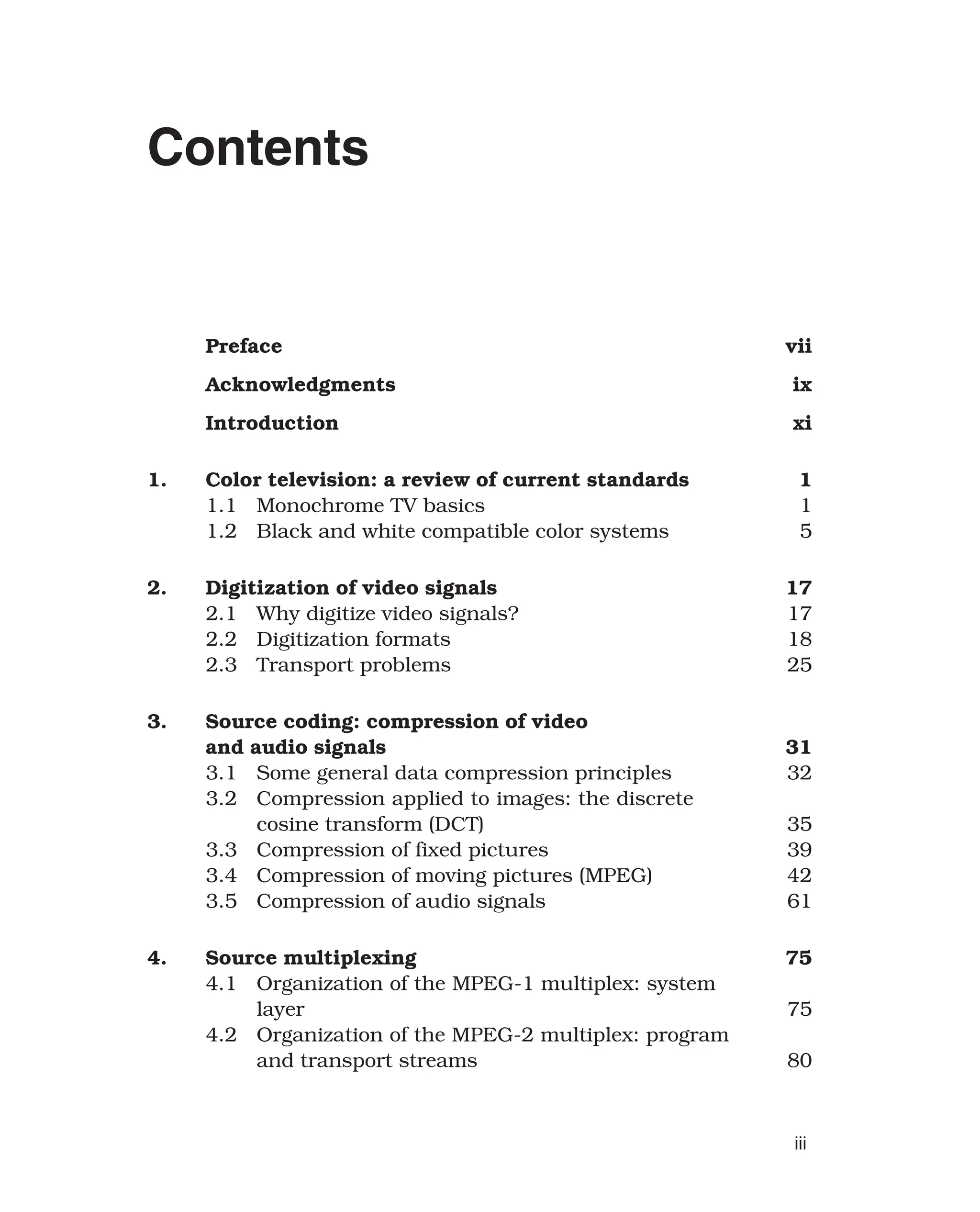
Contents
Preface vii
Acknowledgments ix
Introduction xi
1. Color television: a review of current standards 1
1.1 Monochrome TV basics 1
1.2 Black and white compatible color systems 5
2. Digitization of video signals 17
2.1 Why digitize video signals? 17
2.2 Digitization formats 18
2.3 Transport problems 25
3. Source coding: compression of video
and audio signals 31
3.1 Some general data compression principles 32
3.2 Compression applied to images: the discrete
cosine transform (DCT) 35
3.3 Compression of fixed pictures 39
3.4 Compression of moving pictures (MPEG) 42
3.5 Compression of audio signals 61
4. Source multiplexing 75
4.1 Organization of the MPEG-1 multiplex: system
layer 75
4.2 Organization of the MPEG-2 multiplex: program
and transport streams 80
iii
Contents
5. Scrambling and conditional access 97
5.1 Principles of the scrambling system in the DVB
standard 99
5.2 Conditional access mechanisms 101
5.3 Main conditional access systems 104
6. Channel coding (forward error correction) 105
6.1 Energy dispersal (randomizing) 106
6.2 Reed–Solomon coding (outer coding) 108
6.3 Forney convolutional interleaving (temporal
spreading of errors) 109
6.4 Convolutional coding (inner coding) 111
7. Modulation by digital signals 115
7.1 General discussion on the modulation of a carrier
by digital signals 116
7.2 Quadrature modulations 119
7.3 Modulation characteristics for cable and satellite
digital TV broadcasting (DVB-C and DVB-S) 121
7.4 OFDM modulation for terrestrial digital TV
(DVB-T) 129
7.5 Summary of DVB transmission characteristics
(cable, satellite, terrestrial) 139
8. Reception of digital TV signals 143
8.1 Global view of the transmission/reception
process 143
8.2 Composition of the integrated receiver
decoder (IRD) 145
9. Middleware and interoperability aspects 159
9.1 Main proprietary middlewares used
in Europe 163
9.2 The open European middlewares 167
iv
Contents
10. Evolution: state of the art and perspectives 173
10.1 Digital terrestrial television 173
10.2 Evolution of the set-top box 176
10.3 New architectures 179
10.4 High-Definition Television (HDTV) 183
10.5 Digital TV over IP 185
10.6 Digital terrestrial television for mobiles 193
Appendix A: Error detection and correction
in digital transmissions 199
A1.1 An error detecting code: the parity bit 199
A1.2 Block error correction codes 200
A1.3 Convolutional coding 205
Appendix B: Spectral efficiency of cable and
satellite transmissions with DVB parameters 209
Appendix C: The main other digital TV systems 213
C1.1 The DSS system (satellite, the United States) 213
C2.1 The ATSC system (terrestrial, the United States) 215
C3.1 The ISDB-T system (terrestrial, Japan) 217
Appendix D: The IEEE1394 high speed serial AV
interconnection bus 221
Appendix E: The DiSEqC bus for antenna
system control 225
E1.1 The DiSEqC levels 225
E2.1 DiSEqC basic principles 226
E3.1 Different fields of the DiSEqC message 229
Appendix F: The common interface (DVB-CI) 237
Appendix G: DVI and HDMI links for
interconnecting digital audiovisual equipment 241
Appendix H: Sample chipset for DVB
receivers/decoders 247
v
Contents
Glossary of abbreviations, words, and expressions 249
Abbreviations 249
Words and expressions 262
Bibliography 271
Books 271
Official documents (in English) 272
Press articles and other publications 274
Some useful Internet addresses 275
Index 277
vi
Preface
This book does not aim to make the reader an expert in digital
television (which the author himself is not). Rather, its purpose is
to describe and explain, as simply and as completely as possible,
the various aspects of the very complex problems that had to be
solved in order to define reliable standards for broadcasting digital
pictures to the consumer, and the solutions chosen for the European
DVB system (Digital Video Broadcasting) based on the international
MPEG-2 compression standard.
The book is intended for readers with a background in electronics
and some knowledge of conventional analog television (a reminder of
the basic principles of existing television standards is presented for
those who require it) and for those with a basic digital background.
The main goal is to enable readers to understand the principles of
this new technology, to have a relatively global perspective on it, and,
if they wish, to investigate further any particular aspect by reading
more specialized and more detailed books. At the end, there is a
short bibliography and a glossary of abbreviations and expressions
which will help readers to access some of these references.
For ease of understanding, after a general presentation of the prob-
lem, the order in which the main aspects of digital television broad-
cast standards are described follows the logical progression of the
signal processing steps on the transmitter side—from raw digitiza-
tion used in TV studios to source coding (MPEG-2 compression and
multiplexing), and on to channel coding (from forward error correc-
tion to RF modulation). JPEG and MPEG-1 “predecessor” standards
of MPEG-2 are also described, as MPEG-2 uses the same basic
principles.
vii
Preface
The book ends with a functional description of a digital IRD (inte-
grated receiver decoder), or set-top box, which the concepts dis-
cussed in preceding chapters will help to demystify, and with a
discussion of future prospects.
This third edition includes important updates, including discussion
of TV-over-IP, also known as IPTV or broadband TV (generally via
ADSL); high-definition television (HDTV); as well as TV for handheld
devices (DVB-H and its competitors).
This edition also introduces new standards for compression (MPEG-
4 part 10 AVC, also known as H.264) and transmission (DVB-S2,
DVB-H, DVB-IP, etc.), which are just beginning or will soon be used
by these new television applications.
H. Benoit
viii
Acknowledgments
I would like to thank all those who lent me their support in the
realization of this book, especially Philips Semiconductors labs for
their training and many of the figures illustrating this book; and
also the DVB Project Office, the EBU Technical Publication Service,
and the ETSI Infocentre for permission to reproduce the figures of
which they are the source.
ix
This page intentionally left blank
Introduction
At the end of the 1980s, the possibility of broadcasting fully digi-
tal pictures to the consumer was still seen as a faraway prospect,
and one that was definitely not technically or economically realistic
before the turn of the century. The main reason for this was the
very high bit-rate required for the transmission of digitized 525- or
625-line live video pictures (from 108 to 270 Mb/s without com-
pression). Another reason was that, at that time, it seemed more
urgent and important—at least in the eyes of some politicians and
technocrats—to improve the quality of the TV picture, and huge
amounts of money were invested by the three main world players
(first Japan, then Europe, and finally the U.S.A.) in order to develop
Improved Definition TeleVision (IDTV) and High Definition TeleVi-
sion systems (HDTV), with vertical resolutions from 750 lines for
IDTV to 1125 or 1250 lines for HDTV.
Simply digitized, HDTV pictures would have required bit-rates that
were four times higher than “conventional” pictures, of the order of
up to one gigabit per second! This is why most of the HDTV pro-
posals (MUSE in Japan, HD-MAC in Europe, and the first American
HD proposals) were at that time defined as analog systems with a
digital assistance which can be seen as a prelude to fully digital
compression.
However, by the beginning of the 1990s, the situation had com-
pletely changed. Very quick development of efficient compression
algorithms, resulting in, among other things, the JPEG standard
for fixed images and later the MPEG standard for moving pictures,
showed the possibility to drastically reduce the amount of data
required for the transmission of digital pictures (bit-rates from 1.5
to 30 Mb/s depending on the resolution chosen and the picture
content).
xi
Introduction
At the same time, continuous progress in IC technology allowed
the realization, at an affordable price, of the complex chips and
associated memory required for decompression of digital pictures.
In addition, it appeared that the price of an HDTV receiver would not
quickly reach a level affordable by most consumers, not so much
due to the electronics cost, but mainly because of the very high cost
of the display, regardless of the technology used (big 16/9 tube,
LCD projector, or any other known technology). Furthermore, most
consumers seemed more interested in the content and the number
of programs offered than in an improvement in the picture quality,
and economic crises in most countries resulted in a demand for
“brown goods” oriented more toward the cheaper end of the market.
Mainly on the initiative of the U.S. industry, which could take advan-
tage of its traditional predominance in digital data processing to
regain influence in the electronic consumer goods market, stud-
ies have been reoriented toward the definition of systems allowing
diffusion of digital pictures with equivalent or slightly better qual-
ity than current analog standards, but with many other features
made possible by complete digitization of the signal. The first digital
TV broadcasting for the consumer started in mid-1994 with the
“DirecTV” project, and its success was immediate, resulting in more
than one million subscribers after one year.
However, the Europeans had not gone to sleep—they decided at
the end of 1991 to stop working on analog HDTV (HD-MAC), and
xii
Introduction
created the European Launching Group (ELG) in order to define
and standardize a digital TV broadcasting system. This gave birth in
1993 to the DVB project (Digital Video Broadcasting), based on the
“main profile at main level” (MP@ML) of the international MPEG-2
compression standard.
MPEG-2 is downward-compatible with MPEG-1 and has provisions
for a compatible evolution toward HDTV by using higher levels and
profiles. This resulted in the standardization of three variants for
the various transmission media—satellite (DVB-S), cable (DVB-C),
and terrestrial (DVB-T)—which occurred between 1994 and 1996.
In Europe, the first commercial digital broadcasts were started by
Canal+ on Astra 1 in 1996, shortly followed by TPS and AB-Sat on
Eutelsat’s “Hot Birds.”
It is, however, the Sky group of bouquets—despite having started
digital transmissions on Astra 2 only at the end of 1998 in the United
Kingdom—which has by far the biggest number of subscribers in
Europe (around 10 million at the end of 2005). In addition to BSkyB
in the United Kingdom, the group has included Sky Italia since 2002,
thanks to the acquisition and development of the former Canal+
Italia.
In the last years of the twentieth century, other forms of digital tele-
vision appeared: digital cable television, digital terrestrial television,
and, more recently, digital television via the telephone subscriber
line (IPTV over ADSL). These developments will bring about the
extinction of analog television in Europe around the end of the first
decade of the twenty-first century, with the pace of the transition
from analog to digital varying by country.
On the other hand, the rapid price decrease of large flat-screen
TVs (LCD or Plasma) with a resolution compatible with HDTV
requirements makes them now accessible to a relatively large pub-
lic. This price drop coincides with the availability of more effective
xiii
Introduction
compression standards (such as MPEG-4 AVC/H.264), which will,
finally, enable real wide-scale development of HDTV in Europe.
Last but not least, the ever-increasing sophistication of mobile
phones—most of them equipped with color screens of relatively
big size and high resolution—and the development of transmis-
sion standards adapted to mobility (DVB-H, T-DMB, ISDB-T,
MediaFlo™
) promise the development of a personal television that
is transportable virtually everywhere.
xiv
Color television:
a review of current
standards
1
Let us begin with a bit of history 
1.1 Monochrome TV basics
It should be borne in mind that all current TV standards in use
today are derived from the “black and white” TV standards started
in the 1940s and 1950s, which have defined their framework.
The first attempts at electromechanical television began at the end
of the 1920s, using the Nipkow disk for analysis and reproduction
of the scene to be televised, with a definition of 30 lines and 12.5
images per second. This low definition resulted in a video bandwidth
of less than 10 kHz, allowing these pictures to be broadcast on an
ordinary AM/MW or LW transmitter. The resolution soon improved
to 60, 90, and 120 lines and then stabilized for a while on 180
lines (Germany, France) or 240 lines (England, the United States)
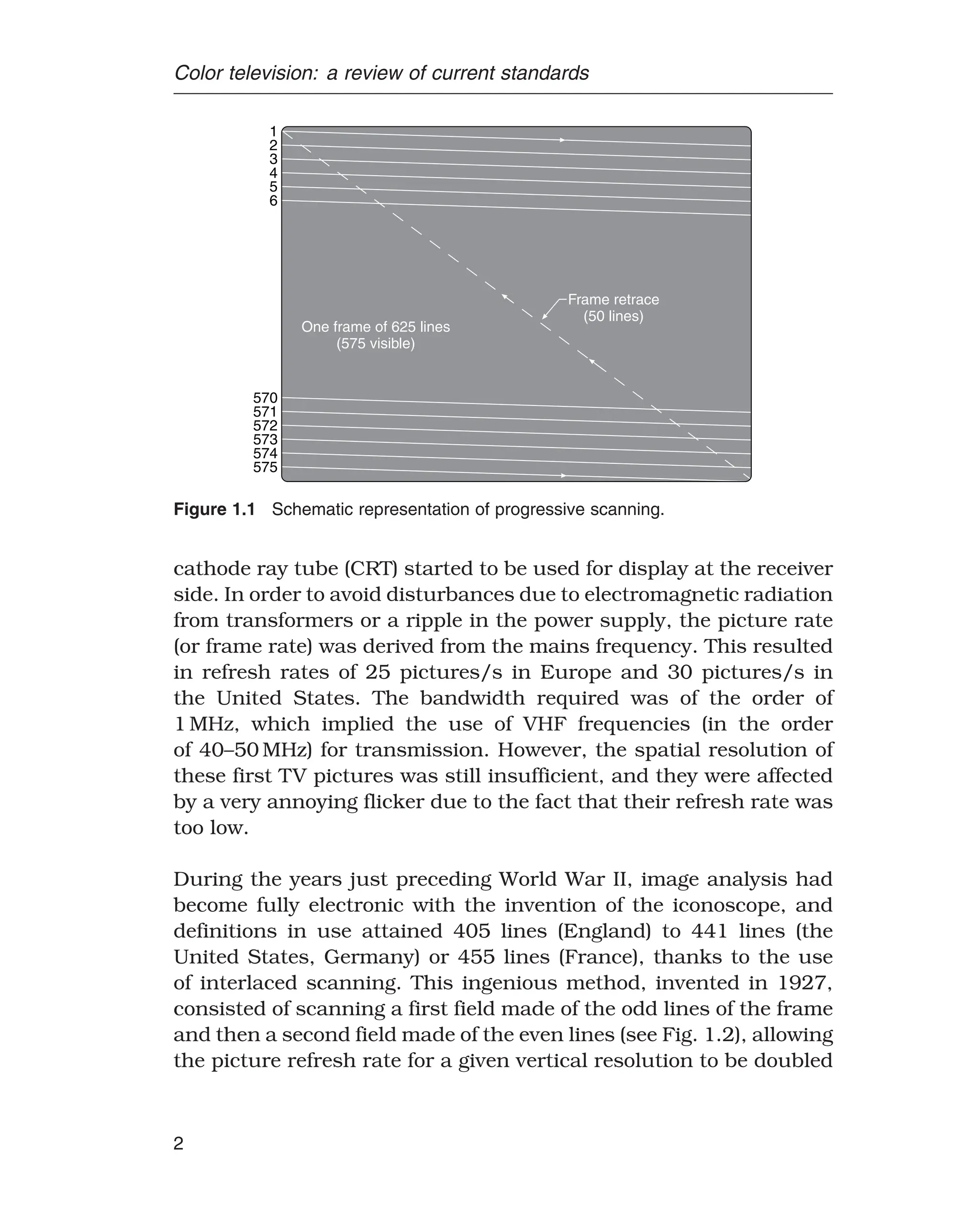
around 1935. Scanning was progressive, which means that all lines
of the pictures were scanned sequentially in one frame, as depicted
in Figure 1.1 (numbered here for a 625-line system).
These definitions, used for the first “regular” broadcasts, were the
practical limit for the Nipkow disk used for picture analysis; the
1
Color television: a review of current standards
One frame of 625 lines
(575 visible)
Frame retrace
(50 lines)
1
2
3
4
5
6
570
571
572
573
574
575
Figure 1.1 Schematic representation of progressive scanning.
cathode ray tube (CRT) started to be used for display at the receiver
side. In order to avoid disturbances due to electromagnetic radiation
from transformers or a ripple in the power supply, the picture rate
(or frame rate) was derived from the mains frequency. This resulted
in refresh rates of 25 pictures/s in Europe and 30 pictures/s in
the United States. The bandwidth required was of the order of
1 MHz, which implied the use of VHF frequencies (in the order
of 40–50 MHz) for transmission. However, the spatial resolution of
these first TV pictures was still insufficient, and they were affected
by a very annoying flicker due to the fact that their refresh rate was
too low.
During the years just preceding World War II, image analysis had
become fully electronic with the invention of the iconoscope, and
definitions in use attained 405 lines (England) to 441 lines (the
United States, Germany) or 455 lines (France), thanks to the use
of interlaced scanning. This ingenious method, invented in 1927,
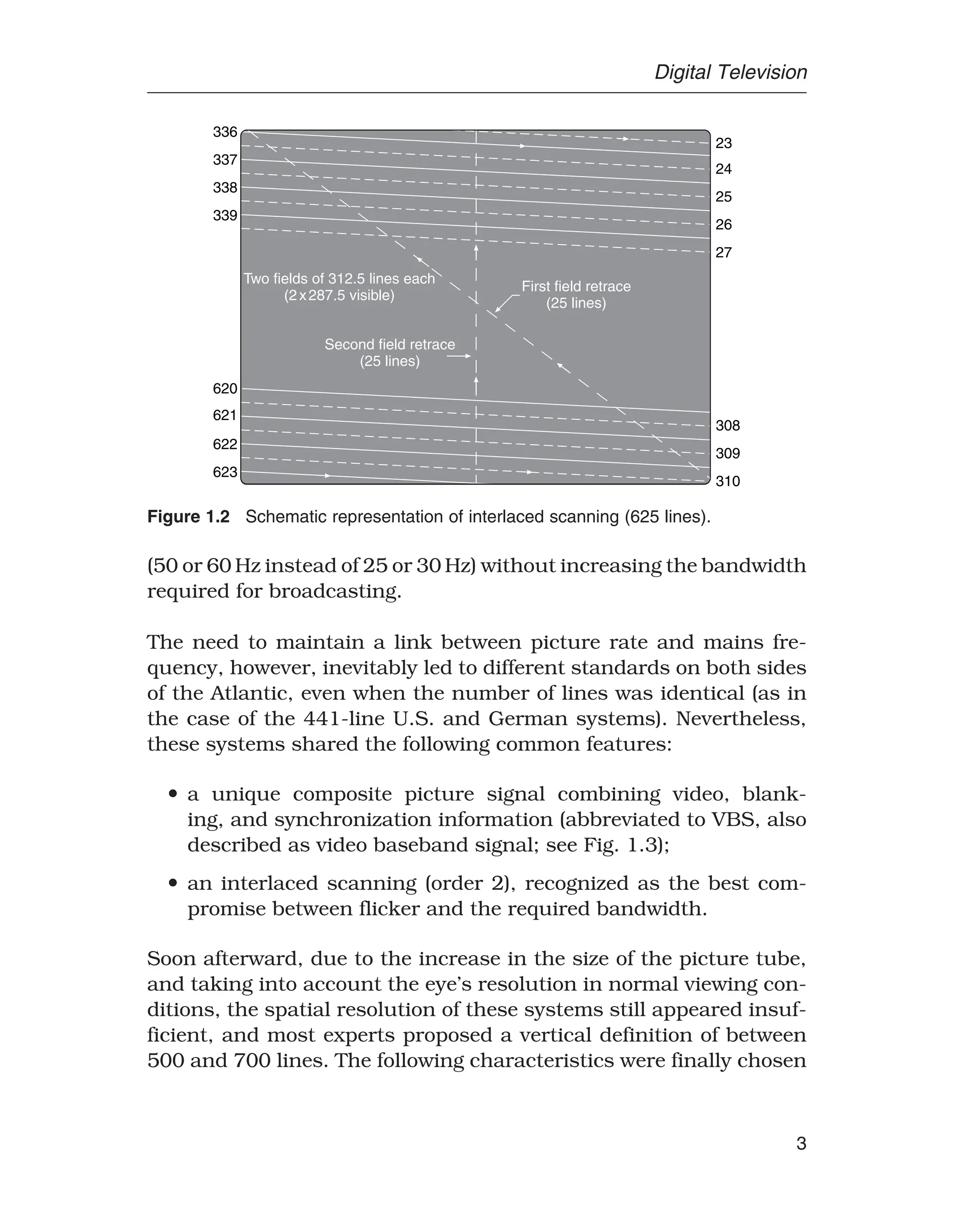
consisted of scanning a first field made of the odd lines of the frame
and then a second field made of the even lines (see Fig. 1.2), allowing
the picture refresh rate for a given vertical resolution to be doubled
2
Digital Television
Two fields of 312.5 lines each
(2x287.5 visible)
First field retrace
(25 lines)
336
337
338
339
620
621
622
623
Second field retrace
(25 lines)
23
24
25
27
308
309
310
26
Figure 1.2 Schematic representation of interlaced scanning (625 lines).
(50 or 60 Hz instead of 25 or 30 Hz) without increasing the bandwidth
required for broadcasting.
The need to maintain a link between picture rate and mains fre-
quency, however, inevitably led to different standards on both sides
of the Atlantic, even when the number of lines was identical (as in
the case of the 441-line U.S. and German systems). Nevertheless,
these systems shared the following common features:
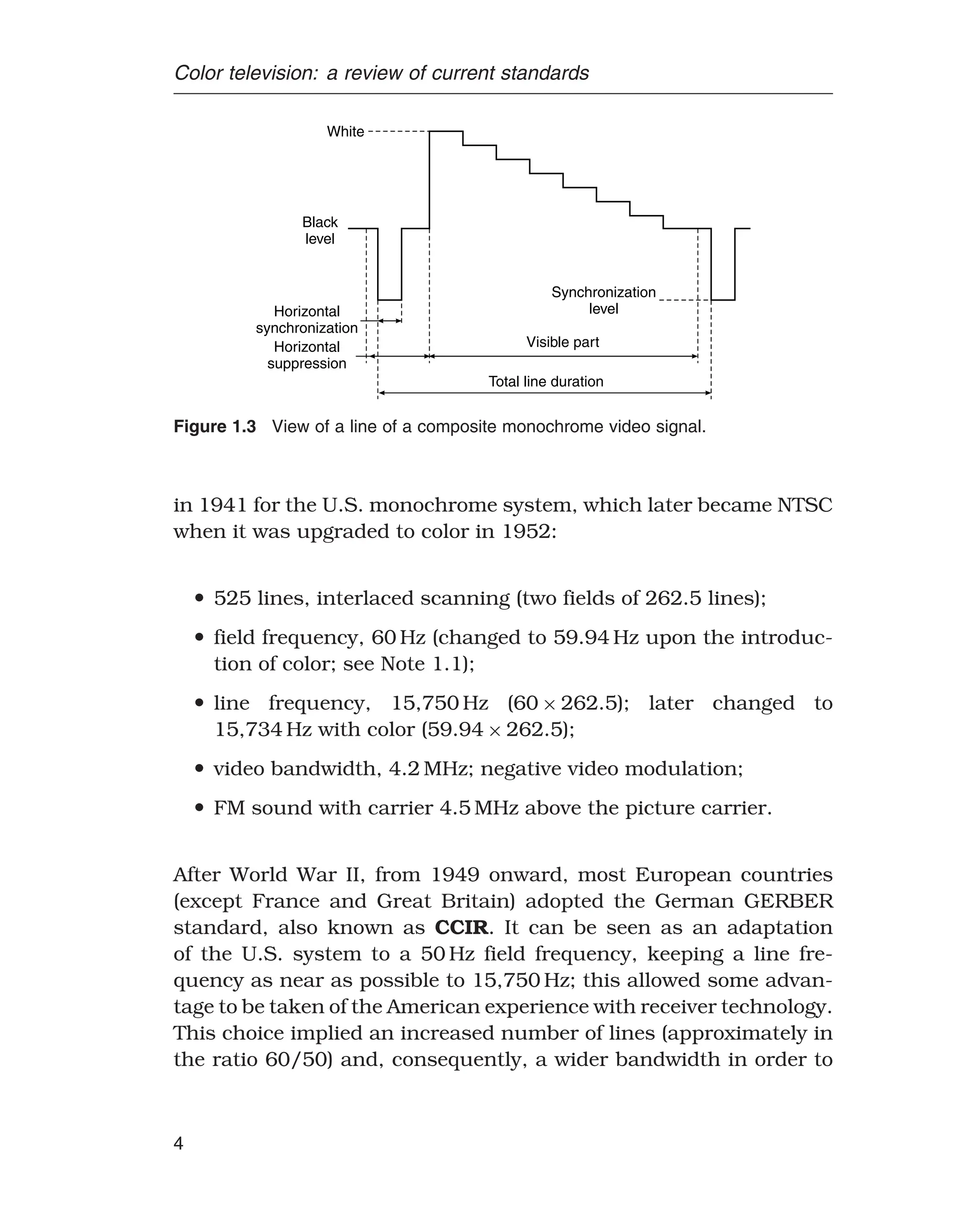
• a unique composite picture signal combining video, blank-
ing, and synchronization information (abbreviated to VBS, also
described as video baseband signal; see Fig. 1.3);
• an interlaced scanning (order 2), recognized as the best com-
promise between flicker and the required bandwidth.
Soon afterward, due to the increase in the size of the picture tube,
and taking into account the eye’s resolution in normal viewing con-
ditions, the spatial resolution of these systems still appeared insuf-
ficient, and most experts proposed a vertical definition of between
500 and 700 lines. The following characteristics were finally chosen
3
Color television: a review of current standards
White
Black
level
Horizontal
synchronization
Horizontal
suppression
Synchronization
level
Visible part
Total line duration
Figure 1.3 View of a line of a composite monochrome video signal.
in 1941 for the U.S. monochrome system, which later became NTSC
when it was upgraded to color in 1952:
• 525 lines, interlaced scanning (two fields of 262.5 lines);
• field frequency, 60 Hz (changed to 59.94 Hz upon the introduc-
tion of color; see Note 1.1);
• line frequency, 15,750 Hz (60 × 262.5); later changed to
15,734 Hz with color (59.94 × 262.5);
• video bandwidth, 4.2 MHz; negative video modulation;
• FM sound with carrier 4.5 MHz above the picture carrier.
After World War II, from 1949 onward, most European countries
(except France and Great Britain) adopted the German GERBER
standard, also known as CCIR. It can be seen as an adaptation
of the U.S. system to a 50 Hz field frequency, keeping a line fre-
quency as near as possible to 15,750 Hz; this allowed some advan-
tage to be taken of the American experience with receiver technology.
This choice implied an increased number of lines (approximately in
the ratio 60/50) and, consequently, a wider bandwidth in order to
4
Digital Television
obtain well-balanced horizontal and vertical resolutions. The follow-
ing characteristics were defined:
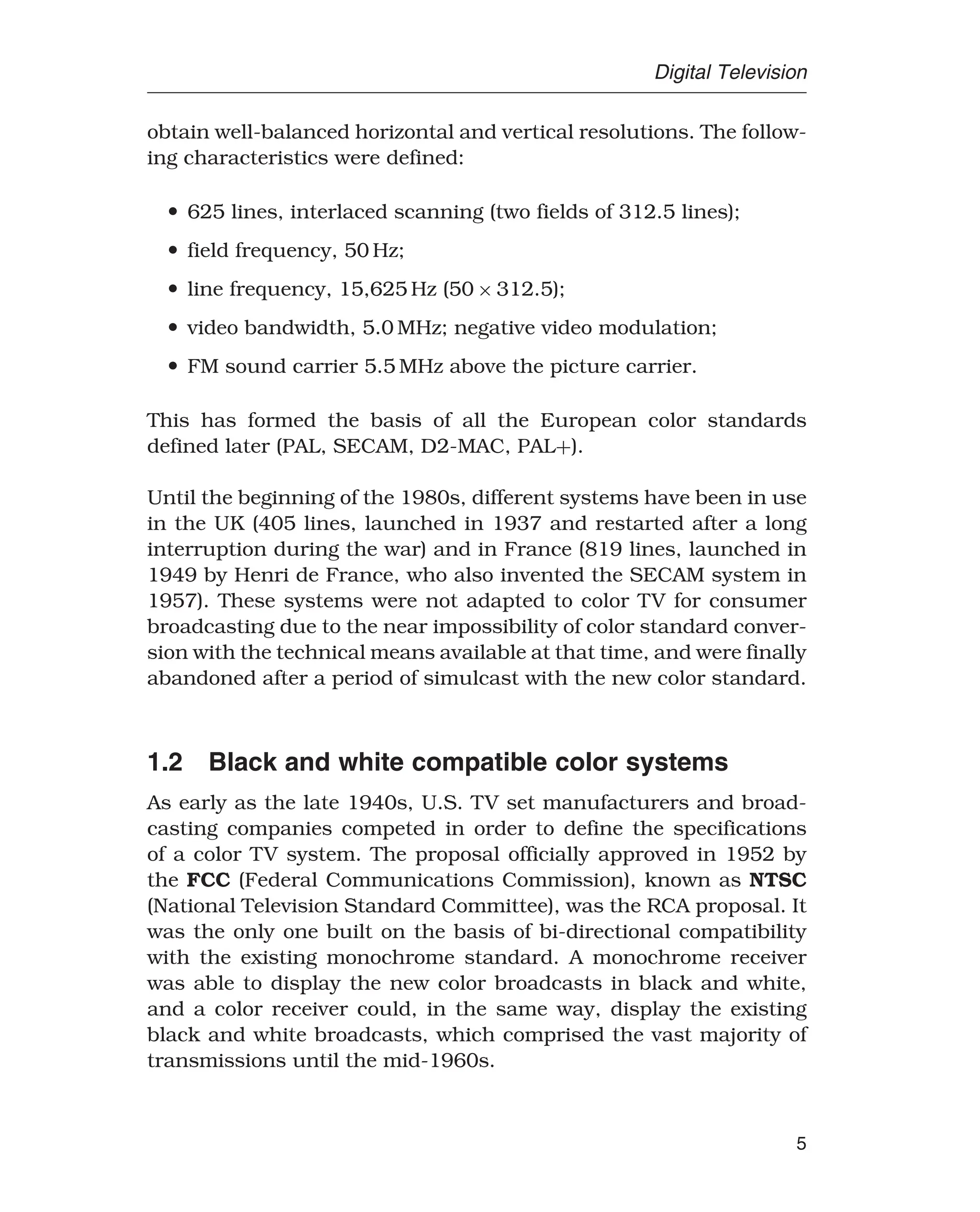
• 625 lines, interlaced scanning (two fields of 312.5 lines);
• field frequency, 50 Hz;
• line frequency, 15,625 Hz (50 × 312.5);
• video bandwidth, 5.0 MHz; negative video modulation;
• FM sound carrier 5.5 MHz above the picture carrier.
This has formed the basis of all the European color standards
defined later (PAL, SECAM, D2-MAC, PAL+).
Until the beginning of the 1980s, different systems have been in use
in the UK (405 lines, launched in 1937 and restarted after a long
interruption during the war) and in France (819 lines, launched in
1949 by Henri de France, who also invented the SECAM system in
1957). These systems were not adapted to color TV for consumer
broadcasting due to the near impossibility of color standard conver-
sion with the technical means available at that time, and were finally
abandoned after a period of simulcast with the new color standard.
1.2 Black and white compatible color systems
As early as the late 1940s, U.S. TV set manufacturers and broad-
casting companies competed in order to define the specifications
of a color TV system. The proposal officially approved in 1952 by
the FCC (Federal Communications Commission), known as NTSC
(National Television Standard Committee), was the RCA proposal. It
was the only one built on the basis of bi-directional compatibility
with the existing monochrome standard. A monochrome receiver
was able to display the new color broadcasts in black and white,
and a color receiver could, in the same way, display the existing
black and white broadcasts, which comprised the vast majority of
transmissions until the mid-1960s.
5
Color television: a review of current standards
In Europe, official color broadcasts started more than 10 years later,
in 1967, with SECAM (séquentiel couleur à mémoire) and PAL (phase
alternating line) systems.
Extensive preliminary studies on color perception and a great deal
of ingenuity were required to define these standards which, despite
their imperfections, still satisfy most of the end users more than
40 years after the first of them, NTSC, came into being. The triple
red/green/blue (RGB) signals delivered by the TV camera had to
be transformed into a signal which, on the one hand, could be
displayable without major artifacts on current black and white
receivers, and on the other hand could be transmitted in the band-
width of an existing TV channel—definitely not a simple task.
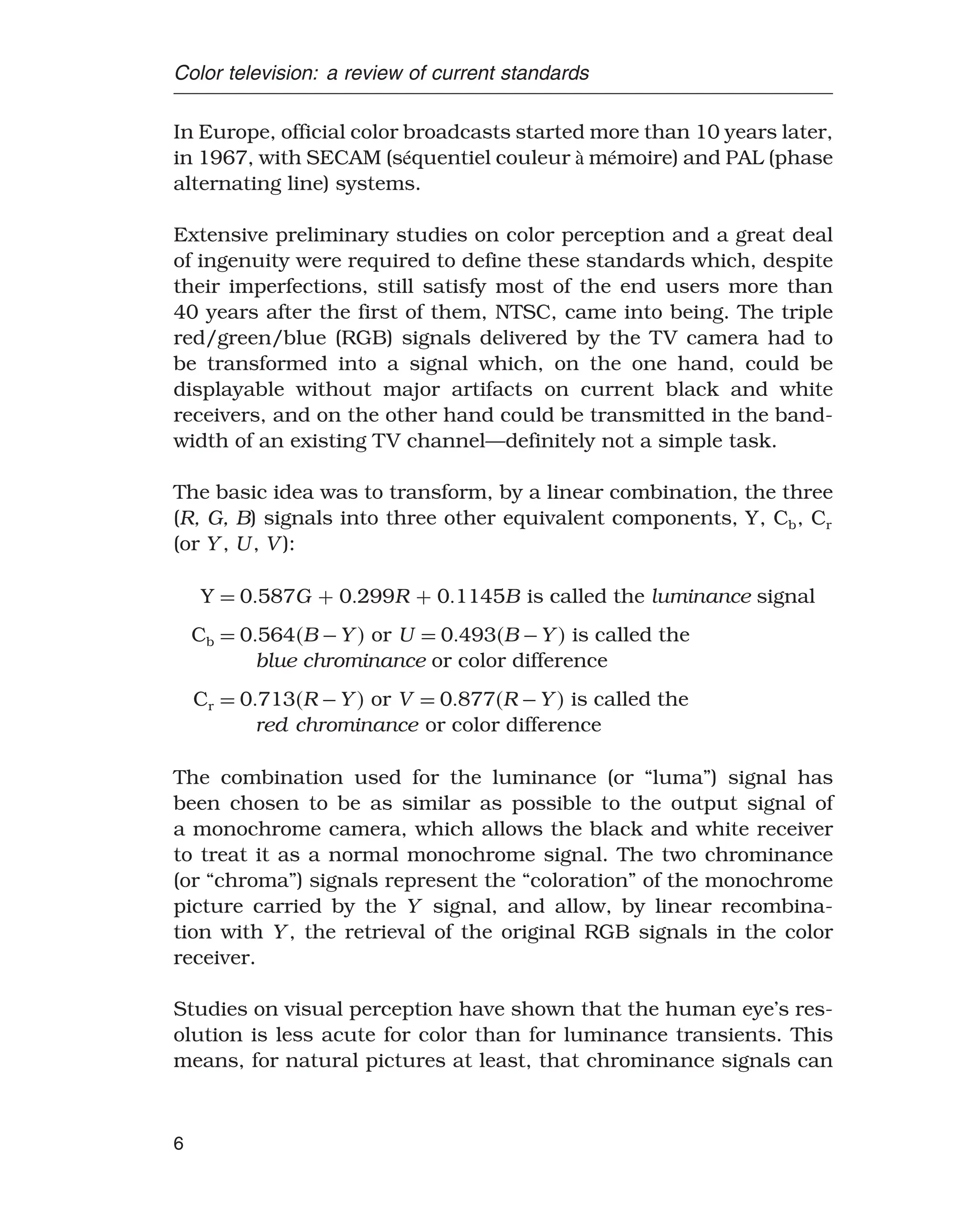
The basic idea was to transform, by a linear combination, the three
(R, G, B) signals into three other equivalent components, Y, Cb, Cr
(or Y , U , V ):
Y = 0587G + 0299R + 01145B is called the luminance signal
Cb = 0564B −Y  or U = 0493B −Y  is called the
blue chrominance or color difference
Cr = 0713R −Y  or V = 0877R −Y  is called the
red chrominance or color difference
The combination used for the luminance (or “luma”) signal has
been chosen to be as similar as possible to the output signal of
a monochrome camera, which allows the black and white receiver
to treat it as a normal monochrome signal. The two chrominance
(or “chroma”) signals represent the “coloration” of the monochrome
picture carried by the Y signal, and allow, by linear recombina-
tion with Y , the retrieval of the original RGB signals in the color
receiver.
Studies on visual perception have shown that the human eye’s res-
olution is less acute for color than for luminance transients. This
means, for natural pictures at least, that chrominance signals can
6
Digital Television
tolerate a strongly reduced bandwidth (one-half to one-quarter of
the luminance bandwidth), which will prove very useful for putting
the chrominance signals within the existing video spectrum. The Y,
Cb, Cr combination is the common point to all color TV systems,
including the newest digital standards, which seems to prove that
the choices of the color TV pioneers were not so bad!
In order to be able to transport these three signals in an existing TV
channel (6 MHz in the United States, 7 or 8 MHz in Europe), a subcar-
rier was added within the video spectrum, modulated by the reduced
bandwidth chrominance signals, thus giving a new composite signal
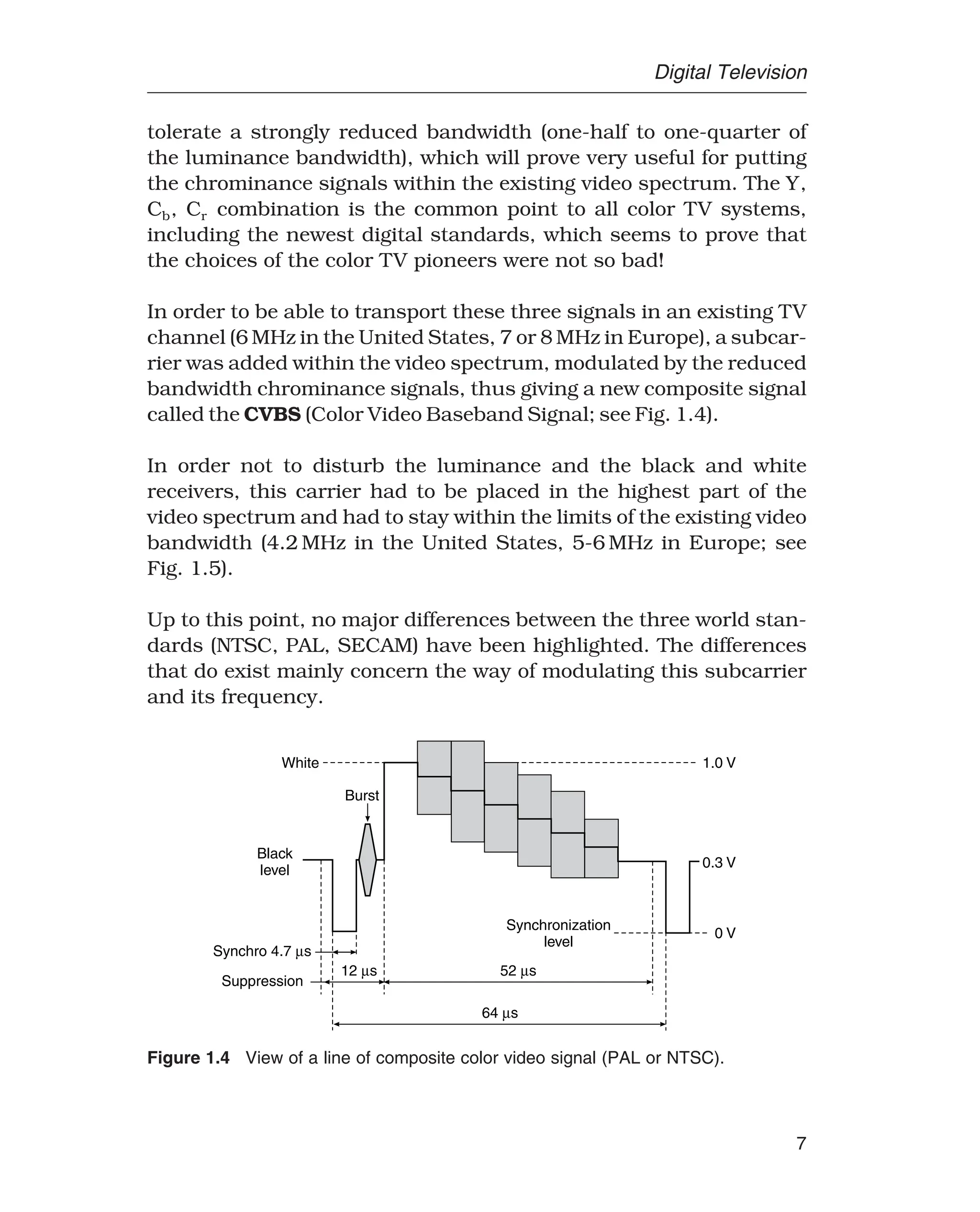
called the CVBS (Color Video Baseband Signal; see Fig. 1.4).
In order not to disturb the luminance and the black and white
receivers, this carrier had to be placed in the highest part of the
video spectrum and had to stay within the limits of the existing video
bandwidth (4.2 MHz in the United States, 5-6 MHz in Europe; see
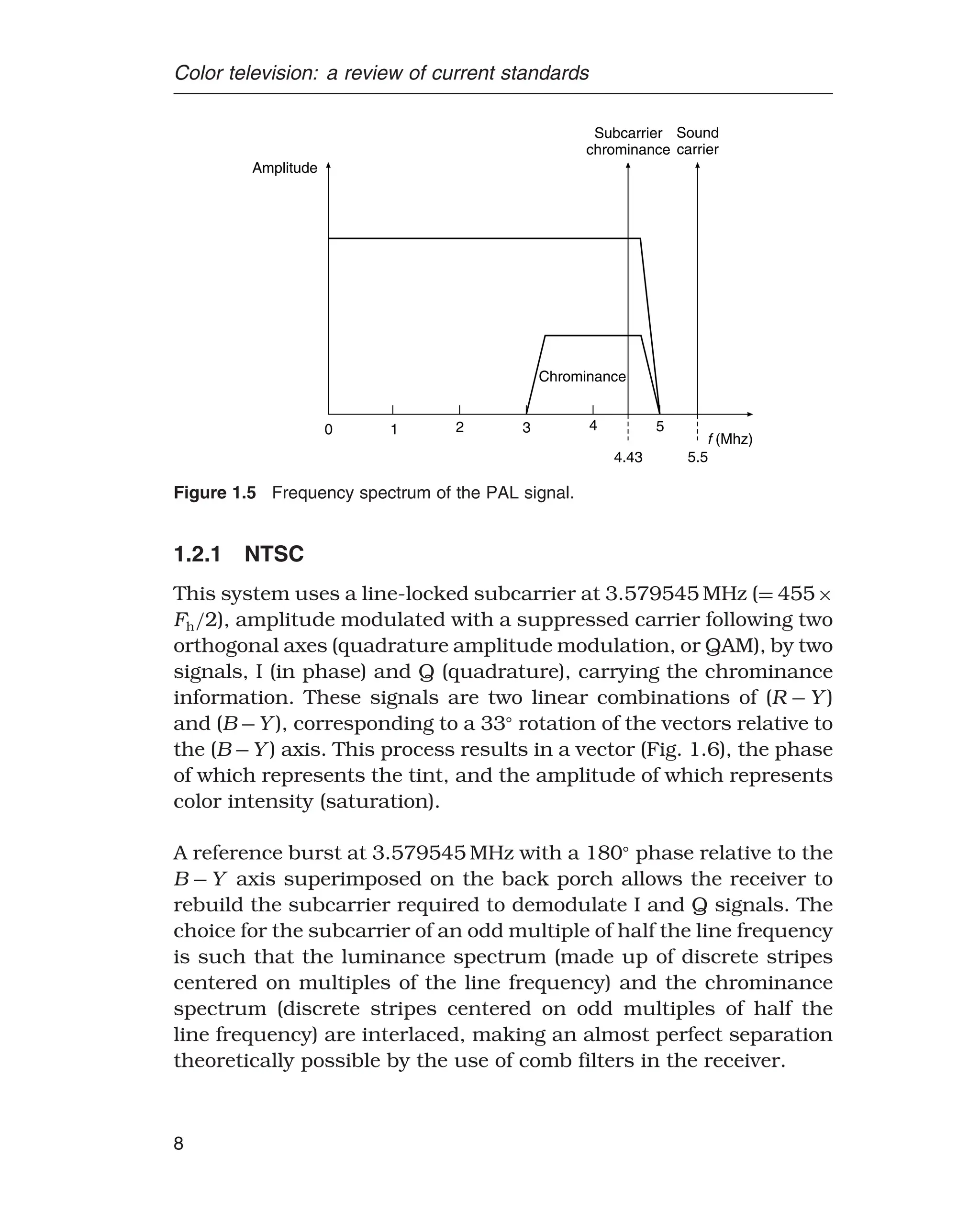
Fig. 1.5).
Up to this point, no major differences between the three world stan-
dards (NTSC, PAL, SECAM) have been highlighted. The differences
that do exist mainly concern the way of modulating this subcarrier
and its frequency.
White
Black
level
Synchro 4.7 s
μ
Suppression
Synchronization
level
52 s
μ
64 s
μ
12 s
μ
1.0 V
0.3 V
0 V
Burst
Figure 1.4 View of a line of composite color video signal (PAL or NTSC).
7
Color television: a review of current standards
Amplitude
Subcarrier
chrominance
Sound
carrier
Chrominance
0 1 2 3 4 5
4.43 5.5
f (Mhz)
Figure 1.5 Frequency spectrum of the PAL signal.
1.2.1 NTSC
This system uses a line-locked subcarrier at 3.579545 MHz (= 455×
Fh/2), amplitude modulated with a suppressed carrier following two
orthogonal axes (quadrature amplitude modulation, or QAM), by two
signals, I (in phase) and Q (quadrature), carrying the chrominance
information. These signals are two linear combinations of (R − Y )
and (B −Y ), corresponding to a 33
rotation of the vectors relative to
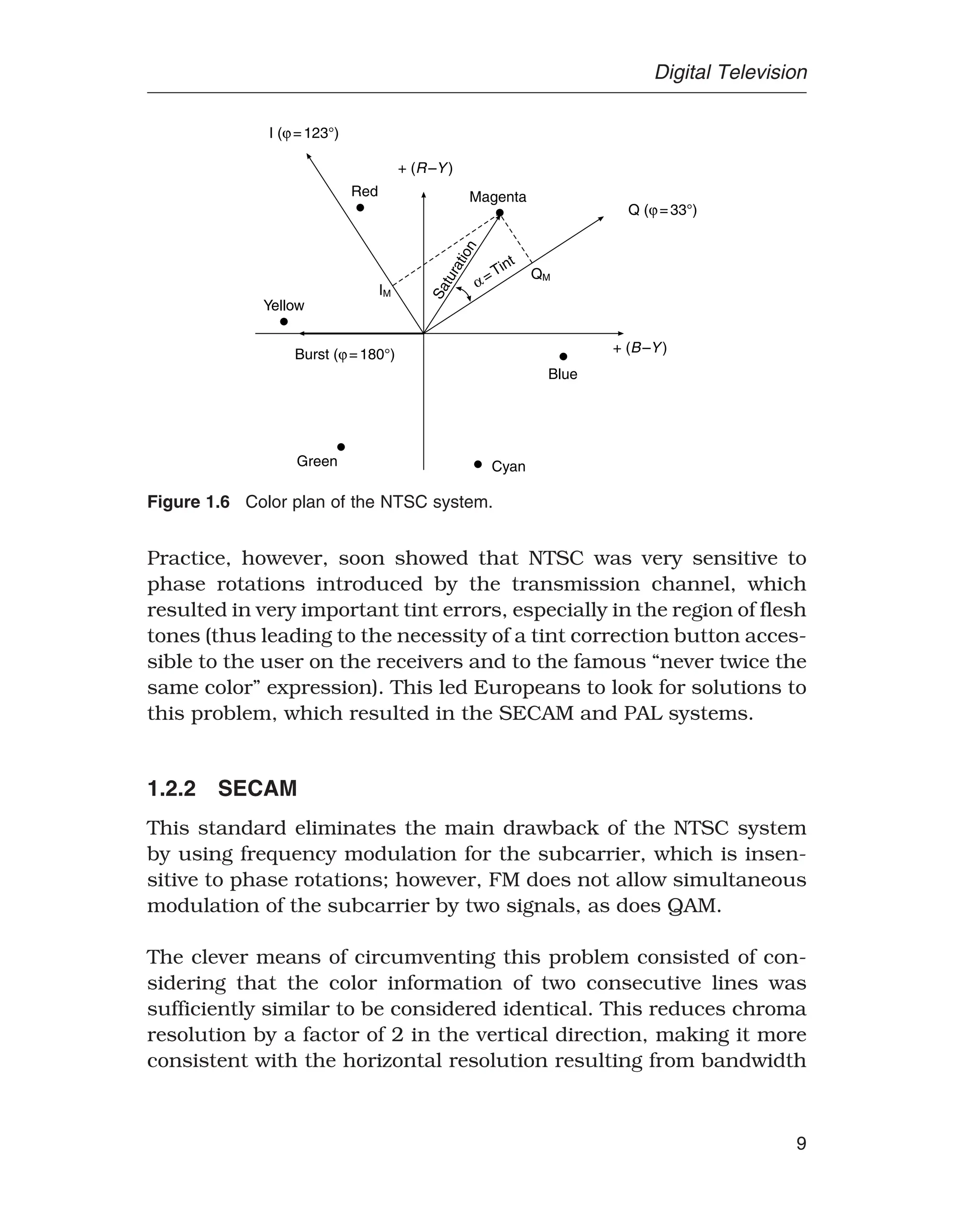
the (B −Y ) axis. This process results in a vector (Fig. 1.6), the phase
of which represents the tint, and the amplitude of which represents
color intensity (saturation).
A reference burst at 3.579545 MHz with a 180
phase relative to the
B − Y axis superimposed on the back porch allows the receiver to
rebuild the subcarrier required to demodulate I and Q signals. The
choice for the subcarrier of an odd multiple of half the line frequency
is such that the luminance spectrum (made up of discrete stripes
centered on multiples of the line frequency) and the chrominance
spectrum (discrete stripes centered on odd multiples of half the
line frequency) are interlaced, making an almost perfect separation
theoretically possible by the use of comb filters in the receiver.
8
Digital Television
I ( =123°)
ϕ
+ ( – )
R Y
Red Magenta
IM
QM
Q ( =33°)
ϕ
Burst ( =180°)
ϕ
Yellow
Blue
+ ( – )
B Y
Green Cyan
S
a
t
u
r
a
t
i
o
n
α=Tint
Figure 1.6 Color plan of the NTSC system.
Practice, however, soon showed that NTSC was very sensitive to
phase rotations introduced by the transmission channel, which
resulted in very important tint errors, especially in the region of flesh
tones (thus leading to the necessity of a tint correction button acces-
sible to the user on the receivers and to the famous “never twice the
same color” expression). This led Europeans to look for solutions to
this problem, which resulted in the SECAM and PAL systems.
1.2.2 SECAM
This standard eliminates the main drawback of the NTSC system
by using frequency modulation for the subcarrier, which is insen-
sitive to phase rotations; however, FM does not allow simultaneous
modulation of the subcarrier by two signals, as does QAM.
The clever means of circumventing this problem consisted of con-
sidering that the color information of two consecutive lines was
sufficiently similar to be considered identical. This reduces chroma
resolution by a factor of 2 in the vertical direction, making it more
consistent with the horizontal resolution resulting from bandwidth
9
Color television: a review of current standards
reduction of the chroma signals. Therefore, it is possible to transmit
alternately one chrominance component, D
b = 15(B −Y ), on one line
and the other, D
r = −19(R −Y ), on the next line. It is then up to the
receiver to recover the two D
b and D
r signals simultaneously, which
can be done by means of a 64 s delay line (one line duration) and
a permutator circuit. Subcarrier frequencies chosen are 4.250 MHz
(= 272×Fh) for the line carrying D
b and 4.406250 MHz (= 282×Fh)
for D
r.
This system is very robust, and gives a very accurate tint reproduc-
tion, but it has some drawbacks due to the frequency modulation—
the subcarrier is always present, even in non-colored parts of the
pictures, making it more visible than in NTSC or PAL on black and
white, and the continuous nature of the FM spectrum does not allow
an efficient comb filtering; rendition of sharp transients between
highly saturated colors is not optimum due to the necessary trun-
cation of maximum FM deviation. In addition, direct mixing of two
or more SECAM signals is not possible.
1.2.3 PAL
This is a close relative of the NTSC system, whose main draw-
back it corrects. It uses a line-locked subcarrier at 4.433619 MHz
(= 1135/4+1/625×Fh), which is QAM modulated by the two color
difference signals U = 0493 (B −Y ) and V = 0877 (R −Y ). In order
to avoid drawbacks due to phase rotations, the phase of the V car-
rier is inverted every second line, which allows cancellation of phase
rotations in the receiver by adding the V signal from two consecutive
lines by means of a 64 s delay line (using the same assumption
as in SECAM, that two consecutive lines can be considered identi-
cal). In order to synchronize the V demodulator, the phase of the
reference burst is alternated from line to line between +135
and
−135
compared to the U vector (0
).
Other features of PAL are very similar to NTSC. In addition to the
main PAL standard (sometimes called PAL B/G), there are two other
10
Digital Television
less well-known variants used in South America in order to accom-
modate the 6 MHz channels taken from NTSC:
• PAL M used in Brazil (525 lines/59.94 Hz, subcarrier at
3.575611 MHz);
• PAL N used in Argentina (625 lines/50 Hz, subcarrier at
3.582056 MHz).
1.2.4 MAC (multiplexed analog components)
During the 1980s, Europeans attempted to define a common stan-
dard for satellite broadcasts, with the goal of improving picture
and sound quality by eliminating drawbacks of composite systems
(cross-color, cross-luminance, reduced bandwidth) and by using
digital sound. This resulted in the MAC systems, with a compatible
extension toward HDTV (called HD-MAC).
D2-MAC is the most well-known of these hybrid systems, even if it
did not achieve its expected success due to its late introduction and
an earlier development of digital TV than anticipated. It replaces fre-
quency division multiplexing of luminance, chrominance, and sound
(bandwidth sharing) of composite standards by a time division mul-
tiplexing (time sharing). It is designed to be compatible with normal
(4:3) and wide-screen (16:9) formats and can be considered in some
aspects an intermediate step on the route to all-digital TV signal
transmission.
On the transmitter side, after sampling (Note 1.2) and analog-to-
digital conversion, Y, Cb and Cr signals are time-compressed by a
factor of 2/3 for Y and 1/3 for Cb and Cr, scrambled if required,
and then reconverted into analog form in order to be transmitted
sequentially over one line duration (see Fig. 1.7 illustrating one
line of a D2-MAC signal). The part of the line usually occupied by
synchronization and blanking is replaced by a burst of so-called
duobinary data (hence the “D2” in D2-MAC). These data carry the
digital sound, synchronization, and other information such as tele-
text, captioning, and picture format (4:3 or 16:9), and in addition,
11
Color television: a review of current standards
0.5 V
0.4 V
0.4 V
0.5 V
0.5 V
0.5 V
0.5 V
Reference
level
Clamp
period
Sound and
data
Chrominance
( or )
U V
Luminance
Y
64 s
μ
Figure 1.7 Composition of a line of a D2-MAC signal.
for pay TV programs, they carry the access control messages of the
Eurocrypt system used with D2-MAC.
As in SECAM, Cb and Cr chroma components are transmitted alter-
nately from line to line in order to reduce the necessary bandwidth
and obtain equivalent resolutions along the two axes of the picture
for the chrominance. This resolution corresponds to the so-called
4:2:0 format (see Section 2.2.2, p. 21); it is almost equivalent to
the professional 4:2:2 format used in TV studios. Time division
multiplexing results in the total elimination of cross-color and cross-
luminance effects, and in a luminance bandwidth of 5 MHz, a sub-
stantial improvement compared with PAL or SECAM.
1.2.5 PAL+
This is a recent development, the primary objective of which was to
allow terrestrial transmission of improved definition 16:9 pictures
(on appropriate receivers) in a compatible way with existing 4/3 PAL
receivers (Note 1.3). To do this, the PAL+ encoder transforms the
576 useful lines of a 16:9 picture into a 4:3 picture in letterbox
format (a format often used for the transmission of films on TV,
with two horizontal black stripes above and below the picture). The
12
Digital Television
visible part occupies only 432 lines (576 × 3/4) on a 4/3 receiver,
and additional information for the PAL+ receiver is encoded in the
remaining 144 lines.
The 432-line letterbox picture is obtained by vertical low-pass fil-
tering of the original 576 lines, and the complementary high-pass
filtering is transmitted on the 4.43 MHz subcarrier during the 144
black lines, which permits the PAL+ receiver to reconstruct a full-
screen 16/9 high resolution picture.
In order to obtain the maximum bandwidth for luminance (5 MHz)
and to reduce cross-color and cross-luminance, the phase of
the subcarrier of the two interlaced lines of consecutive fields is
reversed. This process, known as “colorplus,” allows (by means of
a frame memory in the receiver) cancellation of cross-luminance by
adding the high part of the spectrum of two consecutive frames, and
reduction of cross-color by subtracting them.
A movement compensation is required to avoid artifacts introduced
by the colorplus process on fast moving objects, which, added to
the need for a frame memory, contributes to the relatively high cost
of current PAL+ receivers. The PAL+ system results in a subjective
quality equivalent to D2-MAC on a 16:9 receiver in good reception
conditions (high signal/noise ratio).
In order to inform the receiver of the format of the program being
broadcast (4:3 or 16:9), signalling bits (WSS: wide screen signalling)
and additional information (sound mode, etc.) are added to the first
half of line 23 (Fig. 1.8), which permits the receiver to adapt its dis-
play format. The WSS signal can also be used by ordinary PAL 16/9
receivers simply to modify the vertical amplitude according to the
format, which is sometimes referred to as the “poor man’s PAL+.”
After this introduction (hopefully not too lengthy), we will now
attempt to describe as simply as possible the principles which have
allowed the establishment of new all-digital television standards and
services.
13
Color television: a review of current standards
PAL
burst
0.5 V
Video
Clock reference
+14 information bits
27.4 s
μ
44.5 s
μ 19.5 s
μ
11 s
μ
Figure 1.8 View of line 23 of a PAL+ signal (WSS bits).
Note 1.1
This slight change in line and field frequencies was introduced
in order to minimize the visual effect of beat frequency between
sound (4.50 MHz) and color (3.58 MHz) subcarriers in the
receiver. This change was done by using the sound intercarrier
as a reference for the line frequency
15734 = 4500000/286
Note 1.2
D2-MAC is based on the 4:2:0 digital format (720 points/line
for Y and 360 for Cb and Cr), but for practical reasons, these
numbers had to be slightly reduced to 700 and 350, respec-
tively. This is due to the fact that the duration of 720 samples
at 13.5 MHz (53.33 s) is more than the useful part of the analog
video line (52 s), which could disturb clamping circuits in the
receiver.
14
Digital Television
Note 1.3
PAL+ development took place between 1990 and 1992; after a
period of experimental transmissions, official broadcasts started
in Germany and other countries after the international 1995
Berlin radio/TV exhibition (IFA). PAL+ is officially adopted by
most countries currently using the PAL system. The WSS format
signalling information will also be used independently of PAL+
for conventional PAL or SECAM transmissions.
15
This page intentionally left blank
Digitization of video
signals
2
2.1 Why digitize video signals?
For a number of years, video professionals at television studios have
been using various digital formats, such as D1 (components) and
D2 (composite), for recording and editing video signals. In order to
ease the interoperability of equipment and international program
exchange, the former CCIR (Comité Consultatif International des
Radiocommunications; Note 2.1) has standardized conditions of dig-
itization (recommendation CCIR-601) and interfacing (recommen-
dation CCIR-656) of digital video signals in component form (Y, Cr,
Cb in 4:2:2 format).
The main advantages of these digital formats are that they allow
multiple copies to be made without any degradation in quality, and
the creation of special effects not otherwise possible in analog for-
mat, and they simplify editing of all kinds, as well as permitting
international exchange independent of the broadcast standard to be
used for diffusion (NTSC, PAL, SECAM, D2-MAC, MPEG). However,
the drawback is the very important bit-rate, which makes these
formats unsuitable for transmission to the end user without prior
signal compression.
17
Digitization of video signals
2.2 Digitization formats
If one wants to digitize an analog signal of bandwidth Fmax, it is
necessary to sample its value with a sampling frequency Fs of at
least twice the maximum frequency of this signal to keep its integrity
(Shannon sampling theorem). This is to avoid the negative aliasing
effects of spectrum fall-back: in effect, sampling a signal creates two
parasitic sidebands above and below the sampling frequency, which
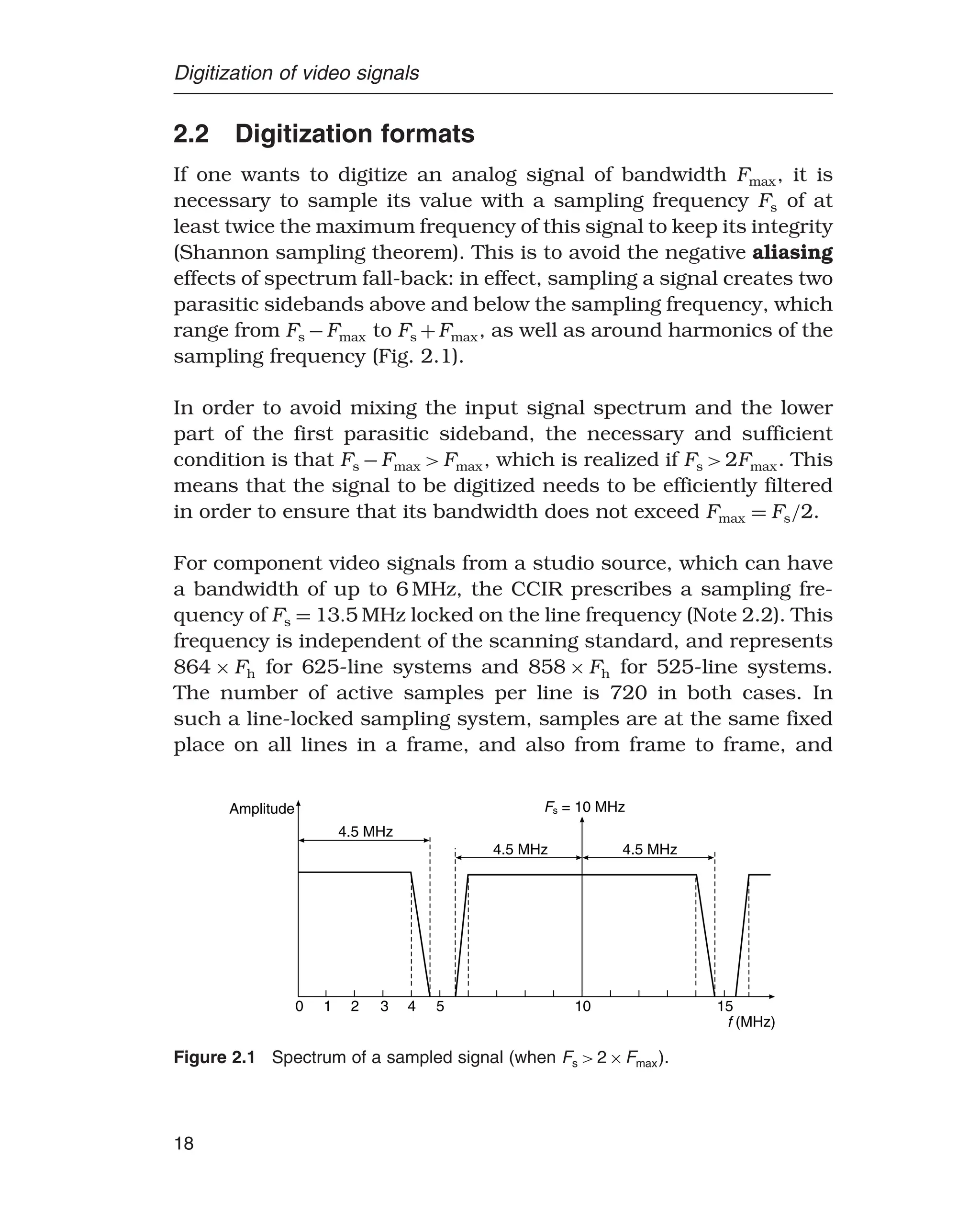
range from Fs −Fmax to Fs +Fmax, as well as around harmonics of the
sampling frequency (Fig. 2.1).
In order to avoid mixing the input signal spectrum and the lower
part of the first parasitic sideband, the necessary and sufficient
condition is that Fs −Fmax Fmax, which is realized if Fs 2Fmax. This
means that the signal to be digitized needs to be efficiently filtered
in order to ensure that its bandwidth does not exceed Fmax = Fs/2.
For component video signals from a studio source, which can have
a bandwidth of up to 6 MHz, the CCIR prescribes a sampling fre-
quency of Fs = 135 MHz locked on the line frequency (Note 2.2). This
frequency is independent of the scanning standard, and represents
864 × Fh for 625-line systems and 858 × Fh for 525-line systems.
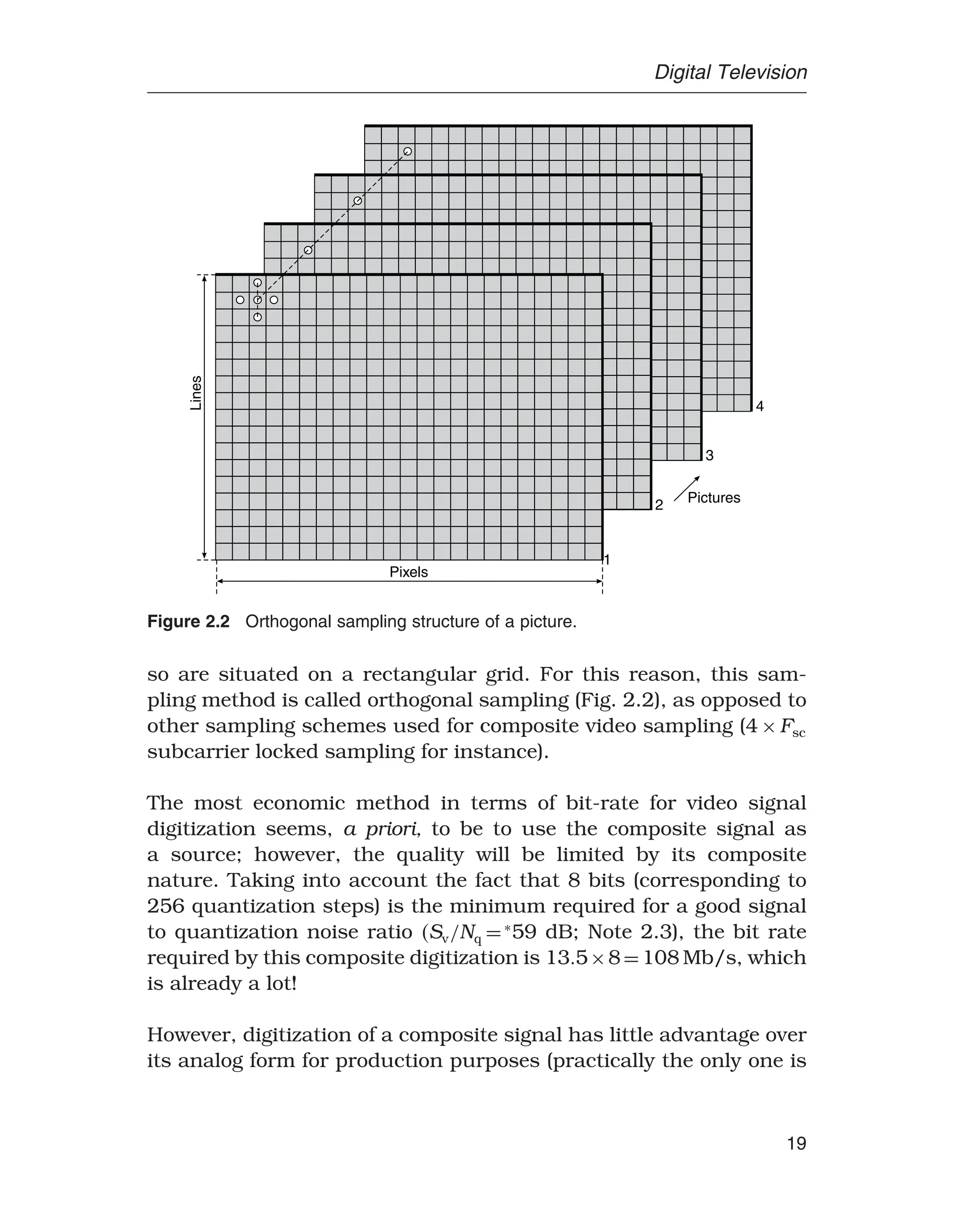
The number of active samples per line is 720 in both cases. In
such a line-locked sampling system, samples are at the same fixed
place on all lines in a frame, and also from frame to frame, and
Amplitude
4.5 MHz
F = 10 MHz
s
4.5 MHz 4.5 MHz
0 1 2 3 4 5 10 15
f (MHz)
Figure 2.1 Spectrum of a sampled signal (when Fs 2×Fmax).
18
Digital Television
1
2
3
Pictures
4
Pixels
Lines
Figure 2.2 Orthogonal sampling structure of a picture.
so are situated on a rectangular grid. For this reason, this sam-
pling method is called orthogonal sampling (Fig. 2.2), as opposed to
other sampling schemes used for composite video sampling (4 ×Fsc
subcarrier locked sampling for instance).
The most economic method in terms of bit-rate for video signal
digitization seems, a priori, to be to use the composite signal as
a source; however, the quality will be limited by its composite
nature. Taking into account the fact that 8 bits (corresponding to
256 quantization steps) is the minimum required for a good signal
to quantization noise ratio Sv/Nq =∗
59 dB; Note 2.3), the bit rate
required by this composite digitization is 135×8=108 Mb/s, which
is already a lot!
However, digitization of a composite signal has little advantage over
its analog form for production purposes (practically the only one is
19
Digitization of video signals
the possibility of multiple copies without degradation). Therefore,
this is not the preferred method for source signal digitization in
broadcast applications, as the composite signal is not very suitable
for most signal manipulations (editing, compression) or interna-
tional exchanges.
2.2.1 The 4:2:2 format
Recommendation CCIR-601, established in 1982, defines digitiza-
tion parameters for video signals in component form based on a Y,
Cb, Cr signal in 4:2:2 format (four Y samples for two Cb samples and
two Cr samples) with 8 bits per sample (with a provision for exten-
sion to 10 bits per sample). The sampling frequency is 13.5 MHz for
luminance and 6.75 MHz for chrominance, regardless of the stan-
dard of the input signal. This results in 720 active video samples per
line for luminance, and 360 active samples per line for each chromi-
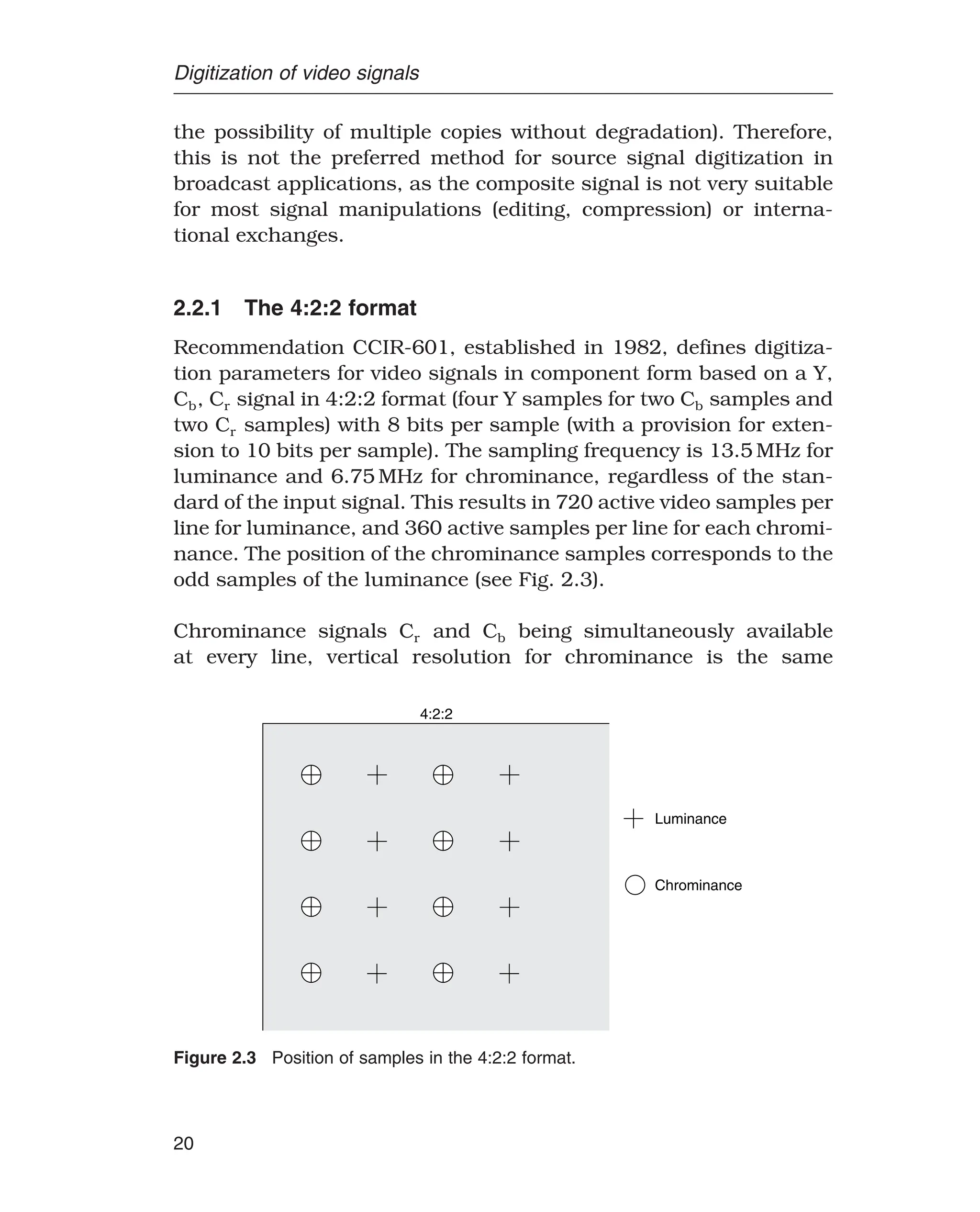
nance. The position of the chrominance samples corresponds to the
odd samples of the luminance (see Fig. 2.3).
Chrominance signals Cr and Cb being simultaneously available
at every line, vertical resolution for chrominance is the same
Luminance
Chrominance
4:2:2
Figure 2.3 Position of samples in the 4:2:2 format.
20
Digital Television
as for luminance (480 lines for 525-line systems, 576 lines for
625-line systems). The total bit-rate resulting from this process is
135 × 8 + 2 × 675 × 8 = 216 Mb/s. With a quantization of 10 bits,
the bit-rate becomes 270 Mb/s! However, if one takes into account
the redundancy involved in digitizing the inactive part of the video
signal (horizontal and vertical blanking periods), the useful bit-rate
goes down to 166 Mb/s with 8 bits per sample. These horizontal and
vertical blanking periods can be filled with other useful data, such
as digital sound, sync, and other information.
Recommendation CCIR-656 defines standardized electrical interfac-
ing conditions for 4:2:2 signals digitized according to recommen-
dation CCIR-601. This is the format used for interfacing D1 digital
video recorders, and is therefore sometimes referred to as the D1
format.
The parallel version of this recommendation provides the signal in a
multiplexed form (Cr1, Y1, Cb1, Y2, Cr3, Y3, Cb3 ) on an 8-bit parallel
interface, together with a 27 MHz clock (one clock period per sample).
Synchronization and other data are included in the data flow. The
normalized connector is a DB25 plug.
There is also a serial form of the CCIR-656 interface for transmission
on a 75  coaxial cable with BNC connectors, requiring a slightly
higher bit-rate (243 Mb/s) due to the use of 9 bits per sample in
this mode.
2.2.2 4:2:0, SIF, CIF, and QCIF formats
For applications that are less demanding in terms of resolution, and
in view of the bit-rate reduction, a certain number of byproducts of
the 4:2:2 format have been defined, as follows.
The 4:2:0 format
This format is obtained from the 4:2:2 format by using the same
chroma samples for two successive lines, in order to reduce the
21
Digitization of video signals
amount of memory required in processing circuitry while at the same
time giving a vertical resolution of the same order as the horizontal
resolution. Luminance and horizontal chrominance resolutions are
the same as for the 4:2:2 format, and thus
• luminance resolution: 720 × 576 (625 lines) or 720 × 480 (525
lines);
• chrominance resolution: 360×288 (625 lines) or 360×240 (525
lines).
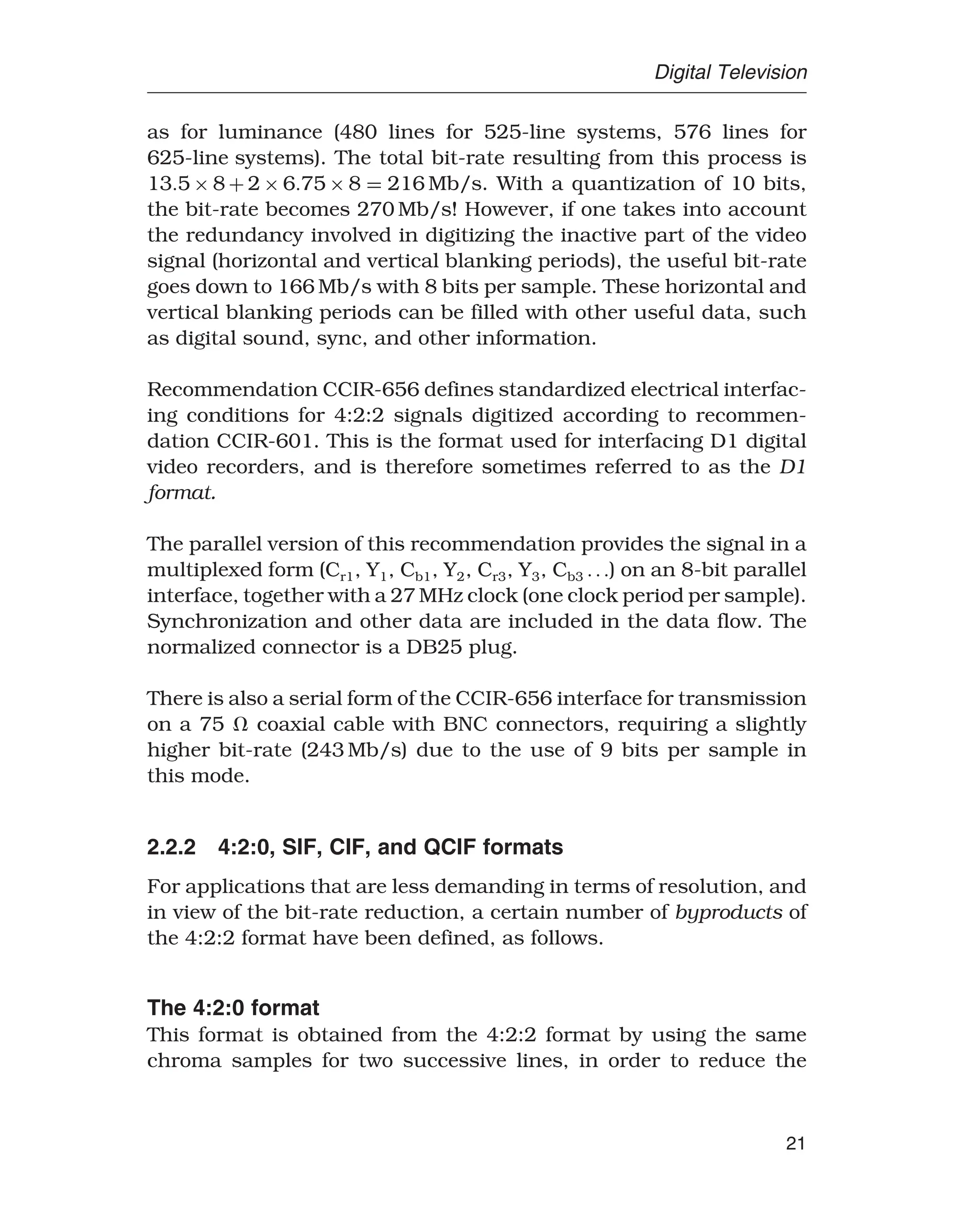
Figure 2.4 shows the position of chroma samples in the 4:2:0 format.
In order to avoid the chrominance line flickering observed in SECAM
at sharp horizontal transients (due to the fact that one chrominance
comes from the current line and the second comes from the preced-
ing one), Cb and Cr samples are obtained by interpolating 4:2:2 sam-
ples of the two successive lines they will “color-ize” at display time.
This 4:2:0 format is of special importance as it is the input format
used for D2-MAC and MPEG-2 (MP@ML) coding.
Luminance
Chrominance
4:2:0
Figure 2.4 Position of samples in the 4:2:0 format.
22
Digital Television
The SIF (source intermediate format)
This format is obtained by halving the spatial resolution in both
directions as well as the temporal resolution, which becomes 25 Hz
for 625-line systems and 29.97 Hz for 525-line systems. Depending
on the originating standard, the spatial resolutions are then:
• luminance resolution: 360 × 288 (625 lines) or 360 × 240 (525
lines);
• chrominance resolution: 180×144 (625 lines) or 180×120 (525
lines).
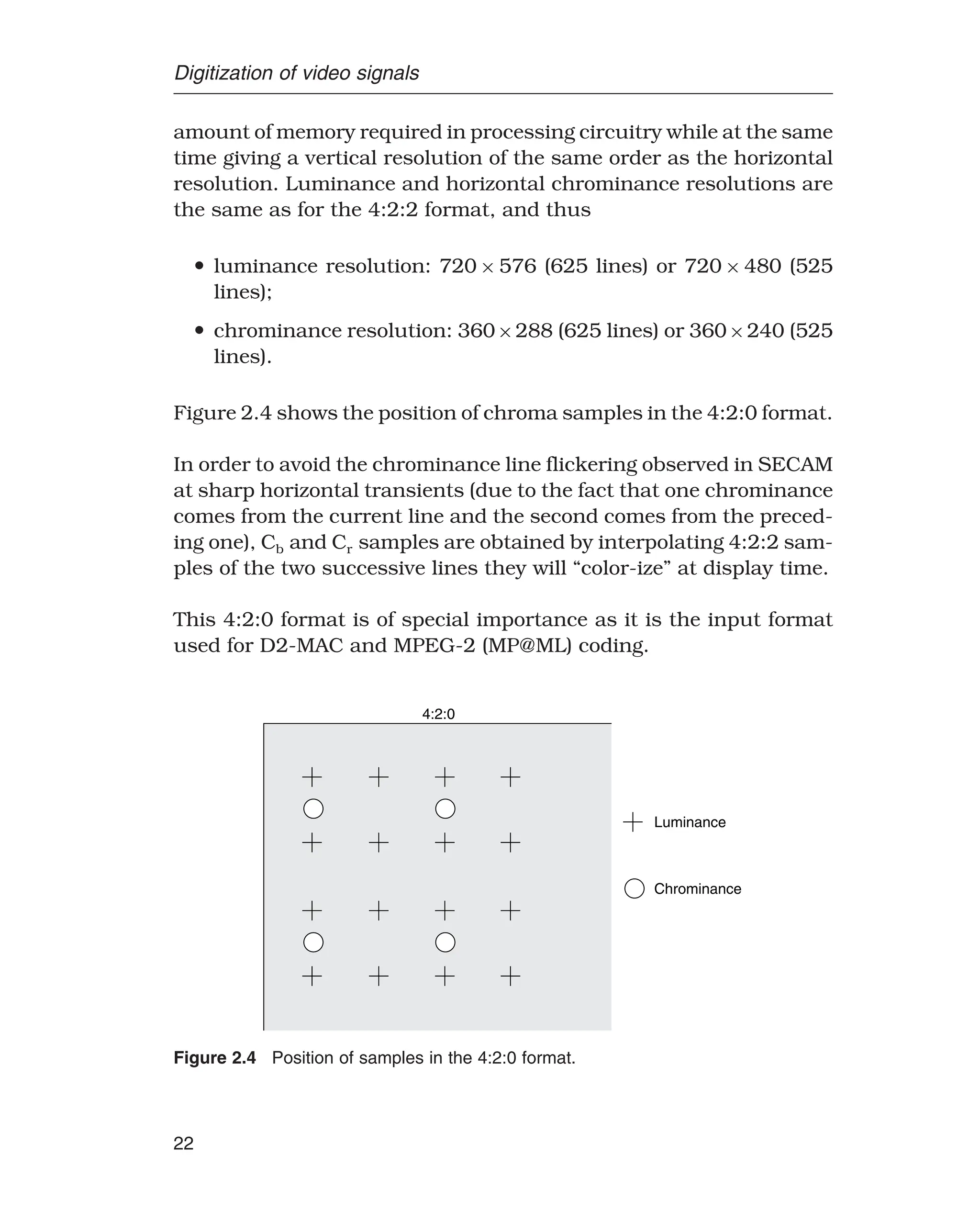
Figure 2.5 illustrates the position of the samples in the SIF format.
Horizontal resolution is obtained by filtering and subsampling the
input signal. The reduction in temporal and vertical resolution is
normally obtained by interpolating samples of the odd and even
fields, but is sometimes achieved by simply dropping every second
field of the interlaced input format. The resolution obtained is the
base for MPEG-1 encoding, and is resulting in a so-called “VHS-like”
quality in terms of resolution.
Luminance
Chrominance
SIF
Discarded samples
Figure 2.5 Position of samples in the SIF format.
23
Digitization of video signals
The CIF (common intermediate format)
This is a compromise between European and American SIF formats:
spatial resolution is taken from the 625-line SIF (360 × 288) and
temporal resolution from the 525-line SIF (29.97 Hz). It is the basis
used for video conferencing.
The QCIF (quarter CIF)
Once again, this reduces the spatial resolution by 4 (2 in each direc-
tion) and the temporal resolution by 2 or 4 (15 or 7.5 Hz). It is the
input format used for ISDN videotelephony using the H261 com-
pression algorithm.
2.2.3 High definition formats 720p, 1080i
After a few false starts (MUSE, HD-MAC, ATSC to some degree)
the conditions necessary to engender wide-scale adoption of high-
definition television (HDTV) seem to have finally been met.
Two standard picture formats have been retained for broadcast
HDTV applications, each existing in two variants (59.94 Hz or 50 Hz
depending on continent):
• The 720p format: this is a progressive scan format with a hori-
zontal resolution of 1280 pixels and a vertical resolution of 720
lines (or pixels).
• The 1280i format: this interlaced format offers a horizontal res-
olution of 1920 pixels and a vertical resolution of 1080 lines (or
pixels).
For these two formats, the horizontal and vertical resolution are
equivalent (square pixels) because they have the same ratio as the
aspect ratio of the picture (16:9).
A quick calculation of the required bit-rate for the digitization in
4:4:4 format of these two HD formats gives bit-rates on the order of
24
Digital Television
1 to 1.5 Gb/s depending on the frame rate and resolution, which is
4 to 5 times greater than for standard-definition interlaced video.
2.3 Transport problems
It is clear that a bit-rate of the order of 200 Mb/s, as required by
the 4:2:2 format, cannot be used for direct broadcast to the end
user, as it would occupy a bandwidth of the order of 40 MHz with a
64-QAM modulation (6 bits/symbol) used for cable, or 135 MHz with
a QPSK modulation (2 bits/symbol) used for satellite. This would
represent 5–6 times the bandwidth required for transmission of an
analog PAL or SECAM signal, and does not even take into account
any error correction algorithm (these concepts will be explained later
in Chapters 6 and 7 on channel coding and modulation). It would
of course be even more unthinkable with the 4 to 5 times higher
bit-rates generated by the digitization of high-definition pictures in
720p or 1080i format.
Compression algorithms, however, have been in use for some years
for contribution links in the field of professional video, which reduce
this bit-rate to 34 Mb/s, but this is still too high for consumer appli-
cations, as it does not give any advantage in terms of capacity over
existing analog transmissions. It was the belief that this problem
would not be solved economically in the foreseeable future (in large
part due to the cost of the memory size required) that gave birth
in the 1980s to hybrid standards such as D2-MAC (analog video,
digital sound) and delayed the introduction of 100 % digital video.
However, the very rapid progress made in compression techniques
and IC technology in the second half of the 1980s made these sys-
tems obsolete soon after their introduction.
The essential conditions required to start digital television broadcast
services were the development of technically and economically viable
solutionstoproblemswhichcanbeclassifiedintotwomaincategories:
• Source coding. This is the technical term for compression. It
encompasses all video and audio compression techniques used
25
Digitization of video signals
MPEG
coding
MPEG
coding
Multiplexing
(+ scrambling)
Forward error
correction (FEC)
Filtering and
modulation
Up-conversion
and amplification
Program 1
Program n
Source coding + multiplexing Channel coding + modulation
Broadcasting
network
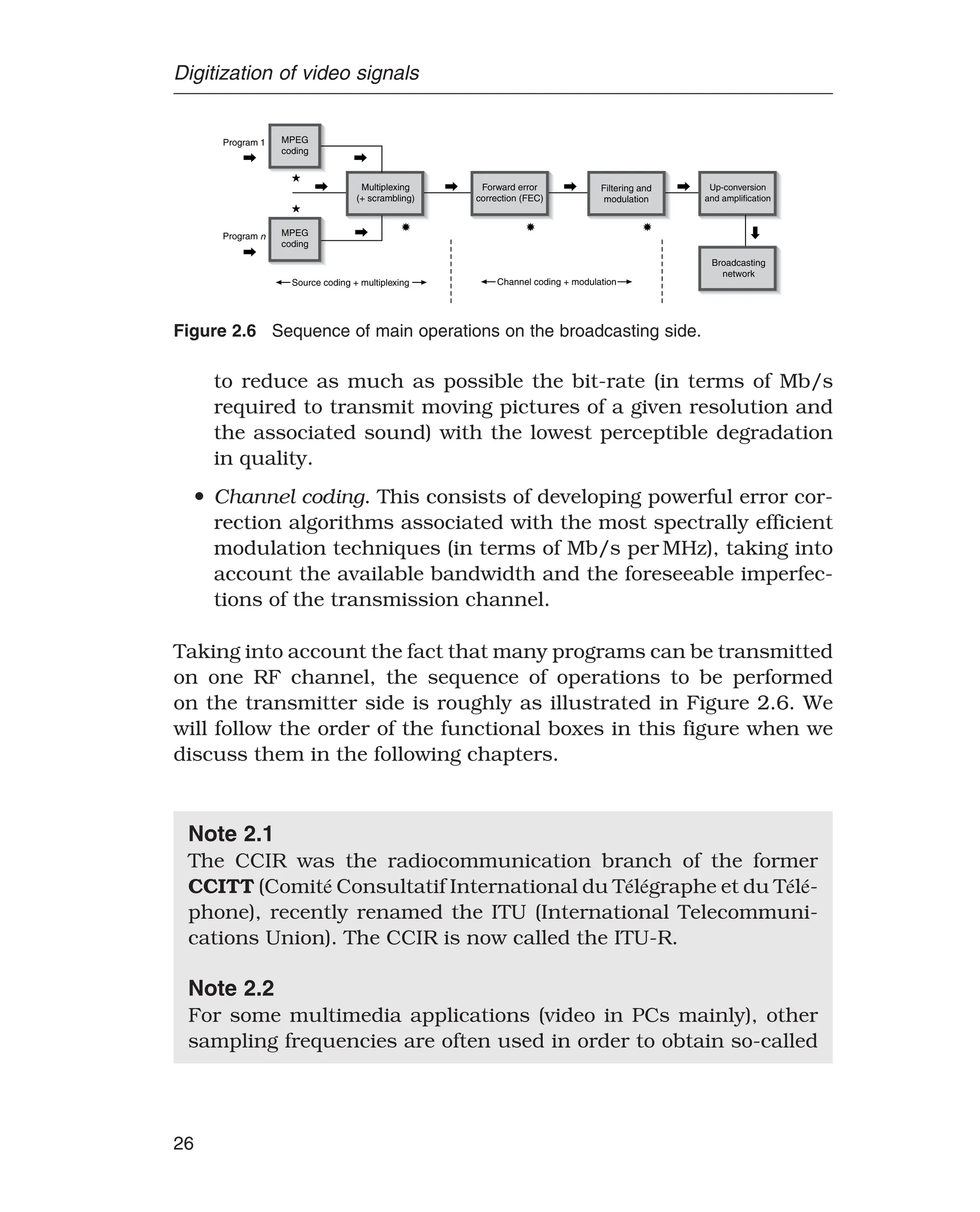
Figure 2.6 Sequence of main operations on the broadcasting side.
to reduce as much as possible the bit-rate (in terms of Mb/s
required to transmit moving pictures of a given resolution and
the associated sound) with the lowest perceptible degradation
in quality.
• Channel coding. This consists of developing powerful error cor-
rection algorithms associated with the most spectrally efficient
modulation techniques (in terms of Mb/s per MHz), taking into
account the available bandwidth and the foreseeable imperfec-
tions of the transmission channel.
Taking into account the fact that many programs can be transmitted
on one RF channel, the sequence of operations to be performed
on the transmitter side is roughly as illustrated in Figure 2.6. We
will follow the order of the functional boxes in this figure when we
discuss them in the following chapters.
Note 2.1
The CCIR was the radiocommunication branch of the former
CCITT (Comité Consultatif International du Télégraphe et du Télé-
phone), recently renamed the ITU (International Telecommuni-
cations Union). The CCIR is now called the ITU-R.
Note 2.2
For some multimedia applications (video in PCs mainly), other
sampling frequencies are often used in order to obtain so-called
26
Digital Television
square pixels to ease mixing of live video and computer images
without aspect ratio distortion. In fact, the aspect ratio of a stan-
dard TV picture and of a computer display is 4/3 (ratio of the width
to the height of the picture); in order to have identical resolutions in
the horizontal and vertical directions, which is the case for today’s
computer display formats, it is necessary that the ratio of the num-
berofpixelsperlinetothenumberofusefullinesbe4/3.Thisisnot
thecaseforCCIR-601derivedformats,eitherin625-linestandards
(720/576  4/3) or in 525-line standards (720/480  4/3).
For 525-line standards (480 useful lines), square pixels imply
480 × 4/3 = 640 pixels/line, which is obtained with a sampling
frequency of 12.2727 MHz. This is not an accident since this
resolution of 640 × 480 corresponds to the basic VGA graphics
mode—this mode is, in fact, an uninterlaced or progressive vari-
ant of the NTSC scanning standard (line frequency = 31,468 Hz,
frame frequency = 59.94 Hz). For 625-line standards (576 useful
lines), square pixels imply 576 × 4/3 = 768 pixels/line, which
requires a sampling frequency of 14.75 MHz.
The 720p and 1080i high-definition formats which have the same
ratio between their horizontal and vertical pixel numbers as the
aspect ratio of the picture (16:9) are square-pixel formats.
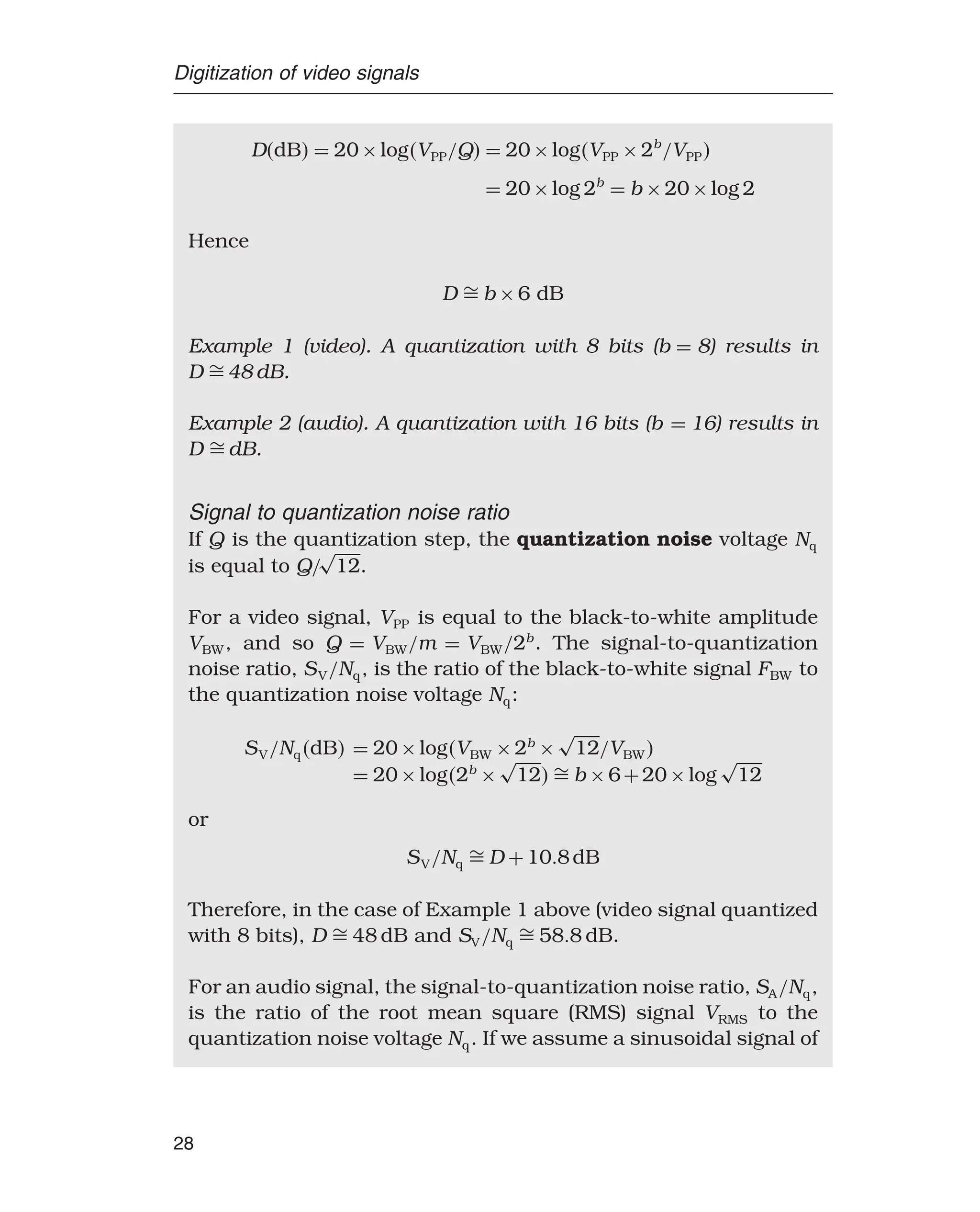
Note 2.3
Dynamic
The dynamic D of a signal with a maximum peak-to-peak ampli-
tude FPP, quantized with m steps (with m = 2b
, where b is the
number of bits of the quantization), is the ratio between VPP and
the maximum peak value of the quantization error, which is equal
to the quantization step Q.
By definition, Q is equal to the maximum peak-to-peak amplitude
FPP divided by the number of quantization steps m, i.e., Q =
VPP/m = VPP/2b
. Hence, the dynamic D (in dB) is equal to
27
Digitization of video signals
DdB = 20×logVPP/Q = 20×logVPP ×2b
/VPP
= 20×log 2b
= b ×20×log 2
Hence
D  b ×6 dB
Example 1 (video). A quantization with 8 bits (b = 8) results in
D  48 dB.
Example 2 (audio). A quantization with 16 bits (b = 16) results in
D  dB.
Signal to quantization noise ratio
If Q is the quantization step, the quantization noise voltage Nq
is equal to Q/
√
12.
For a video signal, VPP is equal to the black-to-white amplitude
VBW, and so Q = VBW/m = VBW/2b
. The signal-to-quantization
noise ratio, SV/Nq, is the ratio of the black-to-white signal FBW to
the quantization noise voltage Nq:
SV/NqdB = 20×logVBW ×2b
×
√
12/VBW
= 20×log2b
×
√
12  b ×6+20×log
√
12
or
SV/Nq  D +108dB
Therefore, in the case of Example 1 above (video signal quantized
with 8 bits), D  48 dB and SV/Nq  588 dB.
For an audio signal, the signal-to-quantization noise ratio, SA/Nq,
is the ratio of the root mean square (RMS) signal VRMS to the
quantization noise voltage Nq. If we assume a sinusoidal signal of
28
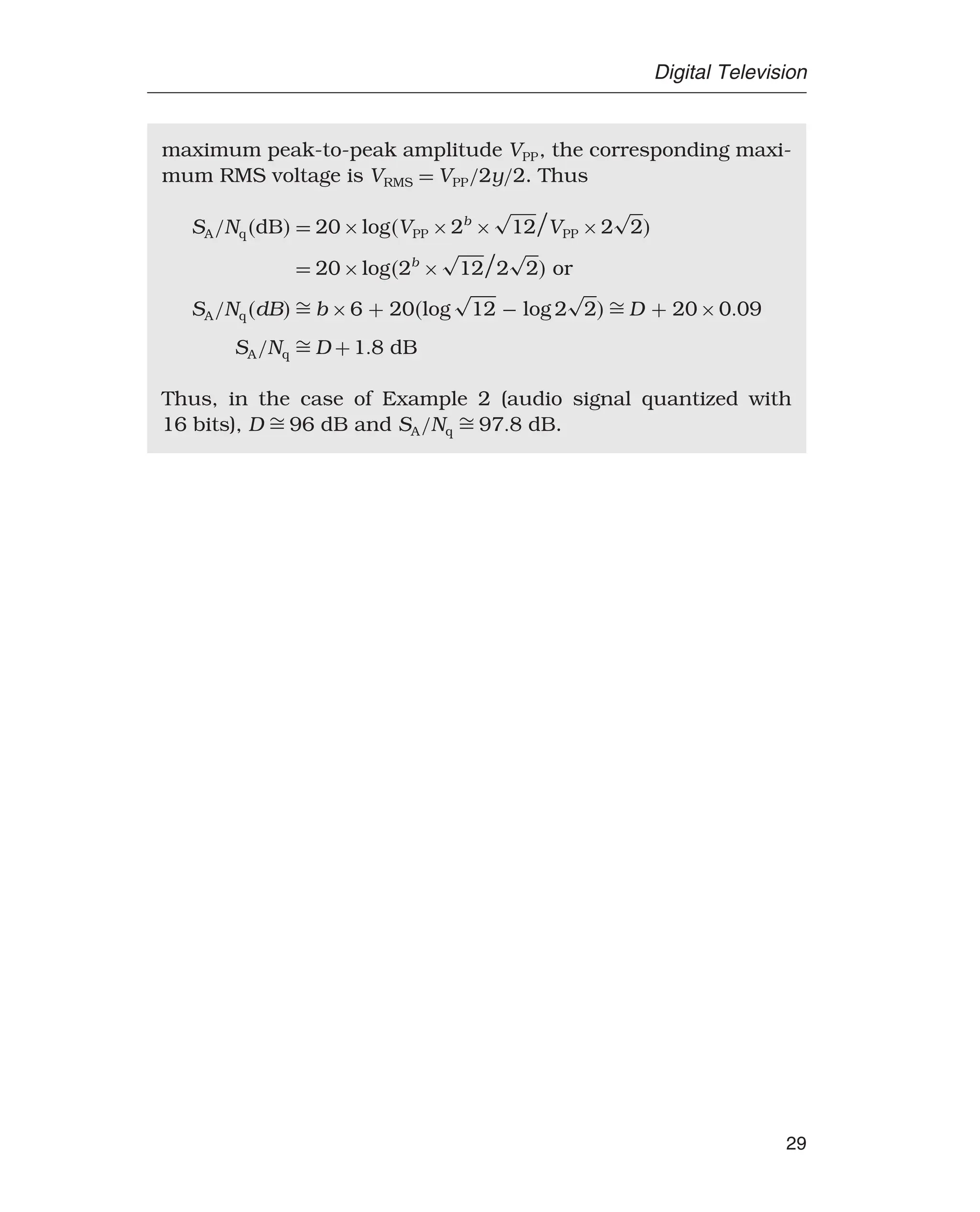
Digital Television
maximum peak-to-peak amplitude VPP, the corresponding maxi-
mum RMS voltage is VRMS = VPP/2y/2. Thus
SA/NqdB = 20×logVPP ×2b
×
√
12

VPP ×2
√
2
= 20×log2b
×
√
12

2
√
2 or
SA/NqdB  b ×6 + 20log
√
12 − log 2
√
2  D + 20×009
SA/Nq  D +18 dB
Thus, in the case of Example 2 (audio signal quantized with
16 bits), D  96 dB and SA/Nq  978 dB.
29
This page intentionally left blank
Source coding:
compression of video
and audio signals
3
In the preceding chapter, we explained why compression was an
absolute must in order to be able to broadcast TV pictures in a
channel of acceptable width. A spectrum bandwidth comparable
to conventional analog broadcasts (6–8 MHz for cable or terrestrial
broadcasts, 27–36 MHz for satellite) implies in practice maximum
bit-rates of the order of 30–40 Mb/s, with the necessary error cor-
rection algorithms and modulation schemes, which are explained in
Chapters 6 and 7.
We will now examine the principles and various steps of video
and audio compression which allow these bit-rates (and in fact
much less) to be achieved, and which are currently being used in
the various video/audio compression standards. These compres-
sion methods use general data compression algorithms applicable
to any kind of data, and exploit the spatial redundancy (correlation
of neighboring points within an image) and the specificities of visual
perception (lack of sensitivity of the eye to fine details) for fixed
pictures (JPEG), and the very high temporal redundancy between
successive images in the case of moving pictures (MPEG). In the
same way, audio compression methods exploit particularities of the
human aural perception to reduce bit-rates by eliminating inaudible
information (psychoacoustic coding).
31
Source coding: compression of video and audio signals
3.1 Some general data compression principles
3.1.1 Run length coding (RLC)
When an information source emits successive message elements
which can deliver relatively long series of identical elements (which,
as explained later in this chapter, is the case with the DCT after
thresholding and quantization), it is advantageous to transmit the
code of this element and the number of successive occurrences
rather than to repeat the code of the element; this gives a variable
compression factor (the longer the series, the bigger the compres-
sion factor). This type of coding which does not lose any information
is defined as reversible. This method is commonly employed for file
compression related to disk storage or transmission by computers
(zip, etc.); it is also the method used in fax machines.
3.1.2 Variable length coding (VLC) or entropy coding
This bit-rate reduction method is based on the fact that the proba-
bility of occurrence of an element generated by a source and coded
on n bits is sometimes not the same (i.e., equiprobable) for all ele-
ments among the 2n
different possibilities. This means that, in order
to reduce the bit-rate required to transmit the sequences generated
by the source, it is advantageous to encode the most frequent ele-
ments with less than n bits and the less frequent elements with
more bits, resulting in an average length that is less than a fixed
length of n bits.
However, if this is to be done in real time, it implies a previous
knowledge of the probability of occurrence of each possible element
generated by the source. We have this knowledge, for example, in
the case of the letters of the alphabet in a given language, and this
allows this method to be used for text compression. This method
is also valid for video images compressed by means of DCT, where
energy is concentrated on a relatively small number of coefficients,
as opposed to the temporal representation of the video signal where
all values are almost equiprobable.
32
Digital Television
One can demonstrate that the information quantity Q transmitted
by an element is equal to the logarithm (base 2) of the inverse of its
probability of appearance p:
Q = log21/p = −log2p
The sum of the information quantity of all elements generated by
a source multiplied by their probability of appearance is called the
entropy, H, of the source:
H =

i
pi log21/pi
The goal of variable length coding (VLC), or entropy coding, is to
approach, as near as is possible, the entropic bit-rate (corresponding
to an averaged number of bits per element as near as possible to the
source’s entropy). The most well-known method for variable length
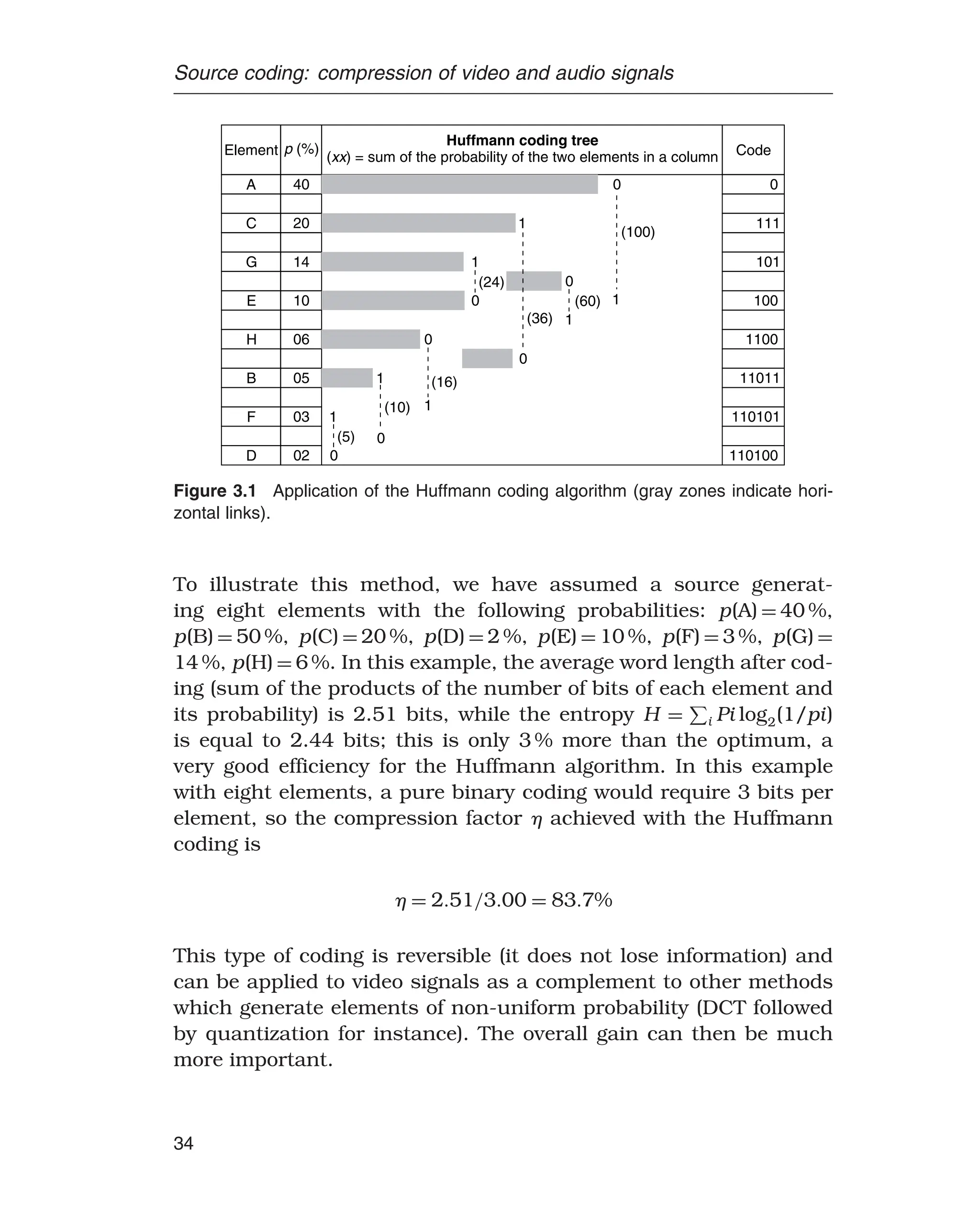
coding is the Huffmann algorithm (illustrated in Fig. 3.1), which
assumes previous knowledge of the probability of each element. It
works in the following way:
• Each element is classified in order of decreasing probability,
forming an “occurrence table” (left part of Fig. 3.1).
• The two elements of lowest probability are then grouped into
one element, the probability of which is the sum of the two prob-
abilities. Bit 0 is attributed to the element of lowest probability
and 1 to the other element; this reduces by one the number of
elements to be classified.
• The new element is then grouped in the same way with the ele-
ment having the next highest probability. 0 and 1 are attributed
in the same way as above, and the process is continued until
all the elements have been coded (sum of the probability of the
last two elements = 100 %).
• In this way, the Huffmann coding tree is built (central part of
Fig. 3.1): the code for each element is obtained by positioning
sequentially the bits encountered in moving along the Huffmann
tree from left to right.
33
Source coding: compression of video and audio signals
Element p (%)
Huffmann coding tree
( ) = sum of the probability of the two elements in a column
xx Code
110100
A
C
G
E
H
B
F
D
40
20
14
10
06
05
03
02
0
111
101
100
1100
11011
110101
0
1
1
0
0
1
0
0
1
0
1
0
(100)
(60)
(24)
(36)
(16)
(10)
(5)
1
1
Figure 3.1 Application of the Huffmann coding algorithm (gray zones indicate hori-
zontal links).
To illustrate this method, we have assumed a source generat-
ing eight elements with the following probabilities: p(A) = 40 %,
p(B) = 50 %, p(C) = 20 %, p(D) = 2 %, p(E) = 10 %, p(F) = 3 %, p(G) =
14 %, p(H) = 6 %. In this example, the average word length after cod-
ing (sum of the products of the number of bits of each element and
its probability) is 2.51 bits, while the entropy H =

i Pi log2(1/pi)
is equal to 2.44 bits; this is only 3 % more than the optimum, a
very good efficiency for the Huffmann algorithm. In this example
with eight elements, a pure binary coding would require 3 bits per
element, so the compression factor  achieved with the Huffmann
coding is
 = 251/300 = 837%
This type of coding is reversible (it does not lose information) and
can be applied to video signals as a complement to other methods
which generate elements of non-uniform probability (DCT followed
by quantization for instance). The overall gain can then be much
more important.
34
Digital Television
3.2 Compression applied to images: the discrete
cosine transform (DCT)
The discrete cosine transform is a particular case of the Fourier
transform applied to discrete (sampled) signals, which decomposes
a periodic signal into a series of sine and cosine harmonic functions.
The signal can then be represented by a series of coefficients of each
of these functions.
Without developing the mathematical details, we will simply indi-
cate that, under certain conditions, the DCT decomposes the signal
into only one series of harmonic cosine functions in phase with the
signal, which reduces by half the number of coefficients necessary
to describe the signal compared to a Fourier transform.
In the case of pictures, the original signal is a sampled bidimensional
signal, and so we will also have a bidimensional DCT (horizontal and
vertical directions), which will transform the luminance (or chromi-
nance) discrete values of a block of N ×N pixels into another block
(or matrix) of N ×N coefficients representing the amplitude of each
of the cosine harmonic functions.
In the transformed block, coefficients on the horizontal axis repre-
sent increasing horizontal frequencies from left to right, and on the
vertical axis they represent increasing vertical frequencies from top
to bottom. The first coefficient in the top left corner (coordinates: 0, 0)
represents null horizontal and vertical frequencies, and is therefore
called the DC coefficient, and the bottom right coefficient represents
the highest spatial frequency component in the two directions.
In order to reduce the complexity of the circuitry and the process-
ing time required, the block size chosen is generally 8 × 8 pixels
(Fig. 3.2), which the DCT transforms into a matrix of 8×8 coefficients
(Fig. 3.3).
A visual representation of the individual contribution of each coef-
ficient to the appearance of the original block of 8×8 pixels can be
35
Another random document with
no related content on Scribd:
it there was left by the time we really considered that we had
finished with it. The gorgeous personages had fortunately most
discreetly retired when we began our repast, and our attendants
consisted of the sweetest little army of dark-eyed waitresses I
personally have ever known to hand sauces and fruits. They were
very picturesquely but, I blush to say, very scantily attired in a collar
of leather studded with turquoise, and a deep blue kerchief held
round their tiny heads with a circlet of dull metal; but I am bound to
confess that this unconventional uniform by no means took away our
appetites—even, I thought that it added a very special, piquant
flavouring to that roast goose—and when the pretty maidens poured
the wine into our cups, out of great stone jars, I thought that never
had juice of grape tasted half so sweet.
CHAPTER IX.
THE MESSENGER OF PRINCESS NEIT-AKRIT
The next day only exists in my mind as a memory of one long and
gorgeous pageant: triumphal processions through the city, shouts of
enthusiastic people, messengers sent flying in every direction
throughout the land, to announce the great news to the inhabitants
of its most outlying corners, with a promise to some of the more
important cities that they should soon in their turn be gladdened by
the sight of the beloved of Ra, the son of Osiris, the messenger of
the Most High. It was a wearying day to us both, who, occupying a
comparatively humble position in our own country, were
unaccustomed to the pomp and glitter of courts, and to the worship
and salaaming of innumerable picturesque people. I, for one, found
my long flowing robes very difficult to manage, and my belt of lapis-
lazuli, on which were engraved sundry characters denoting my
dignity, exceedingly uncomfortable. Hugh seemed to take a keen
delight in wilfully upsetting my gravity at the most solemn moments
by making irreverent remarks about the elderly dignitaries, who
looked for all the world like mummies out of the British Museum
escaped from their glass cases.
In the precincts of the temple of Osiris, raised aloft upon a golden
throne, Hugh Tankerville received the homage of the nobles of the
land, the functionaries, the priests, the scribes and servants of the
court. The “mob,” as the traders and agriculturists were
contemptuously called by the more elevated personages, were not
admitted to this impressive function. They, however, showed their
reverence for the emissary of the gods by making a carpet of
themselves on the temple steps, the terraces and embankments, on
which the beloved of the gods and his wise counsellor were
expected to tread. (A process which I, for one, found exceedingly
uncomfortable, especially when I had to tread on the daintier
portions of this novel carpet; the dark eyes which then peered up at
me in half-awed, half-inquisitive fashion were very disconcerting.)
Truly reverential and adoring! Good old Hugh! It amused him, I
know, for I could see his eyes twinkling in merriment, but his gravity
was unshakable and his dignity superb. The Pharaoh did not appear
at these solemn processions—perhaps he felt that his own
importance was being put in the shade—but Queen Maat-kha never
left Hugh’s side throughout that long day. I could not of course hear
the sweet whisperings with which she helped to beguile the
gorgeous monotony of the festivals, but when I had an opportunity
of watching Hugh closely, I could not detect the faintest sign of
enthusiasm on his part in response to her blandishments.
There was an official banquet in the latter part of the afternoon, at
which the Pharaoh, sarcastic, ailing and silent, presided. I looked at
him as often as I could during the interminable repast, beginning to
guess the nature of the disease from which he was suffering, and
wondering what physicians there were in this strange land to
alleviate his pains and give him relief. He contemptuously ignored
the obsequious greetings of his entourage, as each in their turn,
having entered the banqueting-hall, knelt down before him and
kissed the ground. He seemed to have but one interest in life, and
that was in his two apes, which never left his side, and which
appeared to cause him endless delight. My still imperfect knowledge
of the language prevented me from venturing on an animated
conversation with my neighbour, a pompous, abnormally fat old
man, who reeked of aromatic pomades, and was fed from a spoon
by a young girl, who tasted of every morsel before handing it to him.
Hugh sat next to me on the other side, and in one of the few
intervals of rest which his interesting bride granted him we contrived
to exchange a few words together.
By this time I had got very tired of my robes and my lapis-lazuli
belt. I longed for a clean shirt, a stiff collar, anything firm about my
body, in place of all the flapping, swathing garments which always
got in my way whenever I tried to cross my legs. Now I always had
a habit of tilting my chair back and crossing my legs in good, honest,
insular manner, and I had not yet realised that, in a sort of Roman
toga and petticoats, this attitude was far from elegant; and when in
addition to this I vainly groped for my trousers pockets in which to
bury my hands, like the true-born Englishman I was, and found that
not only I had no pockets but also no… well! I said “Damn!” loudly
and emphatically.
No sooner was this useful and impressive portion of the English
language out of my mouth than I perceived that in the vast hall a
deathlike silence had succeeded the noise of talk and laughter, and
three hundred pairs of ears were straining to catch the strange word
I had uttered, while the Pharaoh’s keen dark eyes were fixed
mockingly upon me.
But it certainly would take a great deal more than just one good
British “Damn!” spoken in an inopportune moment, to ruffle Hugh
Tankerville’s supreme dignity and composure.
“Ye know not the secrets of the tongue which Osiris teacheth his
beloved to speak,” he said with perfect impudence, “and my
counsellor and I speak many words which it is not meet ye people of
Kamt shall hear, unless indeed the gods do grant you leave. Only
those who lead a just and blameless life, who pardon their enemies
and relieve the oppressed, can hope to understand the veiled
mysteries of Osiris’s tongue.”
I tried not to smile. I tried to imitate Hugh’s dignity, and in a
measure I succeeded; but the idea that the true understanding of a
British swear-word could only be the reward of virtue nearly upset
my utmost endeavours at gravity.
Respectful silence had greeted the wonderful announcement, and
three hundred pairs of eyes gazed with awed superstition at the
expounder thereof. Only from the head of the table there came a
low and sarcastic chuckle. Hugh affected not to notice it, and did not
even glance towards the mighty Pharaoh, but from that moment I
had a strong suspicion that, however ignorant on the subject of the
outer world the people of Kamt might be, their ruler at any rate had
but little belief in our divine origin.
What his attitude in the future towards us might be, it was
impossible to guess; but weak and ill as he was, he evidently for the
present had no intention of breaking into open enmity against the
beloved of the gods, who was also the idol of his people.
However, after this little episode, Hugh and I tacitly decided that it
would be best only to speak English when we were alone.
The shades of evening were beginning to draw in when at last we
all rose from the table. Queen Maat-kha led us into the gardens,
while the guests followed or still loitered round the tables, drinking
wine or nibbling honey cakes. The Pharaoh’s litter had disappeared
beyond the alleys, and I for one felt much relieved by his absence.
“The evening is young yet, oh, my beloved,” said the Queen,
clinging affectionately to Hugh. “Isis hath not yet risen beyond the
hills, and the hour is still far when thou must leave me to preside
over the court of judgment at Kamt. Wilt stay with me alone and try
to find, in that mysterious language which Osiris hath taught thee,
words which would convey to me the thought that thou dost think
me fair?”
“Fair above all, my Queen,” said Hugh, earnestly.
“Yet thou knowest not how much fairer I will be the day when
thou standest by my side at the foot of the throne of Isis, in Tanis,
when clouds of incense hover round us, hiding us from the gaping
multitude, and the high priest raises his hand over our heads to give
us a supreme benediction.”
“Thou couldst not be fairer than thou art,” he said, with a certain
want of conviction, which no doubt the lady perceived, for she said a
little sadly:
“How silent thou art, oh, my beloved! Already, perchance, the
destinies of Kamt sit heavily upon thy shoulders. The Pharaoh is sick,
he has no will save for rest and peace, and his enemies have
become powerful in the land.”
“The ruler of Kamt should have no enemies, oh, Queen! for his
rule should be merciful and just; justice disarmeth an enemy’s
hand.”
“Nay, but there are the jealous, the envious,” she said, with the
sweetest of smiles, “those who stand so near to the Pharaoh that
with a touch of the hand they might easily reach the crown which
sits so lightly upon his head.”
“My place, oh, Queen, will be beside the Pharaoh, to protect his
crown from the hands of the jealous and the envious!”
“Ay! I know! and thy protection is great, oh, beloved of the gods!
But is it not meet,” she added pensively, “that some one who is near
and dear to him should pray to the gods night and day, that their
continued blessing may rest upon his head?”
I was beginning to wonder why Queen Maat-kha was suddenly
showing such unwonted solicitude for her son; her sweet manners,
her fascinations exercised to the full, led me to think that she was
playing some hidden game. From the first, the fascinating, exotic
queen had deeply interested me. I was always a keen observer and
earnest student of human nature, and the one or two incidents in
which Maat-kha had been the central figure had already shown me
that, in spite of the many thousands of miles that lay between them,
in spite of barriers of desert waste and inaccessible heights, this
radiant product of an ancient civilisation and her Western twentieth-
century sister had the same feminine, capricious, un-understandable
heart.
That she was even at this moment playing some little game of her
own there could be no doubt; that there was some little feminine
cruelty hidden behind her solicitude for her son was clearly shown by
her almond-shaped eyes, which had gradually narrowed until they
were merely two glittering slits, that again brought back to my mind
the two grim guardians of the gates of Kamt.
The same thought had evidently struck Hugh, for he said, with a
smile:
“Art already tired of thy future lord, oh, my Queen, that thou
turnest thy thoughts to daily and nightly prayers?”
“I?” she said, astonished. “Nay, I was not thinking of myself. There
is truly no one more near or dear to the Pharaoh than his mother,
but my mission is greater and more important in the land than that I
should spend my days and nights in prayer. Nay! there are others.”
“I do not understand.”
“Is it not meet,” she said, speaking rapidly and eagerly, “that one
who, besides being kith and kin to the holy Pharaoh, is also young
and pure—a maiden—beloved of Isis—should devote that young and
still blameless life to the service of the Most High? Her prayers, like
the fragrance of the spotted lily, would rise heavenwards, pure and
undefiled by thoughts or memories of the past. Thou, who has dwelt
among the gods, thou knowest that Ra loveth the songs and worship
of a maid. His priestesses are indeed privileged, for they can sing to
him at all times, praise and worship him, and he always grants their
prayers.”
“Privileged dost thou say? Hast forgotten, oh, Queen! that some
cruel and godless decree of this land doth deprive the priestesses of
Ra of his most precious gift?”
“What is eyesight beside the purity of the soul? The maids of Kamt
vie with each other for the privilege of being among the chosen
priestesses of Ra, who, alone among all women, kneel within the
inner sanctuary of the god. And now when the Pharaoh is sick, when
he hath most need of prayers, there is not one maid of the house of
Memmoun-ra who mingles her song with their song, who kneels with
them, entreating at the foot of the throne of the Most High.”
“Young girls of the royal house, no doubt, have no desire for such
a sacrifice.”
“Girls are thoughtless and selfish,” she said sweetly; “it is for the
older and the wise to counsel them.”
“Dost propose then to counsel one of thy young kinswomen to
give up her life, and what is dearer than life, for the sake of praying
for thy sick son?” asked Hugh, who, I think, as well as I, was
beginning to perceive the subtle game his bride was playing.
“I cannot counsel, I am but a woman, and the Pharaoh’s
kinswoman is wilful and proud,” she said with a sweet smile.
“The Pharaoh’s kinswoman? Art speaking of one young maiden
then?”
“What other being is there in this fair land more worthy of the
honour to be priestess of Ra than my sister’s child, the Princess Neit-
akrit? I cannot counsel her, for, alas! she hath hatred for me, but
thou, oh, son of Ra! canst give her the message which emanates
from the god himself. Thou canst command, and she will not
disobey. Then, when shut off from all temptations, all turmoil and
strife of this world, she will soon forget that she was once young and
fair, and killed the souls of men by her wiles and her beauty; then
she will bless thee for that command, and cherish thy name in her
heart as she would a god’s.”
So that was the hidden game Queen Maat-kha was playing. She
was madly, barbarously jealous of her young kinswoman, and in that
passionate, exotic nature love and hate were absolute, simple and
paramount.
She had fallen a ready prey to Hugh’s mystic personality; his
handsome presence, his supposed supernatural origin had invested
him with a halo of romance. But she knew that Princess Neit-akrit
was young and beautiful, she scented a probable rival, and being a
woman, a simple, ardent, semi-barbaric creature of flesh and blood,
her instinct was to render that rival helpless, before it was too late.
That her suggestion was cruel and abominable goes without
saying; that it would have no effect upon Hugh I felt, of course,
quite sure; he turned to her and said, with quiet sarcasm:
“Dost hate thy young kinswoman so deeply, then, that thou dost
ask me to formulate so monstrous a command?”
But like a cat who has shown her claws before she is ready to
spring, and hides them again under the velvety paw, Queen Maat-
kha said, with the sweetest of smiles and a look of childish
astonishment:
“Thou makest a mock of thy servant, oh, my beloved! Thy words
are but a jest, I know. I hate no one, least of all my sister’s child.”
“Dost fear her then?”
“Not as long as thou art near me,” she said, throwing, with sudden
impulse, a pair of very beautiful arms round Hugh’s neck. “Wilt tell
me that thou dost love me?”
“I claimed thee as my bride before the throne of Ra,” he answered
quietly.
“Wilt prove thy love for me?”
“It needs no other proof.”
“Wilt bind thyself to grant me a request?”
“Command, oh, queen; I will obey if the gods allow.”
“Stay by my side in the palace,” she pleaded; “go not forth by
night or by day beyond the walls of Men-ne-fer. Men-ne-fer is
beautiful and great; it shall be a feast to thine eyes, until the day
when our barges will bear us to Tanis, there to be made man and
wife.”
“Wilt hold me a prisoner of love?” he said, smiling. “I know not if I
can thus bind myself to thy feet, beautiful as thou art. My counsellor
will tell thee that it is meet I shall visit my people and see the cities
wherein dwell my future subjects. Dost begrudge them that, which
already messengers have gone forth to announce?”
“Ay, I begrudge every moment which takes thee away from me.
Presently, to-night, when Isis has risen to illumine the night, thou
wilt go to sit beside the Pharaoh, in the judgment-hall of Kamt, to
pronounce sentence of life and death on all those who have erred or
sinned against our laws. That hour will be martyrdom to me. Think
of what I should suffer if thou wert absent for a day and a night.”
I could see that Hugh, like myself, was much amused by her
strange persistence and her sudden change of tactics. She was
evidently bent on gaining this point, having apparently lost the other,
for she put forth before him all the charms and artifices which a
woman, loved or loving, alone knows how to use. It was getting very
dark, and in the east a faint streak of greyish light heralded the rise
of the moon, but in the semi-darkness I could see the beautiful
Queen’s eyes fixed with a truly magnetic look upon Hugh, while she
half-offered, half-pleaded for a kiss. I think it would have required a
very adamantine or very worn-out old heart to resist such charming
pleading, or refuse so flattering a request, and I doubt not but that
in spite of her earlier, decidedly unpleasant, tactics Hugh was ready
enough to yield and promise all she asked, but unfortunately at this
moment the poetic little scene was suddenly interrupted by a fanfare
of metal trumpets, and from a distance we heard the cry:
“Make way for the messenger of Princess Neit-akrit!”
Even in the darkness I could see that Queen Maat-kha had
become very pale, and a dark frown appeared between her eyes.
“Thou hast not yet promised,” she whispered hurriedly. “Promise,
my beloved, promise.”
“Make way for the messenger of Princess Neit-akrit!”
The sound of the trumpets, the repeated cries, drowned the words
in Hugh’s mouth.
“Promise thou wilt not go,” she entreated for the last time;
“promise thou wilt not leave my side!”
But it was too late, for the trumpets now sounded quite close in
the garden, and preceded by some of the Queen’s servants, a
messenger, in shining tunic and silver helmet, with winged sandals
on his feet—an emblem of his speed—was rapidly approaching
towards us. Impatiently Maat-kha turned to him.
“What dost thou want?” she said imperiously. “Who has given thee
leave to intrude on the presence of thy Queen? Thou deservedst a
whipping at the hands of my slaves for thy daring impudence.”
The messenger, however, seemed well accustomed to this
inhospitable greeting, or in any case was very indifferent to it, for he
knelt down and kissed the ground, then rising again, he quietly
waited until the flood of the lady’s wrath had passed over his head.
Then he began, solemnly:
“From the Most High the Princess Neit-akrit, of the house of
Memmoun-ra, to the beloved of the gods, greeting.”
And again he knelt and presented Hugh with a dainty tablet, on
which a few words had been engraved upon a sheet of wax. I
thought for one moment that the Queen would snatch it out of his
hand, but evidently, mindful of her own dignity, she thought better
of it and stood a little on one side, pale and frowning, while a slave
brought a torch close to Hugh and held it over his head to enable
him to read.
“From the humblest of thy worshippers, greeting, oh, well-beloved
of Ra, envoy of Osiris. This is to apprise thee that the dwelling of thy
servant will be ready to receive thee on the day after to-morrow,
and Neit-akrit will be waiting to welcome thee when Isis is high in
the heavens. Wilt honour her and her house by setting thy foot upon
its threshold?”
“Do not go, my beloved,” whispered the Queen, excitedly.
“Tell thy mistress, messenger,” said Hugh, calmly, “that on the day
after to-morrow, when Isis is high in the heavens, I and my
counsellor will lay our homage at her feet, according to her will.”
The messenger salaamed again. Queen Maat-kha, among her
many powers, had evidently not the one of killing with a look, for
probably otherwise the unfortunate messenger would have paid
dearly for the privilege of bringing Princess Neit-akrit’s greeting. As it
was, he was allowed to depart in peace, and a few very
uncomfortable moments followed—uncomfortable, at least, as far as
two of us were concerned, for good old Hugh seemed highly amused
at the episode, and even had the heartless impudence to give me a
nudge, which fortunately the Queen did not see.
“Wilt thou not bid me farewell, my Queen?” he said, trying to keep
up a sentimental tone. “It is time I went to the judgment-hall, for
Isis will appear anon.”
But without another word she had turned away before Hugh could
stop her, and had disappeared among the trees, while we both heard
a heavy, almost heart-broken sob, which I think ought to have filled
Hugh’s heart with remorse.
CHAPTER X.
THE JUDGMENT-HALL OF MEN-NE-FER
Half an hour later we were being rowed down the canal by
moonlight on our way to the judgment-hall of Men-ne-fer, and had
full leisure to discuss the funny little incident in the garden.
“It was a damnable idea,” said Hugh, with true British emphasis.
“She must have taken me for a fool to think that I should not see
through her artful game.”
“Queen Maat-kha seems certainly to have vowed deadly hatred to
her royal niece. I wonder why.”
“Feminine jealousy, I suppose. All the more serious as the lady
seems to have very few scruples hidden about her fine person. It
strikes me that I shall have to extend a protecting hand over my
defrauded kinswoman.”
“My dear Girlie, it strikes me that that young woman will need no
protection, and that, for aught you know, she bids fair to be your
most dangerous enemy. She is evidently very beautiful, and a
beautiful woman deprived of her rights, justly or unjustly, always has
a large following.”
“A statement worthy of your best college days, oh, Doctor
Sagacissime. Well! we will not despise an enemy worthy of our steel.
So far we have had nothing but triumph, and easy conquests might
begin to pall. But I’ll tell you what we can do, old chap,” he added
with his merry, infectious laugh, “that which shall disarm our
bitterest foe, if indeed she be one. You shall enter the lists for
Princess Neit-akrit’s hand, marry her, and when presently I leave this
fair land to return to the foot of the throne of Ra, I shall solemnly
appoint you and your heirs my successors to the double crown of
Kamt.”
“I’ll tell you what you had better not do,” I rejoined half crossly,
“and that is to fall in love yourself with the fascinating lady. Everyone
seems to be doing it about here.”
“Oh, I?” he said, suddenly becoming serious, and with a touch of
sadness. “I am here with a purpose, altogether besides my own self.
I have to prove to the world that neither my father nor I were fools
or liars. I must study the life, the government, the art of the men;
my heart is crusted over with fragments of papyrus and mummies, it
is impervious even to the beauty of these warm-blooded women.”
“For shame, Girlie! at your age!”
“I have no age, Mark, only a number of wasted years behind me,
and a few on ahead, which I am determined shall be well filled.”
It was a beautiful starlit night, and the crescent moon shone
wonderfully bright over the ancient city, with its marble edifices, its
water-streets, which wound in and out among mimosa and acacia
groves like a bright blue ribbon covered with glistening gems. As
they rowed the boatmen sang a sweet, monotonous barcarolle, and
from east and west, and north and south, at regular intervals,
fanfares of trumpets greeted the crescent moon as she rose.
The great judgment-hall of Men-ne-fer stood—a gigantic circular,
roofless building—high above a flight of dull grey granite steps.
Open to the sky above, it was only lighted by the brilliant yet weird
rays of the moon, which threw into bold relief the semi-circular rows
of seats on which, when we entered, were seated a number of
solemn-looking Egyptians in long flowing robes. They all rose as
Hugh’s figure appeared in the massive, square archway, and he and
I paused a moment to take in the strange picture which lay before
our eyes.
It would be impossible for me to give any definite facts as to the
proportions of this vast coliseum. It looked probably larger than it
really was, owing to the dense shadows into which one-half of it was
plunged and which looked almost limitless. There were several tiers
of stone seats, placed in semi-circle each side of a tall throne, on
which, propped up with cushions, the mighty Pharaoh reclined. On
his left, a foot lower than the kingly throne, sat Ur-tasen, the high
priest of Ra, and at the foot of the throne sat three old men, in one
of whom I recognised my fat neighbour at the banqueting table.
They also rose when Hugh entered, and I noticed that they wore
round their waists heavy belts of lapis-lazuli, on which was engraved
the device: “Justice. Mercy.”
A seat had been placed on the right of the Pharaoh, with a low
one close behind it. These were for the beloved of the gods and his
wise counsellor.
No one spoke a word in the vast and crowded building, as we
made our way down into the arena first, and then up the gradients
to the seats allotted to us. In the shadows behind and all around,
my eyes, becoming accustomed to the gloom, distinguished a crowd
of moving figures, with here and there a glint of helmet and shield.
The silence was becoming weird and almost oppressive. We were
all standing, except the Pharaoh, who looked terribly cadaverous
beneath the gorgeous diadem which he wore. At last Ur-tasen,
raising has hands up towards the starlit sky, began to recite a long
and solemn prayer. It was an invocation to all the gods of Egypt—of
whom I noticed there was a goodly number—for righteousness,
justice and impartiality. The solemn Egyptians in white robes, who, I
concluded, were perhaps the jury, spoke the responses in nasal,
sleepy tones.
While Ur-tasen prayed, a number of slaves, who were naked save
for a white veil wound tightly round their heads, were going about
carrying large trays, from which each member of the jury one by one
took something, which I discovered to be a branch of lotus blossom.
This each man touched with his forehead as he spoke the responses,
and then held solemnly in his right hand.
We were, of course, deeply interested in the proceedings: the
mode of administering justice in every country is the surest keynote
to the character of its people. Here a decided savour of mysticism
accompanied it; the peculiar hour of the night, the weird light of the
moon, the white draperies, the hooded slaves even, all spoke of a
people whose every thought tended towards the picturesque.
But now Ur-tasen had finished speaking. The last response had
been uttered, and silence once again reigned within the mysterious
hall. A herald came forth with long silver trumpet, and stood in the
centre of the arena, with the light of the moon shining full upon him.
He raised his trumpet skywards and blew a deafening blast. Then
three times he called a name in a loud voice,—“Har-sen-tu! Har-sen-
tu! Har-sen-tu!” and every time he called he was answered by a
flourish of trumpets from three different ends of the buildings,
accompanied by the loud cry:
“Is he there? Is he there? Is he there?”
The herald then added:
“Let him come forthwith, with all his sins, before the judgment-
seat of the holy Pharaoh, and in the immediate presence of him
whom Osiris has sent down from heaven, the son of Ra, the beloved
of the gods. Let him come without fear, but let him come covered
with remorse.”
Evidently Har-sen-tu was the first criminal to be tried in our
presence in the great hall of Men-ne-fer. There was a stir among the
crowd, and from out the shadows a curious group detached itself
and came forward slowly and silently. There were men and women,
also two or three children, all dressed in black, and some had their
heads entirely swathed in thick dark veils. In the midst of them,
carried by four men, was the criminal, he who, covered with sins,
was to stand forth before the Pharaoh for judgment, mercy or
pardon. That criminal was the dead body of a man, swathed in white
linen wrappings, through which the sharp features were clearly
discernible. The men who had carried it propped the corpse up in
the middle of the building, facing the Pharaoh, until it stood erect,
weird and ghostlike, stiff and white, sharply outlined by the brilliant
moon against the dense black of the shadows behind, while round,
in picturesque groups, a dozen or so men and women knelt and
stood, the women weeping, the children crouching awed and still,
the men solemn and silent.
And the Pharaoh, with his high priest, the three learned judges,
the numerous jury, sat in solemn judgment upon the dead.
From amidst the group a man came forward, and in quiet,
absolutely passionless tones, began recounting the sins of the
deceased.
“He owned three houses,” he said, “and twenty-five oxen; he had
at one time seventy sheep, and his cows gave him milk in plenty. His
fields were rich in barley and wheat, and he found gold dust amidst
the shingle by the stream close to his house. And yet,” continued the
accuser, “I, his mother’s sister’s child, asked him to lend me a few
pieces of money, also the loan of his cow since my child was sick
and needed the milk, and he refused me, though I asked him thrice;
and all the while he loaded Suem-ka, his concubine, with jewels and
with gold, although Isis had pronounced no marriage blessing upon
their union.”
It took this speaker some little time to recount all the misdeeds of
the dead man, his hardness of heart, his negligences, and the frauds
he had perpetrated: and, above all, his unlawful passion for Suem-
ka, who had been his slave and had become his mistress.
When he had finished a woman came forward, and she, in her
turn, related how she had vainly begged of the rich man to repent
him of his sins and cast the vile slave from him, but he had driven
her away, though he was her own brother, roughly from his door.
There were several accusers who spoke of the dead man’s sins, and
each, when they had finished their tale, added solemnly:
“Therefore do I crave of thee, oh, most holy Pharaoh! of thee,
who dost deliver judgment in the name of Ra, all-creating, of Horus,
all-interceding, and of Osiris, bounty-giving, that thou dost decree
that Har-sen-tu’s body is unfit for preservation, lest it should remain
as an abode for his villainous soul and allow it to rise again in after
years to perpetrate further frauds and cruelties.”
While the accusers spoke there were no protestations on the part
of the mourners, who crowded round their dead. Once or twice a
sob, quickly checked, escaped one of the women’s throats. Judges
and jury listened in solemn silence, and when no more was
forthcoming to speak of the sins of Har-sen-tu, the defenders of the
silent criminal had their say.
His friends and relations evidently, those who had benefited by his
wealth or had not suffered through his hardness. Those too,
perhaps, who had something to gain through the rich man’s death.
The most interesting witness for this strange defence was
undoubtedly Suem-ka, the slave. She was a fine, rather coarse-
looking girl, with large dark eyes and full figure. She was entirely
wrapped in the folds of a thick black veil, but her arms and hands,
as she raised them imploringly towards the Pharaoh, and swore
before Isis that she had never been aught but a lowly handmaiden
to her dead master, were, I noticed, covered with rings and gems.
The rich man had many friends. They formed a veritable phalanx
round his corpse, defying the outraged relatives, confronting his
enemies, and entreating for him the right of embalming, of holy
sepulture, so that his body might be kept pure and undefiled from
decay, ready to once more receive the soul, when it had concluded
its wanderings in the shadowland where dwelleth Anubis and Hor,
and Ra, the Most High.
I felt strangely impressed by this curious pleading for one so silent
and so still, who seemed to stand there in awesome majesty,
hearing accusation and defence with the same contemptuous
solemnity, the same dignity of eternal sleep.
When accusers and defenders had had their say, there was a long
moment of silence: then the three judges rose and recapitulated the
sins and virtues of the dead man. Personally, I must confess that,
had I been on the jury, I should have found it very difficult to give
any opinion on the case. Suem-ka, the slave, with her arms and
hands covered with jewels, was, to my mind, the strongest witness
against the master whom she tried to shield. But then it did not
transpire that the deceased had had a wife, or had any children. The
numerous jury, however, seemed to have made up their minds very
quickly. When the last of the judges had finished speaking, they all
rose from their seats and some held the lotus flower, which they had
in their hand, high over their heads, while the others—and I noticed
that these were decidedly in the minority—dropped the blossom to
the ground.
The judges took count and pronounced a solemn “Ay,” and Suem-
ka, overcome with emotion, fell sobbing at the feet of the dead man.
After this Ur-tasen rose and delivered judgment upon the dead.
“Har-sen-tu! Har-sen-tu! Har-sen-tu! rejoice! The holy Pharaoh
has heard thy sins! But the gods have whispered mercy into the air.
Isis smileth down in joy upon thee.
“Har-sen-tu! Har-sen-tu! Har-sen-tu! go forth from the judgment-
seat of the holy Pharaoh, to face fearlessly the more majestic, more
mysterious throne of Osiris!
“Har-sen-tu! Har-sen-tu! Har-sen-tu! may Anubis, the jackal-
headed god, guide thee! may Horus intercede for thee and Osiris
receive thee in the glorious vault of heaven, where dwelleth Ra, and
where is neither sin nor disease, sorrow nor tears! Har-sen-tu, thou
art pure!”
A scribe handed him a document which he placed before the
Pharaoh, who with his usual contemptuous listlessness placed his
seal upon it. Then I saw the high priest hesitate one moment, while
the scribe waited and the Pharaoh shrugged his shoulders, laughing
in his derisive way. Hugh smiled. I think we both guessed the cause
of the high priest’s hesitation. Ur-tasen was frowning, and looking
now at Hugh, and now at the document in his hand; but Suem-ka,
the slave, happy in her triumph, ended the suspense by shouting:
“Thy hand upon the seal, oh, beloved of the gods!”
With a slight frown Ur-tasen ordered the scribe to hand the
document across to Hugh, who placed his name beside that of the
Pharaoh in bold hieroglyphic characters:
Then the parchment was handed over by one of the judges to the
relatives of the deceased, who, as silently as they had come, retired,
bearing their dead away with them. The laws of Kamt had granted
them leave to perform the last and solemn rites of embalming the
body of their kinsman, and making the body a fitting habitation for
the soul until such time as it should return once more upon earth
from the land of shadows.
And the herald again called thrice upon a name, and again the
dead was arraigned before the living, his virtues extolled by his
friends, his sins magnified by his enemies; but in this case he was
deemed unworthy of embalming; the soul should find no more that
dwelling-place which had been the abode of cruelty and of fraud, of
lying and of cheating, and it should be left to wander homeless in
the dark shadows of death till it had sunk, a lifeless atom, merged in
the immeasurable depths of Nu, the liquid chaos which is
annihilation. The wailing of the relatives of this condemned corpse
was truly pitiable: the law had decreed upon the evil-doer the
sentence of eternal death.
Two more cases were dealt with in the same way. Mr. Tankerville
had often in his picturesque way related to us this judgment of the
dead practised in ancient Egypt, and I remember once having seen a
picture representing the circular hall, the judges and the accused;
but, as in everything else in this wonderful land, how infinitely more
mystic, more poetic was the reality than the imagining. The hour of
the night, the crescent moon above, the silent and solemn corpse,
the most dignified in still majesty amidst all those who dared to
judge him, all this made a picture which has remained one of the
most vivid, the most cherished, in my mind.
CHAPTER XI.
THE TRIAL OF KESH-TA, THE SLAVE
Then came the turn of the living.
Once more the herald called a name—a woman’s—three times:
“Kesh-ta! Kesh-ta! Kesh-ta!” and thrice the cry resounded:
“Is she there? Is she there? Is she there?”
But this time there were no reassuring words about mercy and
fearlessness. The living evidently were more harshly dealt with in
Kamt than the dead.
Pushed and jostled by a couple of men, her hands tied behind her
back, a rope round her neck, a woman suddenly appeared in the
circle of light. Her eyes roamed wildly round, half-defiant, half-
terrified; her hair hung tangled over her shoulders, and the whole of
one side of her face was one ugly gaping wound.
“Who and what art thou?” demanded the judges.
The woman did not reply. She looked to me half a maniac, and
wholly irresponsible; but the men behind her prodded her with their
spears, till she fell upon her knees. Hugh had frowned, his own
special ugly frown. I could see that he would not stand this sort of
thing very long, and I held myself ready to restrain him, if I could,
from doing anything rash, or to lend him a helping hand if he
refused to be restrained.
Suddenly his attention and mine was arrested by a name, and
wondering, we listened, spell-bound by its strange and
unaccountable magic.
The judges had peremptorily repeated:
“Answer! Who and what art thou?”
“I am Kesh-ta,” replied the woman, with surly defiance, “and I am
a slave of Princess Neit-akrit.”
“Why art thou here?”
“Because I hate her,” she half hissed, half shouted, as she turned
her ghastly wounded face to the moonlight, as if to bear witness to
the evil passion in her heart.
“Take care, woman,” warned the judges, “lest thy sacrilegious
tongue bring upon thee judgment more terrible than thou hast
hitherto deserved.”
She laughed a strange, weird, maniacal laugh, and said:
“That cannot be, oh, learned and wisest of the judges of Kamt.
Dost think perchance that thy mind can conceive or thy cruelty
devise a more horrible punishment than that which I endured
yesterday, when my avenging hands tried to reach her evil form and
failed, for want of strength and power?”
“Be silent! and hear from the lips of thy accusers the history of the
heinous sin which thou didst commit yesterday, and for which the
high priest of Ra will anon deliver judgment upon thee.”
“Nay! I will not be silent, and I will not hear! I will tell thee and
the holy Pharaoh, and him who has come from heaven to live
amongst the people of Kamt, I will tell them all of my sin. Let them
hate and loathe me, let them punish me if they will; the Pharaoh is
mighty and the gods are great, but all the powers of heaven and the
might of the throne cannot inflict more suffering on Kesh-ta than she
has already endured.”
“Be silent!” again thundered the judges; and at a sign from them
the two men quickly wound a cloth round the unfortunate woman’s
mouth and a few yards of rope round her body. Thus forcibly silent,
pinioned and helpless, she knelt there before her judges, defiant
and, I thought, crazy, while her accuser began slowly to read the
indictment.
“Kesh-ta, the low-born slave, who has neither father nor mother,
nor brother nor sister, for she is the property of the most pure and
great, the Princess Neit-akrit of the house of Memmoun-ra.
“The gods gave her a son, who through the kindness of the noble
princess became versed in many arts, and being a skilled craftsman
was much esteemed by the great Neit-akrit, of the house of
Memmoun-ra.
“Yesterday, whilst Sem-no-tha knelt before the great princess,
whilst she deigned to speak to her slave, Kesh-ta, his mother, crept
close behind him, and slew her son with her own hand before the
eyes of Neit-akrit, the young and pure princess, and then with the
blood of the abject slave his murderess smeared the garments of
Neit-akrit, causing her to turn sick and faint with loathing.
“Therefore I, the public accuser, do hereby demand, in the name
of the people of Kamt, both freeborn and slave, that this woman, for
this grievous sin she committed, be for ever cast out from the
boundaries of the land; that her body be given as a prey to the
carrion that dwell in the wilderness of the valley of death, so that
the jackals and the vultures might consume the very soul which,
abject and base, had conceived so loathsome a crime.”
There was dead silence after this; I could see Hugh, with clenched
hands and lips tightly set, ready at any cost to prevent the terrible
and awful deed, the consequences of which we had already
witnessed in the lonely desert beyond the gates of Kamt. The
Pharaoh had turned positively livid; amidst his white draperies he
looked more ghostlike and dead than the corpses which had just
now stood before us; Khefaran’s face was still impassive.
Then the judges said solemnly:
“Take the gag off the woman’s mouth; it is her turn to speak now.”
I heaved a sigh of relief. There was a great sense of fairness in
this proceeding, which, for the moment, relieved the tension on my
overwrought nerves. I saw that Hugh, too, was prepared to wait and
listen to what the woman would have to say.
The gag had been removed, and yet Kesh-ta did not speak; it
seemed as if she had ceased to be conscious of her surroundings.
“Woman, thou hast heard the accusation pronounced against
thee: what hast thou to say?”
She looked at the judges, and at the crowd of men, on whose
faces she could see nothing but loathing and horror, then suddenly
her wild and wandering gaze rested upon Hugh, and with a loud
shriek she wrenched her arms from out her bonds, and stretched
them towards him, crying:
“Thou, beloved of the gods, hear me! I ask for no pardon, no
mercy! Remember death, however horrible, is life to me; the arid
wilderness, wherein the gods do not dwell, where bones of evil-
doers lie rotting beneath the sun, will be to me an abode of bliss, for
inaccessible mountains will lie between me and her. There, before
grim and slowly-creeping death overtakes me, I shall have time to
rejoice that I, with my own hands, saved Sem-no-tha, my son, my
beloved, from the same terrible doom. He was a slave, abject at her
feet, but he was tall and handsome, and she smiled on him. And
dost know what happens when Neit-akrit smiles upon a man, be he
freeborn or be he slave? He loses his senses, he becomes
intoxicated, a coward and a perjurer, and his reason goeth forth—a
vagabond—out of his body. Hast heard of Amen-het, the architect,
oh, beloved of the gods? hast heard that for a smile from her he
perjured himself and committed such dire sacrilege that Osiris
himself veiled his countenance for one whole day because of it, until
Amen-het was cast out of Kamt, to perish slowly and miserably body
and soul. And I saw Sem-no-tha at the feet of Neit-akrit! I saw her
smile on him, and knew that he was doomed; knew that to see her
smile again he would lie and he would cheat, would sell his soul for
her and die an eternal death, and I, his mother, who loved him
above all, who had but him in all the world, preferred to see him
dead at my feet, than damned before the judgment-seat of the Most
High!
“Ay! I am guilty of murder,” she continued more excitedly than
ever, “I have nothing to say! I slew Sem-no-tha, the slave of Neit-
akrit!—Her property!—Not mine!—I am only his mother—and am too
old, too weary to smile! Beloved of the gods, they did not tell thee
all my sins; they did not tell thee that when I saw Sem-no-tha lying
dead at my feet, and Neit-akrit kneeling by his side, while a tear of
pity for her handsome slave fell upon his white and rigid form, that
with the knife still warm with his blood, I tried to mar for ever the
beauty of her face. I had no wish to kill her, only to make upon that
ivory white flesh a hideous scar that would make her smile seem like
the grimace of death. But Fano-tu stopped my arm ready to strike,
and to punish me he, with his own hand, made upon my face this
gaping wound, such as I had longed to make on that of Neit-akrit.
You may condemn me—nay, you must cast me out of Kamt, for if
you do not I tell you that were you to bury me beneath the tallest
pyramid the proud Pharaohs have built for themselves, and set the
entire population of Kamt to guard it and me, I yet would creep out
and find my way to her, and I tell you Kesh-ta would not fail twice.”
Exhausted, she sank back, half fainting, on the ground, while
deathlike silence reigned around; one by one every member of the
jury dropped his lotus flower before him, and the judges, having
taken count, pronounced solemnly the word “Guilty!”
Then Ur-tasen rose and delivered judgment.
“Kesh-ta! Kesh-ta! Kesh-ta! thou art accursed! Thy crime is
heinous before the gods! Thy very thoughts pollute the land of
Kamt.
“Kesh-ta! Kesh-ta! Kesh-ta! thou art accursed. Be thy name for
ever erased from the land that bare thee. May the memory of thee
be cast out of the land, for thou art trebly accursed.
“Kesh-ta! Kesh-ta! Kesh-ta! thou are accursed! The gods decree
that thou be cast out for ever beyond the gates of Kamt, into the
valley of death, where dwell neither bird nor beast, where neither
fruit nor tree doth grow, and where thy soul and body, rotting in the
arid sand, shall become a prey for ever to the loathsome carrion of
the desert.”
Kesh-ta’s answer to this terrible fiat was one loud and prolonged
laugh. I felt almost paralysed with the horror of the scene. My mind
persistently conjured up before me the vision of the lonely desert
strewn with whitening bones, the vultures and screeching jackals,
and the loathsome cannibal who once had been just such a living,
breathing, picturesque man as these now before me. The woman’s
crime was horrible, but she was human, and above all, she was a
woman. Trouble seemed to have unhinged her mind, and the
thought to me was loathsome that so irresponsible a being should
suffer such appalling punishment.
Already Ur-tasen had handed up to the Pharaoh the document
that confirmed the awful sentence, and the sick, almost dying, man
prepared, with trembling hand, to give his royal assent to the
monstrous deed, when, in a moment, Hugh was on his feet: he had
shaken off the torpor, which, with grim horror, had also paralysed his
nerves, and drawing his very tall British stature to its full height, he
placed a restraining hand on that of the priest.
“Man!” he said in loud tones, which went echoing through the
vastness of the building, “where is thy justice? Look at that woman
whom thou hast just condemned to tortures so awful which not even
thou, learned as thou art, canst possibly conceive.”
The judges and the jury had one and all risen from their seats and
were staring awestruck at Hugh, who at this moment, tall and white
amidst these dark sons of the black land, looked truly like some
being of another world. The Pharaoh had, after the first moment of
astonishment, quietly shrugged his shoulders, as if he cared little
what the issue of this strange dispute might be between the
stranger and the all-powerful high priest. Ur-tasen alone had
preserved perfect composure and dignified solemnity. Quietly he
folded his arms across his chest and said:
“I, who am vowed to the service of Ra, am placed here upon
earth that I might enforce obedience to his laws.”
“Nay! not to the word, man, to the spirit,” rejoined Hugh.
“Remember Ra’s decree transmitted to Mena, the founder of this
great kingdom, through the mouth of Horus himself:—‘Be just, oh,
man! but, above all, be merciful!’”
“Remember, too, oh, well-beloved of the gods, that same decree
which sayeth:—‘Let no man shed the blood of man, in quarrel,
revenge, or any other cause, for he who sheddeth the blood of man,
his blood, too, shall be shed.’”
“But Kesh-ta is irresponsible, half deprived of her reason by
sorrow and the terrible mutilation which the hand of an inhuman
slave-driver inflicted upon her. To throw a human creature in such a
state in the midst of an arid wilderness without food or drink, as a
punishment for a crime which her hand committed, but not her
mind, is barbarous, monstrous, cruel, unworthy the great people of
Kamt.”
“Let no man shed the blood of man,” repeated the high priest,
solemnly, “in quarrel, revenge, or any other cause. Hast mission, oh,
beloved of Osiris, to upset the decrees of the gods?”
“Nay! I am here to follow the laws of the gods, as well as all the
people of Kamt, but thou, oh, Pharaoh,” he added, turning to the
sick man, “knowest what physical ailments are, knowest how terrible
they are to bear. Think of the moments of the worst pain thou hast
ever endured, and think of them magnified a thousandfold, and then
thou wilt fall far short of the slow and lingering torture to which thou
wouldst subject this half-crazed woman.”
“Let no man shed the blood of man,” repeated the high priest for
the third time, with more solemnity and emphasis, for he noticed,
just as I did, that Hugh’s powerful appeal, his picturesque—to them,
mysterious—presence was strongly influencing the judges and the
jury and all the spectators. One by one the pink lotus blossoms were
lifted upwards, the judges whispered to one another, the men
ceased to buffet and jostle the unfortunate woman.
“Oh, ye who are called upon to decide if a criminal be guilty or
not,” adjured Ur-tasen, stretching his long gaunt arms towards the
multitude, “pause, before you allow cowardly sentiment to mar your
justice and your righteousness. Who is there among you here who
hath not seen our beautiful Princess Neit-akrit? Who hath not gazed
with love and reverence upon the young and exquisite face which
Isis herself hath given her? And who is there among you who,
remembering her beauty, doth not shudder with infinite loathing at
the thought of that face disfigured by the sacrilegious hand of a low-
born slave, of those eyes rendered sightless, of the young lips stilled
by death? Oh, well-beloved of Osiris,” he added, turning again
towards Hugh, “from the foot of the throne of the gods perchance
thou didst not perceive how exquisitely fair is this greatest of the
daughters of Kamt whom thy presence hath deprived of a throne. Is
not thy godlike sire, whose emissary thou art, satisfied? And in
addition to wrenching the double crown of Kamt from her queenly
brow, wouldst take her life, her smile, her sweetness, too?”
Ur-tasen, with wonderful cunning, had played a trump-card, and
no doubt poor old Hugh was in a tight corner. His position towards
the defrauded princess was at best a very ticklish one, and on the
principle that the son of Ra could do no wrong, it was imperative
that not the faintest suspicion should fasten on him that he bore any
ill-will towards his future kinswoman. I wondered what Hugh would
do. I knew my friend out and out, and there was that in his face
which told me plainly that the unfortunate Kesh-ta would not be
“cast out” from the gates of Kamt.
There must have been some subtle magic in the name of Neit-
akrit, for Ur-tasen’s appeal had quickly and completely done its
work. One by one the lotus blossoms had again been dropped, and
the judges simultaneously repeated:
“Death! Death! Death!”
The wretched woman alone among those present seemed not to
take the slightest interest in the proceedings. She crouched in a
heap in the centre of the hall, and the moonlight showed us at fitful
intervals her great, wild eyes, her quivering mouth, and the hideous
wound made by the cruel hand of Fano-tu.
“Death be it then,” said Hugh, determinedly. “She has killed, and
dreams yet to kill. Sinful and dangerous, let her be removed from
Kamt, but by a quick and sudden act of justice, not by the slow
tortures of inhuman revenge.”
“Let no man shed the blood of man,” once again repeated the high
priest with obvious triumph, “in quarrel, revenge, or any other
cause.”
These last words he emphasised with cutting directness, then he
added:
“Thou sayest, oh, well-beloved of the gods, that thou dost honour
the laws of thy sire; remember that he who sheddeth the blood of
man, his blood, too, shall be shed.”
And placing the document once again before the Pharaoh, he said
commandingly, though with outward humility:
“Wilt deign to place thy seal, oh, holy Pharaoh, on this decree
which shall expel from out the gates of Kamt the murdering vermin
that even now crawls at thy feet?”
But with characteristic impulsiveness, and before I could restrain
him, Hugh had snatched the paper from out the high priest’s hand,
and tearing it across he threw it on the ground and placed his foot
upon it.
“Not while I stand on the black soil of Kamt,” he said quietly.
Breathless all had watched the stirring scene before them.
Superstition, reverence, terror, all were depicted on the faces of the
spectators. No one had dared to raise a voice or a finger, even when
Hugh committed this daring act. The Pharaoh had turned, if
possible, even more livid than before, and I could see a slight froth
appearing at the corners of his mouth; he made no movement,
however, and after a while took up his apes and began teasing
them, laughing loudly and drily to himself. I fancied that he a little
bit enjoyed Ur-tasen’s subtle position. The high priest still stood
impassive, with folded arms, and repeated for the fourth time:
“The laws of Ra given unto Mena commandeth that he who sheds
the blood of man, his blood, too, shall be shed. By no hand of man
can the criminal’s blood be shed. The vultures of the wilderness, the
hyenas and the jackals that dwell in the valley of death must shed
the blood of the murderess, that the decrees of Ra and Osiris and
Horus be implicity fulfilled.”
Then he turned to the Pharaoh and added:
“Is it thy will, oh, holy Pharaoh, that the laws prescribed by the
gods follow their course, as they have done since five times a
thousand years? Is it thy will that the base and low vermin which
crawleth at thy feet be allowed to go free and fulfill her murderous
promises, and be a living danger to thy illustrious kinswoman, whom
it is the duty of all the rulers of Kamt to cherish and protect? Or dost
thou decree that in accordance with the will of Ra, who alloweth no
man to shed the blood of man, she shall be cast out for ever from
the land of Kamt, and her sinful blood feed the carrion birds and
beasts of the arid valley of death?”
The Pharaoh gave an indifferent shrug of the shoulders, as if the
matter had ceased to concern him at all. This Ur-tasen interpreted
as a royal assent, for he commanded:
“Take the woman away and bind her with ropes. Let twenty men
stand round to guard her, lest she fulfil her impious threat. Let her
neither sleep, nor eat, nor drink. To-morrow, at break of day, when
the first rays of Osiris peep behind the hills, she shall be led forth
through the mysterious precincts of the temple of Ra and cast out
through the gates of Kamt for ever into the wilderness.”
“By all the gods of heaven, earth or hell,” said Hugh, very quietly,
“I declare unto you that she shall not.”
And before I could stop him he had literally bounded forward, and
slipping past the dumfounded judge and jury had reached the centre
of the hall and was stooping over the prostrate woman.
It was a terrible moment, an eternity of awful suspense to me. I
did not know what Hugh would do, dared not think of what any
rashness on his part might perhaps entail.
“Touch her not, oh, beloved of the gods,” shouted Ur-tasen,
warningly; “she has been judged and found guilty; her touch is
pollution. The gods by my mouth have decreed her fate.”
“Her fate is beyond thy ken and thy decree, oh, man,” said Hugh,
with proud solemnity, as once again his tall stature towered above
them all, “and she now stands before a throne where all is mercy
and there is no revenge.”
The men round had stooped and tried to lift the prostrate woman.
She turned her face upwards to Hugh; the ashen shade over it was
unmistakable; it was that of the dying, but in her eyes, as she
looked at him, there came, as a last flicker of life, a spark of the
deepest, the most touching, gratitude.
Then softly at first, but gradually more and more distinctly, the
whisper was passed round:
“She is dead!”
And in the moonlight all of us there could see on the woman’s
dress a fast-spreading, large stain of blood.
“He who sheddeth the blood of man,” came in thundering accents
from the high priest, “his blood shall be shed. People of Kamt, who
stand here before the face of Isis, I command ye to tell me whose
hand spilt the blood of that woman.”
“Mine,” said Hugh, quietly, throwing his knife far from him, which
fell, with weird and metallic jingle, upon the granite floor. “The hand
of him whom Ra has sent among you all, the hand of him whom
Osiris loveth, who has come to rule over you, bringing you a
message from the foot of the throne of your god. Touch him, any of
you, if you dare!”
Shuddering, awestruck, all gazed upon him, while I, blindly,
impetuously, rushed to his side, to be near him, to ward off the blow
which I felt convinced would fall upon his daring head, or share it
with him if I were powerless to save. I don’t think that I ever
admired him so much as I did then—I who had often seen him recoil
with horror at thought of killing a beast, who understood the
extraordinary, almost superhuman sacrifice it must have cost him, to
free with his own hand this wretched woman from her awful doom.
But with all his enthusiasm, scientific visionary as he was, Hugh
Tankerville knew human nature well, knew that, awestruck with their
own superstition, they no more would have dared to touch him then
than they would have desecrated one of their own gods. There was
long and deathlike silence while Hugh stood before them all with
hand raised upwards in a gesture of command and defiance; then,
slowly, one by one, the judges and the jury and all the assembled
multitude fell forward upon their faces and kissed the granite floor,
while a low murmur went softly echoing through the pillars of the
hall:
“Oh, envoy of Osiris! Beloved of the gods!”
Then I looked towards Ur-tasen and saw that the high priest, too,
had knelt down like the others. Hugh had conquered for the
moment, through the superstition of these strange people and the
magic of his personality, but I dared not think of what the
consequences of his daring act might be.
Without another word he beckoned to me to follow him, and
together we went out of the judgment-hall of Men-ne-fer.

Digital Television 3rd Edition Herve Benoit 2024 scribd download

  • 1.
    Full download ebookat ebookname.com Digital Television 3rd Edition Herve Benoit https://ebookname.com/product/digital-television-3rd- edition-herve-benoit/ OR CLICK BUTTON DOWLOAD NOW Download more ebook from https://ebookname.com
  • 2.
    More products digital(pdf, epub, mobi) instant download maybe you interests ... Into the Newsroom Exploring the Digital Production of Regional Television News 1st Edition Emma Hemmingway https://ebookname.com/product/into-the-newsroom-exploring-the- digital-production-of-regional-television-news-1st-edition-emma- hemmingway/ The Fiber Optic Gyroscope 2nd Edition Herve C. Lefevre https://ebookname.com/product/the-fiber-optic-gyroscope-2nd- edition-herve-c-lefevre/ Digital Video Distribution in Broadband Television Mobile and Converged Networks Trends Challenges and Solutions 1st Edition Sanjoy Paul https://ebookname.com/product/digital-video-distribution-in- broadband-television-mobile-and-converged-networks-trends- challenges-and-solutions-1st-edition-sanjoy-paul/ The Psychopath Theory Research and Practice 1st Edition Hugues Herve (Editor) https://ebookname.com/product/the-psychopath-theory-research-and- practice-1st-edition-hugues-herve-editor/
  • 3.
    Cognition and CrimeOffender Decision Making and Script Analyses 1st Edition Benoit Leclerc https://ebookname.com/product/cognition-and-crime-offender- decision-making-and-script-analyses-1st-edition-benoit-leclerc/ Encyclopedia of Television None https://ebookname.com/product/encyclopedia-of-television-none/ Digital Control of Dynamic Systems 3rd Edition Gene F. Franklin https://ebookname.com/product/digital-control-of-dynamic- systems-3rd-edition-gene-f-franklin/ Contemporary Theatre Film Television Vol 104 Contemporary Theatre Film and Television Thomas Riggs https://ebookname.com/product/contemporary-theatre-film- television-vol-104-contemporary-theatre-film-and-television- thomas-riggs/ Cooking The Quintessential Art California Studies in Food and Culture 1st Edition Herve This https://ebookname.com/product/cooking-the-quintessential-art- california-studies-in-food-and-culture-1st-edition-herve-this/
  • 5.
    Digital Television Satellite, Cable,Terrestrial, IPTV, Mobile TV in the DVB Framework Third Edition Hervé Benoit AMSTERDAM • BOSTON • HEIDELBERG • LONDON NEW YORK • OXFORD • PARIS • SAN DIEGO SAN FRANCISCO • SINGAPORE • SYDNEY • TOKYO Focal Press is an imprint of Elsevier
  • 6.
    Senior Acquisitions Editor:Angelina Ward Publishing Services Manager: George Morrison Project Manager: Mónica González de Mendoza Assistant Editor: Kathryn Spencer Development Editor: Stephen Nathans-Kelly Marketing Manager: Amanda Guest Cover Design: Alisa Andreola Focal Press is an imprint of Elsevier 30 Corporate Drive, Suite 400, Burlington, MA 01803, USA Linacre House, Jordan Hill, Oxford OX2 8DP, UK Copyright © Dunod, 4th edition, Paris 2006. English translation published by Elsevier, 2008. No part of this publication may be reproduced, stored in a retrieval system, or transmitted in any form or by any means, electronic, mechanical, photocopying, recording, or otherwise, without the prior written permission of the publisher. Permissions may be sought directly from Elsevier’s Science & Technology Rights Department in Oxford, UK: phone: ( + 44) 1865 843830, fax: ( + 44) 1865 853333, E-mail: permissions@elsevier.com. You may also complete your request online via the Elsevier homepage (http://elsevier.com), by selecting “Support & Contact” then “Copyright and Permission” and then “Obtaining Permissions.” Recognizing the importance of preserving what has been written, Elsevier prints its books on acid-free paper whenever possible. Library of Congress Cataloging-in-Publication Data Benoit, Hervé. [Télévision numérique. English] Digital television : satellite, cable, terrestrial, iptv, mobile tv in the dvb framework/Hervé Benoit. – 3rd ed. p. cm. Includes bibliographical references and index. ISBN 978-0-240-52081-0 (pbk. : alk. paper) 1. Digital television. I. Title. TK6678.B4613 2008 621.388’07–dc22 2007046661 British Library Cataloguing-in-Publication Data A catalogue record for this book is available from the British Library. ISBN: 978-0-240-52081-0 For information on all Focal Press publications visit our website at www.books.elsevier.com 08 09 10 11 12 5 4 3 2 1 Printed in the United States of America Working together to grow libraries in developing countries www.elsevier.com | www.bookaid.org | www.sabre.org
  • 7.
    Contents Preface vii Acknowledgments ix Introductionxi 1. Color television: a review of current standards 1 1.1 Monochrome TV basics 1 1.2 Black and white compatible color systems 5 2. Digitization of video signals 17 2.1 Why digitize video signals? 17 2.2 Digitization formats 18 2.3 Transport problems 25 3. Source coding: compression of video and audio signals 31 3.1 Some general data compression principles 32 3.2 Compression applied to images: the discrete cosine transform (DCT) 35 3.3 Compression of fixed pictures 39 3.4 Compression of moving pictures (MPEG) 42 3.5 Compression of audio signals 61 4. Source multiplexing 75 4.1 Organization of the MPEG-1 multiplex: system layer 75 4.2 Organization of the MPEG-2 multiplex: program and transport streams 80 iii
  • 8.
    Contents 5. Scrambling andconditional access 97 5.1 Principles of the scrambling system in the DVB standard 99 5.2 Conditional access mechanisms 101 5.3 Main conditional access systems 104 6. Channel coding (forward error correction) 105 6.1 Energy dispersal (randomizing) 106 6.2 Reed–Solomon coding (outer coding) 108 6.3 Forney convolutional interleaving (temporal spreading of errors) 109 6.4 Convolutional coding (inner coding) 111 7. Modulation by digital signals 115 7.1 General discussion on the modulation of a carrier by digital signals 116 7.2 Quadrature modulations 119 7.3 Modulation characteristics for cable and satellite digital TV broadcasting (DVB-C and DVB-S) 121 7.4 OFDM modulation for terrestrial digital TV (DVB-T) 129 7.5 Summary of DVB transmission characteristics (cable, satellite, terrestrial) 139 8. Reception of digital TV signals 143 8.1 Global view of the transmission/reception process 143 8.2 Composition of the integrated receiver decoder (IRD) 145 9. Middleware and interoperability aspects 159 9.1 Main proprietary middlewares used in Europe 163 9.2 The open European middlewares 167 iv
  • 9.
    Contents 10. Evolution: stateof the art and perspectives 173 10.1 Digital terrestrial television 173 10.2 Evolution of the set-top box 176 10.3 New architectures 179 10.4 High-Definition Television (HDTV) 183 10.5 Digital TV over IP 185 10.6 Digital terrestrial television for mobiles 193 Appendix A: Error detection and correction in digital transmissions 199 A1.1 An error detecting code: the parity bit 199 A1.2 Block error correction codes 200 A1.3 Convolutional coding 205 Appendix B: Spectral efficiency of cable and satellite transmissions with DVB parameters 209 Appendix C: The main other digital TV systems 213 C1.1 The DSS system (satellite, the United States) 213 C2.1 The ATSC system (terrestrial, the United States) 215 C3.1 The ISDB-T system (terrestrial, Japan) 217 Appendix D: The IEEE1394 high speed serial AV interconnection bus 221 Appendix E: The DiSEqC bus for antenna system control 225 E1.1 The DiSEqC levels 225 E2.1 DiSEqC basic principles 226 E3.1 Different fields of the DiSEqC message 229 Appendix F: The common interface (DVB-CI) 237 Appendix G: DVI and HDMI links for interconnecting digital audiovisual equipment 241 Appendix H: Sample chipset for DVB receivers/decoders 247 v
  • 10.
    Contents Glossary of abbreviations,words, and expressions 249 Abbreviations 249 Words and expressions 262 Bibliography 271 Books 271 Official documents (in English) 272 Press articles and other publications 274 Some useful Internet addresses 275 Index 277 vi
  • 11.
    Preface This book doesnot aim to make the reader an expert in digital television (which the author himself is not). Rather, its purpose is to describe and explain, as simply and as completely as possible, the various aspects of the very complex problems that had to be solved in order to define reliable standards for broadcasting digital pictures to the consumer, and the solutions chosen for the European DVB system (Digital Video Broadcasting) based on the international MPEG-2 compression standard. The book is intended for readers with a background in electronics and some knowledge of conventional analog television (a reminder of the basic principles of existing television standards is presented for those who require it) and for those with a basic digital background. The main goal is to enable readers to understand the principles of this new technology, to have a relatively global perspective on it, and, if they wish, to investigate further any particular aspect by reading more specialized and more detailed books. At the end, there is a short bibliography and a glossary of abbreviations and expressions which will help readers to access some of these references. For ease of understanding, after a general presentation of the prob- lem, the order in which the main aspects of digital television broad- cast standards are described follows the logical progression of the signal processing steps on the transmitter side—from raw digitiza- tion used in TV studios to source coding (MPEG-2 compression and multiplexing), and on to channel coding (from forward error correc- tion to RF modulation). JPEG and MPEG-1 “predecessor” standards of MPEG-2 are also described, as MPEG-2 uses the same basic principles. vii
  • 12.
    Preface The book endswith a functional description of a digital IRD (inte- grated receiver decoder), or set-top box, which the concepts dis- cussed in preceding chapters will help to demystify, and with a discussion of future prospects. This third edition includes important updates, including discussion of TV-over-IP, also known as IPTV or broadband TV (generally via ADSL); high-definition television (HDTV); as well as TV for handheld devices (DVB-H and its competitors). This edition also introduces new standards for compression (MPEG- 4 part 10 AVC, also known as H.264) and transmission (DVB-S2, DVB-H, DVB-IP, etc.), which are just beginning or will soon be used by these new television applications. H. Benoit viii
  • 13.
    Acknowledgments I would liketo thank all those who lent me their support in the realization of this book, especially Philips Semiconductors labs for their training and many of the figures illustrating this book; and also the DVB Project Office, the EBU Technical Publication Service, and the ETSI Infocentre for permission to reproduce the figures of which they are the source. ix
  • 14.
  • 15.
    Introduction At the endof the 1980s, the possibility of broadcasting fully digi- tal pictures to the consumer was still seen as a faraway prospect, and one that was definitely not technically or economically realistic before the turn of the century. The main reason for this was the very high bit-rate required for the transmission of digitized 525- or 625-line live video pictures (from 108 to 270 Mb/s without com- pression). Another reason was that, at that time, it seemed more urgent and important—at least in the eyes of some politicians and technocrats—to improve the quality of the TV picture, and huge amounts of money were invested by the three main world players (first Japan, then Europe, and finally the U.S.A.) in order to develop Improved Definition TeleVision (IDTV) and High Definition TeleVi- sion systems (HDTV), with vertical resolutions from 750 lines for IDTV to 1125 or 1250 lines for HDTV. Simply digitized, HDTV pictures would have required bit-rates that were four times higher than “conventional” pictures, of the order of up to one gigabit per second! This is why most of the HDTV pro- posals (MUSE in Japan, HD-MAC in Europe, and the first American HD proposals) were at that time defined as analog systems with a digital assistance which can be seen as a prelude to fully digital compression. However, by the beginning of the 1990s, the situation had com- pletely changed. Very quick development of efficient compression algorithms, resulting in, among other things, the JPEG standard for fixed images and later the MPEG standard for moving pictures, showed the possibility to drastically reduce the amount of data required for the transmission of digital pictures (bit-rates from 1.5 to 30 Mb/s depending on the resolution chosen and the picture content). xi
  • 16.
    Introduction At the sametime, continuous progress in IC technology allowed the realization, at an affordable price, of the complex chips and associated memory required for decompression of digital pictures. In addition, it appeared that the price of an HDTV receiver would not quickly reach a level affordable by most consumers, not so much due to the electronics cost, but mainly because of the very high cost of the display, regardless of the technology used (big 16/9 tube, LCD projector, or any other known technology). Furthermore, most consumers seemed more interested in the content and the number of programs offered than in an improvement in the picture quality, and economic crises in most countries resulted in a demand for “brown goods” oriented more toward the cheaper end of the market. Mainly on the initiative of the U.S. industry, which could take advan- tage of its traditional predominance in digital data processing to regain influence in the electronic consumer goods market, stud- ies have been reoriented toward the definition of systems allowing diffusion of digital pictures with equivalent or slightly better qual- ity than current analog standards, but with many other features made possible by complete digitization of the signal. The first digital TV broadcasting for the consumer started in mid-1994 with the “DirecTV” project, and its success was immediate, resulting in more than one million subscribers after one year. However, the Europeans had not gone to sleep—they decided at the end of 1991 to stop working on analog HDTV (HD-MAC), and xii
  • 17.
    Introduction created the EuropeanLaunching Group (ELG) in order to define and standardize a digital TV broadcasting system. This gave birth in 1993 to the DVB project (Digital Video Broadcasting), based on the “main profile at main level” (MP@ML) of the international MPEG-2 compression standard. MPEG-2 is downward-compatible with MPEG-1 and has provisions for a compatible evolution toward HDTV by using higher levels and profiles. This resulted in the standardization of three variants for the various transmission media—satellite (DVB-S), cable (DVB-C), and terrestrial (DVB-T)—which occurred between 1994 and 1996. In Europe, the first commercial digital broadcasts were started by Canal+ on Astra 1 in 1996, shortly followed by TPS and AB-Sat on Eutelsat’s “Hot Birds.” It is, however, the Sky group of bouquets—despite having started digital transmissions on Astra 2 only at the end of 1998 in the United Kingdom—which has by far the biggest number of subscribers in Europe (around 10 million at the end of 2005). In addition to BSkyB in the United Kingdom, the group has included Sky Italia since 2002, thanks to the acquisition and development of the former Canal+ Italia. In the last years of the twentieth century, other forms of digital tele- vision appeared: digital cable television, digital terrestrial television, and, more recently, digital television via the telephone subscriber line (IPTV over ADSL). These developments will bring about the extinction of analog television in Europe around the end of the first decade of the twenty-first century, with the pace of the transition from analog to digital varying by country. On the other hand, the rapid price decrease of large flat-screen TVs (LCD or Plasma) with a resolution compatible with HDTV requirements makes them now accessible to a relatively large pub- lic. This price drop coincides with the availability of more effective xiii
  • 18.
    Introduction compression standards (suchas MPEG-4 AVC/H.264), which will, finally, enable real wide-scale development of HDTV in Europe. Last but not least, the ever-increasing sophistication of mobile phones—most of them equipped with color screens of relatively big size and high resolution—and the development of transmis- sion standards adapted to mobility (DVB-H, T-DMB, ISDB-T, MediaFlo™ ) promise the development of a personal television that is transportable virtually everywhere. xiv
  • 19.
    Color television: a reviewof current standards 1 Let us begin with a bit of history 1.1 Monochrome TV basics It should be borne in mind that all current TV standards in use today are derived from the “black and white” TV standards started in the 1940s and 1950s, which have defined their framework. The first attempts at electromechanical television began at the end of the 1920s, using the Nipkow disk for analysis and reproduction of the scene to be televised, with a definition of 30 lines and 12.5 images per second. This low definition resulted in a video bandwidth of less than 10 kHz, allowing these pictures to be broadcast on an ordinary AM/MW or LW transmitter. The resolution soon improved to 60, 90, and 120 lines and then stabilized for a while on 180 lines (Germany, France) or 240 lines (England, the United States) around 1935. Scanning was progressive, which means that all lines of the pictures were scanned sequentially in one frame, as depicted in Figure 1.1 (numbered here for a 625-line system). These definitions, used for the first “regular” broadcasts, were the practical limit for the Nipkow disk used for picture analysis; the 1
  • 20.
    Color television: areview of current standards One frame of 625 lines (575 visible) Frame retrace (50 lines) 1 2 3 4 5 6 570 571 572 573 574 575 Figure 1.1 Schematic representation of progressive scanning. cathode ray tube (CRT) started to be used for display at the receiver side. In order to avoid disturbances due to electromagnetic radiation from transformers or a ripple in the power supply, the picture rate (or frame rate) was derived from the mains frequency. This resulted in refresh rates of 25 pictures/s in Europe and 30 pictures/s in the United States. The bandwidth required was of the order of 1 MHz, which implied the use of VHF frequencies (in the order of 40–50 MHz) for transmission. However, the spatial resolution of these first TV pictures was still insufficient, and they were affected by a very annoying flicker due to the fact that their refresh rate was too low. During the years just preceding World War II, image analysis had become fully electronic with the invention of the iconoscope, and definitions in use attained 405 lines (England) to 441 lines (the United States, Germany) or 455 lines (France), thanks to the use of interlaced scanning. This ingenious method, invented in 1927, consisted of scanning a first field made of the odd lines of the frame and then a second field made of the even lines (see Fig. 1.2), allowing the picture refresh rate for a given vertical resolution to be doubled 2
  • 21.
    Digital Television Two fieldsof 312.5 lines each (2x287.5 visible) First field retrace (25 lines) 336 337 338 339 620 621 622 623 Second field retrace (25 lines) 23 24 25 27 308 309 310 26 Figure 1.2 Schematic representation of interlaced scanning (625 lines). (50 or 60 Hz instead of 25 or 30 Hz) without increasing the bandwidth required for broadcasting. The need to maintain a link between picture rate and mains fre- quency, however, inevitably led to different standards on both sides of the Atlantic, even when the number of lines was identical (as in the case of the 441-line U.S. and German systems). Nevertheless, these systems shared the following common features: • a unique composite picture signal combining video, blank- ing, and synchronization information (abbreviated to VBS, also described as video baseband signal; see Fig. 1.3); • an interlaced scanning (order 2), recognized as the best com- promise between flicker and the required bandwidth. Soon afterward, due to the increase in the size of the picture tube, and taking into account the eye’s resolution in normal viewing con- ditions, the spatial resolution of these systems still appeared insuf- ficient, and most experts proposed a vertical definition of between 500 and 700 lines. The following characteristics were finally chosen 3
  • 22.
    Color television: areview of current standards White Black level Horizontal synchronization Horizontal suppression Synchronization level Visible part Total line duration Figure 1.3 View of a line of a composite monochrome video signal. in 1941 for the U.S. monochrome system, which later became NTSC when it was upgraded to color in 1952: • 525 lines, interlaced scanning (two fields of 262.5 lines); • field frequency, 60 Hz (changed to 59.94 Hz upon the introduc- tion of color; see Note 1.1); • line frequency, 15,750 Hz (60 × 262.5); later changed to 15,734 Hz with color (59.94 × 262.5); • video bandwidth, 4.2 MHz; negative video modulation; • FM sound with carrier 4.5 MHz above the picture carrier. After World War II, from 1949 onward, most European countries (except France and Great Britain) adopted the German GERBER standard, also known as CCIR. It can be seen as an adaptation of the U.S. system to a 50 Hz field frequency, keeping a line fre- quency as near as possible to 15,750 Hz; this allowed some advan- tage to be taken of the American experience with receiver technology. This choice implied an increased number of lines (approximately in the ratio 60/50) and, consequently, a wider bandwidth in order to 4
  • 23.
    Digital Television obtain well-balancedhorizontal and vertical resolutions. The follow- ing characteristics were defined: • 625 lines, interlaced scanning (two fields of 312.5 lines); • field frequency, 50 Hz; • line frequency, 15,625 Hz (50 × 312.5); • video bandwidth, 5.0 MHz; negative video modulation; • FM sound carrier 5.5 MHz above the picture carrier. This has formed the basis of all the European color standards defined later (PAL, SECAM, D2-MAC, PAL+). Until the beginning of the 1980s, different systems have been in use in the UK (405 lines, launched in 1937 and restarted after a long interruption during the war) and in France (819 lines, launched in 1949 by Henri de France, who also invented the SECAM system in 1957). These systems were not adapted to color TV for consumer broadcasting due to the near impossibility of color standard conver- sion with the technical means available at that time, and were finally abandoned after a period of simulcast with the new color standard. 1.2 Black and white compatible color systems As early as the late 1940s, U.S. TV set manufacturers and broad- casting companies competed in order to define the specifications of a color TV system. The proposal officially approved in 1952 by the FCC (Federal Communications Commission), known as NTSC (National Television Standard Committee), was the RCA proposal. It was the only one built on the basis of bi-directional compatibility with the existing monochrome standard. A monochrome receiver was able to display the new color broadcasts in black and white, and a color receiver could, in the same way, display the existing black and white broadcasts, which comprised the vast majority of transmissions until the mid-1960s. 5
  • 24.
    Color television: areview of current standards In Europe, official color broadcasts started more than 10 years later, in 1967, with SECAM (séquentiel couleur à mémoire) and PAL (phase alternating line) systems. Extensive preliminary studies on color perception and a great deal of ingenuity were required to define these standards which, despite their imperfections, still satisfy most of the end users more than 40 years after the first of them, NTSC, came into being. The triple red/green/blue (RGB) signals delivered by the TV camera had to be transformed into a signal which, on the one hand, could be displayable without major artifacts on current black and white receivers, and on the other hand could be transmitted in the band- width of an existing TV channel—definitely not a simple task. The basic idea was to transform, by a linear combination, the three (R, G, B) signals into three other equivalent components, Y, Cb, Cr (or Y , U , V ): Y = 0587G + 0299R + 01145B is called the luminance signal Cb = 0564B −Y or U = 0493B −Y is called the blue chrominance or color difference Cr = 0713R −Y or V = 0877R −Y is called the red chrominance or color difference The combination used for the luminance (or “luma”) signal has been chosen to be as similar as possible to the output signal of a monochrome camera, which allows the black and white receiver to treat it as a normal monochrome signal. The two chrominance (or “chroma”) signals represent the “coloration” of the monochrome picture carried by the Y signal, and allow, by linear recombina- tion with Y , the retrieval of the original RGB signals in the color receiver. Studies on visual perception have shown that the human eye’s res- olution is less acute for color than for luminance transients. This means, for natural pictures at least, that chrominance signals can 6
  • 25.
    Digital Television tolerate astrongly reduced bandwidth (one-half to one-quarter of the luminance bandwidth), which will prove very useful for putting the chrominance signals within the existing video spectrum. The Y, Cb, Cr combination is the common point to all color TV systems, including the newest digital standards, which seems to prove that the choices of the color TV pioneers were not so bad! In order to be able to transport these three signals in an existing TV channel (6 MHz in the United States, 7 or 8 MHz in Europe), a subcar- rier was added within the video spectrum, modulated by the reduced bandwidth chrominance signals, thus giving a new composite signal called the CVBS (Color Video Baseband Signal; see Fig. 1.4). In order not to disturb the luminance and the black and white receivers, this carrier had to be placed in the highest part of the video spectrum and had to stay within the limits of the existing video bandwidth (4.2 MHz in the United States, 5-6 MHz in Europe; see Fig. 1.5). Up to this point, no major differences between the three world stan- dards (NTSC, PAL, SECAM) have been highlighted. The differences that do exist mainly concern the way of modulating this subcarrier and its frequency. White Black level Synchro 4.7 s μ Suppression Synchronization level 52 s μ 64 s μ 12 s μ 1.0 V 0.3 V 0 V Burst Figure 1.4 View of a line of composite color video signal (PAL or NTSC). 7
  • 26.
    Color television: areview of current standards Amplitude Subcarrier chrominance Sound carrier Chrominance 0 1 2 3 4 5 4.43 5.5 f (Mhz) Figure 1.5 Frequency spectrum of the PAL signal. 1.2.1 NTSC This system uses a line-locked subcarrier at 3.579545 MHz (= 455× Fh/2), amplitude modulated with a suppressed carrier following two orthogonal axes (quadrature amplitude modulation, or QAM), by two signals, I (in phase) and Q (quadrature), carrying the chrominance information. These signals are two linear combinations of (R − Y ) and (B −Y ), corresponding to a 33 rotation of the vectors relative to the (B −Y ) axis. This process results in a vector (Fig. 1.6), the phase of which represents the tint, and the amplitude of which represents color intensity (saturation). A reference burst at 3.579545 MHz with a 180 phase relative to the B − Y axis superimposed on the back porch allows the receiver to rebuild the subcarrier required to demodulate I and Q signals. The choice for the subcarrier of an odd multiple of half the line frequency is such that the luminance spectrum (made up of discrete stripes centered on multiples of the line frequency) and the chrominance spectrum (discrete stripes centered on odd multiples of half the line frequency) are interlaced, making an almost perfect separation theoretically possible by the use of comb filters in the receiver. 8
  • 27.
    Digital Television I (=123°) ϕ + ( – ) R Y Red Magenta IM QM Q ( =33°) ϕ Burst ( =180°) ϕ Yellow Blue + ( – ) B Y Green Cyan S a t u r a t i o n α=Tint Figure 1.6 Color plan of the NTSC system. Practice, however, soon showed that NTSC was very sensitive to phase rotations introduced by the transmission channel, which resulted in very important tint errors, especially in the region of flesh tones (thus leading to the necessity of a tint correction button acces- sible to the user on the receivers and to the famous “never twice the same color” expression). This led Europeans to look for solutions to this problem, which resulted in the SECAM and PAL systems. 1.2.2 SECAM This standard eliminates the main drawback of the NTSC system by using frequency modulation for the subcarrier, which is insen- sitive to phase rotations; however, FM does not allow simultaneous modulation of the subcarrier by two signals, as does QAM. The clever means of circumventing this problem consisted of con- sidering that the color information of two consecutive lines was sufficiently similar to be considered identical. This reduces chroma resolution by a factor of 2 in the vertical direction, making it more consistent with the horizontal resolution resulting from bandwidth 9
  • 28.
    Color television: areview of current standards reduction of the chroma signals. Therefore, it is possible to transmit alternately one chrominance component, D b = 15(B −Y ), on one line and the other, D r = −19(R −Y ), on the next line. It is then up to the receiver to recover the two D b and D r signals simultaneously, which can be done by means of a 64 s delay line (one line duration) and a permutator circuit. Subcarrier frequencies chosen are 4.250 MHz (= 272×Fh) for the line carrying D b and 4.406250 MHz (= 282×Fh) for D r. This system is very robust, and gives a very accurate tint reproduc- tion, but it has some drawbacks due to the frequency modulation— the subcarrier is always present, even in non-colored parts of the pictures, making it more visible than in NTSC or PAL on black and white, and the continuous nature of the FM spectrum does not allow an efficient comb filtering; rendition of sharp transients between highly saturated colors is not optimum due to the necessary trun- cation of maximum FM deviation. In addition, direct mixing of two or more SECAM signals is not possible. 1.2.3 PAL This is a close relative of the NTSC system, whose main draw- back it corrects. It uses a line-locked subcarrier at 4.433619 MHz (= 1135/4+1/625×Fh), which is QAM modulated by the two color difference signals U = 0493 (B −Y ) and V = 0877 (R −Y ). In order to avoid drawbacks due to phase rotations, the phase of the V car- rier is inverted every second line, which allows cancellation of phase rotations in the receiver by adding the V signal from two consecutive lines by means of a 64 s delay line (using the same assumption as in SECAM, that two consecutive lines can be considered identi- cal). In order to synchronize the V demodulator, the phase of the reference burst is alternated from line to line between +135 and −135 compared to the U vector (0 ). Other features of PAL are very similar to NTSC. In addition to the main PAL standard (sometimes called PAL B/G), there are two other 10
  • 29.
    Digital Television less well-knownvariants used in South America in order to accom- modate the 6 MHz channels taken from NTSC: • PAL M used in Brazil (525 lines/59.94 Hz, subcarrier at 3.575611 MHz); • PAL N used in Argentina (625 lines/50 Hz, subcarrier at 3.582056 MHz). 1.2.4 MAC (multiplexed analog components) During the 1980s, Europeans attempted to define a common stan- dard for satellite broadcasts, with the goal of improving picture and sound quality by eliminating drawbacks of composite systems (cross-color, cross-luminance, reduced bandwidth) and by using digital sound. This resulted in the MAC systems, with a compatible extension toward HDTV (called HD-MAC). D2-MAC is the most well-known of these hybrid systems, even if it did not achieve its expected success due to its late introduction and an earlier development of digital TV than anticipated. It replaces fre- quency division multiplexing of luminance, chrominance, and sound (bandwidth sharing) of composite standards by a time division mul- tiplexing (time sharing). It is designed to be compatible with normal (4:3) and wide-screen (16:9) formats and can be considered in some aspects an intermediate step on the route to all-digital TV signal transmission. On the transmitter side, after sampling (Note 1.2) and analog-to- digital conversion, Y, Cb and Cr signals are time-compressed by a factor of 2/3 for Y and 1/3 for Cb and Cr, scrambled if required, and then reconverted into analog form in order to be transmitted sequentially over one line duration (see Fig. 1.7 illustrating one line of a D2-MAC signal). The part of the line usually occupied by synchronization and blanking is replaced by a burst of so-called duobinary data (hence the “D2” in D2-MAC). These data carry the digital sound, synchronization, and other information such as tele- text, captioning, and picture format (4:3 or 16:9), and in addition, 11
  • 30.
    Color television: areview of current standards 0.5 V 0.4 V 0.4 V 0.5 V 0.5 V 0.5 V 0.5 V Reference level Clamp period Sound and data Chrominance ( or ) U V Luminance Y 64 s μ Figure 1.7 Composition of a line of a D2-MAC signal. for pay TV programs, they carry the access control messages of the Eurocrypt system used with D2-MAC. As in SECAM, Cb and Cr chroma components are transmitted alter- nately from line to line in order to reduce the necessary bandwidth and obtain equivalent resolutions along the two axes of the picture for the chrominance. This resolution corresponds to the so-called 4:2:0 format (see Section 2.2.2, p. 21); it is almost equivalent to the professional 4:2:2 format used in TV studios. Time division multiplexing results in the total elimination of cross-color and cross- luminance effects, and in a luminance bandwidth of 5 MHz, a sub- stantial improvement compared with PAL or SECAM. 1.2.5 PAL+ This is a recent development, the primary objective of which was to allow terrestrial transmission of improved definition 16:9 pictures (on appropriate receivers) in a compatible way with existing 4/3 PAL receivers (Note 1.3). To do this, the PAL+ encoder transforms the 576 useful lines of a 16:9 picture into a 4:3 picture in letterbox format (a format often used for the transmission of films on TV, with two horizontal black stripes above and below the picture). The 12
  • 31.
    Digital Television visible partoccupies only 432 lines (576 × 3/4) on a 4/3 receiver, and additional information for the PAL+ receiver is encoded in the remaining 144 lines. The 432-line letterbox picture is obtained by vertical low-pass fil- tering of the original 576 lines, and the complementary high-pass filtering is transmitted on the 4.43 MHz subcarrier during the 144 black lines, which permits the PAL+ receiver to reconstruct a full- screen 16/9 high resolution picture. In order to obtain the maximum bandwidth for luminance (5 MHz) and to reduce cross-color and cross-luminance, the phase of the subcarrier of the two interlaced lines of consecutive fields is reversed. This process, known as “colorplus,” allows (by means of a frame memory in the receiver) cancellation of cross-luminance by adding the high part of the spectrum of two consecutive frames, and reduction of cross-color by subtracting them. A movement compensation is required to avoid artifacts introduced by the colorplus process on fast moving objects, which, added to the need for a frame memory, contributes to the relatively high cost of current PAL+ receivers. The PAL+ system results in a subjective quality equivalent to D2-MAC on a 16:9 receiver in good reception conditions (high signal/noise ratio). In order to inform the receiver of the format of the program being broadcast (4:3 or 16:9), signalling bits (WSS: wide screen signalling) and additional information (sound mode, etc.) are added to the first half of line 23 (Fig. 1.8), which permits the receiver to adapt its dis- play format. The WSS signal can also be used by ordinary PAL 16/9 receivers simply to modify the vertical amplitude according to the format, which is sometimes referred to as the “poor man’s PAL+.” After this introduction (hopefully not too lengthy), we will now attempt to describe as simply as possible the principles which have allowed the establishment of new all-digital television standards and services. 13
  • 32.
    Color television: areview of current standards PAL burst 0.5 V Video Clock reference +14 information bits 27.4 s μ 44.5 s μ 19.5 s μ 11 s μ Figure 1.8 View of line 23 of a PAL+ signal (WSS bits). Note 1.1 This slight change in line and field frequencies was introduced in order to minimize the visual effect of beat frequency between sound (4.50 MHz) and color (3.58 MHz) subcarriers in the receiver. This change was done by using the sound intercarrier as a reference for the line frequency 15734 = 4500000/286 Note 1.2 D2-MAC is based on the 4:2:0 digital format (720 points/line for Y and 360 for Cb and Cr), but for practical reasons, these numbers had to be slightly reduced to 700 and 350, respec- tively. This is due to the fact that the duration of 720 samples at 13.5 MHz (53.33 s) is more than the useful part of the analog video line (52 s), which could disturb clamping circuits in the receiver. 14
  • 33.
    Digital Television Note 1.3 PAL+development took place between 1990 and 1992; after a period of experimental transmissions, official broadcasts started in Germany and other countries after the international 1995 Berlin radio/TV exhibition (IFA). PAL+ is officially adopted by most countries currently using the PAL system. The WSS format signalling information will also be used independently of PAL+ for conventional PAL or SECAM transmissions. 15
  • 34.
  • 35.
    Digitization of video signals 2 2.1Why digitize video signals? For a number of years, video professionals at television studios have been using various digital formats, such as D1 (components) and D2 (composite), for recording and editing video signals. In order to ease the interoperability of equipment and international program exchange, the former CCIR (Comité Consultatif International des Radiocommunications; Note 2.1) has standardized conditions of dig- itization (recommendation CCIR-601) and interfacing (recommen- dation CCIR-656) of digital video signals in component form (Y, Cr, Cb in 4:2:2 format). The main advantages of these digital formats are that they allow multiple copies to be made without any degradation in quality, and the creation of special effects not otherwise possible in analog for- mat, and they simplify editing of all kinds, as well as permitting international exchange independent of the broadcast standard to be used for diffusion (NTSC, PAL, SECAM, D2-MAC, MPEG). However, the drawback is the very important bit-rate, which makes these formats unsuitable for transmission to the end user without prior signal compression. 17
  • 36.
    Digitization of videosignals 2.2 Digitization formats If one wants to digitize an analog signal of bandwidth Fmax, it is necessary to sample its value with a sampling frequency Fs of at least twice the maximum frequency of this signal to keep its integrity (Shannon sampling theorem). This is to avoid the negative aliasing effects of spectrum fall-back: in effect, sampling a signal creates two parasitic sidebands above and below the sampling frequency, which range from Fs −Fmax to Fs +Fmax, as well as around harmonics of the sampling frequency (Fig. 2.1). In order to avoid mixing the input signal spectrum and the lower part of the first parasitic sideband, the necessary and sufficient condition is that Fs −Fmax Fmax, which is realized if Fs 2Fmax. This means that the signal to be digitized needs to be efficiently filtered in order to ensure that its bandwidth does not exceed Fmax = Fs/2. For component video signals from a studio source, which can have a bandwidth of up to 6 MHz, the CCIR prescribes a sampling fre- quency of Fs = 135 MHz locked on the line frequency (Note 2.2). This frequency is independent of the scanning standard, and represents 864 × Fh for 625-line systems and 858 × Fh for 525-line systems. The number of active samples per line is 720 in both cases. In such a line-locked sampling system, samples are at the same fixed place on all lines in a frame, and also from frame to frame, and Amplitude 4.5 MHz F = 10 MHz s 4.5 MHz 4.5 MHz 0 1 2 3 4 5 10 15 f (MHz) Figure 2.1 Spectrum of a sampled signal (when Fs 2×Fmax). 18
  • 37.
    Digital Television 1 2 3 Pictures 4 Pixels Lines Figure 2.2Orthogonal sampling structure of a picture. so are situated on a rectangular grid. For this reason, this sam- pling method is called orthogonal sampling (Fig. 2.2), as opposed to other sampling schemes used for composite video sampling (4 ×Fsc subcarrier locked sampling for instance). The most economic method in terms of bit-rate for video signal digitization seems, a priori, to be to use the composite signal as a source; however, the quality will be limited by its composite nature. Taking into account the fact that 8 bits (corresponding to 256 quantization steps) is the minimum required for a good signal to quantization noise ratio Sv/Nq =∗ 59 dB; Note 2.3), the bit rate required by this composite digitization is 135×8=108 Mb/s, which is already a lot! However, digitization of a composite signal has little advantage over its analog form for production purposes (practically the only one is 19
  • 38.
    Digitization of videosignals the possibility of multiple copies without degradation). Therefore, this is not the preferred method for source signal digitization in broadcast applications, as the composite signal is not very suitable for most signal manipulations (editing, compression) or interna- tional exchanges. 2.2.1 The 4:2:2 format Recommendation CCIR-601, established in 1982, defines digitiza- tion parameters for video signals in component form based on a Y, Cb, Cr signal in 4:2:2 format (four Y samples for two Cb samples and two Cr samples) with 8 bits per sample (with a provision for exten- sion to 10 bits per sample). The sampling frequency is 13.5 MHz for luminance and 6.75 MHz for chrominance, regardless of the stan- dard of the input signal. This results in 720 active video samples per line for luminance, and 360 active samples per line for each chromi- nance. The position of the chrominance samples corresponds to the odd samples of the luminance (see Fig. 2.3). Chrominance signals Cr and Cb being simultaneously available at every line, vertical resolution for chrominance is the same Luminance Chrominance 4:2:2 Figure 2.3 Position of samples in the 4:2:2 format. 20
  • 39.
    Digital Television as forluminance (480 lines for 525-line systems, 576 lines for 625-line systems). The total bit-rate resulting from this process is 135 × 8 + 2 × 675 × 8 = 216 Mb/s. With a quantization of 10 bits, the bit-rate becomes 270 Mb/s! However, if one takes into account the redundancy involved in digitizing the inactive part of the video signal (horizontal and vertical blanking periods), the useful bit-rate goes down to 166 Mb/s with 8 bits per sample. These horizontal and vertical blanking periods can be filled with other useful data, such as digital sound, sync, and other information. Recommendation CCIR-656 defines standardized electrical interfac- ing conditions for 4:2:2 signals digitized according to recommen- dation CCIR-601. This is the format used for interfacing D1 digital video recorders, and is therefore sometimes referred to as the D1 format. The parallel version of this recommendation provides the signal in a multiplexed form (Cr1, Y1, Cb1, Y2, Cr3, Y3, Cb3 ) on an 8-bit parallel interface, together with a 27 MHz clock (one clock period per sample). Synchronization and other data are included in the data flow. The normalized connector is a DB25 plug. There is also a serial form of the CCIR-656 interface for transmission on a 75 coaxial cable with BNC connectors, requiring a slightly higher bit-rate (243 Mb/s) due to the use of 9 bits per sample in this mode. 2.2.2 4:2:0, SIF, CIF, and QCIF formats For applications that are less demanding in terms of resolution, and in view of the bit-rate reduction, a certain number of byproducts of the 4:2:2 format have been defined, as follows. The 4:2:0 format This format is obtained from the 4:2:2 format by using the same chroma samples for two successive lines, in order to reduce the 21
  • 40.
    Digitization of videosignals amount of memory required in processing circuitry while at the same time giving a vertical resolution of the same order as the horizontal resolution. Luminance and horizontal chrominance resolutions are the same as for the 4:2:2 format, and thus • luminance resolution: 720 × 576 (625 lines) or 720 × 480 (525 lines); • chrominance resolution: 360×288 (625 lines) or 360×240 (525 lines). Figure 2.4 shows the position of chroma samples in the 4:2:0 format. In order to avoid the chrominance line flickering observed in SECAM at sharp horizontal transients (due to the fact that one chrominance comes from the current line and the second comes from the preced- ing one), Cb and Cr samples are obtained by interpolating 4:2:2 sam- ples of the two successive lines they will “color-ize” at display time. This 4:2:0 format is of special importance as it is the input format used for D2-MAC and MPEG-2 (MP@ML) coding. Luminance Chrominance 4:2:0 Figure 2.4 Position of samples in the 4:2:0 format. 22
  • 41.
    Digital Television The SIF(source intermediate format) This format is obtained by halving the spatial resolution in both directions as well as the temporal resolution, which becomes 25 Hz for 625-line systems and 29.97 Hz for 525-line systems. Depending on the originating standard, the spatial resolutions are then: • luminance resolution: 360 × 288 (625 lines) or 360 × 240 (525 lines); • chrominance resolution: 180×144 (625 lines) or 180×120 (525 lines). Figure 2.5 illustrates the position of the samples in the SIF format. Horizontal resolution is obtained by filtering and subsampling the input signal. The reduction in temporal and vertical resolution is normally obtained by interpolating samples of the odd and even fields, but is sometimes achieved by simply dropping every second field of the interlaced input format. The resolution obtained is the base for MPEG-1 encoding, and is resulting in a so-called “VHS-like” quality in terms of resolution. Luminance Chrominance SIF Discarded samples Figure 2.5 Position of samples in the SIF format. 23
  • 42.
    Digitization of videosignals The CIF (common intermediate format) This is a compromise between European and American SIF formats: spatial resolution is taken from the 625-line SIF (360 × 288) and temporal resolution from the 525-line SIF (29.97 Hz). It is the basis used for video conferencing. The QCIF (quarter CIF) Once again, this reduces the spatial resolution by 4 (2 in each direc- tion) and the temporal resolution by 2 or 4 (15 or 7.5 Hz). It is the input format used for ISDN videotelephony using the H261 com- pression algorithm. 2.2.3 High definition formats 720p, 1080i After a few false starts (MUSE, HD-MAC, ATSC to some degree) the conditions necessary to engender wide-scale adoption of high- definition television (HDTV) seem to have finally been met. Two standard picture formats have been retained for broadcast HDTV applications, each existing in two variants (59.94 Hz or 50 Hz depending on continent): • The 720p format: this is a progressive scan format with a hori- zontal resolution of 1280 pixels and a vertical resolution of 720 lines (or pixels). • The 1280i format: this interlaced format offers a horizontal res- olution of 1920 pixels and a vertical resolution of 1080 lines (or pixels). For these two formats, the horizontal and vertical resolution are equivalent (square pixels) because they have the same ratio as the aspect ratio of the picture (16:9). A quick calculation of the required bit-rate for the digitization in 4:4:4 format of these two HD formats gives bit-rates on the order of 24
  • 43.
    Digital Television 1 to1.5 Gb/s depending on the frame rate and resolution, which is 4 to 5 times greater than for standard-definition interlaced video. 2.3 Transport problems It is clear that a bit-rate of the order of 200 Mb/s, as required by the 4:2:2 format, cannot be used for direct broadcast to the end user, as it would occupy a bandwidth of the order of 40 MHz with a 64-QAM modulation (6 bits/symbol) used for cable, or 135 MHz with a QPSK modulation (2 bits/symbol) used for satellite. This would represent 5–6 times the bandwidth required for transmission of an analog PAL or SECAM signal, and does not even take into account any error correction algorithm (these concepts will be explained later in Chapters 6 and 7 on channel coding and modulation). It would of course be even more unthinkable with the 4 to 5 times higher bit-rates generated by the digitization of high-definition pictures in 720p or 1080i format. Compression algorithms, however, have been in use for some years for contribution links in the field of professional video, which reduce this bit-rate to 34 Mb/s, but this is still too high for consumer appli- cations, as it does not give any advantage in terms of capacity over existing analog transmissions. It was the belief that this problem would not be solved economically in the foreseeable future (in large part due to the cost of the memory size required) that gave birth in the 1980s to hybrid standards such as D2-MAC (analog video, digital sound) and delayed the introduction of 100 % digital video. However, the very rapid progress made in compression techniques and IC technology in the second half of the 1980s made these sys- tems obsolete soon after their introduction. The essential conditions required to start digital television broadcast services were the development of technically and economically viable solutionstoproblemswhichcanbeclassifiedintotwomaincategories: • Source coding. This is the technical term for compression. It encompasses all video and audio compression techniques used 25
  • 44.
    Digitization of videosignals MPEG coding MPEG coding Multiplexing (+ scrambling) Forward error correction (FEC) Filtering and modulation Up-conversion and amplification Program 1 Program n Source coding + multiplexing Channel coding + modulation Broadcasting network Figure 2.6 Sequence of main operations on the broadcasting side. to reduce as much as possible the bit-rate (in terms of Mb/s required to transmit moving pictures of a given resolution and the associated sound) with the lowest perceptible degradation in quality. • Channel coding. This consists of developing powerful error cor- rection algorithms associated with the most spectrally efficient modulation techniques (in terms of Mb/s per MHz), taking into account the available bandwidth and the foreseeable imperfec- tions of the transmission channel. Taking into account the fact that many programs can be transmitted on one RF channel, the sequence of operations to be performed on the transmitter side is roughly as illustrated in Figure 2.6. We will follow the order of the functional boxes in this figure when we discuss them in the following chapters. Note 2.1 The CCIR was the radiocommunication branch of the former CCITT (Comité Consultatif International du Télégraphe et du Télé- phone), recently renamed the ITU (International Telecommuni- cations Union). The CCIR is now called the ITU-R. Note 2.2 For some multimedia applications (video in PCs mainly), other sampling frequencies are often used in order to obtain so-called 26
  • 45.
    Digital Television square pixelsto ease mixing of live video and computer images without aspect ratio distortion. In fact, the aspect ratio of a stan- dard TV picture and of a computer display is 4/3 (ratio of the width to the height of the picture); in order to have identical resolutions in the horizontal and vertical directions, which is the case for today’s computer display formats, it is necessary that the ratio of the num- berofpixelsperlinetothenumberofusefullinesbe4/3.Thisisnot thecaseforCCIR-601derivedformats,eitherin625-linestandards (720/576 4/3) or in 525-line standards (720/480 4/3). For 525-line standards (480 useful lines), square pixels imply 480 × 4/3 = 640 pixels/line, which is obtained with a sampling frequency of 12.2727 MHz. This is not an accident since this resolution of 640 × 480 corresponds to the basic VGA graphics mode—this mode is, in fact, an uninterlaced or progressive vari- ant of the NTSC scanning standard (line frequency = 31,468 Hz, frame frequency = 59.94 Hz). For 625-line standards (576 useful lines), square pixels imply 576 × 4/3 = 768 pixels/line, which requires a sampling frequency of 14.75 MHz. The 720p and 1080i high-definition formats which have the same ratio between their horizontal and vertical pixel numbers as the aspect ratio of the picture (16:9) are square-pixel formats. Note 2.3 Dynamic The dynamic D of a signal with a maximum peak-to-peak ampli- tude FPP, quantized with m steps (with m = 2b , where b is the number of bits of the quantization), is the ratio between VPP and the maximum peak value of the quantization error, which is equal to the quantization step Q. By definition, Q is equal to the maximum peak-to-peak amplitude FPP divided by the number of quantization steps m, i.e., Q = VPP/m = VPP/2b . Hence, the dynamic D (in dB) is equal to 27
  • 46.
    Digitization of videosignals DdB = 20×logVPP/Q = 20×logVPP ×2b /VPP = 20×log 2b = b ×20×log 2 Hence D b ×6 dB Example 1 (video). A quantization with 8 bits (b = 8) results in D 48 dB. Example 2 (audio). A quantization with 16 bits (b = 16) results in D dB. Signal to quantization noise ratio If Q is the quantization step, the quantization noise voltage Nq is equal to Q/ √ 12. For a video signal, VPP is equal to the black-to-white amplitude VBW, and so Q = VBW/m = VBW/2b . The signal-to-quantization noise ratio, SV/Nq, is the ratio of the black-to-white signal FBW to the quantization noise voltage Nq: SV/NqdB = 20×logVBW ×2b × √ 12/VBW = 20×log2b × √ 12 b ×6+20×log √ 12 or SV/Nq D +108dB Therefore, in the case of Example 1 above (video signal quantized with 8 bits), D 48 dB and SV/Nq 588 dB. For an audio signal, the signal-to-quantization noise ratio, SA/Nq, is the ratio of the root mean square (RMS) signal VRMS to the quantization noise voltage Nq. If we assume a sinusoidal signal of 28
  • 47.
    Digital Television maximum peak-to-peakamplitude VPP, the corresponding maxi- mum RMS voltage is VRMS = VPP/2y/2. Thus SA/NqdB = 20×logVPP ×2b × √ 12 VPP ×2 √ 2 = 20×log2b × √ 12 2 √ 2 or SA/NqdB b ×6 + 20log √ 12 − log 2 √ 2 D + 20×009 SA/Nq D +18 dB Thus, in the case of Example 2 (audio signal quantized with 16 bits), D 96 dB and SA/Nq 978 dB. 29
  • 48.
  • 49.
    Source coding: compression ofvideo and audio signals 3 In the preceding chapter, we explained why compression was an absolute must in order to be able to broadcast TV pictures in a channel of acceptable width. A spectrum bandwidth comparable to conventional analog broadcasts (6–8 MHz for cable or terrestrial broadcasts, 27–36 MHz for satellite) implies in practice maximum bit-rates of the order of 30–40 Mb/s, with the necessary error cor- rection algorithms and modulation schemes, which are explained in Chapters 6 and 7. We will now examine the principles and various steps of video and audio compression which allow these bit-rates (and in fact much less) to be achieved, and which are currently being used in the various video/audio compression standards. These compres- sion methods use general data compression algorithms applicable to any kind of data, and exploit the spatial redundancy (correlation of neighboring points within an image) and the specificities of visual perception (lack of sensitivity of the eye to fine details) for fixed pictures (JPEG), and the very high temporal redundancy between successive images in the case of moving pictures (MPEG). In the same way, audio compression methods exploit particularities of the human aural perception to reduce bit-rates by eliminating inaudible information (psychoacoustic coding). 31
  • 50.
    Source coding: compressionof video and audio signals 3.1 Some general data compression principles 3.1.1 Run length coding (RLC) When an information source emits successive message elements which can deliver relatively long series of identical elements (which, as explained later in this chapter, is the case with the DCT after thresholding and quantization), it is advantageous to transmit the code of this element and the number of successive occurrences rather than to repeat the code of the element; this gives a variable compression factor (the longer the series, the bigger the compres- sion factor). This type of coding which does not lose any information is defined as reversible. This method is commonly employed for file compression related to disk storage or transmission by computers (zip, etc.); it is also the method used in fax machines. 3.1.2 Variable length coding (VLC) or entropy coding This bit-rate reduction method is based on the fact that the proba- bility of occurrence of an element generated by a source and coded on n bits is sometimes not the same (i.e., equiprobable) for all ele- ments among the 2n different possibilities. This means that, in order to reduce the bit-rate required to transmit the sequences generated by the source, it is advantageous to encode the most frequent ele- ments with less than n bits and the less frequent elements with more bits, resulting in an average length that is less than a fixed length of n bits. However, if this is to be done in real time, it implies a previous knowledge of the probability of occurrence of each possible element generated by the source. We have this knowledge, for example, in the case of the letters of the alphabet in a given language, and this allows this method to be used for text compression. This method is also valid for video images compressed by means of DCT, where energy is concentrated on a relatively small number of coefficients, as opposed to the temporal representation of the video signal where all values are almost equiprobable. 32
  • 51.
    Digital Television One candemonstrate that the information quantity Q transmitted by an element is equal to the logarithm (base 2) of the inverse of its probability of appearance p: Q = log21/p = −log2p The sum of the information quantity of all elements generated by a source multiplied by their probability of appearance is called the entropy, H, of the source: H = i pi log21/pi The goal of variable length coding (VLC), or entropy coding, is to approach, as near as is possible, the entropic bit-rate (corresponding to an averaged number of bits per element as near as possible to the source’s entropy). The most well-known method for variable length coding is the Huffmann algorithm (illustrated in Fig. 3.1), which assumes previous knowledge of the probability of each element. It works in the following way: • Each element is classified in order of decreasing probability, forming an “occurrence table” (left part of Fig. 3.1). • The two elements of lowest probability are then grouped into one element, the probability of which is the sum of the two prob- abilities. Bit 0 is attributed to the element of lowest probability and 1 to the other element; this reduces by one the number of elements to be classified. • The new element is then grouped in the same way with the ele- ment having the next highest probability. 0 and 1 are attributed in the same way as above, and the process is continued until all the elements have been coded (sum of the probability of the last two elements = 100 %). • In this way, the Huffmann coding tree is built (central part of Fig. 3.1): the code for each element is obtained by positioning sequentially the bits encountered in moving along the Huffmann tree from left to right. 33
  • 52.
    Source coding: compressionof video and audio signals Element p (%) Huffmann coding tree ( ) = sum of the probability of the two elements in a column xx Code 110100 A C G E H B F D 40 20 14 10 06 05 03 02 0 111 101 100 1100 11011 110101 0 1 1 0 0 1 0 0 1 0 1 0 (100) (60) (24) (36) (16) (10) (5) 1 1 Figure 3.1 Application of the Huffmann coding algorithm (gray zones indicate hori- zontal links). To illustrate this method, we have assumed a source generat- ing eight elements with the following probabilities: p(A) = 40 %, p(B) = 50 %, p(C) = 20 %, p(D) = 2 %, p(E) = 10 %, p(F) = 3 %, p(G) = 14 %, p(H) = 6 %. In this example, the average word length after cod- ing (sum of the products of the number of bits of each element and its probability) is 2.51 bits, while the entropy H = i Pi log2(1/pi) is equal to 2.44 bits; this is only 3 % more than the optimum, a very good efficiency for the Huffmann algorithm. In this example with eight elements, a pure binary coding would require 3 bits per element, so the compression factor achieved with the Huffmann coding is = 251/300 = 837% This type of coding is reversible (it does not lose information) and can be applied to video signals as a complement to other methods which generate elements of non-uniform probability (DCT followed by quantization for instance). The overall gain can then be much more important. 34
  • 53.
    Digital Television 3.2 Compressionapplied to images: the discrete cosine transform (DCT) The discrete cosine transform is a particular case of the Fourier transform applied to discrete (sampled) signals, which decomposes a periodic signal into a series of sine and cosine harmonic functions. The signal can then be represented by a series of coefficients of each of these functions. Without developing the mathematical details, we will simply indi- cate that, under certain conditions, the DCT decomposes the signal into only one series of harmonic cosine functions in phase with the signal, which reduces by half the number of coefficients necessary to describe the signal compared to a Fourier transform. In the case of pictures, the original signal is a sampled bidimensional signal, and so we will also have a bidimensional DCT (horizontal and vertical directions), which will transform the luminance (or chromi- nance) discrete values of a block of N ×N pixels into another block (or matrix) of N ×N coefficients representing the amplitude of each of the cosine harmonic functions. In the transformed block, coefficients on the horizontal axis repre- sent increasing horizontal frequencies from left to right, and on the vertical axis they represent increasing vertical frequencies from top to bottom. The first coefficient in the top left corner (coordinates: 0, 0) represents null horizontal and vertical frequencies, and is therefore called the DC coefficient, and the bottom right coefficient represents the highest spatial frequency component in the two directions. In order to reduce the complexity of the circuitry and the process- ing time required, the block size chosen is generally 8 × 8 pixels (Fig. 3.2), which the DCT transforms into a matrix of 8×8 coefficients (Fig. 3.3). A visual representation of the individual contribution of each coef- ficient to the appearance of the original block of 8×8 pixels can be 35
  • 54.
    Another random documentwith no related content on Scribd:
  • 55.
    it there wasleft by the time we really considered that we had finished with it. The gorgeous personages had fortunately most discreetly retired when we began our repast, and our attendants consisted of the sweetest little army of dark-eyed waitresses I personally have ever known to hand sauces and fruits. They were very picturesquely but, I blush to say, very scantily attired in a collar of leather studded with turquoise, and a deep blue kerchief held round their tiny heads with a circlet of dull metal; but I am bound to confess that this unconventional uniform by no means took away our appetites—even, I thought that it added a very special, piquant flavouring to that roast goose—and when the pretty maidens poured the wine into our cups, out of great stone jars, I thought that never had juice of grape tasted half so sweet.
  • 56.
    CHAPTER IX. THE MESSENGEROF PRINCESS NEIT-AKRIT The next day only exists in my mind as a memory of one long and gorgeous pageant: triumphal processions through the city, shouts of enthusiastic people, messengers sent flying in every direction throughout the land, to announce the great news to the inhabitants of its most outlying corners, with a promise to some of the more important cities that they should soon in their turn be gladdened by the sight of the beloved of Ra, the son of Osiris, the messenger of the Most High. It was a wearying day to us both, who, occupying a comparatively humble position in our own country, were unaccustomed to the pomp and glitter of courts, and to the worship and salaaming of innumerable picturesque people. I, for one, found my long flowing robes very difficult to manage, and my belt of lapis- lazuli, on which were engraved sundry characters denoting my dignity, exceedingly uncomfortable. Hugh seemed to take a keen delight in wilfully upsetting my gravity at the most solemn moments by making irreverent remarks about the elderly dignitaries, who looked for all the world like mummies out of the British Museum escaped from their glass cases. In the precincts of the temple of Osiris, raised aloft upon a golden throne, Hugh Tankerville received the homage of the nobles of the land, the functionaries, the priests, the scribes and servants of the court. The “mob,” as the traders and agriculturists were contemptuously called by the more elevated personages, were not admitted to this impressive function. They, however, showed their reverence for the emissary of the gods by making a carpet of themselves on the temple steps, the terraces and embankments, on which the beloved of the gods and his wise counsellor were expected to tread. (A process which I, for one, found exceedingly uncomfortable, especially when I had to tread on the daintier
  • 57.
    portions of thisnovel carpet; the dark eyes which then peered up at me in half-awed, half-inquisitive fashion were very disconcerting.) Truly reverential and adoring! Good old Hugh! It amused him, I know, for I could see his eyes twinkling in merriment, but his gravity was unshakable and his dignity superb. The Pharaoh did not appear at these solemn processions—perhaps he felt that his own importance was being put in the shade—but Queen Maat-kha never left Hugh’s side throughout that long day. I could not of course hear the sweet whisperings with which she helped to beguile the gorgeous monotony of the festivals, but when I had an opportunity of watching Hugh closely, I could not detect the faintest sign of enthusiasm on his part in response to her blandishments. There was an official banquet in the latter part of the afternoon, at which the Pharaoh, sarcastic, ailing and silent, presided. I looked at him as often as I could during the interminable repast, beginning to guess the nature of the disease from which he was suffering, and wondering what physicians there were in this strange land to alleviate his pains and give him relief. He contemptuously ignored the obsequious greetings of his entourage, as each in their turn, having entered the banqueting-hall, knelt down before him and kissed the ground. He seemed to have but one interest in life, and that was in his two apes, which never left his side, and which appeared to cause him endless delight. My still imperfect knowledge of the language prevented me from venturing on an animated conversation with my neighbour, a pompous, abnormally fat old man, who reeked of aromatic pomades, and was fed from a spoon by a young girl, who tasted of every morsel before handing it to him. Hugh sat next to me on the other side, and in one of the few intervals of rest which his interesting bride granted him we contrived to exchange a few words together. By this time I had got very tired of my robes and my lapis-lazuli belt. I longed for a clean shirt, a stiff collar, anything firm about my body, in place of all the flapping, swathing garments which always got in my way whenever I tried to cross my legs. Now I always had a habit of tilting my chair back and crossing my legs in good, honest, insular manner, and I had not yet realised that, in a sort of Roman
  • 58.
    toga and petticoats,this attitude was far from elegant; and when in addition to this I vainly groped for my trousers pockets in which to bury my hands, like the true-born Englishman I was, and found that not only I had no pockets but also no… well! I said “Damn!” loudly and emphatically. No sooner was this useful and impressive portion of the English language out of my mouth than I perceived that in the vast hall a deathlike silence had succeeded the noise of talk and laughter, and three hundred pairs of ears were straining to catch the strange word I had uttered, while the Pharaoh’s keen dark eyes were fixed mockingly upon me. But it certainly would take a great deal more than just one good British “Damn!” spoken in an inopportune moment, to ruffle Hugh Tankerville’s supreme dignity and composure. “Ye know not the secrets of the tongue which Osiris teacheth his beloved to speak,” he said with perfect impudence, “and my counsellor and I speak many words which it is not meet ye people of Kamt shall hear, unless indeed the gods do grant you leave. Only those who lead a just and blameless life, who pardon their enemies and relieve the oppressed, can hope to understand the veiled mysteries of Osiris’s tongue.” I tried not to smile. I tried to imitate Hugh’s dignity, and in a measure I succeeded; but the idea that the true understanding of a British swear-word could only be the reward of virtue nearly upset my utmost endeavours at gravity. Respectful silence had greeted the wonderful announcement, and three hundred pairs of eyes gazed with awed superstition at the expounder thereof. Only from the head of the table there came a low and sarcastic chuckle. Hugh affected not to notice it, and did not even glance towards the mighty Pharaoh, but from that moment I had a strong suspicion that, however ignorant on the subject of the outer world the people of Kamt might be, their ruler at any rate had but little belief in our divine origin. What his attitude in the future towards us might be, it was impossible to guess; but weak and ill as he was, he evidently for the
  • 59.
    present had nointention of breaking into open enmity against the beloved of the gods, who was also the idol of his people. However, after this little episode, Hugh and I tacitly decided that it would be best only to speak English when we were alone. The shades of evening were beginning to draw in when at last we all rose from the table. Queen Maat-kha led us into the gardens, while the guests followed or still loitered round the tables, drinking wine or nibbling honey cakes. The Pharaoh’s litter had disappeared beyond the alleys, and I for one felt much relieved by his absence. “The evening is young yet, oh, my beloved,” said the Queen, clinging affectionately to Hugh. “Isis hath not yet risen beyond the hills, and the hour is still far when thou must leave me to preside over the court of judgment at Kamt. Wilt stay with me alone and try to find, in that mysterious language which Osiris hath taught thee, words which would convey to me the thought that thou dost think me fair?” “Fair above all, my Queen,” said Hugh, earnestly. “Yet thou knowest not how much fairer I will be the day when thou standest by my side at the foot of the throne of Isis, in Tanis, when clouds of incense hover round us, hiding us from the gaping multitude, and the high priest raises his hand over our heads to give us a supreme benediction.” “Thou couldst not be fairer than thou art,” he said, with a certain want of conviction, which no doubt the lady perceived, for she said a little sadly: “How silent thou art, oh, my beloved! Already, perchance, the destinies of Kamt sit heavily upon thy shoulders. The Pharaoh is sick, he has no will save for rest and peace, and his enemies have become powerful in the land.” “The ruler of Kamt should have no enemies, oh, Queen! for his rule should be merciful and just; justice disarmeth an enemy’s hand.” “Nay, but there are the jealous, the envious,” she said, with the sweetest of smiles, “those who stand so near to the Pharaoh that with a touch of the hand they might easily reach the crown which sits so lightly upon his head.”
  • 60.
    “My place, oh,Queen, will be beside the Pharaoh, to protect his crown from the hands of the jealous and the envious!” “Ay! I know! and thy protection is great, oh, beloved of the gods! But is it not meet,” she added pensively, “that some one who is near and dear to him should pray to the gods night and day, that their continued blessing may rest upon his head?” I was beginning to wonder why Queen Maat-kha was suddenly showing such unwonted solicitude for her son; her sweet manners, her fascinations exercised to the full, led me to think that she was playing some hidden game. From the first, the fascinating, exotic queen had deeply interested me. I was always a keen observer and earnest student of human nature, and the one or two incidents in which Maat-kha had been the central figure had already shown me that, in spite of the many thousands of miles that lay between them, in spite of barriers of desert waste and inaccessible heights, this radiant product of an ancient civilisation and her Western twentieth- century sister had the same feminine, capricious, un-understandable heart. That she was even at this moment playing some little game of her own there could be no doubt; that there was some little feminine cruelty hidden behind her solicitude for her son was clearly shown by her almond-shaped eyes, which had gradually narrowed until they were merely two glittering slits, that again brought back to my mind the two grim guardians of the gates of Kamt. The same thought had evidently struck Hugh, for he said, with a smile: “Art already tired of thy future lord, oh, my Queen, that thou turnest thy thoughts to daily and nightly prayers?” “I?” she said, astonished. “Nay, I was not thinking of myself. There is truly no one more near or dear to the Pharaoh than his mother, but my mission is greater and more important in the land than that I should spend my days and nights in prayer. Nay! there are others.” “I do not understand.” “Is it not meet,” she said, speaking rapidly and eagerly, “that one who, besides being kith and kin to the holy Pharaoh, is also young and pure—a maiden—beloved of Isis—should devote that young and
  • 61.
    still blameless lifeto the service of the Most High? Her prayers, like the fragrance of the spotted lily, would rise heavenwards, pure and undefiled by thoughts or memories of the past. Thou, who has dwelt among the gods, thou knowest that Ra loveth the songs and worship of a maid. His priestesses are indeed privileged, for they can sing to him at all times, praise and worship him, and he always grants their prayers.” “Privileged dost thou say? Hast forgotten, oh, Queen! that some cruel and godless decree of this land doth deprive the priestesses of Ra of his most precious gift?” “What is eyesight beside the purity of the soul? The maids of Kamt vie with each other for the privilege of being among the chosen priestesses of Ra, who, alone among all women, kneel within the inner sanctuary of the god. And now when the Pharaoh is sick, when he hath most need of prayers, there is not one maid of the house of Memmoun-ra who mingles her song with their song, who kneels with them, entreating at the foot of the throne of the Most High.” “Young girls of the royal house, no doubt, have no desire for such a sacrifice.” “Girls are thoughtless and selfish,” she said sweetly; “it is for the older and the wise to counsel them.” “Dost propose then to counsel one of thy young kinswomen to give up her life, and what is dearer than life, for the sake of praying for thy sick son?” asked Hugh, who, I think, as well as I, was beginning to perceive the subtle game his bride was playing. “I cannot counsel, I am but a woman, and the Pharaoh’s kinswoman is wilful and proud,” she said with a sweet smile. “The Pharaoh’s kinswoman? Art speaking of one young maiden then?” “What other being is there in this fair land more worthy of the honour to be priestess of Ra than my sister’s child, the Princess Neit- akrit? I cannot counsel her, for, alas! she hath hatred for me, but thou, oh, son of Ra! canst give her the message which emanates from the god himself. Thou canst command, and she will not disobey. Then, when shut off from all temptations, all turmoil and strife of this world, she will soon forget that she was once young and
  • 62.
    fair, and killedthe souls of men by her wiles and her beauty; then she will bless thee for that command, and cherish thy name in her heart as she would a god’s.” So that was the hidden game Queen Maat-kha was playing. She was madly, barbarously jealous of her young kinswoman, and in that passionate, exotic nature love and hate were absolute, simple and paramount. She had fallen a ready prey to Hugh’s mystic personality; his handsome presence, his supposed supernatural origin had invested him with a halo of romance. But she knew that Princess Neit-akrit was young and beautiful, she scented a probable rival, and being a woman, a simple, ardent, semi-barbaric creature of flesh and blood, her instinct was to render that rival helpless, before it was too late. That her suggestion was cruel and abominable goes without saying; that it would have no effect upon Hugh I felt, of course, quite sure; he turned to her and said, with quiet sarcasm: “Dost hate thy young kinswoman so deeply, then, that thou dost ask me to formulate so monstrous a command?” But like a cat who has shown her claws before she is ready to spring, and hides them again under the velvety paw, Queen Maat- kha said, with the sweetest of smiles and a look of childish astonishment: “Thou makest a mock of thy servant, oh, my beloved! Thy words are but a jest, I know. I hate no one, least of all my sister’s child.” “Dost fear her then?” “Not as long as thou art near me,” she said, throwing, with sudden impulse, a pair of very beautiful arms round Hugh’s neck. “Wilt tell me that thou dost love me?” “I claimed thee as my bride before the throne of Ra,” he answered quietly. “Wilt prove thy love for me?” “It needs no other proof.” “Wilt bind thyself to grant me a request?” “Command, oh, queen; I will obey if the gods allow.” “Stay by my side in the palace,” she pleaded; “go not forth by night or by day beyond the walls of Men-ne-fer. Men-ne-fer is
  • 63.
    beautiful and great;it shall be a feast to thine eyes, until the day when our barges will bear us to Tanis, there to be made man and wife.” “Wilt hold me a prisoner of love?” he said, smiling. “I know not if I can thus bind myself to thy feet, beautiful as thou art. My counsellor will tell thee that it is meet I shall visit my people and see the cities wherein dwell my future subjects. Dost begrudge them that, which already messengers have gone forth to announce?” “Ay, I begrudge every moment which takes thee away from me. Presently, to-night, when Isis has risen to illumine the night, thou wilt go to sit beside the Pharaoh, in the judgment-hall of Kamt, to pronounce sentence of life and death on all those who have erred or sinned against our laws. That hour will be martyrdom to me. Think of what I should suffer if thou wert absent for a day and a night.” I could see that Hugh, like myself, was much amused by her strange persistence and her sudden change of tactics. She was evidently bent on gaining this point, having apparently lost the other, for she put forth before him all the charms and artifices which a woman, loved or loving, alone knows how to use. It was getting very dark, and in the east a faint streak of greyish light heralded the rise of the moon, but in the semi-darkness I could see the beautiful Queen’s eyes fixed with a truly magnetic look upon Hugh, while she half-offered, half-pleaded for a kiss. I think it would have required a very adamantine or very worn-out old heart to resist such charming pleading, or refuse so flattering a request, and I doubt not but that in spite of her earlier, decidedly unpleasant, tactics Hugh was ready enough to yield and promise all she asked, but unfortunately at this moment the poetic little scene was suddenly interrupted by a fanfare of metal trumpets, and from a distance we heard the cry: “Make way for the messenger of Princess Neit-akrit!” Even in the darkness I could see that Queen Maat-kha had become very pale, and a dark frown appeared between her eyes. “Thou hast not yet promised,” she whispered hurriedly. “Promise, my beloved, promise.” “Make way for the messenger of Princess Neit-akrit!”
  • 64.
    The sound ofthe trumpets, the repeated cries, drowned the words in Hugh’s mouth. “Promise thou wilt not go,” she entreated for the last time; “promise thou wilt not leave my side!” But it was too late, for the trumpets now sounded quite close in the garden, and preceded by some of the Queen’s servants, a messenger, in shining tunic and silver helmet, with winged sandals on his feet—an emblem of his speed—was rapidly approaching towards us. Impatiently Maat-kha turned to him. “What dost thou want?” she said imperiously. “Who has given thee leave to intrude on the presence of thy Queen? Thou deservedst a whipping at the hands of my slaves for thy daring impudence.” The messenger, however, seemed well accustomed to this inhospitable greeting, or in any case was very indifferent to it, for he knelt down and kissed the ground, then rising again, he quietly waited until the flood of the lady’s wrath had passed over his head. Then he began, solemnly: “From the Most High the Princess Neit-akrit, of the house of Memmoun-ra, to the beloved of the gods, greeting.” And again he knelt and presented Hugh with a dainty tablet, on which a few words had been engraved upon a sheet of wax. I thought for one moment that the Queen would snatch it out of his hand, but evidently, mindful of her own dignity, she thought better of it and stood a little on one side, pale and frowning, while a slave brought a torch close to Hugh and held it over his head to enable him to read. “From the humblest of thy worshippers, greeting, oh, well-beloved of Ra, envoy of Osiris. This is to apprise thee that the dwelling of thy servant will be ready to receive thee on the day after to-morrow, and Neit-akrit will be waiting to welcome thee when Isis is high in the heavens. Wilt honour her and her house by setting thy foot upon its threshold?” “Do not go, my beloved,” whispered the Queen, excitedly. “Tell thy mistress, messenger,” said Hugh, calmly, “that on the day after to-morrow, when Isis is high in the heavens, I and my counsellor will lay our homage at her feet, according to her will.”
  • 65.
    The messenger salaamedagain. Queen Maat-kha, among her many powers, had evidently not the one of killing with a look, for probably otherwise the unfortunate messenger would have paid dearly for the privilege of bringing Princess Neit-akrit’s greeting. As it was, he was allowed to depart in peace, and a few very uncomfortable moments followed—uncomfortable, at least, as far as two of us were concerned, for good old Hugh seemed highly amused at the episode, and even had the heartless impudence to give me a nudge, which fortunately the Queen did not see. “Wilt thou not bid me farewell, my Queen?” he said, trying to keep up a sentimental tone. “It is time I went to the judgment-hall, for Isis will appear anon.” But without another word she had turned away before Hugh could stop her, and had disappeared among the trees, while we both heard a heavy, almost heart-broken sob, which I think ought to have filled Hugh’s heart with remorse.
  • 66.
    CHAPTER X. THE JUDGMENT-HALLOF MEN-NE-FER Half an hour later we were being rowed down the canal by moonlight on our way to the judgment-hall of Men-ne-fer, and had full leisure to discuss the funny little incident in the garden. “It was a damnable idea,” said Hugh, with true British emphasis. “She must have taken me for a fool to think that I should not see through her artful game.” “Queen Maat-kha seems certainly to have vowed deadly hatred to her royal niece. I wonder why.” “Feminine jealousy, I suppose. All the more serious as the lady seems to have very few scruples hidden about her fine person. It strikes me that I shall have to extend a protecting hand over my defrauded kinswoman.” “My dear Girlie, it strikes me that that young woman will need no protection, and that, for aught you know, she bids fair to be your most dangerous enemy. She is evidently very beautiful, and a beautiful woman deprived of her rights, justly or unjustly, always has a large following.” “A statement worthy of your best college days, oh, Doctor Sagacissime. Well! we will not despise an enemy worthy of our steel. So far we have had nothing but triumph, and easy conquests might begin to pall. But I’ll tell you what we can do, old chap,” he added with his merry, infectious laugh, “that which shall disarm our bitterest foe, if indeed she be one. You shall enter the lists for Princess Neit-akrit’s hand, marry her, and when presently I leave this fair land to return to the foot of the throne of Ra, I shall solemnly appoint you and your heirs my successors to the double crown of Kamt.” “I’ll tell you what you had better not do,” I rejoined half crossly, “and that is to fall in love yourself with the fascinating lady. Everyone seems to be doing it about here.”
  • 67.
    “Oh, I?” hesaid, suddenly becoming serious, and with a touch of sadness. “I am here with a purpose, altogether besides my own self. I have to prove to the world that neither my father nor I were fools or liars. I must study the life, the government, the art of the men; my heart is crusted over with fragments of papyrus and mummies, it is impervious even to the beauty of these warm-blooded women.” “For shame, Girlie! at your age!” “I have no age, Mark, only a number of wasted years behind me, and a few on ahead, which I am determined shall be well filled.” It was a beautiful starlit night, and the crescent moon shone wonderfully bright over the ancient city, with its marble edifices, its water-streets, which wound in and out among mimosa and acacia groves like a bright blue ribbon covered with glistening gems. As they rowed the boatmen sang a sweet, monotonous barcarolle, and from east and west, and north and south, at regular intervals, fanfares of trumpets greeted the crescent moon as she rose. The great judgment-hall of Men-ne-fer stood—a gigantic circular, roofless building—high above a flight of dull grey granite steps. Open to the sky above, it was only lighted by the brilliant yet weird rays of the moon, which threw into bold relief the semi-circular rows of seats on which, when we entered, were seated a number of solemn-looking Egyptians in long flowing robes. They all rose as Hugh’s figure appeared in the massive, square archway, and he and I paused a moment to take in the strange picture which lay before our eyes. It would be impossible for me to give any definite facts as to the proportions of this vast coliseum. It looked probably larger than it really was, owing to the dense shadows into which one-half of it was plunged and which looked almost limitless. There were several tiers of stone seats, placed in semi-circle each side of a tall throne, on which, propped up with cushions, the mighty Pharaoh reclined. On his left, a foot lower than the kingly throne, sat Ur-tasen, the high priest of Ra, and at the foot of the throne sat three old men, in one of whom I recognised my fat neighbour at the banqueting table. They also rose when Hugh entered, and I noticed that they wore
  • 68.
    round their waistsheavy belts of lapis-lazuli, on which was engraved the device: “Justice. Mercy.” A seat had been placed on the right of the Pharaoh, with a low one close behind it. These were for the beloved of the gods and his wise counsellor. No one spoke a word in the vast and crowded building, as we made our way down into the arena first, and then up the gradients to the seats allotted to us. In the shadows behind and all around, my eyes, becoming accustomed to the gloom, distinguished a crowd of moving figures, with here and there a glint of helmet and shield. The silence was becoming weird and almost oppressive. We were all standing, except the Pharaoh, who looked terribly cadaverous beneath the gorgeous diadem which he wore. At last Ur-tasen, raising has hands up towards the starlit sky, began to recite a long and solemn prayer. It was an invocation to all the gods of Egypt—of whom I noticed there was a goodly number—for righteousness, justice and impartiality. The solemn Egyptians in white robes, who, I concluded, were perhaps the jury, spoke the responses in nasal, sleepy tones. While Ur-tasen prayed, a number of slaves, who were naked save for a white veil wound tightly round their heads, were going about carrying large trays, from which each member of the jury one by one took something, which I discovered to be a branch of lotus blossom. This each man touched with his forehead as he spoke the responses, and then held solemnly in his right hand. We were, of course, deeply interested in the proceedings: the mode of administering justice in every country is the surest keynote to the character of its people. Here a decided savour of mysticism accompanied it; the peculiar hour of the night, the weird light of the moon, the white draperies, the hooded slaves even, all spoke of a people whose every thought tended towards the picturesque. But now Ur-tasen had finished speaking. The last response had been uttered, and silence once again reigned within the mysterious hall. A herald came forth with long silver trumpet, and stood in the centre of the arena, with the light of the moon shining full upon him. He raised his trumpet skywards and blew a deafening blast. Then
  • 69.
    three times hecalled a name in a loud voice,—“Har-sen-tu! Har-sen- tu! Har-sen-tu!” and every time he called he was answered by a flourish of trumpets from three different ends of the buildings, accompanied by the loud cry: “Is he there? Is he there? Is he there?” The herald then added: “Let him come forthwith, with all his sins, before the judgment- seat of the holy Pharaoh, and in the immediate presence of him whom Osiris has sent down from heaven, the son of Ra, the beloved of the gods. Let him come without fear, but let him come covered with remorse.” Evidently Har-sen-tu was the first criminal to be tried in our presence in the great hall of Men-ne-fer. There was a stir among the crowd, and from out the shadows a curious group detached itself and came forward slowly and silently. There were men and women, also two or three children, all dressed in black, and some had their heads entirely swathed in thick dark veils. In the midst of them, carried by four men, was the criminal, he who, covered with sins, was to stand forth before the Pharaoh for judgment, mercy or pardon. That criminal was the dead body of a man, swathed in white linen wrappings, through which the sharp features were clearly discernible. The men who had carried it propped the corpse up in the middle of the building, facing the Pharaoh, until it stood erect, weird and ghostlike, stiff and white, sharply outlined by the brilliant moon against the dense black of the shadows behind, while round, in picturesque groups, a dozen or so men and women knelt and stood, the women weeping, the children crouching awed and still, the men solemn and silent. And the Pharaoh, with his high priest, the three learned judges, the numerous jury, sat in solemn judgment upon the dead. From amidst the group a man came forward, and in quiet, absolutely passionless tones, began recounting the sins of the deceased. “He owned three houses,” he said, “and twenty-five oxen; he had at one time seventy sheep, and his cows gave him milk in plenty. His fields were rich in barley and wheat, and he found gold dust amidst
  • 70.
    the shingle bythe stream close to his house. And yet,” continued the accuser, “I, his mother’s sister’s child, asked him to lend me a few pieces of money, also the loan of his cow since my child was sick and needed the milk, and he refused me, though I asked him thrice; and all the while he loaded Suem-ka, his concubine, with jewels and with gold, although Isis had pronounced no marriage blessing upon their union.” It took this speaker some little time to recount all the misdeeds of the dead man, his hardness of heart, his negligences, and the frauds he had perpetrated: and, above all, his unlawful passion for Suem- ka, who had been his slave and had become his mistress. When he had finished a woman came forward, and she, in her turn, related how she had vainly begged of the rich man to repent him of his sins and cast the vile slave from him, but he had driven her away, though he was her own brother, roughly from his door. There were several accusers who spoke of the dead man’s sins, and each, when they had finished their tale, added solemnly: “Therefore do I crave of thee, oh, most holy Pharaoh! of thee, who dost deliver judgment in the name of Ra, all-creating, of Horus, all-interceding, and of Osiris, bounty-giving, that thou dost decree that Har-sen-tu’s body is unfit for preservation, lest it should remain as an abode for his villainous soul and allow it to rise again in after years to perpetrate further frauds and cruelties.” While the accusers spoke there were no protestations on the part of the mourners, who crowded round their dead. Once or twice a sob, quickly checked, escaped one of the women’s throats. Judges and jury listened in solemn silence, and when no more was forthcoming to speak of the sins of Har-sen-tu, the defenders of the silent criminal had their say. His friends and relations evidently, those who had benefited by his wealth or had not suffered through his hardness. Those too, perhaps, who had something to gain through the rich man’s death. The most interesting witness for this strange defence was undoubtedly Suem-ka, the slave. She was a fine, rather coarse- looking girl, with large dark eyes and full figure. She was entirely wrapped in the folds of a thick black veil, but her arms and hands,
  • 71.
    as she raisedthem imploringly towards the Pharaoh, and swore before Isis that she had never been aught but a lowly handmaiden to her dead master, were, I noticed, covered with rings and gems. The rich man had many friends. They formed a veritable phalanx round his corpse, defying the outraged relatives, confronting his enemies, and entreating for him the right of embalming, of holy sepulture, so that his body might be kept pure and undefiled from decay, ready to once more receive the soul, when it had concluded its wanderings in the shadowland where dwelleth Anubis and Hor, and Ra, the Most High. I felt strangely impressed by this curious pleading for one so silent and so still, who seemed to stand there in awesome majesty, hearing accusation and defence with the same contemptuous solemnity, the same dignity of eternal sleep. When accusers and defenders had had their say, there was a long moment of silence: then the three judges rose and recapitulated the sins and virtues of the dead man. Personally, I must confess that, had I been on the jury, I should have found it very difficult to give any opinion on the case. Suem-ka, the slave, with her arms and hands covered with jewels, was, to my mind, the strongest witness against the master whom she tried to shield. But then it did not transpire that the deceased had had a wife, or had any children. The numerous jury, however, seemed to have made up their minds very quickly. When the last of the judges had finished speaking, they all rose from their seats and some held the lotus flower, which they had in their hand, high over their heads, while the others—and I noticed that these were decidedly in the minority—dropped the blossom to the ground. The judges took count and pronounced a solemn “Ay,” and Suem- ka, overcome with emotion, fell sobbing at the feet of the dead man. After this Ur-tasen rose and delivered judgment upon the dead. “Har-sen-tu! Har-sen-tu! Har-sen-tu! rejoice! The holy Pharaoh has heard thy sins! But the gods have whispered mercy into the air. Isis smileth down in joy upon thee. “Har-sen-tu! Har-sen-tu! Har-sen-tu! go forth from the judgment- seat of the holy Pharaoh, to face fearlessly the more majestic, more
  • 72.
    mysterious throne ofOsiris! “Har-sen-tu! Har-sen-tu! Har-sen-tu! may Anubis, the jackal- headed god, guide thee! may Horus intercede for thee and Osiris receive thee in the glorious vault of heaven, where dwelleth Ra, and where is neither sin nor disease, sorrow nor tears! Har-sen-tu, thou art pure!” A scribe handed him a document which he placed before the Pharaoh, who with his usual contemptuous listlessness placed his seal upon it. Then I saw the high priest hesitate one moment, while the scribe waited and the Pharaoh shrugged his shoulders, laughing in his derisive way. Hugh smiled. I think we both guessed the cause of the high priest’s hesitation. Ur-tasen was frowning, and looking now at Hugh, and now at the document in his hand; but Suem-ka, the slave, happy in her triumph, ended the suspense by shouting: “Thy hand upon the seal, oh, beloved of the gods!” With a slight frown Ur-tasen ordered the scribe to hand the document across to Hugh, who placed his name beside that of the Pharaoh in bold hieroglyphic characters: Then the parchment was handed over by one of the judges to the relatives of the deceased, who, as silently as they had come, retired, bearing their dead away with them. The laws of Kamt had granted them leave to perform the last and solemn rites of embalming the body of their kinsman, and making the body a fitting habitation for the soul until such time as it should return once more upon earth from the land of shadows. And the herald again called thrice upon a name, and again the dead was arraigned before the living, his virtues extolled by his friends, his sins magnified by his enemies; but in this case he was deemed unworthy of embalming; the soul should find no more that dwelling-place which had been the abode of cruelty and of fraud, of lying and of cheating, and it should be left to wander homeless in
  • 73.
    the dark shadowsof death till it had sunk, a lifeless atom, merged in the immeasurable depths of Nu, the liquid chaos which is annihilation. The wailing of the relatives of this condemned corpse was truly pitiable: the law had decreed upon the evil-doer the sentence of eternal death. Two more cases were dealt with in the same way. Mr. Tankerville had often in his picturesque way related to us this judgment of the dead practised in ancient Egypt, and I remember once having seen a picture representing the circular hall, the judges and the accused; but, as in everything else in this wonderful land, how infinitely more mystic, more poetic was the reality than the imagining. The hour of the night, the crescent moon above, the silent and solemn corpse, the most dignified in still majesty amidst all those who dared to judge him, all this made a picture which has remained one of the most vivid, the most cherished, in my mind.
  • 74.
    CHAPTER XI. THE TRIALOF KESH-TA, THE SLAVE Then came the turn of the living. Once more the herald called a name—a woman’s—three times: “Kesh-ta! Kesh-ta! Kesh-ta!” and thrice the cry resounded: “Is she there? Is she there? Is she there?” But this time there were no reassuring words about mercy and fearlessness. The living evidently were more harshly dealt with in Kamt than the dead. Pushed and jostled by a couple of men, her hands tied behind her back, a rope round her neck, a woman suddenly appeared in the circle of light. Her eyes roamed wildly round, half-defiant, half- terrified; her hair hung tangled over her shoulders, and the whole of one side of her face was one ugly gaping wound. “Who and what art thou?” demanded the judges. The woman did not reply. She looked to me half a maniac, and wholly irresponsible; but the men behind her prodded her with their spears, till she fell upon her knees. Hugh had frowned, his own special ugly frown. I could see that he would not stand this sort of thing very long, and I held myself ready to restrain him, if I could, from doing anything rash, or to lend him a helping hand if he refused to be restrained. Suddenly his attention and mine was arrested by a name, and wondering, we listened, spell-bound by its strange and unaccountable magic. The judges had peremptorily repeated: “Answer! Who and what art thou?” “I am Kesh-ta,” replied the woman, with surly defiance, “and I am a slave of Princess Neit-akrit.” “Why art thou here?” “Because I hate her,” she half hissed, half shouted, as she turned her ghastly wounded face to the moonlight, as if to bear witness to
  • 75.
    the evil passionin her heart. “Take care, woman,” warned the judges, “lest thy sacrilegious tongue bring upon thee judgment more terrible than thou hast hitherto deserved.” She laughed a strange, weird, maniacal laugh, and said: “That cannot be, oh, learned and wisest of the judges of Kamt. Dost think perchance that thy mind can conceive or thy cruelty devise a more horrible punishment than that which I endured yesterday, when my avenging hands tried to reach her evil form and failed, for want of strength and power?” “Be silent! and hear from the lips of thy accusers the history of the heinous sin which thou didst commit yesterday, and for which the high priest of Ra will anon deliver judgment upon thee.” “Nay! I will not be silent, and I will not hear! I will tell thee and the holy Pharaoh, and him who has come from heaven to live amongst the people of Kamt, I will tell them all of my sin. Let them hate and loathe me, let them punish me if they will; the Pharaoh is mighty and the gods are great, but all the powers of heaven and the might of the throne cannot inflict more suffering on Kesh-ta than she has already endured.” “Be silent!” again thundered the judges; and at a sign from them the two men quickly wound a cloth round the unfortunate woman’s mouth and a few yards of rope round her body. Thus forcibly silent, pinioned and helpless, she knelt there before her judges, defiant and, I thought, crazy, while her accuser began slowly to read the indictment. “Kesh-ta, the low-born slave, who has neither father nor mother, nor brother nor sister, for she is the property of the most pure and great, the Princess Neit-akrit of the house of Memmoun-ra. “The gods gave her a son, who through the kindness of the noble princess became versed in many arts, and being a skilled craftsman was much esteemed by the great Neit-akrit, of the house of Memmoun-ra. “Yesterday, whilst Sem-no-tha knelt before the great princess, whilst she deigned to speak to her slave, Kesh-ta, his mother, crept close behind him, and slew her son with her own hand before the
  • 76.
    eyes of Neit-akrit,the young and pure princess, and then with the blood of the abject slave his murderess smeared the garments of Neit-akrit, causing her to turn sick and faint with loathing. “Therefore I, the public accuser, do hereby demand, in the name of the people of Kamt, both freeborn and slave, that this woman, for this grievous sin she committed, be for ever cast out from the boundaries of the land; that her body be given as a prey to the carrion that dwell in the wilderness of the valley of death, so that the jackals and the vultures might consume the very soul which, abject and base, had conceived so loathsome a crime.” There was dead silence after this; I could see Hugh, with clenched hands and lips tightly set, ready at any cost to prevent the terrible and awful deed, the consequences of which we had already witnessed in the lonely desert beyond the gates of Kamt. The Pharaoh had turned positively livid; amidst his white draperies he looked more ghostlike and dead than the corpses which had just now stood before us; Khefaran’s face was still impassive. Then the judges said solemnly: “Take the gag off the woman’s mouth; it is her turn to speak now.” I heaved a sigh of relief. There was a great sense of fairness in this proceeding, which, for the moment, relieved the tension on my overwrought nerves. I saw that Hugh, too, was prepared to wait and listen to what the woman would have to say. The gag had been removed, and yet Kesh-ta did not speak; it seemed as if she had ceased to be conscious of her surroundings. “Woman, thou hast heard the accusation pronounced against thee: what hast thou to say?” She looked at the judges, and at the crowd of men, on whose faces she could see nothing but loathing and horror, then suddenly her wild and wandering gaze rested upon Hugh, and with a loud shriek she wrenched her arms from out her bonds, and stretched them towards him, crying: “Thou, beloved of the gods, hear me! I ask for no pardon, no mercy! Remember death, however horrible, is life to me; the arid wilderness, wherein the gods do not dwell, where bones of evil- doers lie rotting beneath the sun, will be to me an abode of bliss, for
  • 77.
    inaccessible mountains willlie between me and her. There, before grim and slowly-creeping death overtakes me, I shall have time to rejoice that I, with my own hands, saved Sem-no-tha, my son, my beloved, from the same terrible doom. He was a slave, abject at her feet, but he was tall and handsome, and she smiled on him. And dost know what happens when Neit-akrit smiles upon a man, be he freeborn or be he slave? He loses his senses, he becomes intoxicated, a coward and a perjurer, and his reason goeth forth—a vagabond—out of his body. Hast heard of Amen-het, the architect, oh, beloved of the gods? hast heard that for a smile from her he perjured himself and committed such dire sacrilege that Osiris himself veiled his countenance for one whole day because of it, until Amen-het was cast out of Kamt, to perish slowly and miserably body and soul. And I saw Sem-no-tha at the feet of Neit-akrit! I saw her smile on him, and knew that he was doomed; knew that to see her smile again he would lie and he would cheat, would sell his soul for her and die an eternal death, and I, his mother, who loved him above all, who had but him in all the world, preferred to see him dead at my feet, than damned before the judgment-seat of the Most High! “Ay! I am guilty of murder,” she continued more excitedly than ever, “I have nothing to say! I slew Sem-no-tha, the slave of Neit- akrit!—Her property!—Not mine!—I am only his mother—and am too old, too weary to smile! Beloved of the gods, they did not tell thee all my sins; they did not tell thee that when I saw Sem-no-tha lying dead at my feet, and Neit-akrit kneeling by his side, while a tear of pity for her handsome slave fell upon his white and rigid form, that with the knife still warm with his blood, I tried to mar for ever the beauty of her face. I had no wish to kill her, only to make upon that ivory white flesh a hideous scar that would make her smile seem like the grimace of death. But Fano-tu stopped my arm ready to strike, and to punish me he, with his own hand, made upon my face this gaping wound, such as I had longed to make on that of Neit-akrit. You may condemn me—nay, you must cast me out of Kamt, for if you do not I tell you that were you to bury me beneath the tallest pyramid the proud Pharaohs have built for themselves, and set the
  • 78.
    entire population ofKamt to guard it and me, I yet would creep out and find my way to her, and I tell you Kesh-ta would not fail twice.” Exhausted, she sank back, half fainting, on the ground, while deathlike silence reigned around; one by one every member of the jury dropped his lotus flower before him, and the judges, having taken count, pronounced solemnly the word “Guilty!” Then Ur-tasen rose and delivered judgment. “Kesh-ta! Kesh-ta! Kesh-ta! thou art accursed! Thy crime is heinous before the gods! Thy very thoughts pollute the land of Kamt. “Kesh-ta! Kesh-ta! Kesh-ta! thou art accursed. Be thy name for ever erased from the land that bare thee. May the memory of thee be cast out of the land, for thou art trebly accursed. “Kesh-ta! Kesh-ta! Kesh-ta! thou are accursed! The gods decree that thou be cast out for ever beyond the gates of Kamt, into the valley of death, where dwell neither bird nor beast, where neither fruit nor tree doth grow, and where thy soul and body, rotting in the arid sand, shall become a prey for ever to the loathsome carrion of the desert.” Kesh-ta’s answer to this terrible fiat was one loud and prolonged laugh. I felt almost paralysed with the horror of the scene. My mind persistently conjured up before me the vision of the lonely desert strewn with whitening bones, the vultures and screeching jackals, and the loathsome cannibal who once had been just such a living, breathing, picturesque man as these now before me. The woman’s crime was horrible, but she was human, and above all, she was a woman. Trouble seemed to have unhinged her mind, and the thought to me was loathsome that so irresponsible a being should suffer such appalling punishment. Already Ur-tasen had handed up to the Pharaoh the document that confirmed the awful sentence, and the sick, almost dying, man prepared, with trembling hand, to give his royal assent to the monstrous deed, when, in a moment, Hugh was on his feet: he had shaken off the torpor, which, with grim horror, had also paralysed his nerves, and drawing his very tall British stature to its full height, he placed a restraining hand on that of the priest.
  • 79.
    “Man!” he saidin loud tones, which went echoing through the vastness of the building, “where is thy justice? Look at that woman whom thou hast just condemned to tortures so awful which not even thou, learned as thou art, canst possibly conceive.” The judges and the jury had one and all risen from their seats and were staring awestruck at Hugh, who at this moment, tall and white amidst these dark sons of the black land, looked truly like some being of another world. The Pharaoh had, after the first moment of astonishment, quietly shrugged his shoulders, as if he cared little what the issue of this strange dispute might be between the stranger and the all-powerful high priest. Ur-tasen alone had preserved perfect composure and dignified solemnity. Quietly he folded his arms across his chest and said: “I, who am vowed to the service of Ra, am placed here upon earth that I might enforce obedience to his laws.” “Nay! not to the word, man, to the spirit,” rejoined Hugh. “Remember Ra’s decree transmitted to Mena, the founder of this great kingdom, through the mouth of Horus himself:—‘Be just, oh, man! but, above all, be merciful!’” “Remember, too, oh, well-beloved of the gods, that same decree which sayeth:—‘Let no man shed the blood of man, in quarrel, revenge, or any other cause, for he who sheddeth the blood of man, his blood, too, shall be shed.’” “But Kesh-ta is irresponsible, half deprived of her reason by sorrow and the terrible mutilation which the hand of an inhuman slave-driver inflicted upon her. To throw a human creature in such a state in the midst of an arid wilderness without food or drink, as a punishment for a crime which her hand committed, but not her mind, is barbarous, monstrous, cruel, unworthy the great people of Kamt.” “Let no man shed the blood of man,” repeated the high priest, solemnly, “in quarrel, revenge, or any other cause. Hast mission, oh, beloved of Osiris, to upset the decrees of the gods?” “Nay! I am here to follow the laws of the gods, as well as all the people of Kamt, but thou, oh, Pharaoh,” he added, turning to the sick man, “knowest what physical ailments are, knowest how terrible
  • 80.
    they are tobear. Think of the moments of the worst pain thou hast ever endured, and think of them magnified a thousandfold, and then thou wilt fall far short of the slow and lingering torture to which thou wouldst subject this half-crazed woman.” “Let no man shed the blood of man,” repeated the high priest for the third time, with more solemnity and emphasis, for he noticed, just as I did, that Hugh’s powerful appeal, his picturesque—to them, mysterious—presence was strongly influencing the judges and the jury and all the spectators. One by one the pink lotus blossoms were lifted upwards, the judges whispered to one another, the men ceased to buffet and jostle the unfortunate woman. “Oh, ye who are called upon to decide if a criminal be guilty or not,” adjured Ur-tasen, stretching his long gaunt arms towards the multitude, “pause, before you allow cowardly sentiment to mar your justice and your righteousness. Who is there among you here who hath not seen our beautiful Princess Neit-akrit? Who hath not gazed with love and reverence upon the young and exquisite face which Isis herself hath given her? And who is there among you who, remembering her beauty, doth not shudder with infinite loathing at the thought of that face disfigured by the sacrilegious hand of a low- born slave, of those eyes rendered sightless, of the young lips stilled by death? Oh, well-beloved of Osiris,” he added, turning again towards Hugh, “from the foot of the throne of the gods perchance thou didst not perceive how exquisitely fair is this greatest of the daughters of Kamt whom thy presence hath deprived of a throne. Is not thy godlike sire, whose emissary thou art, satisfied? And in addition to wrenching the double crown of Kamt from her queenly brow, wouldst take her life, her smile, her sweetness, too?” Ur-tasen, with wonderful cunning, had played a trump-card, and no doubt poor old Hugh was in a tight corner. His position towards the defrauded princess was at best a very ticklish one, and on the principle that the son of Ra could do no wrong, it was imperative that not the faintest suspicion should fasten on him that he bore any ill-will towards his future kinswoman. I wondered what Hugh would do. I knew my friend out and out, and there was that in his face
  • 81.
    which told meplainly that the unfortunate Kesh-ta would not be “cast out” from the gates of Kamt. There must have been some subtle magic in the name of Neit- akrit, for Ur-tasen’s appeal had quickly and completely done its work. One by one the lotus blossoms had again been dropped, and the judges simultaneously repeated: “Death! Death! Death!” The wretched woman alone among those present seemed not to take the slightest interest in the proceedings. She crouched in a heap in the centre of the hall, and the moonlight showed us at fitful intervals her great, wild eyes, her quivering mouth, and the hideous wound made by the cruel hand of Fano-tu. “Death be it then,” said Hugh, determinedly. “She has killed, and dreams yet to kill. Sinful and dangerous, let her be removed from Kamt, but by a quick and sudden act of justice, not by the slow tortures of inhuman revenge.” “Let no man shed the blood of man,” once again repeated the high priest with obvious triumph, “in quarrel, revenge, or any other cause.” These last words he emphasised with cutting directness, then he added: “Thou sayest, oh, well-beloved of the gods, that thou dost honour the laws of thy sire; remember that he who sheddeth the blood of man, his blood, too, shall be shed.” And placing the document once again before the Pharaoh, he said commandingly, though with outward humility: “Wilt deign to place thy seal, oh, holy Pharaoh, on this decree which shall expel from out the gates of Kamt the murdering vermin that even now crawls at thy feet?” But with characteristic impulsiveness, and before I could restrain him, Hugh had snatched the paper from out the high priest’s hand, and tearing it across he threw it on the ground and placed his foot upon it. “Not while I stand on the black soil of Kamt,” he said quietly. Breathless all had watched the stirring scene before them. Superstition, reverence, terror, all were depicted on the faces of the
  • 82.
    spectators. No onehad dared to raise a voice or a finger, even when Hugh committed this daring act. The Pharaoh had turned, if possible, even more livid than before, and I could see a slight froth appearing at the corners of his mouth; he made no movement, however, and after a while took up his apes and began teasing them, laughing loudly and drily to himself. I fancied that he a little bit enjoyed Ur-tasen’s subtle position. The high priest still stood impassive, with folded arms, and repeated for the fourth time: “The laws of Ra given unto Mena commandeth that he who sheds the blood of man, his blood, too, shall be shed. By no hand of man can the criminal’s blood be shed. The vultures of the wilderness, the hyenas and the jackals that dwell in the valley of death must shed the blood of the murderess, that the decrees of Ra and Osiris and Horus be implicity fulfilled.” Then he turned to the Pharaoh and added: “Is it thy will, oh, holy Pharaoh, that the laws prescribed by the gods follow their course, as they have done since five times a thousand years? Is it thy will that the base and low vermin which crawleth at thy feet be allowed to go free and fulfill her murderous promises, and be a living danger to thy illustrious kinswoman, whom it is the duty of all the rulers of Kamt to cherish and protect? Or dost thou decree that in accordance with the will of Ra, who alloweth no man to shed the blood of man, she shall be cast out for ever from the land of Kamt, and her sinful blood feed the carrion birds and beasts of the arid valley of death?” The Pharaoh gave an indifferent shrug of the shoulders, as if the matter had ceased to concern him at all. This Ur-tasen interpreted as a royal assent, for he commanded: “Take the woman away and bind her with ropes. Let twenty men stand round to guard her, lest she fulfil her impious threat. Let her neither sleep, nor eat, nor drink. To-morrow, at break of day, when the first rays of Osiris peep behind the hills, she shall be led forth through the mysterious precincts of the temple of Ra and cast out through the gates of Kamt for ever into the wilderness.” “By all the gods of heaven, earth or hell,” said Hugh, very quietly, “I declare unto you that she shall not.”
  • 83.
    And before Icould stop him he had literally bounded forward, and slipping past the dumfounded judge and jury had reached the centre of the hall and was stooping over the prostrate woman. It was a terrible moment, an eternity of awful suspense to me. I did not know what Hugh would do, dared not think of what any rashness on his part might perhaps entail. “Touch her not, oh, beloved of the gods,” shouted Ur-tasen, warningly; “she has been judged and found guilty; her touch is pollution. The gods by my mouth have decreed her fate.” “Her fate is beyond thy ken and thy decree, oh, man,” said Hugh, with proud solemnity, as once again his tall stature towered above them all, “and she now stands before a throne where all is mercy and there is no revenge.” The men round had stooped and tried to lift the prostrate woman. She turned her face upwards to Hugh; the ashen shade over it was unmistakable; it was that of the dying, but in her eyes, as she looked at him, there came, as a last flicker of life, a spark of the deepest, the most touching, gratitude. Then softly at first, but gradually more and more distinctly, the whisper was passed round: “She is dead!” And in the moonlight all of us there could see on the woman’s dress a fast-spreading, large stain of blood. “He who sheddeth the blood of man,” came in thundering accents from the high priest, “his blood shall be shed. People of Kamt, who stand here before the face of Isis, I command ye to tell me whose hand spilt the blood of that woman.” “Mine,” said Hugh, quietly, throwing his knife far from him, which fell, with weird and metallic jingle, upon the granite floor. “The hand of him whom Ra has sent among you all, the hand of him whom Osiris loveth, who has come to rule over you, bringing you a message from the foot of the throne of your god. Touch him, any of you, if you dare!” Shuddering, awestruck, all gazed upon him, while I, blindly, impetuously, rushed to his side, to be near him, to ward off the blow which I felt convinced would fall upon his daring head, or share it
  • 84.
    with him ifI were powerless to save. I don’t think that I ever admired him so much as I did then—I who had often seen him recoil with horror at thought of killing a beast, who understood the extraordinary, almost superhuman sacrifice it must have cost him, to free with his own hand this wretched woman from her awful doom. But with all his enthusiasm, scientific visionary as he was, Hugh Tankerville knew human nature well, knew that, awestruck with their own superstition, they no more would have dared to touch him then than they would have desecrated one of their own gods. There was long and deathlike silence while Hugh stood before them all with hand raised upwards in a gesture of command and defiance; then, slowly, one by one, the judges and the jury and all the assembled multitude fell forward upon their faces and kissed the granite floor, while a low murmur went softly echoing through the pillars of the hall: “Oh, envoy of Osiris! Beloved of the gods!” Then I looked towards Ur-tasen and saw that the high priest, too, had knelt down like the others. Hugh had conquered for the moment, through the superstition of these strange people and the magic of his personality, but I dared not think of what the consequences of his daring act might be. Without another word he beckoned to me to follow him, and together we went out of the judgment-hall of Men-ne-fer.