SEMINAR ON
LI-FI
Under the guidance of
Asst. prof GIRISH KUMAR D
Presented by
KOTESHWAR RAO M
(3BR11IS017)
WHAT IS LI-FI?
 LI-FI is transmission of data through illumination,
i.e. sending data through a LED light bulb that
varies in intensity faster than human eye can
follow
 LI FI- LIGHT FIDEALITY
INTRODUCTION
Li-Fi is now part of visible light communication
(VLC).
Professor Harald Haas, from the University of
Edinburgh in the UK, is widely recognized as the
original founder of Li-Fi. He coined the term Li-Fi
and is Chair of Mobile Communications at the
University of Edinburgh and co-founder of pure LiFi.
Continued…
 In simple terms, Li-Fi can be thought of as a light-based
Wi-Fi.
 Instead of Wi-Fi modems, Li-Fi would use transceiver-
fitted LED lamps that can light a room as well as transmit
and receive information.
PRESENT SCENARIO
Radio Spectrum is congested but the demand for wireless
data double each year .Every thing, it seems want to use
wireless data but the capacity is drying up.
1.4 Million 5 Billion
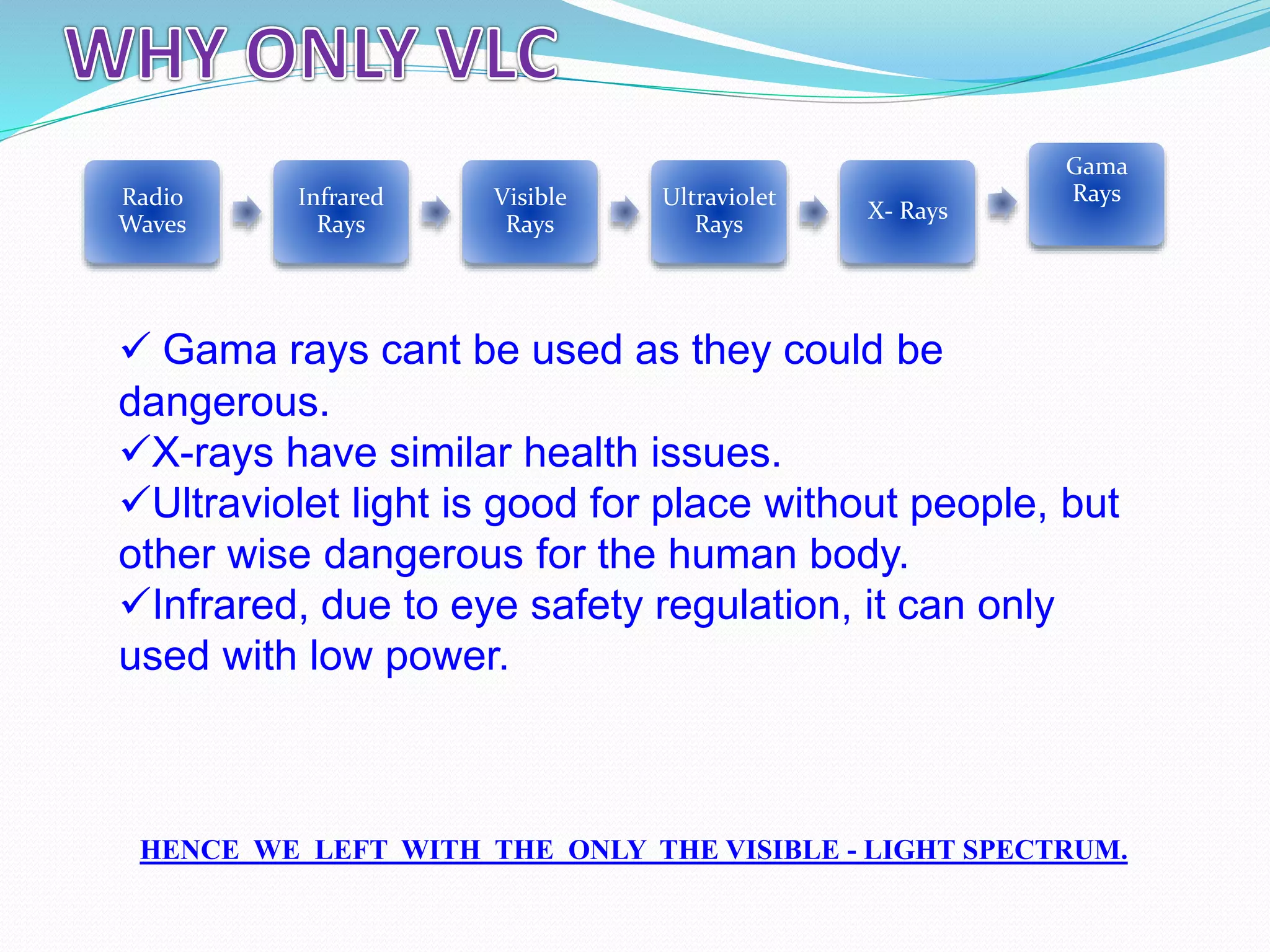
Radio
Waves
Infrared
Rays
Visible
Rays
Ultraviolet
Rays
X- Rays
Gama
Rays
 Gama rays cant be used as they could be
dangerous.
X-rays have similar health issues.
Ultraviolet light is good for place without people, but
other wise dangerous for the human body.
Infrared, due to eye safety regulation, it can only
used with low power.
HENCE WE LEFT WITH THE ONLY THE VISIBLE - LIGHT SPECTRUM.
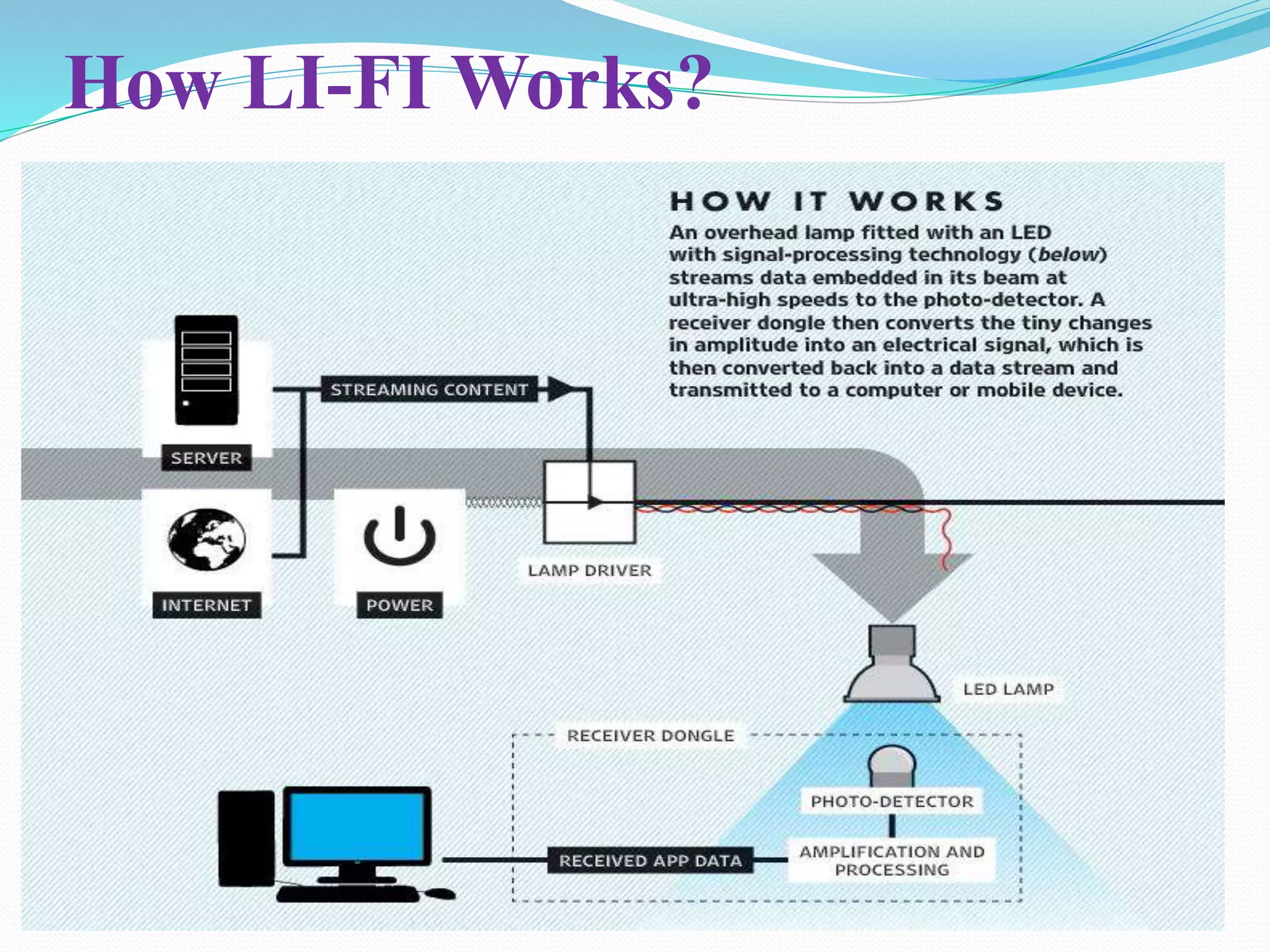
How LI-FI Works?
LI FI CONSTRUCTION
The LI FI product consists of 4 primary sub-
assemblies:
• Bulb
• RF power amplifier circuit (PA)
• Printed circuit board (PCB)
• Enclosure
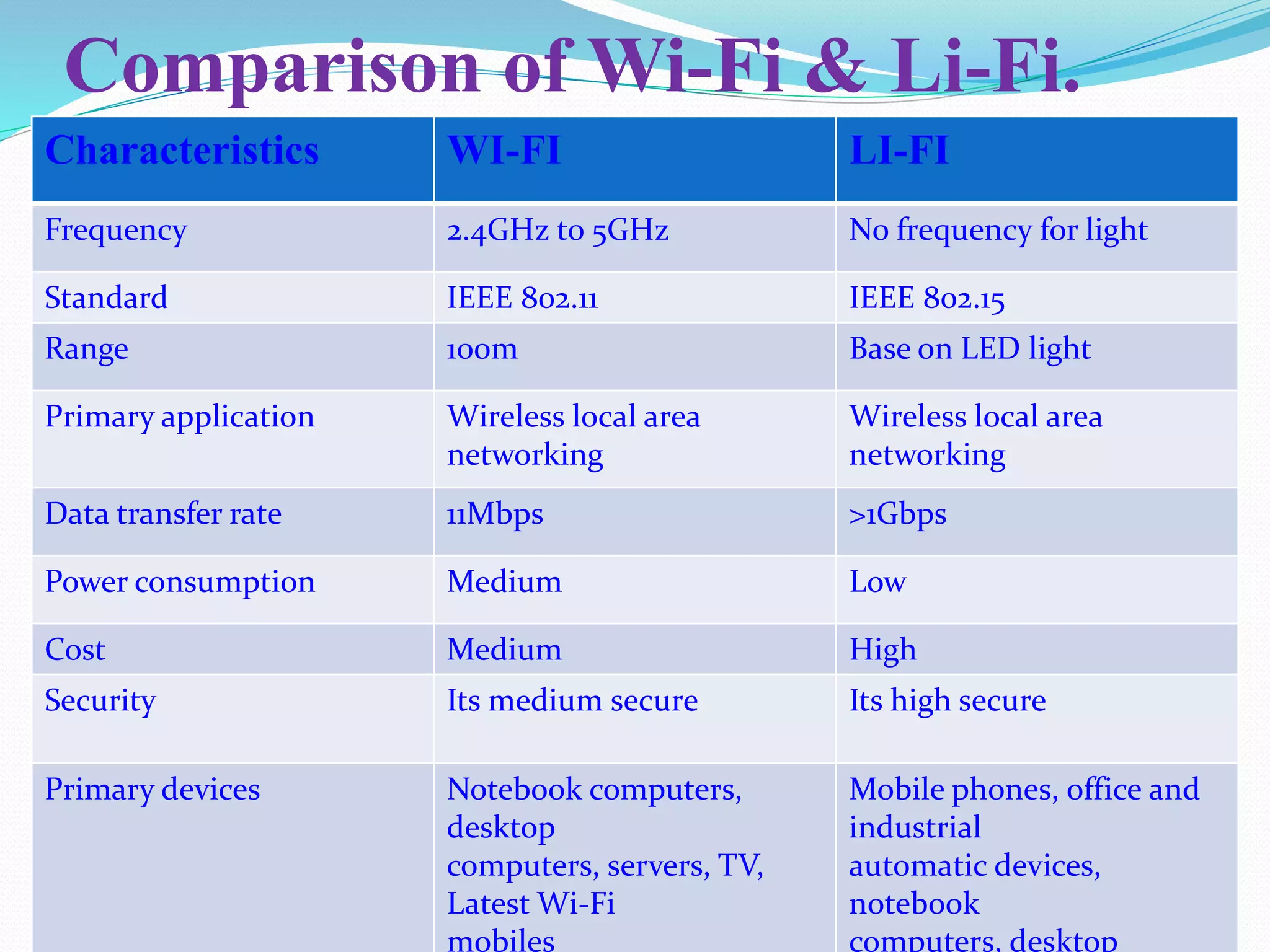
Characteristics WI-FI LI-FI
Frequency 2.4GHz to 5GHz No frequency for light
Standard IEEE 802.11 IEEE 802.15
Range 100m Base on LED light
Primary application Wireless local area
networking
Wireless local area
networking
Data transfer rate 11Mbps >1Gbps
Power consumption Medium Low
Cost Medium High
Security Its medium secure Its high secure
Primary devices Notebook computers,
desktop
computers, servers, TV,
Latest Wi-Fi
mobiles
Mobile phones, office and
industrial
automatic devices,
notebook
computers, desktop
Comparison of Wi-Fi & Li-Fi.
Long service life (10-15 years while usual bulbs last 1-2
years)
Energy Saving (8W LED bulb=60W ordinary Bulb)
Light emitting Diodes are a source of light (release large
amount of energy in the form of light)
Can be switched on/off at very high speed
Energy Efficiency
High speed data transfer
It’s main advantage is it’s bandwidth, It is 10,000 times
than the radio waves
Cost Benefits
Advantages of LI-FI Technology
Disadvantages of LI-FI technology
 The main drawback in LI-FI is power consumption.
 Light signals not easily move just like as radio signals
they will follow certain path so it is also draw back of
LI-FI.
Application area of LI-FI technology
1. Health Technologies
2. Airlines
3. Power plants
4. Under sea working
5. Various other areas
6. Green Information technology
7. Increase Communication safety
8. Multi User Communication
9. Lightings points used as Hotspot
Conclusion
 Possibilities for future utilization are abundant.
Every light bulb can be converted into li-fi signal
receptor to transfer data and we could proceed toward
the cleaner, safer, greener and brighter future.
 The possibilities are numerous and can be explored
further. If this technology can be put into practical use,
every bulb can be used something like a Wi-Fi hotspots to
transmit wireless data.
FUTURE ENHANCEMENT
 Further enhancements like using an array of LEDs for
parallel data transmission or using mixture of red,
green and blue LEDs to alter the light’s frequency with
each frequency encoding a different data channels can
be made.
 Such advancements promise a theoretical speed of 10
Gb/s- means one can download a full high definition
film in just 30 seconds.
Reference
 M. Afghani, H. Haas, H. Elgala, and D. Knipp, “Visible
Light Communication using OFDM” in Proc. of the
2nd International Conference on Testbeds and
Research Infrastructures for the Development of
Networks and Communities (TRIDENTCOM),
Barcelona, Spain, March 1-3 2006, pp. 129-134.
http://www.electronicsforu.com/electronicsforu/circu
itarchives/view_articl asp?sno=778&title%20=%20Li-
Fi%3A+A+New+Paradigm+in+Wireless+Communicati
on&b_type=new&I =12042
 http://en.wikipedia.org/wiki/Li-Fi
THANK YOU

Lifi ppt

  • 1.
    SEMINAR ON LI-FI Under theguidance of Asst. prof GIRISH KUMAR D Presented by KOTESHWAR RAO M (3BR11IS017)
  • 2.
    WHAT IS LI-FI? LI-FI is transmission of data through illumination, i.e. sending data through a LED light bulb that varies in intensity faster than human eye can follow  LI FI- LIGHT FIDEALITY
  • 3.
    INTRODUCTION Li-Fi is nowpart of visible light communication (VLC). Professor Harald Haas, from the University of Edinburgh in the UK, is widely recognized as the original founder of Li-Fi. He coined the term Li-Fi and is Chair of Mobile Communications at the University of Edinburgh and co-founder of pure LiFi.
  • 4.
    Continued…  In simpleterms, Li-Fi can be thought of as a light-based Wi-Fi.  Instead of Wi-Fi modems, Li-Fi would use transceiver- fitted LED lamps that can light a room as well as transmit and receive information.
  • 5.
    PRESENT SCENARIO Radio Spectrumis congested but the demand for wireless data double each year .Every thing, it seems want to use wireless data but the capacity is drying up. 1.4 Million 5 Billion
  • 8.
    Radio Waves Infrared Rays Visible Rays Ultraviolet Rays X- Rays Gama Rays  Gamarays cant be used as they could be dangerous. X-rays have similar health issues. Ultraviolet light is good for place without people, but other wise dangerous for the human body. Infrared, due to eye safety regulation, it can only used with low power. HENCE WE LEFT WITH THE ONLY THE VISIBLE - LIGHT SPECTRUM.
  • 11.
  • 14.
    LI FI CONSTRUCTION TheLI FI product consists of 4 primary sub- assemblies: • Bulb • RF power amplifier circuit (PA) • Printed circuit board (PCB) • Enclosure
  • 16.
    Characteristics WI-FI LI-FI Frequency2.4GHz to 5GHz No frequency for light Standard IEEE 802.11 IEEE 802.15 Range 100m Base on LED light Primary application Wireless local area networking Wireless local area networking Data transfer rate 11Mbps >1Gbps Power consumption Medium Low Cost Medium High Security Its medium secure Its high secure Primary devices Notebook computers, desktop computers, servers, TV, Latest Wi-Fi mobiles Mobile phones, office and industrial automatic devices, notebook computers, desktop Comparison of Wi-Fi & Li-Fi.
  • 18.
    Long service life(10-15 years while usual bulbs last 1-2 years) Energy Saving (8W LED bulb=60W ordinary Bulb) Light emitting Diodes are a source of light (release large amount of energy in the form of light) Can be switched on/off at very high speed Energy Efficiency High speed data transfer It’s main advantage is it’s bandwidth, It is 10,000 times than the radio waves Cost Benefits Advantages of LI-FI Technology
  • 19.
    Disadvantages of LI-FItechnology  The main drawback in LI-FI is power consumption.  Light signals not easily move just like as radio signals they will follow certain path so it is also draw back of LI-FI.
  • 20.
    Application area ofLI-FI technology 1. Health Technologies 2. Airlines 3. Power plants 4. Under sea working 5. Various other areas 6. Green Information technology 7. Increase Communication safety 8. Multi User Communication 9. Lightings points used as Hotspot
  • 21.
    Conclusion  Possibilities forfuture utilization are abundant. Every light bulb can be converted into li-fi signal receptor to transfer data and we could proceed toward the cleaner, safer, greener and brighter future.  The possibilities are numerous and can be explored further. If this technology can be put into practical use, every bulb can be used something like a Wi-Fi hotspots to transmit wireless data.
  • 22.
    FUTURE ENHANCEMENT  Furtherenhancements like using an array of LEDs for parallel data transmission or using mixture of red, green and blue LEDs to alter the light’s frequency with each frequency encoding a different data channels can be made.  Such advancements promise a theoretical speed of 10 Gb/s- means one can download a full high definition film in just 30 seconds.
  • 23.
    Reference  M. Afghani,H. Haas, H. Elgala, and D. Knipp, “Visible Light Communication using OFDM” in Proc. of the 2nd International Conference on Testbeds and Research Infrastructures for the Development of Networks and Communities (TRIDENTCOM), Barcelona, Spain, March 1-3 2006, pp. 129-134. http://www.electronicsforu.com/electronicsforu/circu itarchives/view_articl asp?sno=778&title%20=%20Li- Fi%3A+A+New+Paradigm+in+Wireless+Communicati on&b_type=new&I =12042  http://en.wikipedia.org/wiki/Li-Fi
  • 24.