Electrocardiogram Lilong Tang M.D., Ph.D Department of Cardiology The First Affiliated Hospital  Sun Yat-sen University
 
ECG ( EKG ) is Useful in the Diagnosis of Different kinds of arrhythmia; Enlargement or hypertrophy of atria or ventricles; Myocardial ischemia, injury, infarction; Pericarditis; Effects of some drugs ( Digitalis, Quinidine,  Amiodarone,  etc. ); Disturbance of electrolyte metabolism ( hypokalemia, hyperkalemia, hypocalcemia, hypercalcemia, etc. )
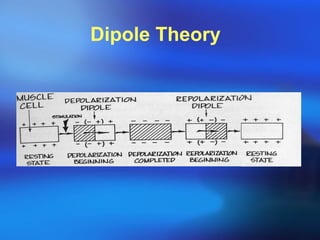
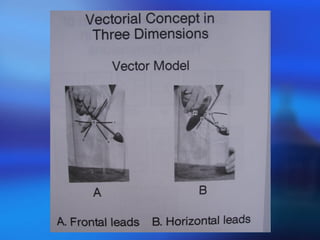
Dipole Theory
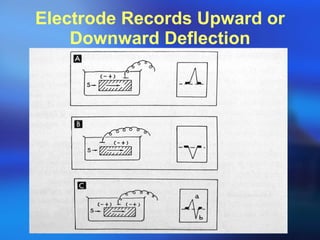
Electrode Records Upward or Downward Deflection
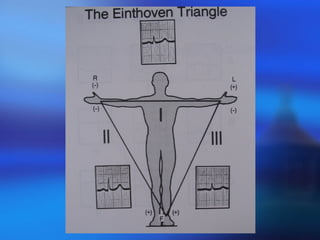
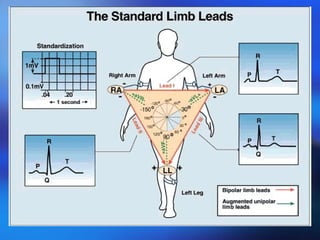
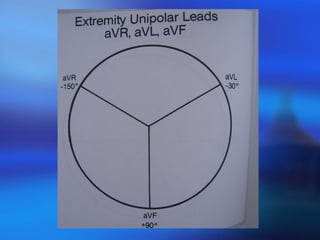
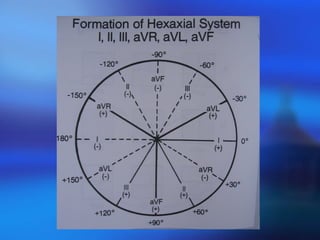
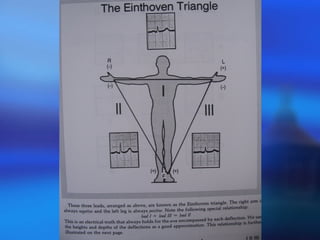
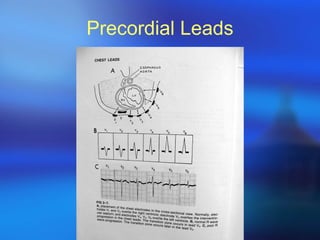
ECG Leads Standard limb leads:  Ⅰ, Ⅱ, Ⅲ ( Augmented ) Unipolar limb leads: aVR, aVL, aVF Chest ( precordial ) leads: V1~V6.


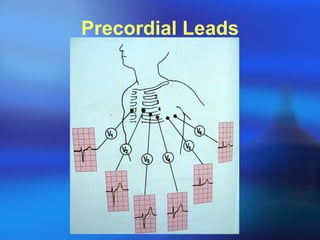
Precordial Leads
 
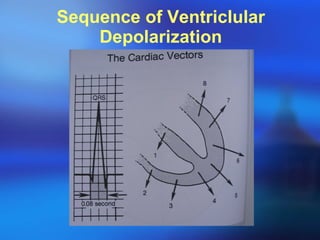
Sequence of Ventriclular Depolarization
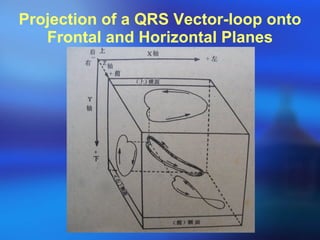
Projection of a QRS Vector-loop onto Frontal and Horizontal Planes
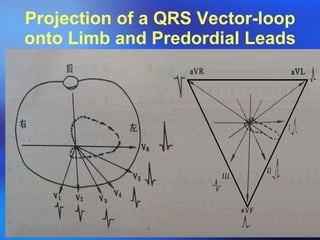
Projection of a QRS Vector-loop onto Limb and Predordial Leads
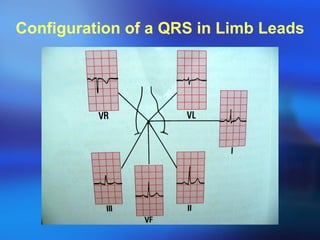
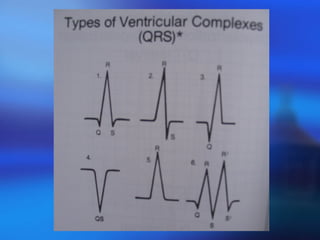
Configuration of a QRS in Limb Leads
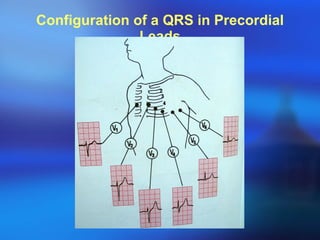
Configuration of a QRS in Precordial Leads
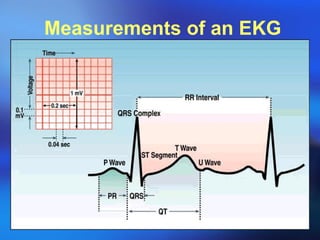
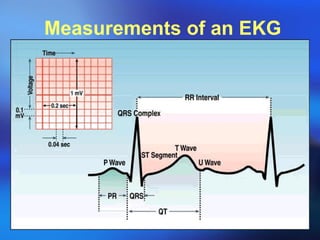
Measurements of an EKG
 
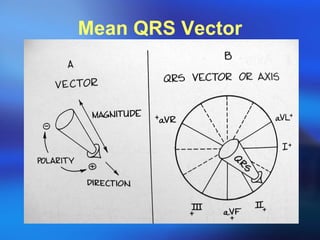
Mean QRS Vector
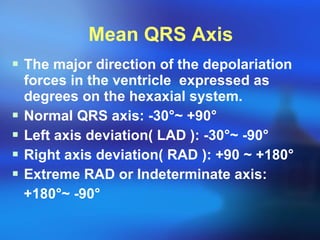
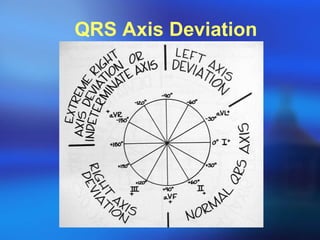
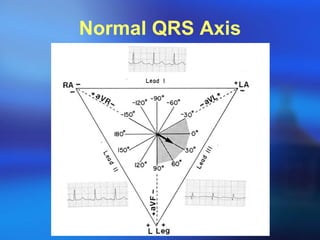
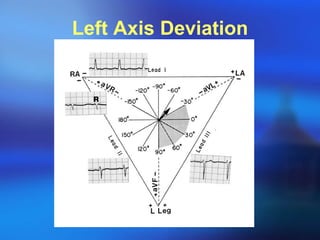
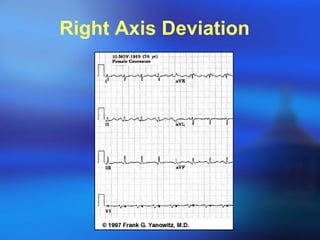
Mean QRS Axis The major direction of the depolariation forces in the ventricle  expressed as degrees on the hexaxial system. Normal QRS axis: -30 ° ~ +90 ° Left axis deviation( LAD ): -30 ° ~ -90 ° Right axis deviation( RAD ): +90 ~ +180 ° Extreme RAD or Indeterminate axis: +180 ° ~ -90 °
QRS Axis Deviation
Normal QRS Axis
Left Axis Deviation
Right Axis Deviation
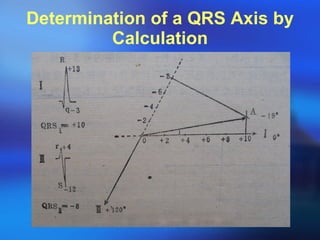
Determination of a QRS Axis by Calculation
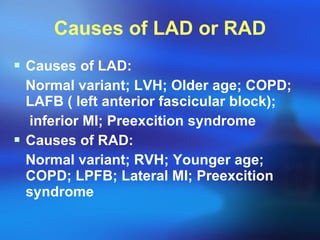
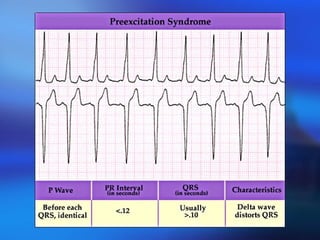
Causes of LAD or RAD Causes of LAD: Normal variant; LVH; Older age; COPD; LAFB ( left anterior fascicular block);  inferior MI; Preexcition syndrome Causes of RAD: Normal variant; RVH; Younger age; COPD; LPFB; Lateral MI; Preexcition syndrome
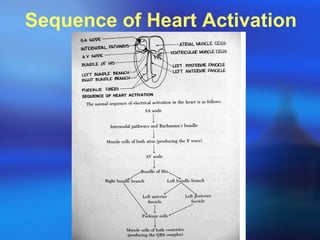
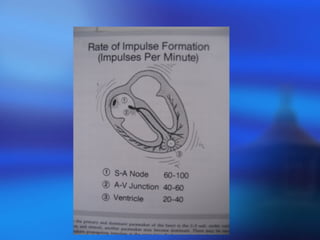
Sequence of Heart Activation
Measurements of an EKG
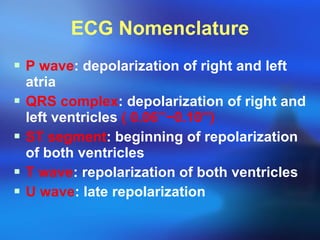
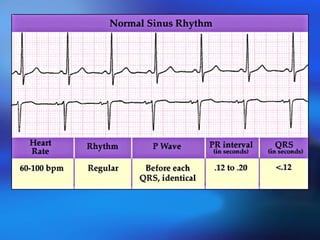
ECG Nomenclature P wave : depolarization of right and left atria QRS complex : depolarization of right and left ventricles  ( 0.06’’~0.10’’) ST segment : beginning of repolarization of both ventricles T wave : repolarization of both ventricles U wave : late repolarization
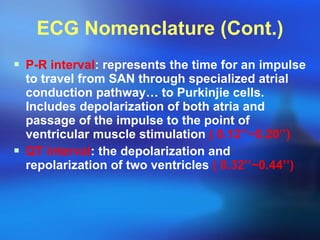
ECG Nomenclature (Cont.) P-R interval : represents the time for an impulse to travel from SAN through specialized atrial conduction pathway… to Purkinjie cells. Includes depolarization of both atria and passage of the impulse to the point of ventricular muscle stimulation  ( 0.12’’~0.20’’) QT interval : the depolarization and repolarization of two ventricles  ( 0.32’’~0.44’’)
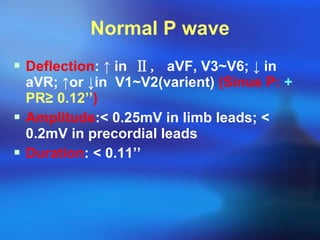
Normal P wave Deflection :  ↑  in  Ⅱ,  aVF, V3~V6;  ↓  in aVR;  ↑or ↓in  V1~V2(varient)  (Sinus P:  +   PR ≥  0.12’’ ) Amplitude : <  0.25mV in limb leads;  <  0.2mV in precordial leads  Duration :  <  0.11’’
 
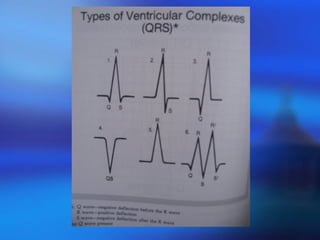
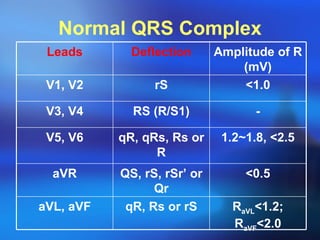
Normal QRS Complex R aVL < 1.2; R aVF < 2.0 qR, Rs or rS aVL, aVF < 0.5 QS, rS, rSr’ or Qr aVR 1.2~1.8,  < 2.5 qR, qRs, Rs or R V5, V6 - RS (R/S1) V3, V4 < 1.0 rS V1, V2 Amplitude of R (mV) Deflection Leads
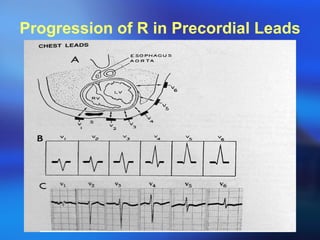
Progression of R in Precordial Leads
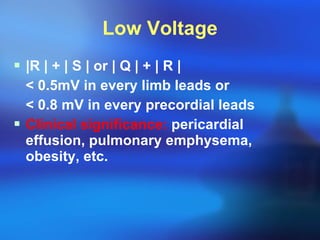
Low Voltage | R  |  +  |  S  |  or  |  Q  |  +  |  R  |   <  0.5mV in every limb leads or  <  0.8 mV in every precordial leads Clinical significance:  pericardial effusion, pulmonary emphysema, obesity, etc.
Abnormal (Pathological) Q Amplitude:   > 1/4R Duration:   > 0.04’’ Clinical significance:  myocadial infarction (MI),  LBBB
T Wave Deflection:  same as the main deflection of QRS in the same lead ( ( ↑ ) in Ⅰ ,  Ⅱ, and  V4~V6; ( ↓ ) in aVR; ( ↑ ) or (+/-) or ( ↓ ) in  Ⅲ, aVL, aVF, V1~V3 Amplitude:   > 1/10 R, 1.2~1.5mV in precordial leads( T V1 < 0.4mV)
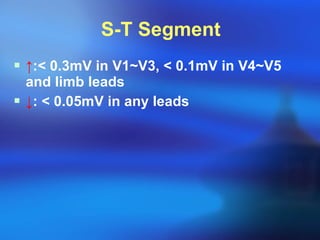
S-T Segment ↑ : <  0.3mV in V1~V3,  <  0.1mV in V4~V5 and limb leads ↓ :  <  0.05mV in any leads
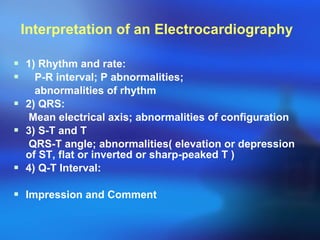
Interpretation of an Electrocardiography  1) Rhythm and rate: P-R interval; P abnormalities;  abnormalities of rhythm 2) QRS: Mean electrical axis; abnormalities of configuration 3) S-T and T QRS-T angle; abnormalities( elevation or depression of ST, flat or inverted or sharp-peaked T ) 4) Q-T Interval: Impression and Comment
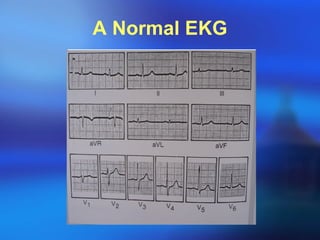
A Normal EKG
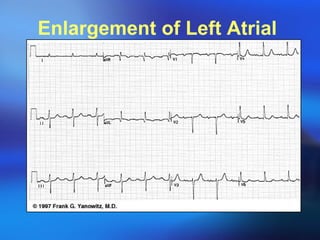
Enlargement of Left Atrial
 
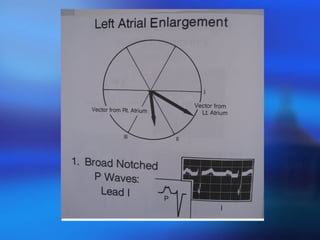
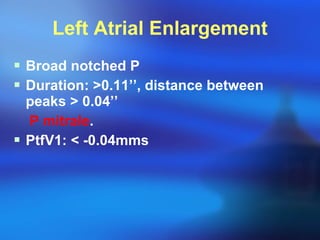
Left Atrial Enlargement Broad notched P Duration:  > 0.11’’, distance between peaks  >  0.04’’ P mitrale . PtfV1:  <  -0.04mms
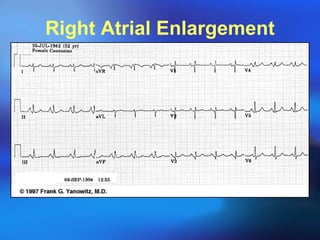
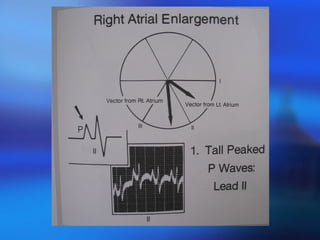
Right Atrial Enlargement
 
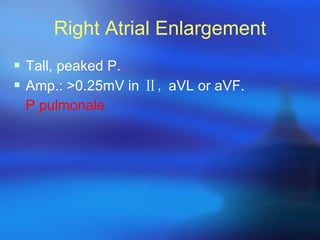
Right Atrial Enlargement Tall, peaked P. Amp.:  > 0.25mV in  Ⅱ,  aVL or aVF. P pulmonale
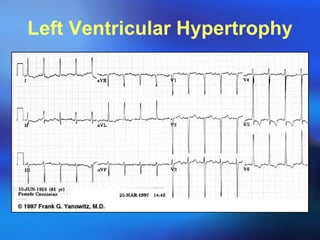
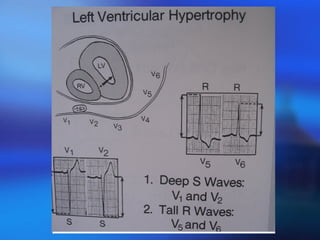
Left Ventricular Hypertrophy
 
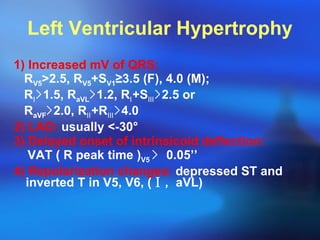
Left Ventricular Hypertrophy 1) Increased mV of QRS: R V5 > 2.5, R V5 +S V1 ≥ 3.5 (F), 4.0 (M);  R Ⅰ > 1.5, R aVL > 1.2, R Ⅰ +S Ⅲ > 2.5 or R aVF > 2.0, R Ⅱ +R Ⅲ > 4.0 2) LAD:  usually  < -30 ° 3) Delayed onset of intrinsicoid deflection:   VAT ( R peak time ) V5  >  0.05’’ 4) Repolarization changes:  depressed ST and inverted T in V5, V6, ( Ⅰ,  aVL)
Right Ventricular Hypertrophy
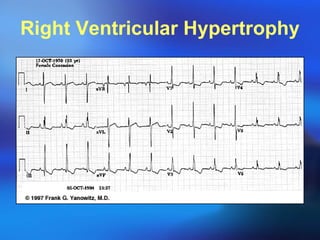
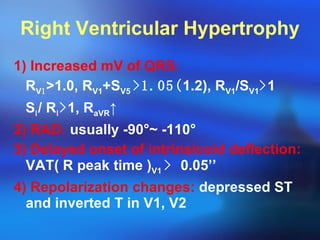
Right Ventricular Hypertrophy 1) Increased mV of QRS: R V 1 > 1.0, R V1 +S V5  >1.05( 1.2), R V1 /S V1 > 1 S Ⅰ / R Ⅰ > 1, R aVR ↑ 2) RAD:  usually -90 ° ~ -110 ° 3) Delayed onset of intrinsicoid deflection:  VAT( R peak time ) V1  >  0.05’’ 4) Repolarization changes:  depressed ST and inverted T in V1, V2
 
AMI-99


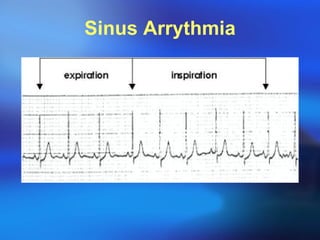
Sinus Arrythmia Sinus P; PRx-PRn ≥ 0.12’’ Clinical Significance: None
Sinus Arrythmia
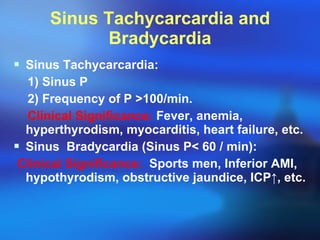
Sinus Tachycarcardia and Bradycardia Sinus Tachycarcardia: 1) Sinus P 2) Frequency of P  > 100/min. Clinical Significance:  Fever, anemia,  hyperthyrodism, myocarditis, heart failure, etc. Sinus  Bradycardia (Sinus P < 60 / min ): Clinical Significance:   Sports men, Inferior AMI, hypothyrodism, obstructive jaundice, ICP ↑, etc.
 
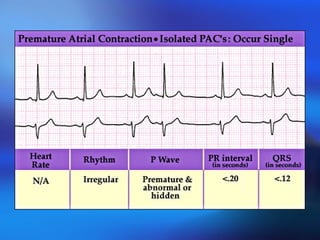
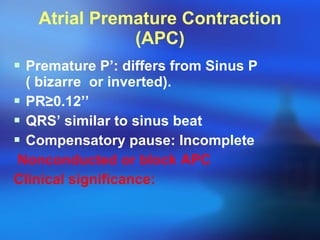
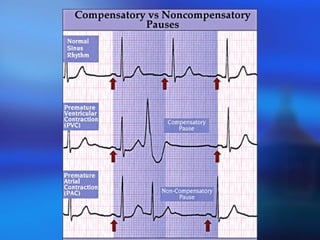
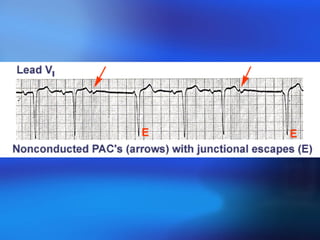
Atrial Premature Contraction (APC) Premature P’: differs from Sinus P ( bizarre  or inverted). PR ≥ 0.12’’ QRS’ similar to sinus beat Compensatory pause: Incomplete Nonconducted or block APC Clinical significance:
 
 
Ventricular Premature Contraction
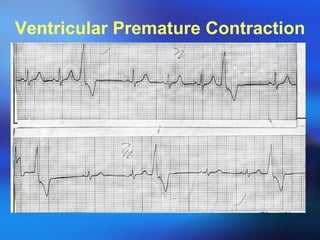
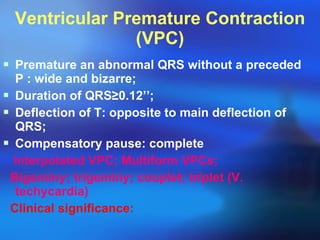
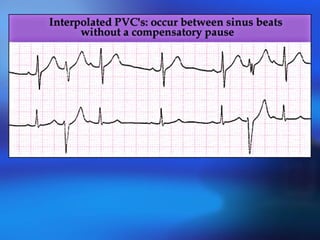
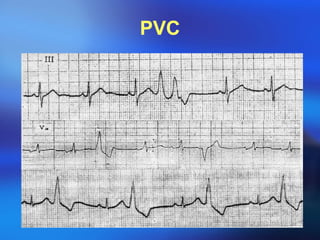
Ventricular Premature Contraction (VPC) Premature an abnormal QRS without a preceded P : wide and bizarre; Duration of QRS ≥ 0.12’’;  Deflection of T: opposite to main deflection of QRS; Compensatory pause: complete Interpolated VPC; Multiform VPCs; Bigeminy; trigeminy; couplet; triplet (V. techycardia) Clinical significance:
 
PVC
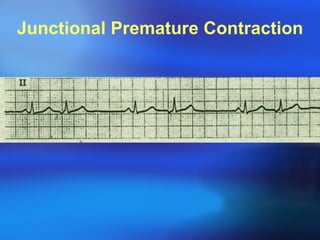
Junctional Premature Contraction
Junctional Premature Contraction (JPC) Premature QRS with or without a  Retrograde P  (P’) (preceding or following QRS); P’-QRS < 0.12’’ or QRS-P’  < 0.20’’; Compensatory pause: Completed or incompleted. Clinical Significance:
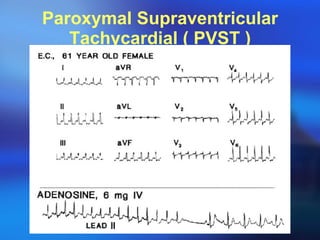
Paroxymal Supraventricular Tachycardial ( PVST )
Supraventricular Paroxysmal Tachycardia Frequency of QRS > 140 (160)/min; Rhythm: regularly; Duration of QRS:  ≤ 0.10’’. Clinical significance:
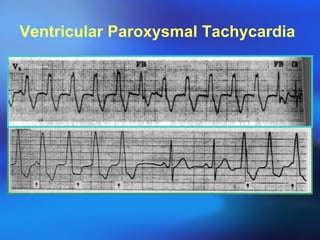
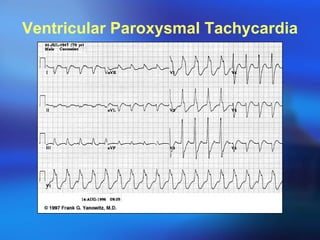
Ventricular Paroxysmal Tachycardia
Ventricular Paroxysmal Tachycardia ≥   3 rapid and continuous PVC; Frequency: 140~200/min ( faster than P); Shape of QRS: wide, bizarre, t ≥ 0.12’’; Deflection of T: Ventricular capture or Fusion. Clinical significance:
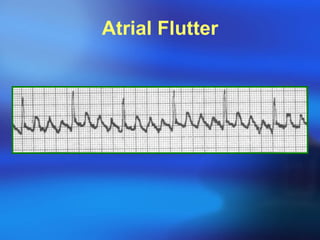
Atrial Flutter
 
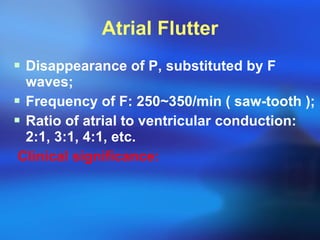
Atrial Flutter Disappearance of P,  substituted by F waves; Frequency of F: 250~350/min ( saw-tooth ); Ratio of atrial to ventricular conduction: 2:1, 3:1, 4:1, etc. Clinical significance:
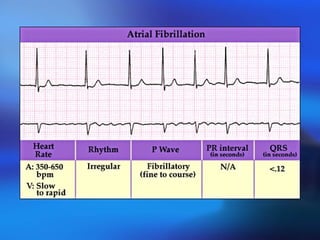
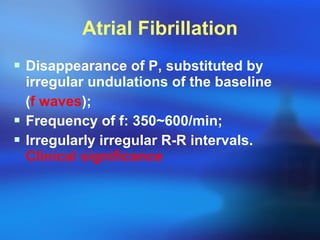
Atrial Fibrillation Disappearance of P,  substituted by irregular undulations of the baseline  ( f waves ); Frequency of f: 350~600/min; Irregularly irregular R-R intervals.  Clinical significance
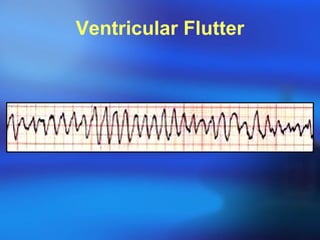
Ventricular Flutter
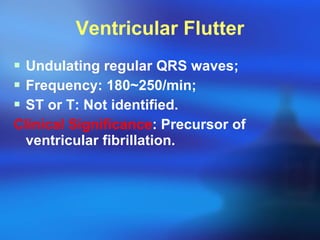
Ventricular Flutter Undulating regular QRS waves; Frequency: 180~250/min; ST or T: Not identified. Clinical Significance : Precursor of ventricular fibrillation.
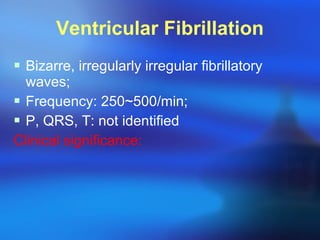
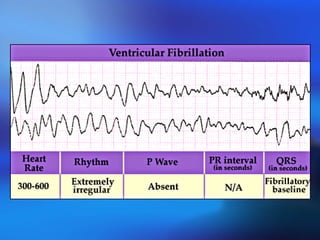
Ventricular Fibrillation Bizarre, irregularly irregular fibrillatory waves; Frequency: 250~500/min; P, QRS, T: not identified Clinical significance:
 
 
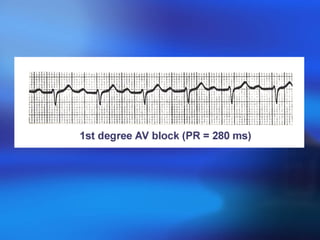
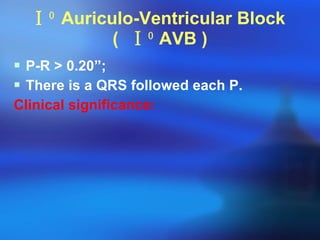
Ⅰ 0  Auriculo-Ventricular Block  (  Ⅰ 0  AVB ) P-R  >  0.20”; There is a QRS followed each P. Clinical significance:
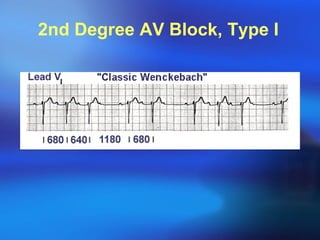
2nd Degree AV Block, Type I
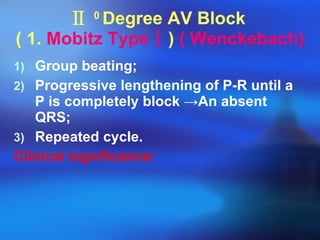
Ⅱ   0  Degree AV Block  ( 1.  Mobitz Type Ⅰ )  ( Wenckebach) Group beating; Progressive lengthening of P-R until a P is completely block  ->An absent QRS; Repeated cycle. Clinical significance:
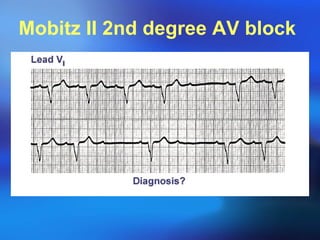
Mobitz II 2nd degree AV block
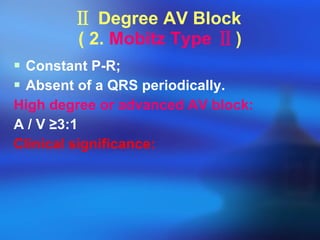
Ⅱ   Degree AV Block  ( 2.  Mobitz Type  Ⅱ ) Constant P-R; Absent of a QRS periodically. High degree or advanced AV block:   A / V  ≥ 3:1 Clinical significance:
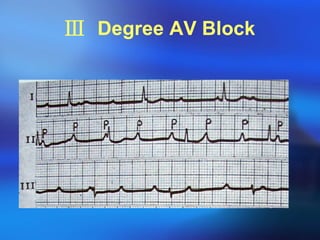
Ⅲ  Degree AV Block
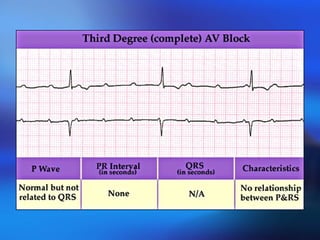
Ⅲ  Degree AV Block  ( Complete AV Block ) The atria ( P waves ) beat independently of the ventricles ( QRS ) Atrial rate is faster than ventricular rate ( escape rhythm ) Clinical significance:  Drugs ( digoxin… ), degeneration from aging, AMI, etc.
 
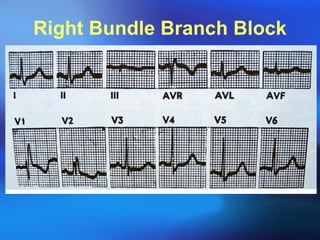
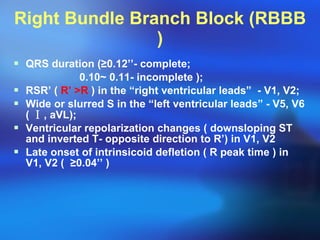
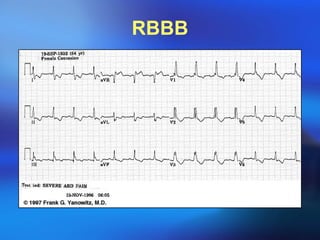
Right Bundle Branch Block
Right Bundle Branch Block (RBBB ) QRS duration ( ≥ 0.12’’- complete; 0.10~ 0.11- incomplete ); RSR’ (  R’  > R  ) in the “right ventricular leads”  - V1, V2; Wide or slurred S in the “left ventricular leads” - V5, V6 (  Ⅰ , aVL); Ventricular repolarization changes ( downsloping ST and inverted T- opposite direction to R’) in V1, V2 Late onset of intrinsicoid defletion ( R peak time ) in V1, V2 (  ≥ 0.04’’ )
RBBB
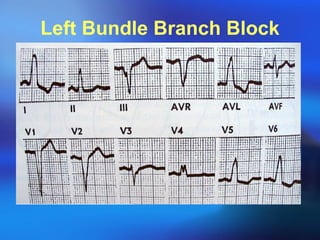
Left Bundle Branch Block
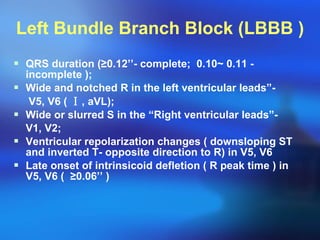
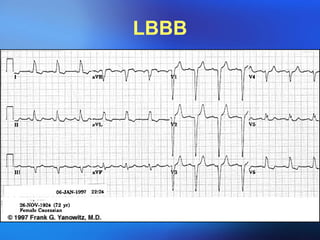
Left Bundle Branch Block (LBBB ) QRS duration ( ≥ 0.12’’- complete;  0.10~ 0.11 - incomplete ); Wide and notched R in the left ventricular leads”-  V5, V6 (  Ⅰ , aVL); Wide or slurred S in the “Right ventricular leads”-  V1, V2; Ventricular repolarization changes ( downsloping ST and inverted T- opposite direction to R) in V5, V6 Late onset of intrinsicoid defletion ( R peak time ) in V5, V6 (  ≥ 0.06’’ )
LBBB
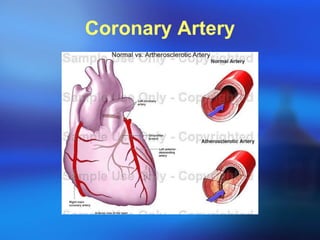
Coronary Artery
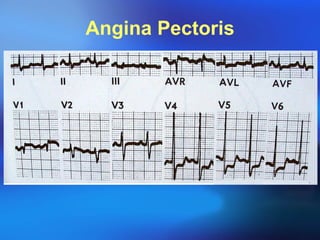
Angina Pectoris
Classic Angina Pectoris  (  Transient subendocardial ischemia )  Depression of ST; ( flat or inverted T )
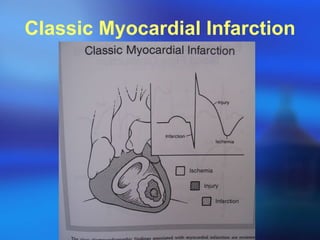
Classic Myocardial Infarction
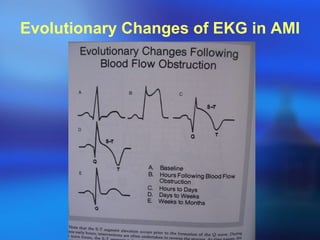
Evolutionary Changes of EKG in AMI
Stages of MI Hyperacute; Acute; Subacute; Old.
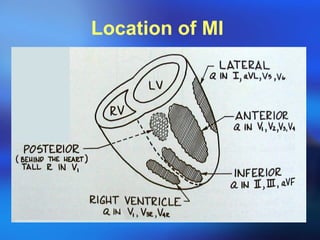
Location of MI
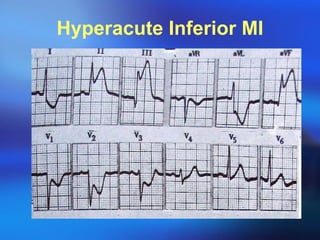
Hyperacute Inferior MI
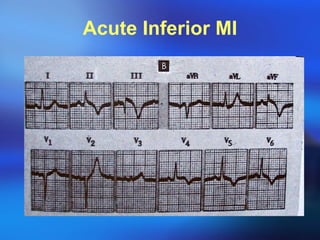
Acute Inferior MI
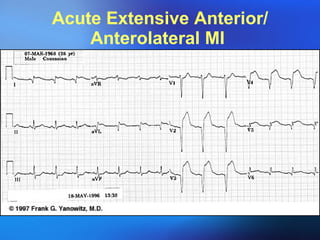
Acute Extensive Anterior/ Anterolateral MI
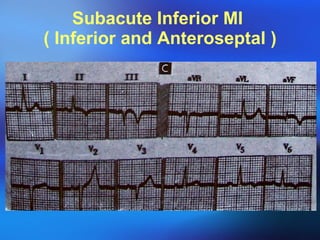
Subacute Inferior MI  ( Inferior and Anteroseptal )
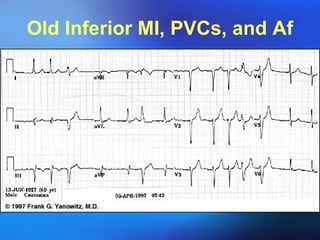
Old Inferior MI, PVCs, and Af
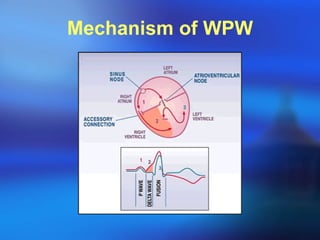
Mechanism of WPW
 
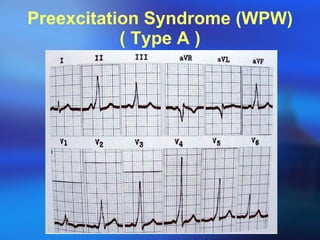
Preexcitation Syndrome (WPW) ( Type A )
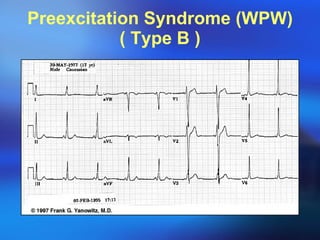
Preexcitation Syndrome (WPW) ( Type B )
Thank You  !
 
 
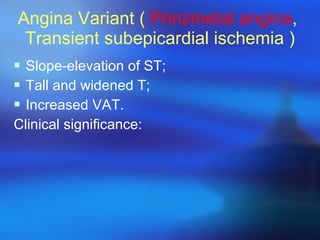
Angina Variant (  Prinzmetal angina ,  Transient subepicardial ischemia ) Slope-elevation of ST; Tall and widened T; Increased VAT. Clinical significance:
Precordial Leads
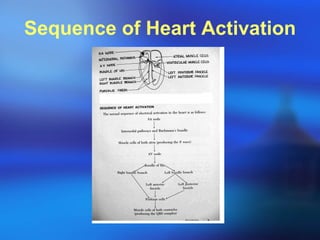
Sequence of Heart Activation

Cardiovascular System

  • 1.
    Electrocardiogram Lilong TangM.D., Ph.D Department of Cardiology The First Affiliated Hospital Sun Yat-sen University
  • 2.
  • 3.
    ECG ( EKG) is Useful in the Diagnosis of Different kinds of arrhythmia; Enlargement or hypertrophy of atria or ventricles; Myocardial ischemia, injury, infarction; Pericarditis; Effects of some drugs ( Digitalis, Quinidine, Amiodarone, etc. ); Disturbance of electrolyte metabolism ( hypokalemia, hyperkalemia, hypocalcemia, hypercalcemia, etc. )
  • 4.
  • 5.
    Electrode Records Upwardor Downward Deflection
  • 6.
    ECG Leads Standardlimb leads: Ⅰ, Ⅱ, Ⅲ ( Augmented ) Unipolar limb leads: aVR, aVL, aVF Chest ( precordial ) leads: V1~V6.
  • 7.
  • 8.
  • 9.
  • 10.
  • 11.
  • 12.
  • 13.
  • 14.
    Projection of aQRS Vector-loop onto Frontal and Horizontal Planes
  • 15.
    Projection of aQRS Vector-loop onto Limb and Predordial Leads
  • 16.
    Configuration of aQRS in Limb Leads
  • 17.
    Configuration of aQRS in Precordial Leads
  • 18.
  • 19.
  • 20.
  • 21.
    Mean QRS AxisThe major direction of the depolariation forces in the ventricle expressed as degrees on the hexaxial system. Normal QRS axis: -30 ° ~ +90 ° Left axis deviation( LAD ): -30 ° ~ -90 ° Right axis deviation( RAD ): +90 ~ +180 ° Extreme RAD or Indeterminate axis: +180 ° ~ -90 °
  • 22.
  • 23.
  • 24.
  • 25.
  • 26.
    Determination of aQRS Axis by Calculation
  • 27.
    Causes of LADor RAD Causes of LAD: Normal variant; LVH; Older age; COPD; LAFB ( left anterior fascicular block); inferior MI; Preexcition syndrome Causes of RAD: Normal variant; RVH; Younger age; COPD; LPFB; Lateral MI; Preexcition syndrome
  • 28.
  • 29.
  • 30.
    ECG Nomenclature Pwave : depolarization of right and left atria QRS complex : depolarization of right and left ventricles ( 0.06’’~0.10’’) ST segment : beginning of repolarization of both ventricles T wave : repolarization of both ventricles U wave : late repolarization
  • 31.
    ECG Nomenclature (Cont.)P-R interval : represents the time for an impulse to travel from SAN through specialized atrial conduction pathway… to Purkinjie cells. Includes depolarization of both atria and passage of the impulse to the point of ventricular muscle stimulation ( 0.12’’~0.20’’) QT interval : the depolarization and repolarization of two ventricles ( 0.32’’~0.44’’)
  • 32.
    Normal P waveDeflection : ↑ in Ⅱ, aVF, V3~V6; ↓ in aVR; ↑or ↓in V1~V2(varient) (Sinus P: + PR ≥ 0.12’’ ) Amplitude : < 0.25mV in limb leads; < 0.2mV in precordial leads Duration : < 0.11’’
  • 33.
  • 34.
    Normal QRS ComplexR aVL < 1.2; R aVF < 2.0 qR, Rs or rS aVL, aVF < 0.5 QS, rS, rSr’ or Qr aVR 1.2~1.8, < 2.5 qR, qRs, Rs or R V5, V6 - RS (R/S1) V3, V4 < 1.0 rS V1, V2 Amplitude of R (mV) Deflection Leads
  • 35.
    Progression of Rin Precordial Leads
  • 36.
    Low Voltage |R | + | S | or | Q | + | R | < 0.5mV in every limb leads or < 0.8 mV in every precordial leads Clinical significance: pericardial effusion, pulmonary emphysema, obesity, etc.
  • 37.
    Abnormal (Pathological) QAmplitude: > 1/4R Duration: > 0.04’’ Clinical significance: myocadial infarction (MI), LBBB
  • 38.
    T Wave Deflection: same as the main deflection of QRS in the same lead ( ( ↑ ) in Ⅰ , Ⅱ, and V4~V6; ( ↓ ) in aVR; ( ↑ ) or (+/-) or ( ↓ ) in Ⅲ, aVL, aVF, V1~V3 Amplitude: > 1/10 R, 1.2~1.5mV in precordial leads( T V1 < 0.4mV)
  • 39.
    S-T Segment ↑: < 0.3mV in V1~V3, < 0.1mV in V4~V5 and limb leads ↓ : < 0.05mV in any leads
  • 40.
    Interpretation of anElectrocardiography 1) Rhythm and rate: P-R interval; P abnormalities; abnormalities of rhythm 2) QRS: Mean electrical axis; abnormalities of configuration 3) S-T and T QRS-T angle; abnormalities( elevation or depression of ST, flat or inverted or sharp-peaked T ) 4) Q-T Interval: Impression and Comment
  • 41.
  • 42.
  • 43.
  • 44.
    Left Atrial EnlargementBroad notched P Duration: > 0.11’’, distance between peaks > 0.04’’ P mitrale . PtfV1: < -0.04mms
  • 45.
  • 46.
  • 47.
    Right Atrial EnlargementTall, peaked P. Amp.: > 0.25mV in Ⅱ, aVL or aVF. P pulmonale
  • 48.
  • 49.
  • 50.
    Left Ventricular Hypertrophy1) Increased mV of QRS: R V5 > 2.5, R V5 +S V1 ≥ 3.5 (F), 4.0 (M); R Ⅰ > 1.5, R aVL > 1.2, R Ⅰ +S Ⅲ > 2.5 or R aVF > 2.0, R Ⅱ +R Ⅲ > 4.0 2) LAD: usually < -30 ° 3) Delayed onset of intrinsicoid deflection: VAT ( R peak time ) V5 > 0.05’’ 4) Repolarization changes: depressed ST and inverted T in V5, V6, ( Ⅰ, aVL)
  • 51.
  • 52.
    Right Ventricular Hypertrophy1) Increased mV of QRS: R V 1 > 1.0, R V1 +S V5 >1.05( 1.2), R V1 /S V1 > 1 S Ⅰ / R Ⅰ > 1, R aVR ↑ 2) RAD: usually -90 ° ~ -110 ° 3) Delayed onset of intrinsicoid deflection: VAT( R peak time ) V1 > 0.05’’ 4) Repolarization changes: depressed ST and inverted T in V1, V2
  • 53.
  • 54.
  • 55.
  • 56.
  • 57.
  • 58.
    Sinus Arrythmia SinusP; PRx-PRn ≥ 0.12’’ Clinical Significance: None
  • 59.
  • 60.
    Sinus Tachycarcardia andBradycardia Sinus Tachycarcardia: 1) Sinus P 2) Frequency of P > 100/min. Clinical Significance: Fever, anemia, hyperthyrodism, myocarditis, heart failure, etc. Sinus Bradycardia (Sinus P < 60 / min ): Clinical Significance: Sports men, Inferior AMI, hypothyrodism, obstructive jaundice, ICP ↑, etc.
  • 61.
  • 62.
    Atrial Premature Contraction(APC) Premature P’: differs from Sinus P ( bizarre or inverted). PR ≥ 0.12’’ QRS’ similar to sinus beat Compensatory pause: Incomplete Nonconducted or block APC Clinical significance:
  • 63.
  • 64.
  • 65.
  • 66.
    Ventricular Premature Contraction(VPC) Premature an abnormal QRS without a preceded P : wide and bizarre; Duration of QRS ≥ 0.12’’; Deflection of T: opposite to main deflection of QRS; Compensatory pause: complete Interpolated VPC; Multiform VPCs; Bigeminy; trigeminy; couplet; triplet (V. techycardia) Clinical significance:
  • 67.
  • 68.
  • 69.
  • 70.
    Junctional Premature Contraction(JPC) Premature QRS with or without a Retrograde P (P’) (preceding or following QRS); P’-QRS < 0.12’’ or QRS-P’ < 0.20’’; Compensatory pause: Completed or incompleted. Clinical Significance:
  • 71.
  • 72.
    Supraventricular Paroxysmal TachycardiaFrequency of QRS > 140 (160)/min; Rhythm: regularly; Duration of QRS: ≤ 0.10’’. Clinical significance:
  • 73.
  • 74.
  • 75.
    Ventricular Paroxysmal Tachycardia≥ 3 rapid and continuous PVC; Frequency: 140~200/min ( faster than P); Shape of QRS: wide, bizarre, t ≥ 0.12’’; Deflection of T: Ventricular capture or Fusion. Clinical significance:
  • 76.
  • 77.
  • 78.
    Atrial Flutter Disappearanceof P, substituted by F waves; Frequency of F: 250~350/min ( saw-tooth ); Ratio of atrial to ventricular conduction: 2:1, 3:1, 4:1, etc. Clinical significance:
  • 79.
    Atrial Fibrillation Disappearanceof P, substituted by irregular undulations of the baseline ( f waves ); Frequency of f: 350~600/min; Irregularly irregular R-R intervals. Clinical significance
  • 80.
  • 81.
    Ventricular Flutter Undulatingregular QRS waves; Frequency: 180~250/min; ST or T: Not identified. Clinical Significance : Precursor of ventricular fibrillation.
  • 82.
    Ventricular Fibrillation Bizarre,irregularly irregular fibrillatory waves; Frequency: 250~500/min; P, QRS, T: not identified Clinical significance:
  • 83.
  • 84.
  • 85.
    Ⅰ 0 Auriculo-Ventricular Block ( Ⅰ 0 AVB ) P-R > 0.20”; There is a QRS followed each P. Clinical significance:
  • 86.
    2nd Degree AVBlock, Type I
  • 87.
    0 Degree AV Block ( 1. Mobitz Type Ⅰ ) ( Wenckebach) Group beating; Progressive lengthening of P-R until a P is completely block ->An absent QRS; Repeated cycle. Clinical significance:
  • 88.
    Mobitz II 2nddegree AV block
  • 89.
    Degree AV Block ( 2. Mobitz Type Ⅱ ) Constant P-R; Absent of a QRS periodically. High degree or advanced AV block: A / V ≥ 3:1 Clinical significance:
  • 90.
    Ⅲ DegreeAV Block
  • 91.
    Ⅲ DegreeAV Block ( Complete AV Block ) The atria ( P waves ) beat independently of the ventricles ( QRS ) Atrial rate is faster than ventricular rate ( escape rhythm ) Clinical significance: Drugs ( digoxin… ), degeneration from aging, AMI, etc.
  • 92.
  • 93.
  • 94.
    Right Bundle BranchBlock (RBBB ) QRS duration ( ≥ 0.12’’- complete; 0.10~ 0.11- incomplete ); RSR’ ( R’ > R ) in the “right ventricular leads” - V1, V2; Wide or slurred S in the “left ventricular leads” - V5, V6 ( Ⅰ , aVL); Ventricular repolarization changes ( downsloping ST and inverted T- opposite direction to R’) in V1, V2 Late onset of intrinsicoid defletion ( R peak time ) in V1, V2 ( ≥ 0.04’’ )
  • 95.
  • 96.
  • 97.
    Left Bundle BranchBlock (LBBB ) QRS duration ( ≥ 0.12’’- complete; 0.10~ 0.11 - incomplete ); Wide and notched R in the left ventricular leads”- V5, V6 ( Ⅰ , aVL); Wide or slurred S in the “Right ventricular leads”- V1, V2; Ventricular repolarization changes ( downsloping ST and inverted T- opposite direction to R) in V5, V6 Late onset of intrinsicoid defletion ( R peak time ) in V5, V6 ( ≥ 0.06’’ )
  • 98.
  • 99.
  • 100.
  • 101.
    Classic Angina Pectoris ( Transient subendocardial ischemia ) Depression of ST; ( flat or inverted T )
  • 102.
  • 103.
  • 104.
    Stages of MIHyperacute; Acute; Subacute; Old.
  • 105.
  • 106.
  • 107.
  • 108.
    Acute Extensive Anterior/Anterolateral MI
  • 109.
    Subacute Inferior MI ( Inferior and Anteroseptal )
  • 110.
    Old Inferior MI,PVCs, and Af
  • 111.
  • 112.
  • 113.
  • 114.
  • 115.
  • 116.
  • 117.
  • 118.
    Angina Variant ( Prinzmetal angina , Transient subepicardial ischemia ) Slope-elevation of ST; Tall and widened T; Increased VAT. Clinical significance:
  • 119.
  • 120.