QRS INTERVAL
Dr.G.VENKATA RAMANA
MBBS DNB FAMILY MEDICINE
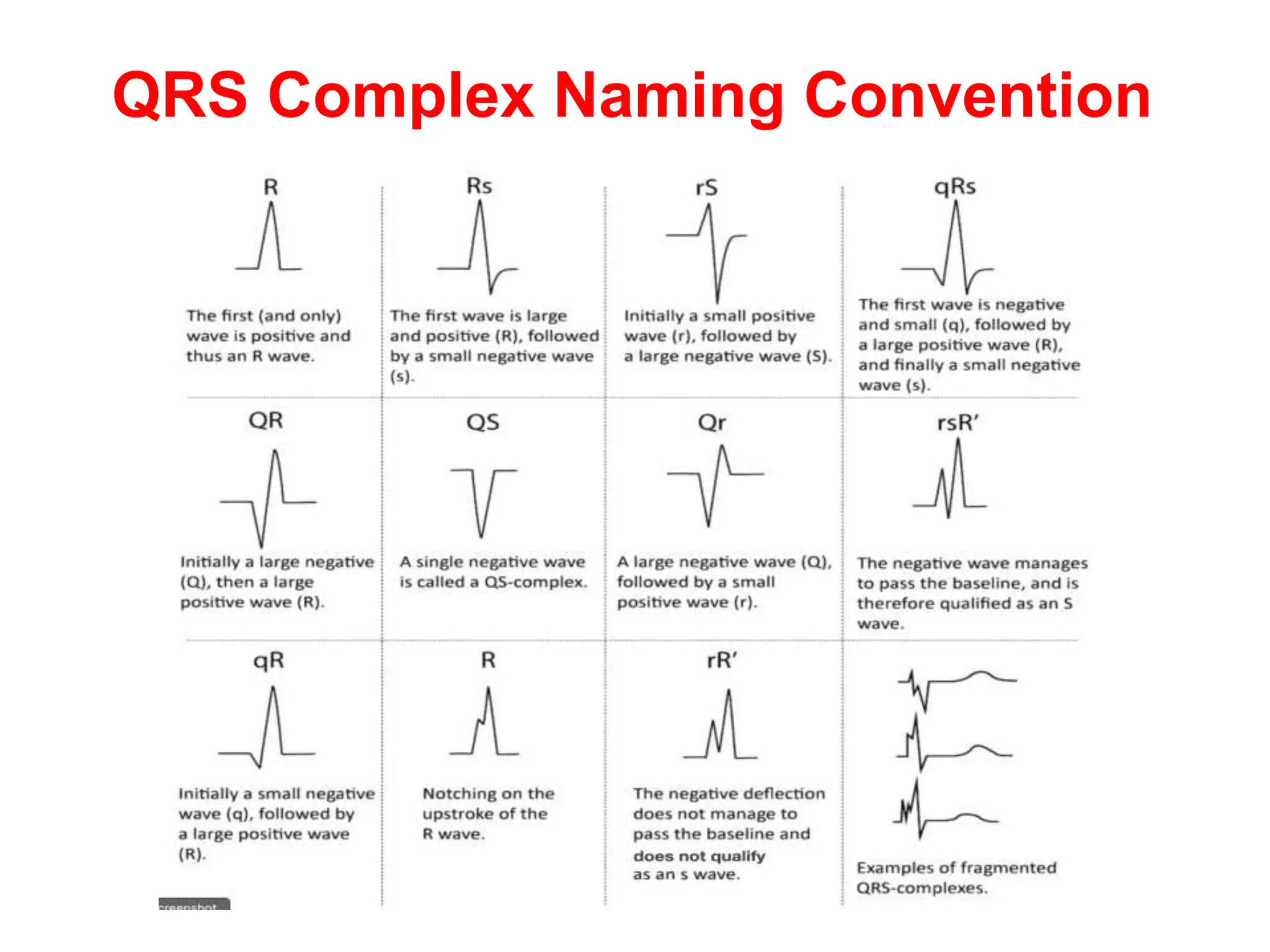
QRS Complex Naming Convention
QRS Complex Morphology
• Main features to consider:
• Are there any pathological Q waves?
• Are any R or S waves too big?
• Is there a dominant R wave in aVR?
• Is there a poor R wave progression?
• Are the QRS complexes too small?
• How is the width of QRS complexes?
• Are any QRS complexes an abnormal shape?
ARE ANY R OR S WAVES TOO BIG?
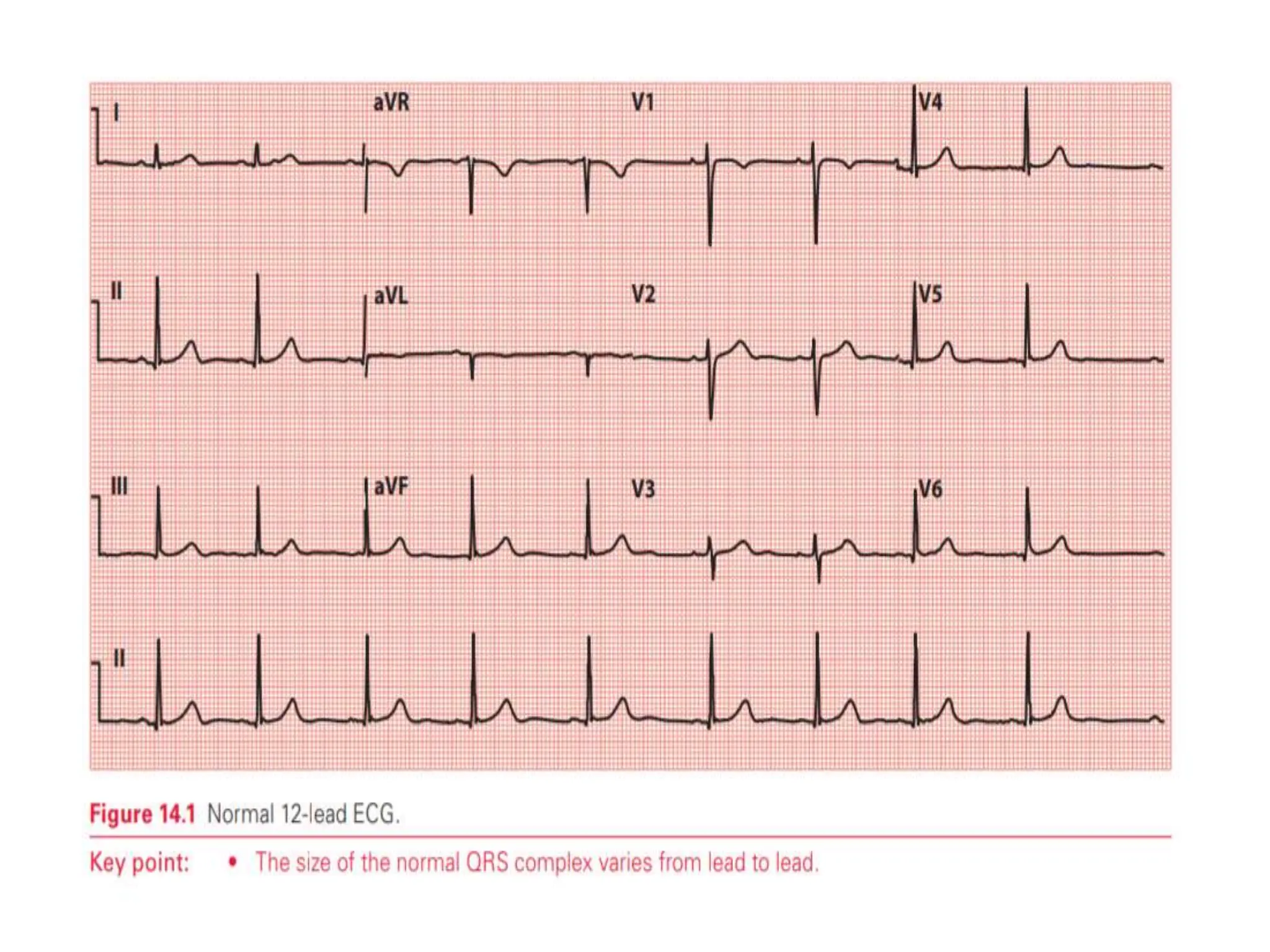
• The height of the R wave and depth of the S wave vary from
lead to lead in the normal ECG
• As a rule, in the normal ECG:
• The R wave increases in height from lead V1 to V5
• The R wave is smaller than the S wave in leads V1 and V2
• The R wave is bigger than the S wave in leads V5 and V6
• The tallest R wave does not exceed 25 mm in height
• The deepest S wave does not exceed 25 mm in depth
• Always look carefully at the R and S waves in each lead,
and check whether they conform to these criteria
• If not, first of all consider:
• Incorrect ECG calibration (should be 1 mV = 10 mm).
• If the calibration is correct, consider whether your
patient has one of the following:
• Left ventricular hypertrophy
• Right ventricular hypertrophy
• Posterior myocardial infarction
• Wolff–Parkinson–White syndrome
• If the QRS complex is also abnormally wide, think of:
• Bundle branch block
Left ventricular hypertrophy
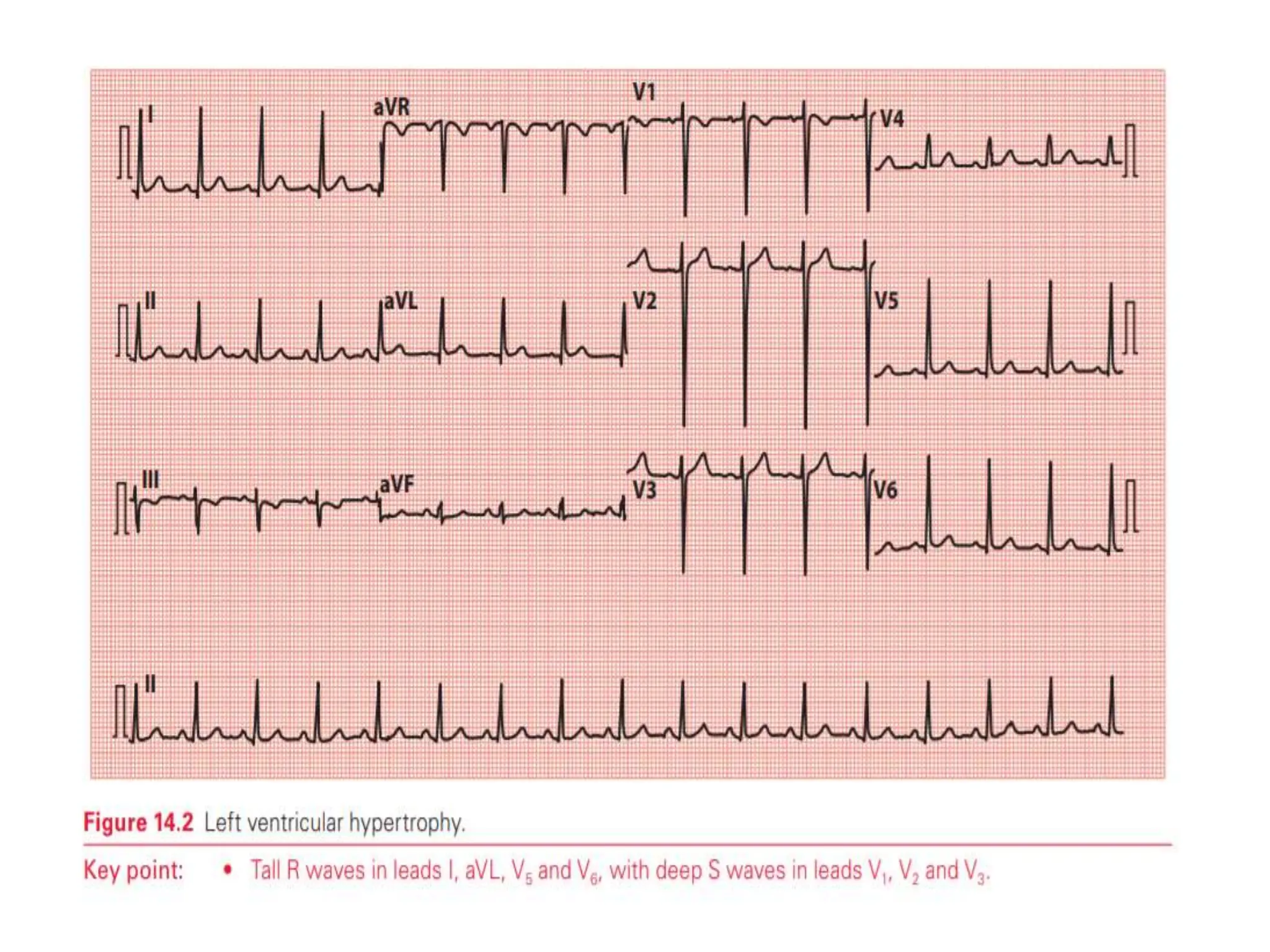
• LVH causes tall R waves in the leads I,aVL,V5 and V6
and the reciprocal change of deep S waves in leads V1
and V2
• Diagnostic criteria for LVH
• In the limb leads:
• R wave >11 mm in lead aVL
• R wave >20 mm in lead aVF
• S wave >14 mm in lead aVR
• Sum of R wave in lead I and S wave in lead III >25 mm.
• In the chest leads:
• R wave of ≥ 25 mm in the left chest leads
• S wave of ≥ 25 mm in the right chest leads
• Sum of S wave in lead V1 and R wave in lead V5 or V6
>35 mm (Sokolow–Lyon criterion)
• Sum of tallest R wave and deepest S wave in the chest
leads >45 mm
• The Cornell criteria involve measuring the S wave in lead V3 and the R
wave in lead aVL
• Left ventricular hypertrophy is indicated by a sum of >28 mm in men and
>20 mm in women
• The Romhilt–Estes scoring system allocates points for the presence of
certain criteria
• A score of 5 indicates left ventricular hypertrophy and a score of 4 indicates
probable left ventricular hypertrophy
• 3 points – for (a) R or S wave in limb leads of ≥20 mm, (b) S wave in right
chest leads of ≥25 mm, or (c) R wave in left chest leads of ≥25 mm
• 3 points – for ST segment and T wave changes (‘typical strain’) in a patient
not taking digitalis (1 point with digitalis)
• 3 points – for P-terminal force in V1 >1 mm deep with a duration >0.04 s
• 2 points – for left axis deviation (beyond –15°)
• 1 point – for QRS complex duration >0.09 s
• 1 point – for intrinsicoid deflection (the interval from the start of the QRS
complex to the peak of the R wave) in V5 or V6 >0.05 s
• If there is evidence of left ventricular hypertrophy on the
ECG, look also for evidence of ‘strain’:
• ST segment depression
• T wave inversion
• Causes of left ventricular hypertrophy
• Hypertension
• Aortic stenosis
• Coarctation of the aorta
• Hypertrophic cardiomyopathy
Right ventricular hypertrophy
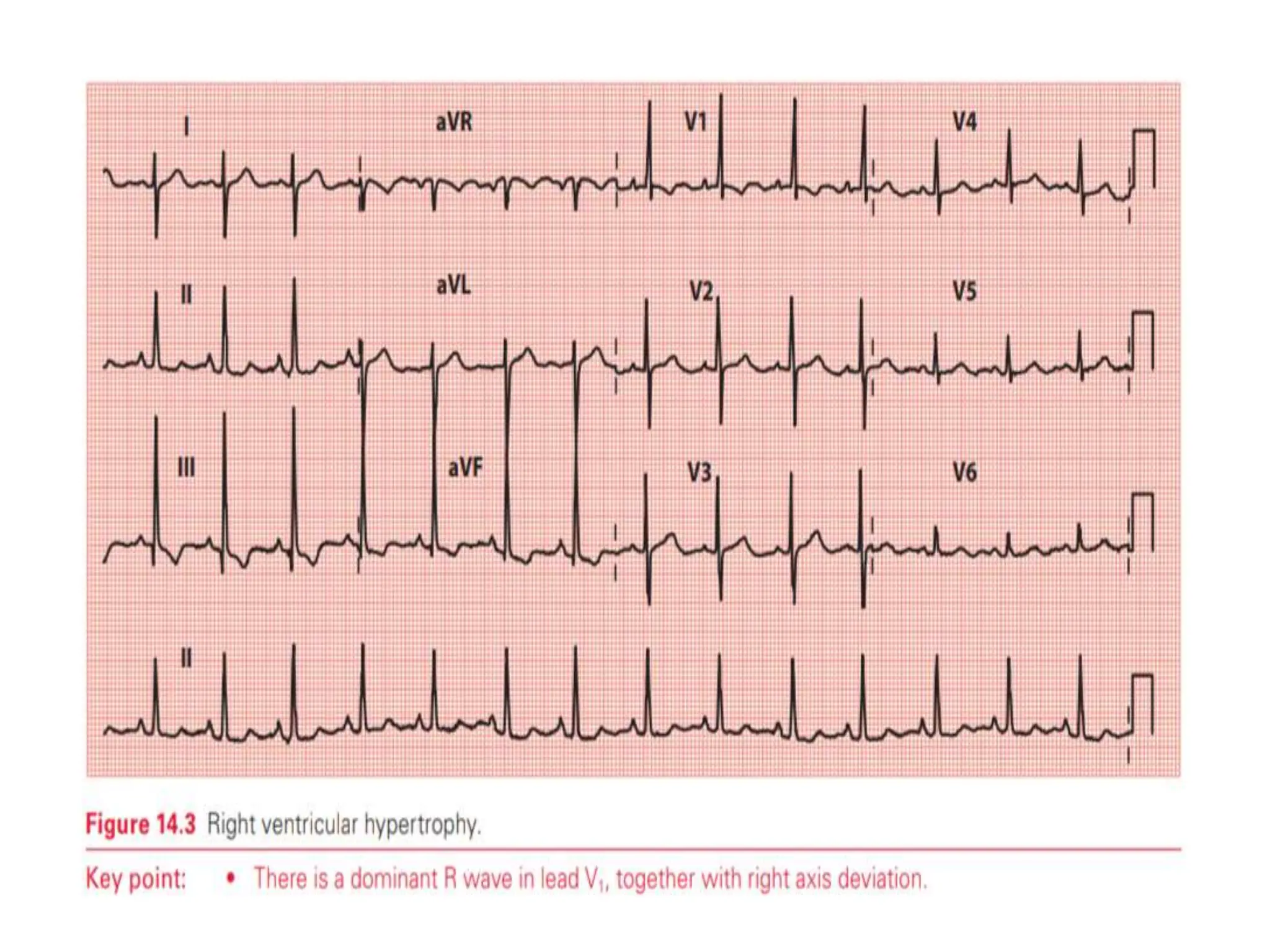
• Right ventricular hypertrophy causes a ‘dominant’ R wave (i.e.
bigger than the S wave) in the leads that ‘look at’ the right ventricle,
particularly V1
• Right ventricular hypertrophy is also associated with:
• Right axis deviation
• Deep S waves in leads V5 and V6
• Right bundle branch block (RBBB)
• and, if ‘strain’ is present:
• ST segment depression
• T wave inversion
• Causes of right ventricular hypertrophy
• Pulmonary hypertension
• Pulmonary stenosis
• Tetralogy of Fallot
• Arrhythmogenic right ventricular cardiomyopathy
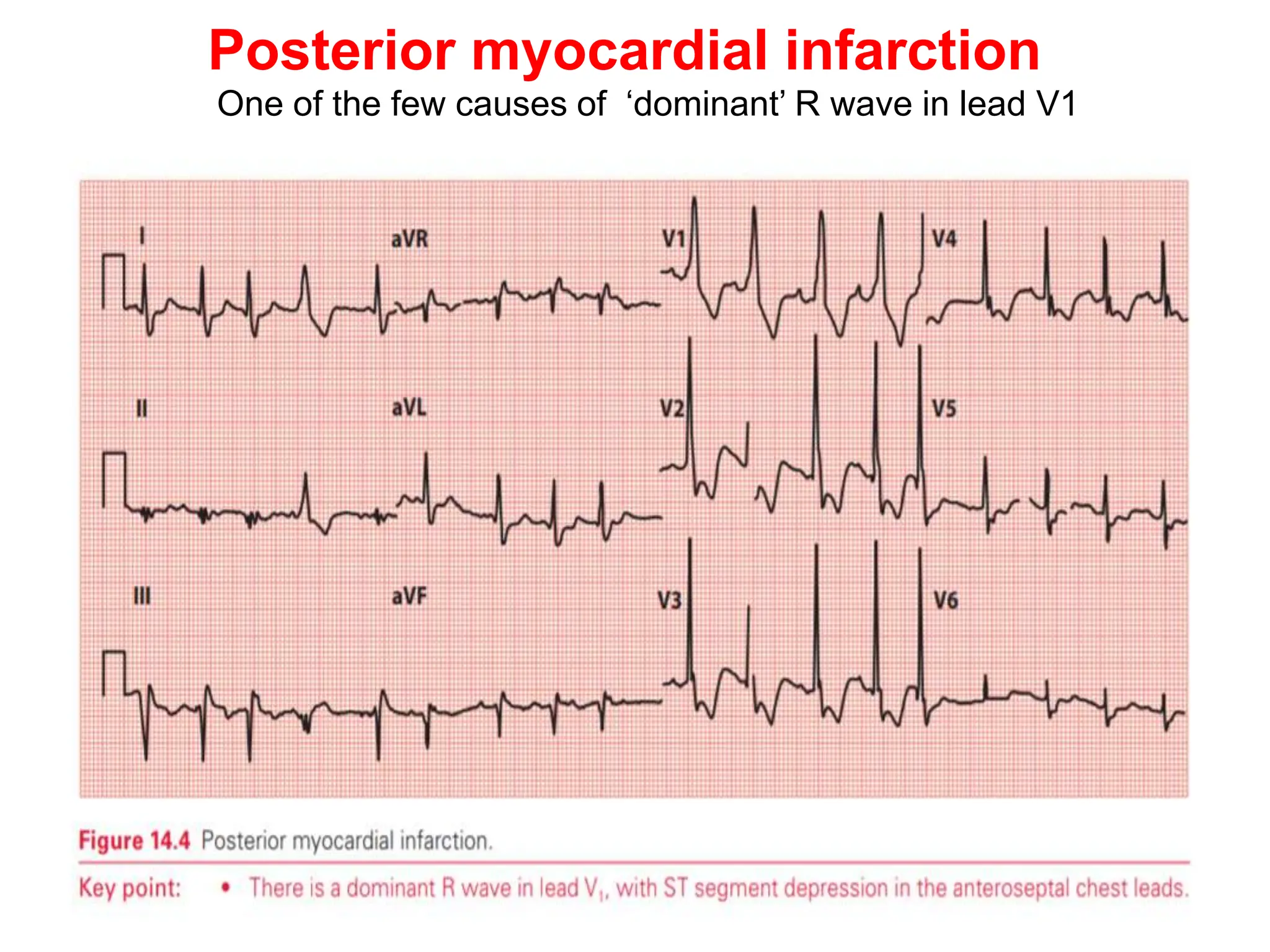
Posterior myocardial infarction
One of the few causes of ‘dominant’ R wave in lead V1
Wolff–Parkinson–White syndrome
• If you see a dominant R wave in leads V1–V3 in
the presence of a short PR interval, think of
Wolff–Parkinson–White syndrome
• Generally, however, a dominant R wave in leads
V1–V3 indicates a left-sided accessory pathway,
whereas a dominant S wave in leads V1–V3
indicates a right-sided accessory pathway
• Dominant R wave in aVR
• Poisoning with sodium-channel blocking
drugs (e.g. TCAs)
• Dextrocardia
• Incorrect lead placement (left/right arm leads
reversed)
• Ventricular tachycardia (VT)
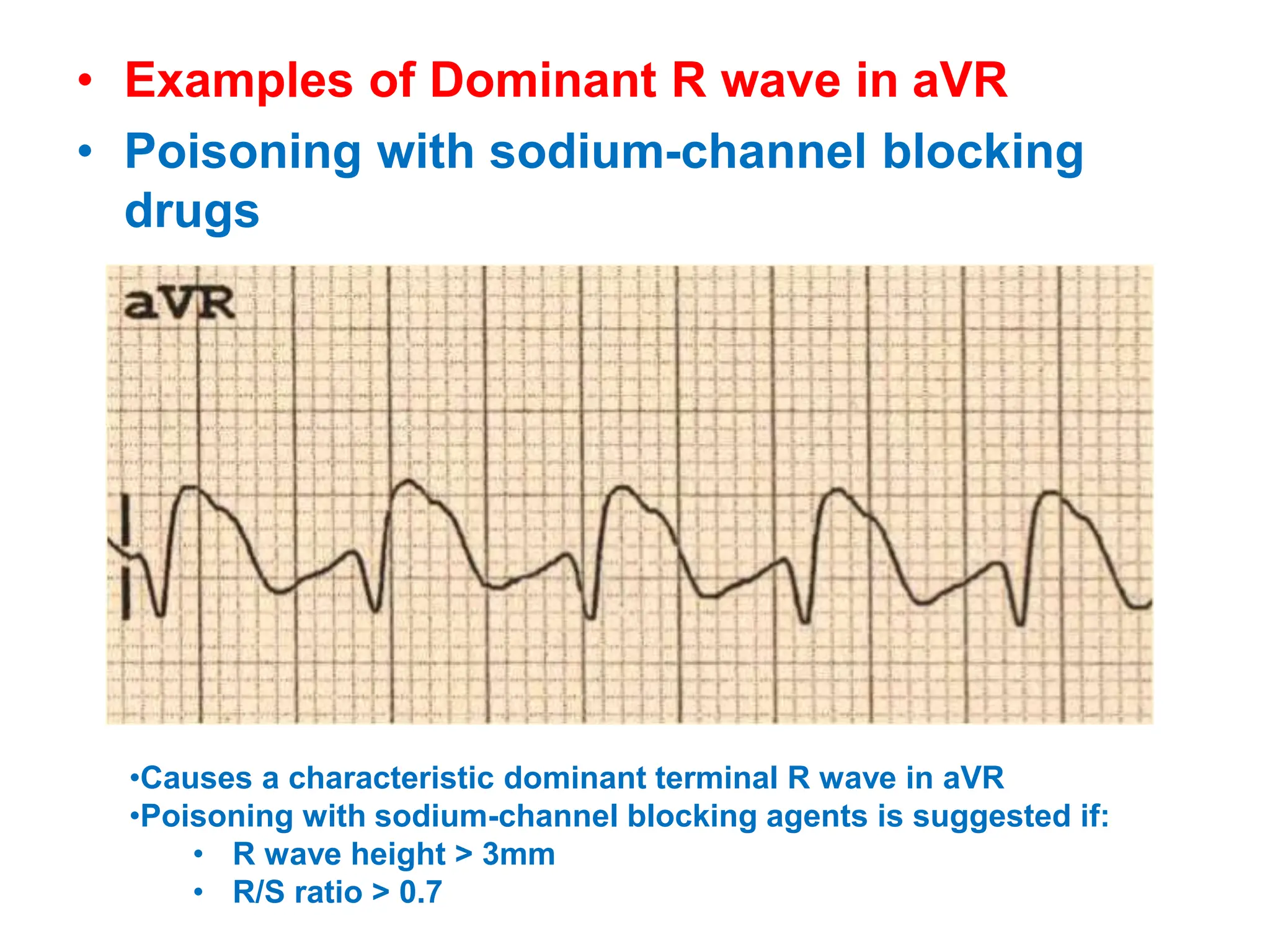
• Examples of Dominant R wave in aVR
• Poisoning with sodium-channel blocking
drugs
•Causes a characteristic dominant terminal R wave in aVR
•Poisoning with sodium-channel blocking agents is suggested if:
• R wave height > 3mm
• R/S ratio > 0.7
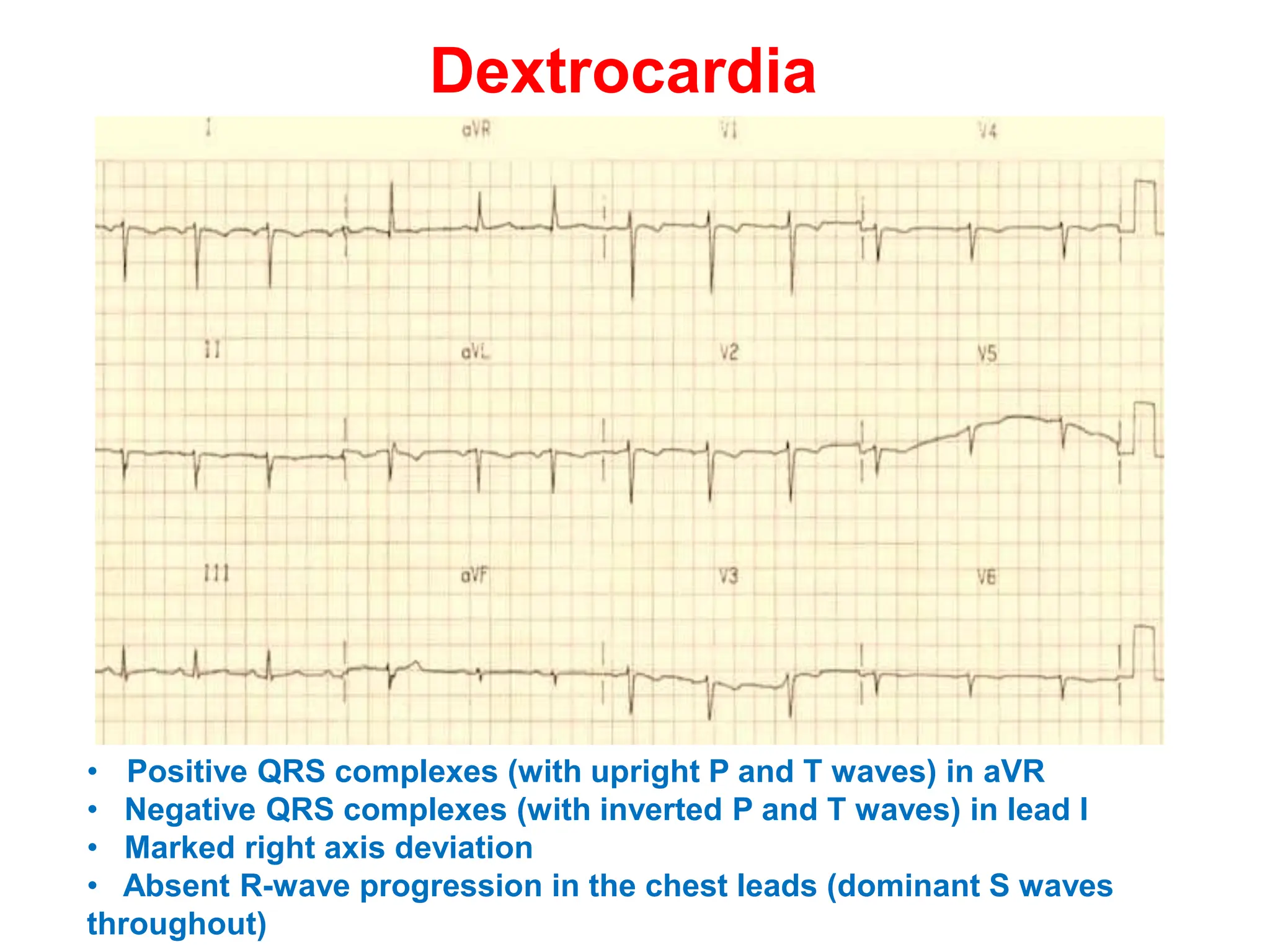
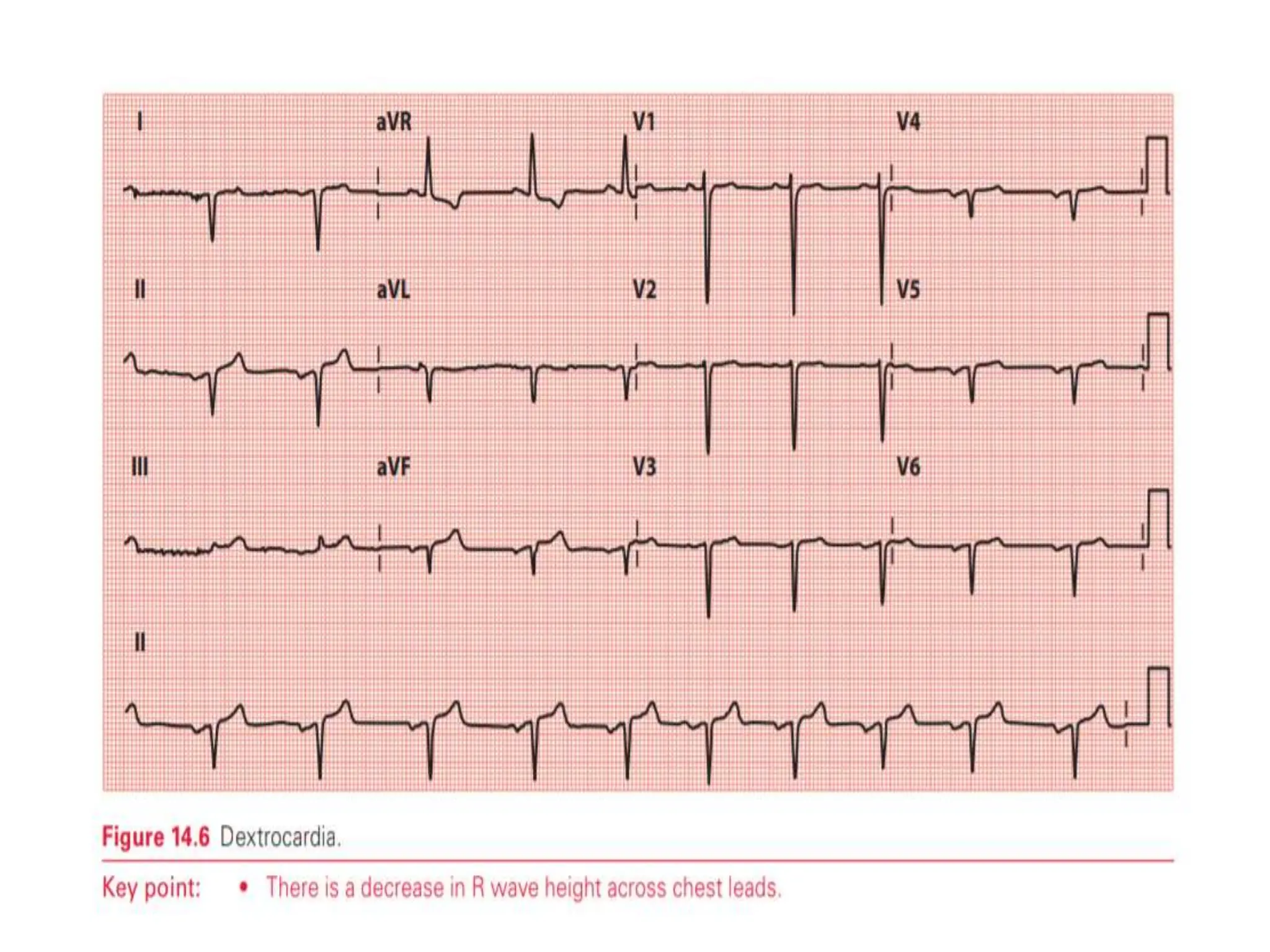
Dextrocardia
• Positive QRS complexes (with upright P and T waves) in aVR
• Negative QRS complexes (with inverted P and T waves) in lead I
• Marked right axis deviation
• Absent R-wave progression in the chest leads (dominant S waves
throughout)
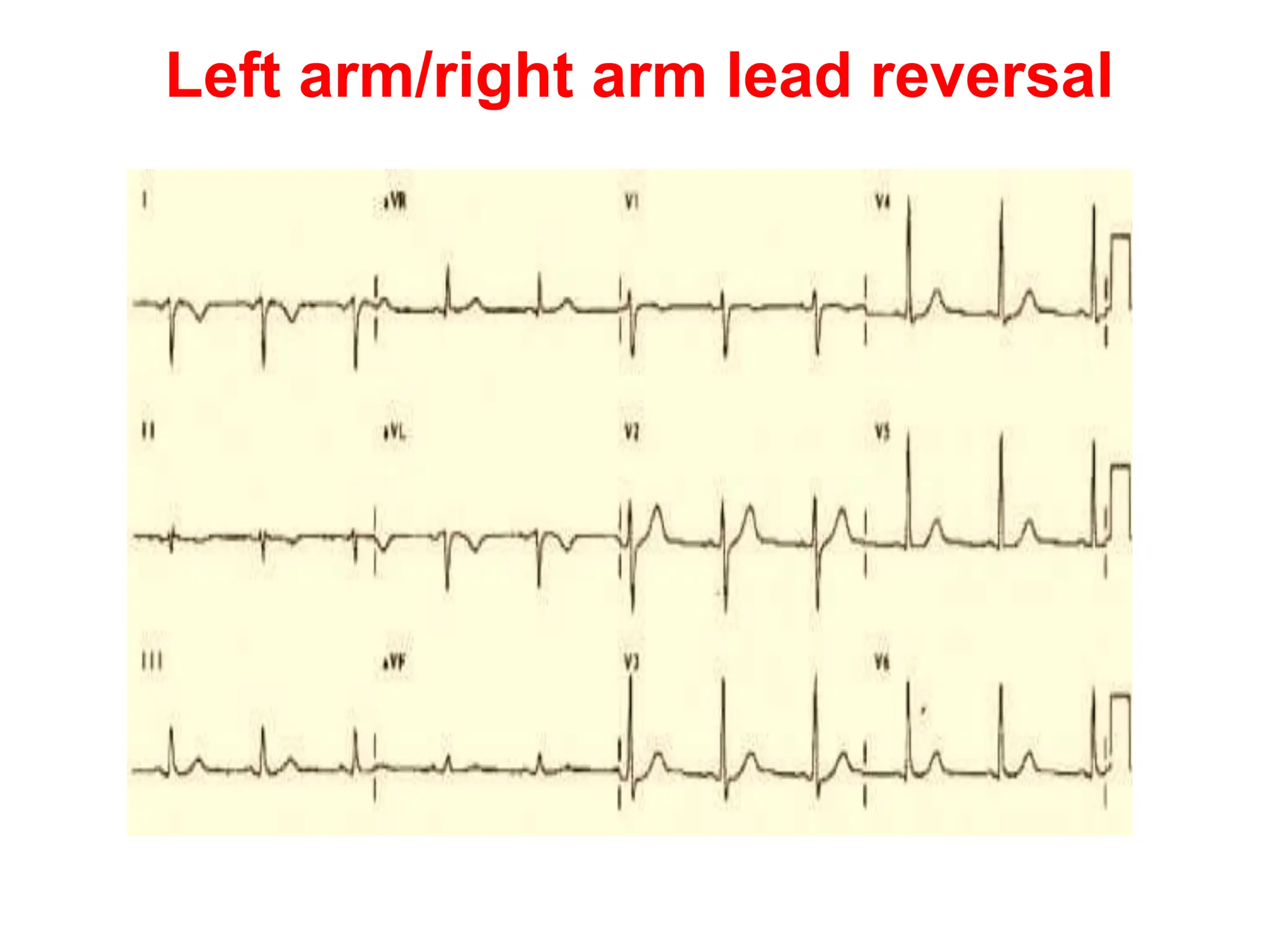
Left arm/right arm lead reversal
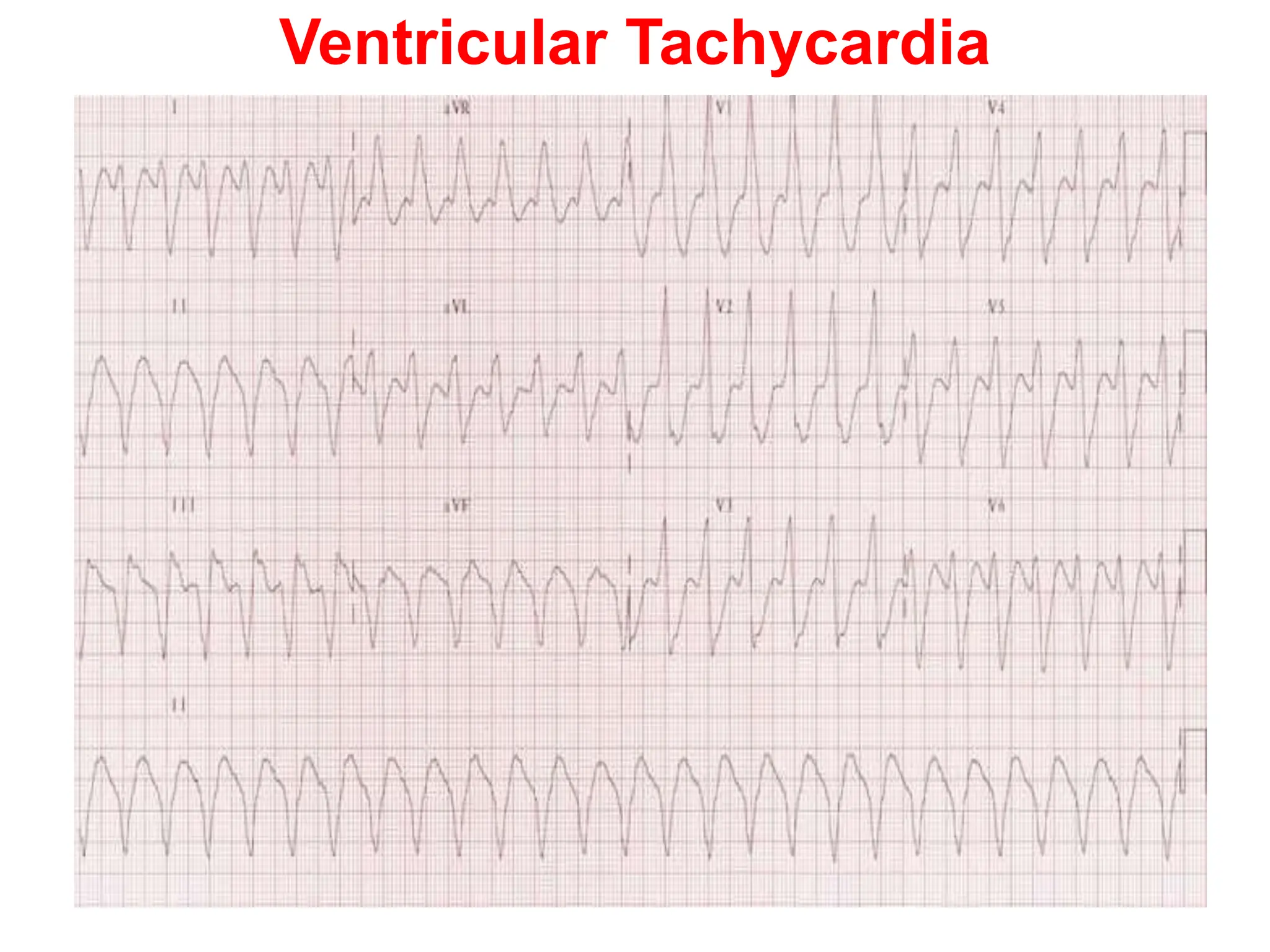
Ventricular Tachycardia
Poor R wave progression
• Poor R-wave progression (PRWP) is a common
ECG finding that is often inconclusively
interpreted as suggestive, but not diagnostic, of
anterior myocardial infarction (AMI)
• Poor R wave progression is described with an R
wave ≤ 3 mm in V3 and is caused by:
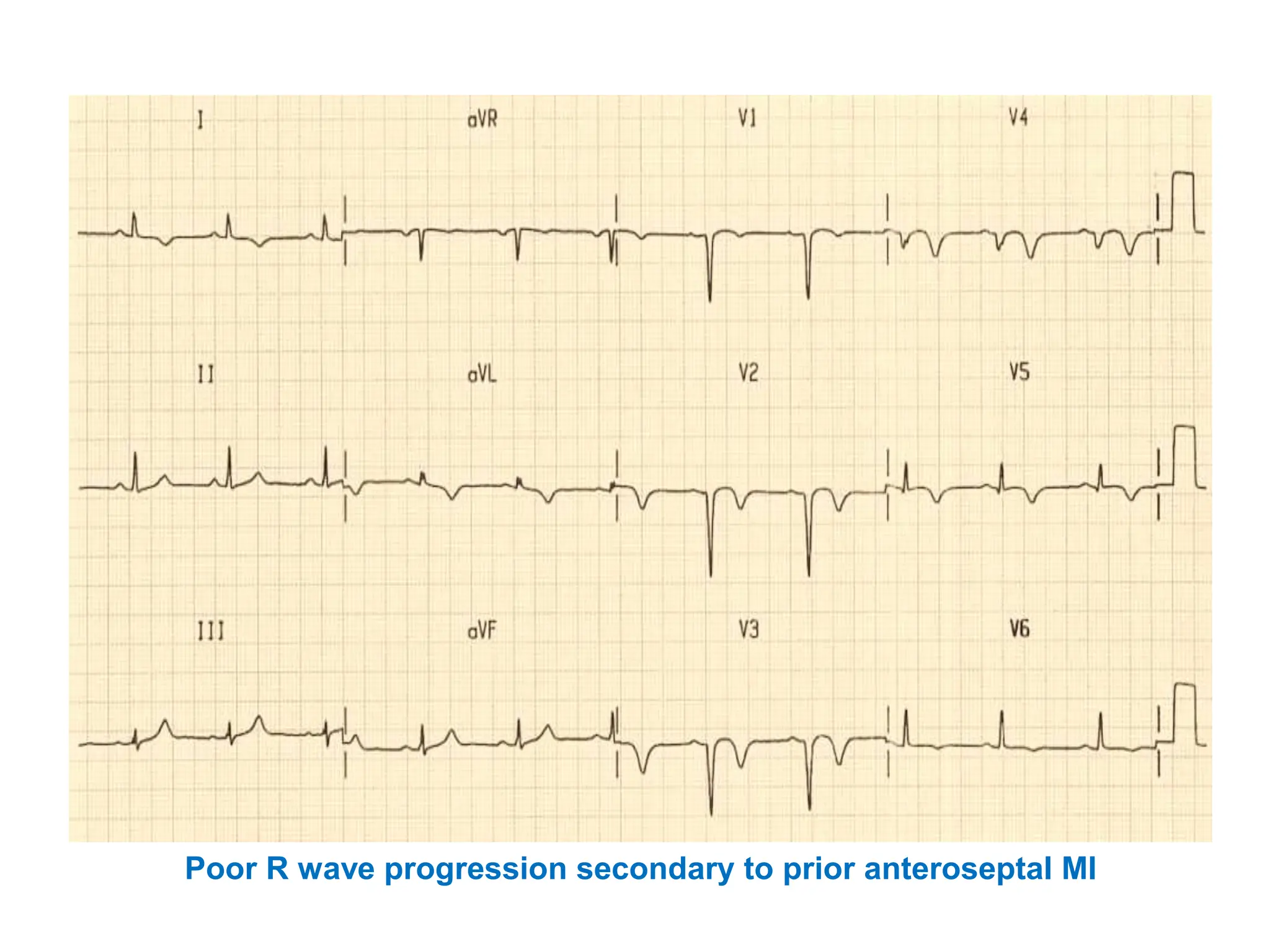
• Prior anteroseptal MI
• Dextrocardia
• LVH
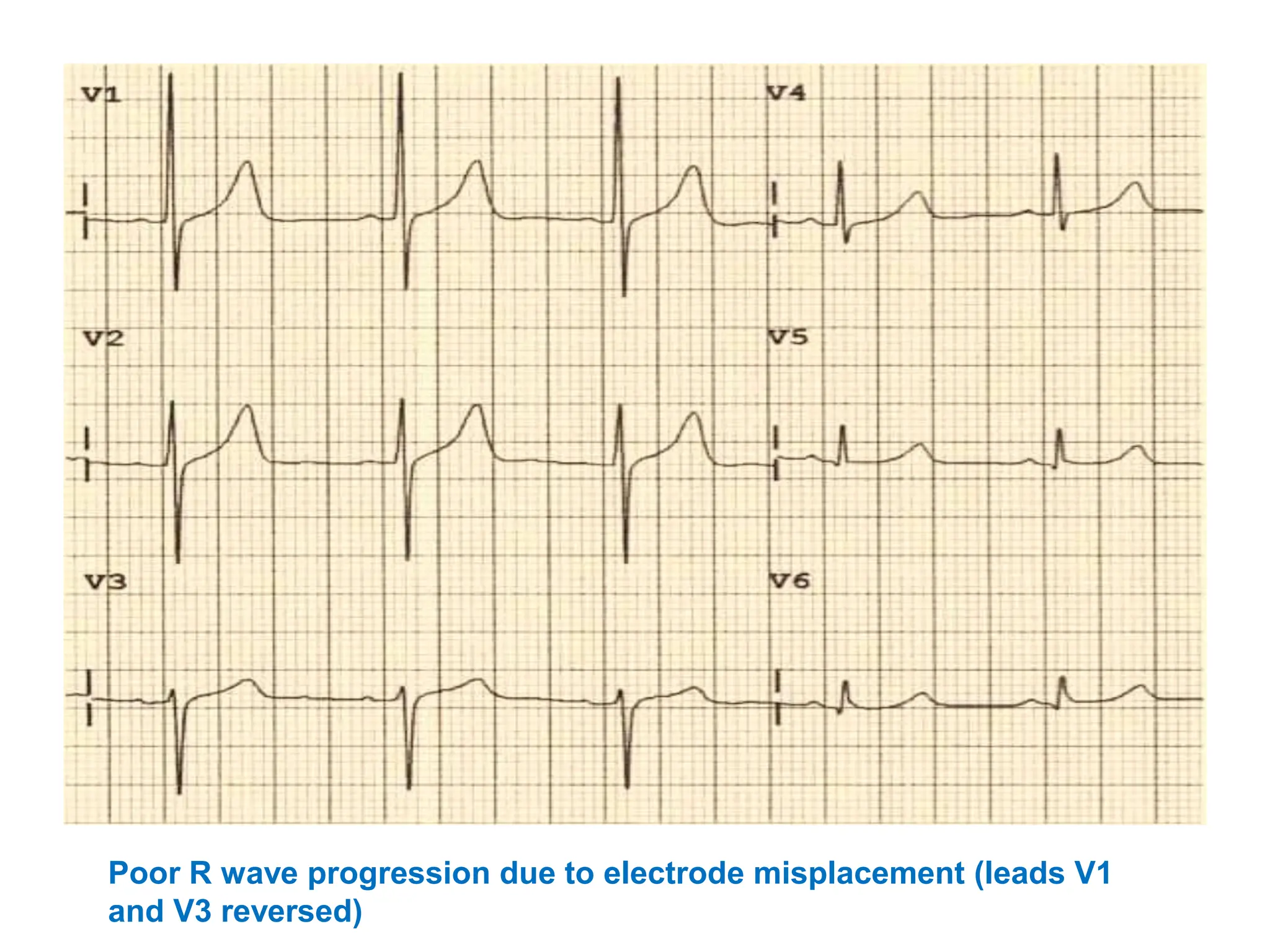
• Inaccurate lead placement
• May be a normal variant
Poor R wave progression secondary to prior anteroseptal MI
Poor R wave progression due to electrode misplacement (leads V1
and V3 reversed)
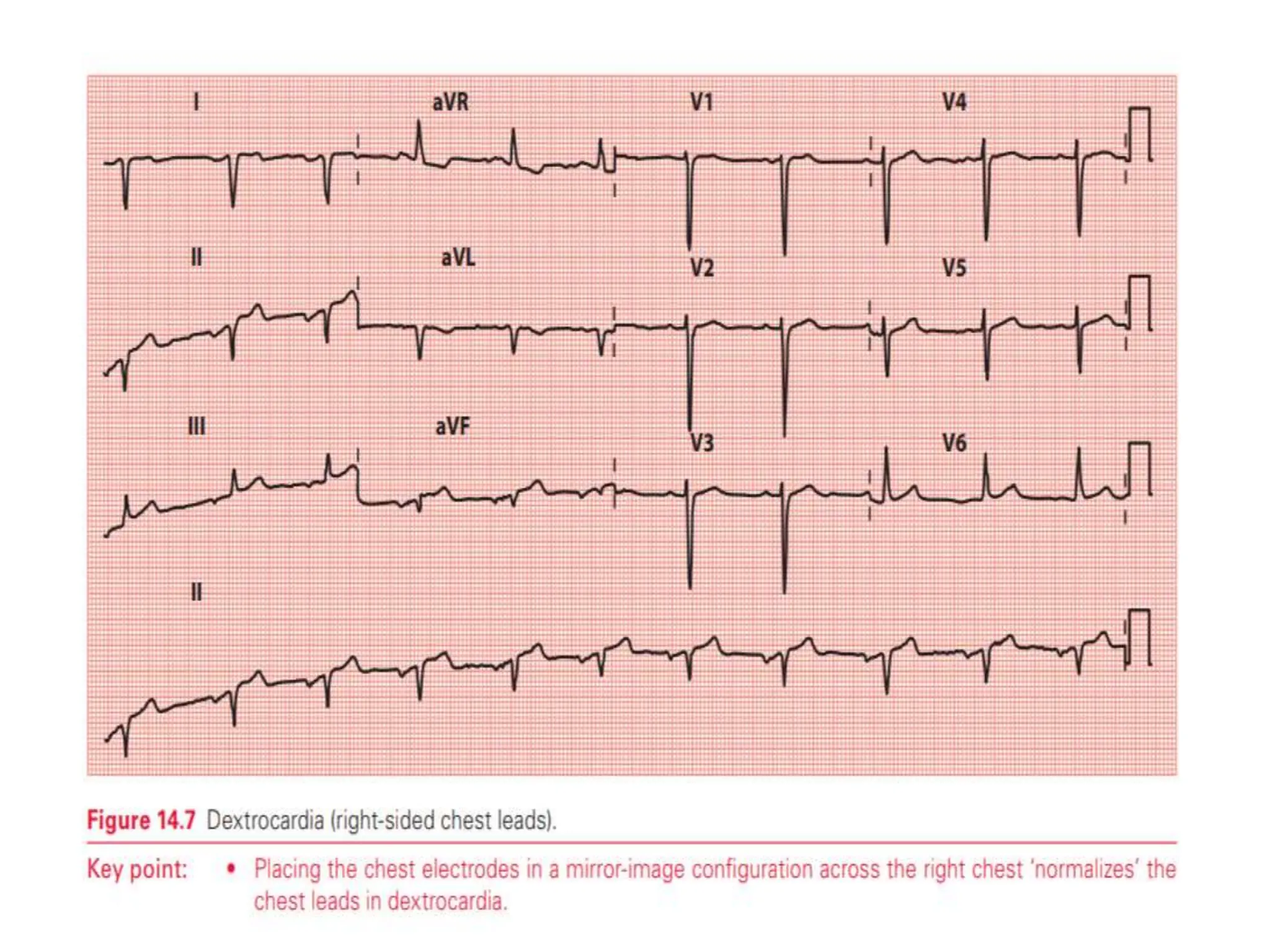
Dextrocardia
• The ECG does not show the normal progressive
increase in R wave height across the chest
leads; instead, the QRS complexes decrease in
height across them
• In addition, the P wave is inverted in lead I and
there is right axis deviation
• Right-sided chest leads will show the pattern
normally seen on the left
ARE THE QRS COMPLEXES TOO
SMALL?
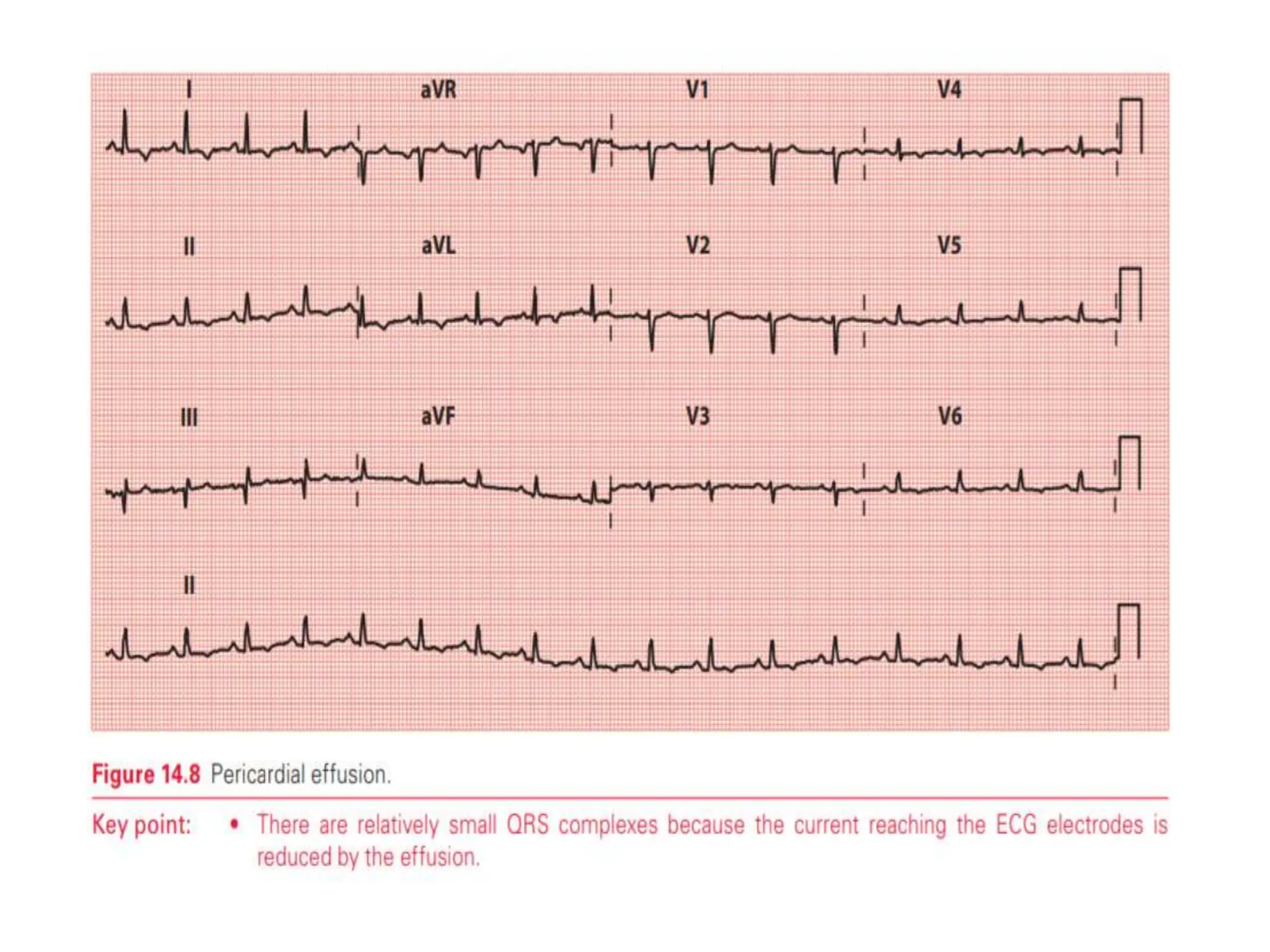
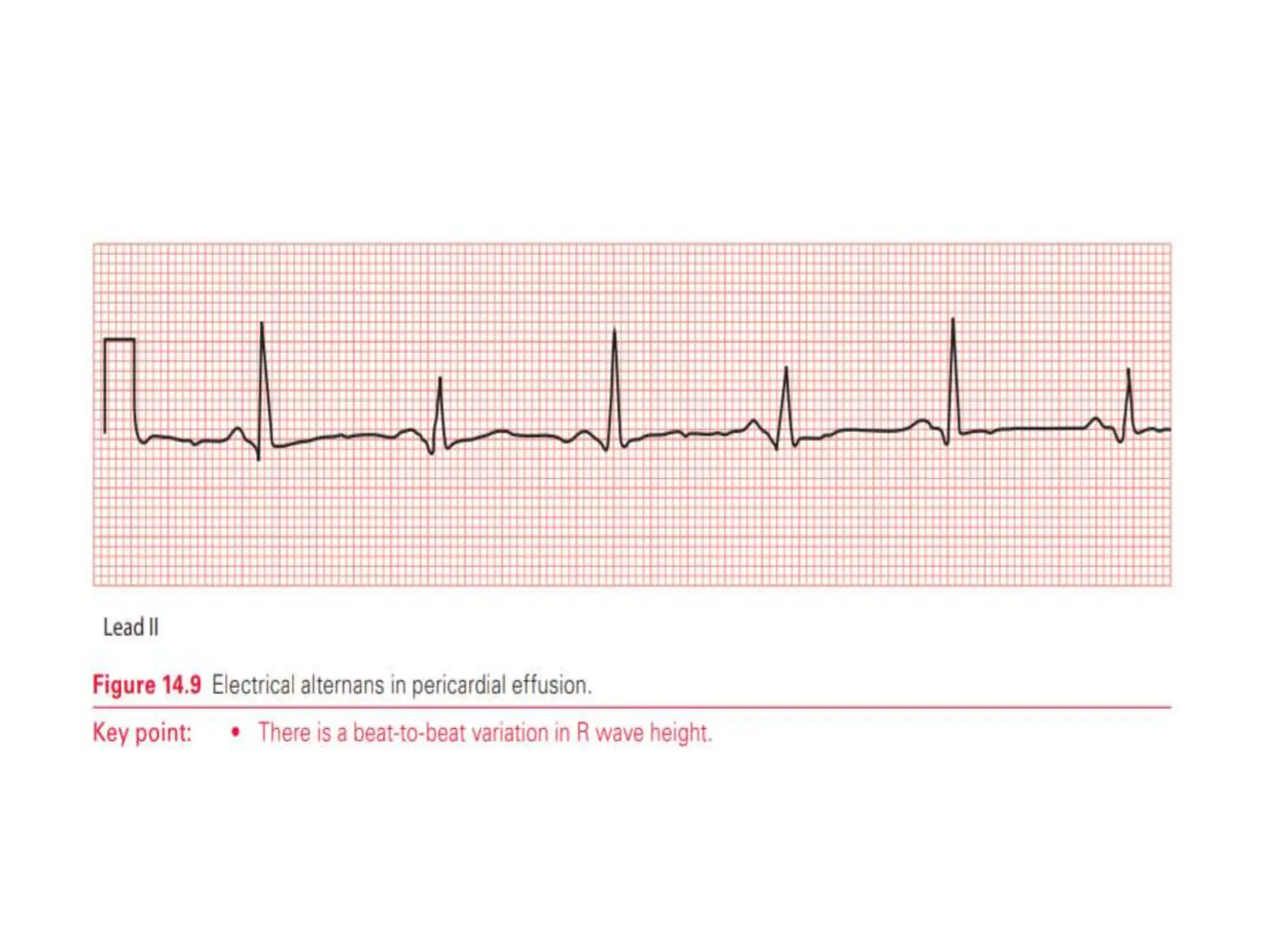
• Low Voltage QRS Morphology
• The QRS is said to be low voltage when:
• The amplitudes of all the QRS complexes
in the limb leads are < 5 mm; or
• The amplitudes of all the QRS complexes
in the precordial leads are < 10 mm
• Causes of low voltage include:
• Incorrect ECG calibration (should be 1 mV = 10 mm)
• Fluid: Pericardial effusion; Pleural effusion
• Fat: Obesity
• Air: Emphysema; Pneumothorax
• Infiltrative / Connective Tissue Disorders
• Myxoedema
• Infiltrative myocardial diseases i.e. restrictive
cardiomyopathy due to amyloidosis, sarcoidosis,
haemochromatosis
• Constrictive pericarditis
• Scleroderma
• Loss of viable myocardium:
• Previous massive MI
• End-stage dilated cardiomyopathy
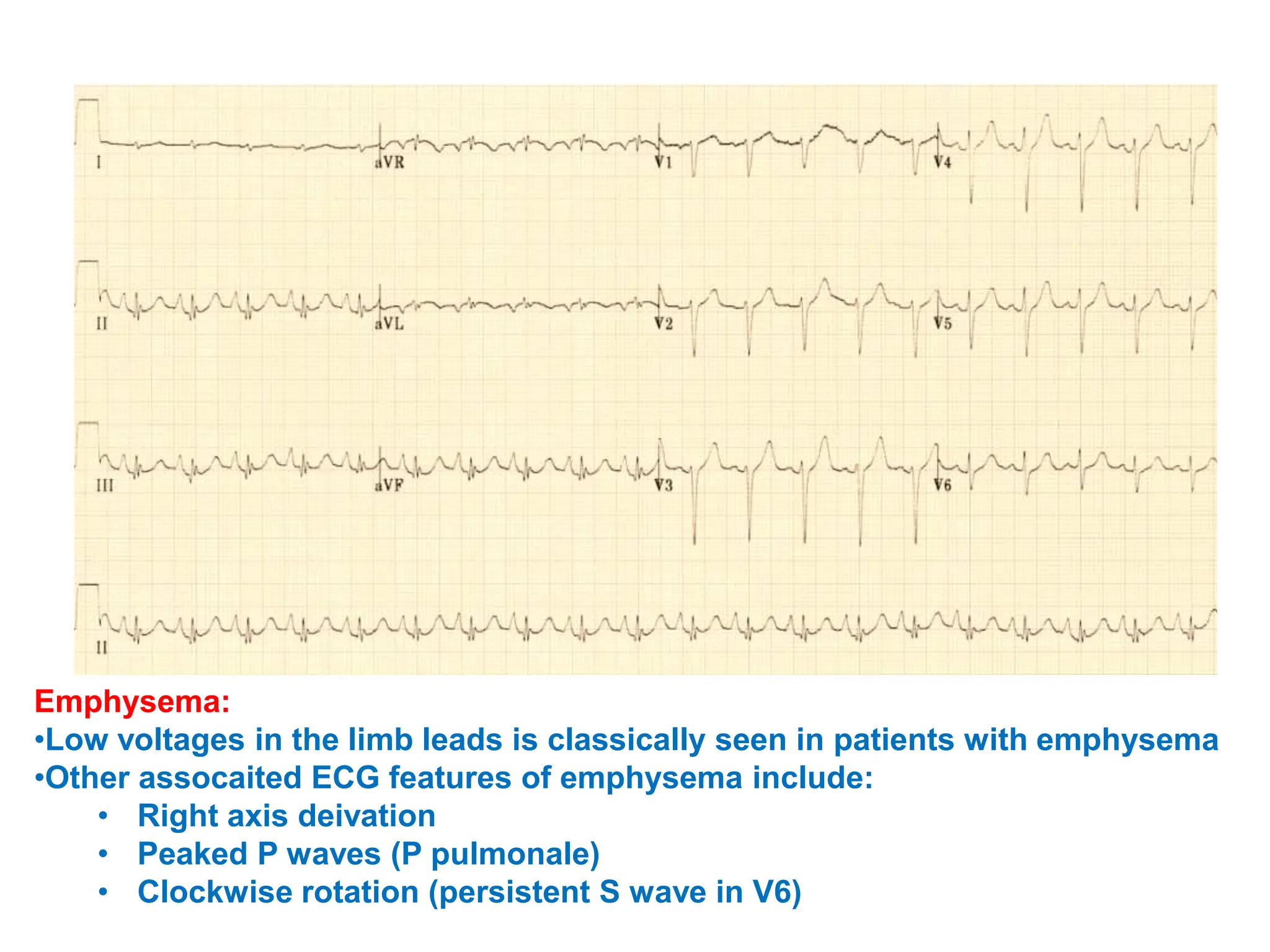
Emphysema:
•Low voltages in the limb leads is classically seen in patients with emphysema
•Other assocaited ECG features of emphysema include:
• Right axis deivation
• Peaked P waves (P pulmonale)
• Clockwise rotation (persistent S wave in V6)
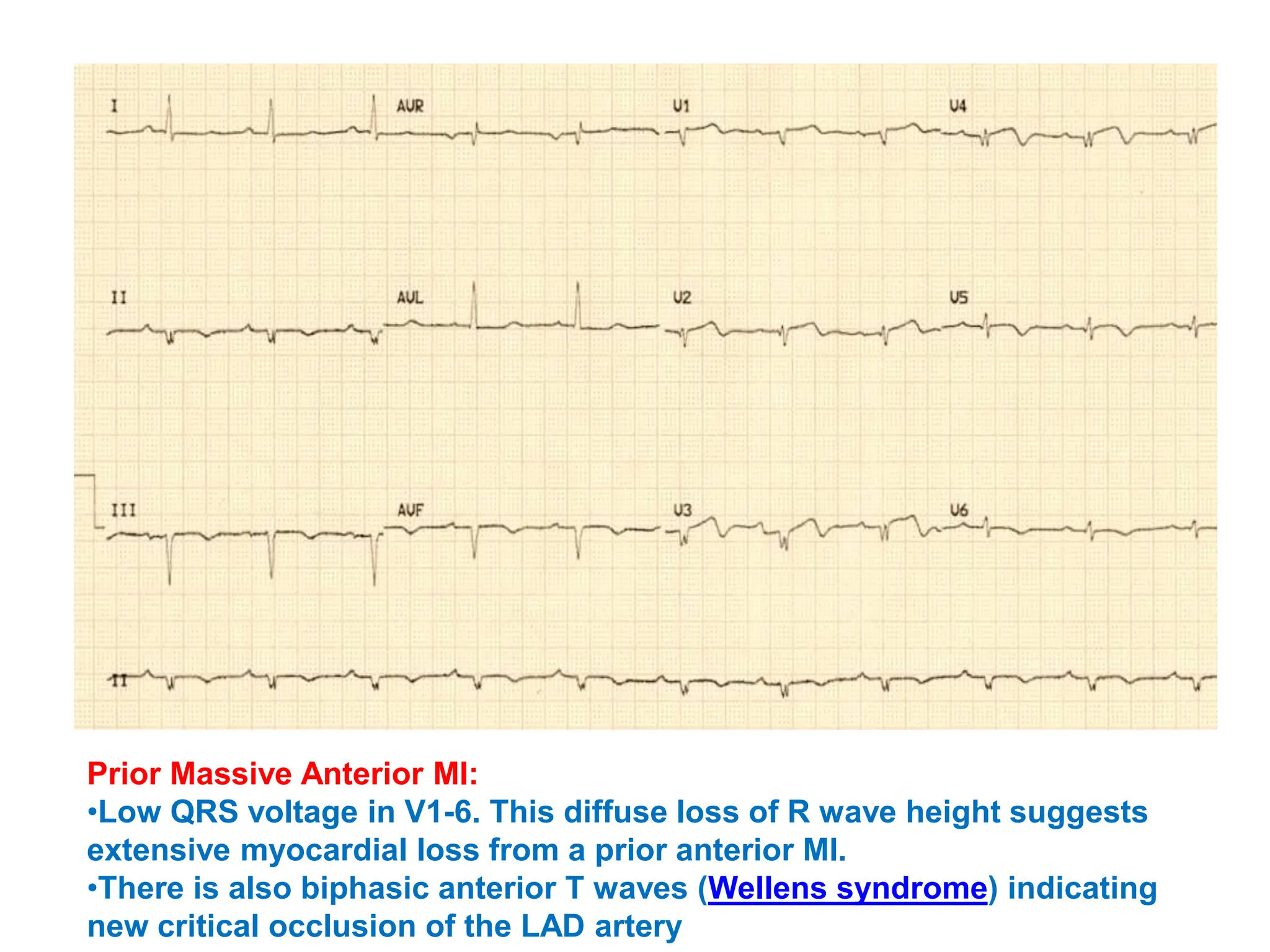
Prior Massive Anterior MI:
•Low QRS voltage in V1-6. This diffuse loss of R wave height suggests
extensive myocardial loss from a prior anterior MI.
•There is also biphasic anterior T waves (Wellens syndrome) indicating
new critical occlusion of the LAD artery
• QRS Width
• Normal QRS width is 70-100 ms (a duration of 110 ms is sometimes
observed in healthy subjects)
• Useful in determining the origin of each QRS complex (e.g. sinus,
atrial, junctional or ventricular)
• Narrow complexes (QRS < 100 ms) are supraventricular in origin
• Broad complexes (QRS > 100 ms) may be either ventricular in
origin, or due to aberrant conduction of supraventricular
complexes (e.g. due to bundle branch block, hyperkalaemia or
sodium-channel blockade)
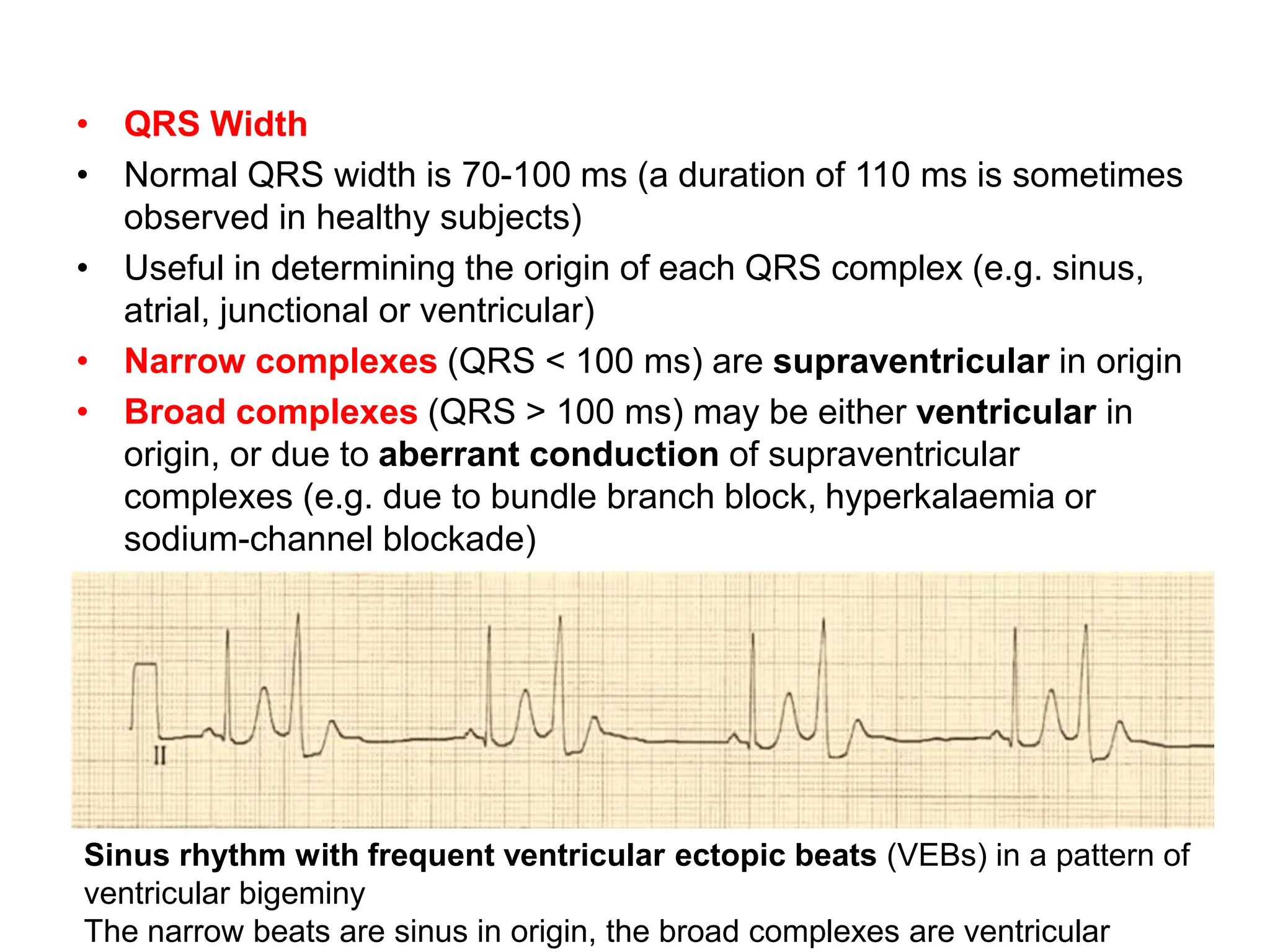
Sinus rhythm with frequent ventricular ectopic beats (VEBs) in a pattern of
ventricular bigeminy
The narrow beats are sinus in origin, the broad complexes are ventricular
• Narrow QRS Complex Morphology
• Narrow (supraventricular) complexes arise from three
main places:
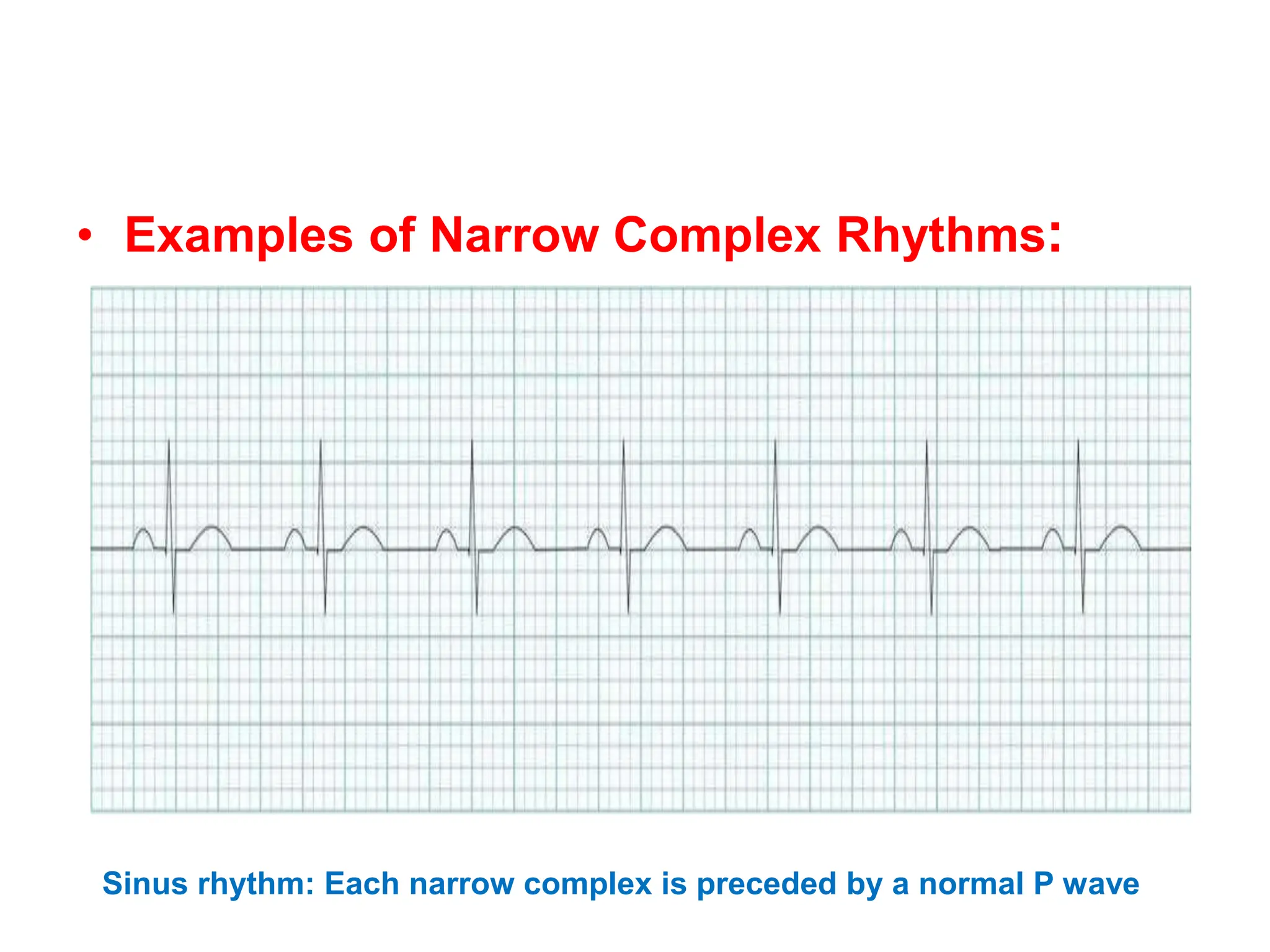
• Sino-atrial node (= normal P wave)
• Atria (= abnormal P wave / flutter wave / fibrillatory wave)
• AV node / junction (= either no P wave or an abnormal P
wave with a PR interval < 120 ms)
• Examples of Narrow Complex Rhythms:
Sinus rhythm: Each narrow complex is preceded by a normal P wave
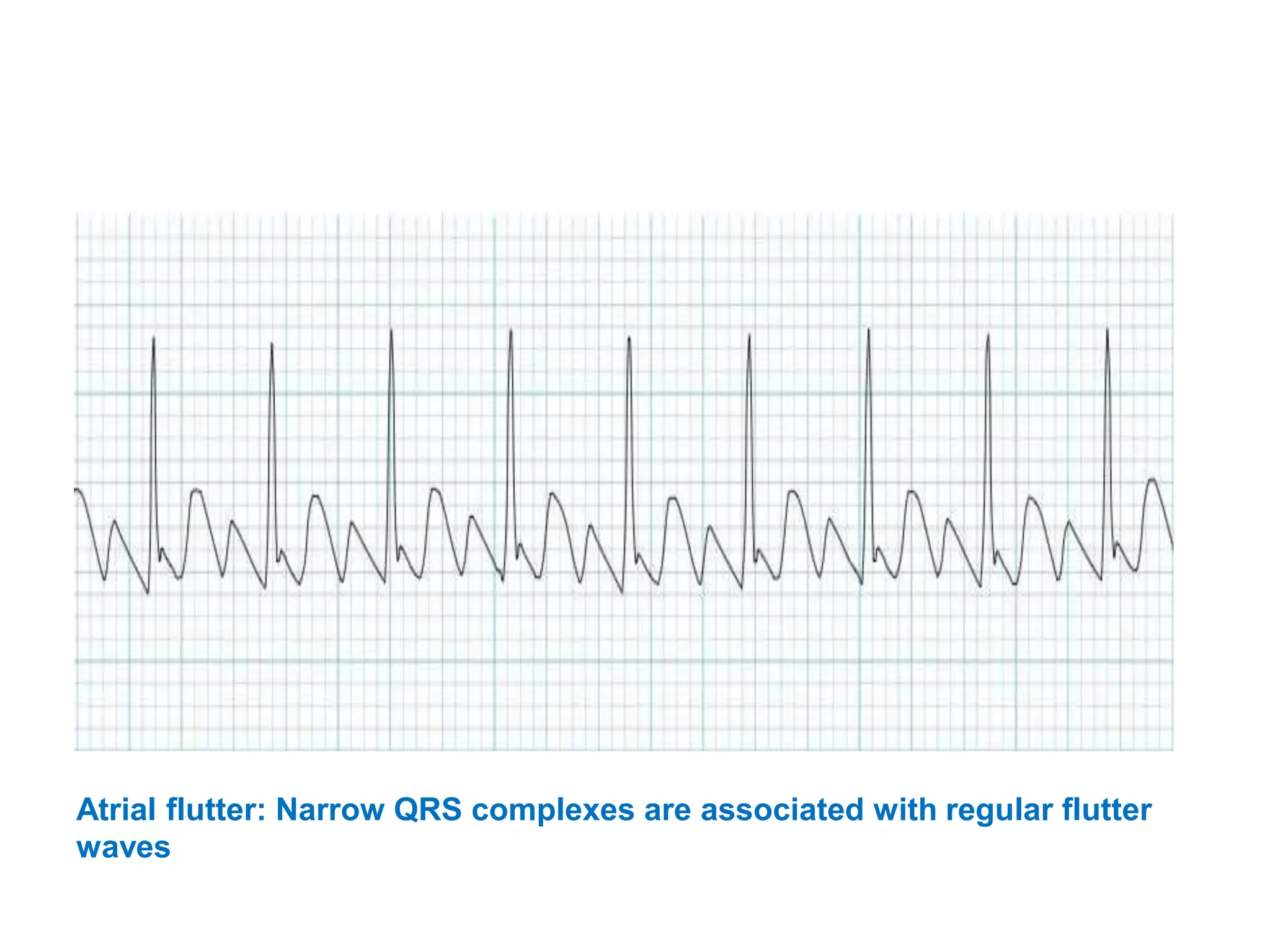
Atrial flutter: Narrow QRS complexes are associated with regular flutter
waves
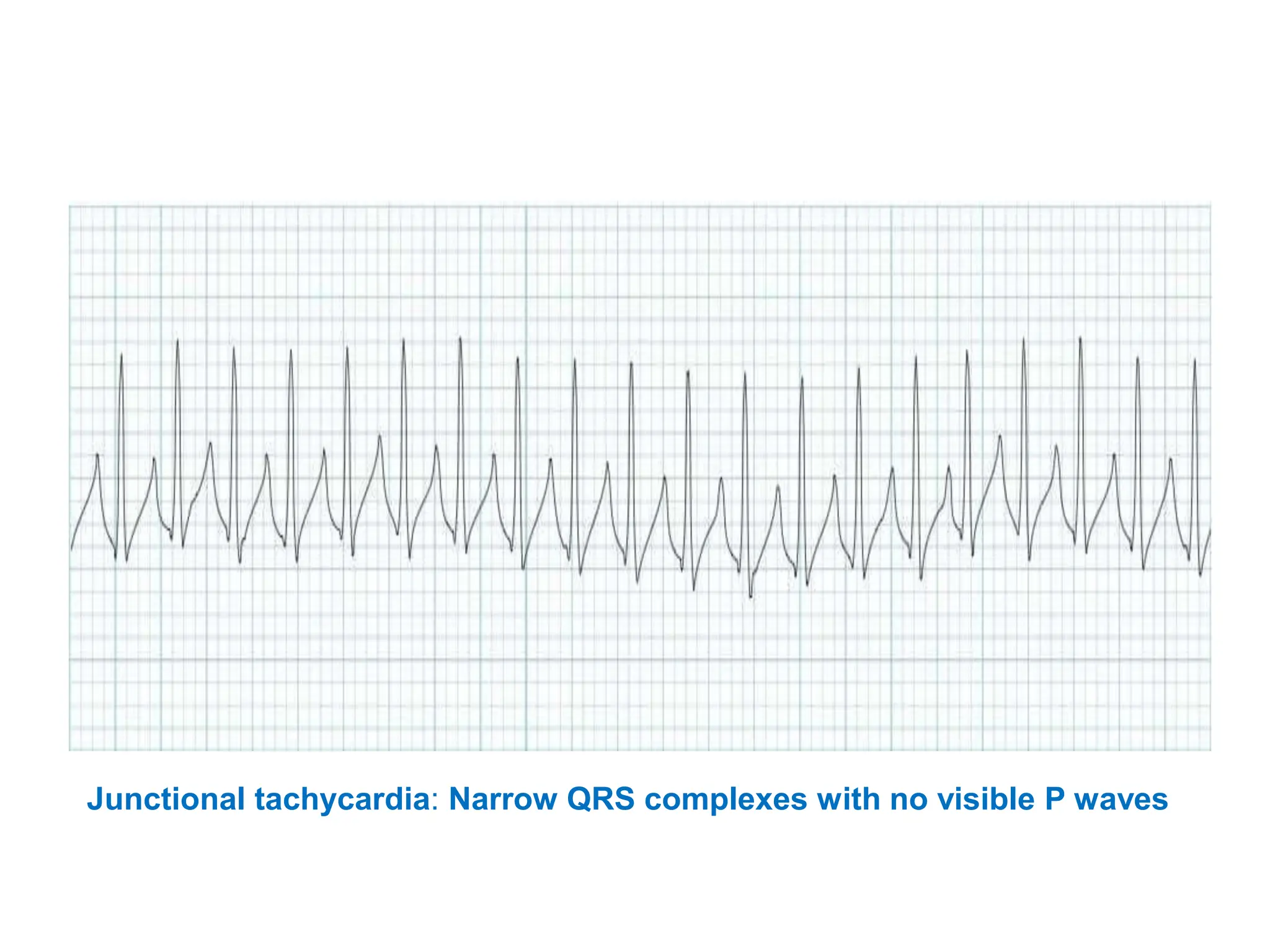
Junctional tachycardia: Narrow QRS complexes with no visible P waves
• Broad QRS Complex Morphology
• A QRS duration > 100 ms is abnormal
• A QRS duration > 120 ms is required for the diagnosis
of bundle branch block or ventricular rhythm
• Broad complexes may be ventricular in origin or due to
aberrant conduction secondary to:
• Bundle branch block (RBBB or LBBB)
• Hyperkalaemia
• Hypothermia
• Poisoning with sodium-channel blocking agents
(e.g. tricyclic antidepressants)
• Pre-excitation (i.e. Wolff-Parkinson-White syndrome)
• Ventricular pacing
• Intermittent aberrancy (e.g. rate-related aberrancy)
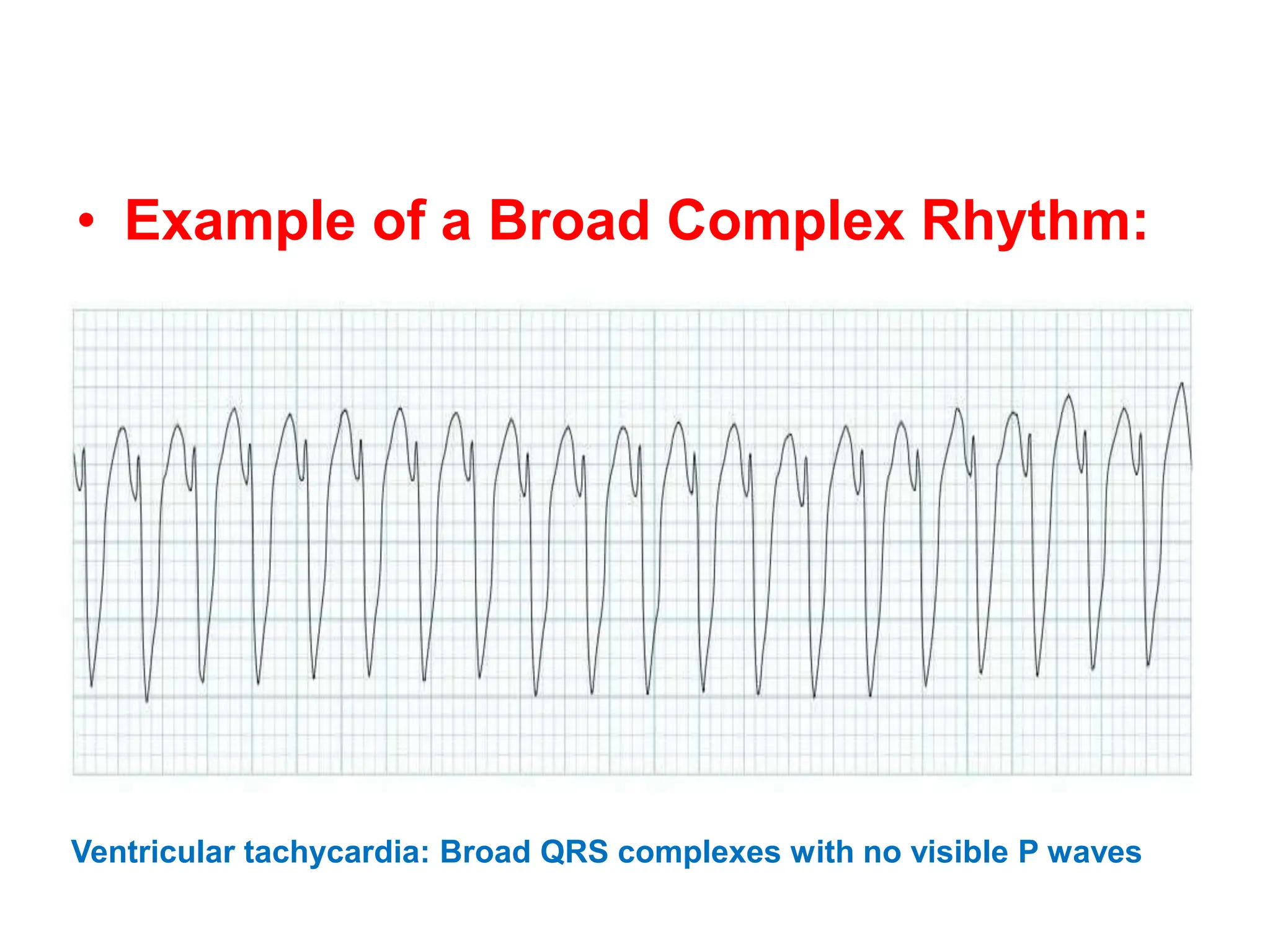
• Example of a Broad Complex Rhythm:
Ventricular tachycardia: Broad QRS complexes with no visible P waves
• Ventricular vs supraventricular rhythms
• Differentiation between ventricular complexes
and aberrantly conducted supraventricular complexes may
be difficult
• In general, aberrant conduction of sinus rhythm and atrial
rhythms (tachycardia, flutter, fibrillation) can usually be
identified by the presence of preceding atrial activity (P
waves, flutter waves, fibrillatory waves)
• However, aberrantly conducted junctional (AV nodal)
complexes may appear identical to ventricular complexes as
both produce broad QRS without any preceding atrial activity
• In the case of ectopic beats, this distinction is not really
important (as occasional ectopic beats do not usually require
treatment)
• However, in the case of sustained tachyarrhythmias, the
distinction between ventricular tachycardia and SVT with
aberrancy becomes more important
• Fortunately, many causes of broad QRS can be identified
by pattern recognition:
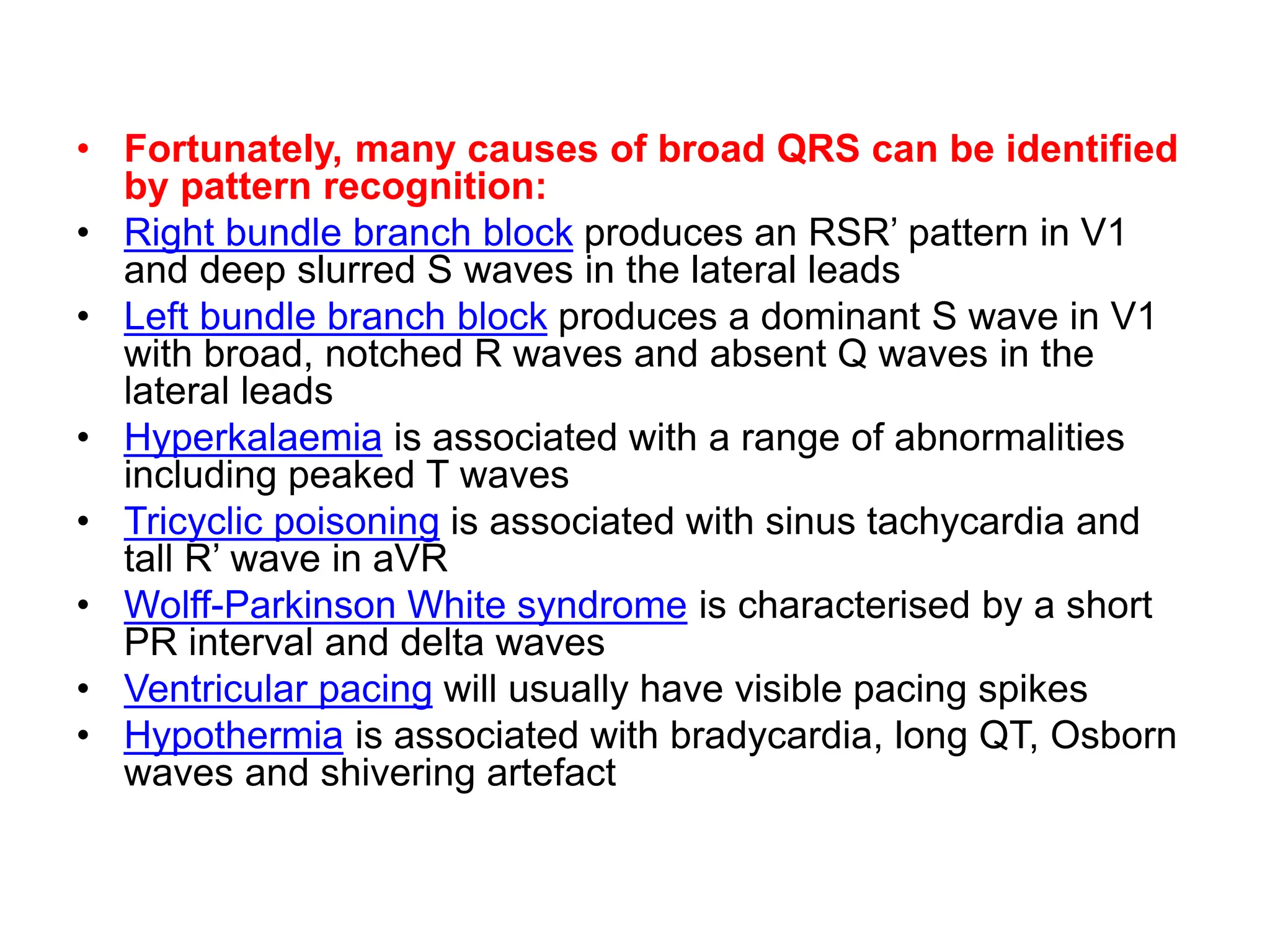
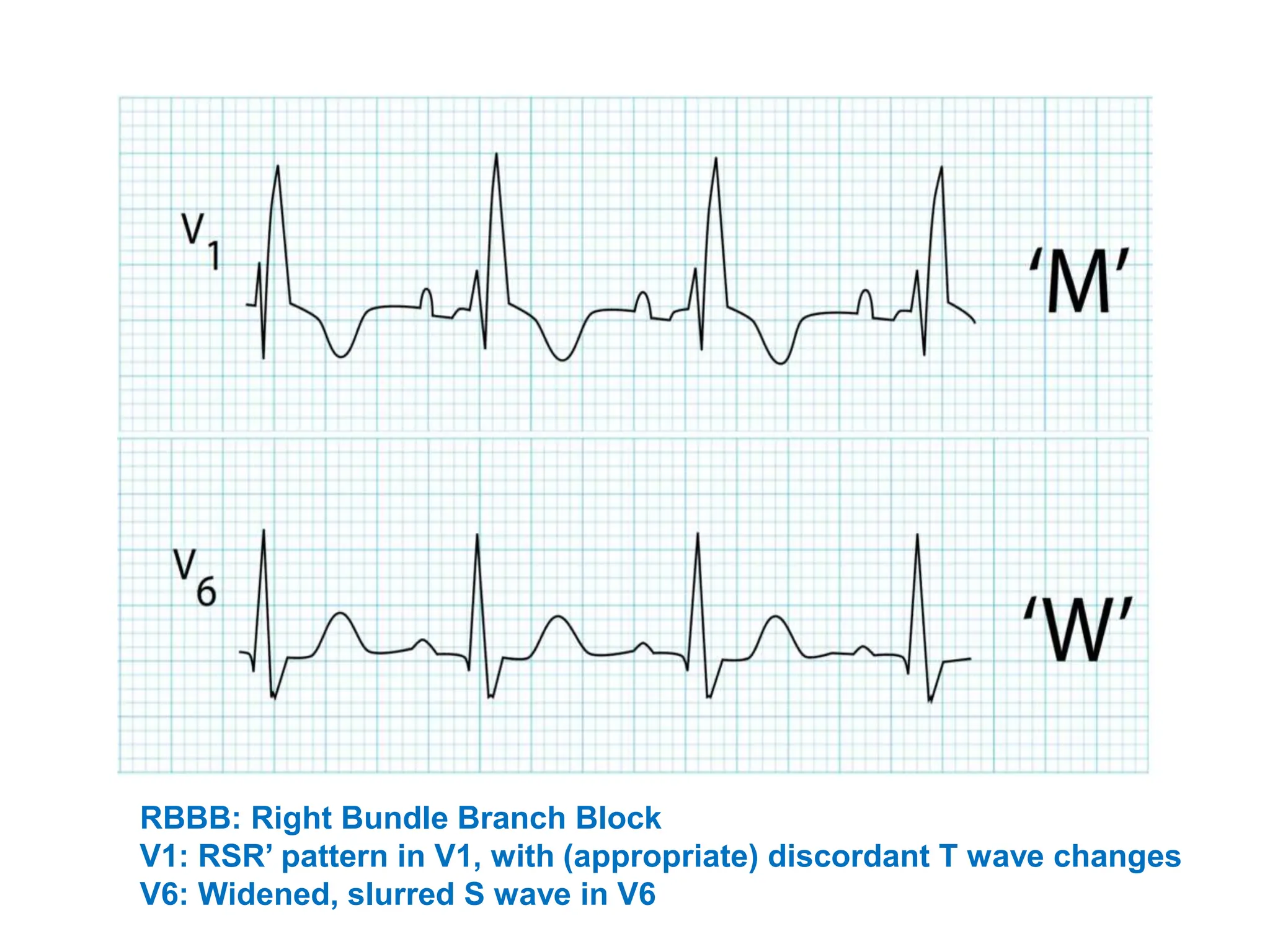
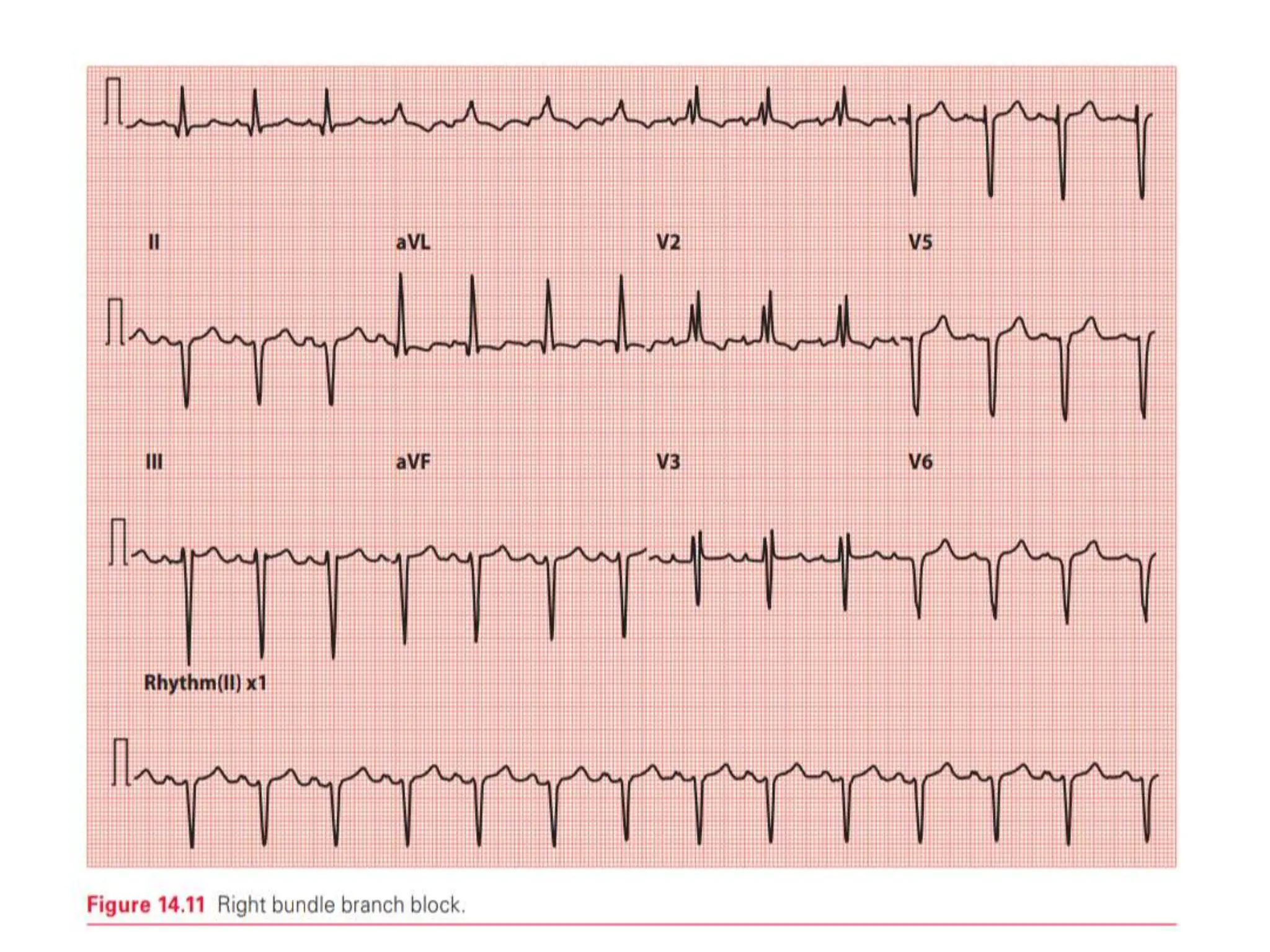
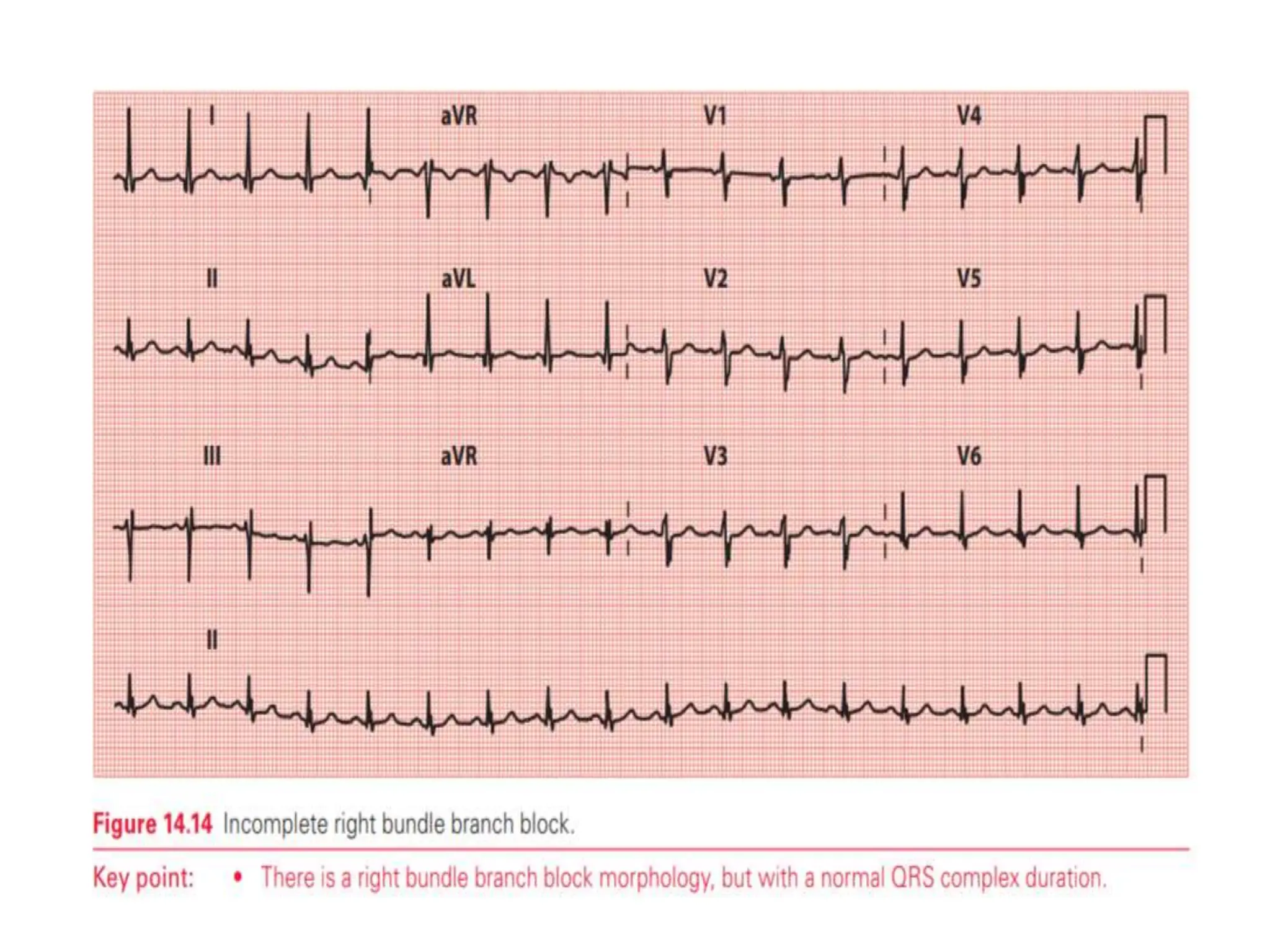
• Right bundle branch block produces an RSR’ pattern in V1
and deep slurred S waves in the lateral leads
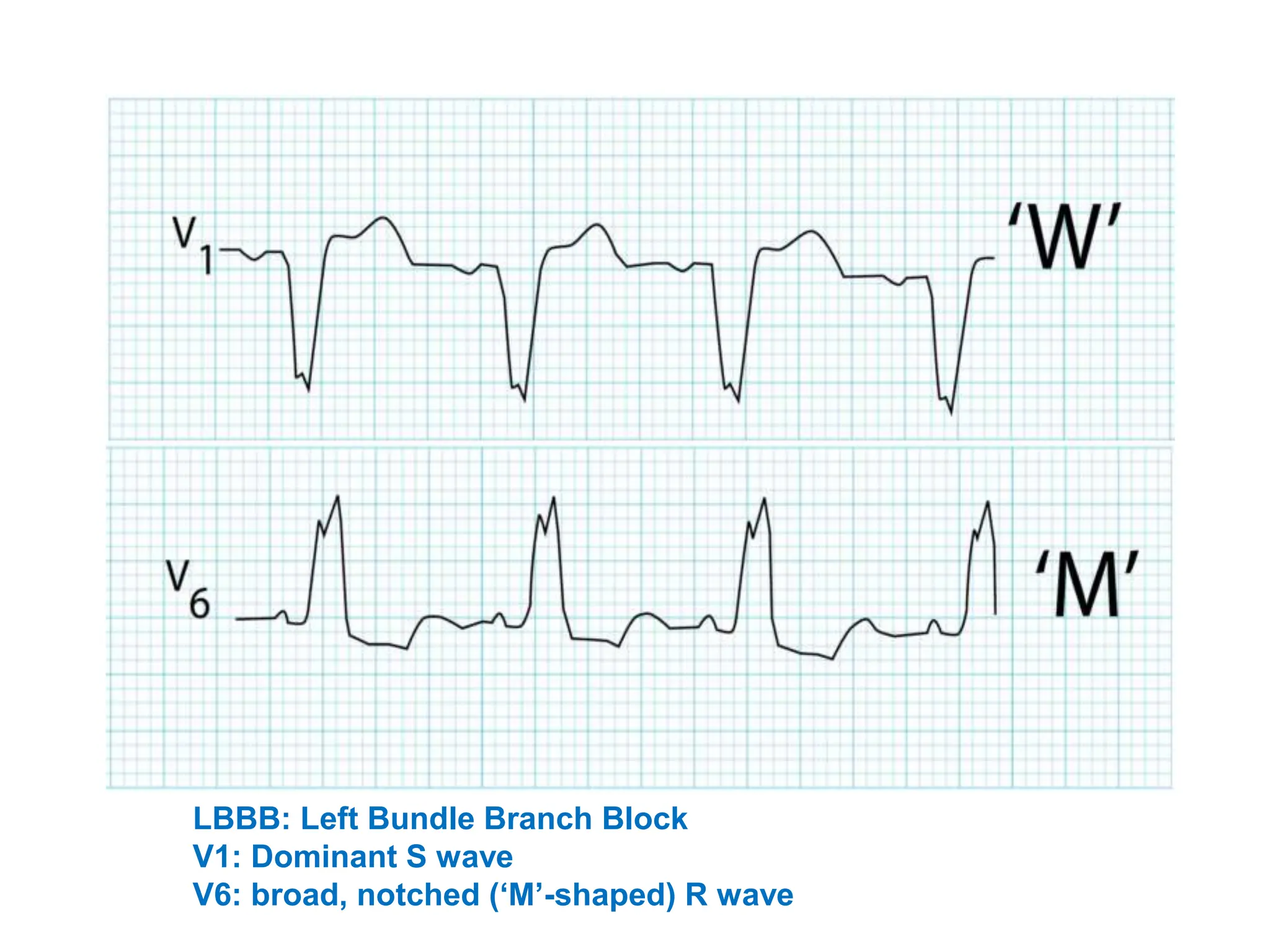
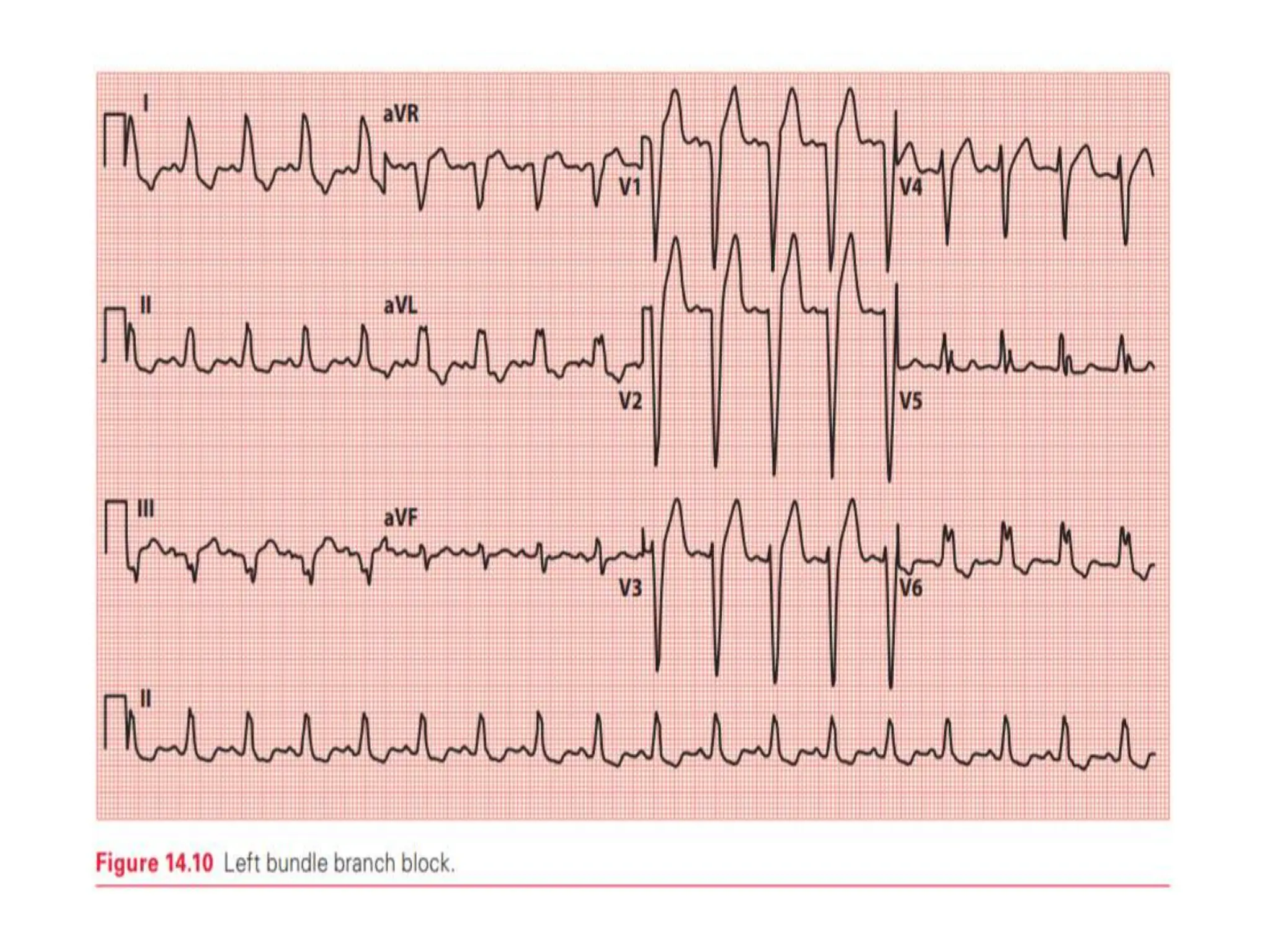
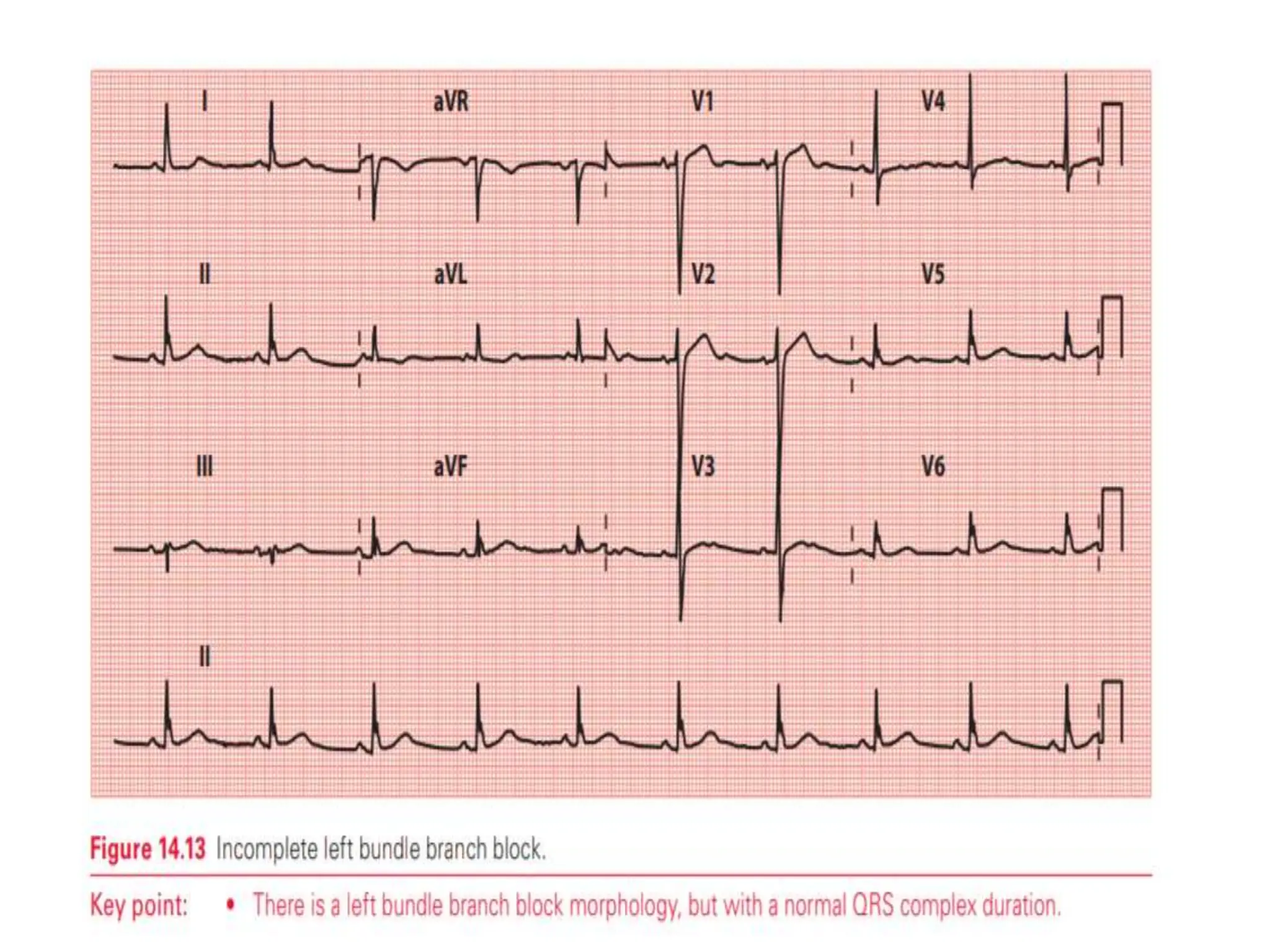
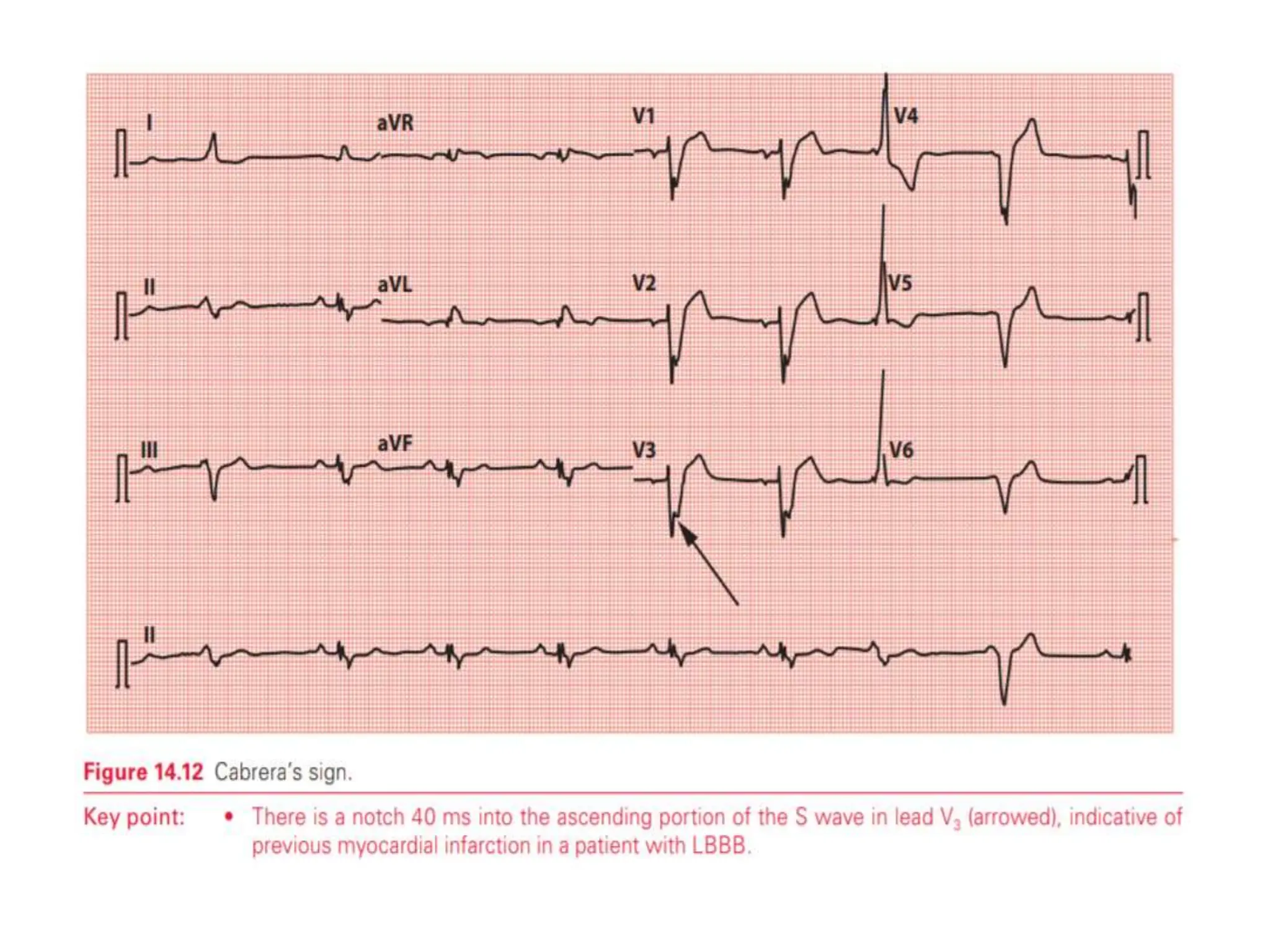
• Left bundle branch block produces a dominant S wave in V1
with broad, notched R waves and absent Q waves in the
lateral leads
• Hyperkalaemia is associated with a range of abnormalities
including peaked T waves
• Tricyclic poisoning is associated with sinus tachycardia and
tall R’ wave in aVR
• Wolff-Parkinson White syndrome is characterised by a short
PR interval and delta waves
• Ventricular pacing will usually have visible pacing spikes
• Hypothermia is associated with bradycardia, long QT, Osborn
waves and shivering artefact
RBBB: Right Bundle Branch Block
V1: RSR’ pattern in V1, with (appropriate) discordant T wave changes
V6: Widened, slurred S wave in V6
LBBB: Left Bundle Branch Block
V1: Dominant S wave
V6: broad, notched (‘M’-shaped) R wave
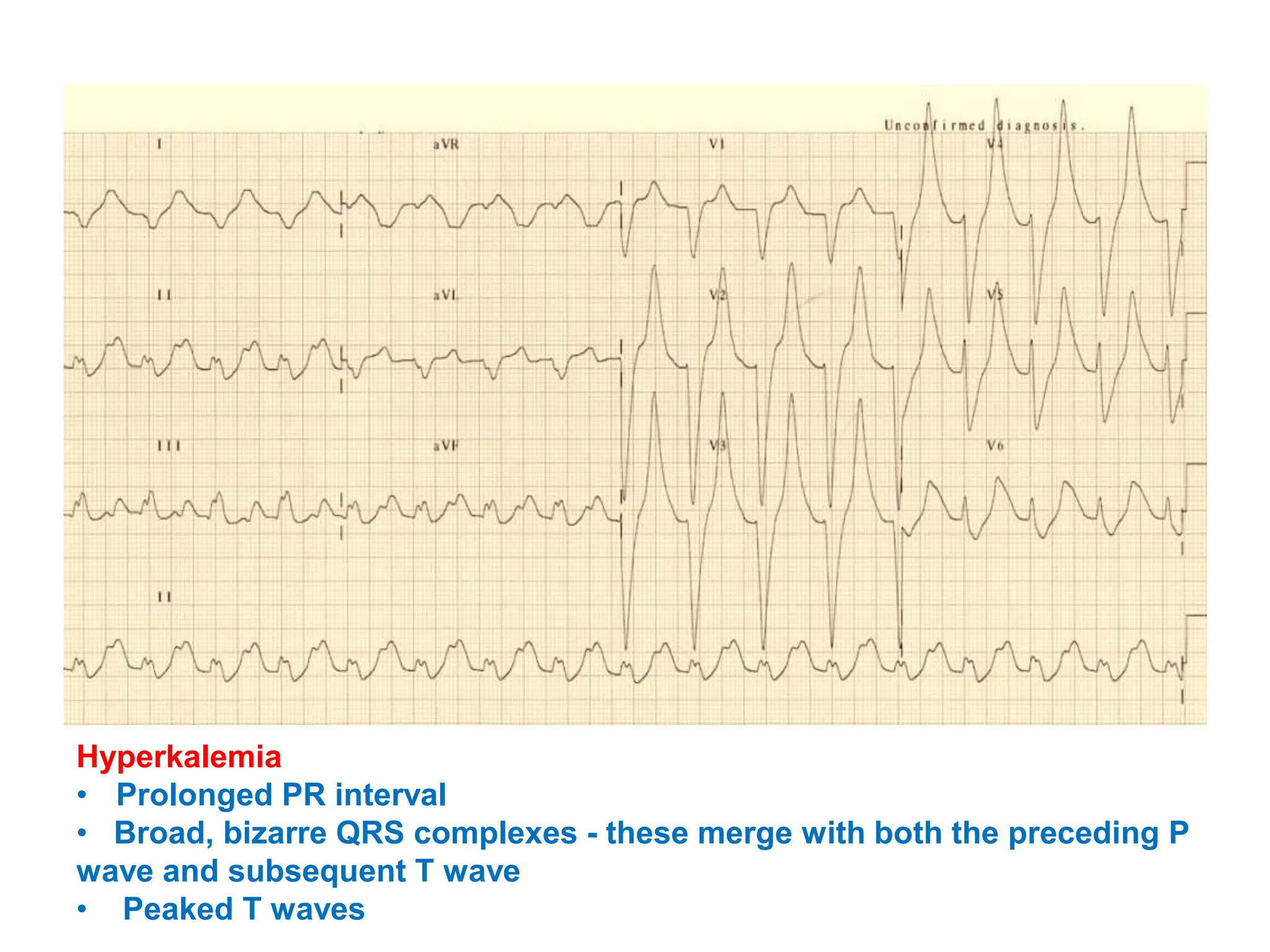
Hyperkalemia
• Prolonged PR interval
• Broad, bizarre QRS complexes - these merge with both the preceding P
wave and subsequent T wave
• Peaked T waves
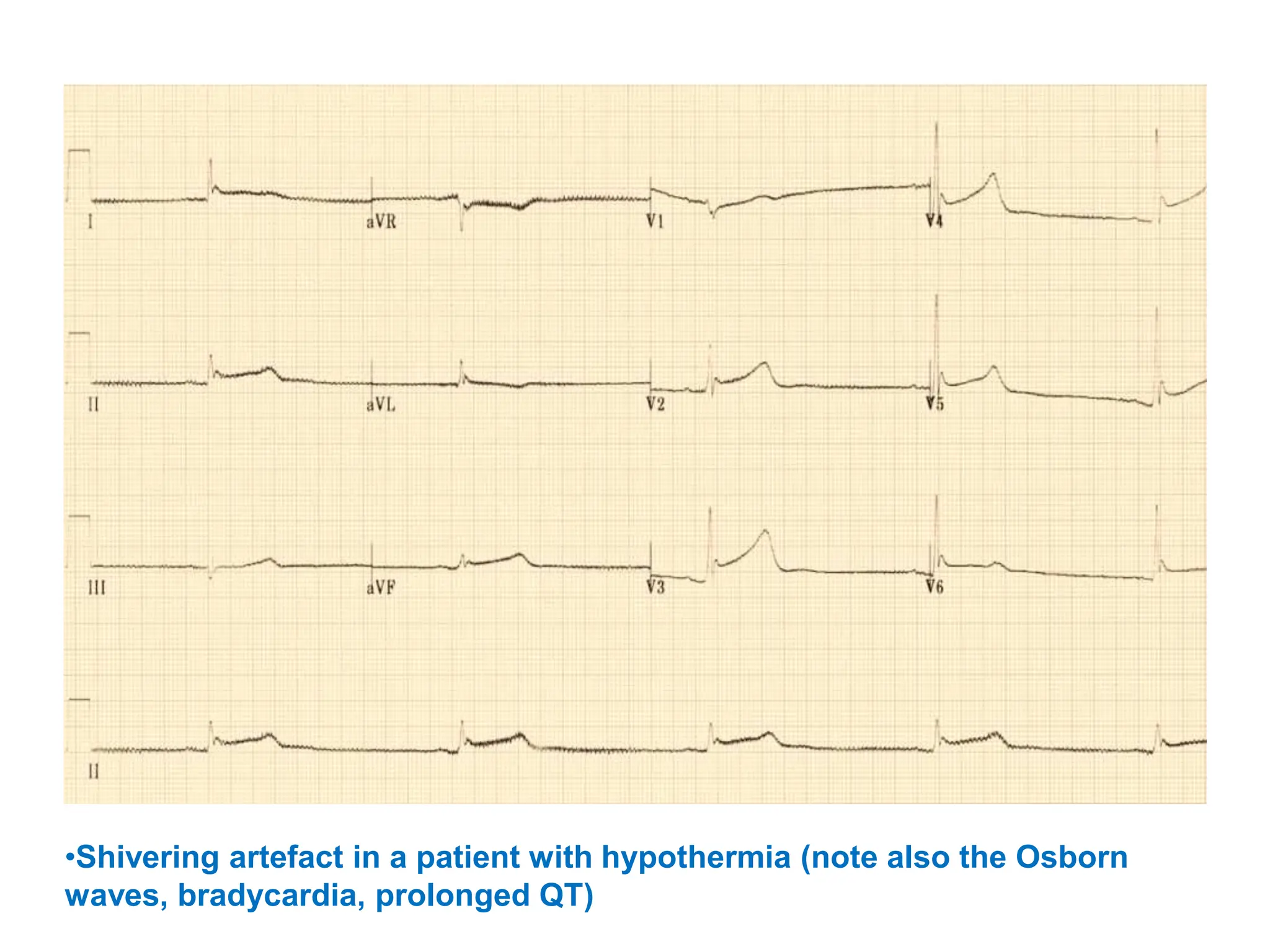
•Shivering artefact in a patient with hypothermia (note also the Osborn
waves, bradycardia, prolonged QT)
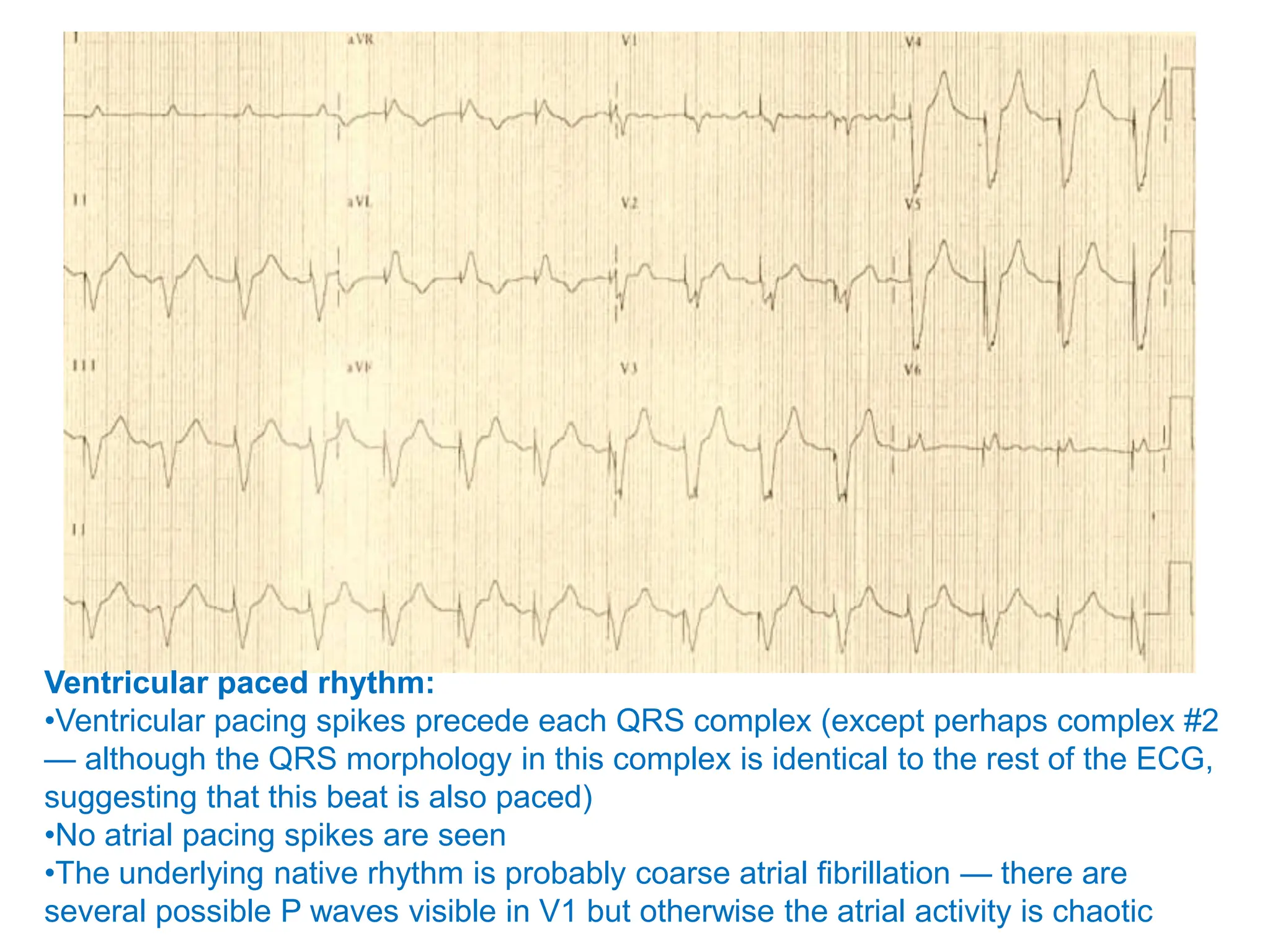
Ventricular paced rhythm:
•Ventricular pacing spikes precede each QRS complex (except perhaps complex #2
— although the QRS morphology in this complex is identical to the rest of the ECG,
suggesting that this beat is also paced)
•No atrial pacing spikes are seen
•The underlying native rhythm is probably coarse atrial fibrillation — there are
several possible P waves visible in V1 but otherwise the atrial activity is chaotic
ARE ANY QRS COMPLEXES AN
ABNORMAL SHAPE?
• Spot Diagnoses
• These cardiac diseases produce distinctive
QRS morphologies that are important not to
miss:
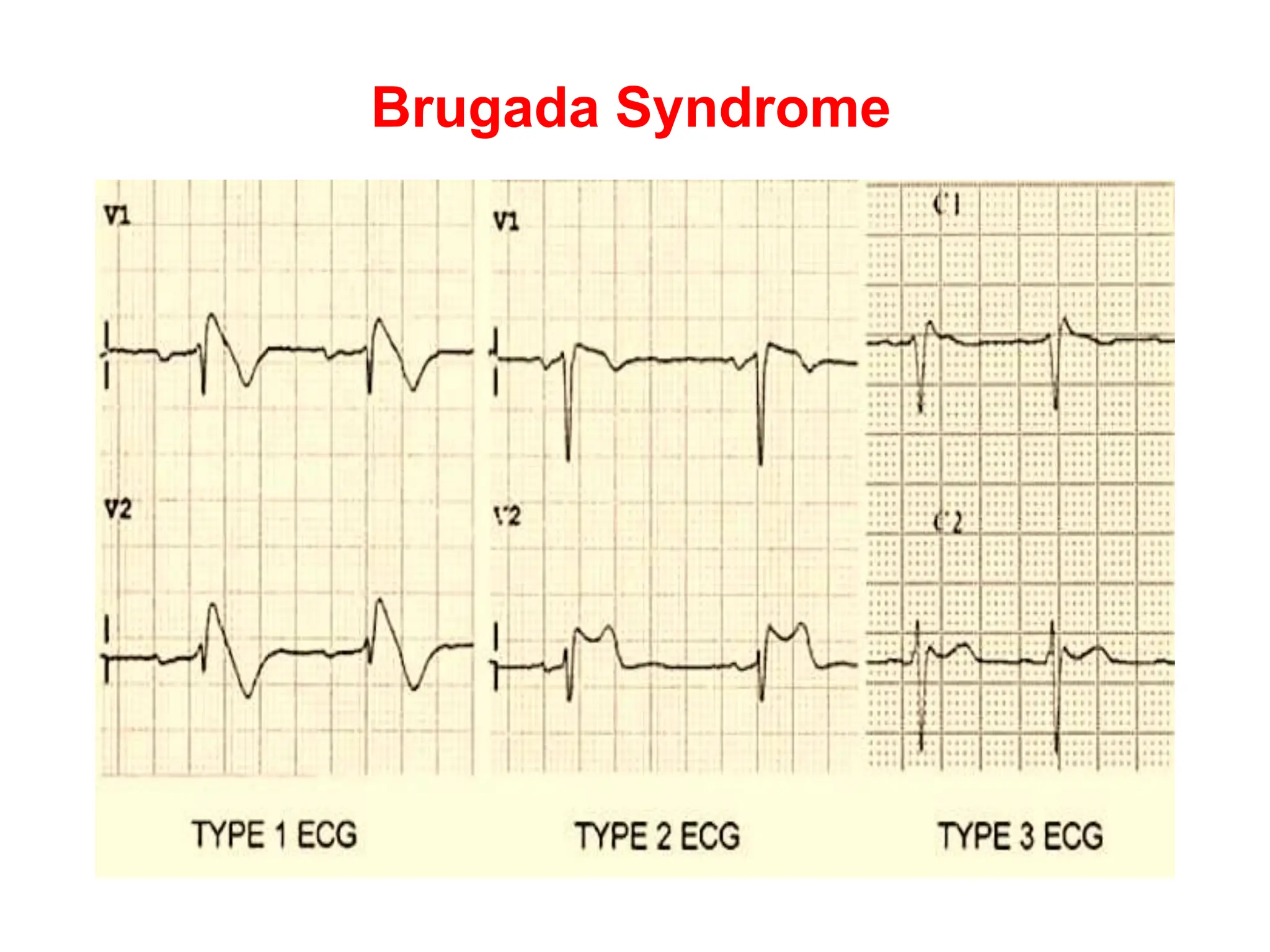
• Brugada syndrome (partial RBBB with ST
elevation in V1-2)
• Wolff-Parkinson White Syndrome (delta
wave)
• Tricyclic poisoning (wide QRS with dominant
R wave in aVR)
Brugada Syndrome
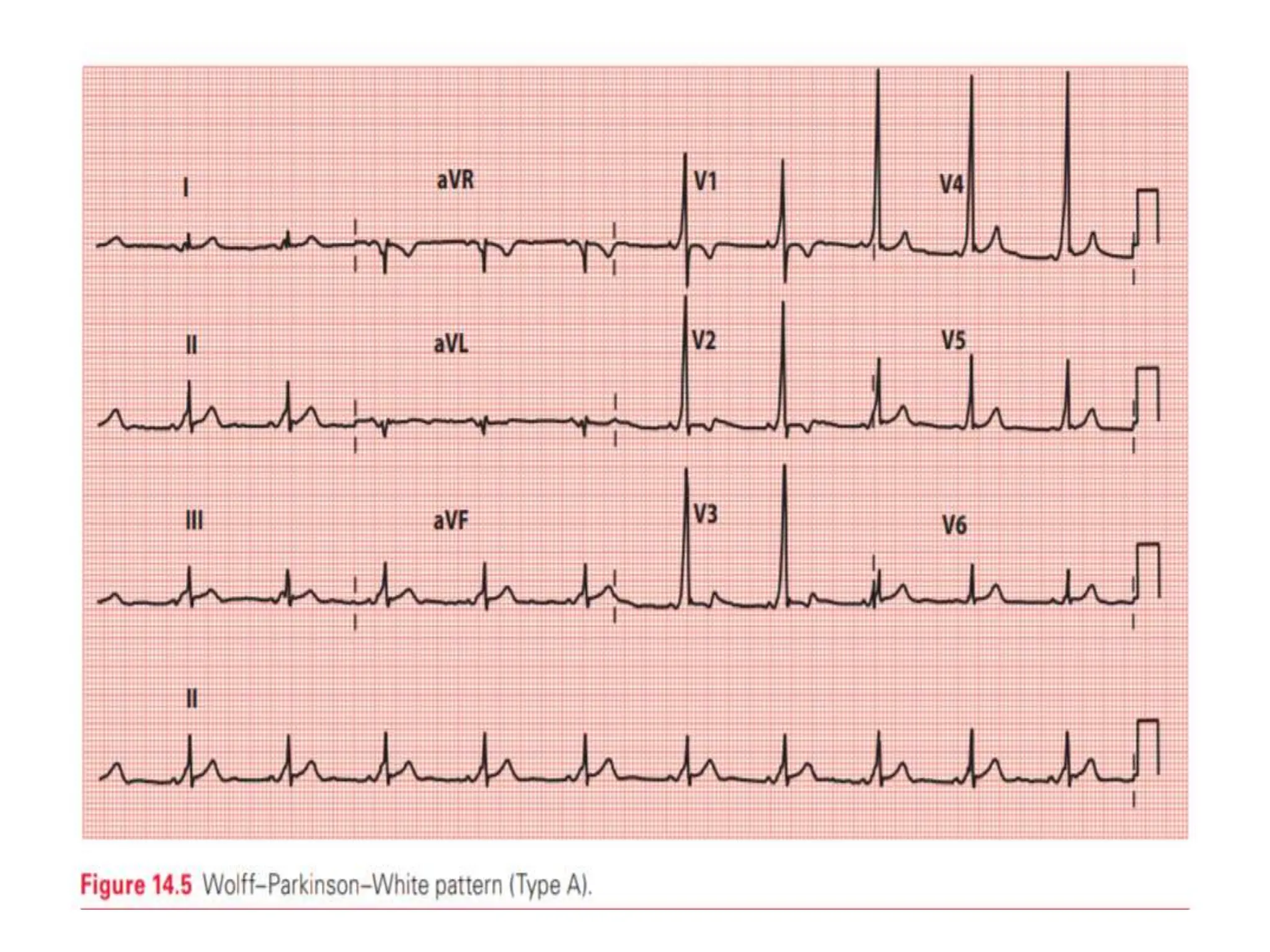
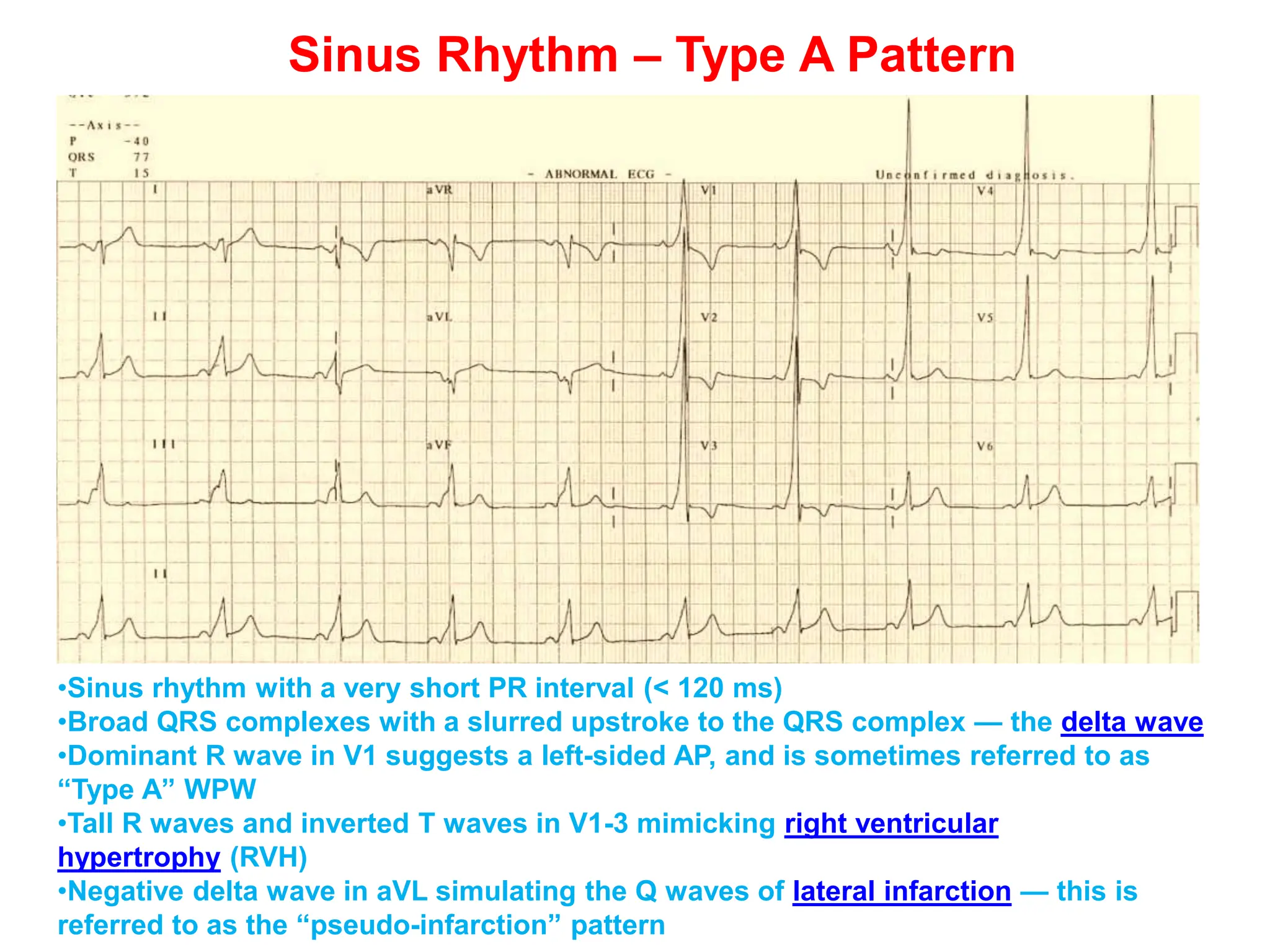
Sinus Rhythm – Type A Pattern
•Sinus rhythm with a very short PR interval (< 120 ms)
•Broad QRS complexes with a slurred upstroke to the QRS complex — the delta wave
•Dominant R wave in V1 suggests a left-sided AP, and is sometimes referred to as
“Type A” WPW
•Tall R waves and inverted T waves in V1-3 mimicking right ventricular
hypertrophy (RVH)
•Negative delta wave in aVL simulating the Q waves of lateral infarction — this is
referred to as the “pseudo-infarction” pattern
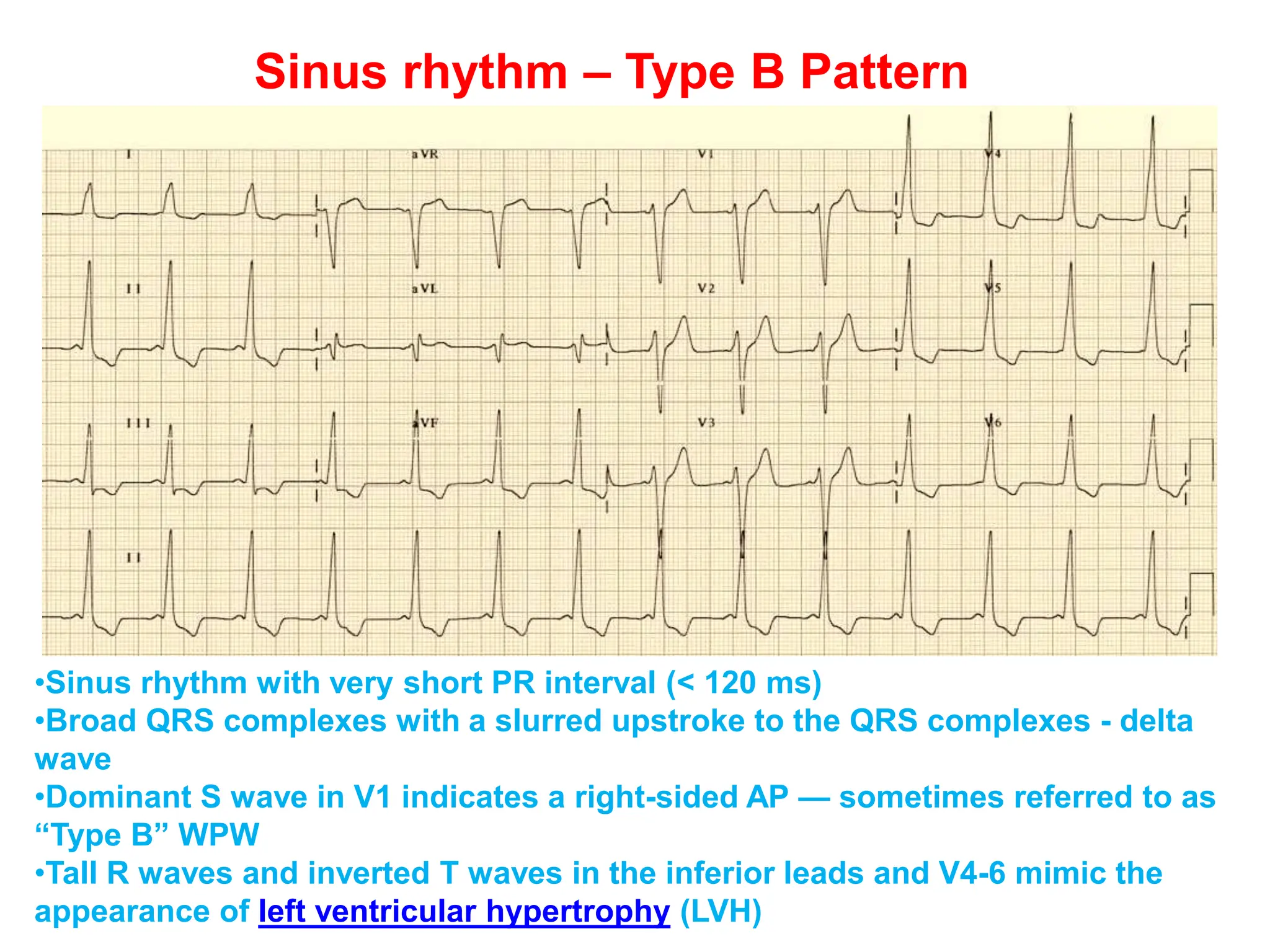
Sinus rhythm – Type B Pattern
•Sinus rhythm with very short PR interval (< 120 ms)
•Broad QRS complexes with a slurred upstroke to the QRS complexes - delta
wave
•Dominant S wave in V1 indicates a right-sided AP — sometimes referred to as
“Type B” WPW
•Tall R waves and inverted T waves in the inferior leads and V4-6 mimic the
appearance of left ventricular hypertrophy (LVH)
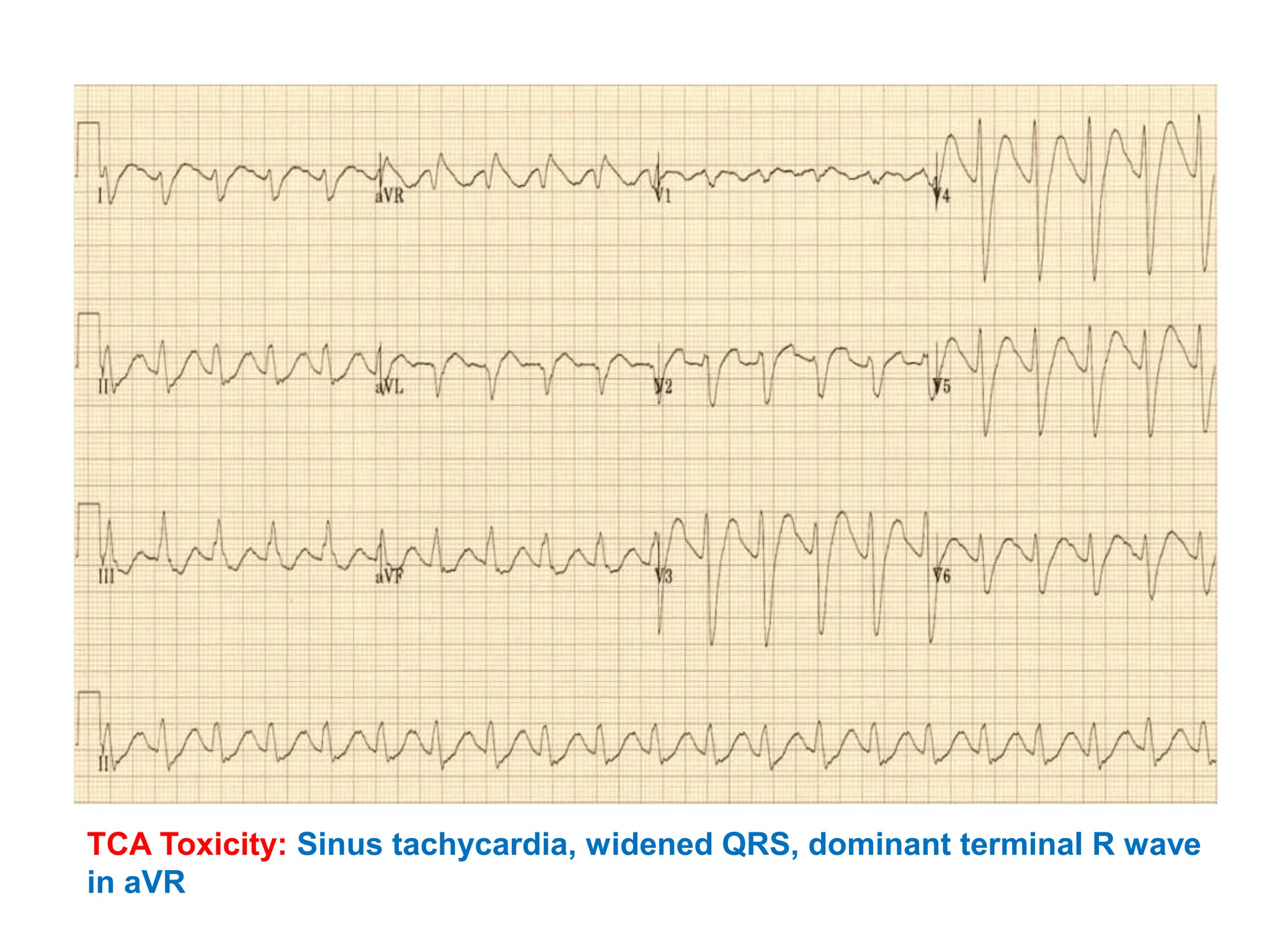
TCA Toxicity: Sinus tachycardia, widened QRS, dominant terminal R wave
in aVR

QRS INTERVAL IN ECG AND ITS ABNORMALITIES

  • 1.
  • 2.
  • 3.
    QRS Complex Morphology •Main features to consider: • Are there any pathological Q waves? • Are any R or S waves too big? • Is there a dominant R wave in aVR? • Is there a poor R wave progression? • Are the QRS complexes too small? • How is the width of QRS complexes? • Are any QRS complexes an abnormal shape?
  • 4.
    ARE ANY ROR S WAVES TOO BIG? • The height of the R wave and depth of the S wave vary from lead to lead in the normal ECG • As a rule, in the normal ECG: • The R wave increases in height from lead V1 to V5 • The R wave is smaller than the S wave in leads V1 and V2 • The R wave is bigger than the S wave in leads V5 and V6 • The tallest R wave does not exceed 25 mm in height • The deepest S wave does not exceed 25 mm in depth
  • 6.
    • Always lookcarefully at the R and S waves in each lead, and check whether they conform to these criteria • If not, first of all consider: • Incorrect ECG calibration (should be 1 mV = 10 mm). • If the calibration is correct, consider whether your patient has one of the following: • Left ventricular hypertrophy • Right ventricular hypertrophy • Posterior myocardial infarction • Wolff–Parkinson–White syndrome • If the QRS complex is also abnormally wide, think of: • Bundle branch block
  • 7.
    Left ventricular hypertrophy •LVH causes tall R waves in the leads I,aVL,V5 and V6 and the reciprocal change of deep S waves in leads V1 and V2 • Diagnostic criteria for LVH • In the limb leads: • R wave >11 mm in lead aVL • R wave >20 mm in lead aVF • S wave >14 mm in lead aVR • Sum of R wave in lead I and S wave in lead III >25 mm. • In the chest leads: • R wave of ≥ 25 mm in the left chest leads • S wave of ≥ 25 mm in the right chest leads • Sum of S wave in lead V1 and R wave in lead V5 or V6 >35 mm (Sokolow–Lyon criterion) • Sum of tallest R wave and deepest S wave in the chest leads >45 mm
  • 9.
    • The Cornellcriteria involve measuring the S wave in lead V3 and the R wave in lead aVL • Left ventricular hypertrophy is indicated by a sum of >28 mm in men and >20 mm in women • The Romhilt–Estes scoring system allocates points for the presence of certain criteria • A score of 5 indicates left ventricular hypertrophy and a score of 4 indicates probable left ventricular hypertrophy • 3 points – for (a) R or S wave in limb leads of ≥20 mm, (b) S wave in right chest leads of ≥25 mm, or (c) R wave in left chest leads of ≥25 mm • 3 points – for ST segment and T wave changes (‘typical strain’) in a patient not taking digitalis (1 point with digitalis) • 3 points – for P-terminal force in V1 >1 mm deep with a duration >0.04 s • 2 points – for left axis deviation (beyond –15°) • 1 point – for QRS complex duration >0.09 s • 1 point – for intrinsicoid deflection (the interval from the start of the QRS complex to the peak of the R wave) in V5 or V6 >0.05 s
  • 10.
    • If thereis evidence of left ventricular hypertrophy on the ECG, look also for evidence of ‘strain’: • ST segment depression • T wave inversion • Causes of left ventricular hypertrophy • Hypertension • Aortic stenosis • Coarctation of the aorta • Hypertrophic cardiomyopathy
  • 11.
    Right ventricular hypertrophy •Right ventricular hypertrophy causes a ‘dominant’ R wave (i.e. bigger than the S wave) in the leads that ‘look at’ the right ventricle, particularly V1 • Right ventricular hypertrophy is also associated with: • Right axis deviation • Deep S waves in leads V5 and V6 • Right bundle branch block (RBBB) • and, if ‘strain’ is present: • ST segment depression • T wave inversion • Causes of right ventricular hypertrophy • Pulmonary hypertension • Pulmonary stenosis • Tetralogy of Fallot • Arrhythmogenic right ventricular cardiomyopathy
  • 13.
    Posterior myocardial infarction Oneof the few causes of ‘dominant’ R wave in lead V1
  • 14.
    Wolff–Parkinson–White syndrome • Ifyou see a dominant R wave in leads V1–V3 in the presence of a short PR interval, think of Wolff–Parkinson–White syndrome • Generally, however, a dominant R wave in leads V1–V3 indicates a left-sided accessory pathway, whereas a dominant S wave in leads V1–V3 indicates a right-sided accessory pathway
  • 16.
    • Dominant Rwave in aVR • Poisoning with sodium-channel blocking drugs (e.g. TCAs) • Dextrocardia • Incorrect lead placement (left/right arm leads reversed) • Ventricular tachycardia (VT)
  • 17.
    • Examples ofDominant R wave in aVR • Poisoning with sodium-channel blocking drugs •Causes a characteristic dominant terminal R wave in aVR •Poisoning with sodium-channel blocking agents is suggested if: • R wave height > 3mm • R/S ratio > 0.7
  • 18.
    Dextrocardia • Positive QRScomplexes (with upright P and T waves) in aVR • Negative QRS complexes (with inverted P and T waves) in lead I • Marked right axis deviation • Absent R-wave progression in the chest leads (dominant S waves throughout)
  • 19.
    Left arm/right armlead reversal
  • 20.
  • 21.
    Poor R waveprogression • Poor R-wave progression (PRWP) is a common ECG finding that is often inconclusively interpreted as suggestive, but not diagnostic, of anterior myocardial infarction (AMI) • Poor R wave progression is described with an R wave ≤ 3 mm in V3 and is caused by: • Prior anteroseptal MI • Dextrocardia • LVH • Inaccurate lead placement • May be a normal variant
  • 22.
    Poor R waveprogression secondary to prior anteroseptal MI
  • 23.
    Poor R waveprogression due to electrode misplacement (leads V1 and V3 reversed)
  • 24.
    Dextrocardia • The ECGdoes not show the normal progressive increase in R wave height across the chest leads; instead, the QRS complexes decrease in height across them • In addition, the P wave is inverted in lead I and there is right axis deviation • Right-sided chest leads will show the pattern normally seen on the left
  • 27.
    ARE THE QRSCOMPLEXES TOO SMALL? • Low Voltage QRS Morphology • The QRS is said to be low voltage when: • The amplitudes of all the QRS complexes in the limb leads are < 5 mm; or • The amplitudes of all the QRS complexes in the precordial leads are < 10 mm
  • 28.
    • Causes oflow voltage include: • Incorrect ECG calibration (should be 1 mV = 10 mm) • Fluid: Pericardial effusion; Pleural effusion • Fat: Obesity • Air: Emphysema; Pneumothorax • Infiltrative / Connective Tissue Disorders • Myxoedema • Infiltrative myocardial diseases i.e. restrictive cardiomyopathy due to amyloidosis, sarcoidosis, haemochromatosis • Constrictive pericarditis • Scleroderma • Loss of viable myocardium: • Previous massive MI • End-stage dilated cardiomyopathy
  • 31.
    Emphysema: •Low voltages inthe limb leads is classically seen in patients with emphysema •Other assocaited ECG features of emphysema include: • Right axis deivation • Peaked P waves (P pulmonale) • Clockwise rotation (persistent S wave in V6)
  • 32.
    Prior Massive AnteriorMI: •Low QRS voltage in V1-6. This diffuse loss of R wave height suggests extensive myocardial loss from a prior anterior MI. •There is also biphasic anterior T waves (Wellens syndrome) indicating new critical occlusion of the LAD artery
  • 33.
    • QRS Width •Normal QRS width is 70-100 ms (a duration of 110 ms is sometimes observed in healthy subjects) • Useful in determining the origin of each QRS complex (e.g. sinus, atrial, junctional or ventricular) • Narrow complexes (QRS < 100 ms) are supraventricular in origin • Broad complexes (QRS > 100 ms) may be either ventricular in origin, or due to aberrant conduction of supraventricular complexes (e.g. due to bundle branch block, hyperkalaemia or sodium-channel blockade) Sinus rhythm with frequent ventricular ectopic beats (VEBs) in a pattern of ventricular bigeminy The narrow beats are sinus in origin, the broad complexes are ventricular
  • 34.
    • Narrow QRSComplex Morphology • Narrow (supraventricular) complexes arise from three main places: • Sino-atrial node (= normal P wave) • Atria (= abnormal P wave / flutter wave / fibrillatory wave) • AV node / junction (= either no P wave or an abnormal P wave with a PR interval < 120 ms)
  • 35.
    • Examples ofNarrow Complex Rhythms: Sinus rhythm: Each narrow complex is preceded by a normal P wave
  • 36.
    Atrial flutter: NarrowQRS complexes are associated with regular flutter waves
  • 37.
    Junctional tachycardia: NarrowQRS complexes with no visible P waves
  • 38.
    • Broad QRSComplex Morphology • A QRS duration > 100 ms is abnormal • A QRS duration > 120 ms is required for the diagnosis of bundle branch block or ventricular rhythm • Broad complexes may be ventricular in origin or due to aberrant conduction secondary to: • Bundle branch block (RBBB or LBBB) • Hyperkalaemia • Hypothermia • Poisoning with sodium-channel blocking agents (e.g. tricyclic antidepressants) • Pre-excitation (i.e. Wolff-Parkinson-White syndrome) • Ventricular pacing • Intermittent aberrancy (e.g. rate-related aberrancy)
  • 39.
    • Example ofa Broad Complex Rhythm: Ventricular tachycardia: Broad QRS complexes with no visible P waves
  • 40.
    • Ventricular vssupraventricular rhythms • Differentiation between ventricular complexes and aberrantly conducted supraventricular complexes may be difficult • In general, aberrant conduction of sinus rhythm and atrial rhythms (tachycardia, flutter, fibrillation) can usually be identified by the presence of preceding atrial activity (P waves, flutter waves, fibrillatory waves) • However, aberrantly conducted junctional (AV nodal) complexes may appear identical to ventricular complexes as both produce broad QRS without any preceding atrial activity • In the case of ectopic beats, this distinction is not really important (as occasional ectopic beats do not usually require treatment) • However, in the case of sustained tachyarrhythmias, the distinction between ventricular tachycardia and SVT with aberrancy becomes more important
  • 41.
    • Fortunately, manycauses of broad QRS can be identified by pattern recognition: • Right bundle branch block produces an RSR’ pattern in V1 and deep slurred S waves in the lateral leads • Left bundle branch block produces a dominant S wave in V1 with broad, notched R waves and absent Q waves in the lateral leads • Hyperkalaemia is associated with a range of abnormalities including peaked T waves • Tricyclic poisoning is associated with sinus tachycardia and tall R’ wave in aVR • Wolff-Parkinson White syndrome is characterised by a short PR interval and delta waves • Ventricular pacing will usually have visible pacing spikes • Hypothermia is associated with bradycardia, long QT, Osborn waves and shivering artefact
  • 42.
    RBBB: Right BundleBranch Block V1: RSR’ pattern in V1, with (appropriate) discordant T wave changes V6: Widened, slurred S wave in V6
  • 45.
    LBBB: Left BundleBranch Block V1: Dominant S wave V6: broad, notched (‘M’-shaped) R wave
  • 49.
    Hyperkalemia • Prolonged PRinterval • Broad, bizarre QRS complexes - these merge with both the preceding P wave and subsequent T wave • Peaked T waves
  • 50.
    •Shivering artefact ina patient with hypothermia (note also the Osborn waves, bradycardia, prolonged QT)
  • 51.
    Ventricular paced rhythm: •Ventricularpacing spikes precede each QRS complex (except perhaps complex #2 — although the QRS morphology in this complex is identical to the rest of the ECG, suggesting that this beat is also paced) •No atrial pacing spikes are seen •The underlying native rhythm is probably coarse atrial fibrillation — there are several possible P waves visible in V1 but otherwise the atrial activity is chaotic
  • 52.
    ARE ANY QRSCOMPLEXES AN ABNORMAL SHAPE? • Spot Diagnoses • These cardiac diseases produce distinctive QRS morphologies that are important not to miss: • Brugada syndrome (partial RBBB with ST elevation in V1-2) • Wolff-Parkinson White Syndrome (delta wave) • Tricyclic poisoning (wide QRS with dominant R wave in aVR)
  • 53.
  • 54.
    Sinus Rhythm –Type A Pattern •Sinus rhythm with a very short PR interval (< 120 ms) •Broad QRS complexes with a slurred upstroke to the QRS complex — the delta wave •Dominant R wave in V1 suggests a left-sided AP, and is sometimes referred to as “Type A” WPW •Tall R waves and inverted T waves in V1-3 mimicking right ventricular hypertrophy (RVH) •Negative delta wave in aVL simulating the Q waves of lateral infarction — this is referred to as the “pseudo-infarction” pattern
  • 55.
    Sinus rhythm –Type B Pattern •Sinus rhythm with very short PR interval (< 120 ms) •Broad QRS complexes with a slurred upstroke to the QRS complexes - delta wave •Dominant S wave in V1 indicates a right-sided AP — sometimes referred to as “Type B” WPW •Tall R waves and inverted T waves in the inferior leads and V4-6 mimic the appearance of left ventricular hypertrophy (LVH)
  • 56.
    TCA Toxicity: Sinustachycardia, widened QRS, dominant terminal R wave in aVR