



HEART BLOCKS AND
PACEMAKER
PRESENTERS: ZAFRAN FARAZ
SHABANA SYED
PRESENTED TO: SHAHIDA ABBASSI
LECTURER IN PGCN HAYATABAD
PESHAWAR
OBJECTIVE
• Discuss Normal A&P of the Heart.
• Define heart block and Explain types of Heart block.
• Describe Nursing Management of Heart Block.
• Define and Explain Pacemaker.
• Explain Nursing Management of Pacemaker.
Understanding Heart block and pacemaker
through video
Cardiovascular Anatomy & Physiology
• Heart is shaped like “Cone”
• “top” of the heart is the base
• “bottom” is the apex
• Heart size = clenched fist
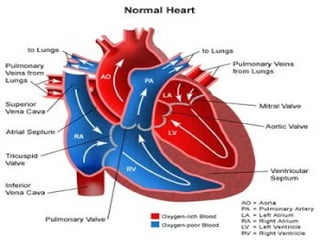
• The heart has 4 valves:
The mitral valve and tricuspid valve, which control blood flow
from the atria to the ventricles
CONT...
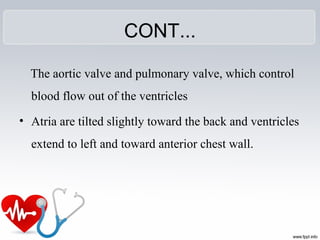
The aortic valve and pulmonary valve, which control
blood flow out of the ventricles
• Atria are tilted slightly toward the back and ventricles
extend to left and toward anterior chest wall.
Cardiovascular: Blood Flow
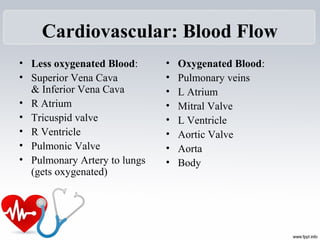
• Less oxygenated Blood:
• Superior Vena Cava
& Inferior Vena Cava
• R Atrium
• Tricuspid valve
• R Ventricle
• Pulmonic Valve
• Pulmonary Artery to lungs
(gets oxygenated)
• Oxygenated Blood:
• Pulmonary veins
• L Atrium
• Mitral Valve
• L Ventricle
• Aortic Valve
• Aorta
• Body
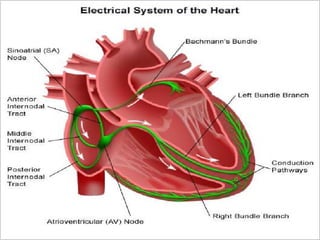
ELECTRICAL SYSTEM OF THE HEART
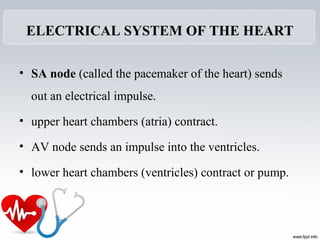
• SA node (called the pacemaker of the heart) sends
out an electrical impulse.
• upper heart chambers (atria) contract.
• AV node sends an impulse into the ventricles.
• lower heart chambers (ventricles) contract or pump.
Cont..
• SA node sends another signal to the atria to
contract, which starts the cycle over again.
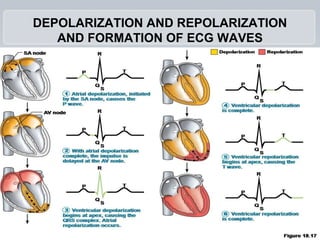
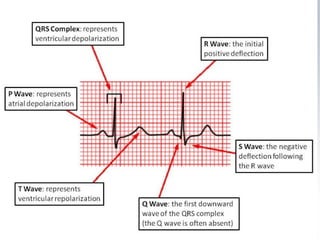
DEPOLARIZATION AND REPOLARIZATION
AND FORMATION OF ECG WAVES
HEART BLOCK
DEFINATION
Heart block is an abnormal heart rhythm where 
the heart beats too slowly (bradycardia). 
In this condition, the electrical signals that tell 
the heart to contract are partially or totally blocked 
between the upper chambers (atria) and the lower 
chambers (ventricles).
TYPES OF HEART BLOCK
• They are further classified as,
1) First degree heart block ( first degree AV block)
2) second degree heart block (second degree AV 
block)
3) third degree heart block (third degree AV block)
First degree heart block
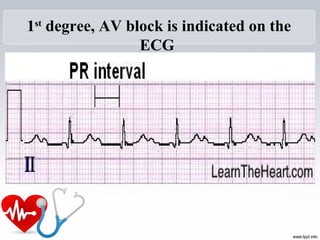
• Electrical impulse moves more slowly than 
normal through the AV node but it still 
conducts each signal.
• Common in highly trained athletes.
Cont...
• Caused by drugs, particularly those that slow 
electrical impulse conduction through the AV node, 
such as beta-blockers, diltiazem, verapamil, digoxin 
and amiodarone.
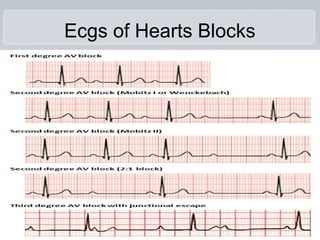
1st
degree, AV block is indicated on the
ECG
Second Degree Heart Block
• Two types:
• Mobitz Type I (Wenkebach)
• Mobitz Type II
Mobitz Type 1
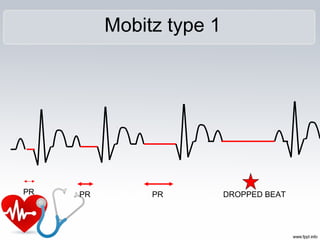
• Less serious form of second-degree heart block.
• Electrical signal goes slower and slower until the 
heart actually skips a beat.
• PR Interval prolongs with each beat until a dropped 
beat is seen
• The PR Interval is NOT constant
Cont..
• After each dropped beat, the PR interval is 
normal and the cycle starts again 
Mobitz type 1
PR PR PR DROPPED BEAT
CONT...
• Clinical Significance
• Slight symptoms e.g.. Lethargy, Confusion
• Treatment
• Pacemaker if during day &/or symptoms
• No treatment if at night.
• Note – this can progress to 3º Heart Block
Mobitz TYPE 2
• Electrical impulses are unable to reach the ventricles. 
• Less common than Type I, and is more serious. 
• Doctor will recommend a pacemaker to treat type II 
second degree heart block, as it frequently progresses 
to third degree heart block. 
CONT...
• Clinical significance – this is more significant disease 
• Treatment – pacemaker
• Note – this can progress to 3º Heart Block
THIRD DEGREE HEART BLOCK
• Also called complete heart block,
• None of the electrical impulses from the atria reach
the ventricles.
• When the ventricles (lower chambers) do not receive
electrical impulses from the atria (upper chambers),
they may generate some impulses on their own, called
junctional or ventricular escape beats.
Cont...
• Ventricular escape beats, the heart’s
naturally occurring backups, are usually very
slow..
SIGNIFICANCE
• Clinical significance:
• Symptoms LOC, Confusion, Dizziness, Low BP
• Can lead to standstill, VF
• Treatment - pacemaker
Ecgs of Hearts Blocks
NURSING MANAGEMENT
Monitor ECG of the patient.
Assess the family history of heart disease.
Assess the history of smoking and alcoholism.
Monitor lab values frequently especially
serum cholesterol levels.
Cont...
Assess for CAD.
Monitor vital signs.
Instruct to avoid high fat and oil rich diet.
SHABANA SYED
PACEMAKER
Pacemaker is an electronic device that
provides electrical stimuli to the heart
muscle.
Pacemaker Design
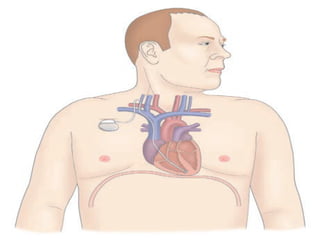
• Pacemakers consist of two components:
1)electronic pulse generator
2) wires (leads, or electrodes) — that's placed
under the skin in your chest to help control
your heartbeat.
FUNCTION OF PACEMAKER
• It produces the electrical impulses that stimulate your
heart to beat.
• The generator is connected to your heart through tiny
wires that are implanted at the same time.
Cont...
• The impulses flow through these leads to your
heart and are timed to flow at regular intervals
just as impulses from your heart's natural
pacemaker would
COMPLICATION OF PACEMAKER
USE
• Following complication may arise from pacemaker:
• Local infection at the entry site of the leads for
temporary pacing, or at the subcutaneous site for
permanent generator placement.
Cont...
• Bleeding and hematoma at the lead entry sites
for temporary pacing or at the subcutaneous
site for permanent generator placement.
CONT..
Movement or dislocation of the lead placed
transvenously (perforation of the
myocardium).
NURSING MANAGEMENT
• Patient’s heart rate and rhythm are monitored
by ECG.
• Device’s settings are noted and compared with
the ECG recordings to assess the device’s
function.
Cont...
• Cardiac output and hemodynamic stability are
assessed to identify the patient’s response to
pacing and the adequacy of pacing.
Cont...
• The appearance or increasing frequency of
dysrhythmia is observed and reported to the
physician.
CONT...
• Incision site where the generator was implanted is
observed for bleeding, hematoma formation, or
infection.
• The patient may complain of continuous throbbing
or pain.
• These symptoms are reported to the physician.
Summary
• Cardiovascular system A&P.
• Heart Block And Types Of Heart Block.
• Pacemaker
Refference
Refference
• https://my.clevelandclinic.org/health/articles/hear
t-block/heart-block-types
• http://www.hrsonline.org/Patient-
Resources/Heart-Diseases-Disorders/Heart-
Block
• https://www.nhlbi.nih.gov/health/health-
topics/topics/hb/types
• https://en.wikipedia.org/wiki/Heart_block
• http://www.hrsonline.org/Patient-Resources/The-
Normal-Heart/Electrical-System
Title
• Text

Heart block by zafran faraz