Module 1. Experienced Street Food Success?
What next?
Streetfood Opportunities for Regions is an Eramus+ funded programme
2
The Current Market
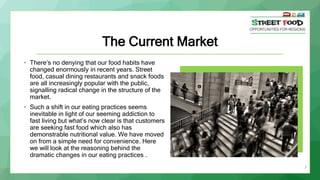
• There’s no denying that our food habits have
changed enormously in recent years. Street
food, casual dining restaurants and snack foods
are all increasingly popular with the public,
signalling radical change in the structure of the
market.
• Such a shift in our eating practices seems
inevitable in light of our seeming addiction to
fast living but what’s now clear is that customers
are seeking fast food which also has
demonstrable nutritional value. We have moved
on from a simple need for convenience. Here
we will look at the reasoning behind the
dramatic changes in our eating practices .
Changing Times
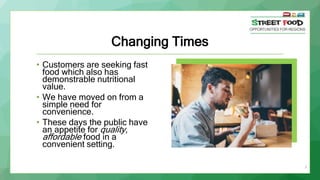
• Customers are seeking fast
food which also has
demonstrable nutritional
value.
• We have moved on from a
simple need for
convenience.
• These days the public have
an appetite for quality,
affordable food in a
convenient setting.
3
Time
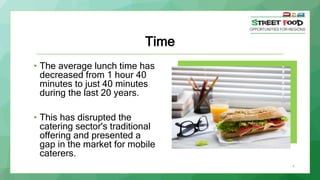
• The average lunch time has
decreased from 1 hour 40
minutes to just 40 minutes
during the last 20 years.
• This has disrupted the
catering sector's traditional
offering and presented a
gap in the market for mobile
caterers.
4
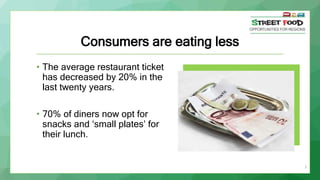
Consumers are eating less
• The average restaurant ticket
has decreased by 20% in the
last twenty years.
• 70% of diners now opt for
snacks and ‘small plates’ for
their lunch.
5
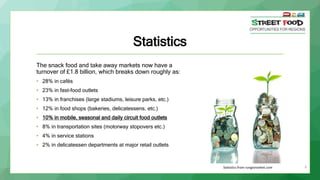
Statistics
The snack food and take away markets now have a
turnover of £1.8 billion, which breaks down roughly as:
• 28% in cafés
• 23% in fast-food outlets
• 13% in franchises (large stadiums, leisure parks, etc.)
• 12% in food shops (bakeries, delicatessens, etc.)
• 10% in mobile, seasonal and daily circuit food outlets
• 8% in transportation sites (motorway stopovers etc.)
• 4% in service stations
• 2% in delicatessen departments at major retail outlets
Statistics from rungismarket.com 6
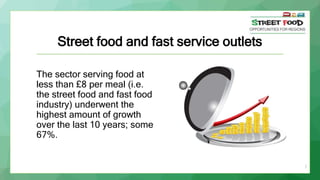
Street food and fast service outlets
The sector serving food at
less than £8 per meal (i.e.
the street food and fast food
industry) underwent the
highest amount of growth
over the last 10 years; some
67%.
7
8
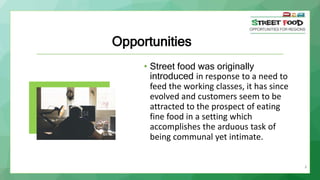
Opportunities
• Street food was originally
introduced in response to a need to
feed the working classes, it has since
evolved and customers seem to be
attracted to the prospect of eating
fine food in a setting which
accomplishes the arduous task of
being communal yet intimate.
9
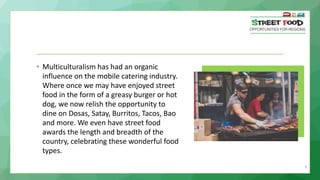
• Multiculturalism has had an organic
influence on the mobile catering industry.
Where once we may have enjoyed street
food in the form of a greasy burger or hot
dog, we now relish the opportunity to
dine on Dosas, Satay, Burritos, Tacos, Bao
and more. We even have street food
awards the length and breadth of the
country, celebrating these wonderful food
types.
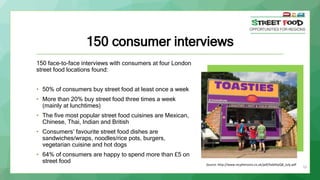
150 consumer interviews
150 face-to-face interviews with consumers at four London
street food locations found:
• 50% of consumers buy street food at least once a week
• More than 20% buy street food three times a week
(mainly at lunchtimes)
• The five most popular street food cuisines are Mexican,
Chinese, Thai, Indian and British
• Consumers’ favourite street food dishes are
sandwiches/wraps, noodles/rice pots, burgers,
vegetarian cuisine and hot dogs
• 64% of consumers are happy to spend more than £5 on
street food Source: http://www.mcphersons.co.uk/pdf/liabilityQB_July.pdf
10
11
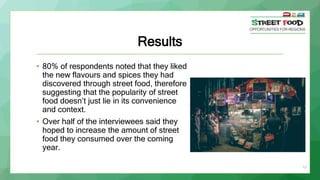
Results
• 80% of respondents noted that they liked
the new flavours and spices they had
discovered through street food, therefore
suggesting that the popularity of street
food doesn’t just lie in its convenience
and context.
• Over half of the interviewees said they
hoped to increase the amount of street
food they consumed over the coming
year.
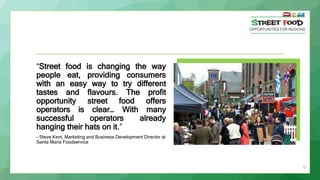
“Street food is changing the way
people eat, providing consumers
with an easy way to try different
tastes and flavours. The profit
opportunity street food offers
operators is clear… With many
successful operators already
hanging their hats on it.”
- Steve Kent, Marketing and Business Development Director at
Santa Maria Foodservice
12
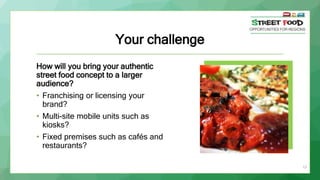
Your challenge
How will you bring your authentic
street food concept to a larger
audience?
• Franchising or licensing your
brand?
• Multi-site mobile units such as
kiosks?
• Fixed premises such as cafés and
restaurants?
13
14
What is a Market Disruptor?
• Market disruptors are individuals or companies who achieve
success by filling a gap in service. They are quite simply
opportunists – skilled in developing start-ups.
• In the short term, these companies:
1. Thrive and invite a huge amount of attention.
2. They make money quickly.
3. They hire quickly.
4. Their company culture appears rich and attractive.
5. Most importantly, they cause huge disruption to the
established restaurant and takeaway markets.
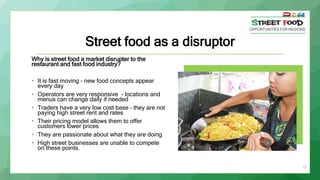
Street food as a disruptor
Why is street food a market disrupter to the
restaurant and fast food industry?
• It is fast moving – new food concepts appear
every day
• Operators are very responsive - locations and
menus can change daily if needed
• Traders have a very low cost base – they are not
paying high street rent and rates
• Their pricing model allows them to offer
customers lower prices
• They are passionate about what they are doing
• High street businesses are unable to compete
on these points.
15
16
Technology Changing the Food Industry
• If you are considering expanding your business, then you would be
wise to not underestimate the power of technology with regards to
increasing earning potential whilst simultaneously decreasing
lengthy, laborious ‘housekeeping’ tasks.
• In an incredibly short amount of time, we have gone from visiting
our local takeaway in person to using mobile apps, effectively
cutting out the personal service we have historically been used to.
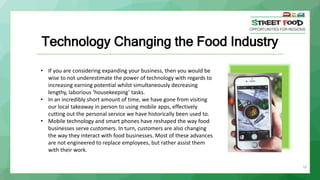
• Mobile technology and smart phones have reshaped the way food
businesses serve customers. In turn, customers are also changing
the way they interact with food businesses. Most of these advances
are not engineered to replace employees, but rather assist them
with their work.
Technology is your friend!
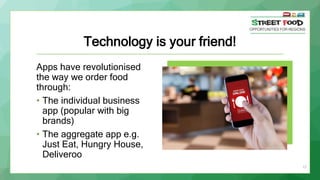
Apps have revolutionised
the way we order food
through:
• The individual business
app (popular with big
brands)
• The aggregate app e.g.
Just Eat, Hungry House,
Deliveroo
17
18
Advantages to using Technology
• The typical food ordering app shows an outlet’s
complete menu so the consumer can order exactly
what they want for pick-up or delivery. They can
register their credit card and pay for their food
through the app.
• Aside from the obvious benefits for customers, food
ordering apps can also be advantageous for food
businesses. Some of the more advanced food
ordering apps use GPS to communicate the
customer’s whereabouts to the food outlet. They’ll
receive a notification when the customer is close-by
so that staff can get the order ready.
• What’s more, apps like these can function in the
same way as loyalty cards. If a customer has ordered
from your food outlet through the app before, they’re
more likely to use it again. Customers can actually
save their favourite meals to re-order at later dates,
after all.
19
Technology is everyone's friend
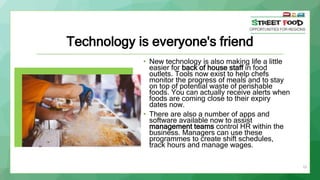
• New technology is also making life a little
easier for back of house staff in food
outlets. Tools now exist to help chefs
monitor the progress of meals and to stay
on top of potential waste of perishable
foods. You can actually receive alerts when
foods are coming close to their expiry
dates now.
• There are also a number of apps and
software available now to assist
management teams control HR within the
business. Managers can use these
programmes to create shift schedules,
track hours and manage wages.
Time to evaluate
20
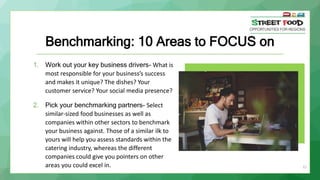
Benchmarking: 10 Areas to FOCUS on
1. Work out your key business drivers- What is
most responsible for your business’s success
and makes it unique? The dishes? Your
customer service? Your social media presence?
2. Pick your benchmarking partners- Select
similar-sized food businesses as well as
companies within other sectors to benchmark
your business against. Those of a similar ilk to
yours will help you assess standards within the
catering industry, whereas the different
companies could give you pointers on other
areas you could excel in. 21
22
3. Look at other business’s objectives- What
makes them unique? What’s giving them the
edge? Do your benchmarking partners have
any of their own drivers that you could adapt
for the benefit of your business upon
expansion?
4. Note your business’s efficiency- How effective
are your production processes? Are your
competitors running a more efficient ship than
you? Are they using different or new processes
that your business could benefit from?
23
5. Consider your resources- Are there any different
areas where your competitors allocate resources in
comparison to your business? How many employees
do they have? Are you investing time and money in
similar areas?
6. Compare costs- Are your outgoings higher, lower or
similar to the average? This might be harder to work
out, but we’ll provide a table of industry averages
later on. Are there any areas where you can make
savings?
7. Work out how productive your employees are-
Assess the productivity of your business by
calculating how many sales are made per member of
staff employed. Are your sales looking healthy? If
not, explore where the problem could be.
24
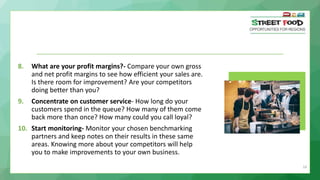
8. What are your profit margins?- Compare your own gross
and net profit margins to see how efficient your sales are.
Is there room for improvement? Are your competitors
doing better than you?
9. Concentrate on customer service- How long do your
customers spend in the queue? How many of them come
back more than once? How many could you call loyal?
10. Start monitoring- Monitor your chosen benchmarking
partners and keep notes on their results in these same
areas. Knowing more about your competitors will help
you to make improvements to your own business.
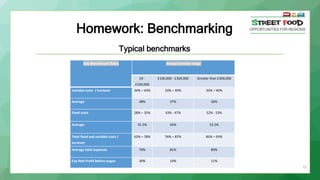
Homework: Benchmarking
Typical benchmarks
Key Benchmark Ratio Annual turnover range
£0 -
£100,000
£100,000 - £300,000 Greater than £300,000
Variable costs / turnover 34% – 43% 33% – 40% 33% – 40%
Average 38% 37% 36%
Fixed costs 28% – 35% 43% - 47% 52% - 53%
Average 31.5% 45% 52.5%
Total fixed and variable costs /
turnover
62% – 78% 76% – 87% 85% – 93%
Average total expenses 70% 81% 89%
Exp Nett Profit before wages 30% 19% 11%
25
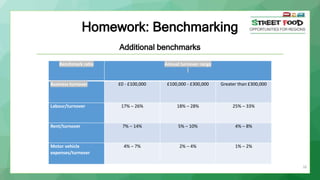
Homework: Benchmarking
Additional benchmarks
Benchmark ratio Annual turnover range
Business turnover £0 - £100,000 £100,000 - £300,000 Greater than £300,000
Labour/turnover 17% – 26% 18% – 28% 25% – 33%
Rent/turnover 7% – 14% 5% – 10% 4% – 8%
Motor vehicle
expenses/turnover
4% – 7% 2% – 4% 1% – 2%
26
27
Case Study
• UK street food pioneer Yianni Papoutsis started up the MEATwagon
in 2009, selling dirty burgers from a £3,000 burger van in London
car parks.
• Along with a number of other early street food entrepreneurs,
Papoutsis would put on what became known as the Towpath
Festivals. Spreading the word on Twitter caused foodies to flock and
enjoy new food in a party atmosphere.
• Later, when the MEATwagon was stolen, south London pub owner
Scott Collins encouraged Papoutsis to set up and cook in a room
above his latest pub in New Cross. Things went well and less than
ten years later, the MEATliquor chain boasted a multimillion pound
turnover. So what are the five secrets to their success?
28
Case Study: MeatLiquor
Click the link below PDF to follow
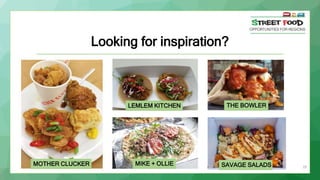
Looking for inspiration?
MOTHER CLUCKER
LEMLEM KITCHEN
MIKE + OLLIE SAVAGE SALADS
THE BOWLER
29
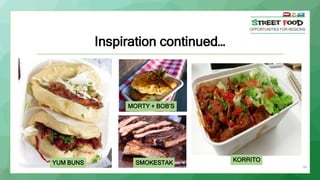
Inspiration continued…
YUM BUNS
MORTY + BOB’S
SMOKESTAK KORRITO
30
31
BAD BROWNIE
Click the link below to get a taste of
how you can turn your dreams into
reality through the use of street food:
https://www.youtube.com/watch?v=CS
19RxsgGTY
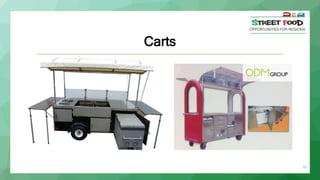
Carts
32
33
Carts continued…..
• The main advantages of trading from a food cart
include cost and height. As you would expect,
carts are inexpensive to purchase and run so can
be a good option for anyone wanting to expand
with minimum investment. In a cart you’ll also be
able to trade from the same level as the
customer, which is hard to achieve in a truck or
trailer.
• The downside of trading from carts is that you
have to transport them to site (which could mean
wheeling them manually for some distance). With
a cart your stock levels are also limited because
of the lack of storage space on board.
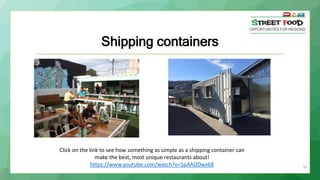
Shipping containers
34
Click on the link to see how something as simple as a shipping container can
make the best, most unique restaurants about!
https://www.youtube.com/watch?v=5pAAlZ0wx68
35
Shipping Containers continued…
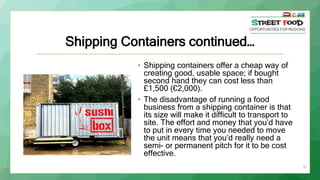
• Shipping containers offer a cheap way of
creating good, usable space; if bought
second hand they can cost less than
£1,500 (€2,000).
• The disadvantage of running a food
business from a shipping container is that
its size will make it difficult to transport to
site. The effort and money that you’d have
to put in every time you needed to move
the unit means that you’d really need a
semi- or permanent pitch for it to be cost
effective.
Novelty vehicles
36
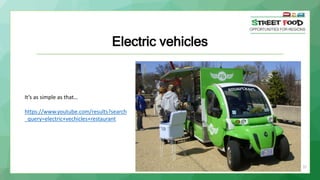
Electric vehicles
37
It’s as simple as that…
https://www.youtube.com/results?search
_query=electric+vechicles+restaurant
38
Electric Vehicles continued…
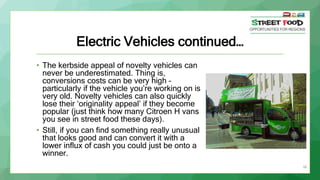
• The kerbside appeal of novelty vehicles can
never be underestimated. Thing is,
conversions costs can be very high –
particularly if the vehicle you’re working on is
very old. Novelty vehicles can also quickly
lose their ‘originality appeal’ if they become
popular (just think how many Citroen H vans
you see in street food these days).
• Still, if you can find something really unusual
that looks good and can convert it with a
lower influx of cash you could just be onto a
winner.
Wearable grills!
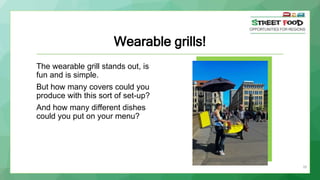
The wearable grill stands out, is
fun and is simple.
But how many covers could you
produce with this sort of set-up?
And how many different dishes
could you put on your menu?
39
Discuss the pros and cons
1. Open a second location
2. License your food product
3. Create new products
4. Align your business with another
5. Make your business into a franchising
opportunity for others
6. Look for government contracts
7. Target different markets
8. Become a supplier
9. Merge with another business
10. Expand globally!
40

Sfofr module 1 powerpoint

  • 1.
    Module 1. ExperiencedStreet Food Success? What next? Streetfood Opportunities for Regions is an Eramus+ funded programme
  • 2.
    2 The Current Market •There’s no denying that our food habits have changed enormously in recent years. Street food, casual dining restaurants and snack foods are all increasingly popular with the public, signalling radical change in the structure of the market. • Such a shift in our eating practices seems inevitable in light of our seeming addiction to fast living but what’s now clear is that customers are seeking fast food which also has demonstrable nutritional value. We have moved on from a simple need for convenience. Here we will look at the reasoning behind the dramatic changes in our eating practices .
  • 3.
    Changing Times • Customersare seeking fast food which also has demonstrable nutritional value. • We have moved on from a simple need for convenience. • These days the public have an appetite for quality, affordable food in a convenient setting. 3
  • 4.
    Time • The averagelunch time has decreased from 1 hour 40 minutes to just 40 minutes during the last 20 years. • This has disrupted the catering sector's traditional offering and presented a gap in the market for mobile caterers. 4
  • 5.
    Consumers are eatingless • The average restaurant ticket has decreased by 20% in the last twenty years. • 70% of diners now opt for snacks and ‘small plates’ for their lunch. 5
  • 6.
    Statistics The snack foodand take away markets now have a turnover of £1.8 billion, which breaks down roughly as: • 28% in cafés • 23% in fast-food outlets • 13% in franchises (large stadiums, leisure parks, etc.) • 12% in food shops (bakeries, delicatessens, etc.) • 10% in mobile, seasonal and daily circuit food outlets • 8% in transportation sites (motorway stopovers etc.) • 4% in service stations • 2% in delicatessen departments at major retail outlets Statistics from rungismarket.com 6
  • 7.
    Street food andfast service outlets The sector serving food at less than £8 per meal (i.e. the street food and fast food industry) underwent the highest amount of growth over the last 10 years; some 67%. 7
  • 8.
    8 Opportunities • Street foodwas originally introduced in response to a need to feed the working classes, it has since evolved and customers seem to be attracted to the prospect of eating fine food in a setting which accomplishes the arduous task of being communal yet intimate.
  • 9.
    9 • Multiculturalism hashad an organic influence on the mobile catering industry. Where once we may have enjoyed street food in the form of a greasy burger or hot dog, we now relish the opportunity to dine on Dosas, Satay, Burritos, Tacos, Bao and more. We even have street food awards the length and breadth of the country, celebrating these wonderful food types.
  • 10.
    150 consumer interviews 150face-to-face interviews with consumers at four London street food locations found: • 50% of consumers buy street food at least once a week • More than 20% buy street food three times a week (mainly at lunchtimes) • The five most popular street food cuisines are Mexican, Chinese, Thai, Indian and British • Consumers’ favourite street food dishes are sandwiches/wraps, noodles/rice pots, burgers, vegetarian cuisine and hot dogs • 64% of consumers are happy to spend more than £5 on street food Source: http://www.mcphersons.co.uk/pdf/liabilityQB_July.pdf 10
  • 11.
    11 Results • 80% ofrespondents noted that they liked the new flavours and spices they had discovered through street food, therefore suggesting that the popularity of street food doesn’t just lie in its convenience and context. • Over half of the interviewees said they hoped to increase the amount of street food they consumed over the coming year.
  • 12.
    “Street food ischanging the way people eat, providing consumers with an easy way to try different tastes and flavours. The profit opportunity street food offers operators is clear… With many successful operators already hanging their hats on it.” - Steve Kent, Marketing and Business Development Director at Santa Maria Foodservice 12
  • 13.
    Your challenge How willyou bring your authentic street food concept to a larger audience? • Franchising or licensing your brand? • Multi-site mobile units such as kiosks? • Fixed premises such as cafés and restaurants? 13
  • 14.
    14 What is aMarket Disruptor? • Market disruptors are individuals or companies who achieve success by filling a gap in service. They are quite simply opportunists – skilled in developing start-ups. • In the short term, these companies: 1. Thrive and invite a huge amount of attention. 2. They make money quickly. 3. They hire quickly. 4. Their company culture appears rich and attractive. 5. Most importantly, they cause huge disruption to the established restaurant and takeaway markets.
  • 15.
    Street food asa disruptor Why is street food a market disrupter to the restaurant and fast food industry? • It is fast moving – new food concepts appear every day • Operators are very responsive - locations and menus can change daily if needed • Traders have a very low cost base – they are not paying high street rent and rates • Their pricing model allows them to offer customers lower prices • They are passionate about what they are doing • High street businesses are unable to compete on these points. 15
  • 16.
    16 Technology Changing theFood Industry • If you are considering expanding your business, then you would be wise to not underestimate the power of technology with regards to increasing earning potential whilst simultaneously decreasing lengthy, laborious ‘housekeeping’ tasks. • In an incredibly short amount of time, we have gone from visiting our local takeaway in person to using mobile apps, effectively cutting out the personal service we have historically been used to. • Mobile technology and smart phones have reshaped the way food businesses serve customers. In turn, customers are also changing the way they interact with food businesses. Most of these advances are not engineered to replace employees, but rather assist them with their work.
  • 17.
    Technology is yourfriend! Apps have revolutionised the way we order food through: • The individual business app (popular with big brands) • The aggregate app e.g. Just Eat, Hungry House, Deliveroo 17
  • 18.
    18 Advantages to usingTechnology • The typical food ordering app shows an outlet’s complete menu so the consumer can order exactly what they want for pick-up or delivery. They can register their credit card and pay for their food through the app. • Aside from the obvious benefits for customers, food ordering apps can also be advantageous for food businesses. Some of the more advanced food ordering apps use GPS to communicate the customer’s whereabouts to the food outlet. They’ll receive a notification when the customer is close-by so that staff can get the order ready. • What’s more, apps like these can function in the same way as loyalty cards. If a customer has ordered from your food outlet through the app before, they’re more likely to use it again. Customers can actually save their favourite meals to re-order at later dates, after all.
  • 19.
    19 Technology is everyone'sfriend • New technology is also making life a little easier for back of house staff in food outlets. Tools now exist to help chefs monitor the progress of meals and to stay on top of potential waste of perishable foods. You can actually receive alerts when foods are coming close to their expiry dates now. • There are also a number of apps and software available now to assist management teams control HR within the business. Managers can use these programmes to create shift schedules, track hours and manage wages.
  • 20.
  • 21.
    Benchmarking: 10 Areasto FOCUS on 1. Work out your key business drivers- What is most responsible for your business’s success and makes it unique? The dishes? Your customer service? Your social media presence? 2. Pick your benchmarking partners- Select similar-sized food businesses as well as companies within other sectors to benchmark your business against. Those of a similar ilk to yours will help you assess standards within the catering industry, whereas the different companies could give you pointers on other areas you could excel in. 21
  • 22.
    22 3. Look atother business’s objectives- What makes them unique? What’s giving them the edge? Do your benchmarking partners have any of their own drivers that you could adapt for the benefit of your business upon expansion? 4. Note your business’s efficiency- How effective are your production processes? Are your competitors running a more efficient ship than you? Are they using different or new processes that your business could benefit from?
  • 23.
    23 5. Consider yourresources- Are there any different areas where your competitors allocate resources in comparison to your business? How many employees do they have? Are you investing time and money in similar areas? 6. Compare costs- Are your outgoings higher, lower or similar to the average? This might be harder to work out, but we’ll provide a table of industry averages later on. Are there any areas where you can make savings? 7. Work out how productive your employees are- Assess the productivity of your business by calculating how many sales are made per member of staff employed. Are your sales looking healthy? If not, explore where the problem could be.
  • 24.
    24 8. What areyour profit margins?- Compare your own gross and net profit margins to see how efficient your sales are. Is there room for improvement? Are your competitors doing better than you? 9. Concentrate on customer service- How long do your customers spend in the queue? How many of them come back more than once? How many could you call loyal? 10. Start monitoring- Monitor your chosen benchmarking partners and keep notes on their results in these same areas. Knowing more about your competitors will help you to make improvements to your own business.
  • 25.
    Homework: Benchmarking Typical benchmarks KeyBenchmark Ratio Annual turnover range £0 - £100,000 £100,000 - £300,000 Greater than £300,000 Variable costs / turnover 34% – 43% 33% – 40% 33% – 40% Average 38% 37% 36% Fixed costs 28% – 35% 43% - 47% 52% - 53% Average 31.5% 45% 52.5% Total fixed and variable costs / turnover 62% – 78% 76% – 87% 85% – 93% Average total expenses 70% 81% 89% Exp Nett Profit before wages 30% 19% 11% 25
  • 26.
    Homework: Benchmarking Additional benchmarks Benchmarkratio Annual turnover range Business turnover £0 - £100,000 £100,000 - £300,000 Greater than £300,000 Labour/turnover 17% – 26% 18% – 28% 25% – 33% Rent/turnover 7% – 14% 5% – 10% 4% – 8% Motor vehicle expenses/turnover 4% – 7% 2% – 4% 1% – 2% 26
  • 27.
    27 Case Study • UKstreet food pioneer Yianni Papoutsis started up the MEATwagon in 2009, selling dirty burgers from a £3,000 burger van in London car parks. • Along with a number of other early street food entrepreneurs, Papoutsis would put on what became known as the Towpath Festivals. Spreading the word on Twitter caused foodies to flock and enjoy new food in a party atmosphere. • Later, when the MEATwagon was stolen, south London pub owner Scott Collins encouraged Papoutsis to set up and cook in a room above his latest pub in New Cross. Things went well and less than ten years later, the MEATliquor chain boasted a multimillion pound turnover. So what are the five secrets to their success?
  • 28.
    28 Case Study: MeatLiquor Clickthe link below PDF to follow
  • 29.
    Looking for inspiration? MOTHERCLUCKER LEMLEM KITCHEN MIKE + OLLIE SAVAGE SALADS THE BOWLER 29
  • 30.
    Inspiration continued… YUM BUNS MORTY+ BOB’S SMOKESTAK KORRITO 30
  • 31.
    31 BAD BROWNIE Click thelink below to get a taste of how you can turn your dreams into reality through the use of street food: https://www.youtube.com/watch?v=CS 19RxsgGTY
  • 32.
  • 33.
    33 Carts continued….. • Themain advantages of trading from a food cart include cost and height. As you would expect, carts are inexpensive to purchase and run so can be a good option for anyone wanting to expand with minimum investment. In a cart you’ll also be able to trade from the same level as the customer, which is hard to achieve in a truck or trailer. • The downside of trading from carts is that you have to transport them to site (which could mean wheeling them manually for some distance). With a cart your stock levels are also limited because of the lack of storage space on board.
  • 34.
    Shipping containers 34 Click onthe link to see how something as simple as a shipping container can make the best, most unique restaurants about! https://www.youtube.com/watch?v=5pAAlZ0wx68
  • 35.
    35 Shipping Containers continued… •Shipping containers offer a cheap way of creating good, usable space; if bought second hand they can cost less than £1,500 (€2,000). • The disadvantage of running a food business from a shipping container is that its size will make it difficult to transport to site. The effort and money that you’d have to put in every time you needed to move the unit means that you’d really need a semi- or permanent pitch for it to be cost effective.
  • 36.
  • 37.
    Electric vehicles 37 It’s assimple as that… https://www.youtube.com/results?search _query=electric+vechicles+restaurant
  • 38.
    38 Electric Vehicles continued… •The kerbside appeal of novelty vehicles can never be underestimated. Thing is, conversions costs can be very high – particularly if the vehicle you’re working on is very old. Novelty vehicles can also quickly lose their ‘originality appeal’ if they become popular (just think how many Citroen H vans you see in street food these days). • Still, if you can find something really unusual that looks good and can convert it with a lower influx of cash you could just be onto a winner.
  • 39.
    Wearable grills! The wearablegrill stands out, is fun and is simple. But how many covers could you produce with this sort of set-up? And how many different dishes could you put on your menu? 39
  • 40.
    Discuss the prosand cons 1. Open a second location 2. License your food product 3. Create new products 4. Align your business with another 5. Make your business into a franchising opportunity for others 6. Look for government contracts 7. Target different markets 8. Become a supplier 9. Merge with another business 10. Expand globally! 40