By: Jonathon Alvarez Shawn Stults Chris Hill
Industry Environment Restaurant Industry Full Service-  Restaurants with waiters who take your orders, serve drinks, serve food, and wait on you throughout the meal Quick Service-  Pay in advance of receiving the meal, and is generally self serve
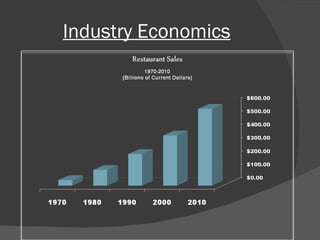
Industry Economics
Industry Driving Forces Technology-  what new technology is available to enhance a product Economic-  how does the economy effect how the industry runs Available Info-  what information is available to improve your company Globalization-  Who are your global competitors
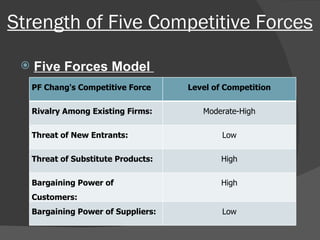
Strength of Five Competitive Forces Five Forces Model  PF Chang's Competitive Force Level of Competition Rivalry Among Existing Firms: Moderate-High Threat of New Entrants: Low Threat of Substitute Products: High Bargaining Power of Customers: High Bargaining Power of Suppliers: Low
Rivalry Among Existing Firms Differentiation  - “Our restaurants’ distinctive contemporary design and decor create a high energy, non-chain image and upscale ambiance in a casual setting.” (10-k) Scale Economies  - In many circumstances many small businesses in the restaurant industry have been able to control very large portions of market share due to few factors Exit Barriers  -  In the restaurant industry only has moderate exiting barriers. Most of the time firms are not going to have much specialized equipment.
Threat of New Entrants Economies of Scale  -  P.F. Chang’s has positioned itself among the top competitors in it industry allowing it to be able to expand as much as possible. First Mover Advantage  - Some established restaurants already have relationships with its customers which can offer a small advantage.  Legal Barriers - There numerous laws and regulations such as licensing and regulation by various governmental authorities
Threat of Substitute Products Relative Price and Performance-  P.F Chang’s keeps the quality of it restaurants up, in order to match the price customers pay for their products.  Customer’s Willingness to Substitute- Due to amount of competition within the restaurant industry and the number of marketing channels switching producers is relatively easy.
Bargaining Power of Suppliers Switching Costs-  The switching cost for the restaurant industry however, is going to be low due to the large amounts of suppliers and substitutes available Differentiation-  In this industry there are very few ways for any supplier to be able to differentiate its product. Volume Per Suppliers-  There are many different options for restaurants to choose a suppler from so the bargaining power of the suppliers is on the lower side
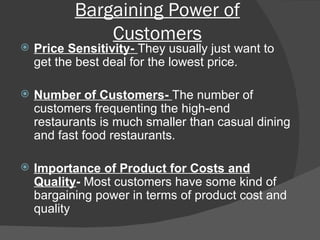
Bargaining Power of Customers Price Sensitivity-  They usually just want to get the best deal for the lowest price.  Number of Customers-  The number of customers frequenting the high-end restaurants is much smaller than casual dining and fast food restaurants.  Importance of Product for Costs and Quality -  Most customers have some kind of bargaining power in terms of product cost and quality
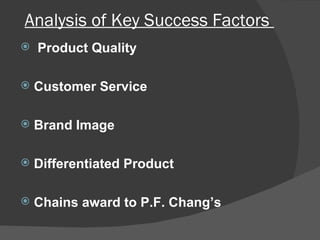
Analysis of Key Success Factors  Product Quality Customer Service  Brand Image  Differentiated Product Chains award to P.F. Chang’s
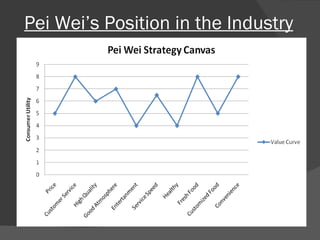
Pei Wei’s Position in the Industry
Pei Wei’s Position in the Industry Compete on: Customer Service Freshness of food Convenience
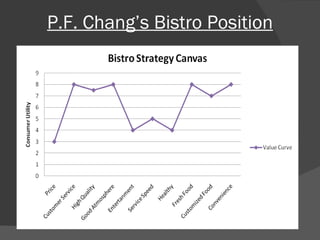
P.F. Chang’s Bistro Position
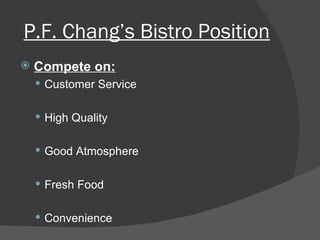
P.F. Chang’s Bistro Position Compete on: Customer Service High Quality Good Atmosphere Fresh Food  Convenience
Position of Competitors in the Industry
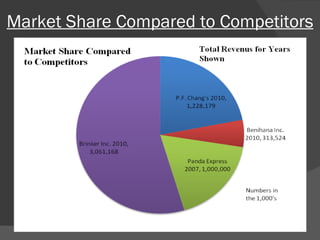
Market Share Compared to Competitors
Conclusion Although P.F. Chang has a great position in its industry, as of right now, compared to its competitors. P.F. Chang’s should continue to try and differentiate itself from the other firms and continues to expand new store to receive economies of scale. Also P.F. Chang’s should also keep an eye out for any moves that Brinker Inc. may try to more within its market which could really hurt P.F. Chang’s profits.
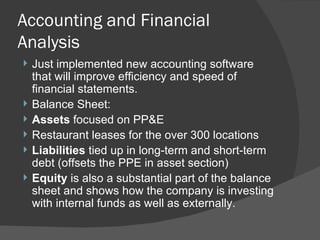
Just implemented new accounting software that will improve efficiency and speed of financial statements. Balance Sheet: Assets  focused on PP&E  restaurant leases for the over 300 locations Liabilities  tied up in long-term and short-term debt (offsets the PPE in asset section) Equity  is also a substantial part of the balance sheet and shows how the company is investing with internal funds as well as externally. Accounting and Financial Analysis
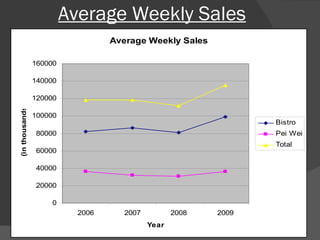
Average Weekly Sales
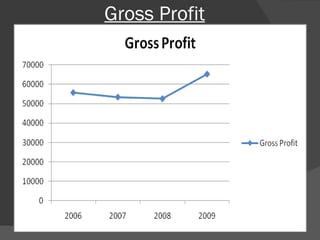
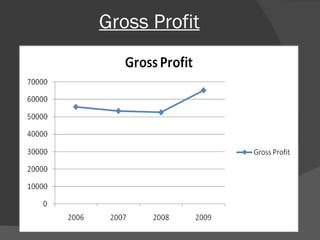
Gross Profit
Repeat customers through word-of-mouth Traditionally has kept away from high advertising expenses but has recently began advertising on the radio, newspaper, and on the internet Marketing Analysis
Management: Information Systems:  Point-of-sale technology to track orders and sales from each restaurant Supply Chain:  Crucial for red ocean industries Distribution Market Advantage Ensures high quality and maintains a good relationship with their suppliers Human Resources:  Goal is to attract, retain and motive management Right people on the bus Level 5 leadership qualities in CEO, Rich Federico Management and HR
Decided to view annual reports from last 4 years Flywheel or doom loop? Looked at things such as: Is the company sticking to a strategy and not constantly changing it? Do they have a strong focus on their core values? And more.. Strategic Outlook
2006:  Realized rough economic times Stressed core values (quality and customer service) Successful tests in new flexible menu Opened up a Bistro in Hawaii “ Hope to use as learning experience for global brand development” Opened up a 3 rd  brand: Taneko Japanese Tavern 2007: Still focused on core values during rough economic times Had strategy to improve in three areas Pei Wei ranked 1 st  among 130 quick/casual restaurant survey Had to close Taneko Hired new and improved employees in the finance, marketing, management, and HR department 2006 and 2007
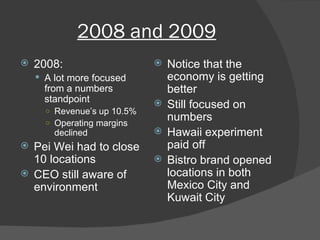
2008: A lot more focused from a numbers standpoint Revenue’s up 10.5% Operating margins declined Pei Wei had to close 10 locations CEO still aware of environment Notice that the economy is getting better Still focused on numbers Hawaii experiment paid off Bistro brand opened locations in both Mexico City and Kuwait City 2008 and 2009
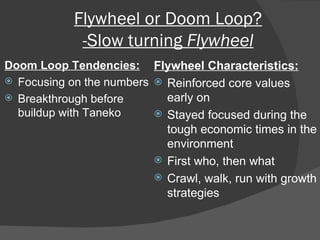
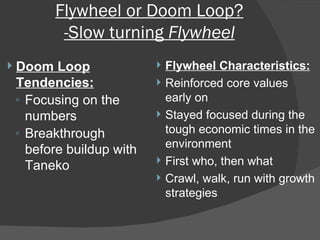
Doom Loop Tendencies: Focusing on the numbers Breakthrough before buildup with Taneko Flywheel Characteristics: Reinforced core values early on Stayed focused during the tough economic times in the environment First who, then what Crawl, walk, run with growth strategies Flywheel or Doom Loop? -Slow turning  Flywheel
Build on current and implement new ideas Review based on Blue Ocean’s Four Action Framework of Reduce, Raise, Eliminate and Create Set out individual strategies for Bistro and Pei Wei This is because they are in two separate markets and need to focus on different things* Strategy
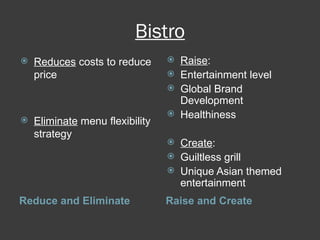
Bistro Reduce and Eliminate Raise and Create Reduces  costs to reduce price Eliminate  menu flexibility strategy Raise :  Entertainment level Global Brand Development Healthiness Create : Guiltless grill Unique Asian themed entertainment
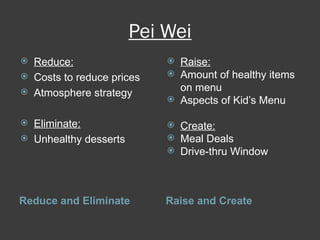
Pei Wei Reduce and Eliminate Raise and Create Reduce: Costs to reduce prices Atmosphere strategy Eliminate: Unhealthy desserts Raise: Amount of healthy items on menu Aspects of Kid’s Menu Create: Meal Deals Drive-thru Window
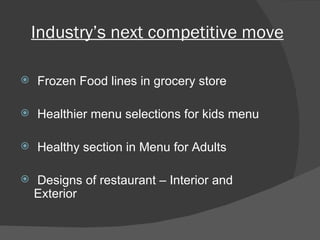
Industry’s next competitive move Frozen Food lines in grocery store Healthier menu selections for kids menu Healthy section in Menu for Adults Designs of restaurant – Interior and Exterior
Cost Positioning
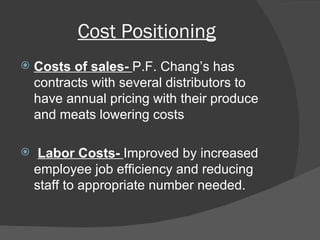
Cost Positioning Costs of sales-  P.F. Chang’s has contracts with several distributors to have annual pricing with their produce and meats lowering costs Labor Costs-  Improved by increased employee job efficiency and reducing staff to appropriate number needed.
Cost Positioning Cont. Operating Costs-  PF Chang’s has become more efficient and have in turn lowered the costs it takes to run the day to day business. Preopening Costs-  As they open more and more restaurants they have learned how to do it and have dramatically lowered the preopening costs over the past 5 years.
Accounting and Financial Analysis Just implemented new accounting software that will improve efficiency and speed of financial statements. Balance Sheet: Assets  focused on PP&E Restaurant leases for the over 300 locations Liabilities  tied up in long-term and short-term debt (offsets the PPE in asset section) Equity  is also a substantial part of the balance sheet and shows how the company is investing with internal funds as well as externally.
Average Weekly Sales
Gross Profit
Marketing Analysis Repeat customers through word-of-mouth Traditionally has kept away from high advertising expenses but has recently began advertising on the radio, newspaper, and on the internet
Management and HR Management: Information Systems:  Point-of-sale technology to track orders and sales from each restaurant Supply Chain:  Crucial for red ocean industries Distribution Market Advantage Ensures high quality and maintains a good relationship  with their suppliers Human Resources:  Goal is to attract, retain and motive management Right people on the bus Level 5 leadership qualities in CEO, Rich Federico
Strategic Outlook Decided to view annual reports from last 4 years Flywheel or doom loop? Looked at things such as: Is the company sticking to a strategy and not constantly changing it? Do they have a strong focus on their core values? And more..
2006 and 2007 2006:  Realized rough economic times Stressed core values (quality and customer service) Successful tests in new flexible menu Opened up a Bistro in Hawaii “ Hope to use as learning experience for global brand development” Opened up a 3 rd  brand: Taneko Japanese Tavern 2007: Still focused on core values during rough economic times Had strategy to improve in three areas Pei Wei ranked 1 st  among 130 quick/casual restaurant survey Had to close Taneko Hired new and improved employees in the finance, marketing, management, and HR department
2008 and 2009 2008: A lot more focused from a numbers standpoint Revenue’s up 10.5% Operating margins declined Pei Wei had to close 10 locations CEO still aware of environment Notice that the economy is getting better Still focused on numbers Hawaii experiment paid off Bistro brand opened locations in both Mexico City and Kuwait City
Flywheel or Doom Loop? -Slow turning  Flywheel Doom Loop Tendencies: Focusing on the numbers Breakthrough before buildup with Taneko Flywheel Characteristics: Reinforced core values early on Stayed focused during the tough economic times in the environment First who, then what Crawl, walk, run with growth strategies
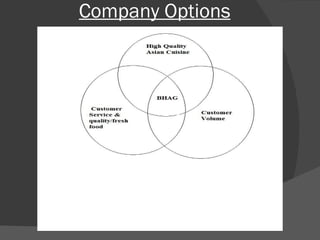
Company Options
Possible Competitive Advantage Brand Recognition- Find a trademark so that anytime people here or see it will think PF Chang’s Become a Cost Leader in the industry Convenience- PF Chang’s has over 350 stores in US
Strategy Build on current and implement new ideas Review based on Blue Ocean’s Four Action Framework of Reduce, Raise, Eliminate and Create Set out individual strategies for Bistro and Pei Wei This is because they are in two separate markets and need to focus on different things*
Bistro Reduce and Eliminate Raise and Create Reduces  costs to reduce price Eliminate  menu flexibility strategy Raise :  Entertainment level Global Brand Development Healthiness Create : Guiltless grill Unique Asian themed entertainment
Pei Wei Reduce and Eliminate Raise and Create Reduce: Costs to reduce prices Atmosphere strategy Eliminate: Unhealthy desserts Raise: Amount of healthy items on menu Aspects of Kid’s Menu Create: Meal Deals Drive-thru Window
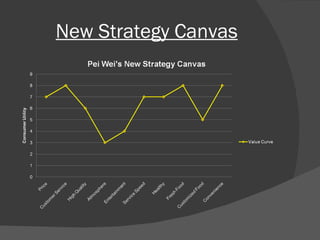
New Strategy Canvas
New Strategy Canvas

PF Changs Market Strategy

  • 1.
    By: Jonathon AlvarezShawn Stults Chris Hill
  • 2.
    Industry Environment RestaurantIndustry Full Service- Restaurants with waiters who take your orders, serve drinks, serve food, and wait on you throughout the meal Quick Service- Pay in advance of receiving the meal, and is generally self serve
  • 3.
  • 4.
    Industry Driving ForcesTechnology- what new technology is available to enhance a product Economic- how does the economy effect how the industry runs Available Info- what information is available to improve your company Globalization- Who are your global competitors
  • 5.
    Strength of FiveCompetitive Forces Five Forces Model PF Chang's Competitive Force Level of Competition Rivalry Among Existing Firms: Moderate-High Threat of New Entrants: Low Threat of Substitute Products: High Bargaining Power of Customers: High Bargaining Power of Suppliers: Low
  • 6.
    Rivalry Among ExistingFirms Differentiation - “Our restaurants’ distinctive contemporary design and decor create a high energy, non-chain image and upscale ambiance in a casual setting.” (10-k) Scale Economies - In many circumstances many small businesses in the restaurant industry have been able to control very large portions of market share due to few factors Exit Barriers - In the restaurant industry only has moderate exiting barriers. Most of the time firms are not going to have much specialized equipment.
  • 7.
    Threat of NewEntrants Economies of Scale - P.F. Chang’s has positioned itself among the top competitors in it industry allowing it to be able to expand as much as possible. First Mover Advantage - Some established restaurants already have relationships with its customers which can offer a small advantage. Legal Barriers - There numerous laws and regulations such as licensing and regulation by various governmental authorities
  • 8.
    Threat of SubstituteProducts Relative Price and Performance- P.F Chang’s keeps the quality of it restaurants up, in order to match the price customers pay for their products. Customer’s Willingness to Substitute- Due to amount of competition within the restaurant industry and the number of marketing channels switching producers is relatively easy.
  • 9.
    Bargaining Power ofSuppliers Switching Costs- The switching cost for the restaurant industry however, is going to be low due to the large amounts of suppliers and substitutes available Differentiation- In this industry there are very few ways for any supplier to be able to differentiate its product. Volume Per Suppliers- There are many different options for restaurants to choose a suppler from so the bargaining power of the suppliers is on the lower side
  • 10.
    Bargaining Power ofCustomers Price Sensitivity- They usually just want to get the best deal for the lowest price. Number of Customers- The number of customers frequenting the high-end restaurants is much smaller than casual dining and fast food restaurants. Importance of Product for Costs and Quality - Most customers have some kind of bargaining power in terms of product cost and quality
  • 11.
    Analysis of KeySuccess Factors Product Quality Customer Service Brand Image Differentiated Product Chains award to P.F. Chang’s
  • 12.
    Pei Wei’s Positionin the Industry
  • 13.
    Pei Wei’s Positionin the Industry Compete on: Customer Service Freshness of food Convenience
  • 14.
  • 15.
    P.F. Chang’s BistroPosition Compete on: Customer Service High Quality Good Atmosphere Fresh Food Convenience
  • 16.
    Position of Competitorsin the Industry
  • 17.
    Market Share Comparedto Competitors
  • 18.
    Conclusion Although P.F.Chang has a great position in its industry, as of right now, compared to its competitors. P.F. Chang’s should continue to try and differentiate itself from the other firms and continues to expand new store to receive economies of scale. Also P.F. Chang’s should also keep an eye out for any moves that Brinker Inc. may try to more within its market which could really hurt P.F. Chang’s profits.
  • 19.
    Just implemented newaccounting software that will improve efficiency and speed of financial statements. Balance Sheet: Assets focused on PP&E restaurant leases for the over 300 locations Liabilities tied up in long-term and short-term debt (offsets the PPE in asset section) Equity is also a substantial part of the balance sheet and shows how the company is investing with internal funds as well as externally. Accounting and Financial Analysis
  • 20.
  • 21.
  • 22.
    Repeat customers throughword-of-mouth Traditionally has kept away from high advertising expenses but has recently began advertising on the radio, newspaper, and on the internet Marketing Analysis
  • 23.
    Management: Information Systems: Point-of-sale technology to track orders and sales from each restaurant Supply Chain: Crucial for red ocean industries Distribution Market Advantage Ensures high quality and maintains a good relationship with their suppliers Human Resources: Goal is to attract, retain and motive management Right people on the bus Level 5 leadership qualities in CEO, Rich Federico Management and HR
  • 24.
    Decided to viewannual reports from last 4 years Flywheel or doom loop? Looked at things such as: Is the company sticking to a strategy and not constantly changing it? Do they have a strong focus on their core values? And more.. Strategic Outlook
  • 25.
    2006: Realizedrough economic times Stressed core values (quality and customer service) Successful tests in new flexible menu Opened up a Bistro in Hawaii “ Hope to use as learning experience for global brand development” Opened up a 3 rd brand: Taneko Japanese Tavern 2007: Still focused on core values during rough economic times Had strategy to improve in three areas Pei Wei ranked 1 st among 130 quick/casual restaurant survey Had to close Taneko Hired new and improved employees in the finance, marketing, management, and HR department 2006 and 2007
  • 26.
    2008: A lotmore focused from a numbers standpoint Revenue’s up 10.5% Operating margins declined Pei Wei had to close 10 locations CEO still aware of environment Notice that the economy is getting better Still focused on numbers Hawaii experiment paid off Bistro brand opened locations in both Mexico City and Kuwait City 2008 and 2009
  • 27.
    Doom Loop Tendencies:Focusing on the numbers Breakthrough before buildup with Taneko Flywheel Characteristics: Reinforced core values early on Stayed focused during the tough economic times in the environment First who, then what Crawl, walk, run with growth strategies Flywheel or Doom Loop? -Slow turning Flywheel
  • 28.
    Build on currentand implement new ideas Review based on Blue Ocean’s Four Action Framework of Reduce, Raise, Eliminate and Create Set out individual strategies for Bistro and Pei Wei This is because they are in two separate markets and need to focus on different things* Strategy
  • 29.
    Bistro Reduce andEliminate Raise and Create Reduces costs to reduce price Eliminate menu flexibility strategy Raise : Entertainment level Global Brand Development Healthiness Create : Guiltless grill Unique Asian themed entertainment
  • 30.
    Pei Wei Reduceand Eliminate Raise and Create Reduce: Costs to reduce prices Atmosphere strategy Eliminate: Unhealthy desserts Raise: Amount of healthy items on menu Aspects of Kid’s Menu Create: Meal Deals Drive-thru Window
  • 31.
    Industry’s next competitivemove Frozen Food lines in grocery store Healthier menu selections for kids menu Healthy section in Menu for Adults Designs of restaurant – Interior and Exterior
  • 32.
  • 33.
    Cost Positioning Costsof sales- P.F. Chang’s has contracts with several distributors to have annual pricing with their produce and meats lowering costs Labor Costs- Improved by increased employee job efficiency and reducing staff to appropriate number needed.
  • 34.
    Cost Positioning Cont.Operating Costs- PF Chang’s has become more efficient and have in turn lowered the costs it takes to run the day to day business. Preopening Costs- As they open more and more restaurants they have learned how to do it and have dramatically lowered the preopening costs over the past 5 years.
  • 35.
    Accounting and FinancialAnalysis Just implemented new accounting software that will improve efficiency and speed of financial statements. Balance Sheet: Assets focused on PP&E Restaurant leases for the over 300 locations Liabilities tied up in long-term and short-term debt (offsets the PPE in asset section) Equity is also a substantial part of the balance sheet and shows how the company is investing with internal funds as well as externally.
  • 36.
  • 37.
  • 38.
    Marketing Analysis Repeatcustomers through word-of-mouth Traditionally has kept away from high advertising expenses but has recently began advertising on the radio, newspaper, and on the internet
  • 39.
    Management and HRManagement: Information Systems: Point-of-sale technology to track orders and sales from each restaurant Supply Chain: Crucial for red ocean industries Distribution Market Advantage Ensures high quality and maintains a good relationship with their suppliers Human Resources: Goal is to attract, retain and motive management Right people on the bus Level 5 leadership qualities in CEO, Rich Federico
  • 40.
    Strategic Outlook Decidedto view annual reports from last 4 years Flywheel or doom loop? Looked at things such as: Is the company sticking to a strategy and not constantly changing it? Do they have a strong focus on their core values? And more..
  • 41.
    2006 and 20072006: Realized rough economic times Stressed core values (quality and customer service) Successful tests in new flexible menu Opened up a Bistro in Hawaii “ Hope to use as learning experience for global brand development” Opened up a 3 rd brand: Taneko Japanese Tavern 2007: Still focused on core values during rough economic times Had strategy to improve in three areas Pei Wei ranked 1 st among 130 quick/casual restaurant survey Had to close Taneko Hired new and improved employees in the finance, marketing, management, and HR department
  • 42.
    2008 and 20092008: A lot more focused from a numbers standpoint Revenue’s up 10.5% Operating margins declined Pei Wei had to close 10 locations CEO still aware of environment Notice that the economy is getting better Still focused on numbers Hawaii experiment paid off Bistro brand opened locations in both Mexico City and Kuwait City
  • 43.
    Flywheel or DoomLoop? -Slow turning Flywheel Doom Loop Tendencies: Focusing on the numbers Breakthrough before buildup with Taneko Flywheel Characteristics: Reinforced core values early on Stayed focused during the tough economic times in the environment First who, then what Crawl, walk, run with growth strategies
  • 44.
  • 45.
    Possible Competitive AdvantageBrand Recognition- Find a trademark so that anytime people here or see it will think PF Chang’s Become a Cost Leader in the industry Convenience- PF Chang’s has over 350 stores in US
  • 46.
    Strategy Build oncurrent and implement new ideas Review based on Blue Ocean’s Four Action Framework of Reduce, Raise, Eliminate and Create Set out individual strategies for Bistro and Pei Wei This is because they are in two separate markets and need to focus on different things*
  • 47.
    Bistro Reduce andEliminate Raise and Create Reduces costs to reduce price Eliminate menu flexibility strategy Raise : Entertainment level Global Brand Development Healthiness Create : Guiltless grill Unique Asian themed entertainment
  • 48.
    Pei Wei Reduceand Eliminate Raise and Create Reduce: Costs to reduce prices Atmosphere strategy Eliminate: Unhealthy desserts Raise: Amount of healthy items on menu Aspects of Kid’s Menu Create: Meal Deals Drive-thru Window
  • 49.
  • 50.