FOOD & BEVERAGE
SOLUTION
04-Oct-15 Prepared By Mohamed Helal 1
RESTAURANT POS SOFTWARE AND BAR
BILLING SYSTEM
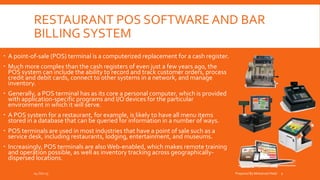
 A point-of-sale (POS) terminal is a computerized replacement for a cash register.
 Much more complex than the cash registers of even just a few years ago, the
POS system can include the ability to record and track customer orders, process
credit and debit cards, connect to other systems in a network, and manage
inventory.
 Generally, a POS terminal has as its core a personal computer, which is provided
with application-specific programs and I/O devices for the particular
environment in which it will serve.
 A POS system for a restaurant, for example, is likely to have all menu items
stored in a database that can be queried for information in a number of ways.
 POS terminals are used in most industries that have a point of sale such as a
service desk, including restaurants, lodging, entertainment, and museums.
 Increasingly, POS terminals are alsoWeb-enabled, which makes remote training
and operation possible, as well as inventory tracking across geographically-
dispersed locations.
04-Oct-15 Prepared By Mohamed Helal 2
MOST IMPORTANT FEATURES IN F&B
SYSTEMS
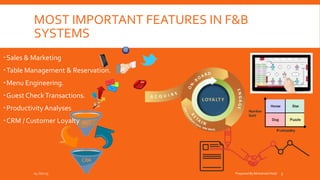
Sales & Marketing
Table Management & Reservation.
Menu Engineering.
Guest CheckTransactions.
Productivity Analyses
CRM / Customer Loyalty
04-Oct-15 Prepared By Mohamed Helal 3
TYPES OF FOOD & BEVERAGE OUTLETS
 Cafe offer teas, coffees, soft drinks, snacks and often light meals usually from breakfast to
early suppers.They require fast service to ensure a fast turnover of customers.
 Cafeterias are often attached to institutions such as museum or educational
establishments or maybe recreational facilities such as golf.They offer light refreshments,
teas, coffees, and soft drinks, and snacks.
 Food halls/Food courts are becoming popular especially in shopping centres. Food
outlets serving a wide variety different types of fast food surround a common central
dining area.
 Public houses are food outlet that offer meals range from simple bar snacks to informal
restaurant-style service. Fast Foods
04-Oct-15 Prepared By Mohamed Helal 4
TYPES OF FOOD AND BEVERAGE OUTLETS
 Casual dining restaurants (bistros) offer casual appearance and atmosphere.There are
service staff dealing with customer in professional way.
 Ethnic restaurants offer service may be as much a part of the cultural experience to the
customer.
 Functions (receptions/banquets/conventions).The number of guests and the style of function can
vary based on the customer.
 Fine dining restaurants usually have a suitably comfortable impressive ambience for the fine
cuisine on offer.
04-Oct-15 Prepared By Mohamed Helal 5
TYPES OF SERVICE
 TakeAway /Take Out /To Go
 Delivery / Catering
 Counter Service
 Self Service
 Fast Foods
 Casual Dining
 Fine Dining
 Executive Lounges
04-Oct-15 Prepared By Mohamed Helal 6
DAY BY DAY PROCESS
 Market Inquiry &Vendor Options Comparison.
 Costing & Menu Engineering.
 Purchasing.
 Goods Receiving.
 Storing
 Issuing
 Production
 Preparing / Cooking
 Serving / Presenting
 Service
 EOD Process
04-Oct-15 Prepared By Mohamed Helal 7
PURCHASING
 Develop purchase specification
 Supplier selection
 Purchasing correct quantities
 No collusion between property and supplier
 Evaluation of purchasing process
04-Oct-15 Prepared By Mohamed Helal 8
RECEIVING
 Development of receiving procedures
 Completion of necessary receiving reports (e.g., addressing financial and security
concerns)
04-Oct-15 Prepared By Mohamed Helal 9
RECEIVING
 Development of receiving procedures
 Completion of necessary receiving reports (e.g., addressing financial and security
concerns)
04-Oct-15 Prepared By Mohamed Helal 10
STORING
 Effective use of perpetual & physical inventory systems
 Control of product quality
 Securing products from theft
 Location of products within storage areas
04-Oct-15 Prepared By Mohamed Helal 11
ISSUING /TRANSFER
 Product rotation concerns
 Matching issues (issue & usage)
 Purchasing as inventory is Consumed
04-Oct-15 Prepared By Mohamed Helal 12
PRODUCTION
 Mise-en-place
 Minimizing food waste / maximizing nutrient retention
04-Oct-15 Prepared By Mohamed Helal 13
PREPARING / COOKING
 Use of standardized recipes
 Use of portion control
 Requirements for food and employee safety
04-Oct-15 Prepared By Mohamed Helal 14
SERVING
 Timing of incoming F&B orders
 Portion control
 Revenue management concerns
04-Oct-15 Prepared By Mohamed Helal 15
SERVICE
 Reservation
 Seating
 Revenue control concerns
 F&B server productivity
 Waiting Duration
 TakingOrder / PlacingOrder
04-Oct-15 Prepared By Mohamed Helal 16
EOD/EOD/EOY PROCESS
Productivity Analyses
Consumption Analyses
Payment Processing
Profit & Loss
Guest Comments
Back
04-Oct-15 Prepared By Mohamed Helal 17

3- Food & Beverage

  • 1.
    FOOD & BEVERAGE SOLUTION 04-Oct-15Prepared By Mohamed Helal 1
  • 2.
    RESTAURANT POS SOFTWAREAND BAR BILLING SYSTEM  A point-of-sale (POS) terminal is a computerized replacement for a cash register.  Much more complex than the cash registers of even just a few years ago, the POS system can include the ability to record and track customer orders, process credit and debit cards, connect to other systems in a network, and manage inventory.  Generally, a POS terminal has as its core a personal computer, which is provided with application-specific programs and I/O devices for the particular environment in which it will serve.  A POS system for a restaurant, for example, is likely to have all menu items stored in a database that can be queried for information in a number of ways.  POS terminals are used in most industries that have a point of sale such as a service desk, including restaurants, lodging, entertainment, and museums.  Increasingly, POS terminals are alsoWeb-enabled, which makes remote training and operation possible, as well as inventory tracking across geographically- dispersed locations. 04-Oct-15 Prepared By Mohamed Helal 2
  • 3.
    MOST IMPORTANT FEATURESIN F&B SYSTEMS Sales & Marketing Table Management & Reservation. Menu Engineering. Guest CheckTransactions. Productivity Analyses CRM / Customer Loyalty 04-Oct-15 Prepared By Mohamed Helal 3
  • 4.
    TYPES OF FOOD& BEVERAGE OUTLETS  Cafe offer teas, coffees, soft drinks, snacks and often light meals usually from breakfast to early suppers.They require fast service to ensure a fast turnover of customers.  Cafeterias are often attached to institutions such as museum or educational establishments or maybe recreational facilities such as golf.They offer light refreshments, teas, coffees, and soft drinks, and snacks.  Food halls/Food courts are becoming popular especially in shopping centres. Food outlets serving a wide variety different types of fast food surround a common central dining area.  Public houses are food outlet that offer meals range from simple bar snacks to informal restaurant-style service. Fast Foods 04-Oct-15 Prepared By Mohamed Helal 4
  • 5.
    TYPES OF FOODAND BEVERAGE OUTLETS  Casual dining restaurants (bistros) offer casual appearance and atmosphere.There are service staff dealing with customer in professional way.  Ethnic restaurants offer service may be as much a part of the cultural experience to the customer.  Functions (receptions/banquets/conventions).The number of guests and the style of function can vary based on the customer.  Fine dining restaurants usually have a suitably comfortable impressive ambience for the fine cuisine on offer. 04-Oct-15 Prepared By Mohamed Helal 5
  • 6.
    TYPES OF SERVICE TakeAway /Take Out /To Go  Delivery / Catering  Counter Service  Self Service  Fast Foods  Casual Dining  Fine Dining  Executive Lounges 04-Oct-15 Prepared By Mohamed Helal 6
  • 7.
    DAY BY DAYPROCESS  Market Inquiry &Vendor Options Comparison.  Costing & Menu Engineering.  Purchasing.  Goods Receiving.  Storing  Issuing  Production  Preparing / Cooking  Serving / Presenting  Service  EOD Process 04-Oct-15 Prepared By Mohamed Helal 7
  • 8.
    PURCHASING  Develop purchasespecification  Supplier selection  Purchasing correct quantities  No collusion between property and supplier  Evaluation of purchasing process 04-Oct-15 Prepared By Mohamed Helal 8
  • 9.
    RECEIVING  Development ofreceiving procedures  Completion of necessary receiving reports (e.g., addressing financial and security concerns) 04-Oct-15 Prepared By Mohamed Helal 9
  • 10.
    RECEIVING  Development ofreceiving procedures  Completion of necessary receiving reports (e.g., addressing financial and security concerns) 04-Oct-15 Prepared By Mohamed Helal 10
  • 11.
    STORING  Effective useof perpetual & physical inventory systems  Control of product quality  Securing products from theft  Location of products within storage areas 04-Oct-15 Prepared By Mohamed Helal 11
  • 12.
    ISSUING /TRANSFER  Productrotation concerns  Matching issues (issue & usage)  Purchasing as inventory is Consumed 04-Oct-15 Prepared By Mohamed Helal 12
  • 13.
    PRODUCTION  Mise-en-place  Minimizingfood waste / maximizing nutrient retention 04-Oct-15 Prepared By Mohamed Helal 13
  • 14.
    PREPARING / COOKING Use of standardized recipes  Use of portion control  Requirements for food and employee safety 04-Oct-15 Prepared By Mohamed Helal 14
  • 15.
    SERVING  Timing ofincoming F&B orders  Portion control  Revenue management concerns 04-Oct-15 Prepared By Mohamed Helal 15
  • 16.
    SERVICE  Reservation  Seating Revenue control concerns  F&B server productivity  Waiting Duration  TakingOrder / PlacingOrder 04-Oct-15 Prepared By Mohamed Helal 16
  • 17.
    EOD/EOD/EOY PROCESS Productivity Analyses ConsumptionAnalyses Payment Processing Profit & Loss Guest Comments Back 04-Oct-15 Prepared By Mohamed Helal 17