5
Creating Long-Term
Loyalty Relationships
1
Chapter Questions

What are customer value, satisfaction, and
loyalty, and how can companies deliver them?

What is the lifetime value of customers and
how can marketers maximize it?

How can companies attract and retain
customers and cultivate strong customer
relationships?

What are the pros and cons of database
marketing?
Copyright © 2011 Pearson Education, Inc. Publishing as Prentice Hall 5-2
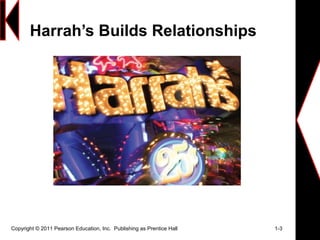
Harrah’s Builds Relationships
Copyright © 2011 Pearson Education, Inc. Publishing as Prentice Hall 1-3
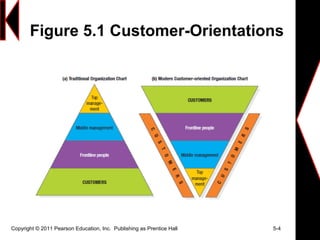
Figure 5.1 Customer-Orientations
Copyright © 2011 Pearson Education, Inc. Publishing as Prentice Hall 5-4
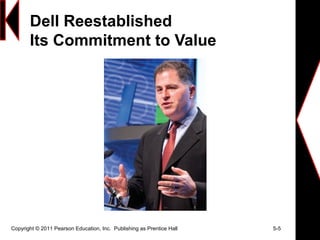
Dell Reestablished
Its Commitment to Value
Copyright © 2011 Pearson Education, Inc. Publishing as Prentice Hall 5-5
What is
Customer Perceived Value?

Customer perceived value is the
difference between the prospective
customer’s evaluation of all the benefits
and all the costs of an offering and the
perceived alternatives.
Copyright © 2011 Pearson Education, Inc. Publishing as Prentice Hall 5-6
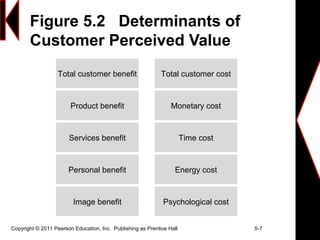
Figure 5.2 Determinants of
Customer Perceived Value
Copyright © 2011 Pearson Education, Inc. Publishing as Prentice Hall 5-7
Image benefit Psychological cost
Personal benefit Energy cost
Services benefit Time cost
Product benefit Monetary cost
Total customer benefit Total customer cost
Caterpillar Maximizes
Customer Value
Copyright © 2011 Pearson Education, Inc. Publishing as Prentice Hall 5-8
Steps in a
Customer Value Analysis

Identify major attributes and benefits that
customers value

Assess the qualitative importance of different
attributes and benefits

Assess the company’s and competitor’s
performances on the different customer values
against rated importance

Examine ratings of specific segments

Monitor customer values over time
Copyright © 2011 Pearson Education, Inc. Publishing as Prentice Hall 5-9
Copyright © 2011 Pearson Education, Inc. Publishing as Prentice Hall 5-10
What is Loyalty?
Loyalty is a deeply held commitment to re-
buy or re-patronize a preferred product or
service in the future despite situational
influences and marketing efforts having the
potential to cause switching behavior.
Copyright © 2011 Pearson Education, Inc. Publishing as Prentice Hall 5-11
Top Brands in Customer Loyalty

Apple iPhone

Clairol

Samsung

Mary Kay

Grey Goose

Clinique

Avis

Wal-Mart

Google

Amazon

Bing

J.Crew

AT&T Wireless

Discover Card

Verizon Wireless

Cheerios
Establishing Value
Copyright © 2011 Pearson Education, Inc. Publishing as Prentice Hall 5-12
Copyright © 2011 Pearson Education, Inc. Publishing as Prentice Hall 5-13
Measuring Satisfaction

Periodic surveys

Customer loss rate

Mystery shoppers

Minor competitive performance

Strength Gaining Potential

Manage/ Monitor Competitive Position
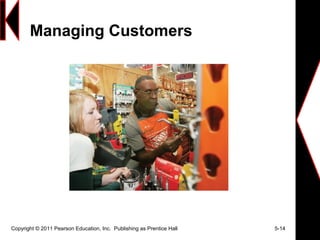
Managing Customers
Copyright © 2011 Pearson Education, Inc. Publishing as Prentice Hall 5-14
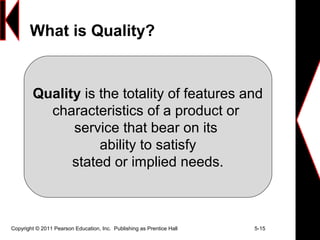
Copyright © 2011 Pearson Education, Inc. Publishing as Prentice Hall 5-15
What is Quality?
Quality is the totality of features and
characteristics of a product or
service that bear on its
ability to satisfy
stated or implied needs.
Copyright © 2011 Pearson Education, Inc. Publishing as Prentice Hall 5-16
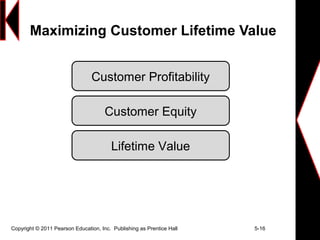
Maximizing Customer Lifetime Value
Customer Profitability
Customer Equity
Lifetime Value
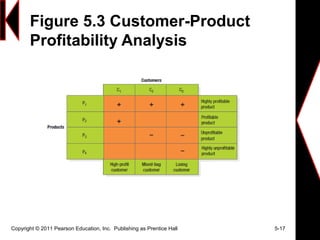
Figure 5.3 Customer-Product
Profitability Analysis
Copyright © 2011 Pearson Education, Inc. Publishing as Prentice Hall 5-17
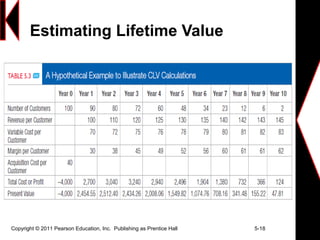
Copyright © 2011 Pearson Education, Inc. Publishing as Prentice Hall 5-18
Estimating Lifetime Value
Copyright © 2011 Pearson Education, Inc. Publishing as Prentice Hall 5-19
What is
Customer Relationship Management?
CRM is the process of carefully managing
detailed information about individual
customers and all customer touch points to
maximize customer loyalty.
Copyright © 2011 Pearson Education, Inc. Publishing as Prentice Hall 5-20
Framework for CRM

Identify prospects and customers

Differentiate customers by needs and value to
company

Interact to improve knowledge

Customize for each customer
Amy’s Maximized Word of Mouth
Copyright © 2011 Pearson Education, Inc. Publishing as Prentice Hall 5-21
Copyright © 2011 Pearson Education, Inc. Publishing as Prentice Hall 5-22
Attracting and
Retaining Customers

Reduce the rate of defection

Increase longevity

Enhance share of wallet

Terminate low-profit customers

Focus more effort on high-profit customers
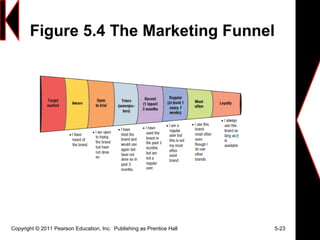
Figure 5.4 The Marketing Funnel
Copyright © 2011 Pearson Education, Inc. Publishing as Prentice Hall 5-23
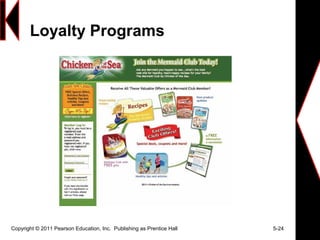
Loyalty Programs
Copyright © 2011 Pearson Education, Inc. Publishing as Prentice Hall 5-24
Database Key Concepts

Customer database

Database marketing

Mailing list

Business database

Data warehouse

Data mining
Copyright © 2011 Pearson Education, Inc. Publishing as Prentice Hall 5-25
Copyright © 2011 Pearson Education, Inc. Publishing as Prentice Hall 5-26
Using the Database

To identify prospects

To target offers

To deepen loyalty

To reactivate customers

To avoid mistakes
Copyright © 2011 Pearson Education, Inc. Publishing as Prentice Hall 5-27
Don’t Build a Database When

The product is a once-in-a-lifetime purchase

Customers do not show loyalty

The unit sale is very small

The cost of gathering information is too high
For Review

What are customer value, satisfaction, and
loyalty, and how can companies deliver them?

What is the lifetime value of customers and
how can marketers maximize it?

How can companies attract and retain
customers and cultivate strong customer
relationships?

What are the pros and cons of database
marketing?
Copyright © 2011 Pearson Education, Inc. Publishing as Prentice Hall 5-28

creating-long-term-loyalty-relationships

  • 1.
  • 2.
    Chapter Questions  What arecustomer value, satisfaction, and loyalty, and how can companies deliver them?  What is the lifetime value of customers and how can marketers maximize it?  How can companies attract and retain customers and cultivate strong customer relationships?  What are the pros and cons of database marketing? Copyright © 2011 Pearson Education, Inc. Publishing as Prentice Hall 5-2
  • 3.
    Harrah’s Builds Relationships Copyright© 2011 Pearson Education, Inc. Publishing as Prentice Hall 1-3
  • 4.
    Figure 5.1 Customer-Orientations Copyright© 2011 Pearson Education, Inc. Publishing as Prentice Hall 5-4
  • 5.
    Dell Reestablished Its Commitmentto Value Copyright © 2011 Pearson Education, Inc. Publishing as Prentice Hall 5-5
  • 6.
    What is Customer PerceivedValue?  Customer perceived value is the difference between the prospective customer’s evaluation of all the benefits and all the costs of an offering and the perceived alternatives. Copyright © 2011 Pearson Education, Inc. Publishing as Prentice Hall 5-6
  • 7.
    Figure 5.2 Determinantsof Customer Perceived Value Copyright © 2011 Pearson Education, Inc. Publishing as Prentice Hall 5-7 Image benefit Psychological cost Personal benefit Energy cost Services benefit Time cost Product benefit Monetary cost Total customer benefit Total customer cost
  • 8.
    Caterpillar Maximizes Customer Value Copyright© 2011 Pearson Education, Inc. Publishing as Prentice Hall 5-8
  • 9.
    Steps in a CustomerValue Analysis  Identify major attributes and benefits that customers value  Assess the qualitative importance of different attributes and benefits  Assess the company’s and competitor’s performances on the different customer values against rated importance  Examine ratings of specific segments  Monitor customer values over time Copyright © 2011 Pearson Education, Inc. Publishing as Prentice Hall 5-9
  • 10.
    Copyright © 2011Pearson Education, Inc. Publishing as Prentice Hall 5-10 What is Loyalty? Loyalty is a deeply held commitment to re- buy or re-patronize a preferred product or service in the future despite situational influences and marketing efforts having the potential to cause switching behavior.
  • 11.
    Copyright © 2011Pearson Education, Inc. Publishing as Prentice Hall 5-11 Top Brands in Customer Loyalty  Apple iPhone  Clairol  Samsung  Mary Kay  Grey Goose  Clinique  Avis  Wal-Mart  Google  Amazon  Bing  J.Crew  AT&T Wireless  Discover Card  Verizon Wireless  Cheerios
  • 12.
    Establishing Value Copyright ©2011 Pearson Education, Inc. Publishing as Prentice Hall 5-12
  • 13.
    Copyright © 2011Pearson Education, Inc. Publishing as Prentice Hall 5-13 Measuring Satisfaction  Periodic surveys  Customer loss rate  Mystery shoppers  Minor competitive performance  Strength Gaining Potential  Manage/ Monitor Competitive Position
  • 14.
    Managing Customers Copyright ©2011 Pearson Education, Inc. Publishing as Prentice Hall 5-14
  • 15.
    Copyright © 2011Pearson Education, Inc. Publishing as Prentice Hall 5-15 What is Quality? Quality is the totality of features and characteristics of a product or service that bear on its ability to satisfy stated or implied needs.
  • 16.
    Copyright © 2011Pearson Education, Inc. Publishing as Prentice Hall 5-16 Maximizing Customer Lifetime Value Customer Profitability Customer Equity Lifetime Value
  • 17.
    Figure 5.3 Customer-Product ProfitabilityAnalysis Copyright © 2011 Pearson Education, Inc. Publishing as Prentice Hall 5-17
  • 18.
    Copyright © 2011Pearson Education, Inc. Publishing as Prentice Hall 5-18 Estimating Lifetime Value
  • 19.
    Copyright © 2011Pearson Education, Inc. Publishing as Prentice Hall 5-19 What is Customer Relationship Management? CRM is the process of carefully managing detailed information about individual customers and all customer touch points to maximize customer loyalty.
  • 20.
    Copyright © 2011Pearson Education, Inc. Publishing as Prentice Hall 5-20 Framework for CRM  Identify prospects and customers  Differentiate customers by needs and value to company  Interact to improve knowledge  Customize for each customer
  • 21.
    Amy’s Maximized Wordof Mouth Copyright © 2011 Pearson Education, Inc. Publishing as Prentice Hall 5-21
  • 22.
    Copyright © 2011Pearson Education, Inc. Publishing as Prentice Hall 5-22 Attracting and Retaining Customers  Reduce the rate of defection  Increase longevity  Enhance share of wallet  Terminate low-profit customers  Focus more effort on high-profit customers
  • 23.
    Figure 5.4 TheMarketing Funnel Copyright © 2011 Pearson Education, Inc. Publishing as Prentice Hall 5-23
  • 24.
    Loyalty Programs Copyright ©2011 Pearson Education, Inc. Publishing as Prentice Hall 5-24
  • 25.
    Database Key Concepts  Customerdatabase  Database marketing  Mailing list  Business database  Data warehouse  Data mining Copyright © 2011 Pearson Education, Inc. Publishing as Prentice Hall 5-25
  • 26.
    Copyright © 2011Pearson Education, Inc. Publishing as Prentice Hall 5-26 Using the Database  To identify prospects  To target offers  To deepen loyalty  To reactivate customers  To avoid mistakes
  • 27.
    Copyright © 2011Pearson Education, Inc. Publishing as Prentice Hall 5-27 Don’t Build a Database When  The product is a once-in-a-lifetime purchase  Customers do not show loyalty  The unit sale is very small  The cost of gathering information is too high
  • 28.
    For Review  What arecustomer value, satisfaction, and loyalty, and how can companies deliver them?  What is the lifetime value of customers and how can marketers maximize it?  How can companies attract and retain customers and cultivate strong customer relationships?  What are the pros and cons of database marketing? Copyright © 2011 Pearson Education, Inc. Publishing as Prentice Hall 5-28

Editor's Notes