Creating Customer Value,
Satisfaction,
and Loyalty
Prepared By,
Mr. Nishant Agrawal
Chapter Questions
• What are customer value, satisfaction, and
loyalty, and how can companies deliver
them?
• What is the lifetime value of customers?
• How can companies cultivate strong
customer relationships?
• How can companies both attract and retain
customers?
• What is database marketing?
Ritz Carlton - Famous for its
Exceptional Service
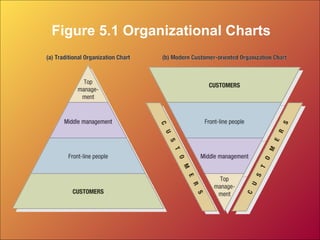
Figure 5.1 Organizational Charts
What is Customer Perceived Value?
•Consumers are better educated and informed than ever
•Customer perceived value is the difference between
the prospective / future customer’s evaluation of all the
benefits and all the costs of an offering and the perceived
alternatives.
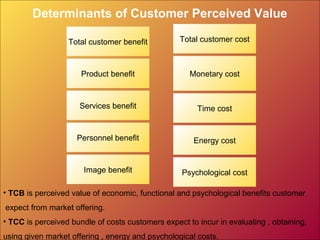
Determinants of Customer Perceived Value
Image benefit Psychological cost
Personnel benefit Energy cost
Services benefit Time cost
Product benefit Monetary cost
Total customer benefit Total customer cost
• TCB is perceived value of economic, functional and psychological benefits customer
expect from market offering.
• TCC is perceived bundle of costs customers expect to incur in evaluating , obtaining,
using given market offering , energy and psychological costs.
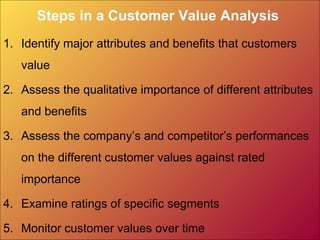
Steps in a Customer Value Analysis
1. Identify major attributes and benefits that customers
value
2. Assess the qualitative importance of different attributes
and benefits
3. Assess the company’s and competitor’s performances
on the different customer values against rated
importance
4. Examine ratings of specific segments
5. Monitor customer values over time
What is Loyalty?
Loyalty is a deeply held commitment to re-buy
a preferred product or service in the future
despite situational influences and marketing
efforts having the potential to cause switching
behavior.
The Value Proposition
The whole cluster of
benefits the
company promises
to deliver
Total Customer Satisfaction
• Satisfaction is person’s feeling of pleasure or
disappointment that result from comparing product’s
perceived performance to expectation.
• Performance falls short of expectation customer is dissatisfied.
• If it matches expectation customer is satisfied.
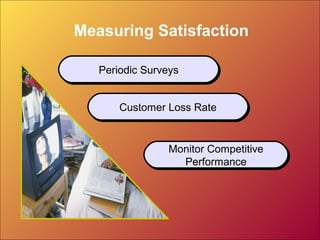
Measuring Satisfaction
Periodic SurveysPeriodic Surveys
Customer Loss RateCustomer Loss Rate
Monitor Competitive
Performance
Monitor Competitive
Performance
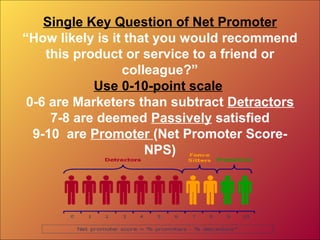
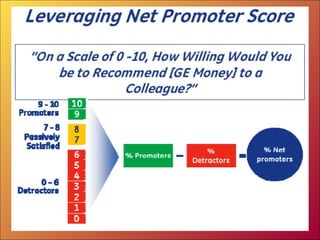
Single Key Question of Net Promoter
“How likely is it that you would recommend
this product or service to a friend or
colleague?”
Use 0-10-point scale
0-6 are Marketers than subtract Detractors
7-8 are deemed Passively satisfied
9-10 are Promoter (Net Promoter Score-
NPS)
World class companies used NPS
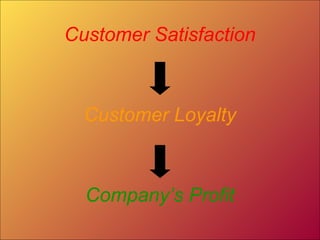
Customer Satisfaction
Customer Loyalty
Company’s Profit
What is Quality?
Quality is the totality of features and
characteristics of a product or
service that bear on its ability to satisfy
stated or implied needs.
Marketing and Total Quality
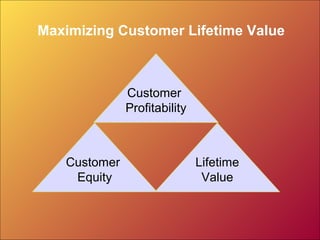
Maximizing Customer Lifetime Value
Customer
Profitability
Customer
Equity
Lifetime
Value
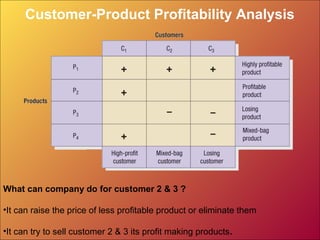
Customer-Product Profitability Analysis
What can company do for customer 2 & 3 ?
•It can raise the price of less profitable product or eliminate them
•It can try to sell customer 2 & 3 its profit making products.
Customer Lifetime Value
(Formula Page No: 116)
• CLV described net present value of stream of
future profits expected over customer’s lifetime
purchase.
What is Customer Relationship Management?
• CRM is the process of carefully managing detailed
information about individual customers and all
customer touchpoints to maximize customer loyalty.
• CRM enables companies to provide excellent real time
customer service through effective use of individual
account information.
Personalizing Marketing
• It is about making sure the brand and its marketing are
relevant as possible to as many customer as possible – a
challenge , given that no two customers are identical.
• E commerce companies looking to attract and retain
customers are discovering that personalization goes beyong
creating customized information.
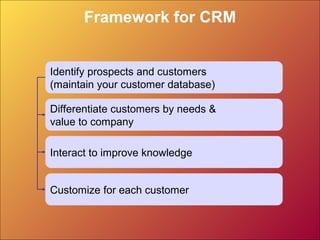
Framework for CRM
Identify prospects and customers
(maintain your customer database)
Differentiate customers by needs &
value to company
Interact to improve knowledge
Customize for each customer
Harrah’s
targets
hundreds of
segments
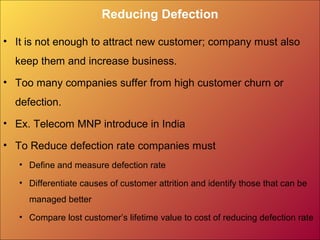
Reducing Defection
• It is not enough to attract new customer; company must also
keep them and increase business.
• Too many companies suffer from high customer churn or
defection.
• Ex. Telecom MNP introduce in India
• To Reduce defection rate companies must
• Define and measure defection rate
• Differentiate causes of customer attrition and identify those that can be
managed better
• Compare lost customer’s lifetime value to cost of reducing defection rate
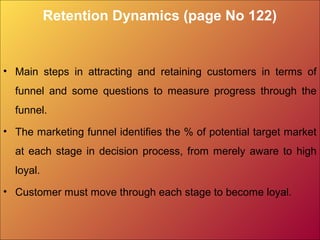
Retention Dynamics (page No 122)
• Main steps in attracting and retaining customers in terms of
funnel and some questions to measure progress through the
funnel.
• The marketing funnel identifies the % of potential target market
at each stage in decision process, from merely aware to high
loyal.
• Customer must move through each stage to become loyal.
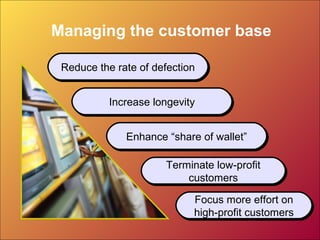
Managing the customer base
Reduce the rate of defectionReduce the rate of defection
Increase longevityIncrease longevity
Enhance “share of wallet”Enhance “share of wallet”
Terminate low-profit
customers
Terminate low-profit
customers
Focus more effort on
high-profit customers
Focus more effort on
high-profit customers
Building Loyalty
• Creating a strong , tight connection to customer is dream of
any marketer and often the key to long term marketing
success.
• Following sections explain 3 types of marketing activities
companies are using to improve loyalty and retention.
1. Interacting with customers
2. Developing Loyalty Programs
3. Creating institutional Ties
Customer Retention
• Acquisition of customers can cost five times more than
retaining current customers.
• The average customer loses 10% of its customers each
year.
• A 5% reduction to the customer defection rate can
increase profits by 25% to 85%.
• The customer profit rate increases over the life of a
retained customer.
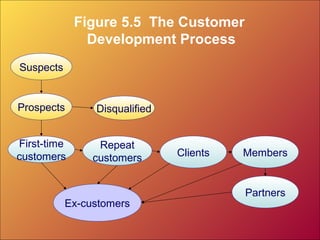
Figure 5.5 The Customer
Development Process
Prospects
Suspects
Disqualified
First-time
customers
Repeat
customers Clients Members
Partners
Ex-customers
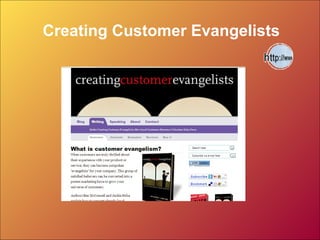
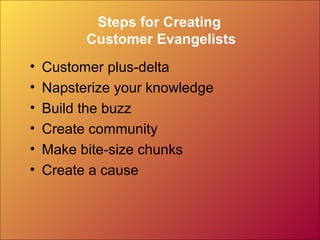
Creating Customer Evangelists
Steps for Creating
Customer Evangelists
• Customer plus-delta
• Napsterize your knowledge
• Build the buzz
• Create community
• Make bite-size chunks
• Create a cause
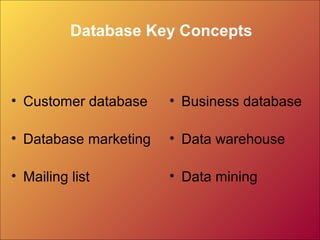
Database Key Concepts
• Customer database
• Database marketing
• Mailing list
• Business database
• Data warehouse
• Data mining
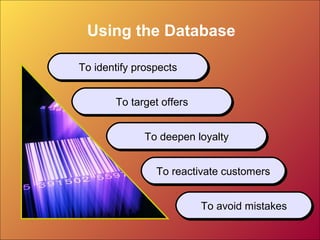
Using the Database
To identify prospectsTo identify prospects
To target offersTo target offers
To deepen loyaltyTo deepen loyalty
To reactivate customersTo reactivate customers
To avoid mistakesTo avoid mistakes
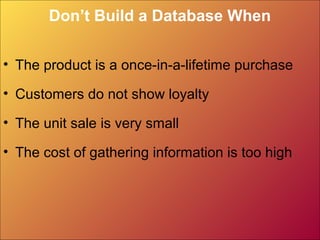
Don’t Build a Database When
• The product is a once-in-a-lifetime purchase
• Customers do not show loyalty
• The unit sale is very small
• The cost of gathering information is too high
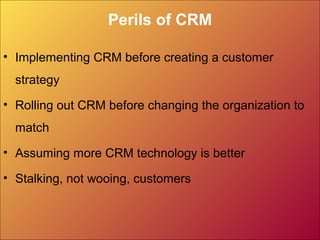
Perils of CRM
• Implementing CRM before creating a customer
strategy
• Rolling out CRM before changing the organization to
match
• Assuming more CRM technology is better
• Stalking, not wooing, customers
Marketing Debate
 Online vs. Offline Privacy?
Take a position:
1. Privacy is a bigger issue in the
online world than in the offline world.
or
2. Consumers receive more benefit
than risk from marketers knowing
their personal information.
Marketing Discussion
 Choose a business and show how
you would go about developing a
quantitative formulation that captures
the concept of customer lifetime value.
Assignments
1. What are the techniques used for monitoring
customer satisfaction?
Chapter 4 Creating Customer Value, Satisfaction, and Loyalty

Chapter 4 Creating Customer Value, Satisfaction, and Loyalty

  • 1.
    Creating Customer Value, Satisfaction, andLoyalty Prepared By, Mr. Nishant Agrawal
  • 2.
    Chapter Questions • Whatare customer value, satisfaction, and loyalty, and how can companies deliver them? • What is the lifetime value of customers? • How can companies cultivate strong customer relationships? • How can companies both attract and retain customers? • What is database marketing?
  • 3.
    Ritz Carlton -Famous for its Exceptional Service
  • 4.
  • 5.
    What is CustomerPerceived Value? •Consumers are better educated and informed than ever •Customer perceived value is the difference between the prospective / future customer’s evaluation of all the benefits and all the costs of an offering and the perceived alternatives.
  • 6.
    Determinants of CustomerPerceived Value Image benefit Psychological cost Personnel benefit Energy cost Services benefit Time cost Product benefit Monetary cost Total customer benefit Total customer cost • TCB is perceived value of economic, functional and psychological benefits customer expect from market offering. • TCC is perceived bundle of costs customers expect to incur in evaluating , obtaining, using given market offering , energy and psychological costs.
  • 7.
    Steps in aCustomer Value Analysis 1. Identify major attributes and benefits that customers value 2. Assess the qualitative importance of different attributes and benefits 3. Assess the company’s and competitor’s performances on the different customer values against rated importance 4. Examine ratings of specific segments 5. Monitor customer values over time
  • 8.
    What is Loyalty? Loyaltyis a deeply held commitment to re-buy a preferred product or service in the future despite situational influences and marketing efforts having the potential to cause switching behavior.
  • 9.
    The Value Proposition Thewhole cluster of benefits the company promises to deliver
  • 10.
    Total Customer Satisfaction •Satisfaction is person’s feeling of pleasure or disappointment that result from comparing product’s perceived performance to expectation. • Performance falls short of expectation customer is dissatisfied. • If it matches expectation customer is satisfied.
  • 11.
    Measuring Satisfaction Periodic SurveysPeriodicSurveys Customer Loss RateCustomer Loss Rate Monitor Competitive Performance Monitor Competitive Performance
  • 12.
    Single Key Questionof Net Promoter “How likely is it that you would recommend this product or service to a friend or colleague?” Use 0-10-point scale 0-6 are Marketers than subtract Detractors 7-8 are deemed Passively satisfied 9-10 are Promoter (Net Promoter Score- NPS)
  • 14.
  • 15.
  • 16.
    What is Quality? Qualityis the totality of features and characteristics of a product or service that bear on its ability to satisfy stated or implied needs.
  • 17.
  • 18.
    Maximizing Customer LifetimeValue Customer Profitability Customer Equity Lifetime Value
  • 19.
    Customer-Product Profitability Analysis Whatcan company do for customer 2 & 3 ? •It can raise the price of less profitable product or eliminate them •It can try to sell customer 2 & 3 its profit making products.
  • 20.
    Customer Lifetime Value (FormulaPage No: 116) • CLV described net present value of stream of future profits expected over customer’s lifetime purchase.
  • 21.
    What is CustomerRelationship Management? • CRM is the process of carefully managing detailed information about individual customers and all customer touchpoints to maximize customer loyalty. • CRM enables companies to provide excellent real time customer service through effective use of individual account information.
  • 22.
    Personalizing Marketing • Itis about making sure the brand and its marketing are relevant as possible to as many customer as possible – a challenge , given that no two customers are identical. • E commerce companies looking to attract and retain customers are discovering that personalization goes beyong creating customized information.
  • 23.
    Framework for CRM Identifyprospects and customers (maintain your customer database) Differentiate customers by needs & value to company Interact to improve knowledge Customize for each customer
  • 24.
  • 25.
    Reducing Defection • Itis not enough to attract new customer; company must also keep them and increase business. • Too many companies suffer from high customer churn or defection. • Ex. Telecom MNP introduce in India • To Reduce defection rate companies must • Define and measure defection rate • Differentiate causes of customer attrition and identify those that can be managed better • Compare lost customer’s lifetime value to cost of reducing defection rate
  • 26.
    Retention Dynamics (pageNo 122) • Main steps in attracting and retaining customers in terms of funnel and some questions to measure progress through the funnel. • The marketing funnel identifies the % of potential target market at each stage in decision process, from merely aware to high loyal. • Customer must move through each stage to become loyal.
  • 27.
    Managing the customerbase Reduce the rate of defectionReduce the rate of defection Increase longevityIncrease longevity Enhance “share of wallet”Enhance “share of wallet” Terminate low-profit customers Terminate low-profit customers Focus more effort on high-profit customers Focus more effort on high-profit customers
  • 28.
    Building Loyalty • Creatinga strong , tight connection to customer is dream of any marketer and often the key to long term marketing success. • Following sections explain 3 types of marketing activities companies are using to improve loyalty and retention. 1. Interacting with customers 2. Developing Loyalty Programs 3. Creating institutional Ties
  • 29.
    Customer Retention • Acquisitionof customers can cost five times more than retaining current customers. • The average customer loses 10% of its customers each year. • A 5% reduction to the customer defection rate can increase profits by 25% to 85%. • The customer profit rate increases over the life of a retained customer.
  • 30.
    Figure 5.5 TheCustomer Development Process Prospects Suspects Disqualified First-time customers Repeat customers Clients Members Partners Ex-customers
  • 31.
  • 32.
    Steps for Creating CustomerEvangelists • Customer plus-delta • Napsterize your knowledge • Build the buzz • Create community • Make bite-size chunks • Create a cause
  • 33.
    Database Key Concepts •Customer database • Database marketing • Mailing list • Business database • Data warehouse • Data mining
  • 34.
    Using the Database Toidentify prospectsTo identify prospects To target offersTo target offers To deepen loyaltyTo deepen loyalty To reactivate customersTo reactivate customers To avoid mistakesTo avoid mistakes
  • 35.
    Don’t Build aDatabase When • The product is a once-in-a-lifetime purchase • Customers do not show loyalty • The unit sale is very small • The cost of gathering information is too high
  • 36.
    Perils of CRM •Implementing CRM before creating a customer strategy • Rolling out CRM before changing the organization to match • Assuming more CRM technology is better • Stalking, not wooing, customers
  • 37.
    Marketing Debate  Onlinevs. Offline Privacy? Take a position: 1. Privacy is a bigger issue in the online world than in the offline world. or 2. Consumers receive more benefit than risk from marketers knowing their personal information.
  • 38.
    Marketing Discussion  Choosea business and show how you would go about developing a quantitative formulation that captures the concept of customer lifetime value.
  • 39.
    Assignments 1. What arethe techniques used for monitoring customer satisfaction?