TGA-FTIR ANALYSIS OF WOODY BIOMASS
 AND COAL FOR ENERGY PRODUCTION

     Qingzheng (George) Cheng1, Jingxin Wang1
         Kaushlendra Singh1, John Zondlo2
      1Division of Forestry and Natural Resources
                 2Chemical Engineering

   West Virginia University , Morgantown, WV 26506
             FPS Conference, Portland, Orogon
                      June 21, 2011
                              1


                   Outline


             •    Introduction
             •    Objectives
             •    Materials and Methods
             •    Results
             •    Conclusions


                              2


                                                     1
Introduction


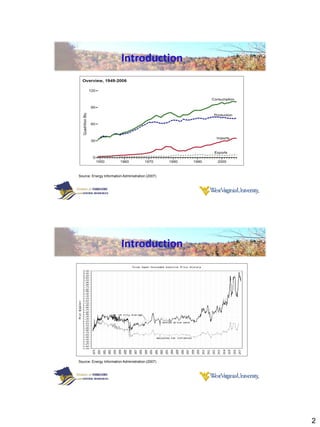
Source: Energy Information Administration (2007)


                          Introduction


Source: Energy Information Administration (2007)


                                                   2
Introduction
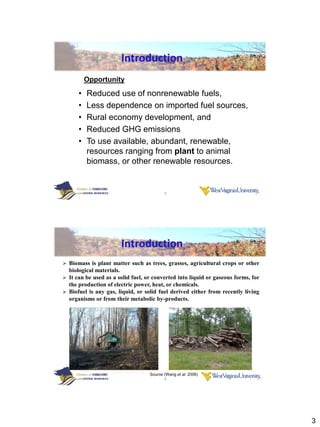
          Opportunity

      •   Reduced use of nonrenewable fuels,
      •   Less dependence on imported fuel sources,
      •   Rural economy development, and
      •   Reduced GHG emissions
      •   To use available, abundant, renewable,
          resources ranging from plant to animal
          biomass, or other renewable resources.


                                          5


                          Introduction
 Biomass is plant matter such as trees, grasses, agricultural crops or other
  biological materials.
 It can be used as a solid fuel, or converted into liquid or gaseous forms, for
  the production of electric power, heat, or chemicals.
 Biofuel is any gas, liquid, or solid fuel derived either from recently living
  organisms or from their metabolic by-products.


                                   Source (Wang et al. 2006)
                                          6


                                                                                   3
Introduction
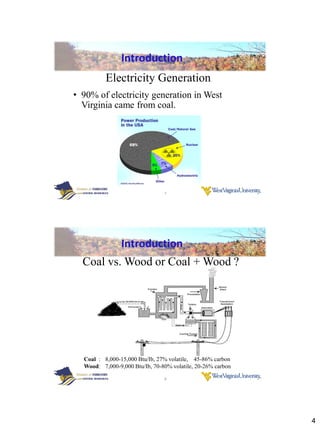
          Electricity Generation
• 90% of electricity generation in West
  Virginia came from coal.


                                7


                Introduction
  Coal vs. Wood or Coal + Wood ?


  Coal : 8,000-15,000 Btu/Ib, 27% volatile, 45-86% carbon
  Wood: 7,000-9,000 Btu/Ib, 70-80% volatile, 20-26% carbon

                                8


                                                             4
Introduction
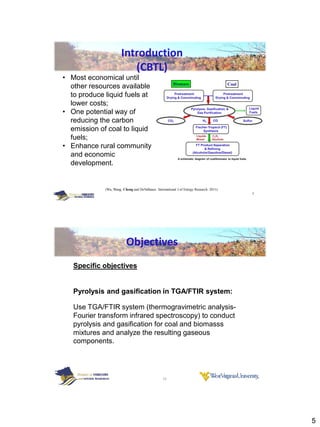
                          (CBTL)
• Most economical until
  other resources available
  to produce liquid fuels at
  lower costs;
• One potential way of
  reducing the carbon
  emission of coal to liquid
  fuels;
• Enhance rural community
  and economic
  development.


             (Wu, Wang, Cheng and DeVallance. International J of Energy Research 2011)
                                                                                         9


                          Objectives
   Specific objectives


   Pyrolysis and gasification in TGA/FTIR system:

   Use TGA/FTIR system (thermogravimetric analysis-
   Fourier transform infrared spectroscopy) to conduct
   pyrolysis and gasification for coal and biomasss
   mixtures and analyze the resulting gaseous
   components.


                                                  10


                                                                                             5
Materials

 Yellow poplar
 Red oak
 Kingwood Coal

  King-   90                80        70           50          20
 wood
 Yellow   10                20        30           50          80
 poplar
Red oak   ---               20         ---         ---         ---


                                 11


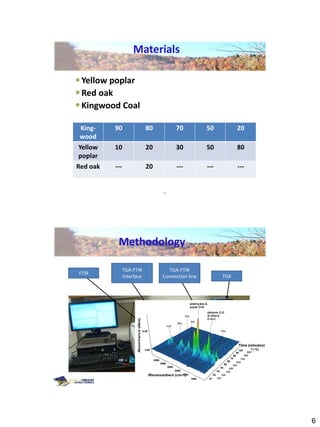
           Methodology

                TGA-FTIR           TGA-FTIR
FTIR
                Interface        Connection line         TGA


                                                                     12


                                                                          6
Methodology

• Thermogravimetric analysis (TGA)
  T: room-950 °C, 10 °C/min (natrigen flow
  rate 50 ml/min)
• Fourier transform infrared
  spectroscopy (FTIR):
  Resolution: range at 4 cm-1
  Spectra collected every 30 s


                      13


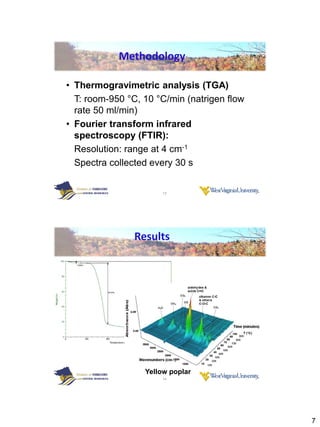
                Results


                  Yellow poplar
                      14


                                             7
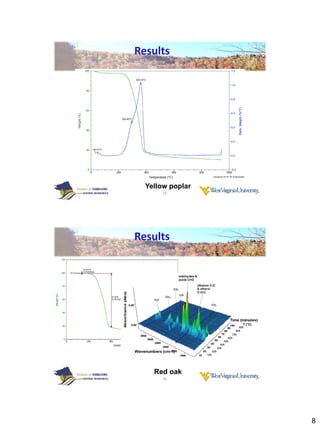
Results


  Yellow poplar
      15


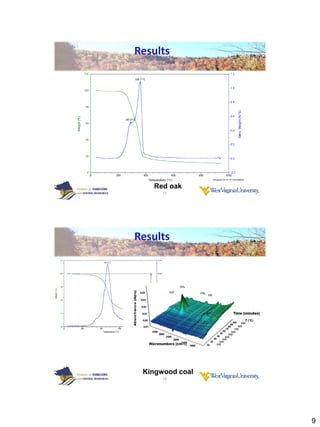
Results


    Red oak
      16


                  8
Results


   Red oak
      17


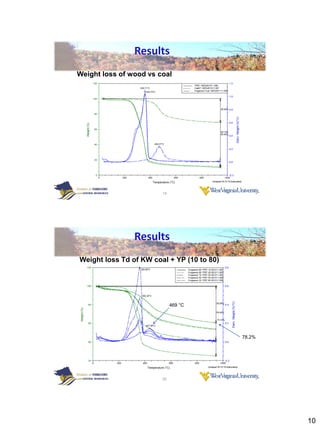
Results


 Kingwood coal
      18


                 9
Results
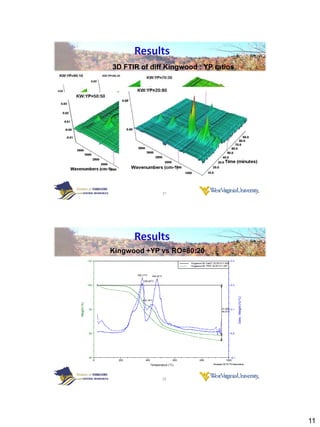
Weight loss of wood vs coal


                        19


                Results
Weight loss Td of KW coal + YP (10 to 80)


                             469 °C


                                            78.2%


                        20


                                                    10
Results
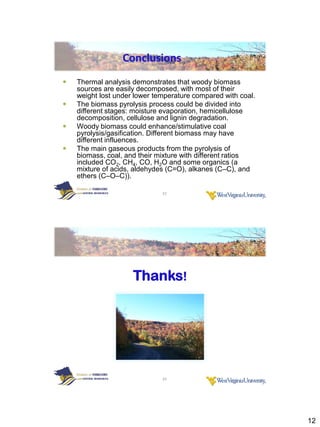
3D FTIR of diff Kingwood : YP ratios


              21


      Results
Kingwood +YP vs RO=80:20


              22


                                       11
Conclusions
   Thermal analysis demonstrates that woody biomass
    sources are easily decomposed, with most of their
    weight lost under lower temperature compared with coal.
   The biomass pyrolysis process could be divided into
    different stages: moisture evaporation, hemicellulose
    decomposition, cellulose and lignin degradation.
   Woody biomass could enhance/stimulative coal
    pyrolysis/gasification. Different biomass may have
    different influences.
   The main gaseous products from the pyrolysis of
    biomass, coal, and their mixture with different ratios
    included CO2, CH4, CO, H2O and some organics (a
    mixture of acids, aldehydes (C=O), alkanes (C–C), and
    ethers (C–O–C)).

                              23


                     Thanks!


                              24


                                                              12

Session 23 ic2011 cheng

  • 1.
    TGA-FTIR ANALYSIS OFWOODY BIOMASS AND COAL FOR ENERGY PRODUCTION Qingzheng (George) Cheng1, Jingxin Wang1 Kaushlendra Singh1, John Zondlo2 1Division of Forestry and Natural Resources 2Chemical Engineering West Virginia University , Morgantown, WV 26506 FPS Conference, Portland, Orogon June 21, 2011 1 Outline • Introduction • Objectives • Materials and Methods • Results • Conclusions 2 1
  • 2.
    Introduction Source: Energy InformationAdministration (2007) Introduction Source: Energy Information Administration (2007) 2
  • 3.
    Introduction Opportunity • Reduced use of nonrenewable fuels, • Less dependence on imported fuel sources, • Rural economy development, and • Reduced GHG emissions • To use available, abundant, renewable, resources ranging from plant to animal biomass, or other renewable resources. 5 Introduction  Biomass is plant matter such as trees, grasses, agricultural crops or other biological materials.  It can be used as a solid fuel, or converted into liquid or gaseous forms, for the production of electric power, heat, or chemicals.  Biofuel is any gas, liquid, or solid fuel derived either from recently living organisms or from their metabolic by-products. Source (Wang et al. 2006) 6 3
  • 4.
    Introduction Electricity Generation • 90% of electricity generation in West Virginia came from coal. 7 Introduction Coal vs. Wood or Coal + Wood ? Coal : 8,000-15,000 Btu/Ib, 27% volatile, 45-86% carbon Wood: 7,000-9,000 Btu/Ib, 70-80% volatile, 20-26% carbon 8 4
  • 5.
    Introduction (CBTL) • Most economical until other resources available to produce liquid fuels at lower costs; • One potential way of reducing the carbon emission of coal to liquid fuels; • Enhance rural community and economic development. (Wu, Wang, Cheng and DeVallance. International J of Energy Research 2011) 9 Objectives Specific objectives Pyrolysis and gasification in TGA/FTIR system: Use TGA/FTIR system (thermogravimetric analysis- Fourier transform infrared spectroscopy) to conduct pyrolysis and gasification for coal and biomasss mixtures and analyze the resulting gaseous components. 10 5
  • 6.
    Materials  Yellow poplar Red oak  Kingwood Coal King- 90 80 70 50 20 wood Yellow 10 20 30 50 80 poplar Red oak --- 20 --- --- --- 11 Methodology TGA-FTIR TGA-FTIR FTIR Interface Connection line TGA 12 6
  • 7.
    Methodology • Thermogravimetric analysis(TGA) T: room-950 °C, 10 °C/min (natrigen flow rate 50 ml/min) • Fourier transform infrared spectroscopy (FTIR): Resolution: range at 4 cm-1 Spectra collected every 30 s 13 Results Yellow poplar 14 7
  • 8.
    Results Yellowpoplar 15 Results Red oak 16 8
  • 9.
    Results Red oak 17 Results Kingwood coal 18 9
  • 10.
    Results Weight loss ofwood vs coal 19 Results Weight loss Td of KW coal + YP (10 to 80) 469 °C 78.2% 20 10
  • 11.
    Results 3D FTIR ofdiff Kingwood : YP ratios 21 Results Kingwood +YP vs RO=80:20 22 11
  • 12.
    Conclusions  Thermal analysis demonstrates that woody biomass sources are easily decomposed, with most of their weight lost under lower temperature compared with coal.  The biomass pyrolysis process could be divided into different stages: moisture evaporation, hemicellulose decomposition, cellulose and lignin degradation.  Woody biomass could enhance/stimulative coal pyrolysis/gasification. Different biomass may have different influences.  The main gaseous products from the pyrolysis of biomass, coal, and their mixture with different ratios included CO2, CH4, CO, H2O and some organics (a mixture of acids, aldehydes (C=O), alkanes (C–C), and ethers (C–O–C)). 23 Thanks! 24 12