Estimation of the wood properties of 
tropical, sub‐tropical and temperate 
pine species using NIR spectroscopy

            L.R. Schimleck1, J. L. M. Matos2, 
              R. Trianoski2 and J. G. Prata2
  1Warnell School of Forestry & Natural Res., University of Georgia
   2Department of Forest Sciences, Federal University of Parana
Introduction


 Extensive field trials have been established 
 in South America that aim to evaluate the 
 growth and adaptability of several tropical, 
 sub‐tropical and temperate pine species. 
 To fully assess their suitability for 
 deployment in plantations wood property 
 information needs to be collected for 
 multiple species, which is prohibitively 
 expensive using lab‐based methods.

 Interest exists in using near infrared (NIR) 
 spectroscopy to estimate mechanical 
 properties (MOE, MOR). This study aims to 
 develop multiple pine species calibrations 
 and to compare calibrations using lab 
 based and portable spectrometers. 
Species and sites examined


   Samples collected from trials established by CAMCORE and The Center for 
   the Genetic Conservation and Management of Tropical Pines

     Species                            Age            Location

     Pinus caribaea var. bahamensis     17 anos        Itararé ‐ SP

     Pinus caribaea var. caribaea       17 anos        Itararé ‐ SP

     Pinus caribaea var. hondurensis    18 anos        Ventania ‐ PR

     Pinus chiapensis                   18 anos        Ventania ‐ PR

     Pinus maximinoi                    18 anos        Ventania ‐ PR

     Pinus oocarpa                      18 anos        Ventania ‐ PR

     Pinus taeda                        18 anos        Ventania ‐ PR

     Pinus tecunumanii                  18 anos        Ventania ‐ PR
Location of sites


                    1 = Camcore, 2 = C.C.G.M.P.T
Sample collection
Sample collection


     Species                           Number of    Age (yr)   Average diameter at    Average height 
                                       trees                   breast height (cm)     (m)

     Pinus caribaea var. bahamensis        5           17               37                 27.0

     Pinus caribaea var. caribaea          5           17               37                 26.3
     Pinus caribaea var. hondurensis       5           18               42                 25.1
     Pinus chiapensis                      5           18               46                 29.8

     Pinus maximinoi                       5           18               47                 27.6

     Pinus oocarpa                         5           18               41                 26.7

     Pinus taeda                           5           18               32                 18.4

     Pinus tecunumanii                     5           18               46                 25.9


                     Base of the tree cut to provide two 2.6 m long logs
                     Ist log used for veneer, 2nd log used for wood 
                     property analysis
                     10 cm thick slab cut through the pith, and consecutive 
                     static bending samples cut from the slab
Wood property evaluation
Wood properties


           Properties      Density   Elastic properties   Compression    Shear   Hardness


            Species       (12%)       MOR         MOE     MOR    MOE     MPa        N
                          kg/m3       MPa         MPa     MPa    MPa

       P. c.bahamensis       484       63        6.568    33     9.550    10       2795


       P. c caribaea         433       56        6.060    30    10.480     9       2138


       P. c.hondurensis      500       64        7.206    36    11.324    11       2667


       P. chiapensis         440       61        7.590    36    11.546     9       2511


       P. maximinoi          530       70        9.045    40    14.133    11       3383


       P. oocarpa            540       68        7.788    41    13.597    12       3403


       P. taeda              516       63        8.234    40    13.197    10       3138


       P. tecunumanii        561       71        8.878    42    15.109    11       3393
Near infrared (NIR) spectroscopy


                        Widely used to measure parameters that are time 
                        consuming to measure
                        NIR spectrum closely related to wood chemistry
                        Applicable to static bending samples and has been 
                        used to estimate a range of wood properties
                        Calibrations limited to a small number of species or 
                        sites
                        Global calibrations – rare in forestry (several reasons)
                         • NIR applied to wood for only a short time
                         • Most properties are expensive to measure
                         • Limited networks to share samples
Near infrared (NIR) spectroscopy


                         Transverse   Radial
Near infrared (NIR) spectroscopy
Building calibration models based on NIR and wood property data 


                   Estimation of a parameter involves the following steps:

                      Collect spectra of calibration samples

                       Develop a calibration (regression)
                   (y = B0 + X1*B1 + X2*B2 + ………..+ XN*BN)

                      Collect NIR spectra of test (or unknown) samples

                      Estimate parameter of interest for test set samples 
                      using the calibration
Calibrations for density (334 samples)


    Calibration                         Number of    R2          SEC          SECV      RPDC
                                        Factors

    FOSS Static

    Density (Kg/m3) ‐ Radial face           8             0.81         35.6      38.5      2.1

    Density (Kg/m3) ‐ Transverse face       8             0.80         36.8      38.3      2.2
    FOSS Probe

    Density (Kg/m3) ‐ Radial face           4             0.51         57.8      58.8      1.4

    Density (Kg/m3) ‐ Transverse face       10            0.68         46.8      49.3      1.7
    ASD Probe

    Density (Kg/m3) ‐ Radial face           8             0.73         43.2      45.8      2.0

    Density (Kg/m3) ‐ Transverse face       10            0.70         45.0      48.5      1.8
Calibration for Density (transverse face, FOSS Static)


                                           900

                                           800
                Measured density (kg/m3)


                                           700

                                           600

                                           500
                                                                               8 factors
                                                                               R2 = 0.80
                                           400
                                                                            SEC = 36.8 kg/m3
                                           300                             SECV = 38.3 kg/m3
                                                                              RPDc = 2.2
                                           200
                                              200   300    400    500     600    700      800   900

                                                          NIR-estimated density (kg/m3)
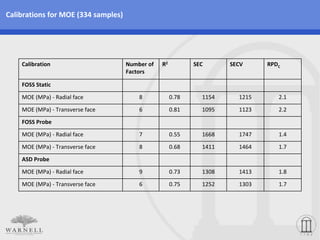
Calibrations for MOE (334 samples)


    Calibration                      Number of    R2          SEC      SECV     RPDC
                                     Factors

    FOSS Static

    MOE (MPa) ‐ Radial face              8             0.78     1154     1215      2.1

    MOE (MPa) ‐ Transverse face          6             0.81     1095     1123      2.2
    FOSS Probe

    MOE (MPa) ‐ Radial face              7             0.55     1668     1747      1.4

    MOE (MPa) ‐ Transverse face          8             0.68     1411     1464      1.7
    ASD Probe

    MOE (MPa) ‐ Radial face              9             0.73     1308     1413      1.8

    MOE (MPa) ‐ Transverse face          6             0.75     1252     1303      1.7
Calibration for MOE (transverse face, FOSS Static)


                                           16000
                Measured stiffness (MPa)


                                           12000


                                           8000

                                                                             6 factors
                                                                             R2 = 0.81
                                           4000
                                                                          SEC = 1095 MPa
                                                                         SECV = 1123 MPa
                                                                            RPDc = 2.2
                                              0
                                                   0   4000       8000        12000    16000

                                                       NIR-estimated stiffness (MPa)
Calibrations for MOR (334 samples)


    Calibration                      Number of    R2          SEC          SECV      RPDC
                                     Factors

    FOSS Static

    MOR (MPa) ‐ Radial face              4             0.69         8.4       8.6       1.7

    MOR (MPa) ‐ Transverse face          6             0.73         7.9       8.0       1.9
    FOSS Probe

    MOR (MPa) ‐ Radial face              7             0.50         10.6      11.2      1.3

    MOR (MPa) ‐ Transverse face          10            0.61         9.3       10.4      1.4
    ASD Probe

    MOR (MPa) ‐ Radial face              8             0.67         8.6       9.2       1.6

    MOR (MPa) ‐ Transverse face          5             0.64         9.0       9.2       1.6
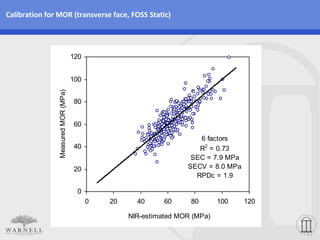
Calibration for MOR (transverse face, FOSS Static)


                                     120


                                     100
                Measured MOR (MPa)


                                     80


                                     60

                                                                       6 factors
                                     40                                R2 = 0.73
                                                                     SEC = 7.9 MPa
                                     20                             SECV = 8.0 MPa
                                                                      RPDc = 1.9

                                      0
                                           0   20     40      60     80       100    120

                                                    NIR-estimated MOR (MPa)
Conclusions


        • Wood property calibrations obtained for density, MOE and 
          MOR using several pine species growing on two sites

        • Transverse surface spectra marginally better than radial face 
          spectra

        • FOSS Static system provided the strongest calibrations, 
          followed by ASD probe and FOSS probe systems

Session 9 ic2011 schimleck

  • 1.
    Estimation of the wood properties of  tropical, sub‐tropical and temperate  pine species using NIR spectroscopy L.R. Schimleck1, J. L. M. Matos2,  R. Trianoski2 and J. G. Prata2 1Warnell School of Forestry & Natural Res., University of Georgia 2Department of Forest Sciences, Federal University of Parana
  • 2.
    Introduction Extensive field trials have been established  in South America that aim to evaluate the  growth and adaptability of several tropical,  sub‐tropical and temperate pine species.  To fully assess their suitability for  deployment in plantations wood property  information needs to be collected for  multiple species, which is prohibitively  expensive using lab‐based methods. Interest exists in using near infrared (NIR)  spectroscopy to estimate mechanical  properties (MOE, MOR). This study aims to  develop multiple pine species calibrations  and to compare calibrations using lab  based and portable spectrometers. 
  • 3.
    Species and sites examined Samples collected from trials established by CAMCORE and The Center for  the Genetic Conservation and Management of Tropical Pines Species Age Location Pinus caribaea var. bahamensis 17 anos Itararé ‐ SP Pinus caribaea var. caribaea 17 anos Itararé ‐ SP Pinus caribaea var. hondurensis  18 anos  Ventania ‐ PR Pinus chiapensis 18 anos Ventania ‐ PR Pinus maximinoi 18 anos Ventania ‐ PR Pinus oocarpa  18 anos Ventania ‐ PR Pinus taeda 18 anos Ventania ‐ PR Pinus tecunumanii 18 anos Ventania ‐ PR
  • 4.
    Location of sites 1 = Camcore, 2 = C.C.G.M.P.T
  • 5.
  • 6.
    Sample collection Species Number of  Age (yr) Average diameter at  Average height  trees breast height (cm) (m) Pinus caribaea var. bahamensis 5 17 37 27.0 Pinus caribaea var. caribaea 5 17 37 26.3 Pinus caribaea var. hondurensis 5 18 42 25.1 Pinus chiapensis 5 18 46 29.8 Pinus maximinoi 5 18 47 27.6 Pinus oocarpa 5 18 41 26.7 Pinus taeda 5 18 32 18.4 Pinus tecunumanii 5 18 46 25.9 Base of the tree cut to provide two 2.6 m long logs Ist log used for veneer, 2nd log used for wood  property analysis 10 cm thick slab cut through the pith, and consecutive  static bending samples cut from the slab
  • 7.
  • 8.
  • 9.
    Wood properties Properties Density Elastic properties Compression Shear Hardness Species (12%) MOR MOE MOR MOE MPa N kg/m3 MPa MPa MPa MPa P. c.bahamensis 484 63 6.568 33 9.550 10 2795 P. c caribaea 433 56 6.060 30 10.480 9 2138 P. c.hondurensis 500 64 7.206 36 11.324 11 2667 P. chiapensis 440 61 7.590 36 11.546 9 2511 P. maximinoi 530 70 9.045 40 14.133 11 3383 P. oocarpa 540 68 7.788 41 13.597 12 3403 P. taeda 516 63 8.234 40 13.197 10 3138 P. tecunumanii 561 71 8.878 42 15.109 11 3393
  • 10.
    Near infrared (NIR) spectroscopy Widely used to measure parameters that are time  consuming to measure NIR spectrum closely related to wood chemistry Applicable to static bending samples and has been  used to estimate a range of wood properties Calibrations limited to a small number of species or  sites Global calibrations – rare in forestry (several reasons) • NIR applied to wood for only a short time • Most properties are expensive to measure • Limited networks to share samples
  • 11.
  • 12.
  • 13.
  • 14.
  • 15.
  • 16.
    Building calibration models based on NIR and wood property data  Estimation of a parameter involves the following steps: Collect spectra of calibration samples Develop a calibration (regression) (y = B0 + X1*B1 + X2*B2 + ………..+ XN*BN) Collect NIR spectra of test (or unknown) samples Estimate parameter of interest for test set samples  using the calibration
  • 17.
    Calibrations for density (334 samples) Calibration Number of  R2 SEC SECV RPDC Factors FOSS Static Density (Kg/m3) ‐ Radial face 8 0.81 35.6 38.5 2.1 Density (Kg/m3) ‐ Transverse face 8 0.80 36.8 38.3 2.2 FOSS Probe Density (Kg/m3) ‐ Radial face 4 0.51 57.8 58.8 1.4 Density (Kg/m3) ‐ Transverse face 10 0.68 46.8 49.3 1.7 ASD Probe Density (Kg/m3) ‐ Radial face 8 0.73 43.2 45.8 2.0 Density (Kg/m3) ‐ Transverse face 10 0.70 45.0 48.5 1.8
  • 18.
    Calibration for Density (transverse face, FOSS Static) 900 800 Measured density (kg/m3) 700 600 500 8 factors R2 = 0.80 400 SEC = 36.8 kg/m3 300 SECV = 38.3 kg/m3 RPDc = 2.2 200 200 300 400 500 600 700 800 900 NIR-estimated density (kg/m3)
  • 19.
    Calibrations for MOE (334 samples) Calibration Number of  R2 SEC SECV RPDC Factors FOSS Static MOE (MPa) ‐ Radial face 8 0.78 1154 1215 2.1 MOE (MPa) ‐ Transverse face 6 0.81 1095 1123 2.2 FOSS Probe MOE (MPa) ‐ Radial face 7 0.55 1668 1747 1.4 MOE (MPa) ‐ Transverse face 8 0.68 1411 1464 1.7 ASD Probe MOE (MPa) ‐ Radial face 9 0.73 1308 1413 1.8 MOE (MPa) ‐ Transverse face 6 0.75 1252 1303 1.7
  • 20.
    Calibration for MOE (transverse face, FOSS Static) 16000 Measured stiffness (MPa) 12000 8000 6 factors R2 = 0.81 4000 SEC = 1095 MPa SECV = 1123 MPa RPDc = 2.2 0 0 4000 8000 12000 16000 NIR-estimated stiffness (MPa)
  • 21.
    Calibrations for MOR (334 samples) Calibration Number of  R2 SEC SECV RPDC Factors FOSS Static MOR (MPa) ‐ Radial face 4 0.69 8.4 8.6 1.7 MOR (MPa) ‐ Transverse face 6 0.73 7.9 8.0 1.9 FOSS Probe MOR (MPa) ‐ Radial face 7 0.50 10.6 11.2 1.3 MOR (MPa) ‐ Transverse face 10 0.61 9.3 10.4 1.4 ASD Probe MOR (MPa) ‐ Radial face 8 0.67 8.6 9.2 1.6 MOR (MPa) ‐ Transverse face 5 0.64 9.0 9.2 1.6
  • 22.
    Calibration for MOR (transverse face, FOSS Static) 120 100 Measured MOR (MPa) 80 60 6 factors 40 R2 = 0.73 SEC = 7.9 MPa 20 SECV = 8.0 MPa RPDc = 1.9 0 0 20 40 60 80 100 120 NIR-estimated MOR (MPa)
  • 23.
    Conclusions • Wood property calibrations obtained for density, MOE and  MOR using several pine species growing on two sites • Transverse surface spectra marginally better than radial face  spectra • FOSS Static system provided the strongest calibrations,  followed by ASD probe and FOSS probe systems