Jesse Daystar, Richard Venditti, Hasan Jameel, Mike Jett

             North Carolina State University
             Forest Biomaterials Department

Forest Products Society’s 65th International Convention on
          June 19-21, 2011 in Portland, Oregon.
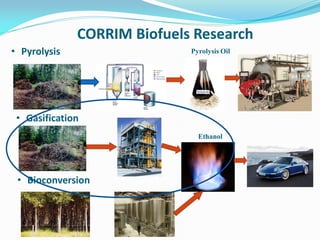
CORRIM Biofuels Research
• Pyrolysis                  Pyrolysis Oil


 • Gasification
                               Ethanol


 • Bioconversion
Outline
 Introduction
 Research Objective and Goal
 LCA Approach
    Goal and Scope
    Boundaries
    Data collection
 Results
 Conclusions
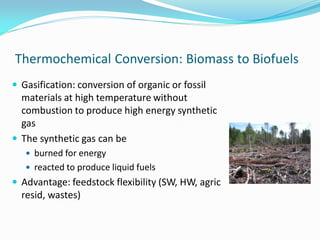
Thermochemical Conversion: Biomass to Biofuels
 Gasification: conversion of organic or fossil
  materials at high temperature without
  combustion to produce high energy synthetic
  gas
 The synthetic gas can be
    burned for energy
    reacted to produce liquid fuels
 Advantage: feedstock flexibility (SW, HW, agric
  resid, wastes)
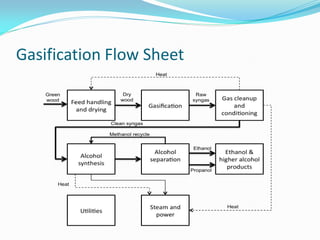
Gasification Flow Sheet
Research Objective and Goal


                              6
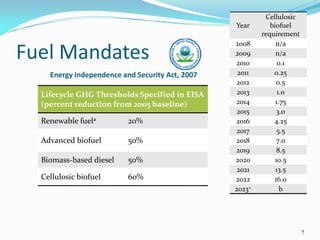
EISA Renewable Fuel Volum
                                                          Cellulosic  Biom
                                                  Year      biofuel
                                                         requirement   req
                                                  2008        n/a
Fuel Mandates                                     2009
                                                  2010
                                                              n/a
                                                               0.1
    Energy Independence and Security Act, 2007     2011      0.25
                                                   2012        0.5
  Lifecycle GHG Thresholds Specified in EISA       2013        1.0
  (percent reduction from 2005 baseline)          2014        1.75
                                                   2015        3.0
  Renewable fuela         20%                     2016       4.25
                                                   2017        5.5
  Advanced biofuel        50%                     2018         7.0
                                                  2019         8.5
  Biomass-based diesel    50%                     2020        10.5
                                                   2021       13.5
  Cellulosic biofuel      60%                     2022       16.0
                                                  2023+         b


                                                                   7
Research Objectives
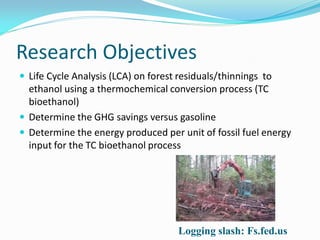
 Life Cycle Analysis (LCA) on forest residuals/thinnings to
  ethanol using a thermochemical conversion process (TC
  bioethanol)
 Determine the GHG savings versus gasoline
 Determine the energy produced per unit of fossil fuel energy
  input for the TC bioethanol process


                                     Logging slash: Fs.fed.us
LCA Goal:
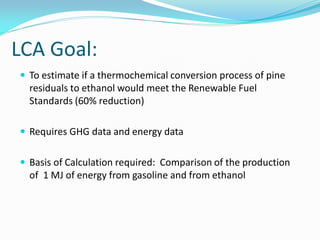
 To estimate if a thermochemical conversion process of pine
  residuals to ethanol would meet the Renewable Fuel
  Standards (60% reduction)

 Requires GHG data and energy data


 Basis of Calculation required: Comparison of the production
  of 1 MJ of energy from gasoline and from ethanol
LCA Approach


               10
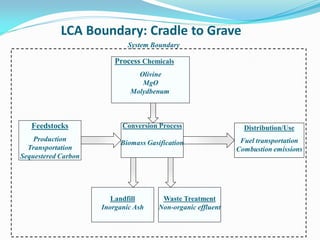
LCA Boundary: Cradle to Grave
                             System Boundary

                         Process Chemicals
                               Olivine
                                MgO
                             Molydbenum


   Feedstocks              Conversion Process                 Distribution/Use
    Production                                               Fuel transportation
                          Biomass Gasification
  Transportation                                            Combustion emissions
Sequestered Carbon


                        Landfill      Waste Treatment
                     Inorganic Ash   Non-organic effluent
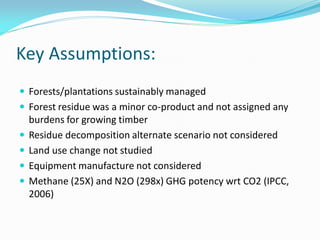
Key Assumptions:
 Forests/plantations sustainably managed
 Forest residue was a minor co-product and not assigned any
    burdens for growing timber
   Residue decomposition alternate scenario not considered
   Land use change not studied
   Equipment manufacture not considered
   Methane (25X) and N2O (298x) GHG potency wrt CO2 (IPCC,
    2006)
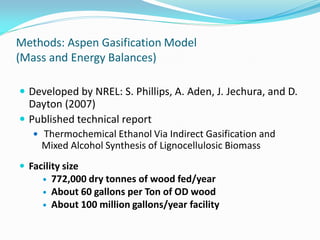
Methods: Aspen Gasification Model
(Mass and Energy Balances)

 Developed by NREL: S. Phillips, A. Aden, J. Jechura, and D.
  Dayton (2007)
 Published technical report
    Thermochemical Ethanol Via Indirect Gasification and
     Mixed Alcohol Synthesis of Lignocellulosic Biomass
 Facility size
        772,000 dry tonnes of wood fed/year
        About 60 gallons per Ton of OD wood
        About 100 million gallons/year facility
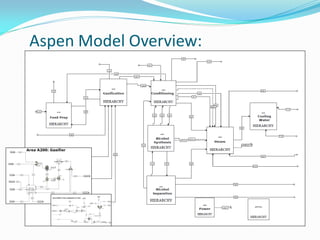
Aspen Model Overview:
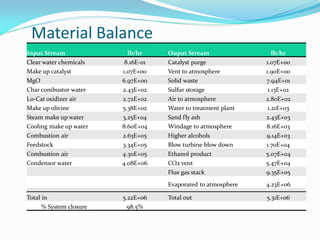
Material Balance
Input Stream               lb/hr     Ouput Stream                  lb/hr
Clear water chemicals     8.16E-01   Catalyst purge             1.07E+00
Make up catalyst         1.07E+00    Vent to atmosphere         1.90E+00
MgO                      6.97E+00    Solid waste                7.94E+01
Char combustor water     2.43E+02    Sulfur storage              1.13E+02
Lo-Cat oxidizer air      2.72E+02    Air to atmosphere          2.80E+02
Make up olivine          5.38E+02    Water to treatment plant    1.21E+03
Steam make up water      3.25E+04    Sand fly ash               2.43E+03
Cooling make up water    8.60E+04    Windage to atmosphere      8.16E+03
Combustion air           2.63E+05    Higher alcohols            9.14E+03
Feedstock                3.34E+05    Blow turbine blow down     1.70E+04
Combustion air           4.30E+05    Ethanol product            5.07E+04
Condensor water          4.08E+06    CO2 vent                   5.47E+04
                                     Flue gas stack             9.35E+05
                                     Evaporated to atmosphere   4.23E+06

Total in                 5.22E+06    Total out                  5.31E+06
      % System closure     98.5%
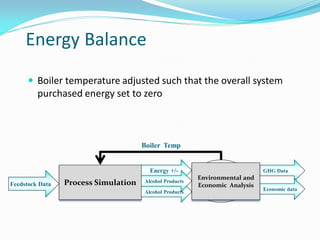
Energy Balance
       Boiler temperature adjusted such that the overall system
         purchased energy set to zero


                                      Boiler Temp


                                        Energy +/-                            GHG Data
                                                          Environmental and
Feedstock Data   Process Simulation   Alcohol Products   Adjust Boiler Temp
                                                          Economic Analysis
                                                                              Economic data
                                      Alcohol Products
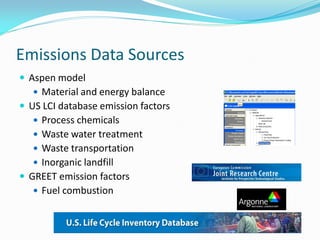
Emissions Data Sources
 Aspen model
    Material and energy balance
 US LCI database emission factors
    Process chemicals
    Waste water treatment
    Waste transportation
    Inorganic landfill
 GREET emission factors
    Fuel combustion
Results


          18
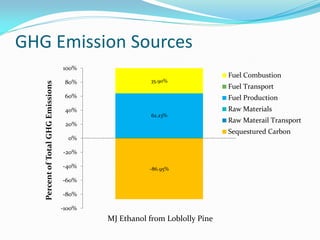
GHG Emission Sources
                                    100%
                                                                            Fuel Combustion
                                     80%               35.90%
   Percent of Total GHG Emissions


                                                                            Fuel Transport
                                     60%                                    Fuel Production
                                     40%                                    Raw Materials
                                                        62.23%
                                                                            Raw Materail Transport
                                     20%
                                                                            Sequestured Carbon
                                      0%

                                    -20%

                                    -40%               -86.95%

                                    -60%

                                    -80%

                                    -100%
                                            MJ Ethanol from Loblolly Pine
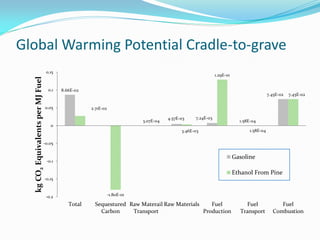
Global Warming Potential Cradle-to-grave
                                   0.15
                                                                                                                 1.29E-01
  kg CO2 Equivalents per MJ Fuel


                                     0.1   8.66E-02
                                                                                                                                              7.45E-02   7.45E-02

                                   0.05               2.71E-02

                                                                                        4.57E-03      7.24E-03
                                                                             3.07E-04                                         1.58E-04
                                      0
                                                                                              3.46E-03                             1.58E-04

                             -0.05


                                                                                                                            Gasoline
                                    -0.1

                                                                                                                            Ethanol From Pine
                                   -0.15


                                   -0.2                          -1.80E-01

                                              Total    Sequestured Raw Materail Raw Materials    Fuel                           Fuel               Fuel
                                                         Carbon     Transport                 Production                      Transport         Combustion
                                                                                         Axis Title
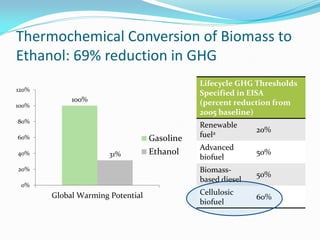
Thermochemical Conversion of Biomass to
Ethanol: 69% reduction in GHG
                                             Lifecycle GHG Thresholds
120%
                                             Specified in EISA
            100%                             (percent reduction from
100%
                                             2005 baseline)
80%
                                             Renewable
                                                            20%
60%                               Gasoline   fuela
                                             Advanced
40%                   31%         Ethanol                   50%
                                             biofuel
20%                                          Biomass-
                                                            50%
                                             based diesel
 0%
       Global Warming Potential              Cellulosic
                                                            60%
                                             biofuel
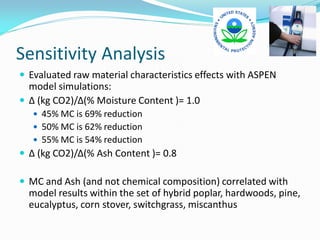
Sensitivity Analysis
 Evaluated raw material characteristics effects with ASPEN
  model simulations:
 Δ (kg CO2)/Δ(% Moisture Content )= 1.0
    45% MC is 69% reduction
    50% MC is 62% reduction
    55% MC is 54% reduction
 Δ (kg CO2)/Δ(% Ash Content )= 0.8

 MC and Ash (and not chemical composition) correlated with
  model results within the set of hybrid poplar, hardwoods, pine,
  eucalyptus, corn stover, switchgrass, miscanthus
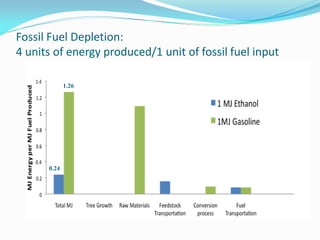
Fossil Fuel Depletion:
4 units of energy produced/1 unit of fossil fuel input

             1.26


      0.24
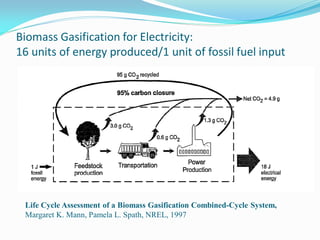
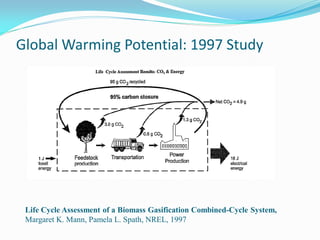
Biomass Gasification for Electricity:
16 units of energy produced/1 unit of fossil fuel input


 Life Cycle Assessment of a Biomass Gasification Combined-Cycle System,
 Margaret K. Mann, Pamela L. Spath, NREL, 1997
Conclusions
 Biomass growth and emissions during thermochemical
  conversion dominate the GHG balance for biothenol
  production
 Production and use of TC bioethanol reduces GHG emissions
  by 69% relative to gasoline, qualifies as cellulosic biofuel
 The production of TC bioethanol produces 4 units of energy
  per 1 unit of fossil fuel consumed, lower yield than biomass
  gasification to electricity
Acknowledgements
 Consortium for Research on Renewable Industrial Materials
 Department of Energy
 Maureen Puettmann – SimaPro assistance
Introduction


               27
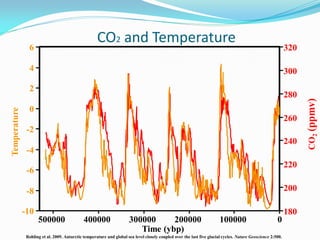
CO2 and Temperature
                6                                                                                                                                            320

                4                                                                                                                                            300
                2
                                                                                                                                                             280


                                                                                                                                                                   CO2 (ppmv)
                0
Temperature


                                                                                                                                                             260
               -2
                                                                                                                                                             240
               -4
                                                                                                                                                             220
               -6

               -8                                                                                                                                            200

              -10                                                                                                                                            180
                     500000                   400000                   300000     200000                                100000                         0
                                                                          Time (ybp)
               Rohling et al. 2009. Antarctic temperature and global sea level closely coupled over the last five glacial cycles. Nature Geoscience 2:500.
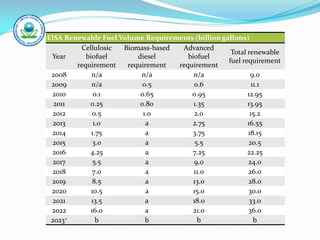
EISA Renewable Fuel Volume Requirements (billion gallons)
         Cellulosic  Biomass-based  Advanced
                                                    Total renewable
 Year      biofuel       diesel       biofuel
                                                   fuel requirement
        requirement   requirement  requirement
 2008        n/a          n/a           n/a                9.0
 2009        n/a           0.5          0.6                 11.1
 2010         0.1         0.65         0.95               12.95
  2011      0.25          0.80          1.35              13.95
  2012       0.5           1.0          2.0                15.2
  2013        1.0           a          2.75               16.55
 2014        1.75           a          3.75               18.15
  2015        3.0           a            5.5               20.5
 2016       4.25            a          7.25               22.25
  2017        5.5           a           9.0               24.0
 2018        7.0            a           11.0              26.0
 2019        8.5            a           13.0              28.0
 2020        10.5           a           15.0              30.0
  2021       13.5           a          18.0                33.0
 2022       16.0            a           21.0              36.0
 2023+         b            b             b                  b
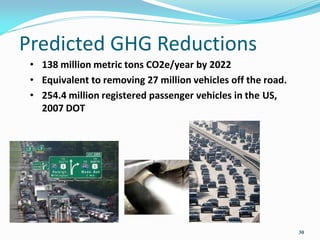
Predicted GHG Reductions
 • 138 million metric tons CO2e/year by 2022
 • Equivalent to removing 27 million vehicles off the road.
 • 254.4 million registered passenger vehicles in the US,
   2007 DOT


                                                              30
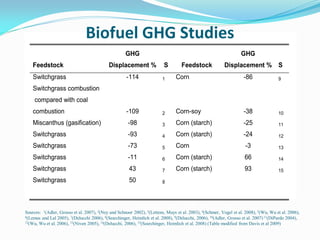
Biofuel GHG Studies
                                                     GHG                                                          GHG
    Feedstock                               Displacement %               S         Feedstock             Displacement % S
    Switchgrass                                      -114                1      Corn                                -86               9

    Switchgrass combustion
     compared with coal
    combustion                                       -109                2      Corn-soy                            -38               10

    Miscanthus (gasification)                         -98                3      Corn (starch)                       -25               11

    Switchgrass                                       -93                4      Corn (starch)                       -24               12

    Switchgrass                                       -73                5      Corn                                 -3               13

    Switchgrass                                       -11                6      Corn (starch)                       66                14

    Switchgrass                                        43                7      Corn (starch)                       93                15

    Switchgrass                                        50                8


Sources: 1(Adler, Grosso et al. 2007), 2(Ney and Schnoor 2002), 3(Lettens, Muys et al. 2003), 4(Schmer, Vogel et al. 2008), 5(Wu, Wu et al. 2006),
6(Lemus and Lal 2005), 7(Delucchi 2006), 8(Searchinger, Heimlich et al. 2008), 9(Delucchi, 2006), 10(Adler, Grosso et al. 2007) 11(DiPardo 2004),
12(Wu, Wu et al. 2006), 13(Niven 2005), 14(Delucchi, 2006), 15(Searchinger, Heimlich et al. 2008) (Table modified from Davis et al 2009)
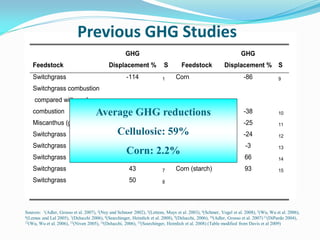
Previous GHG Studies
                                                     GHG                                                          GHG
    Feedstock                               Displacement %               S         Feedstock             Displacement % S
    Switchgrass                                      -114                1      Corn                                -86               9

    Switchgrass combustion
     compared with coal
    combustion                       Average GHG 2reductions
                                           -109      Corn-soy                                                       -38               10

    Miscanthus (gasification)                         -98                3      Corn (starch)                       -25               11

    Switchgrass                                  Cellulosic: 59% (starch)
                                                   -93     4  Corn                                                  -24               12

    Switchgrass                                       -73   5                   Corn                                 -3               13
                                                     Corn: 2.2%
    Switchgrass                                       -11                6      Corn (starch)                       66                14

    Switchgrass                                        43                7      Corn (starch)                       93                15

    Switchgrass                                        50                8


Sources: 1(Adler, Grosso et al. 2007), 2(Ney and Schnoor 2002), 3(Lettens, Muys et al. 2003), 4(Schmer, Vogel et al. 2008), 5(Wu, Wu et al. 2006),
6(Lemus and Lal 2005), 7(Delucchi 2006), 8(Searchinger, Heimlich et al. 2008), 9(Delucchi, 2006), 10(Adler, Grosso et al. 2007) 11(DiPardo 2004),
12(Wu, Wu et al. 2006), 13(Niven 2005), 14(Delucchi, 2006), 15(Searchinger, Heimlich et al. 2008) (Table modified from Davis et al 2009)
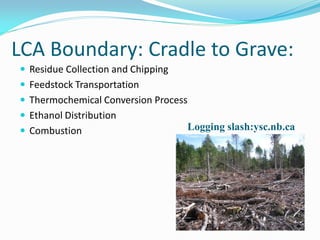
LCA Boundary: Cradle to Grave:
 Residue Collection and Chipping
 Feedstock Transportation
 Thermochemical Conversion Process
 Ethanol Distribution
 Combustion                        Logging slash:ysc.nb.ca
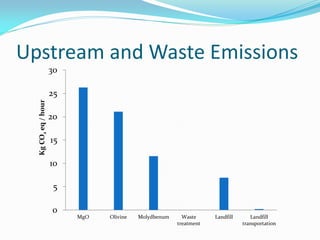
Upstream and Waste Emissions
                     30

                     25
  Kg CO2 eq / hour


                     20

                     15

                     10

                      5

                     0
                          MgO   Olivine   Molydbenum     Waste     Landfill      Landfill
                                                       treatment              transportation
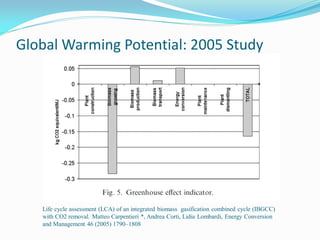
Global Warming Potential: 2005 Study


   Life cycle assessment (LCA) of an integrated biomass gasification combined cycle (IBGCC)
   with CO2 removal. Matteo Carpentieri *, Andrea Corti, Lidia Lombardi, Energy Conversion
   and Management 46 (2005) 1790–1808
Global Warming Potential: 1997 Study


 Life Cycle Assessment of a Biomass Gasification Combined-Cycle System,
 Margaret K. Mann, Pamela L. Spath, NREL, 1997

Session 17 ic2011 venditti

  • 1.
    Jesse Daystar, RichardVenditti, Hasan Jameel, Mike Jett North Carolina State University Forest Biomaterials Department Forest Products Society’s 65th International Convention on June 19-21, 2011 in Portland, Oregon.
  • 2.
    CORRIM Biofuels Research •Pyrolysis Pyrolysis Oil • Gasification Ethanol • Bioconversion
  • 3.
    Outline  Introduction  ResearchObjective and Goal  LCA Approach  Goal and Scope  Boundaries  Data collection  Results  Conclusions
  • 4.
    Thermochemical Conversion: Biomassto Biofuels  Gasification: conversion of organic or fossil materials at high temperature without combustion to produce high energy synthetic gas  The synthetic gas can be  burned for energy  reacted to produce liquid fuels  Advantage: feedstock flexibility (SW, HW, agric resid, wastes)
  • 5.
  • 6.
  • 7.
    EISA Renewable FuelVolum Cellulosic Biom Year biofuel requirement req 2008 n/a Fuel Mandates 2009 2010 n/a 0.1 Energy Independence and Security Act, 2007 2011 0.25 2012 0.5 Lifecycle GHG Thresholds Specified in EISA 2013 1.0 (percent reduction from 2005 baseline) 2014 1.75 2015 3.0 Renewable fuela 20% 2016 4.25 2017 5.5 Advanced biofuel 50% 2018 7.0 2019 8.5 Biomass-based diesel 50% 2020 10.5 2021 13.5 Cellulosic biofuel 60% 2022 16.0 2023+ b 7
  • 8.
    Research Objectives  LifeCycle Analysis (LCA) on forest residuals/thinnings to ethanol using a thermochemical conversion process (TC bioethanol)  Determine the GHG savings versus gasoline  Determine the energy produced per unit of fossil fuel energy input for the TC bioethanol process Logging slash: Fs.fed.us
  • 9.
    LCA Goal:  Toestimate if a thermochemical conversion process of pine residuals to ethanol would meet the Renewable Fuel Standards (60% reduction)  Requires GHG data and energy data  Basis of Calculation required: Comparison of the production of 1 MJ of energy from gasoline and from ethanol
  • 10.
  • 11.
    LCA Boundary: Cradleto Grave System Boundary Process Chemicals Olivine MgO Molydbenum Feedstocks Conversion Process Distribution/Use Production Fuel transportation Biomass Gasification Transportation Combustion emissions Sequestered Carbon Landfill Waste Treatment Inorganic Ash Non-organic effluent
  • 12.
    Key Assumptions:  Forests/plantationssustainably managed  Forest residue was a minor co-product and not assigned any burdens for growing timber  Residue decomposition alternate scenario not considered  Land use change not studied  Equipment manufacture not considered  Methane (25X) and N2O (298x) GHG potency wrt CO2 (IPCC, 2006)
  • 13.
    Methods: Aspen GasificationModel (Mass and Energy Balances)  Developed by NREL: S. Phillips, A. Aden, J. Jechura, and D. Dayton (2007)  Published technical report  Thermochemical Ethanol Via Indirect Gasification and Mixed Alcohol Synthesis of Lignocellulosic Biomass  Facility size  772,000 dry tonnes of wood fed/year  About 60 gallons per Ton of OD wood  About 100 million gallons/year facility
  • 14.
  • 15.
    Material Balance Input Stream lb/hr Ouput Stream lb/hr Clear water chemicals 8.16E-01 Catalyst purge 1.07E+00 Make up catalyst 1.07E+00 Vent to atmosphere 1.90E+00 MgO 6.97E+00 Solid waste 7.94E+01 Char combustor water 2.43E+02 Sulfur storage 1.13E+02 Lo-Cat oxidizer air 2.72E+02 Air to atmosphere 2.80E+02 Make up olivine 5.38E+02 Water to treatment plant 1.21E+03 Steam make up water 3.25E+04 Sand fly ash 2.43E+03 Cooling make up water 8.60E+04 Windage to atmosphere 8.16E+03 Combustion air 2.63E+05 Higher alcohols 9.14E+03 Feedstock 3.34E+05 Blow turbine blow down 1.70E+04 Combustion air 4.30E+05 Ethanol product 5.07E+04 Condensor water 4.08E+06 CO2 vent 5.47E+04 Flue gas stack 9.35E+05 Evaporated to atmosphere 4.23E+06 Total in 5.22E+06 Total out 5.31E+06 % System closure 98.5%
  • 16.
    Energy Balance  Boiler temperature adjusted such that the overall system purchased energy set to zero Boiler Temp Energy +/- GHG Data Environmental and Feedstock Data Process Simulation Alcohol Products Adjust Boiler Temp Economic Analysis Economic data Alcohol Products
  • 17.
    Emissions Data Sources Aspen model  Material and energy balance  US LCI database emission factors  Process chemicals  Waste water treatment  Waste transportation  Inorganic landfill  GREET emission factors  Fuel combustion
  • 18.
  • 19.
    GHG Emission Sources 100% Fuel Combustion 80% 35.90% Percent of Total GHG Emissions Fuel Transport 60% Fuel Production 40% Raw Materials 62.23% Raw Materail Transport 20% Sequestured Carbon 0% -20% -40% -86.95% -60% -80% -100% MJ Ethanol from Loblolly Pine
  • 20.
    Global Warming PotentialCradle-to-grave 0.15 1.29E-01 kg CO2 Equivalents per MJ Fuel 0.1 8.66E-02 7.45E-02 7.45E-02 0.05 2.71E-02 4.57E-03 7.24E-03 3.07E-04 1.58E-04 0 3.46E-03 1.58E-04 -0.05 Gasoline -0.1 Ethanol From Pine -0.15 -0.2 -1.80E-01 Total Sequestured Raw Materail Raw Materials Fuel Fuel Fuel Carbon Transport Production Transport Combustion Axis Title
  • 21.
    Thermochemical Conversion ofBiomass to Ethanol: 69% reduction in GHG Lifecycle GHG Thresholds 120% Specified in EISA 100% (percent reduction from 100% 2005 baseline) 80% Renewable 20% 60% Gasoline fuela Advanced 40% 31% Ethanol 50% biofuel 20% Biomass- 50% based diesel 0% Global Warming Potential Cellulosic 60% biofuel
  • 22.
    Sensitivity Analysis  Evaluatedraw material characteristics effects with ASPEN model simulations:  Δ (kg CO2)/Δ(% Moisture Content )= 1.0  45% MC is 69% reduction  50% MC is 62% reduction  55% MC is 54% reduction  Δ (kg CO2)/Δ(% Ash Content )= 0.8  MC and Ash (and not chemical composition) correlated with model results within the set of hybrid poplar, hardwoods, pine, eucalyptus, corn stover, switchgrass, miscanthus
  • 23.
    Fossil Fuel Depletion: 4units of energy produced/1 unit of fossil fuel input 1.26 0.24
  • 24.
    Biomass Gasification forElectricity: 16 units of energy produced/1 unit of fossil fuel input Life Cycle Assessment of a Biomass Gasification Combined-Cycle System, Margaret K. Mann, Pamela L. Spath, NREL, 1997
  • 25.
    Conclusions  Biomass growthand emissions during thermochemical conversion dominate the GHG balance for biothenol production  Production and use of TC bioethanol reduces GHG emissions by 69% relative to gasoline, qualifies as cellulosic biofuel  The production of TC bioethanol produces 4 units of energy per 1 unit of fossil fuel consumed, lower yield than biomass gasification to electricity
  • 26.
    Acknowledgements  Consortium forResearch on Renewable Industrial Materials  Department of Energy  Maureen Puettmann – SimaPro assistance
  • 27.
  • 28.
    CO2 and Temperature 6 320 4 300 2 280 CO2 (ppmv) 0 Temperature 260 -2 240 -4 220 -6 -8 200 -10 180 500000 400000 300000 200000 100000 0 Time (ybp) Rohling et al. 2009. Antarctic temperature and global sea level closely coupled over the last five glacial cycles. Nature Geoscience 2:500.
  • 29.
    EISA Renewable FuelVolume Requirements (billion gallons) Cellulosic Biomass-based Advanced Total renewable Year biofuel diesel biofuel fuel requirement requirement requirement requirement 2008 n/a n/a n/a 9.0 2009 n/a 0.5 0.6 11.1 2010 0.1 0.65 0.95 12.95 2011 0.25 0.80 1.35 13.95 2012 0.5 1.0 2.0 15.2 2013 1.0 a 2.75 16.55 2014 1.75 a 3.75 18.15 2015 3.0 a 5.5 20.5 2016 4.25 a 7.25 22.25 2017 5.5 a 9.0 24.0 2018 7.0 a 11.0 26.0 2019 8.5 a 13.0 28.0 2020 10.5 a 15.0 30.0 2021 13.5 a 18.0 33.0 2022 16.0 a 21.0 36.0 2023+ b b b b
  • 30.
    Predicted GHG Reductions • 138 million metric tons CO2e/year by 2022 • Equivalent to removing 27 million vehicles off the road. • 254.4 million registered passenger vehicles in the US, 2007 DOT 30
  • 31.
    Biofuel GHG Studies GHG GHG Feedstock Displacement % S Feedstock Displacement % S Switchgrass -114 1 Corn -86 9 Switchgrass combustion compared with coal combustion -109 2 Corn-soy -38 10 Miscanthus (gasification) -98 3 Corn (starch) -25 11 Switchgrass -93 4 Corn (starch) -24 12 Switchgrass -73 5 Corn -3 13 Switchgrass -11 6 Corn (starch) 66 14 Switchgrass 43 7 Corn (starch) 93 15 Switchgrass 50 8 Sources: 1(Adler, Grosso et al. 2007), 2(Ney and Schnoor 2002), 3(Lettens, Muys et al. 2003), 4(Schmer, Vogel et al. 2008), 5(Wu, Wu et al. 2006), 6(Lemus and Lal 2005), 7(Delucchi 2006), 8(Searchinger, Heimlich et al. 2008), 9(Delucchi, 2006), 10(Adler, Grosso et al. 2007) 11(DiPardo 2004), 12(Wu, Wu et al. 2006), 13(Niven 2005), 14(Delucchi, 2006), 15(Searchinger, Heimlich et al. 2008) (Table modified from Davis et al 2009)
  • 32.
    Previous GHG Studies GHG GHG Feedstock Displacement % S Feedstock Displacement % S Switchgrass -114 1 Corn -86 9 Switchgrass combustion compared with coal combustion Average GHG 2reductions -109 Corn-soy -38 10 Miscanthus (gasification) -98 3 Corn (starch) -25 11 Switchgrass Cellulosic: 59% (starch) -93 4 Corn -24 12 Switchgrass -73 5 Corn -3 13 Corn: 2.2% Switchgrass -11 6 Corn (starch) 66 14 Switchgrass 43 7 Corn (starch) 93 15 Switchgrass 50 8 Sources: 1(Adler, Grosso et al. 2007), 2(Ney and Schnoor 2002), 3(Lettens, Muys et al. 2003), 4(Schmer, Vogel et al. 2008), 5(Wu, Wu et al. 2006), 6(Lemus and Lal 2005), 7(Delucchi 2006), 8(Searchinger, Heimlich et al. 2008), 9(Delucchi, 2006), 10(Adler, Grosso et al. 2007) 11(DiPardo 2004), 12(Wu, Wu et al. 2006), 13(Niven 2005), 14(Delucchi, 2006), 15(Searchinger, Heimlich et al. 2008) (Table modified from Davis et al 2009)
  • 33.
    LCA Boundary: Cradleto Grave:  Residue Collection and Chipping  Feedstock Transportation  Thermochemical Conversion Process  Ethanol Distribution  Combustion Logging slash:ysc.nb.ca
  • 34.
    Upstream and WasteEmissions 30 25 Kg CO2 eq / hour 20 15 10 5 0 MgO Olivine Molydbenum Waste Landfill Landfill treatment transportation
  • 35.
    Global Warming Potential:2005 Study Life cycle assessment (LCA) of an integrated biomass gasification combined cycle (IBGCC) with CO2 removal. Matteo Carpentieri *, Andrea Corti, Lidia Lombardi, Energy Conversion and Management 46 (2005) 1790–1808
  • 36.
    Global Warming Potential:1997 Study Life Cycle Assessment of a Biomass Gasification Combined-Cycle System, Margaret K. Mann, Pamela L. Spath, NREL, 1997