Introduction to bioenergy in Denmark
         Status and trends


   Polish-Danish Bioenergy Meeting
  October 7th October 2010, Gdansk
Content


 Overview of bioenergy in Denmark
 Political objectives for bioenergy and biogas
 Status on biogas in Denmark
 Biogas in combination with slurry separation
 Case: Morso Bioenergy
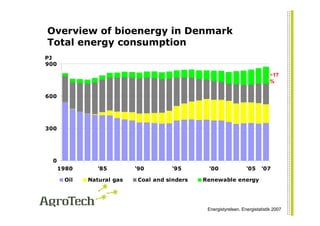
Overview of bioenergy in Denmark
Total energy consumption
PJ
900

                                                                              ≈17
                                                                              %

600


300


  0
      1980      '85        '90       '95       '00                '05     '07

       Oil   Natural gas   Coal and sinders   Renewable energy


                                               Energistyrelsen, Energistatistik 2007
Sources of renewable energy in DK
PJ
140

120

100

 80
                                                                                  Biomass
 60                                                                               = 72%

 40

 20

     0
         1980         '85           '90   '95       '00          '05 '07
                Wind                        Straw
                Wood                        Biogas
                Garbage, biodegr.           Geothermal heat etc.


                                                       Energistyrelsen, Energistatistik 2007
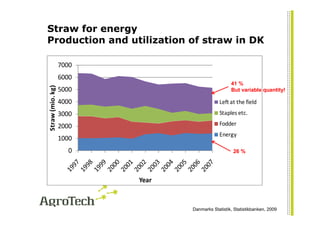
Straw for energy
Production and utilization of straw in DK

                  7000
                  6000
                                                  41 %
Straw (mio. kg)


                  5000                            But variable quantity!

                  4000                       Left at the field
                  3000                       Staples etc.

                  2000                       Fodder
                                             Energy
                  1000
                     0                             26 %


                         Year


                                Danmarks Statistik, Statistikbanken, 2009
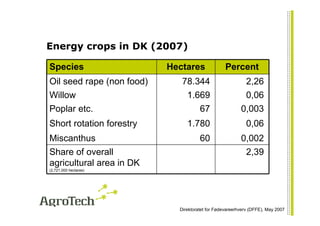
Energy crops in DK (2007)

Species                    Hectares               Percent
Oil seed rape (non food)      78.344                       2,26
Willow                          1.669                     0,06
Poplar etc.                        67                    0,003
Short rotation forestry         1.780                      0,06
Miscanthus                            60                 0,002
Share of overall                                          2,39
agricultural area in DK
(2,721,000 hectares)


                             Direktoratet for Fødevareerhverv (DFFE), May 2007
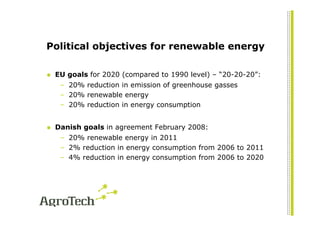
Political objectives for renewable energy

 EU goals for 2020 (compared to 1990 level) – “20-20-20”:
  – 20% reduction in emission of greenhouse gasses
  – 20% renewable energy
  – 20% reduction in energy consumption


 Danish goals in agreement February 2008:
  – 20% renewable energy in 2011
  – 2% reduction in energy consumption from 2006 to 2011
  – 4% reduction in energy consumption from 2006 to 2020
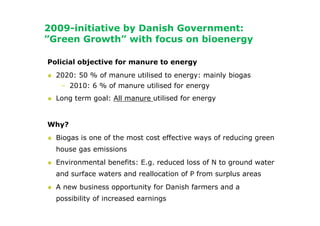
2009-initiative by Danish Government:
”Green Growth” with focus on bioenergy

Policial objective for manure to energy
  2020: 50 % of manure utilised to energy: mainly biogas
   – 2010: 6 % of manure utilised for energy
  Long term goal: All manure utilised for energy


Why?
  Biogas is one of the most cost effective ways of reducing green
  house gas emissions
  Environmental benefits: E.g. reduced loss of N to ground water
  and surface waters and reallocation of P from surplus areas
  A new business opportunity for Danish farmers and a
  possibility of increased earnings
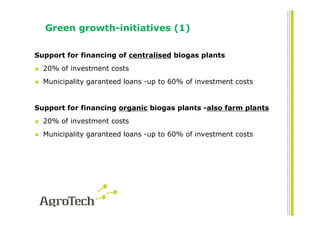
Green growth-initiatives (1)

Support for financing of centralised biogas plants
  20% of investment costs
  Municipality garanteed loans -up to 60% of investment costs


Support for financing organic biogas plants -also farm plants
  20% of investment costs
  Municipality garanteed loans -up to 60% of investment costs
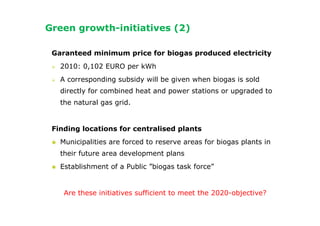
Green growth-initiatives (2)

 Garanteed minimum price for biogas produced electricity
   2010: 0,102 EURO per kWh
   A corresponding subsidy will be given when biogas is sold
   directly for combined heat and power stations or upgraded to
   the natural gas grid.


 Finding locations for centralised plants
   Municipalities are forced to reserve areas for biogas plants in
   their future area development plans
   Establishment of a Public ”biogas task force”


    Are these initiatives sufficient to meet the 2020-objective?
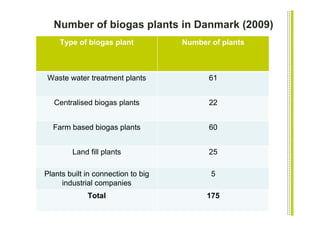
Number of biogas plants in Danmark (2009)
    Type of biogas plant            Number of plants


Waste water treatment plants              61


   Centralised biogas plants              22


  Farm based biogas plants                60


        Land fill plants                  25

Plants built in connection to big          5
     industrial companies
             Total                        175
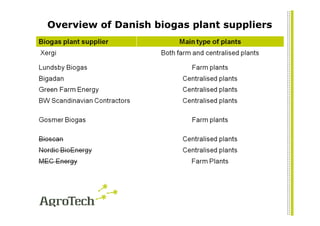
Overview of Danish biogas plant suppliers
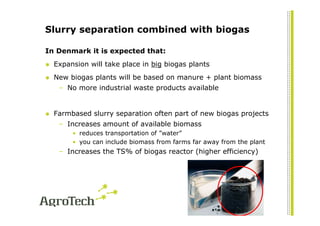
Slurry separation combined with biogas

In Denmark it is expected that:
  Expansion will take place in big biogas plants
  New biogas plants will be based on manure + plant biomass
   – No more industrial waste products available


  Farmbased slurry separation often part of new biogas projects
   – Increases amount of available biomass
       • reduces transportation of ”water”
       • you can include biomass from farms far away from the plant
   – Increases the TS% of biogas reactor (higher efficiency)
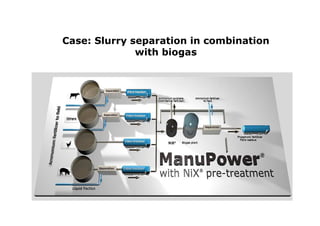
Case: Slurry separation in combination
              with biogas
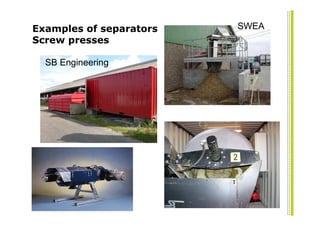
Examples of separators   SWEA
Screw presses

  SB Engineering
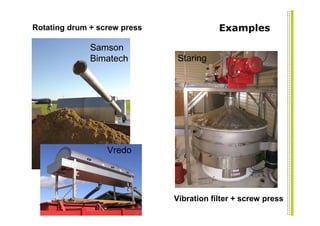
Rotating drum + screw press               Examples

              Samson
              Bimatech         Staring


                  Vredo


                              Vibration filter + screw press
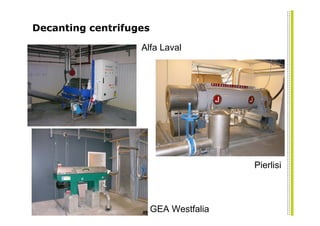
Decanting centrifuges

                   Alfa Laval


                                        Pierlisi


                        GEA Westfalia
Status of slurry separation in Denmark


Around 35 million tons of slurry per year

1 million tonnes of slurry separated per year
   • Approx. 3 % of total slurry production


A growing interest for slurry separation
   • In areas with intensive animal production
   • In regions that drain off to vulnerable surface waters
   • On large scale animal production farms
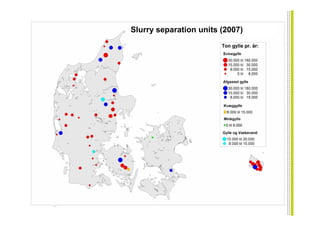
Slurry separation units (2007)
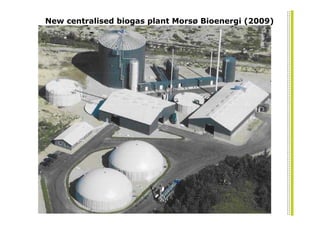
New centralised biogas plant Morsø Bioenergi (2009)
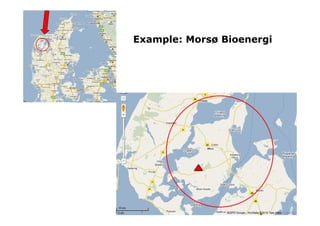
Case: Morsø Bioenergi

Background
  Island with very high livestock density – mainly pigs
  Surplus of nutrients from manure (N og P)
  Vulnerable surface waters around Mors island (Limfjord)
  Long distance to land available for manure application
Example: Morsø Bioenergi
The idea of Morsø bioenergi


 Establishment of a biogas plant based on manure
  No import of nutrient rich waste products
 Decentralised slurry separation at farms far from biogas plant
  – Fixed separators owned by farmers
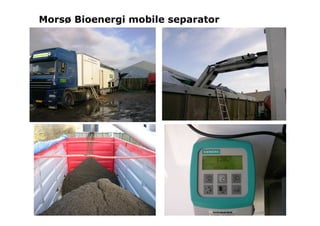
  – Mobil decanting centrifuge owned
 Post-separation of digested biomass to up-concentrate N and P
 in the solid fraction.
 Drying and pelletizing the solid fraction
 Export of ”fiber-pellets” out of the island
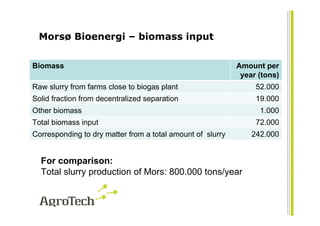
Morsø Bioenergi – biomass input


Biomass                                                     Amount per
                                                             year (tons)
Raw slurry from farms close to biogas plant                      52.000
Solid fraction from decentralized separation                     19.000
Other biomass                                                     1.000
Total biomass input                                              72.000
Corresponding to dry matter from a total amount of slurry       242.000


  For comparison:
  Total slurry production of Mors: 800.000 tons/year
Morsø Bioenergi mobile separator
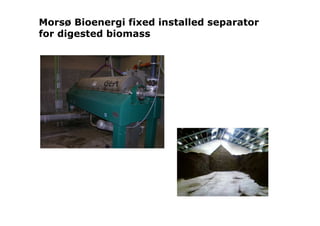
Morsø Bioenergi fixed installed separator
for digested biomass
Slurry separation as a way to increase
biomass basis for biogas production?

Challenges
  What is the biogas yield from solid fraction?
   –   Big differences due to slurry type and separator
   –   Separation of old slurry?
   –   After separation there is still dry matter in liquid fraction
   –   Pre-treatment of solid fraction to increase yield
   –   N-inhibitation of reactor due to solid fraction?
  Who shall pay the costs of separation?
   – A need to develop cheaper separation systems
   – Potential for development of in-house separation systems
  Optimisation of logistics to reduce loss of N and C during
  storage and transport of solid fraction
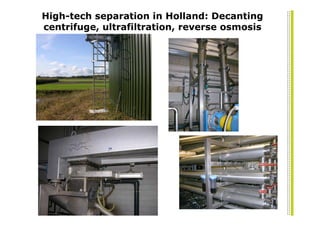
High-tech separation in Holland: Decanting
centrifuge, ultrafiltration, reverse osmosis
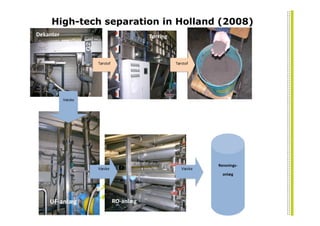
High-tech separation in Holland (2008)
Dekanter                                Tørring


                   Tørstof                        Tørstof


           Væske


                                                             Rensnings-
                   Væske                             Væske
                                                               anlæg


    UF-anlæg                 RO-anlæg
Questions or comments?


 Phone: +45 87 43 84 68
 E-mail: tqf@agrotech.dk

Thorkild Q Frandsen - Introduction to bioenergy in Denmark Status and trends

  • 1.
    Introduction to bioenergyin Denmark Status and trends Polish-Danish Bioenergy Meeting October 7th October 2010, Gdansk
  • 2.
    Content Overview ofbioenergy in Denmark Political objectives for bioenergy and biogas Status on biogas in Denmark Biogas in combination with slurry separation Case: Morso Bioenergy
  • 3.
    Overview of bioenergyin Denmark Total energy consumption PJ 900 ≈17 % 600 300 0 1980 '85 '90 '95 '00 '05 '07 Oil Natural gas Coal and sinders Renewable energy Energistyrelsen, Energistatistik 2007
  • 4.
    Sources of renewableenergy in DK PJ 140 120 100 80 Biomass 60 = 72% 40 20 0 1980 '85 '90 '95 '00 '05 '07 Wind Straw Wood Biogas Garbage, biodegr. Geothermal heat etc. Energistyrelsen, Energistatistik 2007
  • 5.
    Straw for energy Productionand utilization of straw in DK 7000 6000 41 % Straw (mio. kg) 5000 But variable quantity! 4000 Left at the field 3000 Staples etc. 2000 Fodder Energy 1000 0 26 % Year Danmarks Statistik, Statistikbanken, 2009
  • 6.
    Energy crops inDK (2007) Species Hectares Percent Oil seed rape (non food) 78.344 2,26 Willow 1.669 0,06 Poplar etc. 67 0,003 Short rotation forestry 1.780 0,06 Miscanthus 60 0,002 Share of overall 2,39 agricultural area in DK (2,721,000 hectares) Direktoratet for Fødevareerhverv (DFFE), May 2007
  • 7.
    Political objectives forrenewable energy EU goals for 2020 (compared to 1990 level) – “20-20-20”: – 20% reduction in emission of greenhouse gasses – 20% renewable energy – 20% reduction in energy consumption Danish goals in agreement February 2008: – 20% renewable energy in 2011 – 2% reduction in energy consumption from 2006 to 2011 – 4% reduction in energy consumption from 2006 to 2020
  • 8.
    2009-initiative by DanishGovernment: ”Green Growth” with focus on bioenergy Policial objective for manure to energy 2020: 50 % of manure utilised to energy: mainly biogas – 2010: 6 % of manure utilised for energy Long term goal: All manure utilised for energy Why? Biogas is one of the most cost effective ways of reducing green house gas emissions Environmental benefits: E.g. reduced loss of N to ground water and surface waters and reallocation of P from surplus areas A new business opportunity for Danish farmers and a possibility of increased earnings
  • 9.
    Green growth-initiatives (1) Supportfor financing of centralised biogas plants 20% of investment costs Municipality garanteed loans -up to 60% of investment costs Support for financing organic biogas plants -also farm plants 20% of investment costs Municipality garanteed loans -up to 60% of investment costs
  • 10.
    Green growth-initiatives (2) Garanteed minimum price for biogas produced electricity 2010: 0,102 EURO per kWh A corresponding subsidy will be given when biogas is sold directly for combined heat and power stations or upgraded to the natural gas grid. Finding locations for centralised plants Municipalities are forced to reserve areas for biogas plants in their future area development plans Establishment of a Public ”biogas task force” Are these initiatives sufficient to meet the 2020-objective?
  • 11.
    Number of biogasplants in Danmark (2009) Type of biogas plant Number of plants Waste water treatment plants 61 Centralised biogas plants 22 Farm based biogas plants 60 Land fill plants 25 Plants built in connection to big 5 industrial companies Total 175
  • 12.
    Overview of Danishbiogas plant suppliers
  • 13.
    Slurry separation combinedwith biogas In Denmark it is expected that: Expansion will take place in big biogas plants New biogas plants will be based on manure + plant biomass – No more industrial waste products available Farmbased slurry separation often part of new biogas projects – Increases amount of available biomass • reduces transportation of ”water” • you can include biomass from farms far away from the plant – Increases the TS% of biogas reactor (higher efficiency)
  • 14.
    Case: Slurry separationin combination with biogas
  • 15.
    Examples of separators SWEA Screw presses SB Engineering
  • 16.
    Rotating drum +screw press Examples Samson Bimatech Staring Vredo Vibration filter + screw press
  • 17.
    Decanting centrifuges Alfa Laval Pierlisi GEA Westfalia
  • 18.
    Status of slurryseparation in Denmark Around 35 million tons of slurry per year 1 million tonnes of slurry separated per year • Approx. 3 % of total slurry production A growing interest for slurry separation • In areas with intensive animal production • In regions that drain off to vulnerable surface waters • On large scale animal production farms
  • 19.
  • 20.
    New centralised biogasplant Morsø Bioenergi (2009)
  • 21.
    Case: Morsø Bioenergi Background Island with very high livestock density – mainly pigs Surplus of nutrients from manure (N og P) Vulnerable surface waters around Mors island (Limfjord) Long distance to land available for manure application
  • 22.
  • 23.
    The idea ofMorsø bioenergi Establishment of a biogas plant based on manure No import of nutrient rich waste products Decentralised slurry separation at farms far from biogas plant – Fixed separators owned by farmers – Mobil decanting centrifuge owned Post-separation of digested biomass to up-concentrate N and P in the solid fraction. Drying and pelletizing the solid fraction Export of ”fiber-pellets” out of the island
  • 24.
    Morsø Bioenergi –biomass input Biomass Amount per year (tons) Raw slurry from farms close to biogas plant 52.000 Solid fraction from decentralized separation 19.000 Other biomass 1.000 Total biomass input 72.000 Corresponding to dry matter from a total amount of slurry 242.000 For comparison: Total slurry production of Mors: 800.000 tons/year
  • 25.
  • 26.
    Morsø Bioenergi fixedinstalled separator for digested biomass
  • 27.
    Slurry separation asa way to increase biomass basis for biogas production? Challenges What is the biogas yield from solid fraction? – Big differences due to slurry type and separator – Separation of old slurry? – After separation there is still dry matter in liquid fraction – Pre-treatment of solid fraction to increase yield – N-inhibitation of reactor due to solid fraction? Who shall pay the costs of separation? – A need to develop cheaper separation systems – Potential for development of in-house separation systems Optimisation of logistics to reduce loss of N and C during storage and transport of solid fraction
  • 28.
    High-tech separation inHolland: Decanting centrifuge, ultrafiltration, reverse osmosis
  • 29.
    High-tech separation inHolland (2008) Dekanter Tørring Tørstof Tørstof Væske Rensnings- Væske Væske anlæg UF-anlæg RO-anlæg
  • 30.
    Questions or comments? Phone: +45 87 43 84 68 E-mail: tqf@agrotech.dk