Biochar is the result of
Pyrolysis
[fire – separating]
Open Area
 Not to windy
 Access for truck deliveries
 Exhaust won’t disturb
people or livestock
Low Tech Methods for Making Biochar
Metal Needed Method
1 Drum Drum
2 GI or tin cans Stoves- gasifier/rocket
3 GI Sheet/steel plates
Metal cone - Clean Kiln Designs -FC flame cap / flame curtain
(FC) -Top Fed Open Draft FC units
4 Drums/GI Furnace/ ovens/ retorts
5 Steel matting/cage Top Light Up Draft Cage [TLUD]
6 Optional Open Rice Hull (Ipa) Piles
7 None Peter Hirst's Conservation Burn technique [Also TLUD]
Terra Preta
Dark Earth
Amazonian Dark Earths
"Terra Preta de Indio"
Indian Black Earth is the local name for certain
dark earths in the Brazilian Amazon region.
Unknown methods of biochar production where
utilized via pyrolysis in the forest: some form of
“sustainable” slash and char developed huge areas
for food production.
These dark earths occur in several countries in
South America and Europe and Eastern USA. In
the Amazon it was created by pre-Columbian
Indians from 500 to 2500 years B.P. and
abandoned after the invasion of Europeans.
1658 Johann Rudolf Glauber confirmed that the acid contained in pyroligneous water was the same
acid contained in vinegar (Emrich, 1985; Klark, 1925).
1661 The separation of a spirituous liquid from volatile products of wood distillation was described
by Robert Boyle (Klark, 1925).
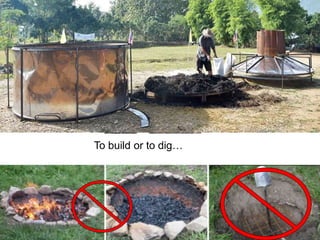
To build or to dig…
http://www.familiamission.org/blog/activated-biochar
To build or to dig…
LIGNIN
The complex amorphous organic component of
wood that acts as the binder between cells and
is responsible for its rigidity. It decomposes
very slowly by microbial action.
Wood that has been seasoned for 9-12 months still contains about 20-25% moisture, most of which is
wood resins. These resins play an important part in the three stages of wood combustion.
Wood that has been seasoned for 9-12 months still contains about 20-25% moisture, most of which is
wood resins. These resins play an important part in the three stages of wood combustion.
Stage 1 - the kindling fire warms up the fresh load of wood and any remaining water content is
removed by evaporation and vaporization.
Seasoned Wood
Wood that has been seasoned for 9-12 months still contains about 20-25% moisture, most of which is
wood resins. These resins play an important part in the three stages of wood combustion.
Stage 1 - the kindling fire warms up the fresh load of wood and any remaining water content is
removed by evaporation and vaporization.
Stage 2 - As the wood reaches 500 degrees the resins begin to break down chemically, and volatile
gases are released which squirt out through the wood fiber and ignite, boosting the temperature of the
fire to around 1,100 degrees and producing 50-60% of the heat value from that load of wood.
Seasoned Wood
Wood that has been seasoned for 9-12 months still contains about 20-25% moisture, most of which is
wood resins. These resins play an important part in the three stages of wood combustion.
Stage 1 - the kindling fire warms up the fresh load of wood and any remaining water content is
removed by evaporation and vaporization.
Stage 2 - As the wood reaches 500 degrees the resins begin to break down chemically, and volatile
gases are released which squirt out through the wood fiber and ignite, boosting the temperature of the
fire to around 1,100 degrees and producing 50-60% of the heat value from that load of wood.
Stage 3 - As the gases burn away, the flames finally attack the wood fiber itself, and extract the
remaining heat value through the process known as charcoaling.
Seasoned Wood
Heat + charcoal
More heat + ash
Wood that has been seasoned for 9-12 months still contains about 20-25% moisture, most of which is
wood resins. These resins play an important part in the three stages of wood combustion.
Stage 1 - the kindling fire warms up the fresh load of wood and any remaining water content is
removed by evaporation and vaporization.
Stage 2 - As the wood reaches 500 degrees the resins begin to break down chemically, and volatile
gases are released which squirt out through the wood fiber and ignite, boosting the temperature of the
fire to around 1,100 degrees and producing 50-60% of the heat value from that load of wood.
Stage 3 - As the gases burn away, the flames finally attack the wood fiber itself, and extract the
remaining heat value through the process known as charcoaling.
Seasoned Wood
Heat + charcoal
If your firewood has dried to the point where it has lost its resin content, your
fire will go directly from Stage 1 (warming up to combustion temperature) to
Stage 3 (charcoaling), skipping Stage 2 and missing out on 50-60% of the heat
(and burn time) you'd expect to get from that load of wood
A. C. A. P.
Biochar:
Activated
Charged
Aged
Piled (or bagged)
Pyrolysis is a thermochemical
decomposition of organic material
at elevated temperatures in the
absence of oxygen. It involves the
simultaneous change of chemical
composition and physical phase,
and is irreversible. The word is
coined from the Greek-derived
elements pyro "fire" and lysis
"separating".
Biochar is the result of
Pyrolysis
[fire – separating]
1792 England commercialized luminating gas manufactured from wood (Klark, 1925). 1812
Taylor showed that methyl alcohol was present in the liquid obtained from the
distillation of pyroligneous water (Klark, 1925).
1819 The first pyrolysis oven to transfer heat through its metal walls was designed by
Carl Reichenbach (Klark, 1925).
“A Dictionary Of Modern Gardening”, by George William Johnson, David
Landreth, 1847.
Charcoal Soot, a chief constituent of which is charcoal, has long been known
as a very effective fertilizer;
https://turkeysong.wordpress.com/2012/05/18/some-citations-on-biochar-in-europe-and-america-in-the-19th-century/
1835 Methyl alcohol, an isolated product of crude wood spirit, was discovered by Jean
Baptiste Andre Dumas and Eugene Peligot which confirmed Taylor’s ideas on the nature of
pyroligneous acid (Klark, 1925).
1850 Horizontal retorts (1 meter diameter, and 3 meters long) were used mainly by Germany,
England, and Austria, while the French were becoming more inclined to the use of vertical retorts
made portable by Robiquete (Klark, 1925).
1856 An increase in demand for methyl alcohol was a result of Sr. William H. Perkin’s patent on
aniline purple (Klark, 1925).
1864 The discovery of iodine increased the demand for wood spirits (Klark, 1925). 1870 Early
investigations performed by Tobias Lowitz resulted in a new, chemically
pure acetic acid (Klark, 1925).
The American wheat culturist: a practical treatise on the
culture of wheat … 1868
Charcoal Dust As A Fertilizer. Charcoal is composed almost
entirely of pure carbon; and when small fragments are exposed
to the influences of the weather, they undergo very little change
during a long term of years. Still the roots of growing plants will
lay hold of the small pieces of charcoal, and appropriate the
substance contained in the coal to the growth and development
of the stems, leaves, and seeds of grain, fruit, and vegetables.
Experienced chemists assure us, charcoal, and particularly
charcoal dust, has the power of attracting and fixing large
quantities of ammonia, a substance which enters largely into the
formation of useful plants, and of retaining this fertilizing material
when buried in the soil, until the fine fibres of the roots of growing
plants require it for promoting their growth.
https://turkeysong.wordpress.com/2012/05/18/some-citations-on-biochar-in-europe-and-america-in-the-19th-century/
1870 The rise of the celluloid industry and the manufacture of smokeless powder
increased the demand for acetone (Klark, 1925).
1880 The wood distillation industry began to expand (Klark, 1925).
1920-1950 The rise of the petroleum industry caused a decline in wood distillation (Klark,
1925).
1970 Oil Crisis gave rise to the need for alternative liquid fuels.
1970-90s Development of new pyrolysis reactors occurred side by side with the
understanding of the fundamentals of biomass pyrolysis reactions (Boroson et al., Bridgwater et al.,
1994; 1989 a, b; Evans et al., 1987 a, b; Mottocks, 1981, Piskortz et al., 1988a, b; Scott et al.,
1984, 1988).
Thai Charcoal Kiln
Charcoal As A Manure 1860………..
Liebig gives the results of a series of experiments by Lukas on
the use of charcoal as a manure, which seem to corroborate his
opinion. From the facts which these chemists, however, adduce,
it is evident that the beneficial action of charcoal, as a fertilizer,
depends upon the presence of other substances besides carbon.
Liebig notes (Organic Chem., p. 62) that “plants thrive in
powdered charcoal, and may be brought to blossom, and bear
fruit, if exposed to the influence of the rain and the atmosphere.
Plants do no not, however, attain maturity under ordinary
circumstances in charcoal powder when they are moistened with
pure distilled water instead of rain or river water. Rain water
must, therefore, contain within it one of the essentials of
vegetable life; and it has been shown that this is the presence of
a compound containing nitrogen; the exclusion of which entirely
deprives humus and charcoal of their influence on vegetation. It
is ammonia, to
https://turkeysong.wordpress.com/2012/05/18/some-citations-on-biochar-in-europe-and-america-in-the-19th-century/
Thai Charcoal Kiln
Clean Kiln
Designs
Top Fed Open Draft FC units
Clean contiki Designs
Appropriate Technology
Top Fed Open Draft FC units
Clean Kiln Designs
Top Fed Open Draft FC units
Clean Kiln Designs
Top Fed Open Draft FC units
Clean Kiln Designs
Clean Kiln Designs
Clean Kiln Designs
To build or to dig…
Top Light Up Draft
TLUD Pile
Lumber yard waste
Lumber yard waste
Clean Kiln Designs
Bent and bolted GI sheet
Top Fed Open Draft FC units
Clean Kiln Designs
Top Feed Metal Cone
Top Fed Open Draft FC units
Clean Kiln Designs
Top Feed Metal Cone
Top Fed Open Draft FC units
Clean Kiln Designs
Top Feed Metal Cone
Top Fed Open Draft FC units
Clean Kiln Designs
Top Feed Metal Cone
Top Fed Open Draft FC units
Clean Kiln Designs
Top Feed Metal Cone
Top Fed Open Draft FC units
Clean Kiln Designs
Top Feed Metal Cone
Top Fed Open Draft FC units
Clean Kiln Designs
Top Feed Metal Cone
Top Fed Open Draft FC units
Clean Kiln Designs
Top Feed Metal Cone
Top Fed Open Draft FC units
Clean Kiln Designs
Top Feed Metal Cone
Top Fed Open Draft FC units
Clean Kiln Designs
Top Feed Metal Cone
Top Fed Open Draft FC units
Clean Kiln Designs
Top Feed Metal Cone
Top Fed Open Draft FC units
Clean Kiln Designs
Top Feed Metal Cone
Top Fed Open Draft FC units
Clean Kiln Designs
Top Feed Metal Cone
Top Fed Open Draft FC units
T.L.U.D.
Top Light Up Draft
Peter Hirst's Conservation Burn technique
Appropriate Technology
T.L.O.B.
Top Light Open Burn
T.L.U.D.
Top Light Up DraftAppropriate Technology
Make Fuel Cube
H = L = W
T.L.U.D.
Top Light Up Draft
Wind baffle
T.L.U.D.
Top Light Up Draft
Water moisture removal
T.L.U.D.
Top Light Up Draft
T.L.U.D.
Top Light Up Draft
T.L.U.D.
Top Light Up Draft
T.L.U.D.
Top Light Up Draft
T.L.U.D.
Top Light Up Draft
Harvest
T.L.U.D.
Top Light UpDraft
Peter Hirst's Conservation Burn technique
Appropriate Technology
T.L.O.B.
Top Light Open Burn
Make Fuel Cube
H = L = W
T.L.U.D.
Top Light UpDraft
Peter Hirst's Conservation Burn technique
Details of this BioChar
Burn:
Material: young douglas
fir and ponderosa pine
saplings 2-5” in diameter
Moisture content:
estimated 20-50%. Sat
on ground for one year.
Date burned: May 4,
2014
Size of pile: about 5 feet
square cube, estimated
2000 lb
Biochar yield: about 60
gallons(8 cu ft)
http://www.technorcalnotes.com/biochar
Peter Hirst's Conservation Burn technique
Cut and carry goat feed
Legume trees and shrubs
Cut and carry goat feed
Low smoke, high yield:
1. Uniform diameter
2. Uniform length
3. Cubical (H = L = W)
4. Keep fire on top
Cut and carry goat feed
1
2
Cut and carry goat feed
T.L.U.D.
Top Light UpDraft
Conservation burn
T.L.O.B.
Top Light Open Burn
Peter Hirst's Conservation Burn technique
T.L.U.D.
Top Light UpDraft
Conservation burn
Very little smoke
T.L.O.B.
Top Light Open Burn
T.L.U.D.
Top Light UpDraft
Conservation burn
Very little smoke
T.L.O.B.
Top Light Open Burn
Still very little smoke
T.L.O.B.
Top Light Open Burn
Douse with water
T.L.O.B.
Top Light Open Burn
Charge with:
EME
FAA
Compost tea
W.S.C.
10:02 AM
TLOB
Migratory Pyrolytic Front (MPF)
10:13 AM
TLOB
Migratory Pyrolytic Front (MPF)
Pyrolysis @ 700º C
10:25 AM
TLOB
Migratory Pyrolytic Front (MPF)
Pyrolysis @ 700º C
10:32 AM
TLOB
Migratory Pyrolytic Front (MPF)
10:42 AM
TLOB
Activating with water
Pyrolysis @ 700º C
Charging with EM and compost tea
10:58 AM
Bagged and ready for raised beds
11:10 AM
1 cu M dead fall wood
280 L biochar
Add to soil
T.L.U.D.
Top Light UpDraft
Wigwam method for termite
infested wood cuts
Wigwam method for termite
infested wood cuts
Wigwam method for termite
infested wood cuts
Wigwam method for termite
infested wood cuts
Wigwam method for termite
infested wood cuts
Peter Hirst's Conservation Burn technique
1. Similar size materials
2. Top Light Up Draft
3. Proportional dimensions
High carbon
Crop residues
Top Light Up Draft
TLUD Cage
Migratory Pyrolytic Front (MPF)
Top Light Up Draft
TLUD Cage
High carbon
Crop residues
Migratory Pyrolytic Front (MPF)
Top Light Up Draft
TLUD Cage
Migratory Pyrolytic Front (MPF)
Top Light Up Draft
TLUD Cage
High carbon
Crop residues
Top Light Up Draft
TLUD Cage
High carbon
Crop residues
Top Light Up Draft
TLUD Cage
High carbon
Crop residues
You can pyrolize anything
What’s next?
Top Light Up Draft
TLUD Cage
Coco Husk
Top Light Up Draft
TLUD Cage
Coco Husk
Top Light Up Draft
TLUD Cage
Coco Husk
Top Light Up Draft
TLUD Cage
Coco Husk
Top Light Up Draft
TLUD Cage
Coco Husk
Top Light Up Draft
TLUD Cage
Coco Husk
Top Light Up Draft
TLUD Cage
Coco Husk
Top Light Up Draft
TLUD Cage
Coco Husk
Top Light Up Draft
TLUD Cage
Coco Husk
Top Light Up Draft
TLUD Cage
Coco Husk
Top Light Up Draft
TLUD Cage
Coco Husk
Top Light Up Draft
TLUD Cage
Coco Husk char
Explosion?
Accelerant?
Top light w/ newspaper
Brush char
Top Light Up Draft
TLUD Pile
Coconut leaves/waste
Top Light Up Draft
TLUD Pile
Bamboo waste
Top Light Up Draft
TLUD Pile
Roofing waste
Top Light Up Draft
TLUD Pile
Cut and carry waste
From goat farm
Traditional method:
The nightly Sweep n’ Smolder
1. Wasteful
2. Inefficient
3. Legal
Illegal Squatter Pile
1. Wasteful
2. Inefficient
3. Illegal
Traditional method:
Mound kiln
1. Wasteful
2. Inefficient
3. Labor intensive
4. Legal
Improved TLUD
Mound kiln
Improved TLUD
Mound kiln
Improved TLUD
Mound kiln
Improved TLUD
Mound kiln
Improved TLUD
Mound kiln
1. Wasteful
2. Inefficient
3. Legal
Landfill method
Top Light Up Draft
TLUD Pile
Lumber yard waste
Lumber yard waste
Top Light Up Draft
TLUD Pile
Clean kiln design
Top Light Up Draft
TLUD Pile
Clean kiln design
Fertilizer from lumber yard waste
Product Description
Fully automatic continuous waste tyre pyrolysis plant includes waste tire pretreatment
system, continuous pyrolysis system with continuous feeding and discharge system
controlled by PLC system. The main part is the continuous pyrolysis system.
Continuous waste tyre pyrolysis plant is for processing waste tires into fuel oil and
carbon black for recycle use. Due to continuous feeding and discharge system, the
continuous waste tyre pyrolysis plant can keep working without stop, thus to save
energy and time. Also PLC control system makes much less labor cost.
Raw material
The raw material which can produce fuel oil by our fully automatic continuous waste tyre
pyrolysis plant includes waste tire/tyre, waste plastic of PE, PP, PS, ABS, waste plastic
from paper mills, and rubber cable, big tires and small tires,etc.
Sustainable agriculture: the efficient conversion of land’s by-products back into food.
“Modern agriculture: the use of land to convert petroleum into food.”
Frankenfood
Biochar
Keith Mikkelson
Mik@mozcom.com
Terra Preta
Dark Earth
Amazonian Dark Earths
"Terra Preta de Indio"
Indian Black Earth is the local name for certain
dark earths in the Brazilian Amazon region.
Unknown methods of biochar production where
utilized via pyrolysis in the forest: some form of
“sustainable” slash and char developed huge areas
for food production.
These dark earths occur in several countries in
South America and Europe and Eastern USA. In
the Amazon it was created by pre-Columbian
Indians from 500 to 2500 years B.P. and
abandoned after the invasion of Europeans.
surcosqochasAmphitheater terraces:
SOUTH AMERICA
The sketch, of a small portion of the plateau, shows
how the qochas were linked to one another, through
an extensive network of canals. Twin circles are
'mother qochas'. (from: Erickson, 2000)
Micro Climates
Terra Preta
1. Typically, the ability of soils to retain cations
in an exchangeable and thus plant-available
form (cation exchange capacity [CEC])
increases in proportion to the amount of soil
organic matter
• Biochar has an even greater ability
than other soil organic matter to adsorb
cations per unit carbon due to its
greater surface area,
• greater negative surface charge
• greater charge density
2. Biochar appears to be able to strongly
adsorb phosphate, even though it is an
anion, although the mechanism for this
process is not fully understood.
3. These properties make biochar a unique
substance, retaining exchangeable and
therefore plant-available nutrients in the soil,
and offering the possibility of improving crop
yields while decreasing environmental
pollution by nutrients considerably
Radically transforms soils
I.R.R.I.
PhilRice
Pyrolysis is a
thermochemical
decomposition of
organic material at
elevated temperatures in
the absence of oxygen
(or any halogen). It
involves the simultaneous
change of chemical
composition and physical
phase, and is irreversible.
The word is coined from
the Greek-derived
elements pyro "fire" and
lysis "separating".
More CO and CO2 than biochar
Appropriate Technology?
Industrial Biochar
50% of 50% is virtually permanent carbon fixation
SiteRice Hull
 Open Area
 Not too windy
 Access for truck deliveries
 Exhaust won’t disturb people or livestock
4 Low Tech Methods to Making Biochar
1. Open Rice Hull (Ipa) Piles
2. Stoves
3. Furnace ovens
4. Drum
Fertilizer/Feed-Grain Terms
Grade Name Filipino Waste Source Carbon/Nitrogen
• [D4] Rice Hull Ipa, From high -
Labhang Dehusking carbon
• [D3] Crushed Rice Magaspang from beltway high carbon/
Hull some nitrogen
• [D2] Rice Bran Darak from cleaning some carbon/
some nitrogen
• [D1] Rice Bran Tiki Tiki from polishing high protein-
nitrogen
D1
for feed
$
$$
$$$
$$$$
D4
for uling
[D 2] is inferior to
[D1] but can be
supplemented with
more fish meal
Feed-Grain Selection
[D 1] [D 3]
[D 4][D 2]
Puting
Bigas –
white rice
Pinawa –
Unpolished
rice
[D 4]
[D 2]
Kanin –
white rice
Palay
PalaySmall
Mill
Large
Mill
Small Mill
Remedy
You can lose
many Pesos
without the
right feed
stock
Cooking charcoal
as a by-product
CRH Production
• Start core fire with
wood
CRH Production
• Start core fire with
wood
• Add rice hull to
smother
Vent
=
CRH Production
• Start core fire with
wood
• Add rice hull to
smother
• Watch for venting
CRH Production
• Start core fire with
wood
• Add rice hull to
smother
• Watch for venting
• Smother blackened
hulls
CRH Production
• Start core fire with
wood
• Add rice hull to
smother
• Watch for venting
• Smother blackened
hulls
Extinguish
HARVESTING
• Start core fire with
wood
• Add rice hull to
smother
• Watch for venting
• Smother blackened
hulls
• Harvest by spraying
water through pile
http://cru.cahe.wsu.edu/CEPublications/
FS147E/FS147E.pdf
Natural Rice Hull Vinegar
Rice hull vinegar
Production
Natural Rice
Hull Vinegar
Anaerobic
Waterless
harvest
Thai Charcoal Oven
Operation of Charcoal
Oven
14. Install bamboo pipe
with wet cloth
15. Collect vinegar
Congratulations!
Expect 20-22% recovery by weight
We know of no readily available in-field pyrolyzers that meet our specs.
Warm Heart offers two:
FU2: 3.4 m3 capacity, Type I or II feed stocks; moved and
assembled by 2 men; fits in small pickup with room for quenching
water tank and biochar; burn time corn stalk 15 minutes, cob 80
minutes; yield 18%
FU3 prototype: Actual will
have 7.7 m3 capacity,
assumed to be Type II only,
moved and assembled by
3 men; fits in pickup;
anticipated yield, 25%
Type II pyrolyzers
USES
• Potting soil
• Bokashi
• Soil amendment
• Livestock bedding
• Livestock feed
• Bokashi Bombs
(Mud Balls)
• Vermiculture
Feedstock
(They produce a
natural pelletized
Terra Preta)
Ancient Inoculation Method
Sustainable Agriculture
Inoculation Comparison
• Takes advanced
management and time
• No guarantee of results
• Cultures can have
contamination
• P 60/ backpack sprayer
• Simple management
• Little time
• Guaranteed results
• Cultures will be pure
• P 1/ backpack sprayer
• Potting soil
Soil Blocks
•Save space
•Minimize transplant shock
Potting House
Universal Mix
1/4 Soil
1/4 Sand
1/4 Vermicast
1/4 Uling na ipa
Soil
amendment
• Bokashi
BOKASHI:
Fermented Rice Hull Charcoal
(EM, Kitchen Waste, etc)
Vermiculture Feedstock
(They produce a natural
pelletized Terra Preta)
Vermicast close up
Vermiculture: The African
Night crawler produces a
natural pelletized Terra Preta
 Open Area
 Not to windy
 Access for truck deliveries
 Exhaust won’t disturb
people or livestock
Low Tech Methods for Making Biochar
Metal Needed Method
1 Drum Drum
2 GI or tin cans Stoves
3 GI Sheet/steel plates Metal cone - Clean Kiln Designs
4 Drums/GI Furnace/ ovens/ retorts
5 Steel matting Top Light Up Draft Cage [TLUD]
6 Optional Open Rice Hull (Ipa) Piles
7 None Peter Hirst's Conservation Burn technique [Also TLUD]

Biochar 3

  • 1.
    Biochar is theresult of Pyrolysis [fire – separating]
  • 2.
    Open Area  Notto windy  Access for truck deliveries  Exhaust won’t disturb people or livestock Low Tech Methods for Making Biochar Metal Needed Method 1 Drum Drum 2 GI or tin cans Stoves- gasifier/rocket 3 GI Sheet/steel plates Metal cone - Clean Kiln Designs -FC flame cap / flame curtain (FC) -Top Fed Open Draft FC units 4 Drums/GI Furnace/ ovens/ retorts 5 Steel matting/cage Top Light Up Draft Cage [TLUD] 6 Optional Open Rice Hull (Ipa) Piles 7 None Peter Hirst's Conservation Burn technique [Also TLUD]
  • 3.
    Terra Preta Dark Earth AmazonianDark Earths "Terra Preta de Indio" Indian Black Earth is the local name for certain dark earths in the Brazilian Amazon region. Unknown methods of biochar production where utilized via pyrolysis in the forest: some form of “sustainable” slash and char developed huge areas for food production. These dark earths occur in several countries in South America and Europe and Eastern USA. In the Amazon it was created by pre-Columbian Indians from 500 to 2500 years B.P. and abandoned after the invasion of Europeans.
  • 8.
    1658 Johann RudolfGlauber confirmed that the acid contained in pyroligneous water was the same acid contained in vinegar (Emrich, 1985; Klark, 1925). 1661 The separation of a spirituous liquid from volatile products of wood distillation was described by Robert Boyle (Klark, 1925).
  • 9.
    To build orto dig…
  • 10.
  • 11.
    To build orto dig…
  • 12.
    LIGNIN The complex amorphousorganic component of wood that acts as the binder between cells and is responsible for its rigidity. It decomposes very slowly by microbial action.
  • 13.
    Wood that hasbeen seasoned for 9-12 months still contains about 20-25% moisture, most of which is wood resins. These resins play an important part in the three stages of wood combustion.
  • 14.
    Wood that hasbeen seasoned for 9-12 months still contains about 20-25% moisture, most of which is wood resins. These resins play an important part in the three stages of wood combustion. Stage 1 - the kindling fire warms up the fresh load of wood and any remaining water content is removed by evaporation and vaporization. Seasoned Wood
  • 15.
    Wood that hasbeen seasoned for 9-12 months still contains about 20-25% moisture, most of which is wood resins. These resins play an important part in the three stages of wood combustion. Stage 1 - the kindling fire warms up the fresh load of wood and any remaining water content is removed by evaporation and vaporization. Stage 2 - As the wood reaches 500 degrees the resins begin to break down chemically, and volatile gases are released which squirt out through the wood fiber and ignite, boosting the temperature of the fire to around 1,100 degrees and producing 50-60% of the heat value from that load of wood. Seasoned Wood
  • 16.
    Wood that hasbeen seasoned for 9-12 months still contains about 20-25% moisture, most of which is wood resins. These resins play an important part in the three stages of wood combustion. Stage 1 - the kindling fire warms up the fresh load of wood and any remaining water content is removed by evaporation and vaporization. Stage 2 - As the wood reaches 500 degrees the resins begin to break down chemically, and volatile gases are released which squirt out through the wood fiber and ignite, boosting the temperature of the fire to around 1,100 degrees and producing 50-60% of the heat value from that load of wood. Stage 3 - As the gases burn away, the flames finally attack the wood fiber itself, and extract the remaining heat value through the process known as charcoaling. Seasoned Wood Heat + charcoal More heat + ash
  • 17.
    Wood that hasbeen seasoned for 9-12 months still contains about 20-25% moisture, most of which is wood resins. These resins play an important part in the three stages of wood combustion. Stage 1 - the kindling fire warms up the fresh load of wood and any remaining water content is removed by evaporation and vaporization. Stage 2 - As the wood reaches 500 degrees the resins begin to break down chemically, and volatile gases are released which squirt out through the wood fiber and ignite, boosting the temperature of the fire to around 1,100 degrees and producing 50-60% of the heat value from that load of wood. Stage 3 - As the gases burn away, the flames finally attack the wood fiber itself, and extract the remaining heat value through the process known as charcoaling. Seasoned Wood Heat + charcoal
  • 18.
    If your firewoodhas dried to the point where it has lost its resin content, your fire will go directly from Stage 1 (warming up to combustion temperature) to Stage 3 (charcoaling), skipping Stage 2 and missing out on 50-60% of the heat (and burn time) you'd expect to get from that load of wood
  • 19.
    A. C. A.P. Biochar: Activated Charged Aged Piled (or bagged)
  • 20.
    Pyrolysis is athermochemical decomposition of organic material at elevated temperatures in the absence of oxygen. It involves the simultaneous change of chemical composition and physical phase, and is irreversible. The word is coined from the Greek-derived elements pyro "fire" and lysis "separating". Biochar is the result of Pyrolysis [fire – separating]
  • 21.
    1792 England commercializedluminating gas manufactured from wood (Klark, 1925). 1812 Taylor showed that methyl alcohol was present in the liquid obtained from the distillation of pyroligneous water (Klark, 1925). 1819 The first pyrolysis oven to transfer heat through its metal walls was designed by Carl Reichenbach (Klark, 1925).
  • 22.
    “A Dictionary OfModern Gardening”, by George William Johnson, David Landreth, 1847. Charcoal Soot, a chief constituent of which is charcoal, has long been known as a very effective fertilizer; https://turkeysong.wordpress.com/2012/05/18/some-citations-on-biochar-in-europe-and-america-in-the-19th-century/
  • 23.
  • 24.
    1835 Methyl alcohol,an isolated product of crude wood spirit, was discovered by Jean Baptiste Andre Dumas and Eugene Peligot which confirmed Taylor’s ideas on the nature of pyroligneous acid (Klark, 1925). 1850 Horizontal retorts (1 meter diameter, and 3 meters long) were used mainly by Germany, England, and Austria, while the French were becoming more inclined to the use of vertical retorts made portable by Robiquete (Klark, 1925). 1856 An increase in demand for methyl alcohol was a result of Sr. William H. Perkin’s patent on aniline purple (Klark, 1925). 1864 The discovery of iodine increased the demand for wood spirits (Klark, 1925). 1870 Early investigations performed by Tobias Lowitz resulted in a new, chemically pure acetic acid (Klark, 1925).
  • 25.
    The American wheatculturist: a practical treatise on the culture of wheat … 1868 Charcoal Dust As A Fertilizer. Charcoal is composed almost entirely of pure carbon; and when small fragments are exposed to the influences of the weather, they undergo very little change during a long term of years. Still the roots of growing plants will lay hold of the small pieces of charcoal, and appropriate the substance contained in the coal to the growth and development of the stems, leaves, and seeds of grain, fruit, and vegetables. Experienced chemists assure us, charcoal, and particularly charcoal dust, has the power of attracting and fixing large quantities of ammonia, a substance which enters largely into the formation of useful plants, and of retaining this fertilizing material when buried in the soil, until the fine fibres of the roots of growing plants require it for promoting their growth. https://turkeysong.wordpress.com/2012/05/18/some-citations-on-biochar-in-europe-and-america-in-the-19th-century/
  • 26.
    1870 The riseof the celluloid industry and the manufacture of smokeless powder increased the demand for acetone (Klark, 1925). 1880 The wood distillation industry began to expand (Klark, 1925). 1920-1950 The rise of the petroleum industry caused a decline in wood distillation (Klark, 1925). 1970 Oil Crisis gave rise to the need for alternative liquid fuels. 1970-90s Development of new pyrolysis reactors occurred side by side with the understanding of the fundamentals of biomass pyrolysis reactions (Boroson et al., Bridgwater et al., 1994; 1989 a, b; Evans et al., 1987 a, b; Mottocks, 1981, Piskortz et al., 1988a, b; Scott et al., 1984, 1988).
  • 27.
    Thai Charcoal Kiln CharcoalAs A Manure 1860……….. Liebig gives the results of a series of experiments by Lukas on the use of charcoal as a manure, which seem to corroborate his opinion. From the facts which these chemists, however, adduce, it is evident that the beneficial action of charcoal, as a fertilizer, depends upon the presence of other substances besides carbon. Liebig notes (Organic Chem., p. 62) that “plants thrive in powdered charcoal, and may be brought to blossom, and bear fruit, if exposed to the influence of the rain and the atmosphere. Plants do no not, however, attain maturity under ordinary circumstances in charcoal powder when they are moistened with pure distilled water instead of rain or river water. Rain water must, therefore, contain within it one of the essentials of vegetable life; and it has been shown that this is the presence of a compound containing nitrogen; the exclusion of which entirely deprives humus and charcoal of their influence on vegetation. It is ammonia, to https://turkeysong.wordpress.com/2012/05/18/some-citations-on-biochar-in-europe-and-america-in-the-19th-century/
  • 28.
  • 29.
    Clean Kiln Designs Top FedOpen Draft FC units
  • 30.
    Clean contiki Designs AppropriateTechnology Top Fed Open Draft FC units
  • 31.
    Clean Kiln Designs TopFed Open Draft FC units
  • 32.
    Clean Kiln Designs TopFed Open Draft FC units
  • 33.
  • 34.
  • 35.
  • 37.
    To build orto dig…
  • 38.
    Top Light UpDraft TLUD Pile Lumber yard waste
  • 39.
  • 40.
    Clean Kiln Designs Bentand bolted GI sheet Top Fed Open Draft FC units
  • 41.
    Clean Kiln Designs TopFeed Metal Cone Top Fed Open Draft FC units
  • 42.
    Clean Kiln Designs TopFeed Metal Cone Top Fed Open Draft FC units
  • 43.
    Clean Kiln Designs TopFeed Metal Cone Top Fed Open Draft FC units
  • 44.
    Clean Kiln Designs TopFeed Metal Cone Top Fed Open Draft FC units
  • 45.
    Clean Kiln Designs TopFeed Metal Cone Top Fed Open Draft FC units
  • 46.
    Clean Kiln Designs TopFeed Metal Cone Top Fed Open Draft FC units
  • 47.
    Clean Kiln Designs TopFeed Metal Cone Top Fed Open Draft FC units
  • 48.
    Clean Kiln Designs TopFeed Metal Cone Top Fed Open Draft FC units
  • 49.
    Clean Kiln Designs TopFeed Metal Cone Top Fed Open Draft FC units
  • 50.
    Clean Kiln Designs TopFeed Metal Cone Top Fed Open Draft FC units
  • 51.
    Clean Kiln Designs TopFeed Metal Cone Top Fed Open Draft FC units
  • 52.
    Clean Kiln Designs TopFeed Metal Cone Top Fed Open Draft FC units
  • 53.
    Clean Kiln Designs TopFeed Metal Cone Top Fed Open Draft FC units
  • 54.
    T.L.U.D. Top Light UpDraft Peter Hirst's Conservation Burn technique Appropriate Technology T.L.O.B. Top Light Open Burn
  • 55.
    T.L.U.D. Top Light UpDraftAppropriate Technology Make Fuel Cube H = L = W
  • 56.
    T.L.U.D. Top Light UpDraft Wind baffle
  • 57.
    T.L.U.D. Top Light UpDraft Water moisture removal
  • 58.
  • 59.
  • 60.
  • 61.
  • 62.
    T.L.U.D. Top Light UpDraft Harvest
  • 63.
    T.L.U.D. Top Light UpDraft PeterHirst's Conservation Burn technique Appropriate Technology T.L.O.B. Top Light Open Burn Make Fuel Cube H = L = W
  • 64.
    T.L.U.D. Top Light UpDraft PeterHirst's Conservation Burn technique
  • 66.
    Details of thisBioChar Burn: Material: young douglas fir and ponderosa pine saplings 2-5” in diameter Moisture content: estimated 20-50%. Sat on ground for one year. Date burned: May 4, 2014 Size of pile: about 5 feet square cube, estimated 2000 lb Biochar yield: about 60 gallons(8 cu ft) http://www.technorcalnotes.com/biochar Peter Hirst's Conservation Burn technique
  • 67.
    Cut and carrygoat feed Legume trees and shrubs
  • 68.
    Cut and carrygoat feed
  • 69.
    Cut and carrygoat feed
  • 70.
    Cut and carrygoat feed
  • 71.
    Cut and carrygoat feed
  • 72.
    Cut and carrygoat feed
  • 73.
    Cut and carrygoat feed Low smoke, high yield: 1. Uniform diameter 2. Uniform length 3. Cubical (H = L = W) 4. Keep fire on top
  • 74.
    Cut and carrygoat feed
  • 75.
  • 76.
    Cut and carrygoat feed
  • 77.
    T.L.U.D. Top Light UpDraft Conservationburn T.L.O.B. Top Light Open Burn
  • 78.
    Peter Hirst's ConservationBurn technique T.L.U.D. Top Light UpDraft Conservation burn Very little smoke T.L.O.B. Top Light Open Burn
  • 79.
    T.L.U.D. Top Light UpDraft Conservationburn Very little smoke T.L.O.B. Top Light Open Burn
  • 80.
    Still very littlesmoke T.L.O.B. Top Light Open Burn
  • 81.
  • 82.
  • 83.
  • 84.
  • 85.
    Pyrolysis @ 700ºC 10:25 AM TLOB Migratory Pyrolytic Front (MPF)
  • 86.
    Pyrolysis @ 700ºC 10:32 AM TLOB Migratory Pyrolytic Front (MPF)
  • 87.
  • 88.
  • 89.
    Charging with EMand compost tea 10:58 AM
  • 90.
    Bagged and readyfor raised beds 11:10 AM 1 cu M dead fall wood 280 L biochar
  • 91.
  • 92.
  • 93.
    Wigwam method fortermite infested wood cuts
  • 94.
    Wigwam method fortermite infested wood cuts
  • 95.
    Wigwam method fortermite infested wood cuts
  • 96.
    Wigwam method fortermite infested wood cuts
  • 97.
    Wigwam method fortermite infested wood cuts
  • 98.
    Peter Hirst's ConservationBurn technique 1. Similar size materials 2. Top Light Up Draft 3. Proportional dimensions
  • 99.
  • 100.
    Top Light UpDraft TLUD Cage Migratory Pyrolytic Front (MPF)
  • 101.
    Top Light UpDraft TLUD Cage High carbon Crop residues Migratory Pyrolytic Front (MPF)
  • 102.
    Top Light UpDraft TLUD Cage Migratory Pyrolytic Front (MPF)
  • 103.
    Top Light UpDraft TLUD Cage High carbon Crop residues
  • 104.
    Top Light UpDraft TLUD Cage High carbon Crop residues
  • 105.
    Top Light UpDraft TLUD Cage High carbon Crop residues
  • 106.
  • 107.
  • 109.
    Top Light UpDraft TLUD Cage Coco Husk
  • 110.
    Top Light UpDraft TLUD Cage Coco Husk
  • 111.
    Top Light UpDraft TLUD Cage Coco Husk
  • 112.
    Top Light UpDraft TLUD Cage Coco Husk
  • 113.
    Top Light UpDraft TLUD Cage Coco Husk
  • 114.
    Top Light UpDraft TLUD Cage Coco Husk
  • 115.
    Top Light UpDraft TLUD Cage Coco Husk
  • 116.
    Top Light UpDraft TLUD Cage Coco Husk
  • 117.
    Top Light UpDraft TLUD Cage Coco Husk
  • 118.
    Top Light UpDraft TLUD Cage Coco Husk
  • 119.
    Top Light UpDraft TLUD Cage Coco Husk
  • 120.
    Top Light UpDraft TLUD Cage Coco Husk char
  • 121.
  • 122.
    Top light w/newspaper
  • 123.
  • 124.
    Top Light UpDraft TLUD Pile Coconut leaves/waste
  • 125.
  • 126.
    Top Light UpDraft TLUD Pile Bamboo waste
  • 127.
    Top Light UpDraft TLUD Pile Roofing waste
  • 128.
    Top Light UpDraft TLUD Pile Cut and carry waste From goat farm
  • 129.
    Traditional method: The nightlySweep n’ Smolder 1. Wasteful 2. Inefficient 3. Legal
  • 130.
    Illegal Squatter Pile 1.Wasteful 2. Inefficient 3. Illegal
  • 131.
    Traditional method: Mound kiln 1.Wasteful 2. Inefficient 3. Labor intensive 4. Legal
  • 132.
  • 133.
  • 134.
  • 135.
  • 136.
  • 137.
    1. Wasteful 2. Inefficient 3.Legal Landfill method
  • 138.
    Top Light UpDraft TLUD Pile Lumber yard waste
  • 139.
  • 140.
    Top Light UpDraft TLUD Pile Clean kiln design
  • 141.
    Top Light UpDraft TLUD Pile Clean kiln design
  • 142.
  • 143.
    Product Description Fully automaticcontinuous waste tyre pyrolysis plant includes waste tire pretreatment system, continuous pyrolysis system with continuous feeding and discharge system controlled by PLC system. The main part is the continuous pyrolysis system. Continuous waste tyre pyrolysis plant is for processing waste tires into fuel oil and carbon black for recycle use. Due to continuous feeding and discharge system, the continuous waste tyre pyrolysis plant can keep working without stop, thus to save energy and time. Also PLC control system makes much less labor cost. Raw material The raw material which can produce fuel oil by our fully automatic continuous waste tyre pyrolysis plant includes waste tire/tyre, waste plastic of PE, PP, PS, ABS, waste plastic from paper mills, and rubber cable, big tires and small tires,etc.
  • 146.
    Sustainable agriculture: theefficient conversion of land’s by-products back into food.
  • 147.
    “Modern agriculture: theuse of land to convert petroleum into food.”
  • 148.
  • 150.
  • 151.
    Terra Preta Dark Earth AmazonianDark Earths "Terra Preta de Indio" Indian Black Earth is the local name for certain dark earths in the Brazilian Amazon region. Unknown methods of biochar production where utilized via pyrolysis in the forest: some form of “sustainable” slash and char developed huge areas for food production. These dark earths occur in several countries in South America and Europe and Eastern USA. In the Amazon it was created by pre-Columbian Indians from 500 to 2500 years B.P. and abandoned after the invasion of Europeans.
  • 156.
  • 157.
    The sketch, ofa small portion of the plateau, shows how the qochas were linked to one another, through an extensive network of canals. Twin circles are 'mother qochas'. (from: Erickson, 2000)
  • 158.
  • 160.
    Terra Preta 1. Typically,the ability of soils to retain cations in an exchangeable and thus plant-available form (cation exchange capacity [CEC]) increases in proportion to the amount of soil organic matter • Biochar has an even greater ability than other soil organic matter to adsorb cations per unit carbon due to its greater surface area, • greater negative surface charge • greater charge density 2. Biochar appears to be able to strongly adsorb phosphate, even though it is an anion, although the mechanism for this process is not fully understood. 3. These properties make biochar a unique substance, retaining exchangeable and therefore plant-available nutrients in the soil, and offering the possibility of improving crop yields while decreasing environmental pollution by nutrients considerably Radically transforms soils I.R.R.I. PhilRice
  • 162.
    Pyrolysis is a thermochemical decompositionof organic material at elevated temperatures in the absence of oxygen (or any halogen). It involves the simultaneous change of chemical composition and physical phase, and is irreversible. The word is coined from the Greek-derived elements pyro "fire" and lysis "separating".
  • 163.
    More CO andCO2 than biochar Appropriate Technology?
  • 164.
    Industrial Biochar 50% of50% is virtually permanent carbon fixation
  • 165.
    SiteRice Hull  OpenArea  Not too windy  Access for truck deliveries  Exhaust won’t disturb people or livestock 4 Low Tech Methods to Making Biochar 1. Open Rice Hull (Ipa) Piles 2. Stoves 3. Furnace ovens 4. Drum
  • 166.
    Fertilizer/Feed-Grain Terms Grade NameFilipino Waste Source Carbon/Nitrogen • [D4] Rice Hull Ipa, From high - Labhang Dehusking carbon • [D3] Crushed Rice Magaspang from beltway high carbon/ Hull some nitrogen • [D2] Rice Bran Darak from cleaning some carbon/ some nitrogen • [D1] Rice Bran Tiki Tiki from polishing high protein- nitrogen D1 for feed $ $$ $$$ $$$$ D4 for uling
  • 168.
    [D 2] isinferior to [D1] but can be supplemented with more fish meal Feed-Grain Selection [D 1] [D 3] [D 4][D 2] Puting Bigas – white rice Pinawa – Unpolished rice [D 4] [D 2] Kanin – white rice Palay PalaySmall Mill Large Mill Small Mill Remedy You can lose many Pesos without the right feed stock
  • 169.
  • 170.
    CRH Production • Startcore fire with wood
  • 171.
    CRH Production • Startcore fire with wood • Add rice hull to smother
  • 174.
  • 175.
  • 176.
    CRH Production • Startcore fire with wood • Add rice hull to smother • Watch for venting
  • 180.
    CRH Production • Startcore fire with wood • Add rice hull to smother • Watch for venting • Smother blackened hulls
  • 181.
    CRH Production • Startcore fire with wood • Add rice hull to smother • Watch for venting • Smother blackened hulls
  • 182.
  • 184.
    HARVESTING • Start corefire with wood • Add rice hull to smother • Watch for venting • Smother blackened hulls • Harvest by spraying water through pile
  • 190.
  • 196.
  • 197.
  • 198.
  • 212.
  • 216.
  • 217.
    Operation of Charcoal Oven 14.Install bamboo pipe with wet cloth 15. Collect vinegar
  • 218.
  • 220.
    We know ofno readily available in-field pyrolyzers that meet our specs. Warm Heart offers two: FU2: 3.4 m3 capacity, Type I or II feed stocks; moved and assembled by 2 men; fits in small pickup with room for quenching water tank and biochar; burn time corn stalk 15 minutes, cob 80 minutes; yield 18% FU3 prototype: Actual will have 7.7 m3 capacity, assumed to be Type II only, moved and assembled by 3 men; fits in pickup; anticipated yield, 25% Type II pyrolyzers
  • 221.
    USES • Potting soil •Bokashi • Soil amendment • Livestock bedding • Livestock feed • Bokashi Bombs (Mud Balls) • Vermiculture Feedstock (They produce a natural pelletized Terra Preta)
  • 222.
  • 223.
    Inoculation Comparison • Takesadvanced management and time • No guarantee of results • Cultures can have contamination • P 60/ backpack sprayer • Simple management • Little time • Guaranteed results • Cultures will be pure • P 1/ backpack sprayer
  • 224.
  • 230.
  • 246.
  • 248.
    Universal Mix 1/4 Soil 1/4Sand 1/4 Vermicast 1/4 Uling na ipa
  • 249.
  • 251.
  • 252.
    BOKASHI: Fermented Rice HullCharcoal (EM, Kitchen Waste, etc)
  • 253.
    Vermiculture Feedstock (They producea natural pelletized Terra Preta)
  • 255.
    Vermicast close up Vermiculture:The African Night crawler produces a natural pelletized Terra Preta
  • 256.
     Open Area Not to windy  Access for truck deliveries  Exhaust won’t disturb people or livestock Low Tech Methods for Making Biochar Metal Needed Method 1 Drum Drum 2 GI or tin cans Stoves 3 GI Sheet/steel plates Metal cone - Clean Kiln Designs 4 Drums/GI Furnace/ ovens/ retorts 5 Steel matting Top Light Up Draft Cage [TLUD] 6 Optional Open Rice Hull (Ipa) Piles 7 None Peter Hirst's Conservation Burn technique [Also TLUD]