~ There is still time to avoid the worst impacts of climate change, if we take strong action now. ~
                                                                                          Sir Nicholas Stern


SUMMERLAND’S COMMUNITY
CLIMATE ACTION PLAN


                Prepared by Development Services, District of Summerland
                                                  Julie McGuire, Planner
                                                          March 24, 2011
Acknowledgements

This Plan was sponsored by the District of Summerland.


District of Summerland Mayor and Council
       Mayor Janice Perrino
       Councillor Lloyd Christopherson
       Councillor Gordon Clark
       Councillor Sam Elia
       Councillor Bruce Hallquist
       Councillor Jim Kyluik
       Councillor Ken Roberge


Climate Action Advisory Group
       Andrea Agur
       Bill Atkinson
       Deborah Cavel-Greant
       Don Hudgeon
       Eric Gerritts
       Kathryn McCourt
       Margaret Holler
       Perry Feser
       Sherri Macdonald


District of Summerland Staff
       Ian McIntosh
       Allan Mann
       Dawn Boothe
       Don De Gagne
       Dave Hill
       Don Darling
       Scott Lee
       Mike Fetterer
       Suzie Kedge
       Glenn Noble
SUMMERLAND’S COMMUNITY

    CLIMATE ACTION PLAN


   EXECUTIVE SUMMARY                                                                               March 2011


              WHY TAKE ACTION ON CLIMATE CHANGE?
Climate Change
Climate change is a major challenge facing our society. Climate change is a measurable long-term shift in climate that
can be caused by natural processes and human activity. The build-up of greenhouse gas (GHG) emissions in the atmos-
phere from the burning of fossil fuels is a major contributor to climate change. In BC’s interior, between the years
1895 and 1995, average annual temperature warmed by 1.1°C . Climate Change IS occurring and expected to continue
over this century with economic, social, and environmental impacts. Additionally, the reliance on fossil fuels is com-
promising the environment through increasing greenhouse gas emissions and energy security through rising energy
costs. How these challenges are currently addressed by all levels of government and individuals will determine the
ease with which their impacts are felt.

Provincial Legislation
The Government of British Columbia is committed to addressing climate change and to reducing greenhouse gas emis-
sions. This commitment was demonstrated by introducing Bill 44: Greenhouse Gas Reduction Targets Act (2007). Bill 44
commits the Provincial Government to a province-wide reduction of GHG emissions below 2007 levels of 33% by 2020
and 80% by 2050.
Nearly half of GHG emissions are under the influence of B.C. local governments and so the Province enacted Bill 27
requiring all local governments to include greenhouse gas reduction targets within their Official Community Plans and
Regional Growth Strategies .


Summerland’s OCP targets for the reduction of GHG emissions are:
                                                                                   33%                     80%
    33% below 2007 levels by 2020; and
    80% below 2007 levels by 2050.
                                                                                   2020                    2050
SUMMERLAND’S COMMUNITY CLIMATE ACTION PLAN

                          WHERE DOES SUMMERLAND STAND?
 The Province of British Columbia prepared community energy and emissions inventories for each local government
 in BC for 2007. Having baseline data from 2007 will help Summerland measure progress towards reducing carbon
 emissions. An energy and emissions assessment also shows how much energy we are using, the source, and resulting
 greenhouse gas emissions.

                                                                                                           Summerland’s Source of GHG
                       Summerland’s Source of Energy, 2007
                                                                                                               Emissions, 2007

     Gasoline                                                                         525 MJ (37.8%)

  Natural Gas                                                    374 MJ (26.9%)
                                                                                                               Solid Waste
    Electricity                                                351 MJ (25.3%)                                   14,678 t        Buildings
                                                                                                                   19%          20,178 t
   Diesel Fuel                    87 MJ (6.3%)
                                                                                                                                  26%
        Wood             35 MJ 2.6%

     Propane          7 MJ 0.5%
                                                                                                                       On Road
   Other Fuel         5 MJ 0.3%                                                                                     Transportation
   Heating Oil        4 MJ 0.3%                                                                                        42,225 t
                                                                                                                         55%
                  0           100            200      300        400            500          600
                                            Energy in Megajoules (MJ)


    2007 Baseline for Summerland                                                           Buildings: The amount of electricity and
                                                                                           natural gas delivered to Summerland by major
          1,388,595 Gigajoules (GJ) of energy Used
                                                                                           utility companies in British Columbia, not
          77,081 tonnes of CO2e emitted                                                    exclusively for buildings.
          $32.9 Million spent on energy in the                                             On-road Transportation: The amount of fuel
          community or $2,992 per person                                                   used by on-road vehicles registered, from
                                                                                           ICBC, in Summerland.
   The Challenge that lies ahead                                                           Solid Waste: The amount of solid waste
To reach the emissions reductions tar-                                                     disposed of at the landfill in Summerland.
gets in the OCP, by 2020 Summerland
   must be removing at least 25,437
 tonnes of CO2e from the atmosphere
per year and work up to 61,665 tonnes
         CO2e yearly by 2050.
                                                                                                            33%
Business as Usual is based on current
energy consumption data and a pro-
jected population growth rate of 1%.                                                                                                        80%
SUMMERLAND’S COMMUNITY CLIMATE ACTION PLAN

                         HOW WILL WE TAKE CLIMATE ACTION?
Goal 1: Minimize urban sprawl and promote compact, energy-                                     Goal 4: Identify and support effective greenhouse gas reduction initi-
        efficient development with access to amenities within walking                                  atives.
        and cycling distance.                                                                    Promote the Canada Post Red Dot Campaign to reduce junk mail.
  Support the trading of ALR land within 800 metres or about a 10 minute walk of down-           Encourage anaerobic digestion opportunities for orchards, wineries & breweries.
  town with land in the periphery if additional development land is required.                    Consider hosting a District-wide garage sale to encourage reuse and recycling.
  Review Official Community Plan and Land Use Map to limit urban sprawl and promote
  smart growth. This may include guiding growth in nodes and along corridors and in              Work with the private sector to increase the diversion of construction and demolition
  areas where there is municipal sewer. Refine the UGA (urban growth area).                      materials from the landfill.
  Increase densities in the 1999 Zoning Bylaw.                                                   Work with the business community to reduce the use of plastic bags and increase the
                                                                                                 use of cloth bags for purchases.
  Prepare a sustainable development checklist to be used during the development appli-
  cation process.                                                                                Investigate alternative ways to charge for garbage. This may include implementing a
                                                                                                 one-bag limit on garbage or going from a flat-rate system to a pay-per-use system.
  Consider reviewing the Development Cost Charges Bylaw, Fees and Charges Bylaw, and
  the Procedures Bylaw to ensure that the regulations are promoting energy-efficient,            Consider disseminating recycling/waste bins throughout the community. These bins
  compact development and not urban sprawl.                                                      separate garbage and recycling and are placed in public areas like downtown, parks,
                                                                                                 arenas, etc.
  Consider Investigating changes to the Fees & Charges Bylaw regarding the electric
  heating installation charge.                                                                   Research the feasibility of a Municipal RE-USE IT location where people can bring build-
                                                                                                 ing materials that have reuse value.
  Review the suitability of creating a development permit area (DPA) for sustainable
  development.                                                                                   Consider providing glass pick-up or recycling if it is viable. Even if it is just a bin some-
                                                                                                 where or pick-up once a month.
  Consider preparing a Downtown Plan that includes opportunities for sustainability.
                                                                                                 Investigate a commercial recycling program for Summerland businesses.
  Consider preparing a Transit Plan with maps of proposed routes and coordinated with
  growth nodes and corridors.
  Consider rewriting the Official Community Plan to integrate land use, transportation,        Goal 5: Promote energy conservation and dissemination of renewa-
  and energy planning into one document.                                                               ble energy technologies.
  Development Services staff will provide current sustainability information and promote         Consider implementing a time-of-use energy consumption education program and
  incentive programs to people who make inquiries and/or take a Building Permit Appli-           make home energy monitors available to customers, for a limited time to educate them
  cation.                                                                                        on usage.
  Consider exploring an incentive based permit fee where fees decrease as sustainability         Consider new technologies and/or partnerships that reduce peak energy demand,
  features increase.                                                                             generate renewable energy, or reduce energy consumption.
  Request a Home Energy Audit with applications for new buildings or major renovations.          Consider regulations for wind turbines in the Zoning Bylaw.
  This home energy rating will be put into the Municipal system (GIS database) attached
  to the property.                                                                               Consider a program that makes Smart Meters available to customers who are either
                                                                                                 interested in producing on-site renewable energy or interested in time-of-use data.
  Support the continuation of the Green Cents program, or equivalent, and its evolution          Also make available a guide outlining the standards and procedures.
  to provide "green certification" for businesses to show their sustainability initiatives
  while reducing greenhouse gas emissions.                                                       Investigate opportunities for alternative renewable energy generation
                                                                                                 (geothermal, wind farms, micro-hydro on creeks).
  Encourage individual metering of utilities in multi-unit residences.
                                                                                                 Investigate opportunities for district energy and/or lake cooling.
                                                                                                 Consider preparing a Plan to move towards a Smart Grid.

                                                                                               Goal 6: Maintain and enhance the urban ecosystem.
                                                                                                 Support the creation of a local food map like a tourist map that locates local food
                                                                                                 suppliers such as local fruit, wine, eggs, chickens, etc.
Goal 2: Improve transportation efficiency.                                                       Support Municipally owned vacant lots to be used for community gardens.
  Support private transit options.                                                               Review policy and regulations to ensure parking lots are landscaped to provide shade
  Lobby BC Transit for better transit service and consider regional partnerships to im-          and permeability.
  prove transit service.                                                                         Consider adding street trees as a requirement in the Subdivision and Development
  Improve pedestrian and cycling infrastructure. This includes more multi-use trails that        Bylaw.
  are connected to a trail network. All collector road re-construction should consider the       Consider preparing a Tree Preservation Bylaw.
  inclusion of bicycle lanes and sidewalks.
  Provide information on transportation alternatives (electric assist bicycles) and com-
  municate the lifestyle and financial benefits of public transit and active transportation.   Goal 7: Demonstrate Municipal leadership.
  Encourage strata buildings to provide co-op vehicles to allow for parking reductions.          Consider updating the community travel survey at regular intervals. This information
  Investigate the construction of a multi-use trail between Lower Town and Trout Creek.          will provide more accurate travel data for Summerland.
  Consider providing adequate and accessible bicycle parking at all Municipal facilities.        Consider mapping Summerland's urban forest and identify tree planting locations in the
  Support a bicycle co-op; organizations where volunteers teach people how to ride, fix,         municipality.
  and build bicycles for free or cost recovery.                                                  Based on the District of Summerland's yearly operational carbon footprint and the
  Promote amenities for electric vehicles and micro vehicles.                                    dollar amount equal to the prevailing market value of a tonne of carbon will be set
                                                                                                 aside in the annual budgeting process to buy carbon offsets or for inclusion in the
  Consider developing a strategy for electric vehicle charging stations (pay per kWh) in         Climate Action Fund.
  core areas of Summerland.                                                                      All newly constructed, municipally owned and operated buildings, shall be at least 25
  Support a regional carpool initiative.                                                         percent more energy efficient than those built to Provincial building codes.
  Support and participate in Bike to Work Week and Car-Free Day programs.                        Promote the ideas of "Carbon-neutral Vacations" or "Eco-Tourism" in Summerland
  Consider providing anti-idling signage for the downtown core.                                  through the Chamber of Commerce.
  Consider a pilot project that follows the transportation habits of a few families in Sum-      Support incentives to bring new green businesses to the community.
  merland over one month. Then provide them with tools like carpool.ca and motor                 Encourage industrial businesses to cooperate in sharing resources to reduce waste and
  assist bicycles for one month and see if they were able to reduce their vehicle use.           pollution.
  Provide "Smart-Driver" tips to residents to help them reduce their fuel consumption            Consider implementing a rain barrel program to be rolled out with the first metered
  and GHG emissions.                                                                             water bill.
                                                                                                 Encourage greywater recycling and rainwater harvesting in new developments.
Goal 3: Support public participation, education and awareness initia-                            Provide educational material on Xeriscaping and eco-lawn (or lawn alternatives).
        tives.
                                                                                                 Support initiatives that improve air quality such as increasing our urban forest, lowering
  Consider posting sustainability information on the District of Summerland website.             transportation emissions and improving and reducing all wood burning practices.
  Consider preparing a Communications Plan to address education and outreach for                 Review and enforce outdoor burning regulations.
  Summerland's Climate Action Plan.
  Form a Climate Action Working Group to work with staff to increase community aware-
  ness and aide in Plan implementation.
  Consider collaborating with the RDOS to develop a Sustainable South Okanagan Web-
  site with information, blog, and possibly a re-use trading site.
  Support the offering of a xeriscaping course.
  Support the offering of water conservation and/or drip irrigation courses.
SUMMERLAND’S COMMUNITY CLIMATE ACTION PLAN

                                            WHAT’S NEXT?

Implementation and Monitoring
                                       Form a Climate Action Working Group
Responsibilities of this working group will include:
   Actively promoting Summerland’s Community Climate Action Plan within the community through participation,
   education, and awareness initiatives;
   Ensuring that the goals within the Plan are met through implementing the actions; and
   Reporting annually on the progress of the actions within the Plan;

                                       District of Summerland Responsibility
   The District of Summerland will appoint a staff member to be responsible for coordinating the implementation of
   the Community Climate Action Plan.

                                      Integration into Planning and Budgeting
   Actions will be identified for inclusion into the District’s annual budget and priorities planning process.

                                                   Monitor Progress
A fundamental component of the Community Climate Action Plan is to enable the District of Summerland to assess the
progress of the community towards the defined targets to reduce GHG emissions. Indicators will help determine if the
actions that have been implemented are moving the District towards or away from the goals within the Plan and if
changes are needed. The Plan has a list of suggested indicators to monitor progress.

                                                       Reporting
   It is proposed that a brief annual progress report be prepared by the Climate Action Working Group to monitor
   progress of the implementation of the CCAP.
   It is recommended that Summerland community energy and emissions data be analyzed every four years starting
   with the 2010 collection year. The in-depth reporting every four years will reduce the amount of work associated
   with compiling data on an annual basis.

                                                        Funding
   The District of Summerland has limited monetary resources available which limits the incentives that can be of-
   fered for residents to take climate action.
   It is expected that the District of Summerland will be able to provide staff and program administration resources,
   while other organizations will have to be relied on to provide funding incentives. Partnerships and cost sharing ini-
   tiatives can build relationships and reduce costs to achieve the most from implementing the Community Climate
   Action Plan.

                                                               For Information Contact:

                                                               Julie McGuire, BA, MSc. Pl.     13211 Henry Avenue
                                                               Planner                         Box 159
                                                               jmcguire@summerland.ca          Summerland, BC V0H 1Z0
                                                               250-404-4049                    www.summerland.ca
Table of Contents
1     Introduction ........................................................................................................................ 1
    1.1    Climate Change ........................................................................................................... 1
    1.2    Benefits of Climate Action Planning ............................................................................. 1
       1.2.1         Environmental ....................................................................................................................... 2
       1.2.2         Economic ............................................................................................................................... 2
       1.2.3         Social ..................................................................................................................................... 2
  1.3  Plan Development........................................................................................................ 2
  1.4  Community Engagement.............................................................................................. 3
  1.5  Objectives of the Climate Action Plan .......................................................................... 3
  1.6  Plan Organization ........................................................................................................ 3
2   Summerland Context .......................................................................................................... 4
  2.1  Climate ........................................................................................................................ 4
  2.2  Energy Security ........................................................................................................... 5
  2.3  Population and Dwellings ............................................................................................. 6
  2.4  Open Air Burning ......................................................................................................... 7
  2.5  Provincial Direction ...................................................................................................... 8
  2.6  Regional Climate Action Planning ................................................................................ 9
  2.7  Local Climate Action Planning ....................................................................................10
3   Baseline Energy and GHG Emissions ...............................................................................12
  3.1  Energy Consumption ..................................................................................................12
  3.2  Greenhouse Gas Emissions .......................................................................................13
       3.2.1         District of Summerland Energy & GHG Emissions Profile .................................................. 14
    3.3   Simple Growth Forecast..............................................................................................15
4     Taking Climate Action .......................................................................................................16
    4.1   Plan Goals to Address Climate Change ......................................................................16
    4.2   Initiatives and Actions .................................................................................................16
       4.2.1    Goal 1: Minimize urban sprawl and promote compact, energy-efficient development with
       access to amenities within walking and cycling distance. .................................................................. 18
       4.2.2    Goal 2: Improve transportation efficiency. .......................................................................... 21
       4.2.3    Goal 3: Support public participation, education and awareness initiatives. ........................ 24
       4.2.4    Goal 4: Identify and support effective greenhouse gas reduction initiatives. ...................... 26
       4.2.5    Goal 5: Promote energy conservation and dissemination of renewable energy
       technologies. ...................................................................................................................................... 28
       4.2.6    Goal 6: Maintain and enhance the urban ecosystem.......................................................... 30
       4.2.7    Goal 7: Demonstrate Municipal leadership. ........................................................................ 32
5     Implementation and Monitoring .........................................................................................35
    5.1   Administration .............................................................................................................35
       5.1.1         Climate Action Working Group ............................................................................................ 35
       5.1.2         Support from District of Summerland Staff ......................................................................... 35
       5.1.3         Integration into Planning and Budgeting ............................................................................. 35
    5.2      Monitoring and Reporting ............................................................................................36
       5.2.1         Annual Reporting................................................................................................................. 37
       5.2.2         Four Year Reporting ............................................................................................................ 37
    5.3      Funding.......................................................................................................................38
       5.3.1         Partnerships ........................................................................................................................ 38
  5.4  Implementation Timeline .............................................................................................39
6   Appendix ...........................................................................................................................40
  6.1  Appendix A: FortisBC Estimated Rate Increases ........................................................40
List of Figures
Figure 1: Location of the District of Summerland. ....................................................................... 4
Figure 2: Comparison of Business-as-usual to GHG Emissions Reduction Targets for
Summerland. ............................................................................................................................11
Figure 3: Greenhouse Gas Emissions (tCO2e) by Sector for the District of Summerland (2007)
.................................................................................................................................................13
Figure 4: Percentage of Energy Use (MJ) for the District of Summerland (2007) ......................13
Figure 5: Simple Growth Forecast for GHG emissions for the District of Summerland by Sector
2007 to 2030. ............................................................................................................................15


List of Tables
Table 1: Range of predicted changes in winter and summer temperature and precipitation by
2050 for the Central Interior in British Columbia. ........................................................................ 4
Table 2: Population and Dwelling Type within the District of Summerland (1996, 2006, 2010). .. 7
Table 3: Open Air Burning Statistics for the District of Summerland January 2010 to December
2010........................................................................................................................................... 7
Table 4: Six Growth Management Goals in the South Okanagan Regional Growth Strategy. .... 9
Table 5: Eight Regional Strategies in the South Okanagan Similkameen Regional Community
Climate Action Plan. ..................................................................................................................10
Table 6: Energy Use and GHG Emissions by Energy Type, 2007. ............................................12
Table 7: Energy Use and GHG Emissions for the District of Summerland, 2007. (BC, 2010) ....14
Table 8: Suggested Indicators for Monitoring progress of the CCAP. ........................................36
Table 9: Programs Available to Support Climate Action. ...........................................................38
Table 10: CCAP Implementation Timeline to 2012 ....................................................................39
Summerland’s Community Climate Action Plan                                                                   Page | 1


       1 Introduction
       1.1 CLIMATE CHANGE
       Climate Change is a significant challenge facing our society. Climate change is a measurable
       long-term shift in climate that can be caused by natural processes and human activity. A major
       concern is the build-up of greenhouse gas (GHG) emissions in the atmosphere from the burning
       of fossil fuels. Fossil fuels are a non-renewable resource and reserves are being depleted. Peak
       Oil is a concept of a point in time when the rate of global petroleum extraction reaches a peak
       and starts to decline. With petroleum production declining and demand for petroleum increasing,
       the end of cheap fossil fuels is at hand. Climate Change is occurring and expected to continue
       over this century with economic, social, and environmental impacts. Additionally, the reliance on
       fossil fuels is compromising the environment through increasing greenhouse gas emissions and
       energy security through rising energy costs. How these challenges are currently addressed by
       all levels of government and individuals will determine the ease with which their impacts are felt.
       There are two aspects of climate change that local
       governments need to address. The first is the
       amount of greenhouse gas emissions they generate
       that contributes to climate change. The second is to
       adapt to the changes in climate due to high levels of
       GHG emissions in the atmosphere. Some of the
       anticipated impacts due to climate change are heat
       waves, drought, intense precipitation, and extreme
       weather events that may result in flash floods, forest
       fires, and reduced water quality. Municipalities need
       to adjust policies and take action to reduce GHG                               Photo by: F. Martens
       emissions and the negative impacts of climate
       change.
       A review of Summerland’s Official Community Plan (2008) identified a key community direction
       to set clear limits to growth and reduce the reliance on the automobile1. This shows support for
       community action to reduce greenhouse gas emissions. The District of Summerland is taking
       action through planning initiatives and collaboration with neighbouring local governments. In
       addition to reducing greenhouse gas emissions, climate action will also make Summerland a
       more liveable and economically stable community.

       1.2 BENEFITS OF CLIMATE ACTION PLANNING
       A local government is responsible for providing an environmentally, economically, and socially
       sustainable community for current and future residents. Choices made now will determine future
       costs and benefits to a community. Investing in Climate Action Planning will set the roadmap for
       future decision-making and lead the way to a more sustainable community. The benefits of
       Climate Action Planning are outlined below.


       1
           District of Summerland. 2008. Official Community Plan. Section 4.2.1.
Page | 2                                                                         Summerland’s Community Climate Action Plan


           1.2.1    Environmental
           ―Energy efficiency and renewable energy result in reduced GHG emissions, improved air
           quality, and healthier ecosystems‖2.

           1.2.2    Economic
           Aside from being good for the environment,
           investing    in    energy-efficient  technologies,
           renewable energy, sustainable transportation, and
           waste reduction technologies can boost the local
           economy and significantly reduce energy costs.
           Also, reducing dependence on fossil fuels can help
           when energy prices soar and if there are brown or
           black-outs with energy supply.
                                                                                                               Photo by: L. Vinnedge

           1.2.3    Social
           A Community Climate Action Plan will recommend actions to address the built environment
           through more compact, walkable, and energy-efficient development. Actions may include
           adopting zoning practices that regulate land use patterns and built forms that increase densities
           and reduce urban sprawl. This type of sustainable development can have multiple benefits to a
           community. Sustainable development can reduce automobile dependence, increase walkability,
           and decrease energy use which improves quality of life.
           There are also health benefits associated with sustainable development such as improved air
           quality and health due to a more active lifestyle.

           1.3 PLAN DEVELOPMENT
           Summerland’s Climate Action Plan was initiated in 2009 with a Council decision to hire a
           Climate Action Planner. The District of Summerland, Development Services Department,
           coordinated the Climate Action Planning initiative with input from a Climate Action Advisory
           Group comprised of community stakeholders. The Climate Action Plan is a multi-year project
           expected to be complete in 2011.
           The planning process consisted of the following steps:
               1. Analyzed data provided by the Province of British Columbia to establish the 2007
                  baseline energy and emissions for Summerland.
               2. Prepared an update to the Official Community Plan to establish goals for climate action,
                  greenhouse gas emissions reduction targets, and policies based on feedback from the
                  public and staff.
               3. Prepared a Community Climate Action Plan outlining baseline data, goals, targets,
                  actions to reduce community greenhouse gas emissions, and an implementation and
                  monitoring strategy.
               4. Will continue to monitor energy and emissions data and report reduction achievements
                  as well as amend the Community Climate Action Plan periodically to keep it current.


           2
            Community Energy Association (CEA). (2008, September). Community energy & emissions planning: A guide for B.C. local
           governments. p. 3. Retrieved January 12, 2010, from the Community Energy Association Web site:
           http://www.communityenergy.bc.ca/resources/cea-publications-0.
Summerland’s Community Climate Action Plan                                                               Page | 3


       1.4 COMMUNITY ENGAGEMENT
       The District of Summerland provided opportunities for public involvement in the preparation of
       Summerland’s Community Climate Action Plan. Public involvement included the following:
              An initial open house to provide information and gain feedback on greenhouse gas
              emissions targets for Summerland (May 6, 2010).
              A Community Climate Action Plan Newsletter
              (Delivered in first week of July 2010).
              An open house to provide information and gain
              feedback on proposed Official Community Plan
              changes to address climate change (July 15,
              2010).
              A Climate Action Advisory Group was formed
              (first meeting September 16, 2010).
              The Climate Action Workshop #1 was held to
              discuss and analyze specific actions to reduce
              greenhouse gas emissions (November 10, 2010).
              The Climate Action Workshop #2 was held to screen and prioritize specific actions
              (December 7, 2010).
              An open house was held to gain feedback on the draft Community Climate Action Plan
              for Summerland (March 9, 2011).
              Council Statutory Public Hearing (2011).

       1.5 OBJECTIVES OF THE CLIMATE ACTION PLAN
       The overall objective of Summerland’s Community Climate Action Plan is to provide a roadmap
       to achieve the greenhouse gas emissions reduction targets set out in the Official Community
       Plan. The Province of British Columbia provided 2007 baseline data in a Community Energy
       and Emissions Inventory (CEEI) Report. In this CEEI report for Summerland, GHG emissions
       were broken out into the following sectors: buildings, on-road transportation, and solid waste.
       Therefore, the focus of this Plan is to reduce greenhouse gas emissions from these three
       sectors.

       1.6 PLAN ORGANIZATION
       Summerland’s Community Climate Action Plan is organized into five sections:
       Section 1: Introduction explains the issue of climate change and the need for climate action
                   planning.
       Section 2: Summerland Context examines Summerland’s climate, energy, statistics, and
                  direction from different levels of government.
       Section 3: Baseline Energy and GHG Emissions provides energy consumption and
                  greenhouse gas (GHG) emissions data as well as a simple growth forecast.
       Section 4: Taking Climate Action specifies goals, initiatives, and actions including action
                  timelines and department responsibility.
       Section 5: Implementation and Monitoring outlines steps to move forward once the Plan has
                   been adopted.
Page | 4                                                                           Summerland’s Community Climate Action Plan


           2 Summerland Context
           The District of Summerland is located within the Regional District of Okanagan Similkameen on
           the south-western shore of Okanagan Lake (see Figure 1). Summerland has a total area of
           approximately 7442 hectares (18,389 acres)3. The population of the District of Summerland was
           11,007 people in 20104.


                                           Figure 1: Location of the District of Summerland.

           2.1 CLIMATE
           The climate in British Columbia has changed over the last hundred years and effects are
           evident in the Okanagan Valley. British Columbia’s average annual temperature, between the
           years 1895 and 1995, warmed by 0.6ºC at the coast, 1.1°C in the interior and 1.7°C in the
           north5. In southern BC, precipitation has increased by 2 to 4 percent per decade between 1929
           and 19986. Climate models are predicting warmer, wetter winters and hotter, dryer summers
           with an increase in total annual water supply (See Table 1). What this may mean for
           Summerland is less snow, more rain, flooding and the need for stormwater management in the
           spring and drought and increased water demand in the summer.
           Table 1: Range of predicted changes in winter and summer temperature and precipitation by 2050
           for the Central Interior in British Columbia.7
           BC Location                  Temperature Change by 2050 (ºC)                      Precipitation Change by 2050 (%)
                                            Winter           Summer                             Winter              Summer
           Central Interior           0.5 to 4.5 warmer 1.5 to 3.5 warmer                   0 to 30 wetter        -20 to 0 drier


           3
             District of Summerland. 2008. Official Community Plan. Section 2.2.
           4
             BC Stats. http://www.bcstats.gov.bc.ca/.
           5
             British Columbia Ministry of Environment. Climate Change: Provincial Impacts. Website accessed December 23, 2010.
           http://www.env.gov.bc.ca/cas/impacts/bc.html.
           6
             Ibid.
           7
             British Columbia Ministry of Environment. British Columbia Coast and Marine Environment Project 2006: Climate Change.
           Accessed online December 24, 2010 at
           http://www.env.gov.bc.ca/soe/indicators/bcce_temp/03_climate_change/technical_paper/climate_change.pdf.
Summerland’s Community Climate Action Plan                                                                                            Page | 5


       In addition to BC’s changing climate, the current BC population is projected to increase to
       6.1 million by 20368. This population growth and accompanying activity will place additional
       demands on the quality and supply of water. Small changes in climate can have significant
       ecological, social, and economic consequences. This has already been seen with the mountain
       pine beetle infestation in interior BC.
       All local governments in British Columbia face obstacles adapting to the impacts of climate
       change and the challenge of reaching Provincial greenhouse gas emissions reduction targets.
       The District of Summerland is a small municipality within the Regional District of Okanagan
       Similkameen. Although small, this municipality recognizes the significant impact they can make
       to reduce their contributions to climate change.

       2.2 ENERGY SECURITY
       As a society, we are dependent on fossil fuels to maintain our way of life. How we heat and cool
       our homes, how we travel between destinations, the products we use, and the food we eat all
       require fossil fuels in some way. When world demand for oil surpasses supply, prices start to
       increase for virtually everything. This phenomenon is inevitable and our dependence on fossil
       fuels makes us vulnerable to fluctuating energy prices.
       Fluctuations in energy markets since 2007 have made it difficult to forecast our energy future.
       Various sources forecast varying demands, supplies, and prices of energy. The following
       sources for information are from respected organizations:
                ―World primary energy demand is projected to increase by 1.5% per year between 2007
                and 2030...an overall increase of 40%.‖9
                Output from existing oil fields will drop by almost two-thirds by 2030, requiring
                investment in new fields, unconventional oil, and natural gas liquids.10
                Oil prices are assumed to reach $100 per barrel by 2020 and $115 per barrel by 2030 (in
                year-2008) dollars.11
                ―Natural gas consumption worldwide increases by 44 percent‖ between 2007 and 2035.
                Natural Gas supplies should keep markets
                well supplied and prices low.12
                FortisBC estimates that rate increases
                between the years 2012 and 2016 will be
                more than 35 percent.13 If the District of
                Summerland increases electricity prices at the
                same rate, residents could be paying
                12.75 cents/kWh by 2016. These rate
                increases are estimates and are based on the
                need for future infrastructure upgrades and
                expansion.
                                                                                                                Photo by: S. Reimer


       8
         BC Stats. http://www.bcstats.gov.bc.ca/
       9
         International Energy Agency. World Energy Outlook Executive Summary 2009. p. 4.
       10
          International Energy Agency. World Energy Outlook 2009. Presentation to the press. Slide 6.
       http://www.iea.org/speech/2009/Tanaka/WEO2009_Press_Conference.pdf.
       11
          International Energy Agency. World Energy Outlook Executive Summary 2009. p. 6.
       12
          US Energy Information Association. International Energy Outlook 2010. p. 3.
       13
          FortisBC. Feb 2011. FortisBC Integrated System Plan. Presentation from Public Open House. Slide 22.
Page | 6                                                                          Summerland’s Community Climate Action Plan


                    ―Falling energy investment will have far-reaching and depending on how governments
                    respond, potentially serious consequences for energy security, climate change, and
                    energy poverty.‖14
           In 2007, Summerland residents and businesses spent over $32 million on energy. Much of this
           money leaves our local economy and goes to Fortis, Terasen, and big oil companies. If
           Summerland doesn’t switch to more efficient vehicle and building technologies, improve public
           transit, and reduce urban sprawl, energy spending could double by 2030.
           FortisBC provides bulk electrical power to Summerland Power for distribution which allows the
           District to pass cost benefits to customers. However, the District of Summerland is at the mercy
           of FortisBC regarding rate increases. Money paid to FortisBC is money leaving the community
           and going to a utility company as well as the provincial and federal governments in the form of
           taxes. By investing in energy conservation, energy efficiency, or local renewable energy
           projects, Summerland may have more independence and security from energy price shocks or
           supply shortages. Also, money saved or spent in the community will remain in the community
           and stimulate the local economy.
           Investing in renewable energy could reduce Summerland’s vulnerability to energy instability and
           boost the economy. There are numerous economic benefits to investing in renewable energy.
           ―Given rapidly rising interest in energy alternatives,
           future years may well see worldwide employment
           soar—possibly as high as 2.1 million [jobs] in wind
           energy and 6.3 million [jobs] in solar PVs15 by
           2030, and on the order of 12 million jobs in
           biofuels-related agriculture and industry.‖16 By
           investing in technology to reduce dependence on
           fossil fuel and electricity from Fortis, Summerland
           could reduce vulnerability to the fluctuations in
           energy prices. Also, the local economy would see
           a boost with the creation of jobs directly or
           indirectly related to the green economy.

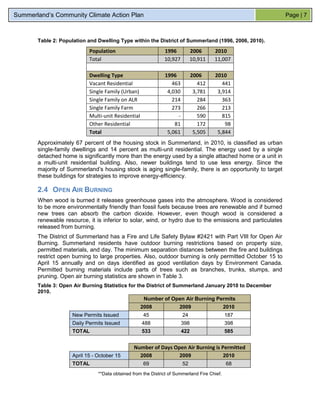
           2.3 POPULATION AND DWELLINGS
           Between 1996 and 2010, population growth for the Regional
           District of Okanagan-Similkameen (RDOS) was 5.3 percent.
           Summerland’s population growth between 1996 and 2010 was
           0.73 percent17 (see Table 2). British Columbia Statistics estimate
           that the Regional District of Okanagan-Similkameen (RDOS) will
           experience an annual population growth rate of between 0.1 and
           0.6 percent to 203618. There are no data projecting
           Summerland’s population change to 2036; however the
           Regional Community Climate Action Plan uses a 1 percent
           growth rate for Summerland in regional calculations.


           14
              International Energy Agency. World Energy Outlook Executive Summary 2009. p. 5.
           15
              Photovoltaics.
           16
              Worldwatch Institute. Green Jobs: Towards decent work in a sustainable, low carbon world. UNEP/ILO/IOE/ITUC, September
           2008.
           17
              BC Stats. Regional Population Estimates and Projections. http://www.bcstats.gov.bc.ca. Accessed January 25, 2011.
           18
              BC Stats. Regional Population Estimates and Projections. http://www.bcstats.gov.bc.ca. Accessed January 25, 2011.
Summerland’s Community Climate Action Plan                                                                 Page | 7


       Table 2: Population and Dwelling Type within the District of Summerland (1996, 2006, 2010).

                           Population                         1996          2006      2010
                           Total                              10,927        10,911    11,007

                           Dwelling Type                      1996           2006     2010
                           Vacant Residential                    463            412      441
                           Single Family (Urban)               4,030          3,781    3,914
                           Single Family on ALR                  214            284      363
                           Single Family Farm                    273            266      213
                           Multi-unit Residential                  -            590      815
                           Other Residential                      81            172       98
                           Total                               5,061          5,505    5,844
       Approximately 67 percent of the housing stock in Summerland, in 2010, is classified as urban
       single-family dwellings and 14 percent as multi-unit residential. The energy used by a single
       detached home is significantly more than the energy used by a single attached home or a unit in
       a multi-unit residential building. Also, newer buildings tend to use less energy. Since the
       majority of Summerland’s housing stock is aging single-family, there is an opportunity to target
       these buildings for strategies to improve energy-efficiency.

       2.4 OPEN AIR BURNING
       When wood is burned it releases greenhouse gases into the atmosphere. Wood is considered
       to be more environmentally friendly than fossil fuels because trees are renewable and if burned
       new trees can absorb the carbon dioxide. However, even though wood is considered a
       renewable resource, it is inferior to solar, wind, or hydro due to the emissions and particulates
       released from burning.
       The District of Summerland has a Fire and Life Safety Bylaw #2421 with Part VIII for Open Air
       Burning. Summerland residents have outdoor burning restrictions based on property size,
       permitted materials, and day. The minimum separation distances between the fire and buildings
       restrict open burning to large properties. Also, outdoor burning is only permitted October 15 to
       April 15 annually and on days identified as good ventilation days by Environment Canada.
       Permitted burning materials include parts of trees such as branches, trunks, stumps, and
       pruning. Open air burning statistics are shown in Table 3.
       Table 3: Open Air Burning Statistics for the District of Summerland January 2010 to December
       2010.
                                                   Number of Open Air Burning Permits
                                                    2008             2009                    2010
                    New Permits Issued              45                 24                    187
                    Daily Permits Issued            488                398                   398
                    TOTAL                           533                422                   585


                                                Number of Days Open Air Burning is Permitted
                    April 15 - October 15           2008             2009                    2010
                    TOTAL                           69                 52                    68
                               **Data obtained from the District of Summerland Fire Chief.
Page | 8                                                                       Summerland’s Community Climate Action Plan


           2.5 PROVINCIAL DIRECTION
           The Government of British Columbia is committed to addressing climate change and to reducing
           greenhouse gas emissions. This commitment was demonstrated by introducing Bill 44:
           Greenhouse Gas Reduction Targets Act (2007). The Greenhouse Gas Reduction Targets Act
           (2007) commits the Provincial Government to a province-wide reduction of GHG emissions
           below 2007 levels by 33 per cent by 2020 and 80 per cent by 2050. The Community Energy
           Association reports an estimate that nearly half of GHG emissions are under the influence of
           B.C. local governments and therefore they will play a major role in achieving Provincial GHG
           reduction goals19.
           To help achieve the Provincial reduction targets, the BC Government passed a number of
           significant plans and policies. Some of these include:
                    Bill 27 (2008), Local Government (Green Communities) Statutes Amendment Act.
                    This legislation led to amendments in the Local Government Act (LGA) requiring local
                    governments to include greenhouse gas reduction targets within their Official Community
                    Plans and Regional Growth Strategies20.
                    Climate Action Charter. This Charter is a voluntary measure acknowledging the major
                    role that Municipalities play in reducing Provincial greenhouse gas emissions. Signing on
                    the Climate Action Charter commits each municipality to21:
                         o   measure and report their community GHG emissions;
                         o   become carbon neutral in respect of their operations by 2012; and
                         o   create complete, compact, more energy efficient rural and urban communities.
                    BC Climate Action Plan. This Plan features key actions for every sector of the
                    economy to take the Province 73% of the way to meeting the 2020 emissions reduction
                    target of 33% below 2007 emissions levels.22
                    2008 Utilities Commission Amendment Act. This Act is to encourage more low-
                    carbon energy generation projects.
                    BC Building Code. The Greening of the BC Building code is an ongoing project to
                    improve energy performance of housing and reduce potable water consumption.
           If the Province needs to reduce GHG emissions below 2007 levels by 33 per cent by 2020 and
           80 per cent by 2050, they need to be aggressive and show leadership.


           19
              Community Energy Association. Community Energy and Emissions Planning: A Guide for B.C. Local Governments. September
           2008. p. 2.
           20
              See the Local Government Act (LGA) (1996) Section 877 (3) and Section 850 (2).
           21
              B.C. Climate Action Charter. (2009, October). Retrieved from
           http://www.cd.gov.bc.ca/ministry/whatsnew/climate_action_charter.htm
           22
              Province of British Columbia. Climate Action Plan. 2008.
Summerland’s Community Climate Action Plan                                                                     Page | 9


       2.6 REGIONAL CLIMATE ACTION PLANNING
       The Regional District Okanagan-Similkameen
       (RDOS) is responsible for many areas of planning
       that impact climate change such as growth
       management, transportation, waste management,
       and air quality. To maximize the benefit of actions to
       reduce greenhouse gas (GHG) emissions, it is
       important to build partnerships between the region
       and member municipalities. There are opportunities
       to share resources, leverage investments, and
       encourage regional consistencies which could result
                                                                                        Photo by: K. Carrier
       in increased public involvement.
       The South Okanagan Regional Growth Strategy
       (RGS), Bylaw 2421, 2007, has six growth management goals (See Table 4).
       Table 4: Six Growth Management Goals in the South Okanagan Regional Growth Strategy.
                  Six Growth Management Goals - South Okanagan Regional Growth Strategy
                   Goal 1    Promote sustainable economic diversification
                   Goal 2    Ensure the health of ecosystems
                   Goal 3    Promote inclusive and accountable governance
                   Goal 4    Carefully direct human settlement
                   Goal 5    Maximize the efficient use of infrastructure
                   Goal 6    Create safe, culturally diverse and healthy communities
       The Regional Growth Strategy (RGS) has policy to support climate action goals and initiatives
       set out in this Plan.
       Some policies under Goal 2 are:
              EN3. Reduce contribution to and increase adaptation to climate change.
              EN4. Protect regional air quality.
              EN5. Promote water sustainability through conservation and related best practices.
       Some policies under Goal 4 are:
              H1. Dialogue between rural and urban communities to direct development to Primary
              Growth Areas and, to a lesser extent, to Rural Growth Areas.
              H2. Promote compact urban form.
              H5. Recognize the critical link between infrastructure, environment, social conditions and
              human settlement for effective growth management.
       Some policies under Goal 5 are:
              I2. Preferentially direct development where public cost-efficient service and infrastructure
              is possible.
              I3. Recognize the critical link between water resource management, human settlement
              and effective growth management.
              I4. Minimize waste production through education, regulations that promote reduction and
              recycling programs in the region.
              I6. Increase transportation options, improve transportation efficiency and reduce
              automobile dependency.
Page | 10                                                                    Summerland’s Community Climate Action Plan


        The Regional District of Okanagan-Similkameen (RDOS), in partnership with Keremeos, Oliver,
        Osoyoos, Penticton, Princeton, and Summerland, developed a Regional Community Climate
        Action Plan. The South Okanagan Similkameen Regional Community Climate Action Plan has
        eight strategies to provide guidance on how to reduce regional energy use and greenhouse gas
        (GHG) emissions (See Table 5).
        Table 5: Eight Regional Strategies in the South Okanagan Similkameen Regional Community
        Climate Action Plan.
                                        Eight Regional Strategies (Regional CCAP)
                                Strategy 1   Build Energy Efficient Buildings
                                Strategy 2   Improve Energy Efficiency of Existing Buildings
                                Strategy 3   Increase Use of Alternative Energy
                                Strategy 4   Build Energy Efficient Developments
                                Strategy 5   Improve Alternative Transportation Amenities
                                Strategy 6   Promote More Efficient Vehicle Use
                                Strategy 7   Reduce & Divert Waste from Landfills
                                Strategy 8   Maximize Value from Agricultural Wastes
        Estimated greenhouse gas emissions in the RDOS for 2007 are 598,107 tonnes of carbon
        dioxide equivalent (tCO2e). With a population of 79,475 residents, this is about 7.5 tCO2e per
        person. The Regional target is a 15 percent reduction in GHG emissions from 2007 levels by
        203023.
        The RDOS and the District of Summerland will continue to work together towards the collective
        goal of reducing GHG emissions.

        2.7 LOCAL CLIMATE ACTION PLANNING
        In addition to Regional carbon emissions reduction target, the District of Summerland Official
        Community Plan (OCP), 2008, also sets targets for the reduction of GHG emissions. These
        targets are:
                 33 percent below 2007 levels by 2020; and
                 80 percent below 2007 levels by 2050.
        These targets have been set to match the targets adopted by the Government of British
        Columbia through Bill 44 – 2007 Greenhouse Gas Reductions Targets Act. Committing to
        reduce greenhouse gas emissions 33 percent below 2007 levels by 2020 is an aggressive
        target for Summerland, but was the target chosen through the public consultation process.
        To reach the emissions reductions targets, by 2020 Summerland must be removing at least
        27,437 tonnes of carbon dioxide equivalent (tCO2e) from the atmosphere per year and work up
        to 61,665 tCO2e yearly by 2050. The graph in Figure 2 illustrates the challenge that lies ahead
        to reduce greenhouse gas emissions significantly below 2007 levels. The red dashed line shows
        the 2007 baseline greenhouse gas emissions for Summerland of 77,081 tCO2e24. The blue line
        shows GHG emissions levels if no action is taken (business-as-usual), based on current energy
        consumption data and a projected population growth of one percent. The green line shows how
        much GHG emissions need to be reduced to reach our set targets.


        23
           Regional District Okanagan-Similkameen (RDOS). South Okanagan Similkameen Regional Community Climate Action Plan. Draft
        2011.
        24
           BC Ministry of Environment. Community Energy and Emissions Inventory: Reports. Summerland District Municipality Updated
        2007 Community Energy and Emissions Inventory. June 30, 2010. http://www.env.gov.bc.ca/cas/mitigation/ceei/reports.html.
Summerland’s Community Climate Action Plan                                                             Page | 11


       Figure 2: Comparison of Business-as-usual to GHG Emissions Reduction Targets for
       Summerland.
                                                        140,000
                                                        140,000


                     GHG Emissions Reductions (tCO2e)
                    GHG Emissions Reductions (tCO2e)
                                                        120,000
                                                        120,000
                                                        100,000
                                                        100,000
                                                         80,000
                                                         80,000
                                                         60,000
                                                         60,000
                                                         40,000      Business as Usual   33%
                                                         40,000      Business as Usual
                                                                     2007 Baseline
                                                         20,000      2007 Baseline
                                                         20,000      Reduction Targets
                                                                     Reduction Targets          80%
                                                             0
                                                             0
                                                              2007                       2020   2050
                                                              2007                       2020   2050
                                                                                         Year
                                                                                         Year
Page | 12                                                                        Summerland’s Community Climate Action Plan


        3 Baseline Energy and GHG Emissions
        This section summarizes the Summerland District Municipality Updated 2007 Community
        Energy and Emissions Inventory (June 30, 2010) compiled by the Province of British Columbia,
        Ministry of Environment.

        3.1 ENERGY CONSUMPTION
        Energy consumption within the District of Summerland, in 2007, was over 1.38 million gigajoules
        (GJ) (See Table 6). This energy consumption resulted in total emissions of 77,081 tonnes of
        carbon dioxide equivalent (tCO2e)25. For a 2007 population of 11,012, this is about 7 tonnes per
        person per year of greenhouse gas emissions. At current prices, this represents a spending of
        more than $32.9 million dollars annually or $2,992 dollars per person.
        Table 6: Energy Use and GHG Emissions by Energy Type, 2007.
                                                                                                  Estimated
                                                                   Energy           CO2e
                              Energy Type                                                          Energy
                                                                    (GJ)          (tonnes)
                                                                                                 Expenditures
                              Electricity                            351,457            659      $8,586,630.98
                              Natural Gas                            373,515        18,788       $5,668,494.78
                              Propane                                   7,107           434            $4,726.16
                              Wood                                    35,467              13            Unknown
                              Heating Oil                               4,029           284            $3,791.29
                              Gasoline                               525,223        35,881      $16,251,925.79
                              Diesel                                  86,964          6,151      $2,352,349.89
                              Other Transportation Fuel                 4,833           193          $83,891.08
                              Solid Waste                                           14,678              Unknown
                              Total                               1,388,595         77,081      $32,951,809.96
        Source: BC Ministry of Environment CEEI Reports, June 30, 2010 for Energy and CO2. Energy expenditures were calculated using
        2007 prices of fuel from the following websites: http://www.mjervin.com/ and
        http://www.terasengas.com/documents/ratestariffs/TerasenGasInc_RateReferenceGuide.pdf


        25
          All energy and GHG emissions data is calculated using both District and CEEI data. Province of BC. Ministry of Environment.
        Summerland District Municipality Updated 2007 Community Energy and Emissions Inventory (CEEI). June 30, 2010.
Summerland’s Community Climate Action Plan                                                                                              Page | 13


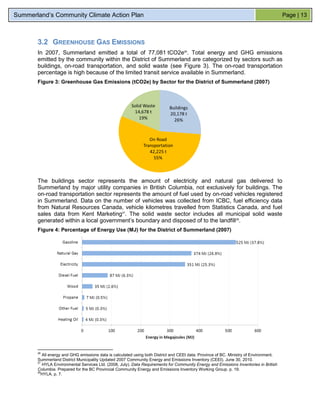
       3.2 GREENHOUSE GAS EMISSIONS
       In 2007, Summerland emitted a total of 77,081 tCO2e26. Total energy and GHG emissions
       emitted by the community within the District of Summerland are categorized by sectors such as
       buildings, on-road transportation, and solid waste (see Figure 3). The on-road transportation
       percentage is high because of the limited transit service available in Summerland.
       Figure 3: Greenhouse Gas Emissions (tCO2e) by Sector for the District of Summerland (2007)


       The buildings sector represents the amount of electricity and natural gas delivered to
       Summerland by major utility companies in British Columbia, not exclusively for buildings. The
       on-road transportation sector represents the amount of fuel used by on-road vehicles registered
       in Summerland. Data on the number of vehicles was collected from ICBC, fuel efficiency data
       from Natural Resources Canada, vehicle kilometres travelled from Statistics Canada, and fuel
       sales data from Kent Marketing27. The solid waste sector includes all municipal solid waste
       generated within a local government’s boundary and disposed of to the landfill28.
       Figure 4: Percentage of Energy Use (MJ) for the District of Summerland (2007)


       26
          All energy and GHG emissions data is calculated using both District and CEEI data. Province of BC. Ministry of Environment.
       Summerland District Municipality Updated 2007 Community Energy and Emissions Inventory (CEEI). June 30, 2010.
       27
          HYLA Environmental Services Ltd. (2008, July). Data Requirements for Community Energy and Emissions Inventories in British
       Columbia. Prepared for the BC Provincial Community Energy and Emissions Inventory Working Group. p. 19.
       28
         HYLA. p. 7.
Page | 14                                                                                              Summerland’s Community Climate Action Plan


        3.2.1             District of Summerland Energy & GHG Emissions Profile
        Table 7: Energy Use and GHG Emissions for the District of Summerland, 2007. (BC, 2010)2930

                                                                                                                                                          Estimated Energy
            Buildings                                         Type           Consumption        Unit        Energy (GJ) CO2e (t) Energy (%) CO2e(t) (%)
                                                                                                                                                            Expenditures

            Residential                            Electricity (BC Hydro)        3,675,902   kWh                 13,233        91                            $321,641.43
                                                   Electricity (DoS)            61,154,227   kWh                220,155       367                           $5,503,880.43
                                                   Natural Gas                     241,881   GJ                 241,881    12,167                           $2,646,178.14
                                                   Heating Oil                       4,029   GJ                   4,029       284                             $3,791.29
                                                   Propane                           7,107   GJ                   7,107       434                             $4,726.16
                                                   Wood                             35,467   GJ                  35,467        13
                                                                                                                521,872    13,356    37.58%      17.33%     $8,480,217.44
            Commercial/Small-Medium Industrial     Electricity (BC Hydro)          188,357 kWh                      678         5                            $16,481.24
                                                   Electricity (DoS)            25,752,221 kWh                   92,708       155                           $2,317,699.89
                                                   Natural Gas                     131,634 GJ                   131,634     6,621                           $3,022,316.64
                                                                                                                225,020     6,781    16.20%       8.80%     $5,356,497.77
            Municipal (District of Summerland)     Electricity (DoS)             4,784,254 kWh                   17,223        29                            $258,830.00
            Municipal Streetlights                 Electricity (DoS)             2,071,989 kWh                    7,459        12                            $168,098.00
                                                                                                                 24,682        41     1.78%       0.05%      $426,928.00
                                                                             Electricity                        351,457       659
                                                                             Natural Gas                        373,515    18,788
                                                                             Propane                              7,107       434
                                                                             Wood                                35,467        13
                                                                             Heating Oil                          4,029       284
            Building Totals                                                  Buildings:                         771,575    20,178    55.57%      26.18%    $14,263,643.21


                                                                                                                                                          Estimated Energy
            On Road Transportation                                           Consumption        Unit        Energy (GJ) CO2e (t) Energy %     CO2e(t) %
                                                                                                                                                            Expenditures

            Small Passenger Cars                   Gasoline                      2,647,035 litres                92,646     6,331                          $2,866,738.91
                                                   Diesel Fuel                     126,229 litres                 4,835       345                           $130,773.24
                                                   Other Fuel                          642 litres                    25         1                              $426.93
                                                                                                                 97,506     6,677     7.02%       8.66%    $2,997,939.08
            Large Passenger Cars                   Gasoline                      2,819,226 litres                98,673     6,703                          $3,053,221.76
                                                   Diesel Fuel                      36,637 litres                 1,403       100                            $37,955.93
                                                   Other Fuel                        4,727 litres                   181         7                             $3,143.46
                                                                                                                100,257     6,810     7.22%       8.83%    $3,094,321.15
            Light Trucks, Vans, SUVs               Gasoline                      9,220,176 litres               322,706    22,099                          $9,985,450.61
                                                   Diesel Fuel                     848,390 litres                32,493     2,318                           $878,932.04
                                                   Other Fuel                       99,495 litres                 3,811       152                            $66,164.18
                                                                                                                359,010    24,569    25.85%      31.87%    $10,930,546.82
            Commercial Vehicles                    Gasoline                        110,199 litres                 3,857       257                           $119,345.52
                                                   Diesel Fuel                     227,836 litres                 8,726       613                           $236,038.10
                                                   Other Fuel                       15,784 litres                   605        24                            $10,496.36
                                                                                                                 13,188       894     0.95%       1.16%     $365,879.97
            Tractor Trailer Trucks                 Gasoline                          2,380 litres                    83         6                             $2,577.54
                                                   Diesel Fuel                     950,784 litres                36,415     2,558                           $985,012.22
                                                   Other Fuel                        2,380 litres                    91         4                             $1,582.70
                                                                                                                 36,589     2,568     2.63%       3.33%     $989,172.46
            Motorhomes                             Gasoline                        131,414 litres                 4,599       307                           $142,321.36
                                                   Diesel Fuel                      18,205 litres                   697        49                            $18,860.38
                                                   Other Fuel                        1,661 litres                    64         3                             $1,104.57
                                                                                                                  5,360       359     0.39%       0.47%     $162,286.31
            Motorcycles, Mopeds                    Gasoline                         70,113 litres                 2,454       164                            $75,932.38
                                                                                                                  2,454       164     0.18%       0.21%      $75,932.38
            Bus                                    Gasoline                          5,852 litres                   205        14                             $6,337.72
                                                   Diesel Fuel                      62,527 litres                 2,395       168                            $64,777.97
                                                   Other Fuel                        1,463 litres                    56         2                              $972.90
                                                                                                                  2,656       184     0.19%       0.24%      $72,088.58
                                                                                              Gasoline:         525,223    35,881
                                                                                                  Diesel:        86,964     6,151
                                                                                             Other Fuel:          4,833       193
                                                                                              All Fuels:        617,020    42,225    44.43%      54.78%    $18,688,166.75

            Solid Waste                                                                                       Mass (t)    CO2e (t) Energy % CO2e(t) %
                                                                     Community Solid Waste                  15,623        14,678      0.00%    19.04%

            Grand Total of Transportation / Buildings / Solid Waste:                                          1,388,595    77,081   100.00%     100.00%      $32,951,809.96


        29
           BC Ministry of Environment. 2010. Summerland District Municipality Updated 2007 Community Energy and Emissions Inventory.
        June 30, 2010.
        30
           Energy expenditures were estimated based on average 2007 costs for each energy type in Kelowna.
Summerland’s Community Climate Action Plan                                                                                                  Page | 15


       3.3 SIMPLE GROWTH FORECAST
       The figure below forecasts emissions by sector to the year 2030 using a simple growth
       scenario. A simple growth scenario assumes emissions will increase with population and that
       there will be no intervention from government or the private sector to address climate change.
       This is a hypothetical scenario that forecasts Summerland’s GHG emissions reaching 96,904
       tonnes of CO2e by 2039 if we continue, business-as-usual, without any new technology or
       taking any action to mitigate Climate Change.
       Figure 5: Simple Growth Forecast for GHG emissions for the District of Summerland by Sector
       2007 to 2030.31


       31
            Annual sector emissions are calculated by multiplying 2007 emissions by the forecast 1% population growth rate for each year.
Page | 16                                                      Summerland’s Community Climate Action Plan


        4 Taking Climate Action
        This section of the Plan outlines each goal as set out in the Official Community Plan (OCP),
        each initiative under each goal, and each action under each initiative. Each action has a section
        for description, timeframe, responsibility, costs and comments. There are four categories under
        timeframe: short-term, medium-term, long-term, or ongoing. All of the timeframes are
        considered to start upon Council adoption of the Community Climate Action Plan (CCAP).
        Short-term refers to actions that should be complete in less than two years. Medium-term refers
        to actions that should be complete in less than five years. Long-term refers to actions that might
        not be complete before five years. Ongoing refers to actions that will be considered at any time.
        The responsibility section refers to the District Department that will be responsible for
        implementing the action. Many actions have more than one department listed as being
        responsible. The first department listed is the one responsible for the action and the second
        department listed should be consulted.
        Costs are difficult to speculate with accuracy, especially when actions are three to five or more
        years in the future. Any dollar value assigned to an action is an estimate. Most of the actions are
        undeveloped ideas that need further research to provide accurate cost estimates and timelines
        before deciding if the action is feasible and can be successfully implemented. Any implemented
        action must meet the climate action goals and move Summerland towards meeting their
        greenhouse gas reduction targets.

        4.1 PLAN GOALS TO ADDRESS CLIMATE CHANGE
        Summerland’s Community Climate Action Plan is guided by goals set out in the Official
        Community Plan. These Official Community Plan Goals to address Climate Change are as
        follows:
        Goal #1: Minimize urban sprawl and promote compact, energy-efficient development with
                 access to amenities within walking and cycling distance.
        Goal #2: Improve transportation efficiency.
        Goal #3: Support public participation, education and awareness initiatives.
        Goal #4: Identify and support effective greenhouse gas reduction initiatives.
        Goal #5: Promote energy conservation and dissemination of renewable energy technologies.
        Goal #6: Maintain and enhance the urban ecosystem.
        Goal #7: Demonstrate Municipal leadership.

        4.2 INITIATIVES AND ACTIONS
        Goal #1: Minimize urban sprawl and promote compact, energy-efficient development with
                 access to amenities within walking and cycling distance.
               Initiative 1-1: Support initiatives that promote compact development and minimize urban
                               sprawl.
               Initiative 1-2: Incorporate energy efficiency into planning documents and processes.
               Initiative 1-3: Improve the energy efficiency of buildings.
Summerland’s Community Climate Action Plan                                                                  Page | 17


       Goal #2: Improve transportation efficiency.
             Initiative 2-1: Improve and/or provide transit service between communities and within
                             Summerland.
             Initiative 2-2: Support transportation alternatives and infrastructure that leads to the
                             reduction of greenhouse gas emissions.
             Initiative 2-3: Support initiatives that target the transformation of transportation habits.
       Goal #3: Support public participation, education and awareness initiatives.
             Initiative 3-1: Communicate with the public regarding climate action.
             Initiative 3-2: Support the offering of climate-related courses or workshops to the public
                             through the Summerland Recreation Guide.
       Goal #4: Identify and support effective greenhouse gas reduction initiatives.
             Initiative 4-1: Support initiatives that reduce and divert solid waste from the landfill.
             Initiative 4-2: Enhance existing solid waste management processes and practices.
       Goal #5: Promote energy conservation and dissemination of renewable energy
                technologies.
             Initiative 5-1: Encourage energy conservation in buildings.
             Initiative 5-2: Support the development and utilization of renewable energy sources.
       Goal #6: Maintain and enhance the urban ecosystem.
             Initiative 6-1: Encourage and support local food production and distribution.
             Initiative 6-2: Incorporate policy into planning documents that enhances the proliferation
                             of trees and vegetation.
       Goal #7: Demonstrate Municipal leadership.
             Initiative 7-1: Support the collection of data for Community Energy and Emissions
                             Inventory Reports.
             Initiative 7-2: Support Summerland's Climate Action Fund.
             Initiative 7-3: Improve energy efficiency of municipally owned and operated buildings.
             Initiative 7-4: Support green economic development initiatives.
             Initiative 7-5: Support water conservation initiatives.
             Initiative 7-6: Support initiatives to enhance air quality
Page | 18                                                                    Summerland’s Community Climate Action Plan


        4.2.1       Goal 1: Minimize urban sprawl and promote compact, energy-efficient
                    development with access to amenities within walking and cycling distance.

        Description

        Summerland’s Official Community Plan emphasizes the importance of a healthy community
        consistent with Smart Growth principles which encourage compact, mixed-use neighbourhoods.
        A pattern of development that can reduce greenhouse gas emissions is one that allows people
        to make more trips by foot or bicycle. This includes directing development in core areas with
        existing infrastructure to reduce urban sprawl and encouraging diverse, energy-efficient,
        housing opportunities.

        Initiatives and Actions

            Initiative 1-1   Support initiatives that promote compact development and minimize urban sprawl.
                             Support the trading of ALR land within 800 metres or about a 10 minute walk of downtown
            Action 1-11
                             with land in the periphery if additional development land is required.
            Timeframe        Ongoing
                             This should only be considered if all other land in the downtown core and within 800 metres or a 10
            Description
                             minute walk vicinity has been intensified.
        Responsibility       Development Services Department
            Cost             Staff time
         Comments
                             Review Official Community Plan and Land Use Map to limit urban sprawl and promote smart
            Action 1-12      growth. This may include guiding growth in nodes and along corridors and in areas where
                             there is municipal sewer. Refine the UGA (urban growth area).
         Timeframe           Short-term
         Description
        Responsibility       Development Services Department
            Cost             $50,000 but there may be some grant money available for this study
         Comments


         Initiative 1-2      Incorporate energy efficiency into planning documents and processes.
          Action 1-21        Increase densities in the 1999 Zoning Bylaw.
          Timeframe          Short-term
          Description        The zoning bylaw is being reviewed and should be updated in 2011 to increase densities.
        Responsibility       Development Services Department
              Cost           Already paid for.
          Comments
                             Prepare a sustainable development checklist to be used during the development application
            Action 1-22
                             process.
            Timeframe        Short-term
                             This would provide education to developers and hopefully result in more energy-efficient
                             development. It could encourage green space, green roofs, and water efficiency. A Sustainability
            Description
                             Checklist could be prepared in-house and based on existing checklists in the RGS and the DCC
                             Bylaw for the City of Penticton.
        Responsibility       Development Services Department
            Cost             Staff time
         Comments            Work in cooperation with the Development Community to create a checklist that is comprehensive.
Summerland’s Community Climate Action Plan                                                                                   Page | 19


        Initiative 1-2   Incorporate energy efficiency into planning documents and processes. Continued…
                         Consider reviewing the Development Cost Charges Bylaw, Fees and Charges Bylaw, and
        Action 1-23      the Procedures Bylaw to ensure that the regulations are promoting energy-efficient,
                         compact development and not urban sprawl.
        Timeframe        Short-term
        Description
       Responsibility    Development Services Department / Administration Department
           Cost          Staff time
        Comments
                         Consider Investigating changes to the Fees & Charges Bylaw regarding the electric heating
        Action 1-24
                         installation charge.
         Timeframe       Short-term
                         For people building or renovating, this bylaw discourages the installation of electric heat over
        Description
                         natural gas, when electricity from hydro is more environmentally friendly.
       Responsibility    Summerland Power/Administration/Development Services Departments
           Cost          Staff time
        Comments
                         Review the suitability of creating a development permit area (DPA) for sustainable
        Action 1-25
                         development.
         Timeframe       Medium-term
                         The Local Government Act currently provides that an official community plan may designate areas
                         for ecological protection, revitalization, form and character, energy and water conservation, and
        Description
                         greenhouse gas reduction. This is the main tool for articulating how development and design shall
                         meet expectations for smart land use and climate change action at a site or neighbourhood level.
       Responsibility    Development Services Department
           Cost          Staff time
        Comments
        Action 1-26      Consider preparing a Downtown Plan that includes opportunities for sustainability.
        Timeframe        Long-term
                         Currently the DoS does not have a Downtown Plan, but they have Downtown Design Guidelines. A
        Description      Downtown Plan would re-evaluate existing land uses, heights, densities and direct growth in a
                         sustainable way.
       Responsibility    Development Services Department
                         If done in-house it would only be staff time, but to hire a consultant might cost approximately
            Cost
                         $25,000.
         Comments
                         Consider preparing a Transit Plan with maps of proposed routes and coordinated with
        Action 1-27
                         growth nodes and corridors.
         Timeframe       Long-term
                         The 2008 DoS Transportation Master Plan has a preliminary concept for public transit in
                         Summerland. However, there is a need for a more specific Transit Plan that shows nodes and
        Description
                         corridors. This is necessary so that Summerland can plan growth nodes and preserve land for
                         future bus stops.
       Responsibility    Engineering and Public Works / Development Services
           Cost          $50,000
        Comments
Page | 20                                                                      Summerland’s Community Climate Action Plan


            Initiative 1-2   Incorporate energy efficiency into planning documents and processes. Continued…
                             Consider rewriting the Official Community Plan to integrate land use, transportation, and
            Action 1-28
                             energy planning into one document.
            Timeframe        Long-term
            Description      Development Services Department
                             The OCP was updated in 2008 and should be revisited every 10 years. Since land-use,
                             transportation, and energy planning are interconnected, the next Official Community Plan re-write
        Responsibility
                             should integrate these concepts into one document. When this is done, there should be extensive
                             public involvement.
                             An estimate of $100,000 for writing a new Official Community that also integrates transportation
                Cost
                             and energy planning into one document.
            Comments


            Initiative 1-3   Improve the energy efficiency of buildings.
                             Development Services staff will provide current sustainability information and promote
            Action 1-31
                             incentive programs to people who make inquiries and/or take a Building Permit Application.
            Timeframe        Short-term/Ongoing
                             A member of the Development Services staff will research current incentives and create an
            Description      information sheet that can be attached to permit applications. All staff will need to be up-to-date on
                             this information so that they can relay the information to customers at the counter.
        Responsibility       Development Services Department
            Cost             Staff time and office supplies.
         Comments
                             Consider exploring an incentive based permit fee where fees decrease as sustainability
            Action 1-32
                             features increase.
            Timeframe        Short-term
                             A sustainability evaluation tool would be used to evaluate a project. During the next fee review, a
            Description
                             graduated permit fee system based on sustainability could be created.
        Responsibility       Development Services Department
            Cost             Staff time
                             The development industry should be consulted regarding the price structure and the evaluation
            Comments
                             tool.
                             Request a Home Energy Audit with applications for new buildings or major renovations.
            Action 1-33      This home energy rating will be put into the Municipal system (GIS database) attached to the
                             property.
            Timeframe        Short-term
                             To qualify for energy rebates, homeowners must have two home energy audits completed; one
                             before work is done and then one after. There may be subsidies for the homeowner's first home
                             energy audit. For a homeowner doing major renovations, they would have to bring in the results of
            Description
                             the first blower door test prior to being given a permit. For new home owners, they would have to
                             have an energy audit completed once the home is complete. They would bring the report in to the
                             Development Services Office after final inspection
        Responsibility       Development Services Department
            Cost             $200 for each energy audit
         Comments            This is already an action in the OCP.
Summerland’s Community Climate Action Plan                                                                                         Page | 21


        Initiative 1-3   Improve the energy efficiency of buildings. Continued…
                         Support the continuation of the Green Cents program, or equivalent, and its evolution to
        Action 1-34      provide "green certification" for businesses to show their sustainability initiatives while
                         reducing greenhouse gas emissions.
         Timeframe       Medium-term/Ongoing
                         The Green Cents Project is a regional initiative to promote sustainable business practices while
                         helping small businesses save money. An Environmental Auditor assesses energy use for a
        Description
                         specific business, then goes to physically assess the building and talk to the owner/renter.
                         Suggestions are given and information provided to the business owner.
       Responsibility    RDOS, Fortis, OBWB / Development Services Department
           Cost          None
        Comments         Funding for this Program finished in February 2011.
        Action 1-35      Encourage individual metering of utilities in multi-unit residences.
        Timeframe        Long-term
                         Most multi-unit residential buildings have separate electrical meters, but they should also have
        Description      separate water and if possible gas meters. Having individual meters offers personal responsibility
                         for consumption.
       Responsibility    Development Services Department
                         Additional meters would mean additional cost for the developer. There may be additional costs to
            Cost
                         the Municipality for upkeep and maybe replacement.
         Comments        If there is a shared boiler that requires natural gas, there would only be a need for one meter.

       4.2.2    Goal 2: Improve transportation efficiency.

       Description

       In 2007, on-road transportation accounted for 55 percent of total Summerland GHG emissions.
       With this goal, GHG emissions reductions will be achieved by shifting some trips made by
       automobile to alternative modes of transportation such as transit, walking, and cycling.
       Reductions in GHG emissions can also be made by providing information to promote smart
       driving, anti-idling, and energy-efficient vehicle choices.

       Initiatives and Actions

        Initiative 2-1   Improve and/or provide transit service between communities and within Summerland.
         Action 2-11     Support private transit options.
         Timeframe       Ongoing
                         Transit systems work with private contractors to develop and operate bus or rail services as well as
                         enhance or deliver other aspects of their operation including customer information, passenger
        Description
                         shelters, advertising management, facility management, fleet maintenance, and advanced
                         technologies for monitoring and improving operations.
       Responsibility    Engineering and Public Works / Development Services Department
           Cost          None
                         The operation of British Columbia’s Whistler and Valley Express (WAVE) transit service is
         Comments
                         contracted out to a private company.
                         Lobby BC Transit for better transit service and consider regional partnerships to improve
        Action 2-12
                         transit service.
        Timeframe        Ongoing
        Description      Continue discussions with the RDOS and BC Transit to move towards a regional transit scheme.
       Responsibility    Administration / Development Services Department
           Cost          None
                         In theory, public-private partnerships offer several benefits to municipalities: they can reduce costs,
         Comments        open up new funding sources, implement projects faster by taking processes out of the public
                         realm, and transfer risk to the private sector.
Page | 22                                                                     Summerland’s Community Climate Action Plan


                             Support transportation alternatives and infrastructure that leads to the reduction of
            Initiative 2-2
                             greenhouse gas emissions.
                             Consider improving pedestrian and cycling infrastructure. This includes more multi-use
            Action 2-21      trails that are connected to a trail network. All collector road re-construction should
                             consider the inclusion of bicycle lanes and sidewalks.
            Timeframe        Ongoing
                             The 2008 Transportation Master Plan has a concept for Summerland's Bicycle and Trail Network
            Description
                             along with recommended primary routes for bicycle lanes.
        Responsibility       Engineering and Public Works / Development Services Department
            Cost             Estimated costs are outlined for specific routes in the TMP
         Comments
                             Provide information on transportation alternatives (electric assist bicycles) and
            Action 2-22
                             communicate the lifestyle and financial benefits of public transit and active transportation.
         Timeframe           Short-term/Ongoing
         Description         This could be done in the form of a specific brochure or as tips in the newsletter.
        Responsibility       Administration in cooperation with E & PW and Development Services Department
            Cost             Staff time and possibly $1500 for brochure printing
         Comments
         Action 2-23         Encourage strata buildings to provide co-op vehicles to allow for parking reductions.
         Timeframe           Short-term
         Description         This could be encouraged by the Development Services staff when dealing with a developer.
        Responsibility       Development Services Department
            Cost             None
         Comments
         Action 2-24         Investigate the construction of a multi-use trail between Lower Town and Trout Creek.
         Timeframe           Short-term
                             Future multi-use trail routes are detailed in the Transportation Master Plan and one missing link is
            Description      the Lakeshore Drive to Trout Creek connection running parallel to Lake Okanagan and adjacent to
                             Highway 97.
        Responsibility       Development Services Department
            Cost             A feasibility study might cost between $25,000 to $50,000
         Comments            A feasibility study may be prepared in 2011.
         Action 2-25         Consider providing adequate and accessible bicycle parking at all Municipal facilities.
         Timeframe           Medium-term
         Description         Bicycle parking should be available and easily accessible from the Municipal building entrance.
        Responsibility       Administration Department / Development Services Department
                             Depends on number of existing bicycle racks and their location. One bike rack can cost between
                Cost
                             $350 and $500.
            Comments
                             Support a bicycle co-op; organizations where volunteers teach people how to ride, fix, and
            Action 2-26
                             build bicycles for free or cost recovery.
            Timeframe        Medium-term
                             A non-profit society could be started by community members to support the bicycle as a healthy
            Description      and ecologically-sound mode of everyday urban travel. Volunteers could teach people how to do
                             maintenance and repairs. Bicycles could be donated and sold to cover costs.
        Responsibility       Administration / Development Services Department
            Cost             None
         Comments
Summerland’s Community Climate Action Plan                                                                                       Page | 23


                         Support transportation alternatives and infrastructure that leads to the reduction of
        Initiative 2-2
                         greenhouse gas emissions. Continued…
        Action 2-27      Promote amenities for electric vehicles and micro vehicles.
        Timeframe        Long-term
                         An amenity might be priority parking or parking in the shade of a tree or providing parking that only
        Description      fits a micro-vehicle. It may include parking stalls for energy-efficient vehicles that include pay
                         electric charging stations.
       Responsibility    Development Services Department
           Cost          None
                         The Zoning Bylaw Review is looking at ways to accommodate the provision of alternate-fuelled
         Comments
                         vehicles.
                         Consider developing a strategy for electric vehicle charging stations (pay per kWh) in core
        Action 2-28
                         areas of Summerland.
         Timeframe       Long-term
                         Providing charging stations for electric vehicles would bring these vehicles and people into
        Description
                         Summerland, boosting the local economy.
       Responsibility    Development Services Department
           Cost          Cost per station is approximately $7800 USD.
        Comments         One company might have a monopoly on EV charging stations across North America.


        Initiative 2-3   Support initiatives that target the transformation of transportation habits.
         Action 2-31     Support a regional carpool initiative.
         Timeframe       Short-term/Ongoing
                         Carpool.ca offers free carpooling services to commuters in partnership with employers, post-
                         secondary institutions, and regional governments. Carpool.ca relies on partners to keep the
        Description      program going. Partners pay an annual subscription fee that includes a menu of services. Kelowna,
                         Vernon, and Kamloops are members. For our commuters to be able to use this service, we would
                         have to become a partner as well as Municipalities where people would be commuting to and from.
       Responsibility    Administration Department / Development Services Department
           Cost          Approximately $2000 - $3000 per year for all the member municipalities in the South Okanagan.
                         Possible partnership between the RDOS, City of Penticton, Osoyoos, Oliver, Summerland,
         Comments
                         Peachland, Okanagan College, Regional Health Authority, etc.
        Action 2-32      Support and participate in Bike to Work Week and Car-Free Day programs.
        Timeframe        Short-term/Ongoing
                         Bike to Work’s mandate is to encourage and promote the use of the bicycle as transportation to
                         work. In the Thompson/Okanagan region, Bike to Work Week is May 10 to 16, 2011. In 2010,
        Description      Penticton had 63 teams registered with 377 cyclists biking to work. World Car Free Day is every
                         September 22, where people from around the world gather to remind the world that we don't have
                         to accept our car-dominated society.
       Responsibility    All Departments
           Cost          None
        Comments
        Action 2-33      Consider providing anti-idling signage for the downtown core.
        Timeframe        Short-term
        Description      The signs would be there to encourage people not to idle needlessly.
       Responsibility    Engineering and Public Works Department
           Cost          Signs might cost $1000 - $2000 plus staff time to install them.
        Comments         The signs are not there to enforce a bylaw, but to encourage good behaviour.
Page | 24                                                                     Summerland’s Community Climate Action Plan


            Initiative 2-3   Support initiatives that target the transformation of transportation habits. Continued…
                             Consider a pilot project that follows the transportation habits of a few families in
             Action 2-34     Summerland over one month. Then provide them with tools like carpool.ca and motor assist
                             bicycles for one month and see if they were able to reduce their vehicle use.
             Timeframe       Medium-term
                             This Pilot Project would be highly publicized and educational for the families and the community. It
             Description     wouldn't cost much, but it would be the publicity and educational component that would be the
                             benefit. It could be done leading up to Bike to Work Week.
        Responsibility       Development Services Department
            Cost             Depends on the structure of the Pilot Project.
         Comments
                             Provide "Smart-Driver" tips to residents to help them reduce their fuel consumption and
             Action 2-35
                             GHG emissions.
             Timeframe       Medium-term
                             NRCAN provides course material for the SmartDriver in the City course. The course is for fleets
                             that operate within a 100 km radius of their head office. It has been designed to make fleets more
             Description     fuel-efficient, reduce business costs, protect the environment and provide defensive driving
                             techniques. This course has been designed with adult learning in mind and the information can be
                             delivered as a training session or tips. Tips could be put in the newsletter.
        Responsibility       Administration Department / Development Services Department
            Cost             Staff time
         Comments


        4.2.3       Goal 3: Support public participation, education and awareness initiatives.

        Description

        To promote a more sustainable future for Summerland, it is essential to know how to encourage
        residents to adopt more sustainable behaviour. A commonly used strategy for those who
        promote sustainability is Community-Based Social Marketing. Research in this type of marketing
        ―indicates that initiatives to promote behaviour change are often most effective when they are
        carried out at the community level and involve direct contact with people‖32. Therefore, the
        success of this Community Climate Action Plan requires a focus on public participation,
        education, and raising awareness. Involving members of the community will nurture support for
        the Plan and increase participation in the various climate action initiatives.
        Changing behaviour can be a challenging process that needs a strategic approach. This is why
        there is a short-term action, 2-12, to prepare a Communications Plan for climate action. A
        Communications Plan will outline the strategic approach to initiating many of the other actions.

        Initiatives and Actions

         Initiative 3-1      Communicate with the public regarding climate action.
          Action 3-11        Consider posting sustainability information on the District of Summerland website.
          Timeframe          Short-term/Ongoing
          Description        Provide information on a web page.
        Responsibility       Administration Department / Development Services Department
              Cost           Staff time.
          Comments


        32
          McKenzie-Mohr, Doug. Fostering Sustainable Behavior: Community-Based Social Marketing. p. 1. Accessed January 11, 2011.
        http://www.cbsm.com/.
Summerland’s Community Climate Action Plan                                                                                     Page | 25


        Initiative 3-1   Communicate with the public regarding climate action. Continued…
                         Consider preparing a Communications Plan to address education and outreach for
        Action 3-12
                         Summerland's Climate Action Plan.
         Timeframe       Short-term
                         A Communications Plan for Climate Action would help with implementing the actions. The DoS
        Description      would have to either hire a consultant to prepare a Communications Plan or have this as part of the
                         job description of an employee.
       Responsibility    Administration Department / Development Services Department
           Cost          Unknown
        Comments
                         Form a Climate Action Working Group to work with staff to increase community awareness
        Action 3-13
                         and aide in Plan implementation.
         Timeframe       Short-term
                         This group will work with staff to increase community awareness and aide in implementation. This
        Description      would ensure that actions in the Climate Action Plan were followed-through on. The DoS would
                         choose Group members consisting of members of the community and employees of the DoS.
       Responsibility    Development Services Department
           Cost          Staff time.
        Comments         There would need to be a chair person to organize the meetings and agendas.
                         Consider collaborating with the RDOS to develop a Sustainable South Okanagan Website
        Action 3-14
                         with information, blog, and possibly a re-use trading site.
         Timeframe       Medium-term/Ongoing
                         Rather than each South Okanagan Municipality providing information on their respective web sites,
        Description
                         one central location would be more efficient.
       Responsibility    Development Services Department and RDOS
           Cost          Unknown
        Comments


                         Support the offering of climate-related courses or workshops to the public through the
        Initiative 3-2
                         Summerland Recreation Guide.
        Action 3-21      Support the offering of a xeriscaping course.
        Timeframe        Medium-term
                         There are courses being offered through Okanagan College. We could promote these courses or
        Description
                         bring the teacher in and offer a special course in Summerland.
       Responsibility    Parks Department / Development Services Department
           Cost          None
        Comments
        Action 3-22      Support the offering of water conservation and/or drip irrigation courses.
        Timeframe        Medium-term
                         There may be a DoS employee that could offer a workshop on this or a qualified member of the
        Description      public. The DoS should be willing to accommodate people willing to teach these courses and put
                         the course information in the Recreation Guide.
       Responsibility    Parks Department / Development Services Department
           Cost          Staff time
        Comments
Page | 26                                                                        Summerland’s Community Climate Action Plan


        4.2.4        Goal 4: Identify and support effective greenhouse gas reduction initiatives.

        Description

        In Summerland, approximately 19 percent of community greenhouse gas (GHG) emissions
        come from Municipal solid waste. To meet Goal 1, Summerland will support initiatives that
        reduce the amount of solid waste sent to the landfill thereby reducing GHG emissions. The
        initiatives and actions described below focus on areas where the District of Summerland has
        influence.

        Initiatives and Actions

            Initiative 4-1     Support Initiatives that reduce and divert solid waste from the landfill.
             Action 4-11       Promote the Canada Post Red Dot Campaign to reduce junk mail.
             Timeframe         Ongoing
                               Canada Post has eco-friendly consumer choice options that reduce waste. People just need to put
                               a ―No Admail‖ or ―No Junk Mail‖ sign on their mailbox. The Consumer Choice database is
             Description
                               decremented for each person opting out, and advertisers reduce their print quantities accordingly.
                               The DoS33 could provide this information to people in the Newsletter.
        Responsibility         Administration Department / Development Services Department
            Cost               No additional cost to put this in our newsletter.
         Comments              People don't need to purchase a RedDot, but it is a good campaign.
         Action 4-12           Encourage anaerobic digestion opportunities for orchards, wineries & breweries.
         Timeframe             Ongoing
                               Anaerobic digestion of wine vinasses is widespread in the world. Wineries, distilleries, and
             Description       breweries are staring to use/treat their wastewater to create methane. The DoS should support
                               applicants who are interested in anaerobic digestion for their winery/brewery/distillation process.
        Responsibility         Engineering and Public Works Department / Development Services Department
            Cost               No cost to the Municipality.
                               This may not be feasible for small wineries, but if the wineries collaborated in a project, there is
             Comments
                               potential.
             Action 4-13       Consider hosting a District-wide garage sale to encourage reuse and recycling.
             Timeframe         Short-term
                               In the past, Summerland has hosted a community-wide garage sale. This could be done again. It
             Description       could also be change to a different format such as people renting a table at the arena to sell their
                               items or have a tailgate sale.
        Responsibility         Administration Department / Development Services Department
            Cost               Staff time and advertising.
         Comments              This could be either very simple or more involved depending on DoS resources.
                               Work with the private sector to increase the diversion of construction and demolition
             Action 4-14
                               materials from the landfill.
             Timeframe         Medium-term
                               Currently demolition material, gypsum board, concrete and masonry are subject to tipping fees.
             Description       Some landfills accept separated construction materials such as unpainted drywall, unpainted wood,
                               metals, asphalt shingles, etc. at a reduced fee.
        Responsibility         Engineering and Public Works Department / Development Services Department
            Cost               Unknown
         Comments


        33
             DoS is the abbreviation for District of Summerland.
Summerland’s Community Climate Action Plan                                                                                         Page | 27


        Initiative 4-1   Support Initiatives that reduce and divert solid waste from the landfill. Continued…
                         Work with the business community to reduce the use of plastic bags and increase the use
        Action 4-15
                         of cloth bags for purchases.
         Timeframe       Long-term
                         DoS could encourage businesses to try different methods to reduce the use of plastic bags. This
                         might include charging for plastic bags or there could be a system where there is a bin of cloth
        Description
                         bags for people to take one and leave one, so that if you forget your cloth bag, you can borrow one
                         from the bin and then bring it back another time (the honor system).
       Responsibility    Climate Action Committee / Development Services Department
           Cost          None
                         This might put the burden on the businesses to comply and we wouldn't want owners to lose
         Comments
                         business.


        Initiative 4-2   Enhance existing solid waste management processes and practices.
                         Investigate alternative ways to charge for garbage. This may include implementing a one-
        Action 4-21
                         bag limit on garbage or going from a flat-rate system to a pay-per-use system.
         Timeframe       Long-term
                         Currently, a flat rate is charged for garbage pick-up and residents have the option of purchasing
        Description      bag tags for more than two bags of Garbage. DoS should consider reducing the bag limit to one
                         bag OR replacing the current flat-rate garbage billing system with a charge per bag of garbage.
       Responsibility    Engineering and Public Works Department / Development Services Department
           Cost          This might not cost DoS more money.

                         The RFP for the collection of garbage, compostable materials, and large items and collection,
         Comments
                         processing and marketing of recyclable material was awarded in 2011 for a 5-year term.

                         Consider disseminating recycling/waste bins throughout the community. These bins
        Action 4-22      separate garbage and recycling and are placed in public areas like downtown, parks,
                         arenas, etc.
         Timeframe       Medium-term
                         The DoS could manage a program where businesses sponsor a BIN (garbage, paper, can/bottles)
                         in a public place. The Program could start with just a few bins in public/municipal facilities like the
        Description      arena, pool, and City Hall. Money could be made back through the sponsorship and from returning
                         the bottles/cans. The cost would come from having someone to take away the garbage and
                         recycling.
       Responsibility    Parks Department / Development Services Department
                         It depends on how much we would charge a business to sponsor a garbage/recycle bin. We might
            Cost
                         be able to recover costs.
         Comments        Offering a program like this would show leadership and cost the DoS very little.
                         Research the feasibility of a Municipal RE-USE IT location where people can bring building
        Action 4-23
                         materials that have reuse value.
        Timeframe        Medium-term
        Description      If there is space at the Landfill, the DoS could let people leave and take items with reuse value.
       Responsibility    Engineering and Public Works Department / Development Services Department
                         We would only need to supply some space. Because people are just leaving and taking free items,
            Cost
                         there is no need for administration.
         Comments
Page | 28                                                                         Summerland’s Community Climate Action Plan


            Initiative 4-2    Enhance existing solid waste management processes and practices. Continued…
                              Consider providing glass pick-up or recycling if it is viable. Even if it is just a bin
             Action 4-24
                              somewhere or pick-up once a month.
             Timeframe        Long-term
                              The DoS could implement a system for recycling glass. If there is no market for glass, it could be
             Description
                              used for fill and if there is a market, it could be sold for a profit.
        Responsibility        Engineering and Public Works Department / Development Services Department
            Cost              Unknown
         Comments             Neighbouring municipalities offer glass recycling even if it does go to OK Falls to be used as fill.
         Action 4-25          Investigate a commercial recycling program for Summerland businesses.
         Timeframe            Long-term
         Description          Currently, the DoS does not provide this service to businesses.
        Responsibility        Engineering and Public Works Department / Development Services Department
            Cost              This would cost us more, but the costs could be recovered by charging the businesses.
                              Businesses hire independent garbage services. If the DoS offered this service it might put some
             Comments
                              people out of work.


        4.2.5       Goal 5: Promote energy conservation and dissemination of renewable energy
                    technologies.

        Description

        Most electricity in British Columbia is generated from hydro, which is a form of renewable
        energy that produces no direct waste. Hydroelectricity also produces a lot less greenhouse gas
        emissions than power generated from fossil fuels. The District of Summerland owns and
        operates an electrical utility company called Summerland Power and purchases bulk power
        from Fortis.
        The 2008 Summerland Electrical Master Plan distinguishes between ―two components of
        electricity: demand and consumption‖34. ―Demand is the peak electricity required at one time
        expressed in kilowatts (KW). Consumption or energy is the electrical usage over time expressed
        as kilowatt-hours‖ (kWh)35. Summerland is expecting growth in peak demand which will require
        electrical infrastructure upgrades.
        The actions in this section target the reduction of Summerland’s peak energy and consumption
        as well as supporting the development of renewable energy sources. Reducing peak energy
        demand in Summerland could have multiple benefits such as saving higher demand charges
        from Fortis, reducing the need for system expansion, and increasing system stability during
        peak demand periods.
        Renewable energy is energy that comes from sources that are renewable such as sunlight,
        water, wind, and geothermal heat. By supporting renewable energy projects, the District of
        Summerland could reduce its dependence on Fortis and try to insulate customers from price
        increases and possibly electricity shortages. Also, supporting local renewable energy projects
        will keep energy dollars in the local economy.


        34
             District of Summerland. September 2008. Summerland Electrical Master Plan 2008. p. 7.
        35
             District of Summerland. September 2008. Summerland Electrical Master Plan 2008. p. 7.
Summerland’s Community Climate Action Plan                                                                                        Page | 29


       Initiatives and Actions

        Initiative 5-1   Encourage energy conservation in buildings.
                         Consider implementing a time-of-use energy consumption education program and make
        Action 5-11
                         home energy monitors available to customers, for a limited time to educate them on usage.
         Timeframe       Medium-term
                         Time of Use electricity monitoring determines electricity usage any time during the day. Typically
                         the production cost of electricity is highest during the daytime peak usage period, and low during
        Description
                         the night, when usage is low. Shifting energy usage to off-peak hours would save the DoS peak
                         demand costs.
       Responsibility    Summerland Power / Development Services Department
           Cost          Monitors can cost between $100 and $200
        Comments


        Initiative 5-2   Support the development and utilization of renewable energy sources.
                         Consider new technologies and/or partnerships that reduce peak energy demand, generate
        Action 5-21
                         renewable energy, or reduce energy consumption.
         Timeframe       Ongoing
                         If a resident or business owner approaches the District with an innovative idea to reduce GHG
        Description
                         emissions, staff should work to help these individuals.
       Responsibility    All Departments and staff
           Cost          Staff time
        Comments
        Action 5-22      Consider regulations for wind turbines in the Zoning Bylaw.
        Timeframe        Short-term
                         There are different types and sizes of wind turbines that people might want to install for their home.
        Description      The DoS should have regulations to deal with these. This is being reviewed in the Zoning Bylaw
                         Review and should be changed in 2011.
       Responsibility    Development Services Department
           Cost          Included in cost of zoning bylaw review
        Comments
                         Consider a program that makes Smart Meters available to customers who are either
        Action 5-23      interested in producing on-site renewable energy or interested in time-of-use data. Also
                         make available a guide outlining the standards and procedures.
        Timeframe        Medium-term
        Description      Smart meters could be available for free for the first few customers generating renewable energy.
       Responsibility    Engineering and Public Works / Summerland Power / Development Services Department
           Cost          Unknown
        Comments
                         Investigate opportunities for alternative renewable energy generation (geothermal, wind
        Action 5-24
                         farms, micro-hydro on creeks).
         Timeframe       Long-term
                         Renewable energy for Summerland Power could reduce dependence on Fortis. A renewable
                         energy study could provide information such as cost/benefit analysis, implications to the
        Description
                         environment, implementation, and GHG emissions reduction estimates. The finished study could
                         allow us to take advantage of grants for renewable energy generation.
       Responsibility    Administration / Summerland Power / Development Services Department
           Cost          Unknown
        Comments
Page | 30                                                                     Summerland’s Community Climate Action Plan


            Initiative 5-2   Support the development and utilization of renewable energy sources. Continued…
             Action 5-25     Investigate opportunities for district energy and/or lake cooling.
             Timeframe       Long-term
                             If the DoS were looking to expand and diversify their Municipal utility, District Energy and/or Lake
             Description
                             Cooling should be investigated. A feasibility study would need to be completed first.
        Responsibility       Administration / Summerland Power / Development Services Department
            Cost             Unknown
         Comments
         Action 5-26         Consider preparing a Plan to move towards a Smart Grid.
         Timeframe           Long-term - Over the next 25 years
                             The basic concept of Smart Grid is to add monitoring, analysis, control, and communication
                             capabilities to the electrical delivery system to maximize the throughput of the system while
                             reducing the energy consumption. The smart grid is made possible by applying sensing,
             Description     measurement and control devices with two-way communications to electricity production,
                             transmission, distribution and consumption parts of the power grid that communicate information
                             about grid condition to system users, operators and automated devices, making it possible to
                             dynamically respond to changes in grid condition.
        Responsibility       Summerland Power / Development Services Department
            Cost             Depends on the extent of the system.
         Comments


        4.2.6       Goal 6: Maintain and enhance the urban ecosystem.

        Description

        The aim of this goal is to reduce GHG emissions by increasing carbon sinks through
        encouraging more trees and vegetation in the community. An energy and emissions inventory,
        reports the sources of greenhouse gas emissions (fuel combustion) and removal of GHG
        emissions by sinks (plants and trees) for an identified area over a specified period of time. A
        carbon sink absorbs carbon dioxide from the atmosphere. Currently, the BC Ministry of
        Environment CEEI reports calculate carbon sinks at the Regional level36. Future CEEI reports
        may consider counting tree canopy cover at the municipal level. The District of Summerland can
        improve tree canopy cover (sinks) by supporting the planting of more trees.

        Initiatives and Actions

            Initiative 6-1   Encourage and support local food production and distribution.
                             Support the creation of a local food map like a tourist map that locates local food suppliers
             Action 6-11
                             such as local fruit, wine, eggs, chickens, etc.
             Timeframe       Short-term
                             A local food map is a direct marketing tool for farms in Summerland. A local food map would
                             showcase local farms and other food producers to create a stronger connection between
             Description
                             consumers and producers and to promote a vibrant local food culture. This is a project that could
                             be taken on by a local non-profit organization and possibly directed by the Chamber of Commerce.
        Responsibility       All
            Cost             None
         Comments


        36
          BC Ministry of Environment. Technical methods and Guidance Document for 2007 CEEI Reports: Community Energy and
        Emissions Inventory (CEEI) Initiative. Draft May 2010.
        http://www.env.gov.bc.ca/cas/mitigation/ceei/CEEI_TechMethods_Guidance_final.pdf.
Summerland’s Community Climate Action Plan                                                                                        Page | 31


        Initiative 6-1   Encourage and support local food production and distribution. Continued…
        Action 6-12      Support Municipally owned vacant lots to be used for community gardens.
         Timeframe       Medium-term
                         This would allow vacant lots to be used to grow fruit and vegetables until the lot is ready to be
        Description      redeveloped. It might bring community members together and give residents access to local food
                         sources. A project like this would have to be initiated by the community.
       Responsibility    All
           Cost          None
        Comments


                         Incorporate policy into planning documents that enhances the proliferation of trees and
        Initiative 6-2
                         vegetation.
                         Review policy and regulations to ensure parking lots are landscaped to provide shade and
        Action 6-21
                         permeability.
        Timeframe        Short-term
                         This would keep vehicles cooler requiring less air conditioning. Vegetation also reduces the urban
        Description      heat island effect. The landscape design would need to comply with CPTED (Crime Prevention
                         Through Environmental Design) to ensure pedestrian safety at night.
       Responsibilit
                         Development Services Department
             y
           Cost          Unknown
        Comments
        Action 6-22      Consider adding street trees as a requirement in the Subdivision and Development Bylaw.
        Timeframe        Medium-term
        Description      Street trees would be in the cross-sections of roads.
       Responsibilit
                         Engineering and Public Works / Development Services Department
             y
           Cost          Staff time
        Comments
        Action 6-23      Consider preparing a Tree Preservation Bylaw.
        Timeframe        Long-term
                         A Tree Preservation Bylaw would first require a computerized inventory of all trees on City-owned
        Description      property and road allowances as well as significant public or private trees. Then state regulations to
                         disallow anyone from damaging, removing, or destroying any tree with exceptions.
       Responsibilit
                         Development Services Department
            y
          Cost           Staff time
        Comments
Page | 32                                                                     Summerland’s Community Climate Action Plan


        4.2.7       Goal 7: Demonstrate Municipal leadership.

        Description

        By demonstrating municipal leadership in community energy and emissions reduction, the
        District of Summerland could inspire residents and other municipalities to take action on climate
        change. It will also show commitment to contributing to a more sustainable Summerland.

        Initiatives and Actions

            Initiative 7-1   Support the collection of data for Community Energy and Emissions Inventory Reports.
                             Consider updating the community travel survey at regular intervals. This information will
            Action 7-11
                             provide more accurate travel data for Summerland.
            Timeframe        Long-term/Ongoing
                             As part of the work on the 2008 TMP, a Summerland Transportation Survey was conducted in April
            Description      2007. This travel survey should be redone periodically to monitor changes in Summerland's travel
                             habits.
        Responsibility       Engineering and Public Works / Development Services Department
            Cost             Staff time and survey mail-out material and postage.
         Comments
                             Consider mapping Summerland's urban forest and identify tree planting locations in the
            Action 7-12
                             municipality.
            Timeframe        Long-term
                             Trees are considered a GHG sink. CEEI Reports have 13 additional supporting indicators that are
                             under consideration for future inclusion in future CEEI Reports. One of these indicators is under the
            Description
                             Land Use category and called Tree Canopy Cover which is the % change in tree canopy cover.
                             Monitoring this indicator will provide data for the future.
        Responsibility       Development Services Department - GIS Support Person
            Cost             Staff time
         Comments


            Initiative 7-2   Support Summerland's Climate Action Fund.
                             Based on the District of Summerland's yearly operational carbon footprint and the dollar
            Action 7-21      amount equal to the prevailing market value of a tonne of carbon will be set aside in the
                             annual budgeting process to buy carbon offsets or for inclusion in the Climate Action Fund.
            Timeframe        Medium-term/Ongoing
                             In 2009 DoS emitted 1363.85 tCO2e. If carbon credits cost $25/Tonne, DoS would pay $34,096
            Description      that year. Similar to this calculation, a yearly amount would be calculated and put into the Climate
                             Action Fund.
        Responsibility       Development Service Department / Finance
            Cost             Calculated yearly, but shouldn't be more than $35,000 per year.
         Comments
Summerland’s Community Climate Action Plan                                                                                   Page | 33


        Initiative 7-3   Improve energy efficiency of Municipally owned and operated buildings.
                         All newly constructed, municipally owned and operated buildings, shall be at least 25
        Action 7-31
                         percent more energy efficient than those built to Provincial building codes.
         Timeframe       Ongoing
                         Any new Municipal building will be designed and constructed to be an example of energy efficiency
        Description      for the community. Keeping costs in mind, the building will have to be at least 25 percent more
                         energy efficient than required by the BC building code.
       Responsibility    ALL Departments
           Cost          2-5% premium, but can save 10 times as much over the lifecycle of the building
        Comments


        Initiative 7-4   Support green economic development initiatives.
                         Promote the ideas of "Carbon-neutral Vacations" or "Eco-Tourism" in Summerland through
        Action 7-41
                         the Chamber of Commerce.
         Timeframe       Short-term
                         Ecotourism provides an up-and-coming economic development opportunity for areas with natural
        Description      beauty and cultural uniqueness. Carbon Neutral vacations might include biking, walking, eating
                         local, etc. This initiative would have to be promoted by the Chamber of Commerce.
       Responsibility    All Departments
           Cost          None
        Comments
        Action 7-42      Support incentives to bring new green businesses to the community.
        Timeframe        Medium-term
        Description      Research various incentives, including a property tax rebate.
       Responsibility    All Departments
           Cost          Unknown
        Comments
                         Encourage industrial businesses to cooperate in sharing resources to reduce waste and
        Action 7-43
                         pollution.
         Timeframe       Medium-term
                         If a new industry is coming to Summerland, there could be opportunities for the building and
        Description
                         process to share resources with neighbouring industry.
       Responsibility    Development Services Department
           Cost          None
        Comments
Page | 34                                                                    Summerland’s Community Climate Action Plan


            Initiative 7-5   Support water conservation initiatives.
                             Consider implementing a rain barrel program to be rolled out with the first metered water
            Action 7-51
                             bill.
            Timeframe        Short-term/Ongoing
                             Offer residents a rain barrel for a subsidized price and provide them with water conservation
            Description
                             information.
        Responsibility       Development Services Department
            Cost             There may be grant money
         Comments
         Action 7-52         Encourage greywater recycling and rainwater harvesting in new developments.
         Timeframe           Short-term
         Description         Provide developers with information on greywater recycling and rainwater harvesting.
        Responsibility       Development Services Department
            Cost             Staff time
         Comments
         Action 7-53         Provide educational material on Xeriscaping and eco-lawn (or lawn alternatives).
         Timeframe           Short-term
         Description         There could be brochures available for people to take home.
        Responsibility       Development Services Department
            Cost             Staff time to make the brochure and minimal cost to print the brochure.
         Comments


            Initiative 7-6   Support initiatives to enhance air quality.
                             Support initiatives that improve air quality such as increasing our urban forest, lowering
            Action 7-61
                             transportation emissions and improving and reducing all wood burning practices.
         Timeframe           Ongoing
         Description
        Responsibility       All Departments
            Cost             None
         Comments
         Action 7-62         Review and enforce outdoor burning regulations.
         Timeframe           Ongoing
                             There is a bylaw in place that restricts outdoor burning by property size, permitted materials, and
            Description      days. Outdoor burning is only permitted Oct 15 – Apr. 15 each year and on days identified as good
                             ventilation days by Environment Canada. The DoS has a good compliance record.
        Responsibility       Fire Department / Development Services Department
            Cost             Staff time
         Comments
Summerland’s Community Climate Action Plan                                                             Page | 35


       5 Implementation and Monitoring
       This section sets out a strategy for implementing and monitoring Summerland Community
       Climate Action Plan.

       5.1 ADMINISTRATION
       5.1.1   Climate Action Working Group
       One of the actions in this Plan (Action 3-13) is to form a Climate Action Working Group to work
       with staff to increase community awareness and aide in Plan implementation. This working
       group will replace the Climate Action Advisory Group that was formed for the preparation of the
       Community Climate Action Plan and will dissolve upon completion. The Climate Action Working
       Group will include representatives from:
               The District of Summerland
               Utilities
               Building Associations (CHBA)
               Chamber of Commerce
               Real Estate
               Agriculture
               Interested members of the public
       Responsibilities of this working group will include:
               Actively promoting Summerland’s Community Climate Action Plan within the community
               through participation, education, and awareness initiatives;
               Ensuring that the goals within the Plan are met through implementing the actions; and
               Reporting annually on the progress of the actions within the Plan.

       5.1.2   Support from District of Summerland Staff
       The District of Summerland hired a temporary Climate Action Planner to complete this
       Community Climate Action Plan (CCAP). When a Plan is complete a Municipality usually
       appoints a staff member to be responsible for implementation and monitoring or hires a full-time
       employee. The District of Summerland could fill the vacant Planner position and assign this
       employee to coordinate implementation of the CCAP with the help of the Climate Action
       Working Group.
       Another option is to assign actions to each department manager and have time and resources
       allocated in the annual budget. With no one person responsible for Plan implementation, this
       option might be less successful.

       5.1.3   Integration into Planning and Budgeting
       Summerland’s Community Climate Action Plan has a number of actions to help reduce
       community greenhouse gas emissions. It is recommended that, upon adoption, each action be
       identified for inclusion into the District’s annual budget and priorities planning process.
Page | 36                                                                                      Summerland’s Community Climate Action Plan


        5.2 MONITORING AND REPORTING
        Summerland Community Climate Action Plan (CCAP) will guide the District’s decision making
        with regards to planning to address climate change. A fundamental component of this Plan is to
        enable the District of Summerland to assess the progress of the community towards the defined
        targets to reduce GHG emissions. Indicators will help determine if the actions that have been
        implemented are moving the District towards or away from the goals within the Plan and if
        changes are needed.
        The indicators listed in Table 8 are suggested for monitoring the progress of Summerland’s
        CCAP.
        Table 8: Suggested Indicators for Monitoring progress of the CCAP.

                                             Initiative                                              Indicator

                                                                      1.    Amount of agricultural land reserve (ha).
             Land Use


                                           Support initiatives that
                                             promote compact
                                                                      2.    Residential density (how many people per net hectare).
                                             development and
                                           prevent urban sprawl.
                                                                      3.    Residential dwellings by housing type.
                                                                            Energy used and greenhouse gas emissions for on road
                                                                      4.
                                                                            transportation (Based on BC Provincial CEEI Reports).
             Transportation


                                           Support transportation
                                                                            Travel modal split for the various forms of travel, such as vehicle
                                              alternatives and              driver, vehicle passenger, public transit, walk, bicycle,
                                             infrastructure that      5.
                                                                            motorcycle/scooter, taxi or other (Every five years starting in
                                           leads to the reduction
                                                                            2012).
                                             of greenhouse gas
                                                 emissions.           6.    Annual transit ridership.
                                                                            Kilometers of trail/bicycle lanes within the Summerland
                                                                      7.
                                                                            boundaries.
                                                                            Energy used and greenhouse gas emissions for buildings
                                                                      8.
             Buildings


                                                                            (Based on BC Provincial CEEI Reports).
                                            Improve the energy        9.    The number of projects using alternative energy.
                                           efficiency of buildings.
                                                                      10.   Number of buildings with an energy rating in Summerland.
                                                                      11.   Energy and emissions data from Municipal operations.
                                           Support Initiatives that         Tonnes of solid waste to the landfill and GHG emissions (Based
            Waste
            Solid


                                                                      12.
                                           reduce and divert solid          on BC Provincial CEEI Reports).
                                           waste from the landfill.   13.   Tonnes of waste diverted from the landfill (recycled material).
                                           Incorporate policy into
             Air Quality Water Ecosystem


                                            planning documents
                                             that enhances the        14.   Percent of tree canopy cover.
                                            proliferation of trees
                                               and vegetation.
                                                Support water
                                                conservation          15.   Water consumption (residential and agricultural).
                                                  initiatives.
                                                                            Percentage of days where the ambient air quality exceeds
                                                                      16.   provincial objectives and Canada wide standards for PM2.5 or
                                            Support initiatives to          ground level ozone.
                                            enhance air quality.
                                                                            Open burning permits issued and number of days open burning
                                                                      17.
                                                                            is permitted.
Summerland’s Community Climate Action Plan                                                                                 Page | 37


       5.2.1    Annual Reporting
       It is proposed that a brief annual progress report be prepared by the Climate Action Working
       Group to monitor progress of the implementation of the CCAP. The annual report will include:
                The progress and outcomes of actions implemented;
                Recommendations on amendments to the Plan, District policy, or procedures to better
                achieve the goals of the Plan;
                An action plan for the coming year.
       The annual report should be shared with the Community through various forms of media.

       5.2.2    Four Year Reporting
       ―Following the 2007 [CEEI] report, the Ministry of Environment intends to prepare a B.C.
       GHG inventory report for every even subsequent year (i.e., 2008, 2010, 2012 and beyond)
       of data‖.37 It is recommended that Summerland community energy and emissions data be
       analyzed every four years starting with the 2010 collection year. This will include:
                An energy and emissions inventory compared to the 2007 baseline;
                A detailed review of the actions and their success; and
                Recommendations for Plan amendments.
       The in-depth reporting every four years will reduce the amount of work associated with
       compiling data on an annual basis. Also, the CEEI reports will only be available every two years
       and many of the indicators can be obtained from this report.


       37
         BC Ministry of Environment. Technical methods and Guidance Document for 2007 CEEI Reports: Community Energy and
       Emissions Inventory (CEEI) Initiative. Draft May 2010.
       http://www.env.gov.bc.ca/cas/mitigation/ceei/CEEI_TechMethods_Guidance_final.pdf.
Page | 38                                                                                       Summerland’s Community Climate Action Plan


        5.3 FUNDING
        Pursuing actions to address climate change can mean incurring costs. These costs may include
        staff time for program development, money for promotional material, money or trade-offs to
        provide incentives. The District of Summerland has limited monetary resources available which
        limits the incentives that can be offered for residents to take climate action. It is expected that
        the District of Summerland will be able to provide staff and program administration resources,
        while other organizations will have to be relied on to provide funding incentives. It is expected
        that resources and funds from annual budgets will be allocated to implement Summerland’s
        CCAP.

        5.3.1                          Partnerships
        Partnerships and cost sharing initiatives can build relationships and reduce costs to achieve the
        most from implementing the CCAP (See Table 9). There are programs currently being offered
        by other organizations that don’t need to be duplicated by the District of Summerland. However,
        the District can share this information to the benefit of the community. There are also
        opportunities to cost-share with other organizations to take advantage of economies of scale.
        Also, if a program is successful in one municipality, information can be shared to reduce
        program design time. The District of Summerland would benefit from forming partnerships and
        taking advantage of existing programs.
        Table 9: Programs Available to Support Climate Action.

            Focus                                                Sources for information, funding, and partnerships
             Area                              Federal                     Provincial                 Utility          Other Organizations
             Land Use Administration


                                            General Strategic
                                           Priorities Fund and
                                          Innovations Fund for                                                       Union of BC Municipalities
                                                                   BC Climate Action Toolkit
                                          Capacity Building or                                                                (UBCM)
                                         Integrated Community
                                              Sustainability
                                                                     Ministry of Community                              Community Energy
                                         FCM - Green Municipal      and Rural Development,                                Association
                                                 Fund                 Smart Development
                                                                     Partnership Program                                 Smart Growth BC
                                                                                                  Fortis - Partner
             Buildings


                                                                       BC Building Code            in Efficiency     Real Estate Foundation of
                                                                                                     Program         British Columbia Funding
                                                                                                   Fortis - New               Program
                                                                         Live Smart BC
                                                                                                  Home Program
             Transportation


                                                                    Alternative Fuel Vehicles
                                                                                                                            Carpool.ca
                                                                        Tax Concessions
                                         FCM - Green Municipal
                                                Fund.
                                                                   Residential Energy Credit
                                                                                                                         Green Fleets BC
                                                                     and Rebate Program
             Water Energy


                                         FCM - Green Municipal     Residential Energy Credit       Fortis - Power
                                                                                                                             Solar BC
                                                Fund.                and Rebate Program           Sense Program

                                                                                                                      Okanagan Basin Water
                                                                                                                             Board
Summerland’s Community Climate Action Plan                                                       Page | 39


       5.4 IMPLEMENTATION TIMELINE
       The timeline below is a recommended schedule for implementation.
       Table 10: CCAP Implementation Timeline to 2012

                          CCAP Adoption
          Summer 2011
                          Assign a Staff Member responsible to coordinate Plan implementation.
           Fall 2011      Form a Climate Action Working Group
                          Prepare a Communications Plan to address education and outreach for
                          Summerland's Climate Action Plan.
         Winter 2011/12
                          Review actions and define the annual cycle of actions and budget.
                          Include actions in to the Municipal budget process
                          Ongoing implementation and program development
             2012
                          Apply for funding opportunities
                          Prepare the annual CCAP progress report.
          Winter 2012
                          Make amendments to the CCAP for the next year.
Page | 40                                                   Summerland’s Community Climate Action Plan


        6 Appendix
        6.1 APPENDIX A: FORTISBC ESTIMATED RATE INCREASES
        The following slide is from a public open house that FortisBC held in February 2011 regarding
        their Integrated System Plan. This slide is showing estimated rate increases.

Summerland Community Global Warming Plan of Action

  • 1.
    ~ There isstill time to avoid the worst impacts of climate change, if we take strong action now. ~ Sir Nicholas Stern SUMMERLAND’S COMMUNITY CLIMATE ACTION PLAN Prepared by Development Services, District of Summerland Julie McGuire, Planner March 24, 2011
  • 3.
    Acknowledgements This Plan wassponsored by the District of Summerland. District of Summerland Mayor and Council Mayor Janice Perrino Councillor Lloyd Christopherson Councillor Gordon Clark Councillor Sam Elia Councillor Bruce Hallquist Councillor Jim Kyluik Councillor Ken Roberge Climate Action Advisory Group Andrea Agur Bill Atkinson Deborah Cavel-Greant Don Hudgeon Eric Gerritts Kathryn McCourt Margaret Holler Perry Feser Sherri Macdonald District of Summerland Staff Ian McIntosh Allan Mann Dawn Boothe Don De Gagne Dave Hill Don Darling Scott Lee Mike Fetterer Suzie Kedge Glenn Noble
  • 5.
    SUMMERLAND’S COMMUNITY CLIMATE ACTION PLAN EXECUTIVE SUMMARY March 2011 WHY TAKE ACTION ON CLIMATE CHANGE? Climate Change Climate change is a major challenge facing our society. Climate change is a measurable long-term shift in climate that can be caused by natural processes and human activity. The build-up of greenhouse gas (GHG) emissions in the atmos- phere from the burning of fossil fuels is a major contributor to climate change. In BC’s interior, between the years 1895 and 1995, average annual temperature warmed by 1.1°C . Climate Change IS occurring and expected to continue over this century with economic, social, and environmental impacts. Additionally, the reliance on fossil fuels is com- promising the environment through increasing greenhouse gas emissions and energy security through rising energy costs. How these challenges are currently addressed by all levels of government and individuals will determine the ease with which their impacts are felt. Provincial Legislation The Government of British Columbia is committed to addressing climate change and to reducing greenhouse gas emis- sions. This commitment was demonstrated by introducing Bill 44: Greenhouse Gas Reduction Targets Act (2007). Bill 44 commits the Provincial Government to a province-wide reduction of GHG emissions below 2007 levels of 33% by 2020 and 80% by 2050. Nearly half of GHG emissions are under the influence of B.C. local governments and so the Province enacted Bill 27 requiring all local governments to include greenhouse gas reduction targets within their Official Community Plans and Regional Growth Strategies . Summerland’s OCP targets for the reduction of GHG emissions are: 33% 80% 33% below 2007 levels by 2020; and 80% below 2007 levels by 2050. 2020 2050
  • 6.
    SUMMERLAND’S COMMUNITY CLIMATEACTION PLAN WHERE DOES SUMMERLAND STAND? The Province of British Columbia prepared community energy and emissions inventories for each local government in BC for 2007. Having baseline data from 2007 will help Summerland measure progress towards reducing carbon emissions. An energy and emissions assessment also shows how much energy we are using, the source, and resulting greenhouse gas emissions. Summerland’s Source of GHG Summerland’s Source of Energy, 2007 Emissions, 2007 Gasoline 525 MJ (37.8%) Natural Gas 374 MJ (26.9%) Solid Waste Electricity 351 MJ (25.3%) 14,678 t Buildings 19% 20,178 t Diesel Fuel 87 MJ (6.3%) 26% Wood 35 MJ 2.6% Propane 7 MJ 0.5% On Road Other Fuel 5 MJ 0.3% Transportation Heating Oil 4 MJ 0.3% 42,225 t 55% 0 100 200 300 400 500 600 Energy in Megajoules (MJ) 2007 Baseline for Summerland Buildings: The amount of electricity and natural gas delivered to Summerland by major 1,388,595 Gigajoules (GJ) of energy Used utility companies in British Columbia, not 77,081 tonnes of CO2e emitted exclusively for buildings. $32.9 Million spent on energy in the On-road Transportation: The amount of fuel community or $2,992 per person used by on-road vehicles registered, from ICBC, in Summerland. The Challenge that lies ahead Solid Waste: The amount of solid waste To reach the emissions reductions tar- disposed of at the landfill in Summerland. gets in the OCP, by 2020 Summerland must be removing at least 25,437 tonnes of CO2e from the atmosphere per year and work up to 61,665 tonnes CO2e yearly by 2050. 33% Business as Usual is based on current energy consumption data and a pro- jected population growth rate of 1%. 80%
  • 7.
    SUMMERLAND’S COMMUNITY CLIMATEACTION PLAN HOW WILL WE TAKE CLIMATE ACTION? Goal 1: Minimize urban sprawl and promote compact, energy- Goal 4: Identify and support effective greenhouse gas reduction initi- efficient development with access to amenities within walking atives. and cycling distance. Promote the Canada Post Red Dot Campaign to reduce junk mail. Support the trading of ALR land within 800 metres or about a 10 minute walk of down- Encourage anaerobic digestion opportunities for orchards, wineries & breweries. town with land in the periphery if additional development land is required. Consider hosting a District-wide garage sale to encourage reuse and recycling. Review Official Community Plan and Land Use Map to limit urban sprawl and promote smart growth. This may include guiding growth in nodes and along corridors and in Work with the private sector to increase the diversion of construction and demolition areas where there is municipal sewer. Refine the UGA (urban growth area). materials from the landfill. Increase densities in the 1999 Zoning Bylaw. Work with the business community to reduce the use of plastic bags and increase the use of cloth bags for purchases. Prepare a sustainable development checklist to be used during the development appli- cation process. Investigate alternative ways to charge for garbage. This may include implementing a one-bag limit on garbage or going from a flat-rate system to a pay-per-use system. Consider reviewing the Development Cost Charges Bylaw, Fees and Charges Bylaw, and the Procedures Bylaw to ensure that the regulations are promoting energy-efficient, Consider disseminating recycling/waste bins throughout the community. These bins compact development and not urban sprawl. separate garbage and recycling and are placed in public areas like downtown, parks, arenas, etc. Consider Investigating changes to the Fees & Charges Bylaw regarding the electric heating installation charge. Research the feasibility of a Municipal RE-USE IT location where people can bring build- ing materials that have reuse value. Review the suitability of creating a development permit area (DPA) for sustainable development. Consider providing glass pick-up or recycling if it is viable. Even if it is just a bin some- where or pick-up once a month. Consider preparing a Downtown Plan that includes opportunities for sustainability. Investigate a commercial recycling program for Summerland businesses. Consider preparing a Transit Plan with maps of proposed routes and coordinated with growth nodes and corridors. Consider rewriting the Official Community Plan to integrate land use, transportation, Goal 5: Promote energy conservation and dissemination of renewa- and energy planning into one document. ble energy technologies. Development Services staff will provide current sustainability information and promote Consider implementing a time-of-use energy consumption education program and incentive programs to people who make inquiries and/or take a Building Permit Appli- make home energy monitors available to customers, for a limited time to educate them cation. on usage. Consider exploring an incentive based permit fee where fees decrease as sustainability Consider new technologies and/or partnerships that reduce peak energy demand, features increase. generate renewable energy, or reduce energy consumption. Request a Home Energy Audit with applications for new buildings or major renovations. Consider regulations for wind turbines in the Zoning Bylaw. This home energy rating will be put into the Municipal system (GIS database) attached to the property. Consider a program that makes Smart Meters available to customers who are either interested in producing on-site renewable energy or interested in time-of-use data. Support the continuation of the Green Cents program, or equivalent, and its evolution Also make available a guide outlining the standards and procedures. to provide "green certification" for businesses to show their sustainability initiatives while reducing greenhouse gas emissions. Investigate opportunities for alternative renewable energy generation (geothermal, wind farms, micro-hydro on creeks). Encourage individual metering of utilities in multi-unit residences. Investigate opportunities for district energy and/or lake cooling. Consider preparing a Plan to move towards a Smart Grid. Goal 6: Maintain and enhance the urban ecosystem. Support the creation of a local food map like a tourist map that locates local food suppliers such as local fruit, wine, eggs, chickens, etc. Goal 2: Improve transportation efficiency. Support Municipally owned vacant lots to be used for community gardens. Support private transit options. Review policy and regulations to ensure parking lots are landscaped to provide shade Lobby BC Transit for better transit service and consider regional partnerships to im- and permeability. prove transit service. Consider adding street trees as a requirement in the Subdivision and Development Improve pedestrian and cycling infrastructure. This includes more multi-use trails that Bylaw. are connected to a trail network. All collector road re-construction should consider the Consider preparing a Tree Preservation Bylaw. inclusion of bicycle lanes and sidewalks. Provide information on transportation alternatives (electric assist bicycles) and com- municate the lifestyle and financial benefits of public transit and active transportation. Goal 7: Demonstrate Municipal leadership. Encourage strata buildings to provide co-op vehicles to allow for parking reductions. Consider updating the community travel survey at regular intervals. This information Investigate the construction of a multi-use trail between Lower Town and Trout Creek. will provide more accurate travel data for Summerland. Consider providing adequate and accessible bicycle parking at all Municipal facilities. Consider mapping Summerland's urban forest and identify tree planting locations in the Support a bicycle co-op; organizations where volunteers teach people how to ride, fix, municipality. and build bicycles for free or cost recovery. Based on the District of Summerland's yearly operational carbon footprint and the Promote amenities for electric vehicles and micro vehicles. dollar amount equal to the prevailing market value of a tonne of carbon will be set aside in the annual budgeting process to buy carbon offsets or for inclusion in the Consider developing a strategy for electric vehicle charging stations (pay per kWh) in Climate Action Fund. core areas of Summerland. All newly constructed, municipally owned and operated buildings, shall be at least 25 Support a regional carpool initiative. percent more energy efficient than those built to Provincial building codes. Support and participate in Bike to Work Week and Car-Free Day programs. Promote the ideas of "Carbon-neutral Vacations" or "Eco-Tourism" in Summerland Consider providing anti-idling signage for the downtown core. through the Chamber of Commerce. Consider a pilot project that follows the transportation habits of a few families in Sum- Support incentives to bring new green businesses to the community. merland over one month. Then provide them with tools like carpool.ca and motor Encourage industrial businesses to cooperate in sharing resources to reduce waste and assist bicycles for one month and see if they were able to reduce their vehicle use. pollution. Provide "Smart-Driver" tips to residents to help them reduce their fuel consumption Consider implementing a rain barrel program to be rolled out with the first metered and GHG emissions. water bill. Encourage greywater recycling and rainwater harvesting in new developments. Goal 3: Support public participation, education and awareness initia- Provide educational material on Xeriscaping and eco-lawn (or lawn alternatives). tives. Support initiatives that improve air quality such as increasing our urban forest, lowering Consider posting sustainability information on the District of Summerland website. transportation emissions and improving and reducing all wood burning practices. Consider preparing a Communications Plan to address education and outreach for Review and enforce outdoor burning regulations. Summerland's Climate Action Plan. Form a Climate Action Working Group to work with staff to increase community aware- ness and aide in Plan implementation. Consider collaborating with the RDOS to develop a Sustainable South Okanagan Web- site with information, blog, and possibly a re-use trading site. Support the offering of a xeriscaping course. Support the offering of water conservation and/or drip irrigation courses.
  • 8.
    SUMMERLAND’S COMMUNITY CLIMATEACTION PLAN WHAT’S NEXT? Implementation and Monitoring Form a Climate Action Working Group Responsibilities of this working group will include: Actively promoting Summerland’s Community Climate Action Plan within the community through participation, education, and awareness initiatives; Ensuring that the goals within the Plan are met through implementing the actions; and Reporting annually on the progress of the actions within the Plan; District of Summerland Responsibility The District of Summerland will appoint a staff member to be responsible for coordinating the implementation of the Community Climate Action Plan. Integration into Planning and Budgeting Actions will be identified for inclusion into the District’s annual budget and priorities planning process. Monitor Progress A fundamental component of the Community Climate Action Plan is to enable the District of Summerland to assess the progress of the community towards the defined targets to reduce GHG emissions. Indicators will help determine if the actions that have been implemented are moving the District towards or away from the goals within the Plan and if changes are needed. The Plan has a list of suggested indicators to monitor progress. Reporting It is proposed that a brief annual progress report be prepared by the Climate Action Working Group to monitor progress of the implementation of the CCAP. It is recommended that Summerland community energy and emissions data be analyzed every four years starting with the 2010 collection year. The in-depth reporting every four years will reduce the amount of work associated with compiling data on an annual basis. Funding The District of Summerland has limited monetary resources available which limits the incentives that can be of- fered for residents to take climate action. It is expected that the District of Summerland will be able to provide staff and program administration resources, while other organizations will have to be relied on to provide funding incentives. Partnerships and cost sharing ini- tiatives can build relationships and reduce costs to achieve the most from implementing the Community Climate Action Plan. For Information Contact: Julie McGuire, BA, MSc. Pl. 13211 Henry Avenue Planner Box 159 jmcguire@summerland.ca Summerland, BC V0H 1Z0 250-404-4049 www.summerland.ca
  • 9.
    Table of Contents 1 Introduction ........................................................................................................................ 1 1.1 Climate Change ........................................................................................................... 1 1.2 Benefits of Climate Action Planning ............................................................................. 1 1.2.1 Environmental ....................................................................................................................... 2 1.2.2 Economic ............................................................................................................................... 2 1.2.3 Social ..................................................................................................................................... 2 1.3 Plan Development........................................................................................................ 2 1.4 Community Engagement.............................................................................................. 3 1.5 Objectives of the Climate Action Plan .......................................................................... 3 1.6 Plan Organization ........................................................................................................ 3 2 Summerland Context .......................................................................................................... 4 2.1 Climate ........................................................................................................................ 4 2.2 Energy Security ........................................................................................................... 5 2.3 Population and Dwellings ............................................................................................. 6 2.4 Open Air Burning ......................................................................................................... 7 2.5 Provincial Direction ...................................................................................................... 8 2.6 Regional Climate Action Planning ................................................................................ 9 2.7 Local Climate Action Planning ....................................................................................10 3 Baseline Energy and GHG Emissions ...............................................................................12 3.1 Energy Consumption ..................................................................................................12 3.2 Greenhouse Gas Emissions .......................................................................................13 3.2.1 District of Summerland Energy & GHG Emissions Profile .................................................. 14 3.3 Simple Growth Forecast..............................................................................................15 4 Taking Climate Action .......................................................................................................16 4.1 Plan Goals to Address Climate Change ......................................................................16 4.2 Initiatives and Actions .................................................................................................16 4.2.1 Goal 1: Minimize urban sprawl and promote compact, energy-efficient development with access to amenities within walking and cycling distance. .................................................................. 18 4.2.2 Goal 2: Improve transportation efficiency. .......................................................................... 21 4.2.3 Goal 3: Support public participation, education and awareness initiatives. ........................ 24 4.2.4 Goal 4: Identify and support effective greenhouse gas reduction initiatives. ...................... 26 4.2.5 Goal 5: Promote energy conservation and dissemination of renewable energy technologies. ...................................................................................................................................... 28 4.2.6 Goal 6: Maintain and enhance the urban ecosystem.......................................................... 30 4.2.7 Goal 7: Demonstrate Municipal leadership. ........................................................................ 32 5 Implementation and Monitoring .........................................................................................35 5.1 Administration .............................................................................................................35 5.1.1 Climate Action Working Group ............................................................................................ 35 5.1.2 Support from District of Summerland Staff ......................................................................... 35 5.1.3 Integration into Planning and Budgeting ............................................................................. 35 5.2 Monitoring and Reporting ............................................................................................36 5.2.1 Annual Reporting................................................................................................................. 37 5.2.2 Four Year Reporting ............................................................................................................ 37 5.3 Funding.......................................................................................................................38 5.3.1 Partnerships ........................................................................................................................ 38 5.4 Implementation Timeline .............................................................................................39 6 Appendix ...........................................................................................................................40 6.1 Appendix A: FortisBC Estimated Rate Increases ........................................................40
  • 10.
    List of Figures Figure1: Location of the District of Summerland. ....................................................................... 4 Figure 2: Comparison of Business-as-usual to GHG Emissions Reduction Targets for Summerland. ............................................................................................................................11 Figure 3: Greenhouse Gas Emissions (tCO2e) by Sector for the District of Summerland (2007) .................................................................................................................................................13 Figure 4: Percentage of Energy Use (MJ) for the District of Summerland (2007) ......................13 Figure 5: Simple Growth Forecast for GHG emissions for the District of Summerland by Sector 2007 to 2030. ............................................................................................................................15 List of Tables Table 1: Range of predicted changes in winter and summer temperature and precipitation by 2050 for the Central Interior in British Columbia. ........................................................................ 4 Table 2: Population and Dwelling Type within the District of Summerland (1996, 2006, 2010). .. 7 Table 3: Open Air Burning Statistics for the District of Summerland January 2010 to December 2010........................................................................................................................................... 7 Table 4: Six Growth Management Goals in the South Okanagan Regional Growth Strategy. .... 9 Table 5: Eight Regional Strategies in the South Okanagan Similkameen Regional Community Climate Action Plan. ..................................................................................................................10 Table 6: Energy Use and GHG Emissions by Energy Type, 2007. ............................................12 Table 7: Energy Use and GHG Emissions for the District of Summerland, 2007. (BC, 2010) ....14 Table 8: Suggested Indicators for Monitoring progress of the CCAP. ........................................36 Table 9: Programs Available to Support Climate Action. ...........................................................38 Table 10: CCAP Implementation Timeline to 2012 ....................................................................39
  • 11.
    Summerland’s Community ClimateAction Plan Page | 1 1 Introduction 1.1 CLIMATE CHANGE Climate Change is a significant challenge facing our society. Climate change is a measurable long-term shift in climate that can be caused by natural processes and human activity. A major concern is the build-up of greenhouse gas (GHG) emissions in the atmosphere from the burning of fossil fuels. Fossil fuels are a non-renewable resource and reserves are being depleted. Peak Oil is a concept of a point in time when the rate of global petroleum extraction reaches a peak and starts to decline. With petroleum production declining and demand for petroleum increasing, the end of cheap fossil fuels is at hand. Climate Change is occurring and expected to continue over this century with economic, social, and environmental impacts. Additionally, the reliance on fossil fuels is compromising the environment through increasing greenhouse gas emissions and energy security through rising energy costs. How these challenges are currently addressed by all levels of government and individuals will determine the ease with which their impacts are felt. There are two aspects of climate change that local governments need to address. The first is the amount of greenhouse gas emissions they generate that contributes to climate change. The second is to adapt to the changes in climate due to high levels of GHG emissions in the atmosphere. Some of the anticipated impacts due to climate change are heat waves, drought, intense precipitation, and extreme weather events that may result in flash floods, forest fires, and reduced water quality. Municipalities need to adjust policies and take action to reduce GHG Photo by: F. Martens emissions and the negative impacts of climate change. A review of Summerland’s Official Community Plan (2008) identified a key community direction to set clear limits to growth and reduce the reliance on the automobile1. This shows support for community action to reduce greenhouse gas emissions. The District of Summerland is taking action through planning initiatives and collaboration with neighbouring local governments. In addition to reducing greenhouse gas emissions, climate action will also make Summerland a more liveable and economically stable community. 1.2 BENEFITS OF CLIMATE ACTION PLANNING A local government is responsible for providing an environmentally, economically, and socially sustainable community for current and future residents. Choices made now will determine future costs and benefits to a community. Investing in Climate Action Planning will set the roadmap for future decision-making and lead the way to a more sustainable community. The benefits of Climate Action Planning are outlined below. 1 District of Summerland. 2008. Official Community Plan. Section 4.2.1.
  • 12.
    Page | 2 Summerland’s Community Climate Action Plan 1.2.1 Environmental ―Energy efficiency and renewable energy result in reduced GHG emissions, improved air quality, and healthier ecosystems‖2. 1.2.2 Economic Aside from being good for the environment, investing in energy-efficient technologies, renewable energy, sustainable transportation, and waste reduction technologies can boost the local economy and significantly reduce energy costs. Also, reducing dependence on fossil fuels can help when energy prices soar and if there are brown or black-outs with energy supply. Photo by: L. Vinnedge 1.2.3 Social A Community Climate Action Plan will recommend actions to address the built environment through more compact, walkable, and energy-efficient development. Actions may include adopting zoning practices that regulate land use patterns and built forms that increase densities and reduce urban sprawl. This type of sustainable development can have multiple benefits to a community. Sustainable development can reduce automobile dependence, increase walkability, and decrease energy use which improves quality of life. There are also health benefits associated with sustainable development such as improved air quality and health due to a more active lifestyle. 1.3 PLAN DEVELOPMENT Summerland’s Climate Action Plan was initiated in 2009 with a Council decision to hire a Climate Action Planner. The District of Summerland, Development Services Department, coordinated the Climate Action Planning initiative with input from a Climate Action Advisory Group comprised of community stakeholders. The Climate Action Plan is a multi-year project expected to be complete in 2011. The planning process consisted of the following steps: 1. Analyzed data provided by the Province of British Columbia to establish the 2007 baseline energy and emissions for Summerland. 2. Prepared an update to the Official Community Plan to establish goals for climate action, greenhouse gas emissions reduction targets, and policies based on feedback from the public and staff. 3. Prepared a Community Climate Action Plan outlining baseline data, goals, targets, actions to reduce community greenhouse gas emissions, and an implementation and monitoring strategy. 4. Will continue to monitor energy and emissions data and report reduction achievements as well as amend the Community Climate Action Plan periodically to keep it current. 2 Community Energy Association (CEA). (2008, September). Community energy & emissions planning: A guide for B.C. local governments. p. 3. Retrieved January 12, 2010, from the Community Energy Association Web site: http://www.communityenergy.bc.ca/resources/cea-publications-0.
  • 13.
    Summerland’s Community ClimateAction Plan Page | 3 1.4 COMMUNITY ENGAGEMENT The District of Summerland provided opportunities for public involvement in the preparation of Summerland’s Community Climate Action Plan. Public involvement included the following: An initial open house to provide information and gain feedback on greenhouse gas emissions targets for Summerland (May 6, 2010). A Community Climate Action Plan Newsletter (Delivered in first week of July 2010). An open house to provide information and gain feedback on proposed Official Community Plan changes to address climate change (July 15, 2010). A Climate Action Advisory Group was formed (first meeting September 16, 2010). The Climate Action Workshop #1 was held to discuss and analyze specific actions to reduce greenhouse gas emissions (November 10, 2010). The Climate Action Workshop #2 was held to screen and prioritize specific actions (December 7, 2010). An open house was held to gain feedback on the draft Community Climate Action Plan for Summerland (March 9, 2011). Council Statutory Public Hearing (2011). 1.5 OBJECTIVES OF THE CLIMATE ACTION PLAN The overall objective of Summerland’s Community Climate Action Plan is to provide a roadmap to achieve the greenhouse gas emissions reduction targets set out in the Official Community Plan. The Province of British Columbia provided 2007 baseline data in a Community Energy and Emissions Inventory (CEEI) Report. In this CEEI report for Summerland, GHG emissions were broken out into the following sectors: buildings, on-road transportation, and solid waste. Therefore, the focus of this Plan is to reduce greenhouse gas emissions from these three sectors. 1.6 PLAN ORGANIZATION Summerland’s Community Climate Action Plan is organized into five sections: Section 1: Introduction explains the issue of climate change and the need for climate action planning. Section 2: Summerland Context examines Summerland’s climate, energy, statistics, and direction from different levels of government. Section 3: Baseline Energy and GHG Emissions provides energy consumption and greenhouse gas (GHG) emissions data as well as a simple growth forecast. Section 4: Taking Climate Action specifies goals, initiatives, and actions including action timelines and department responsibility. Section 5: Implementation and Monitoring outlines steps to move forward once the Plan has been adopted.
  • 14.
    Page | 4 Summerland’s Community Climate Action Plan 2 Summerland Context The District of Summerland is located within the Regional District of Okanagan Similkameen on the south-western shore of Okanagan Lake (see Figure 1). Summerland has a total area of approximately 7442 hectares (18,389 acres)3. The population of the District of Summerland was 11,007 people in 20104. Figure 1: Location of the District of Summerland. 2.1 CLIMATE The climate in British Columbia has changed over the last hundred years and effects are evident in the Okanagan Valley. British Columbia’s average annual temperature, between the years 1895 and 1995, warmed by 0.6ºC at the coast, 1.1°C in the interior and 1.7°C in the north5. In southern BC, precipitation has increased by 2 to 4 percent per decade between 1929 and 19986. Climate models are predicting warmer, wetter winters and hotter, dryer summers with an increase in total annual water supply (See Table 1). What this may mean for Summerland is less snow, more rain, flooding and the need for stormwater management in the spring and drought and increased water demand in the summer. Table 1: Range of predicted changes in winter and summer temperature and precipitation by 2050 for the Central Interior in British Columbia.7 BC Location Temperature Change by 2050 (ºC) Precipitation Change by 2050 (%) Winter Summer Winter Summer Central Interior 0.5 to 4.5 warmer 1.5 to 3.5 warmer 0 to 30 wetter -20 to 0 drier 3 District of Summerland. 2008. Official Community Plan. Section 2.2. 4 BC Stats. http://www.bcstats.gov.bc.ca/. 5 British Columbia Ministry of Environment. Climate Change: Provincial Impacts. Website accessed December 23, 2010. http://www.env.gov.bc.ca/cas/impacts/bc.html. 6 Ibid. 7 British Columbia Ministry of Environment. British Columbia Coast and Marine Environment Project 2006: Climate Change. Accessed online December 24, 2010 at http://www.env.gov.bc.ca/soe/indicators/bcce_temp/03_climate_change/technical_paper/climate_change.pdf.
  • 15.
    Summerland’s Community ClimateAction Plan Page | 5 In addition to BC’s changing climate, the current BC population is projected to increase to 6.1 million by 20368. This population growth and accompanying activity will place additional demands on the quality and supply of water. Small changes in climate can have significant ecological, social, and economic consequences. This has already been seen with the mountain pine beetle infestation in interior BC. All local governments in British Columbia face obstacles adapting to the impacts of climate change and the challenge of reaching Provincial greenhouse gas emissions reduction targets. The District of Summerland is a small municipality within the Regional District of Okanagan Similkameen. Although small, this municipality recognizes the significant impact they can make to reduce their contributions to climate change. 2.2 ENERGY SECURITY As a society, we are dependent on fossil fuels to maintain our way of life. How we heat and cool our homes, how we travel between destinations, the products we use, and the food we eat all require fossil fuels in some way. When world demand for oil surpasses supply, prices start to increase for virtually everything. This phenomenon is inevitable and our dependence on fossil fuels makes us vulnerable to fluctuating energy prices. Fluctuations in energy markets since 2007 have made it difficult to forecast our energy future. Various sources forecast varying demands, supplies, and prices of energy. The following sources for information are from respected organizations: ―World primary energy demand is projected to increase by 1.5% per year between 2007 and 2030...an overall increase of 40%.‖9 Output from existing oil fields will drop by almost two-thirds by 2030, requiring investment in new fields, unconventional oil, and natural gas liquids.10 Oil prices are assumed to reach $100 per barrel by 2020 and $115 per barrel by 2030 (in year-2008) dollars.11 ―Natural gas consumption worldwide increases by 44 percent‖ between 2007 and 2035. Natural Gas supplies should keep markets well supplied and prices low.12 FortisBC estimates that rate increases between the years 2012 and 2016 will be more than 35 percent.13 If the District of Summerland increases electricity prices at the same rate, residents could be paying 12.75 cents/kWh by 2016. These rate increases are estimates and are based on the need for future infrastructure upgrades and expansion. Photo by: S. Reimer 8 BC Stats. http://www.bcstats.gov.bc.ca/ 9 International Energy Agency. World Energy Outlook Executive Summary 2009. p. 4. 10 International Energy Agency. World Energy Outlook 2009. Presentation to the press. Slide 6. http://www.iea.org/speech/2009/Tanaka/WEO2009_Press_Conference.pdf. 11 International Energy Agency. World Energy Outlook Executive Summary 2009. p. 6. 12 US Energy Information Association. International Energy Outlook 2010. p. 3. 13 FortisBC. Feb 2011. FortisBC Integrated System Plan. Presentation from Public Open House. Slide 22.
  • 16.
    Page | 6 Summerland’s Community Climate Action Plan ―Falling energy investment will have far-reaching and depending on how governments respond, potentially serious consequences for energy security, climate change, and energy poverty.‖14 In 2007, Summerland residents and businesses spent over $32 million on energy. Much of this money leaves our local economy and goes to Fortis, Terasen, and big oil companies. If Summerland doesn’t switch to more efficient vehicle and building technologies, improve public transit, and reduce urban sprawl, energy spending could double by 2030. FortisBC provides bulk electrical power to Summerland Power for distribution which allows the District to pass cost benefits to customers. However, the District of Summerland is at the mercy of FortisBC regarding rate increases. Money paid to FortisBC is money leaving the community and going to a utility company as well as the provincial and federal governments in the form of taxes. By investing in energy conservation, energy efficiency, or local renewable energy projects, Summerland may have more independence and security from energy price shocks or supply shortages. Also, money saved or spent in the community will remain in the community and stimulate the local economy. Investing in renewable energy could reduce Summerland’s vulnerability to energy instability and boost the economy. There are numerous economic benefits to investing in renewable energy. ―Given rapidly rising interest in energy alternatives, future years may well see worldwide employment soar—possibly as high as 2.1 million [jobs] in wind energy and 6.3 million [jobs] in solar PVs15 by 2030, and on the order of 12 million jobs in biofuels-related agriculture and industry.‖16 By investing in technology to reduce dependence on fossil fuel and electricity from Fortis, Summerland could reduce vulnerability to the fluctuations in energy prices. Also, the local economy would see a boost with the creation of jobs directly or indirectly related to the green economy. 2.3 POPULATION AND DWELLINGS Between 1996 and 2010, population growth for the Regional District of Okanagan-Similkameen (RDOS) was 5.3 percent. Summerland’s population growth between 1996 and 2010 was 0.73 percent17 (see Table 2). British Columbia Statistics estimate that the Regional District of Okanagan-Similkameen (RDOS) will experience an annual population growth rate of between 0.1 and 0.6 percent to 203618. There are no data projecting Summerland’s population change to 2036; however the Regional Community Climate Action Plan uses a 1 percent growth rate for Summerland in regional calculations. 14 International Energy Agency. World Energy Outlook Executive Summary 2009. p. 5. 15 Photovoltaics. 16 Worldwatch Institute. Green Jobs: Towards decent work in a sustainable, low carbon world. UNEP/ILO/IOE/ITUC, September 2008. 17 BC Stats. Regional Population Estimates and Projections. http://www.bcstats.gov.bc.ca. Accessed January 25, 2011. 18 BC Stats. Regional Population Estimates and Projections. http://www.bcstats.gov.bc.ca. Accessed January 25, 2011.
  • 17.
    Summerland’s Community ClimateAction Plan Page | 7 Table 2: Population and Dwelling Type within the District of Summerland (1996, 2006, 2010). Population 1996 2006 2010 Total 10,927 10,911 11,007 Dwelling Type 1996 2006 2010 Vacant Residential 463 412 441 Single Family (Urban) 4,030 3,781 3,914 Single Family on ALR 214 284 363 Single Family Farm 273 266 213 Multi-unit Residential - 590 815 Other Residential 81 172 98 Total 5,061 5,505 5,844 Approximately 67 percent of the housing stock in Summerland, in 2010, is classified as urban single-family dwellings and 14 percent as multi-unit residential. The energy used by a single detached home is significantly more than the energy used by a single attached home or a unit in a multi-unit residential building. Also, newer buildings tend to use less energy. Since the majority of Summerland’s housing stock is aging single-family, there is an opportunity to target these buildings for strategies to improve energy-efficiency. 2.4 OPEN AIR BURNING When wood is burned it releases greenhouse gases into the atmosphere. Wood is considered to be more environmentally friendly than fossil fuels because trees are renewable and if burned new trees can absorb the carbon dioxide. However, even though wood is considered a renewable resource, it is inferior to solar, wind, or hydro due to the emissions and particulates released from burning. The District of Summerland has a Fire and Life Safety Bylaw #2421 with Part VIII for Open Air Burning. Summerland residents have outdoor burning restrictions based on property size, permitted materials, and day. The minimum separation distances between the fire and buildings restrict open burning to large properties. Also, outdoor burning is only permitted October 15 to April 15 annually and on days identified as good ventilation days by Environment Canada. Permitted burning materials include parts of trees such as branches, trunks, stumps, and pruning. Open air burning statistics are shown in Table 3. Table 3: Open Air Burning Statistics for the District of Summerland January 2010 to December 2010. Number of Open Air Burning Permits 2008 2009 2010 New Permits Issued 45 24 187 Daily Permits Issued 488 398 398 TOTAL 533 422 585 Number of Days Open Air Burning is Permitted April 15 - October 15 2008 2009 2010 TOTAL 69 52 68 **Data obtained from the District of Summerland Fire Chief.
  • 18.
    Page | 8 Summerland’s Community Climate Action Plan 2.5 PROVINCIAL DIRECTION The Government of British Columbia is committed to addressing climate change and to reducing greenhouse gas emissions. This commitment was demonstrated by introducing Bill 44: Greenhouse Gas Reduction Targets Act (2007). The Greenhouse Gas Reduction Targets Act (2007) commits the Provincial Government to a province-wide reduction of GHG emissions below 2007 levels by 33 per cent by 2020 and 80 per cent by 2050. The Community Energy Association reports an estimate that nearly half of GHG emissions are under the influence of B.C. local governments and therefore they will play a major role in achieving Provincial GHG reduction goals19. To help achieve the Provincial reduction targets, the BC Government passed a number of significant plans and policies. Some of these include: Bill 27 (2008), Local Government (Green Communities) Statutes Amendment Act. This legislation led to amendments in the Local Government Act (LGA) requiring local governments to include greenhouse gas reduction targets within their Official Community Plans and Regional Growth Strategies20. Climate Action Charter. This Charter is a voluntary measure acknowledging the major role that Municipalities play in reducing Provincial greenhouse gas emissions. Signing on the Climate Action Charter commits each municipality to21: o measure and report their community GHG emissions; o become carbon neutral in respect of their operations by 2012; and o create complete, compact, more energy efficient rural and urban communities. BC Climate Action Plan. This Plan features key actions for every sector of the economy to take the Province 73% of the way to meeting the 2020 emissions reduction target of 33% below 2007 emissions levels.22 2008 Utilities Commission Amendment Act. This Act is to encourage more low- carbon energy generation projects. BC Building Code. The Greening of the BC Building code is an ongoing project to improve energy performance of housing and reduce potable water consumption. If the Province needs to reduce GHG emissions below 2007 levels by 33 per cent by 2020 and 80 per cent by 2050, they need to be aggressive and show leadership. 19 Community Energy Association. Community Energy and Emissions Planning: A Guide for B.C. Local Governments. September 2008. p. 2. 20 See the Local Government Act (LGA) (1996) Section 877 (3) and Section 850 (2). 21 B.C. Climate Action Charter. (2009, October). Retrieved from http://www.cd.gov.bc.ca/ministry/whatsnew/climate_action_charter.htm 22 Province of British Columbia. Climate Action Plan. 2008.
  • 19.
    Summerland’s Community ClimateAction Plan Page | 9 2.6 REGIONAL CLIMATE ACTION PLANNING The Regional District Okanagan-Similkameen (RDOS) is responsible for many areas of planning that impact climate change such as growth management, transportation, waste management, and air quality. To maximize the benefit of actions to reduce greenhouse gas (GHG) emissions, it is important to build partnerships between the region and member municipalities. There are opportunities to share resources, leverage investments, and encourage regional consistencies which could result Photo by: K. Carrier in increased public involvement. The South Okanagan Regional Growth Strategy (RGS), Bylaw 2421, 2007, has six growth management goals (See Table 4). Table 4: Six Growth Management Goals in the South Okanagan Regional Growth Strategy. Six Growth Management Goals - South Okanagan Regional Growth Strategy Goal 1 Promote sustainable economic diversification Goal 2 Ensure the health of ecosystems Goal 3 Promote inclusive and accountable governance Goal 4 Carefully direct human settlement Goal 5 Maximize the efficient use of infrastructure Goal 6 Create safe, culturally diverse and healthy communities The Regional Growth Strategy (RGS) has policy to support climate action goals and initiatives set out in this Plan. Some policies under Goal 2 are: EN3. Reduce contribution to and increase adaptation to climate change. EN4. Protect regional air quality. EN5. Promote water sustainability through conservation and related best practices. Some policies under Goal 4 are: H1. Dialogue between rural and urban communities to direct development to Primary Growth Areas and, to a lesser extent, to Rural Growth Areas. H2. Promote compact urban form. H5. Recognize the critical link between infrastructure, environment, social conditions and human settlement for effective growth management. Some policies under Goal 5 are: I2. Preferentially direct development where public cost-efficient service and infrastructure is possible. I3. Recognize the critical link between water resource management, human settlement and effective growth management. I4. Minimize waste production through education, regulations that promote reduction and recycling programs in the region. I6. Increase transportation options, improve transportation efficiency and reduce automobile dependency.
  • 20.
    Page | 10 Summerland’s Community Climate Action Plan The Regional District of Okanagan-Similkameen (RDOS), in partnership with Keremeos, Oliver, Osoyoos, Penticton, Princeton, and Summerland, developed a Regional Community Climate Action Plan. The South Okanagan Similkameen Regional Community Climate Action Plan has eight strategies to provide guidance on how to reduce regional energy use and greenhouse gas (GHG) emissions (See Table 5). Table 5: Eight Regional Strategies in the South Okanagan Similkameen Regional Community Climate Action Plan. Eight Regional Strategies (Regional CCAP) Strategy 1 Build Energy Efficient Buildings Strategy 2 Improve Energy Efficiency of Existing Buildings Strategy 3 Increase Use of Alternative Energy Strategy 4 Build Energy Efficient Developments Strategy 5 Improve Alternative Transportation Amenities Strategy 6 Promote More Efficient Vehicle Use Strategy 7 Reduce & Divert Waste from Landfills Strategy 8 Maximize Value from Agricultural Wastes Estimated greenhouse gas emissions in the RDOS for 2007 are 598,107 tonnes of carbon dioxide equivalent (tCO2e). With a population of 79,475 residents, this is about 7.5 tCO2e per person. The Regional target is a 15 percent reduction in GHG emissions from 2007 levels by 203023. The RDOS and the District of Summerland will continue to work together towards the collective goal of reducing GHG emissions. 2.7 LOCAL CLIMATE ACTION PLANNING In addition to Regional carbon emissions reduction target, the District of Summerland Official Community Plan (OCP), 2008, also sets targets for the reduction of GHG emissions. These targets are: 33 percent below 2007 levels by 2020; and 80 percent below 2007 levels by 2050. These targets have been set to match the targets adopted by the Government of British Columbia through Bill 44 – 2007 Greenhouse Gas Reductions Targets Act. Committing to reduce greenhouse gas emissions 33 percent below 2007 levels by 2020 is an aggressive target for Summerland, but was the target chosen through the public consultation process. To reach the emissions reductions targets, by 2020 Summerland must be removing at least 27,437 tonnes of carbon dioxide equivalent (tCO2e) from the atmosphere per year and work up to 61,665 tCO2e yearly by 2050. The graph in Figure 2 illustrates the challenge that lies ahead to reduce greenhouse gas emissions significantly below 2007 levels. The red dashed line shows the 2007 baseline greenhouse gas emissions for Summerland of 77,081 tCO2e24. The blue line shows GHG emissions levels if no action is taken (business-as-usual), based on current energy consumption data and a projected population growth of one percent. The green line shows how much GHG emissions need to be reduced to reach our set targets. 23 Regional District Okanagan-Similkameen (RDOS). South Okanagan Similkameen Regional Community Climate Action Plan. Draft 2011. 24 BC Ministry of Environment. Community Energy and Emissions Inventory: Reports. Summerland District Municipality Updated 2007 Community Energy and Emissions Inventory. June 30, 2010. http://www.env.gov.bc.ca/cas/mitigation/ceei/reports.html.
  • 21.
    Summerland’s Community ClimateAction Plan Page | 11 Figure 2: Comparison of Business-as-usual to GHG Emissions Reduction Targets for Summerland. 140,000 140,000 GHG Emissions Reductions (tCO2e) GHG Emissions Reductions (tCO2e) 120,000 120,000 100,000 100,000 80,000 80,000 60,000 60,000 40,000 Business as Usual 33% 40,000 Business as Usual 2007 Baseline 20,000 2007 Baseline 20,000 Reduction Targets Reduction Targets 80% 0 0 2007 2020 2050 2007 2020 2050 Year Year
  • 22.
    Page | 12 Summerland’s Community Climate Action Plan 3 Baseline Energy and GHG Emissions This section summarizes the Summerland District Municipality Updated 2007 Community Energy and Emissions Inventory (June 30, 2010) compiled by the Province of British Columbia, Ministry of Environment. 3.1 ENERGY CONSUMPTION Energy consumption within the District of Summerland, in 2007, was over 1.38 million gigajoules (GJ) (See Table 6). This energy consumption resulted in total emissions of 77,081 tonnes of carbon dioxide equivalent (tCO2e)25. For a 2007 population of 11,012, this is about 7 tonnes per person per year of greenhouse gas emissions. At current prices, this represents a spending of more than $32.9 million dollars annually or $2,992 dollars per person. Table 6: Energy Use and GHG Emissions by Energy Type, 2007. Estimated Energy CO2e Energy Type Energy (GJ) (tonnes) Expenditures Electricity 351,457 659 $8,586,630.98 Natural Gas 373,515 18,788 $5,668,494.78 Propane 7,107 434 $4,726.16 Wood 35,467 13 Unknown Heating Oil 4,029 284 $3,791.29 Gasoline 525,223 35,881 $16,251,925.79 Diesel 86,964 6,151 $2,352,349.89 Other Transportation Fuel 4,833 193 $83,891.08 Solid Waste 14,678 Unknown Total 1,388,595 77,081 $32,951,809.96 Source: BC Ministry of Environment CEEI Reports, June 30, 2010 for Energy and CO2. Energy expenditures were calculated using 2007 prices of fuel from the following websites: http://www.mjervin.com/ and http://www.terasengas.com/documents/ratestariffs/TerasenGasInc_RateReferenceGuide.pdf 25 All energy and GHG emissions data is calculated using both District and CEEI data. Province of BC. Ministry of Environment. Summerland District Municipality Updated 2007 Community Energy and Emissions Inventory (CEEI). June 30, 2010.
  • 23.
    Summerland’s Community ClimateAction Plan Page | 13 3.2 GREENHOUSE GAS EMISSIONS In 2007, Summerland emitted a total of 77,081 tCO2e26. Total energy and GHG emissions emitted by the community within the District of Summerland are categorized by sectors such as buildings, on-road transportation, and solid waste (see Figure 3). The on-road transportation percentage is high because of the limited transit service available in Summerland. Figure 3: Greenhouse Gas Emissions (tCO2e) by Sector for the District of Summerland (2007) The buildings sector represents the amount of electricity and natural gas delivered to Summerland by major utility companies in British Columbia, not exclusively for buildings. The on-road transportation sector represents the amount of fuel used by on-road vehicles registered in Summerland. Data on the number of vehicles was collected from ICBC, fuel efficiency data from Natural Resources Canada, vehicle kilometres travelled from Statistics Canada, and fuel sales data from Kent Marketing27. The solid waste sector includes all municipal solid waste generated within a local government’s boundary and disposed of to the landfill28. Figure 4: Percentage of Energy Use (MJ) for the District of Summerland (2007) 26 All energy and GHG emissions data is calculated using both District and CEEI data. Province of BC. Ministry of Environment. Summerland District Municipality Updated 2007 Community Energy and Emissions Inventory (CEEI). June 30, 2010. 27 HYLA Environmental Services Ltd. (2008, July). Data Requirements for Community Energy and Emissions Inventories in British Columbia. Prepared for the BC Provincial Community Energy and Emissions Inventory Working Group. p. 19. 28 HYLA. p. 7.
  • 24.
    Page | 14 Summerland’s Community Climate Action Plan 3.2.1 District of Summerland Energy & GHG Emissions Profile Table 7: Energy Use and GHG Emissions for the District of Summerland, 2007. (BC, 2010)2930 Estimated Energy Buildings Type Consumption Unit Energy (GJ) CO2e (t) Energy (%) CO2e(t) (%) Expenditures Residential Electricity (BC Hydro) 3,675,902 kWh 13,233 91 $321,641.43 Electricity (DoS) 61,154,227 kWh 220,155 367 $5,503,880.43 Natural Gas 241,881 GJ 241,881 12,167 $2,646,178.14 Heating Oil 4,029 GJ 4,029 284 $3,791.29 Propane 7,107 GJ 7,107 434 $4,726.16 Wood 35,467 GJ 35,467 13 521,872 13,356 37.58% 17.33% $8,480,217.44 Commercial/Small-Medium Industrial Electricity (BC Hydro) 188,357 kWh 678 5 $16,481.24 Electricity (DoS) 25,752,221 kWh 92,708 155 $2,317,699.89 Natural Gas 131,634 GJ 131,634 6,621 $3,022,316.64 225,020 6,781 16.20% 8.80% $5,356,497.77 Municipal (District of Summerland) Electricity (DoS) 4,784,254 kWh 17,223 29 $258,830.00 Municipal Streetlights Electricity (DoS) 2,071,989 kWh 7,459 12 $168,098.00 24,682 41 1.78% 0.05% $426,928.00 Electricity 351,457 659 Natural Gas 373,515 18,788 Propane 7,107 434 Wood 35,467 13 Heating Oil 4,029 284 Building Totals Buildings: 771,575 20,178 55.57% 26.18% $14,263,643.21 Estimated Energy On Road Transportation Consumption Unit Energy (GJ) CO2e (t) Energy % CO2e(t) % Expenditures Small Passenger Cars Gasoline 2,647,035 litres 92,646 6,331 $2,866,738.91 Diesel Fuel 126,229 litres 4,835 345 $130,773.24 Other Fuel 642 litres 25 1 $426.93 97,506 6,677 7.02% 8.66% $2,997,939.08 Large Passenger Cars Gasoline 2,819,226 litres 98,673 6,703 $3,053,221.76 Diesel Fuel 36,637 litres 1,403 100 $37,955.93 Other Fuel 4,727 litres 181 7 $3,143.46 100,257 6,810 7.22% 8.83% $3,094,321.15 Light Trucks, Vans, SUVs Gasoline 9,220,176 litres 322,706 22,099 $9,985,450.61 Diesel Fuel 848,390 litres 32,493 2,318 $878,932.04 Other Fuel 99,495 litres 3,811 152 $66,164.18 359,010 24,569 25.85% 31.87% $10,930,546.82 Commercial Vehicles Gasoline 110,199 litres 3,857 257 $119,345.52 Diesel Fuel 227,836 litres 8,726 613 $236,038.10 Other Fuel 15,784 litres 605 24 $10,496.36 13,188 894 0.95% 1.16% $365,879.97 Tractor Trailer Trucks Gasoline 2,380 litres 83 6 $2,577.54 Diesel Fuel 950,784 litres 36,415 2,558 $985,012.22 Other Fuel 2,380 litres 91 4 $1,582.70 36,589 2,568 2.63% 3.33% $989,172.46 Motorhomes Gasoline 131,414 litres 4,599 307 $142,321.36 Diesel Fuel 18,205 litres 697 49 $18,860.38 Other Fuel 1,661 litres 64 3 $1,104.57 5,360 359 0.39% 0.47% $162,286.31 Motorcycles, Mopeds Gasoline 70,113 litres 2,454 164 $75,932.38 2,454 164 0.18% 0.21% $75,932.38 Bus Gasoline 5,852 litres 205 14 $6,337.72 Diesel Fuel 62,527 litres 2,395 168 $64,777.97 Other Fuel 1,463 litres 56 2 $972.90 2,656 184 0.19% 0.24% $72,088.58 Gasoline: 525,223 35,881 Diesel: 86,964 6,151 Other Fuel: 4,833 193 All Fuels: 617,020 42,225 44.43% 54.78% $18,688,166.75 Solid Waste Mass (t) CO2e (t) Energy % CO2e(t) % Community Solid Waste 15,623 14,678 0.00% 19.04% Grand Total of Transportation / Buildings / Solid Waste: 1,388,595 77,081 100.00% 100.00% $32,951,809.96 29 BC Ministry of Environment. 2010. Summerland District Municipality Updated 2007 Community Energy and Emissions Inventory. June 30, 2010. 30 Energy expenditures were estimated based on average 2007 costs for each energy type in Kelowna.
  • 25.
    Summerland’s Community ClimateAction Plan Page | 15 3.3 SIMPLE GROWTH FORECAST The figure below forecasts emissions by sector to the year 2030 using a simple growth scenario. A simple growth scenario assumes emissions will increase with population and that there will be no intervention from government or the private sector to address climate change. This is a hypothetical scenario that forecasts Summerland’s GHG emissions reaching 96,904 tonnes of CO2e by 2039 if we continue, business-as-usual, without any new technology or taking any action to mitigate Climate Change. Figure 5: Simple Growth Forecast for GHG emissions for the District of Summerland by Sector 2007 to 2030.31 31 Annual sector emissions are calculated by multiplying 2007 emissions by the forecast 1% population growth rate for each year.
  • 26.
    Page | 16 Summerland’s Community Climate Action Plan 4 Taking Climate Action This section of the Plan outlines each goal as set out in the Official Community Plan (OCP), each initiative under each goal, and each action under each initiative. Each action has a section for description, timeframe, responsibility, costs and comments. There are four categories under timeframe: short-term, medium-term, long-term, or ongoing. All of the timeframes are considered to start upon Council adoption of the Community Climate Action Plan (CCAP). Short-term refers to actions that should be complete in less than two years. Medium-term refers to actions that should be complete in less than five years. Long-term refers to actions that might not be complete before five years. Ongoing refers to actions that will be considered at any time. The responsibility section refers to the District Department that will be responsible for implementing the action. Many actions have more than one department listed as being responsible. The first department listed is the one responsible for the action and the second department listed should be consulted. Costs are difficult to speculate with accuracy, especially when actions are three to five or more years in the future. Any dollar value assigned to an action is an estimate. Most of the actions are undeveloped ideas that need further research to provide accurate cost estimates and timelines before deciding if the action is feasible and can be successfully implemented. Any implemented action must meet the climate action goals and move Summerland towards meeting their greenhouse gas reduction targets. 4.1 PLAN GOALS TO ADDRESS CLIMATE CHANGE Summerland’s Community Climate Action Plan is guided by goals set out in the Official Community Plan. These Official Community Plan Goals to address Climate Change are as follows: Goal #1: Minimize urban sprawl and promote compact, energy-efficient development with access to amenities within walking and cycling distance. Goal #2: Improve transportation efficiency. Goal #3: Support public participation, education and awareness initiatives. Goal #4: Identify and support effective greenhouse gas reduction initiatives. Goal #5: Promote energy conservation and dissemination of renewable energy technologies. Goal #6: Maintain and enhance the urban ecosystem. Goal #7: Demonstrate Municipal leadership. 4.2 INITIATIVES AND ACTIONS Goal #1: Minimize urban sprawl and promote compact, energy-efficient development with access to amenities within walking and cycling distance. Initiative 1-1: Support initiatives that promote compact development and minimize urban sprawl. Initiative 1-2: Incorporate energy efficiency into planning documents and processes. Initiative 1-3: Improve the energy efficiency of buildings.
  • 27.
    Summerland’s Community ClimateAction Plan Page | 17 Goal #2: Improve transportation efficiency. Initiative 2-1: Improve and/or provide transit service between communities and within Summerland. Initiative 2-2: Support transportation alternatives and infrastructure that leads to the reduction of greenhouse gas emissions. Initiative 2-3: Support initiatives that target the transformation of transportation habits. Goal #3: Support public participation, education and awareness initiatives. Initiative 3-1: Communicate with the public regarding climate action. Initiative 3-2: Support the offering of climate-related courses or workshops to the public through the Summerland Recreation Guide. Goal #4: Identify and support effective greenhouse gas reduction initiatives. Initiative 4-1: Support initiatives that reduce and divert solid waste from the landfill. Initiative 4-2: Enhance existing solid waste management processes and practices. Goal #5: Promote energy conservation and dissemination of renewable energy technologies. Initiative 5-1: Encourage energy conservation in buildings. Initiative 5-2: Support the development and utilization of renewable energy sources. Goal #6: Maintain and enhance the urban ecosystem. Initiative 6-1: Encourage and support local food production and distribution. Initiative 6-2: Incorporate policy into planning documents that enhances the proliferation of trees and vegetation. Goal #7: Demonstrate Municipal leadership. Initiative 7-1: Support the collection of data for Community Energy and Emissions Inventory Reports. Initiative 7-2: Support Summerland's Climate Action Fund. Initiative 7-3: Improve energy efficiency of municipally owned and operated buildings. Initiative 7-4: Support green economic development initiatives. Initiative 7-5: Support water conservation initiatives. Initiative 7-6: Support initiatives to enhance air quality
  • 28.
    Page | 18 Summerland’s Community Climate Action Plan 4.2.1 Goal 1: Minimize urban sprawl and promote compact, energy-efficient development with access to amenities within walking and cycling distance. Description Summerland’s Official Community Plan emphasizes the importance of a healthy community consistent with Smart Growth principles which encourage compact, mixed-use neighbourhoods. A pattern of development that can reduce greenhouse gas emissions is one that allows people to make more trips by foot or bicycle. This includes directing development in core areas with existing infrastructure to reduce urban sprawl and encouraging diverse, energy-efficient, housing opportunities. Initiatives and Actions Initiative 1-1 Support initiatives that promote compact development and minimize urban sprawl. Support the trading of ALR land within 800 metres or about a 10 minute walk of downtown Action 1-11 with land in the periphery if additional development land is required. Timeframe Ongoing This should only be considered if all other land in the downtown core and within 800 metres or a 10 Description minute walk vicinity has been intensified. Responsibility Development Services Department Cost Staff time Comments Review Official Community Plan and Land Use Map to limit urban sprawl and promote smart Action 1-12 growth. This may include guiding growth in nodes and along corridors and in areas where there is municipal sewer. Refine the UGA (urban growth area). Timeframe Short-term Description Responsibility Development Services Department Cost $50,000 but there may be some grant money available for this study Comments Initiative 1-2 Incorporate energy efficiency into planning documents and processes. Action 1-21 Increase densities in the 1999 Zoning Bylaw. Timeframe Short-term Description The zoning bylaw is being reviewed and should be updated in 2011 to increase densities. Responsibility Development Services Department Cost Already paid for. Comments Prepare a sustainable development checklist to be used during the development application Action 1-22 process. Timeframe Short-term This would provide education to developers and hopefully result in more energy-efficient development. It could encourage green space, green roofs, and water efficiency. A Sustainability Description Checklist could be prepared in-house and based on existing checklists in the RGS and the DCC Bylaw for the City of Penticton. Responsibility Development Services Department Cost Staff time Comments Work in cooperation with the Development Community to create a checklist that is comprehensive.
  • 29.
    Summerland’s Community ClimateAction Plan Page | 19 Initiative 1-2 Incorporate energy efficiency into planning documents and processes. Continued… Consider reviewing the Development Cost Charges Bylaw, Fees and Charges Bylaw, and Action 1-23 the Procedures Bylaw to ensure that the regulations are promoting energy-efficient, compact development and not urban sprawl. Timeframe Short-term Description Responsibility Development Services Department / Administration Department Cost Staff time Comments Consider Investigating changes to the Fees & Charges Bylaw regarding the electric heating Action 1-24 installation charge. Timeframe Short-term For people building or renovating, this bylaw discourages the installation of electric heat over Description natural gas, when electricity from hydro is more environmentally friendly. Responsibility Summerland Power/Administration/Development Services Departments Cost Staff time Comments Review the suitability of creating a development permit area (DPA) for sustainable Action 1-25 development. Timeframe Medium-term The Local Government Act currently provides that an official community plan may designate areas for ecological protection, revitalization, form and character, energy and water conservation, and Description greenhouse gas reduction. This is the main tool for articulating how development and design shall meet expectations for smart land use and climate change action at a site or neighbourhood level. Responsibility Development Services Department Cost Staff time Comments Action 1-26 Consider preparing a Downtown Plan that includes opportunities for sustainability. Timeframe Long-term Currently the DoS does not have a Downtown Plan, but they have Downtown Design Guidelines. A Description Downtown Plan would re-evaluate existing land uses, heights, densities and direct growth in a sustainable way. Responsibility Development Services Department If done in-house it would only be staff time, but to hire a consultant might cost approximately Cost $25,000. Comments Consider preparing a Transit Plan with maps of proposed routes and coordinated with Action 1-27 growth nodes and corridors. Timeframe Long-term The 2008 DoS Transportation Master Plan has a preliminary concept for public transit in Summerland. However, there is a need for a more specific Transit Plan that shows nodes and Description corridors. This is necessary so that Summerland can plan growth nodes and preserve land for future bus stops. Responsibility Engineering and Public Works / Development Services Cost $50,000 Comments
  • 30.
    Page | 20 Summerland’s Community Climate Action Plan Initiative 1-2 Incorporate energy efficiency into planning documents and processes. Continued… Consider rewriting the Official Community Plan to integrate land use, transportation, and Action 1-28 energy planning into one document. Timeframe Long-term Description Development Services Department The OCP was updated in 2008 and should be revisited every 10 years. Since land-use, transportation, and energy planning are interconnected, the next Official Community Plan re-write Responsibility should integrate these concepts into one document. When this is done, there should be extensive public involvement. An estimate of $100,000 for writing a new Official Community that also integrates transportation Cost and energy planning into one document. Comments Initiative 1-3 Improve the energy efficiency of buildings. Development Services staff will provide current sustainability information and promote Action 1-31 incentive programs to people who make inquiries and/or take a Building Permit Application. Timeframe Short-term/Ongoing A member of the Development Services staff will research current incentives and create an Description information sheet that can be attached to permit applications. All staff will need to be up-to-date on this information so that they can relay the information to customers at the counter. Responsibility Development Services Department Cost Staff time and office supplies. Comments Consider exploring an incentive based permit fee where fees decrease as sustainability Action 1-32 features increase. Timeframe Short-term A sustainability evaluation tool would be used to evaluate a project. During the next fee review, a Description graduated permit fee system based on sustainability could be created. Responsibility Development Services Department Cost Staff time The development industry should be consulted regarding the price structure and the evaluation Comments tool. Request a Home Energy Audit with applications for new buildings or major renovations. Action 1-33 This home energy rating will be put into the Municipal system (GIS database) attached to the property. Timeframe Short-term To qualify for energy rebates, homeowners must have two home energy audits completed; one before work is done and then one after. There may be subsidies for the homeowner's first home energy audit. For a homeowner doing major renovations, they would have to bring in the results of Description the first blower door test prior to being given a permit. For new home owners, they would have to have an energy audit completed once the home is complete. They would bring the report in to the Development Services Office after final inspection Responsibility Development Services Department Cost $200 for each energy audit Comments This is already an action in the OCP.
  • 31.
    Summerland’s Community ClimateAction Plan Page | 21 Initiative 1-3 Improve the energy efficiency of buildings. Continued… Support the continuation of the Green Cents program, or equivalent, and its evolution to Action 1-34 provide "green certification" for businesses to show their sustainability initiatives while reducing greenhouse gas emissions. Timeframe Medium-term/Ongoing The Green Cents Project is a regional initiative to promote sustainable business practices while helping small businesses save money. An Environmental Auditor assesses energy use for a Description specific business, then goes to physically assess the building and talk to the owner/renter. Suggestions are given and information provided to the business owner. Responsibility RDOS, Fortis, OBWB / Development Services Department Cost None Comments Funding for this Program finished in February 2011. Action 1-35 Encourage individual metering of utilities in multi-unit residences. Timeframe Long-term Most multi-unit residential buildings have separate electrical meters, but they should also have Description separate water and if possible gas meters. Having individual meters offers personal responsibility for consumption. Responsibility Development Services Department Additional meters would mean additional cost for the developer. There may be additional costs to Cost the Municipality for upkeep and maybe replacement. Comments If there is a shared boiler that requires natural gas, there would only be a need for one meter. 4.2.2 Goal 2: Improve transportation efficiency. Description In 2007, on-road transportation accounted for 55 percent of total Summerland GHG emissions. With this goal, GHG emissions reductions will be achieved by shifting some trips made by automobile to alternative modes of transportation such as transit, walking, and cycling. Reductions in GHG emissions can also be made by providing information to promote smart driving, anti-idling, and energy-efficient vehicle choices. Initiatives and Actions Initiative 2-1 Improve and/or provide transit service between communities and within Summerland. Action 2-11 Support private transit options. Timeframe Ongoing Transit systems work with private contractors to develop and operate bus or rail services as well as enhance or deliver other aspects of their operation including customer information, passenger Description shelters, advertising management, facility management, fleet maintenance, and advanced technologies for monitoring and improving operations. Responsibility Engineering and Public Works / Development Services Department Cost None The operation of British Columbia’s Whistler and Valley Express (WAVE) transit service is Comments contracted out to a private company. Lobby BC Transit for better transit service and consider regional partnerships to improve Action 2-12 transit service. Timeframe Ongoing Description Continue discussions with the RDOS and BC Transit to move towards a regional transit scheme. Responsibility Administration / Development Services Department Cost None In theory, public-private partnerships offer several benefits to municipalities: they can reduce costs, Comments open up new funding sources, implement projects faster by taking processes out of the public realm, and transfer risk to the private sector.
  • 32.
    Page | 22 Summerland’s Community Climate Action Plan Support transportation alternatives and infrastructure that leads to the reduction of Initiative 2-2 greenhouse gas emissions. Consider improving pedestrian and cycling infrastructure. This includes more multi-use Action 2-21 trails that are connected to a trail network. All collector road re-construction should consider the inclusion of bicycle lanes and sidewalks. Timeframe Ongoing The 2008 Transportation Master Plan has a concept for Summerland's Bicycle and Trail Network Description along with recommended primary routes for bicycle lanes. Responsibility Engineering and Public Works / Development Services Department Cost Estimated costs are outlined for specific routes in the TMP Comments Provide information on transportation alternatives (electric assist bicycles) and Action 2-22 communicate the lifestyle and financial benefits of public transit and active transportation. Timeframe Short-term/Ongoing Description This could be done in the form of a specific brochure or as tips in the newsletter. Responsibility Administration in cooperation with E & PW and Development Services Department Cost Staff time and possibly $1500 for brochure printing Comments Action 2-23 Encourage strata buildings to provide co-op vehicles to allow for parking reductions. Timeframe Short-term Description This could be encouraged by the Development Services staff when dealing with a developer. Responsibility Development Services Department Cost None Comments Action 2-24 Investigate the construction of a multi-use trail between Lower Town and Trout Creek. Timeframe Short-term Future multi-use trail routes are detailed in the Transportation Master Plan and one missing link is Description the Lakeshore Drive to Trout Creek connection running parallel to Lake Okanagan and adjacent to Highway 97. Responsibility Development Services Department Cost A feasibility study might cost between $25,000 to $50,000 Comments A feasibility study may be prepared in 2011. Action 2-25 Consider providing adequate and accessible bicycle parking at all Municipal facilities. Timeframe Medium-term Description Bicycle parking should be available and easily accessible from the Municipal building entrance. Responsibility Administration Department / Development Services Department Depends on number of existing bicycle racks and their location. One bike rack can cost between Cost $350 and $500. Comments Support a bicycle co-op; organizations where volunteers teach people how to ride, fix, and Action 2-26 build bicycles for free or cost recovery. Timeframe Medium-term A non-profit society could be started by community members to support the bicycle as a healthy Description and ecologically-sound mode of everyday urban travel. Volunteers could teach people how to do maintenance and repairs. Bicycles could be donated and sold to cover costs. Responsibility Administration / Development Services Department Cost None Comments
  • 33.
    Summerland’s Community ClimateAction Plan Page | 23 Support transportation alternatives and infrastructure that leads to the reduction of Initiative 2-2 greenhouse gas emissions. Continued… Action 2-27 Promote amenities for electric vehicles and micro vehicles. Timeframe Long-term An amenity might be priority parking or parking in the shade of a tree or providing parking that only Description fits a micro-vehicle. It may include parking stalls for energy-efficient vehicles that include pay electric charging stations. Responsibility Development Services Department Cost None The Zoning Bylaw Review is looking at ways to accommodate the provision of alternate-fuelled Comments vehicles. Consider developing a strategy for electric vehicle charging stations (pay per kWh) in core Action 2-28 areas of Summerland. Timeframe Long-term Providing charging stations for electric vehicles would bring these vehicles and people into Description Summerland, boosting the local economy. Responsibility Development Services Department Cost Cost per station is approximately $7800 USD. Comments One company might have a monopoly on EV charging stations across North America. Initiative 2-3 Support initiatives that target the transformation of transportation habits. Action 2-31 Support a regional carpool initiative. Timeframe Short-term/Ongoing Carpool.ca offers free carpooling services to commuters in partnership with employers, post- secondary institutions, and regional governments. Carpool.ca relies on partners to keep the Description program going. Partners pay an annual subscription fee that includes a menu of services. Kelowna, Vernon, and Kamloops are members. For our commuters to be able to use this service, we would have to become a partner as well as Municipalities where people would be commuting to and from. Responsibility Administration Department / Development Services Department Cost Approximately $2000 - $3000 per year for all the member municipalities in the South Okanagan. Possible partnership between the RDOS, City of Penticton, Osoyoos, Oliver, Summerland, Comments Peachland, Okanagan College, Regional Health Authority, etc. Action 2-32 Support and participate in Bike to Work Week and Car-Free Day programs. Timeframe Short-term/Ongoing Bike to Work’s mandate is to encourage and promote the use of the bicycle as transportation to work. In the Thompson/Okanagan region, Bike to Work Week is May 10 to 16, 2011. In 2010, Description Penticton had 63 teams registered with 377 cyclists biking to work. World Car Free Day is every September 22, where people from around the world gather to remind the world that we don't have to accept our car-dominated society. Responsibility All Departments Cost None Comments Action 2-33 Consider providing anti-idling signage for the downtown core. Timeframe Short-term Description The signs would be there to encourage people not to idle needlessly. Responsibility Engineering and Public Works Department Cost Signs might cost $1000 - $2000 plus staff time to install them. Comments The signs are not there to enforce a bylaw, but to encourage good behaviour.
  • 34.
    Page | 24 Summerland’s Community Climate Action Plan Initiative 2-3 Support initiatives that target the transformation of transportation habits. Continued… Consider a pilot project that follows the transportation habits of a few families in Action 2-34 Summerland over one month. Then provide them with tools like carpool.ca and motor assist bicycles for one month and see if they were able to reduce their vehicle use. Timeframe Medium-term This Pilot Project would be highly publicized and educational for the families and the community. It Description wouldn't cost much, but it would be the publicity and educational component that would be the benefit. It could be done leading up to Bike to Work Week. Responsibility Development Services Department Cost Depends on the structure of the Pilot Project. Comments Provide "Smart-Driver" tips to residents to help them reduce their fuel consumption and Action 2-35 GHG emissions. Timeframe Medium-term NRCAN provides course material for the SmartDriver in the City course. The course is for fleets that operate within a 100 km radius of their head office. It has been designed to make fleets more Description fuel-efficient, reduce business costs, protect the environment and provide defensive driving techniques. This course has been designed with adult learning in mind and the information can be delivered as a training session or tips. Tips could be put in the newsletter. Responsibility Administration Department / Development Services Department Cost Staff time Comments 4.2.3 Goal 3: Support public participation, education and awareness initiatives. Description To promote a more sustainable future for Summerland, it is essential to know how to encourage residents to adopt more sustainable behaviour. A commonly used strategy for those who promote sustainability is Community-Based Social Marketing. Research in this type of marketing ―indicates that initiatives to promote behaviour change are often most effective when they are carried out at the community level and involve direct contact with people‖32. Therefore, the success of this Community Climate Action Plan requires a focus on public participation, education, and raising awareness. Involving members of the community will nurture support for the Plan and increase participation in the various climate action initiatives. Changing behaviour can be a challenging process that needs a strategic approach. This is why there is a short-term action, 2-12, to prepare a Communications Plan for climate action. A Communications Plan will outline the strategic approach to initiating many of the other actions. Initiatives and Actions Initiative 3-1 Communicate with the public regarding climate action. Action 3-11 Consider posting sustainability information on the District of Summerland website. Timeframe Short-term/Ongoing Description Provide information on a web page. Responsibility Administration Department / Development Services Department Cost Staff time. Comments 32 McKenzie-Mohr, Doug. Fostering Sustainable Behavior: Community-Based Social Marketing. p. 1. Accessed January 11, 2011. http://www.cbsm.com/.
  • 35.
    Summerland’s Community ClimateAction Plan Page | 25 Initiative 3-1 Communicate with the public regarding climate action. Continued… Consider preparing a Communications Plan to address education and outreach for Action 3-12 Summerland's Climate Action Plan. Timeframe Short-term A Communications Plan for Climate Action would help with implementing the actions. The DoS Description would have to either hire a consultant to prepare a Communications Plan or have this as part of the job description of an employee. Responsibility Administration Department / Development Services Department Cost Unknown Comments Form a Climate Action Working Group to work with staff to increase community awareness Action 3-13 and aide in Plan implementation. Timeframe Short-term This group will work with staff to increase community awareness and aide in implementation. This Description would ensure that actions in the Climate Action Plan were followed-through on. The DoS would choose Group members consisting of members of the community and employees of the DoS. Responsibility Development Services Department Cost Staff time. Comments There would need to be a chair person to organize the meetings and agendas. Consider collaborating with the RDOS to develop a Sustainable South Okanagan Website Action 3-14 with information, blog, and possibly a re-use trading site. Timeframe Medium-term/Ongoing Rather than each South Okanagan Municipality providing information on their respective web sites, Description one central location would be more efficient. Responsibility Development Services Department and RDOS Cost Unknown Comments Support the offering of climate-related courses or workshops to the public through the Initiative 3-2 Summerland Recreation Guide. Action 3-21 Support the offering of a xeriscaping course. Timeframe Medium-term There are courses being offered through Okanagan College. We could promote these courses or Description bring the teacher in and offer a special course in Summerland. Responsibility Parks Department / Development Services Department Cost None Comments Action 3-22 Support the offering of water conservation and/or drip irrigation courses. Timeframe Medium-term There may be a DoS employee that could offer a workshop on this or a qualified member of the Description public. The DoS should be willing to accommodate people willing to teach these courses and put the course information in the Recreation Guide. Responsibility Parks Department / Development Services Department Cost Staff time Comments
  • 36.
    Page | 26 Summerland’s Community Climate Action Plan 4.2.4 Goal 4: Identify and support effective greenhouse gas reduction initiatives. Description In Summerland, approximately 19 percent of community greenhouse gas (GHG) emissions come from Municipal solid waste. To meet Goal 1, Summerland will support initiatives that reduce the amount of solid waste sent to the landfill thereby reducing GHG emissions. The initiatives and actions described below focus on areas where the District of Summerland has influence. Initiatives and Actions Initiative 4-1 Support Initiatives that reduce and divert solid waste from the landfill. Action 4-11 Promote the Canada Post Red Dot Campaign to reduce junk mail. Timeframe Ongoing Canada Post has eco-friendly consumer choice options that reduce waste. People just need to put a ―No Admail‖ or ―No Junk Mail‖ sign on their mailbox. The Consumer Choice database is Description decremented for each person opting out, and advertisers reduce their print quantities accordingly. The DoS33 could provide this information to people in the Newsletter. Responsibility Administration Department / Development Services Department Cost No additional cost to put this in our newsletter. Comments People don't need to purchase a RedDot, but it is a good campaign. Action 4-12 Encourage anaerobic digestion opportunities for orchards, wineries & breweries. Timeframe Ongoing Anaerobic digestion of wine vinasses is widespread in the world. Wineries, distilleries, and Description breweries are staring to use/treat their wastewater to create methane. The DoS should support applicants who are interested in anaerobic digestion for their winery/brewery/distillation process. Responsibility Engineering and Public Works Department / Development Services Department Cost No cost to the Municipality. This may not be feasible for small wineries, but if the wineries collaborated in a project, there is Comments potential. Action 4-13 Consider hosting a District-wide garage sale to encourage reuse and recycling. Timeframe Short-term In the past, Summerland has hosted a community-wide garage sale. This could be done again. It Description could also be change to a different format such as people renting a table at the arena to sell their items or have a tailgate sale. Responsibility Administration Department / Development Services Department Cost Staff time and advertising. Comments This could be either very simple or more involved depending on DoS resources. Work with the private sector to increase the diversion of construction and demolition Action 4-14 materials from the landfill. Timeframe Medium-term Currently demolition material, gypsum board, concrete and masonry are subject to tipping fees. Description Some landfills accept separated construction materials such as unpainted drywall, unpainted wood, metals, asphalt shingles, etc. at a reduced fee. Responsibility Engineering and Public Works Department / Development Services Department Cost Unknown Comments 33 DoS is the abbreviation for District of Summerland.
  • 37.
    Summerland’s Community ClimateAction Plan Page | 27 Initiative 4-1 Support Initiatives that reduce and divert solid waste from the landfill. Continued… Work with the business community to reduce the use of plastic bags and increase the use Action 4-15 of cloth bags for purchases. Timeframe Long-term DoS could encourage businesses to try different methods to reduce the use of plastic bags. This might include charging for plastic bags or there could be a system where there is a bin of cloth Description bags for people to take one and leave one, so that if you forget your cloth bag, you can borrow one from the bin and then bring it back another time (the honor system). Responsibility Climate Action Committee / Development Services Department Cost None This might put the burden on the businesses to comply and we wouldn't want owners to lose Comments business. Initiative 4-2 Enhance existing solid waste management processes and practices. Investigate alternative ways to charge for garbage. This may include implementing a one- Action 4-21 bag limit on garbage or going from a flat-rate system to a pay-per-use system. Timeframe Long-term Currently, a flat rate is charged for garbage pick-up and residents have the option of purchasing Description bag tags for more than two bags of Garbage. DoS should consider reducing the bag limit to one bag OR replacing the current flat-rate garbage billing system with a charge per bag of garbage. Responsibility Engineering and Public Works Department / Development Services Department Cost This might not cost DoS more money. The RFP for the collection of garbage, compostable materials, and large items and collection, Comments processing and marketing of recyclable material was awarded in 2011 for a 5-year term. Consider disseminating recycling/waste bins throughout the community. These bins Action 4-22 separate garbage and recycling and are placed in public areas like downtown, parks, arenas, etc. Timeframe Medium-term The DoS could manage a program where businesses sponsor a BIN (garbage, paper, can/bottles) in a public place. The Program could start with just a few bins in public/municipal facilities like the Description arena, pool, and City Hall. Money could be made back through the sponsorship and from returning the bottles/cans. The cost would come from having someone to take away the garbage and recycling. Responsibility Parks Department / Development Services Department It depends on how much we would charge a business to sponsor a garbage/recycle bin. We might Cost be able to recover costs. Comments Offering a program like this would show leadership and cost the DoS very little. Research the feasibility of a Municipal RE-USE IT location where people can bring building Action 4-23 materials that have reuse value. Timeframe Medium-term Description If there is space at the Landfill, the DoS could let people leave and take items with reuse value. Responsibility Engineering and Public Works Department / Development Services Department We would only need to supply some space. Because people are just leaving and taking free items, Cost there is no need for administration. Comments
  • 38.
    Page | 28 Summerland’s Community Climate Action Plan Initiative 4-2 Enhance existing solid waste management processes and practices. Continued… Consider providing glass pick-up or recycling if it is viable. Even if it is just a bin Action 4-24 somewhere or pick-up once a month. Timeframe Long-term The DoS could implement a system for recycling glass. If there is no market for glass, it could be Description used for fill and if there is a market, it could be sold for a profit. Responsibility Engineering and Public Works Department / Development Services Department Cost Unknown Comments Neighbouring municipalities offer glass recycling even if it does go to OK Falls to be used as fill. Action 4-25 Investigate a commercial recycling program for Summerland businesses. Timeframe Long-term Description Currently, the DoS does not provide this service to businesses. Responsibility Engineering and Public Works Department / Development Services Department Cost This would cost us more, but the costs could be recovered by charging the businesses. Businesses hire independent garbage services. If the DoS offered this service it might put some Comments people out of work. 4.2.5 Goal 5: Promote energy conservation and dissemination of renewable energy technologies. Description Most electricity in British Columbia is generated from hydro, which is a form of renewable energy that produces no direct waste. Hydroelectricity also produces a lot less greenhouse gas emissions than power generated from fossil fuels. The District of Summerland owns and operates an electrical utility company called Summerland Power and purchases bulk power from Fortis. The 2008 Summerland Electrical Master Plan distinguishes between ―two components of electricity: demand and consumption‖34. ―Demand is the peak electricity required at one time expressed in kilowatts (KW). Consumption or energy is the electrical usage over time expressed as kilowatt-hours‖ (kWh)35. Summerland is expecting growth in peak demand which will require electrical infrastructure upgrades. The actions in this section target the reduction of Summerland’s peak energy and consumption as well as supporting the development of renewable energy sources. Reducing peak energy demand in Summerland could have multiple benefits such as saving higher demand charges from Fortis, reducing the need for system expansion, and increasing system stability during peak demand periods. Renewable energy is energy that comes from sources that are renewable such as sunlight, water, wind, and geothermal heat. By supporting renewable energy projects, the District of Summerland could reduce its dependence on Fortis and try to insulate customers from price increases and possibly electricity shortages. Also, supporting local renewable energy projects will keep energy dollars in the local economy. 34 District of Summerland. September 2008. Summerland Electrical Master Plan 2008. p. 7. 35 District of Summerland. September 2008. Summerland Electrical Master Plan 2008. p. 7.
  • 39.
    Summerland’s Community ClimateAction Plan Page | 29 Initiatives and Actions Initiative 5-1 Encourage energy conservation in buildings. Consider implementing a time-of-use energy consumption education program and make Action 5-11 home energy monitors available to customers, for a limited time to educate them on usage. Timeframe Medium-term Time of Use electricity monitoring determines electricity usage any time during the day. Typically the production cost of electricity is highest during the daytime peak usage period, and low during Description the night, when usage is low. Shifting energy usage to off-peak hours would save the DoS peak demand costs. Responsibility Summerland Power / Development Services Department Cost Monitors can cost between $100 and $200 Comments Initiative 5-2 Support the development and utilization of renewable energy sources. Consider new technologies and/or partnerships that reduce peak energy demand, generate Action 5-21 renewable energy, or reduce energy consumption. Timeframe Ongoing If a resident or business owner approaches the District with an innovative idea to reduce GHG Description emissions, staff should work to help these individuals. Responsibility All Departments and staff Cost Staff time Comments Action 5-22 Consider regulations for wind turbines in the Zoning Bylaw. Timeframe Short-term There are different types and sizes of wind turbines that people might want to install for their home. Description The DoS should have regulations to deal with these. This is being reviewed in the Zoning Bylaw Review and should be changed in 2011. Responsibility Development Services Department Cost Included in cost of zoning bylaw review Comments Consider a program that makes Smart Meters available to customers who are either Action 5-23 interested in producing on-site renewable energy or interested in time-of-use data. Also make available a guide outlining the standards and procedures. Timeframe Medium-term Description Smart meters could be available for free for the first few customers generating renewable energy. Responsibility Engineering and Public Works / Summerland Power / Development Services Department Cost Unknown Comments Investigate opportunities for alternative renewable energy generation (geothermal, wind Action 5-24 farms, micro-hydro on creeks). Timeframe Long-term Renewable energy for Summerland Power could reduce dependence on Fortis. A renewable energy study could provide information such as cost/benefit analysis, implications to the Description environment, implementation, and GHG emissions reduction estimates. The finished study could allow us to take advantage of grants for renewable energy generation. Responsibility Administration / Summerland Power / Development Services Department Cost Unknown Comments
  • 40.
    Page | 30 Summerland’s Community Climate Action Plan Initiative 5-2 Support the development and utilization of renewable energy sources. Continued… Action 5-25 Investigate opportunities for district energy and/or lake cooling. Timeframe Long-term If the DoS were looking to expand and diversify their Municipal utility, District Energy and/or Lake Description Cooling should be investigated. A feasibility study would need to be completed first. Responsibility Administration / Summerland Power / Development Services Department Cost Unknown Comments Action 5-26 Consider preparing a Plan to move towards a Smart Grid. Timeframe Long-term - Over the next 25 years The basic concept of Smart Grid is to add monitoring, analysis, control, and communication capabilities to the electrical delivery system to maximize the throughput of the system while reducing the energy consumption. The smart grid is made possible by applying sensing, Description measurement and control devices with two-way communications to electricity production, transmission, distribution and consumption parts of the power grid that communicate information about grid condition to system users, operators and automated devices, making it possible to dynamically respond to changes in grid condition. Responsibility Summerland Power / Development Services Department Cost Depends on the extent of the system. Comments 4.2.6 Goal 6: Maintain and enhance the urban ecosystem. Description The aim of this goal is to reduce GHG emissions by increasing carbon sinks through encouraging more trees and vegetation in the community. An energy and emissions inventory, reports the sources of greenhouse gas emissions (fuel combustion) and removal of GHG emissions by sinks (plants and trees) for an identified area over a specified period of time. A carbon sink absorbs carbon dioxide from the atmosphere. Currently, the BC Ministry of Environment CEEI reports calculate carbon sinks at the Regional level36. Future CEEI reports may consider counting tree canopy cover at the municipal level. The District of Summerland can improve tree canopy cover (sinks) by supporting the planting of more trees. Initiatives and Actions Initiative 6-1 Encourage and support local food production and distribution. Support the creation of a local food map like a tourist map that locates local food suppliers Action 6-11 such as local fruit, wine, eggs, chickens, etc. Timeframe Short-term A local food map is a direct marketing tool for farms in Summerland. A local food map would showcase local farms and other food producers to create a stronger connection between Description consumers and producers and to promote a vibrant local food culture. This is a project that could be taken on by a local non-profit organization and possibly directed by the Chamber of Commerce. Responsibility All Cost None Comments 36 BC Ministry of Environment. Technical methods and Guidance Document for 2007 CEEI Reports: Community Energy and Emissions Inventory (CEEI) Initiative. Draft May 2010. http://www.env.gov.bc.ca/cas/mitigation/ceei/CEEI_TechMethods_Guidance_final.pdf.
  • 41.
    Summerland’s Community ClimateAction Plan Page | 31 Initiative 6-1 Encourage and support local food production and distribution. Continued… Action 6-12 Support Municipally owned vacant lots to be used for community gardens. Timeframe Medium-term This would allow vacant lots to be used to grow fruit and vegetables until the lot is ready to be Description redeveloped. It might bring community members together and give residents access to local food sources. A project like this would have to be initiated by the community. Responsibility All Cost None Comments Incorporate policy into planning documents that enhances the proliferation of trees and Initiative 6-2 vegetation. Review policy and regulations to ensure parking lots are landscaped to provide shade and Action 6-21 permeability. Timeframe Short-term This would keep vehicles cooler requiring less air conditioning. Vegetation also reduces the urban Description heat island effect. The landscape design would need to comply with CPTED (Crime Prevention Through Environmental Design) to ensure pedestrian safety at night. Responsibilit Development Services Department y Cost Unknown Comments Action 6-22 Consider adding street trees as a requirement in the Subdivision and Development Bylaw. Timeframe Medium-term Description Street trees would be in the cross-sections of roads. Responsibilit Engineering and Public Works / Development Services Department y Cost Staff time Comments Action 6-23 Consider preparing a Tree Preservation Bylaw. Timeframe Long-term A Tree Preservation Bylaw would first require a computerized inventory of all trees on City-owned Description property and road allowances as well as significant public or private trees. Then state regulations to disallow anyone from damaging, removing, or destroying any tree with exceptions. Responsibilit Development Services Department y Cost Staff time Comments
  • 42.
    Page | 32 Summerland’s Community Climate Action Plan 4.2.7 Goal 7: Demonstrate Municipal leadership. Description By demonstrating municipal leadership in community energy and emissions reduction, the District of Summerland could inspire residents and other municipalities to take action on climate change. It will also show commitment to contributing to a more sustainable Summerland. Initiatives and Actions Initiative 7-1 Support the collection of data for Community Energy and Emissions Inventory Reports. Consider updating the community travel survey at regular intervals. This information will Action 7-11 provide more accurate travel data for Summerland. Timeframe Long-term/Ongoing As part of the work on the 2008 TMP, a Summerland Transportation Survey was conducted in April Description 2007. This travel survey should be redone periodically to monitor changes in Summerland's travel habits. Responsibility Engineering and Public Works / Development Services Department Cost Staff time and survey mail-out material and postage. Comments Consider mapping Summerland's urban forest and identify tree planting locations in the Action 7-12 municipality. Timeframe Long-term Trees are considered a GHG sink. CEEI Reports have 13 additional supporting indicators that are under consideration for future inclusion in future CEEI Reports. One of these indicators is under the Description Land Use category and called Tree Canopy Cover which is the % change in tree canopy cover. Monitoring this indicator will provide data for the future. Responsibility Development Services Department - GIS Support Person Cost Staff time Comments Initiative 7-2 Support Summerland's Climate Action Fund. Based on the District of Summerland's yearly operational carbon footprint and the dollar Action 7-21 amount equal to the prevailing market value of a tonne of carbon will be set aside in the annual budgeting process to buy carbon offsets or for inclusion in the Climate Action Fund. Timeframe Medium-term/Ongoing In 2009 DoS emitted 1363.85 tCO2e. If carbon credits cost $25/Tonne, DoS would pay $34,096 Description that year. Similar to this calculation, a yearly amount would be calculated and put into the Climate Action Fund. Responsibility Development Service Department / Finance Cost Calculated yearly, but shouldn't be more than $35,000 per year. Comments
  • 43.
    Summerland’s Community ClimateAction Plan Page | 33 Initiative 7-3 Improve energy efficiency of Municipally owned and operated buildings. All newly constructed, municipally owned and operated buildings, shall be at least 25 Action 7-31 percent more energy efficient than those built to Provincial building codes. Timeframe Ongoing Any new Municipal building will be designed and constructed to be an example of energy efficiency Description for the community. Keeping costs in mind, the building will have to be at least 25 percent more energy efficient than required by the BC building code. Responsibility ALL Departments Cost 2-5% premium, but can save 10 times as much over the lifecycle of the building Comments Initiative 7-4 Support green economic development initiatives. Promote the ideas of "Carbon-neutral Vacations" or "Eco-Tourism" in Summerland through Action 7-41 the Chamber of Commerce. Timeframe Short-term Ecotourism provides an up-and-coming economic development opportunity for areas with natural Description beauty and cultural uniqueness. Carbon Neutral vacations might include biking, walking, eating local, etc. This initiative would have to be promoted by the Chamber of Commerce. Responsibility All Departments Cost None Comments Action 7-42 Support incentives to bring new green businesses to the community. Timeframe Medium-term Description Research various incentives, including a property tax rebate. Responsibility All Departments Cost Unknown Comments Encourage industrial businesses to cooperate in sharing resources to reduce waste and Action 7-43 pollution. Timeframe Medium-term If a new industry is coming to Summerland, there could be opportunities for the building and Description process to share resources with neighbouring industry. Responsibility Development Services Department Cost None Comments
  • 44.
    Page | 34 Summerland’s Community Climate Action Plan Initiative 7-5 Support water conservation initiatives. Consider implementing a rain barrel program to be rolled out with the first metered water Action 7-51 bill. Timeframe Short-term/Ongoing Offer residents a rain barrel for a subsidized price and provide them with water conservation Description information. Responsibility Development Services Department Cost There may be grant money Comments Action 7-52 Encourage greywater recycling and rainwater harvesting in new developments. Timeframe Short-term Description Provide developers with information on greywater recycling and rainwater harvesting. Responsibility Development Services Department Cost Staff time Comments Action 7-53 Provide educational material on Xeriscaping and eco-lawn (or lawn alternatives). Timeframe Short-term Description There could be brochures available for people to take home. Responsibility Development Services Department Cost Staff time to make the brochure and minimal cost to print the brochure. Comments Initiative 7-6 Support initiatives to enhance air quality. Support initiatives that improve air quality such as increasing our urban forest, lowering Action 7-61 transportation emissions and improving and reducing all wood burning practices. Timeframe Ongoing Description Responsibility All Departments Cost None Comments Action 7-62 Review and enforce outdoor burning regulations. Timeframe Ongoing There is a bylaw in place that restricts outdoor burning by property size, permitted materials, and Description days. Outdoor burning is only permitted Oct 15 – Apr. 15 each year and on days identified as good ventilation days by Environment Canada. The DoS has a good compliance record. Responsibility Fire Department / Development Services Department Cost Staff time Comments
  • 45.
    Summerland’s Community ClimateAction Plan Page | 35 5 Implementation and Monitoring This section sets out a strategy for implementing and monitoring Summerland Community Climate Action Plan. 5.1 ADMINISTRATION 5.1.1 Climate Action Working Group One of the actions in this Plan (Action 3-13) is to form a Climate Action Working Group to work with staff to increase community awareness and aide in Plan implementation. This working group will replace the Climate Action Advisory Group that was formed for the preparation of the Community Climate Action Plan and will dissolve upon completion. The Climate Action Working Group will include representatives from: The District of Summerland Utilities Building Associations (CHBA) Chamber of Commerce Real Estate Agriculture Interested members of the public Responsibilities of this working group will include: Actively promoting Summerland’s Community Climate Action Plan within the community through participation, education, and awareness initiatives; Ensuring that the goals within the Plan are met through implementing the actions; and Reporting annually on the progress of the actions within the Plan. 5.1.2 Support from District of Summerland Staff The District of Summerland hired a temporary Climate Action Planner to complete this Community Climate Action Plan (CCAP). When a Plan is complete a Municipality usually appoints a staff member to be responsible for implementation and monitoring or hires a full-time employee. The District of Summerland could fill the vacant Planner position and assign this employee to coordinate implementation of the CCAP with the help of the Climate Action Working Group. Another option is to assign actions to each department manager and have time and resources allocated in the annual budget. With no one person responsible for Plan implementation, this option might be less successful. 5.1.3 Integration into Planning and Budgeting Summerland’s Community Climate Action Plan has a number of actions to help reduce community greenhouse gas emissions. It is recommended that, upon adoption, each action be identified for inclusion into the District’s annual budget and priorities planning process.
  • 46.
    Page | 36 Summerland’s Community Climate Action Plan 5.2 MONITORING AND REPORTING Summerland Community Climate Action Plan (CCAP) will guide the District’s decision making with regards to planning to address climate change. A fundamental component of this Plan is to enable the District of Summerland to assess the progress of the community towards the defined targets to reduce GHG emissions. Indicators will help determine if the actions that have been implemented are moving the District towards or away from the goals within the Plan and if changes are needed. The indicators listed in Table 8 are suggested for monitoring the progress of Summerland’s CCAP. Table 8: Suggested Indicators for Monitoring progress of the CCAP. Initiative Indicator 1. Amount of agricultural land reserve (ha). Land Use Support initiatives that promote compact 2. Residential density (how many people per net hectare). development and prevent urban sprawl. 3. Residential dwellings by housing type. Energy used and greenhouse gas emissions for on road 4. transportation (Based on BC Provincial CEEI Reports). Transportation Support transportation Travel modal split for the various forms of travel, such as vehicle alternatives and driver, vehicle passenger, public transit, walk, bicycle, infrastructure that 5. motorcycle/scooter, taxi or other (Every five years starting in leads to the reduction 2012). of greenhouse gas emissions. 6. Annual transit ridership. Kilometers of trail/bicycle lanes within the Summerland 7. boundaries. Energy used and greenhouse gas emissions for buildings 8. Buildings (Based on BC Provincial CEEI Reports). Improve the energy 9. The number of projects using alternative energy. efficiency of buildings. 10. Number of buildings with an energy rating in Summerland. 11. Energy and emissions data from Municipal operations. Support Initiatives that Tonnes of solid waste to the landfill and GHG emissions (Based Waste Solid 12. reduce and divert solid on BC Provincial CEEI Reports). waste from the landfill. 13. Tonnes of waste diverted from the landfill (recycled material). Incorporate policy into Air Quality Water Ecosystem planning documents that enhances the 14. Percent of tree canopy cover. proliferation of trees and vegetation. Support water conservation 15. Water consumption (residential and agricultural). initiatives. Percentage of days where the ambient air quality exceeds 16. provincial objectives and Canada wide standards for PM2.5 or Support initiatives to ground level ozone. enhance air quality. Open burning permits issued and number of days open burning 17. is permitted.
  • 47.
    Summerland’s Community ClimateAction Plan Page | 37 5.2.1 Annual Reporting It is proposed that a brief annual progress report be prepared by the Climate Action Working Group to monitor progress of the implementation of the CCAP. The annual report will include: The progress and outcomes of actions implemented; Recommendations on amendments to the Plan, District policy, or procedures to better achieve the goals of the Plan; An action plan for the coming year. The annual report should be shared with the Community through various forms of media. 5.2.2 Four Year Reporting ―Following the 2007 [CEEI] report, the Ministry of Environment intends to prepare a B.C. GHG inventory report for every even subsequent year (i.e., 2008, 2010, 2012 and beyond) of data‖.37 It is recommended that Summerland community energy and emissions data be analyzed every four years starting with the 2010 collection year. This will include: An energy and emissions inventory compared to the 2007 baseline; A detailed review of the actions and their success; and Recommendations for Plan amendments. The in-depth reporting every four years will reduce the amount of work associated with compiling data on an annual basis. Also, the CEEI reports will only be available every two years and many of the indicators can be obtained from this report. 37 BC Ministry of Environment. Technical methods and Guidance Document for 2007 CEEI Reports: Community Energy and Emissions Inventory (CEEI) Initiative. Draft May 2010. http://www.env.gov.bc.ca/cas/mitigation/ceei/CEEI_TechMethods_Guidance_final.pdf.
  • 48.
    Page | 38 Summerland’s Community Climate Action Plan 5.3 FUNDING Pursuing actions to address climate change can mean incurring costs. These costs may include staff time for program development, money for promotional material, money or trade-offs to provide incentives. The District of Summerland has limited monetary resources available which limits the incentives that can be offered for residents to take climate action. It is expected that the District of Summerland will be able to provide staff and program administration resources, while other organizations will have to be relied on to provide funding incentives. It is expected that resources and funds from annual budgets will be allocated to implement Summerland’s CCAP. 5.3.1 Partnerships Partnerships and cost sharing initiatives can build relationships and reduce costs to achieve the most from implementing the CCAP (See Table 9). There are programs currently being offered by other organizations that don’t need to be duplicated by the District of Summerland. However, the District can share this information to the benefit of the community. There are also opportunities to cost-share with other organizations to take advantage of economies of scale. Also, if a program is successful in one municipality, information can be shared to reduce program design time. The District of Summerland would benefit from forming partnerships and taking advantage of existing programs. Table 9: Programs Available to Support Climate Action. Focus Sources for information, funding, and partnerships Area Federal Provincial Utility Other Organizations Land Use Administration General Strategic Priorities Fund and Innovations Fund for Union of BC Municipalities BC Climate Action Toolkit Capacity Building or (UBCM) Integrated Community Sustainability Ministry of Community Community Energy FCM - Green Municipal and Rural Development, Association Fund Smart Development Partnership Program Smart Growth BC Fortis - Partner Buildings BC Building Code in Efficiency Real Estate Foundation of Program British Columbia Funding Fortis - New Program Live Smart BC Home Program Transportation Alternative Fuel Vehicles Carpool.ca Tax Concessions FCM - Green Municipal Fund. Residential Energy Credit Green Fleets BC and Rebate Program Water Energy FCM - Green Municipal Residential Energy Credit Fortis - Power Solar BC Fund. and Rebate Program Sense Program Okanagan Basin Water Board
  • 49.
    Summerland’s Community ClimateAction Plan Page | 39 5.4 IMPLEMENTATION TIMELINE The timeline below is a recommended schedule for implementation. Table 10: CCAP Implementation Timeline to 2012 CCAP Adoption Summer 2011 Assign a Staff Member responsible to coordinate Plan implementation. Fall 2011 Form a Climate Action Working Group Prepare a Communications Plan to address education and outreach for Summerland's Climate Action Plan. Winter 2011/12 Review actions and define the annual cycle of actions and budget. Include actions in to the Municipal budget process Ongoing implementation and program development 2012 Apply for funding opportunities Prepare the annual CCAP progress report. Winter 2012 Make amendments to the CCAP for the next year.
  • 50.
    Page | 40 Summerland’s Community Climate Action Plan 6 Appendix 6.1 APPENDIX A: FORTISBC ESTIMATED RATE INCREASES The following slide is from a public open house that FortisBC held in February 2011 regarding their Integrated System Plan. This slide is showing estimated rate increases.