Combustion_Fundamentals


   Biomass_Combustion
CONTENTS
   Solid Fuels
   Thermo-chemical Reactions
   Effect of raising temp. described
   Comparison of coal & wood as fuel
   Excess air, Efficiency and Turn-down
   Proximate & Ultimate Analysis, HHV
   Chemical composition
   Furnace Design Calculations

                                           2
3
4
Combustion-
PROCESS DESCRIPTION-1
   Combustion refers to rapid oxidation. The
    feedstock is placed into a combustion
    chamber, where it is exposed to high heat.
    This completes the drying of the feedstock.
   Once all of the water has been evaporated,
    the feedstock can become hot enough for
    pyrolysis to occur. (In plant matter, this is
    440°F-620°F for hemicellulose and 480°F-
    930°F for lignin.)


                                                    5
PROCESS DESCRIPTION-2


   Pyrolysis refers to the chemical breakdown of
    the feedstock, and the primary reactions such
    as volatile compounds like carbon monoxide,
    carbon dioxide, methane and tar.
   The release of volatile gases inhibits further
    combustion because they prevent necessary
    oxygen from reaching the feedstock.


                                                 6
PROCESS DESCRIPTION-3


   When completely pyrolyzed, what remains of
    the feedstock is known as char. Given
    sufficient oxygen, oxidation of both the char
    and the volatile gases will occur.
   The oxidation of the gases is referred to as
    flaming combustion, and only carbon dioxide
    and water will remain if the process is given
    enough heat, turbulence and residence time.


                                                    7
8
PROCESS DESCRIPTION-4


   Otherwise, this incomplete conversion will
    yield intermediate chemical compounds like
    carbon monoxide, polycyclic aromatic
    hydrocarbons and chlorinated hydrocarbons,
    all of which are pollutants.
   Likewise, the oxidation of the char is referred
    to as glowing combustion, and its
    completeness is also a function of heat,
    mixing and time


                                                      9
PROCESS DESCRIPTION-5

   So long as every surface of the char
    comes into contact with oxygen, it will react
    and become carbon monoxide and carbon
    dioxide.
   (Ideally, the carbon monoxide will be oxidized
    during flaming combustion and become
    carbon dioxide.)
    Combustion gives off heat. A common
    strategy is to co-fire biomass with fuels like
    coal.
                                                     10
PROCESS DESCRIPTION-6


   There are marginal efficiency losses from co-
    firing biomass, and can provide a waste
    handling solution for industry. Similar to the
    substitution of gasoline with ethanol, the
    inclusion of biomass in coal-firing operations
    can reduce emissions by displacing coal.


                                                 11
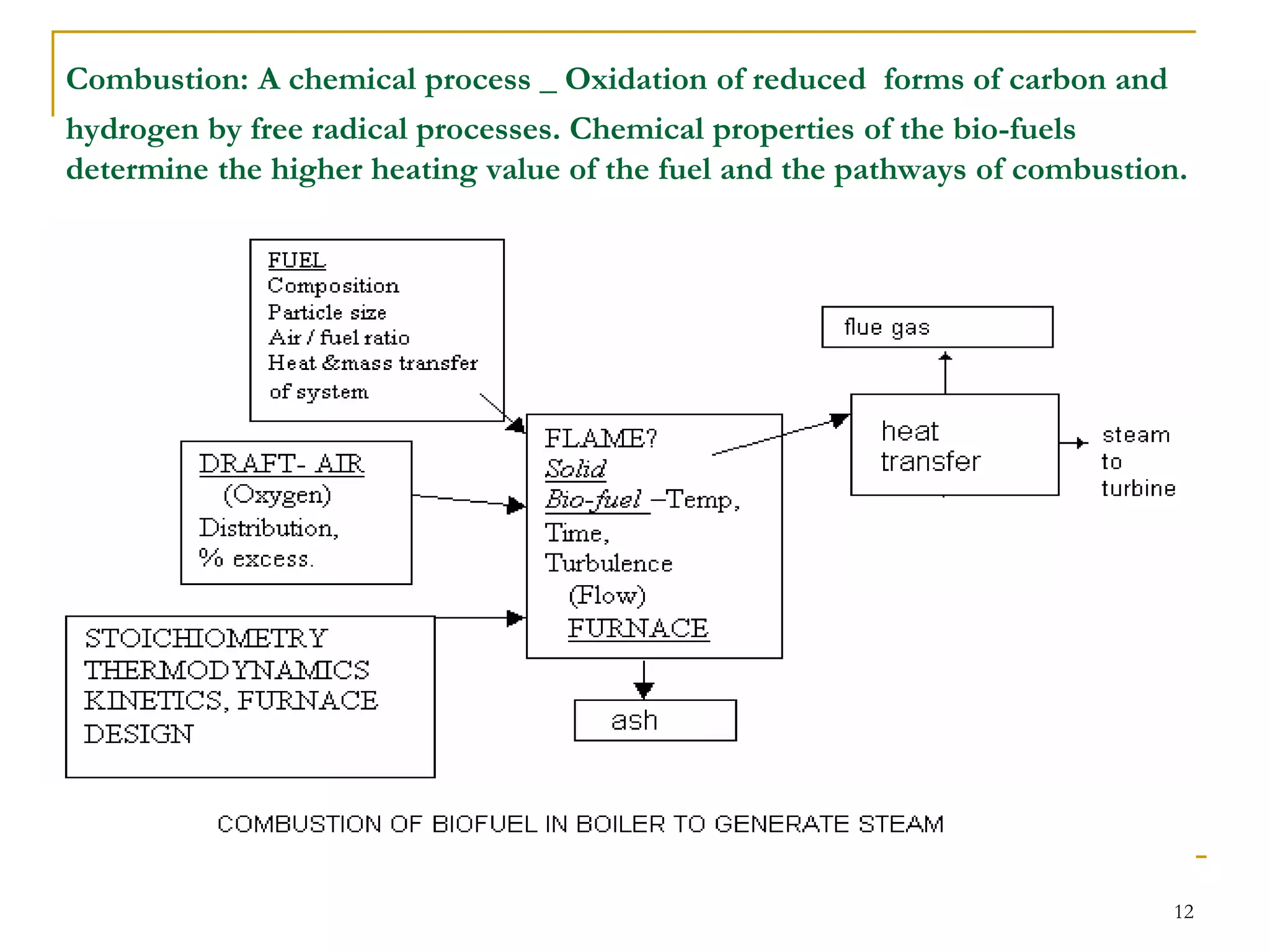
Combustion: A chemical process _ Oxidation of reduced forms of carbon and
hydrogen by free radical processes. Chemical properties of the bio-fuels
determine the higher heating value of the fuel and the pathways of combustion.


                                                                             12
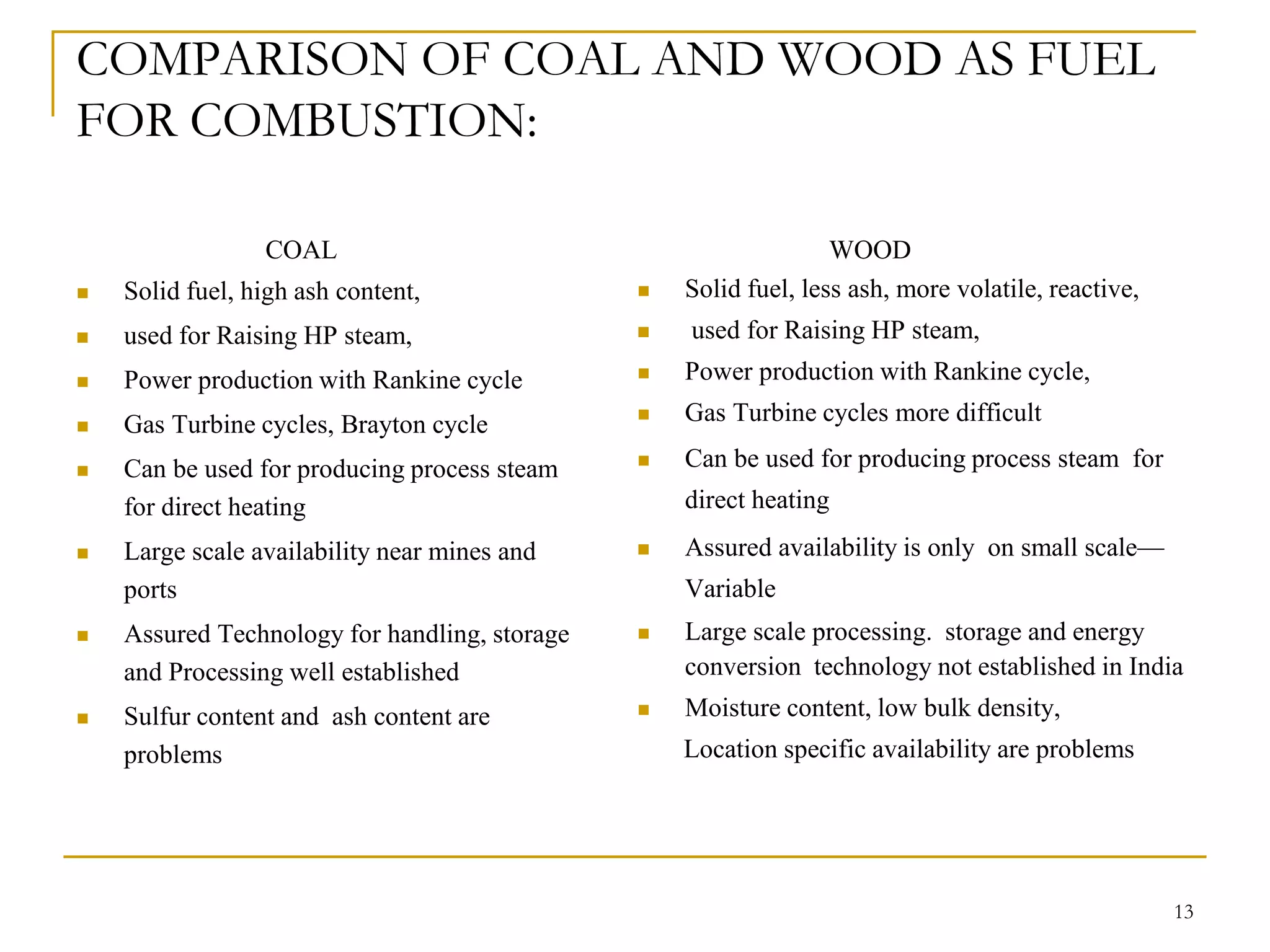
COMPARISON OF COAL AND WOOD AS FUEL
FOR COMBUSTION:

                 COAL                                             WOOD
   Solid fuel, high ash content,                 Solid fuel, less ash, more volatile, reactive,
   used for Raising HP steam,                    used for Raising HP steam,
   Power production with Rankine cycle           Power production with Rankine cycle,

   Gas Turbine cycles, Brayton cycle             Gas Turbine cycles more difficult

   Can be used for producing process steam       Can be used for producing process steam for
    for direct heating                             direct heating
   Large scale availability near mines and       Assured availability is only on small scale—
    ports                                          Variable
   Assured Technology for handling, storage      Large scale processing. storage and energy
    and Processing well established                conversion technology not established in India
   Sulfur content and ash content are            Moisture content, low bulk density,
    problems                                       Location specific availability are problems


                                                                                                    13
The chemistry of combustion:


                               14
Excess Air, Efficiency and Turndown


   Excess Air: The extra amount of air added
    to the burner above that which is required to
    completely burn the f     uel.
   Turndown:      The ratio of the burner’s
    maximum BTUH firing capability to the
    burner’s minimum BTUH firing capability.
   As the excess air is increased, the stack
    temperature rises and the boiler's efficiency
    drops.

                                                    15
PROXIMATE & ULTIMATE
ANALYSIS
   For expressing the complete composition of any
    solid fuel:
    the organic composition,
   proximate analysis and
   ultimate or elemental analysis are used.
   Typical values of chemical composition of some
    biomass are shown in Table 1.
   Table 2. shows average composition, ultimate
    analysis and bulk density of hardwood.
   Table 3. and 4.are data of typical compositions of
    solid fuels.


                                                         16
17
Table: 1.
Chemical composition of some biomass material

   Species       Total ash%   Lignin%    Hemi-        Cellulose %
                                         cellulose%


   Bagasse       2.2          18.4       28.0         33.1


                 16.1         11.9       24.1         30.2
   Rice Straw


   Wheat Straw   6.0          16.0       28.1         39.7


                                                                    18
19
20
21
To determine the quantity of air required for complete
combustion

   To determine the air, the ultimate analysis is useful.
   C + O2 = CO2 +97644 cal /mole [[15 o C]
   H2 +O2 = H2O + 69000 cal / mole [15 o C]
   Excess air % = (40*MCg)/(1- MCg) where MCg is moisture content
    on total wt basis (green). For typical biomass fuels at 50 %
    moisture content, for grate firing system about 40% excess air
    may be required.
   For suspension fired and fluidized bed combustion, air required
    may be 100 % excess
   Distribution of air and whether it is pre-heated is also important


                                                                         22
Higher Heating Value
   Calorific value of a fuel is the total heat produced
    when a unit mass of a fuel is

    completely burnt with pure oxygen. It is also called
    heating value of the fuel. When the c.v. is
    determined, water formed is considered as in vapour
    state, net c. v. is got.
   Gross calorific value or higher heating value of a fuel
    containing C, H and O is given by the expression:
   Cg =[C x 8137 + (H--O/8) x 34500]/100 where C, H
    and O are in % and Cg is in calories.
   Net calorific value is the difference between GCV
    and latent heat of condensation of water vapor
    present in the products

                                                           23
Combustion of wood / biomass

   Biomass fuel enters a combustor in a wet
    (50% moist), dirty, light in weight,
    heterogeneous in particle size, and quite
    reactive condition.
   Moisture content lowers the combustion
    efficiency and affects the economics of the
    fuel utilization.
   Biomass fuels are highly reactive, volatile,
    oxygenated fuels of moderate heating value.


                                                   24
Changes during heating to combustion temperature
   Due to the effect of heating fuel decomposes as the
    exothermic oxidation proceeds.
    Drying, pyrolysis of solid particle, release of
    volatiles and formation of char are followed by pre-
    combustion gas phase reactions and char oxidation
    reactions.


                                                           25
COMPOSITION PARAMETERS AFFECTING
COMBUSTION-1

   Net energy density available in combustion of
    biomass varies from about 10 MJ/kg (green
    wood) to about 40 MJ/kg (Oils/fats). Water
    requires 2.3 MJ/(kg of water) to evaporate.
    Moisture content (MC) influences efficiency
    more than any variable.


                                                26
COMPOSITION PARAMETERS AFFECTING
COMBUSTION-2

   A system which gives a thermal efficiency of
    about 80% while firing a fuel of MC 15%,
    gives reduced efficiencies of 65% when the
    fuel MC is 50 % or more.
   Cellulose embedded in a matrix of hemi-
    cellulose and lignin is the main constituent of
    woody biomass. Compared to coal, biomass
    has less mineral content and wood gives less
    ash than agro-residue.


                                                  27
Conditions for efficient Combustion-1

   Sufficient air to provide oxygen needed for
    complete burning of the fuel. Higher than
    stoichiometric amount of air is supplied.
   Free and intimate contact between fuel and
    oxygen by distribution of air supply.
   Secondary air to burn the volatile mass
    leaving the fuel bed completely before it
    leaves the combustion zone.


                                              28
Conditions for efficient Combustion-2

   Volatile matter leaving the fuel bed should not
    cool below combustion temperature by
    dilution with the flue gas. Flow path should
    assure this.
   Volume of the furnace should be arranged so
    as to provide for expansion of gases at high
    temperature and complete burning of volatile
    matter before flowing away.


                                                  29
Induced draft and Forced draft
     The ∆p required to make the air flow through the
    fuel bed and to the flue gas discharge height is
    called draft of air in a furnace.
   The draft is produced [i] naturally by means of a
    chimney [ii] mechanically by a fan.
       Mechanical draft can be_ induced draft [fan is
    used to suck the gases away from the furnace] _ a
    forced draft _force the air required for combustion
    through the grate.


                                                          30
Principles of furnace design calculations:
Thermal load of fire grate area:


 It is the amount of heat generated in kilo-calories by the
  complete combustion of a solid fuel on one sq. m. of grate
  area/hour.
 Thermal load of fire grate area , QA = W.Cn / A kcal/m2.hr

Thermal load of volume of furnace:
 It is the amount of heat generated in kilo-calories by the
  complete combustion of a solid fuel, in one cu. m. of
  furnace volume/h.
 Thermal load of vol. of furnace, QV = W Cn / V kcal/m3.hr


                                                         31
Thermal efficiency of furnace:


Thermal efficiency of furnace is the ratio of actual heat
  delivered by furnace to the available heat in the fuel

   Thermal efficiency of furnace, ηF =
     (Heat generated – Heat losses) /
                          (Net calorific value
                                      of fuel)

                  = (M.h) / (W Cn)


                                                        32
Example1. Combustion of Municipal Solid Waste
(MSW):

    The ultimate analysis of MSW is given
    below.
   C- 30% H- 4% O- 22% H2O – 24% and ash--
    metal, etc-20%;
   Compute the actual air required and the flue
    gases produced per kg. of MSW if 50%
    excess air is supplied for complete
    combustion.


                                                33
Notations for furnace design calculations


   QA = Thermal load of fire grate area, kcal/m2.hr
   QV = Thermal load of volume of furnace, kcal/m3.hr
   W = Fuel burned kg / hr,
   Cn = Net calorific value of fuel, kcal / kg
   A = furnace grate area, m2
   V = volume of furnace space, m3
   h = enthalpy of flue gas kilocalories/ m3
   M = Flow rate of flue gas, m3/hr


                                                     34
Rice husk based power plant-1
   A power plant of 6 MW power operated in
    Raipur district of M.P. [in 1999] It uses 7
    tonnes of rice husk an hour to produce high
    pressure steam (at 480 o C) _used to
    produce electricity.
   To burn the husk, the plant uses fluidized bed
    combustion type boiler supplied by Thermax.


                                                  35
Rice husk based power plant-2


   The plant is owned by Indo- Lahari Power Limited.
    The estimated capital cost for a megawatt of power
    produced is 35 million rupees as against 40 million
    rupees for a coal based power plant.
    In Raipur area one tonne of rice husk costs about
    rupees 550 per tonne as compared to rupees 1400
    per tonne of coal.


                                                          36
Combustion Theory


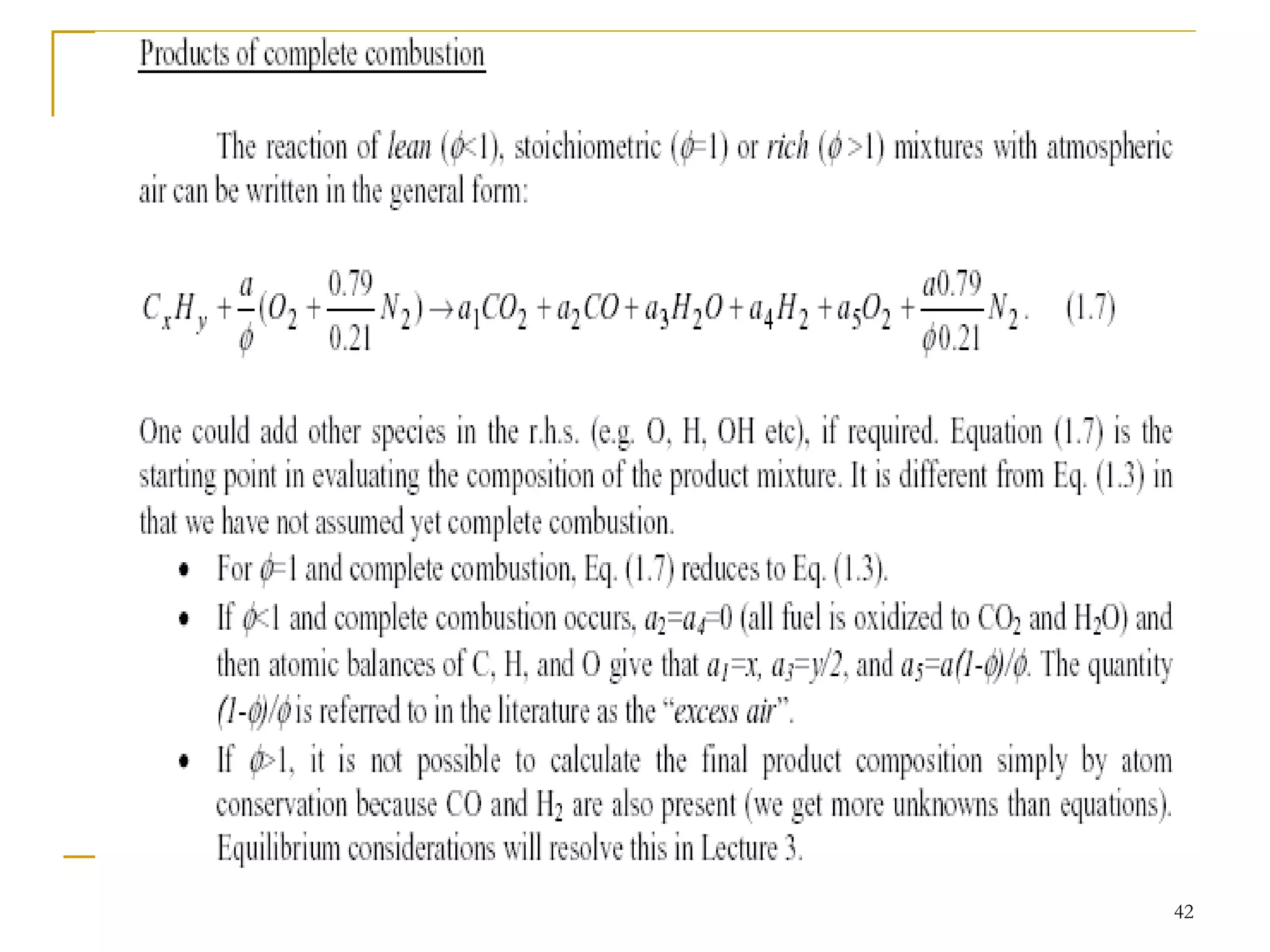
Stoichiometry, Calculations of Equivalent-ratio,
AFR, products of complete combustion,
Concentrations,
38
39
40
41
42
43
44
45
46
47
Real combustion &
Emissions

   in biomass & solid fossil fuel
   combustion and Gasification
49
50
51
52
53
54
55
56
57
58
59
60
61
62
63
64
65
66
67
68
Combustion equipment for solid biomass


    For wood:
   Inclined step grate furnace
   Spreader Stoker
    For solid biomass particulates- (agro-
    residues):
   Cyclonic, Suspension Fired Combustion
    System
   Fluidised Bed Combustion System


                                             69
Inclined step grate furnace
   In the inclined grate system, fuel is
     fed to the top of the grate. In this system,
    heating and drying can occur very near to the
    fuel feed shoot. Solid phase pyrolysis can
    occur as the fuel is sliding down the grate. Char
    oxidation can occur at the base of the grate
    and on the dumping grate. Gas phase
    reactions can be controlled by over-fire air
    distribution and separated completely from
    solid phase reactions.


                                                    70
Spreader Stoker


   In the spreader stoker, fuel particles are fed into
    the firebox and flung, mechanically or
    pneumatically across the grate. Some heating
    and drying and possibly some pyrolysis occurs
    while the particle is in suspension.
   For the most part however, solid phase pyrolysis
    and char oxidation occur on the grate.


                                                      71
Spreader Stoker...

   Pre-combustion gas phase reactions occur
    between the grate and the zone where
    secondary air is introduced.
   Gas phase oxidation occurs either throughout
    the firebox or in the vicinity of the zone where
    secondary air is introduced if the under-grate air
    is limited to sub-stoichiometric quantities.


                                                     72
Cyclonic, Suspension Fired Combustion System

    Horizontal Cyclone Furnace:

    A horizontal cyclone furnace consists of a horizontal
    or slightly inclined cylinder lined with firebricks into
    which air is ejected tangentially at a velocity of 6000-
    7000 m/min so that the flame in the furnace revolves
    at a rpm of 1200 to 1800
    The fuel introduced at the cyclone tip is entrained by
    the revolving mass and is thrown against the cyclone
    walls where it burns.
    The flue gases that escape at high velocities through
    the aperture at the other end of the cyclone are
    substantially free from fly ash.


                                                           73
Cyclonic, Suspension Fired Combustion...


   The heat release rate of (2-5) X 106 kcal/m2-
    hr can be achieved for pulverized coal in a
    cyclone furnace.
   The rotary motion imparted to the flame
    results in an intensive mixing of the flame
    mass and the fuel particles are subjected to
    the action of centrifugal force. This increases
    the residence time of the fuel in the furnace
    and combustion is complete.


                                                  74
Fluidised Bed Combustion System-1


   In fluidized bed combustion, bio-fuel is
    dispersed and burned in a fluidized bed of
    inert particles. Temperature of the bed is
    maintained in the range of 750 to 1000 o C
    so that combustion of the fuel is completed
    but particle sintering is prevented. The
    gaseous products leave the bed at its
    operating temperature, removing about 50%
    of the heat generated.


                                                  75
Fluidised Bed Combustion- 2


   The remainder of the heat is available for direct
    transmission to heat transfer surfaces immersed
    within the bed; in boiler applications these comprise
    a set of steam raising tubes.
    The heat transfer to immersed surfaces is uniformly
    high in comparison with the variation of radiation
    heat transfer through a conventional combustion
    chamber.
   Consequently less heat transfer surface is required
    for a given output and a boiler system occupies a
    smaller volume.


                                                        76
BIOMASS TO BIOENERGY


                       77

Biomass combustion

  • 1.
    Combustion_Fundamentals Biomass_Combustion
  • 2.
    CONTENTS  Solid Fuels  Thermo-chemical Reactions  Effect of raising temp. described  Comparison of coal & wood as fuel  Excess air, Efficiency and Turn-down  Proximate & Ultimate Analysis, HHV  Chemical composition  Furnace Design Calculations 2
  • 3.
  • 4.
  • 5.
    Combustion- PROCESS DESCRIPTION-1  Combustion refers to rapid oxidation. The feedstock is placed into a combustion chamber, where it is exposed to high heat. This completes the drying of the feedstock.  Once all of the water has been evaporated, the feedstock can become hot enough for pyrolysis to occur. (In plant matter, this is 440°F-620°F for hemicellulose and 480°F- 930°F for lignin.) 5
  • 6.
    PROCESS DESCRIPTION-2  Pyrolysis refers to the chemical breakdown of the feedstock, and the primary reactions such as volatile compounds like carbon monoxide, carbon dioxide, methane and tar.  The release of volatile gases inhibits further combustion because they prevent necessary oxygen from reaching the feedstock. 6
  • 7.
    PROCESS DESCRIPTION-3  When completely pyrolyzed, what remains of the feedstock is known as char. Given sufficient oxygen, oxidation of both the char and the volatile gases will occur.  The oxidation of the gases is referred to as flaming combustion, and only carbon dioxide and water will remain if the process is given enough heat, turbulence and residence time. 7
  • 8.
  • 9.
    PROCESS DESCRIPTION-4  Otherwise, this incomplete conversion will yield intermediate chemical compounds like carbon monoxide, polycyclic aromatic hydrocarbons and chlorinated hydrocarbons, all of which are pollutants.  Likewise, the oxidation of the char is referred to as glowing combustion, and its completeness is also a function of heat, mixing and time 9
  • 10.
    PROCESS DESCRIPTION-5  So long as every surface of the char comes into contact with oxygen, it will react and become carbon monoxide and carbon dioxide.  (Ideally, the carbon monoxide will be oxidized during flaming combustion and become carbon dioxide.)  Combustion gives off heat. A common strategy is to co-fire biomass with fuels like coal. 10
  • 11.
    PROCESS DESCRIPTION-6  There are marginal efficiency losses from co- firing biomass, and can provide a waste handling solution for industry. Similar to the substitution of gasoline with ethanol, the inclusion of biomass in coal-firing operations can reduce emissions by displacing coal. 11
  • 12.
    Combustion: A chemicalprocess _ Oxidation of reduced forms of carbon and hydrogen by free radical processes. Chemical properties of the bio-fuels determine the higher heating value of the fuel and the pathways of combustion. 12
  • 13.
    COMPARISON OF COALAND WOOD AS FUEL FOR COMBUSTION: COAL WOOD  Solid fuel, high ash content,  Solid fuel, less ash, more volatile, reactive,  used for Raising HP steam,  used for Raising HP steam,  Power production with Rankine cycle  Power production with Rankine cycle,  Gas Turbine cycles, Brayton cycle  Gas Turbine cycles more difficult  Can be used for producing process steam  Can be used for producing process steam for for direct heating direct heating  Large scale availability near mines and  Assured availability is only on small scale— ports Variable  Assured Technology for handling, storage  Large scale processing. storage and energy and Processing well established conversion technology not established in India  Sulfur content and ash content are  Moisture content, low bulk density, problems Location specific availability are problems 13
  • 14.
    The chemistry ofcombustion: 14
  • 15.
    Excess Air, Efficiencyand Turndown  Excess Air: The extra amount of air added to the burner above that which is required to completely burn the f uel.  Turndown: The ratio of the burner’s maximum BTUH firing capability to the burner’s minimum BTUH firing capability.  As the excess air is increased, the stack temperature rises and the boiler's efficiency drops. 15
  • 16.
    PROXIMATE & ULTIMATE ANALYSIS  For expressing the complete composition of any solid fuel:  the organic composition,  proximate analysis and  ultimate or elemental analysis are used.  Typical values of chemical composition of some biomass are shown in Table 1.  Table 2. shows average composition, ultimate analysis and bulk density of hardwood.  Table 3. and 4.are data of typical compositions of solid fuels. 16
  • 17.
  • 18.
    Table: 1. Chemical compositionof some biomass material Species Total ash% Lignin% Hemi- Cellulose % cellulose% Bagasse 2.2 18.4 28.0 33.1 16.1 11.9 24.1 30.2 Rice Straw Wheat Straw 6.0 16.0 28.1 39.7 18
  • 19.
  • 20.
  • 21.
  • 22.
    To determine thequantity of air required for complete combustion  To determine the air, the ultimate analysis is useful.  C + O2 = CO2 +97644 cal /mole [[15 o C]  H2 +O2 = H2O + 69000 cal / mole [15 o C]  Excess air % = (40*MCg)/(1- MCg) where MCg is moisture content on total wt basis (green). For typical biomass fuels at 50 % moisture content, for grate firing system about 40% excess air may be required.  For suspension fired and fluidized bed combustion, air required may be 100 % excess  Distribution of air and whether it is pre-heated is also important 22
  • 23.
    Higher Heating Value  Calorific value of a fuel is the total heat produced when a unit mass of a fuel is completely burnt with pure oxygen. It is also called heating value of the fuel. When the c.v. is determined, water formed is considered as in vapour state, net c. v. is got.  Gross calorific value or higher heating value of a fuel containing C, H and O is given by the expression:  Cg =[C x 8137 + (H--O/8) x 34500]/100 where C, H and O are in % and Cg is in calories.  Net calorific value is the difference between GCV and latent heat of condensation of water vapor present in the products 23
  • 24.
    Combustion of wood/ biomass  Biomass fuel enters a combustor in a wet (50% moist), dirty, light in weight, heterogeneous in particle size, and quite reactive condition.  Moisture content lowers the combustion efficiency and affects the economics of the fuel utilization.  Biomass fuels are highly reactive, volatile, oxygenated fuels of moderate heating value. 24
  • 25.
    Changes during heatingto combustion temperature  Due to the effect of heating fuel decomposes as the exothermic oxidation proceeds.  Drying, pyrolysis of solid particle, release of volatiles and formation of char are followed by pre- combustion gas phase reactions and char oxidation reactions. 25
  • 26.
    COMPOSITION PARAMETERS AFFECTING COMBUSTION-1  Net energy density available in combustion of biomass varies from about 10 MJ/kg (green wood) to about 40 MJ/kg (Oils/fats). Water requires 2.3 MJ/(kg of water) to evaporate. Moisture content (MC) influences efficiency more than any variable. 26
  • 27.
    COMPOSITION PARAMETERS AFFECTING COMBUSTION-2  A system which gives a thermal efficiency of about 80% while firing a fuel of MC 15%, gives reduced efficiencies of 65% when the fuel MC is 50 % or more.  Cellulose embedded in a matrix of hemi- cellulose and lignin is the main constituent of woody biomass. Compared to coal, biomass has less mineral content and wood gives less ash than agro-residue. 27
  • 28.
    Conditions for efficientCombustion-1  Sufficient air to provide oxygen needed for complete burning of the fuel. Higher than stoichiometric amount of air is supplied.  Free and intimate contact between fuel and oxygen by distribution of air supply.  Secondary air to burn the volatile mass leaving the fuel bed completely before it leaves the combustion zone. 28
  • 29.
    Conditions for efficientCombustion-2  Volatile matter leaving the fuel bed should not cool below combustion temperature by dilution with the flue gas. Flow path should assure this.  Volume of the furnace should be arranged so as to provide for expansion of gases at high temperature and complete burning of volatile matter before flowing away. 29
  • 30.
    Induced draft andForced draft  The ∆p required to make the air flow through the fuel bed and to the flue gas discharge height is called draft of air in a furnace.  The draft is produced [i] naturally by means of a chimney [ii] mechanically by a fan.  Mechanical draft can be_ induced draft [fan is used to suck the gases away from the furnace] _ a forced draft _force the air required for combustion through the grate. 30
  • 31.
    Principles of furnacedesign calculations: Thermal load of fire grate area:  It is the amount of heat generated in kilo-calories by the complete combustion of a solid fuel on one sq. m. of grate area/hour.  Thermal load of fire grate area , QA = W.Cn / A kcal/m2.hr Thermal load of volume of furnace:  It is the amount of heat generated in kilo-calories by the complete combustion of a solid fuel, in one cu. m. of furnace volume/h.  Thermal load of vol. of furnace, QV = W Cn / V kcal/m3.hr 31
  • 32.
    Thermal efficiency offurnace: Thermal efficiency of furnace is the ratio of actual heat delivered by furnace to the available heat in the fuel  Thermal efficiency of furnace, ηF = (Heat generated – Heat losses) / (Net calorific value of fuel) = (M.h) / (W Cn) 32
  • 33.
    Example1. Combustion ofMunicipal Solid Waste (MSW):  The ultimate analysis of MSW is given below.  C- 30% H- 4% O- 22% H2O – 24% and ash-- metal, etc-20%;  Compute the actual air required and the flue gases produced per kg. of MSW if 50% excess air is supplied for complete combustion. 33
  • 34.
    Notations for furnacedesign calculations  QA = Thermal load of fire grate area, kcal/m2.hr  QV = Thermal load of volume of furnace, kcal/m3.hr  W = Fuel burned kg / hr,  Cn = Net calorific value of fuel, kcal / kg  A = furnace grate area, m2  V = volume of furnace space, m3  h = enthalpy of flue gas kilocalories/ m3  M = Flow rate of flue gas, m3/hr 34
  • 35.
    Rice husk basedpower plant-1  A power plant of 6 MW power operated in Raipur district of M.P. [in 1999] It uses 7 tonnes of rice husk an hour to produce high pressure steam (at 480 o C) _used to produce electricity.  To burn the husk, the plant uses fluidized bed combustion type boiler supplied by Thermax. 35
  • 36.
    Rice husk basedpower plant-2  The plant is owned by Indo- Lahari Power Limited. The estimated capital cost for a megawatt of power produced is 35 million rupees as against 40 million rupees for a coal based power plant.  In Raipur area one tonne of rice husk costs about rupees 550 per tonne as compared to rupees 1400 per tonne of coal. 36
  • 37.
    Combustion Theory Stoichiometry, Calculationsof Equivalent-ratio, AFR, products of complete combustion, Concentrations,
  • 38.
  • 39.
  • 40.
  • 41.
  • 42.
  • 43.
  • 44.
  • 45.
  • 46.
  • 47.
  • 48.
    Real combustion & Emissions in biomass & solid fossil fuel combustion and Gasification
  • 49.
  • 50.
  • 51.
  • 52.
  • 53.
  • 54.
  • 55.
  • 56.
  • 57.
  • 58.
  • 59.
  • 60.
  • 61.
  • 62.
  • 63.
  • 64.
  • 65.
  • 66.
  • 67.
  • 68.
  • 69.
    Combustion equipment forsolid biomass For wood:  Inclined step grate furnace  Spreader Stoker For solid biomass particulates- (agro- residues):  Cyclonic, Suspension Fired Combustion System  Fluidised Bed Combustion System 69
  • 70.
    Inclined step gratefurnace  In the inclined grate system, fuel is fed to the top of the grate. In this system, heating and drying can occur very near to the fuel feed shoot. Solid phase pyrolysis can occur as the fuel is sliding down the grate. Char oxidation can occur at the base of the grate and on the dumping grate. Gas phase reactions can be controlled by over-fire air distribution and separated completely from solid phase reactions. 70
  • 71.
    Spreader Stoker  In the spreader stoker, fuel particles are fed into the firebox and flung, mechanically or pneumatically across the grate. Some heating and drying and possibly some pyrolysis occurs while the particle is in suspension.  For the most part however, solid phase pyrolysis and char oxidation occur on the grate. 71
  • 72.
    Spreader Stoker...  Pre-combustion gas phase reactions occur between the grate and the zone where secondary air is introduced.  Gas phase oxidation occurs either throughout the firebox or in the vicinity of the zone where secondary air is introduced if the under-grate air is limited to sub-stoichiometric quantities. 72
  • 73.
    Cyclonic, Suspension FiredCombustion System Horizontal Cyclone Furnace:  A horizontal cyclone furnace consists of a horizontal or slightly inclined cylinder lined with firebricks into which air is ejected tangentially at a velocity of 6000- 7000 m/min so that the flame in the furnace revolves at a rpm of 1200 to 1800  The fuel introduced at the cyclone tip is entrained by the revolving mass and is thrown against the cyclone walls where it burns.  The flue gases that escape at high velocities through the aperture at the other end of the cyclone are substantially free from fly ash. 73
  • 74.
    Cyclonic, Suspension FiredCombustion...  The heat release rate of (2-5) X 106 kcal/m2- hr can be achieved for pulverized coal in a cyclone furnace.  The rotary motion imparted to the flame results in an intensive mixing of the flame mass and the fuel particles are subjected to the action of centrifugal force. This increases the residence time of the fuel in the furnace and combustion is complete. 74
  • 75.
    Fluidised Bed CombustionSystem-1  In fluidized bed combustion, bio-fuel is dispersed and burned in a fluidized bed of inert particles. Temperature of the bed is maintained in the range of 750 to 1000 o C so that combustion of the fuel is completed but particle sintering is prevented. The gaseous products leave the bed at its operating temperature, removing about 50% of the heat generated. 75
  • 76.
    Fluidised Bed Combustion-2  The remainder of the heat is available for direct transmission to heat transfer surfaces immersed within the bed; in boiler applications these comprise a set of steam raising tubes.  The heat transfer to immersed surfaces is uniformly high in comparison with the variation of radiation heat transfer through a conventional combustion chamber.  Consequently less heat transfer surface is required for a given output and a boiler system occupies a smaller volume. 76
  • 77.