Community-driven Solutions to
Achieve Sustainable Forest
Stewardship and Resilience


Chad Davis
Director, Forest Stewardship Program
Context of our work in the PNW
Overharvest;
suppression


 Top down
                Collaboration     Local &
   policy
                                  regional
                                 economic
Lack of trust   Place-based     development
                 solutions


 Economic
  decline
Dry Forest Zone Land Ownership
Economic Conditions (2009)
Theory of Change
• Society needs rural communities to protect,
  restore, & steward ecosystems in order to
  achieve resilient natural & human systems
• Investment in community capacity will
  ensure that rural communities are
  meaningful partners in conservation
• We promote:
  – Collaborative, community-based solutions
  – Business models that are appropriately-scaled and
    targeted at national and regional green markets
  – Public policy that supports these ends
What is capacity?

     Asset
     Asset
  Development
  Development

    Political
   Financial
                    Capital
    Physical
                     Base
Social & Cultural
    Human
What does capacity result in?

• Inspired local leadership

• Collaboration between diverse
  interests

• Strong community-based
  organizations

• Thriving local businesses

• Retained, improved, and new
  facilities, equipment, etc.
What does capacity ultimately do?


•Solves problems

•Motivates innovation

•Inspires replication

•Creates resiliency
SNW Programs of Work
• Community Partnerships
• Forest Stewardship
  – Healthy Forests, Healthy Communities
  – FSC Chain of Custody – Group Certificate

• Klamath & Rangelands
• Policy
  – Rural Voices for Conservation Coalition

• Sustainable Northwest Wood, Inc.
  – For-profit subsidiary wood distribution center
Community Partnerships
• Build strong community based organizations
  and businesses
• Support collaboratively-driven landscape
  scale restoration & stewardship on public
  lands
Community Partnerships
Forest Stewardship
• Increase rural access to green building
  markets (FSC, HFHC)
• Support integrated community-scaled
  facilities, focusing on local/regional energy
  market
Sustainable Northwest Wood, Inc.
• Only distribution center in the country 100%
  committed to sustainable & local
  –   Established in Nov 2008 for wholesale
  –   To date, 80+% of value sold = FSC
  –   Market penetration for juniper products
  –   Retail opportunities developed due to service
Policy Program
• Promote ecologically responsible &
  economically equitable policy solutions
  – Increase investment in natural resource
    stewardship and rural development
• Recently signed national-level MOU with the
  Forest Service
RVCC
• Annual Policy Meeting (Dec)
  – ~100 organizations/businesses/agency
    personell/local gov’t representatives

• Western Week in Washington (April)
  – 100+ meetings in 3 days
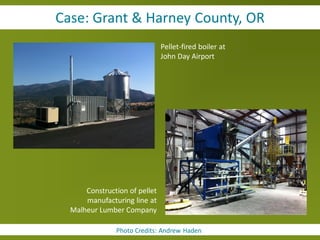
Case: Grant & Harney County, OR
                               Pellet-fired boiler at
                               John Day Airport


      Construction of pellet
      manufacturing line at
  Malheur Lumber Company

               Photo Credits: Andrew Haden
Collaboration

• Blue Mountain Forest Partners
   – 2006 County Judge Mark Webb invited SNW to
     help facilitate the group & develop process
• Collaboration in action!
   – Projects grown from 7,200 acres (Dad’s Creek) to
     40,000 acres (Elk 16) in 3 yrs
   – The Bigger Look
   – USFS Regional Office advanced CFLRP proposal
• Malheur National Forest litigation-free
  for 5 years on veg mgmt
Integrated campus / diversified products

  • New partnership b/t Malheur Lumber
    & Bear Mountain Forest Products
  • Leveraged existing mill; 75 jobs
  • New products using small-diameter
     – Pellets, “bricks”, animal bedding
     – 40,000 tons of biomass utilized
  • 15 new jobs
     – 6% of non-farm workforce
Maximizing Energy: Heat

• Energy “product”: 440,000 MMBtus
  – Heat output equivalent to 18 MW
     • Same volume would produce only 6 MWs in a
       stand alone bio-power facility
  – Reduce energy costs to regional facilities
    (schools & hospitals) by $4.4 million / yr
  – Will displace 3.2 million gallons of oil
Keys to Success
• Diverse support from community-driven
  collaborative process & appropriately-scaled
• Integrated wood products campus
• Maximizes revenue streams from low-value
  material
• Market development is public-private
  partnership
• Bracketed within a regional strategy
A Resilient Forest-based Economy?
              Strong local NGOs
• Tech assistance by federal agencies is significantly
  reduced
• “Common ground” established; ready to go to
  landscape-scale
• Private sector risk averse, particularly re: Fed supply

• Local entrepreneurs are missing
• Leakage of energy spending
• Land tenure in question

  Local Assets / Regional Strategies
What is the role of the FPS?

• Go back to the future!
  – Decentralized production
  – Community “voice” is distinct
  – Thermal energy
• Develop appropriately-scaled solutions
  – Restoration paradigm
  – Social reality
  – Local assets
• Seek partnerships
  – Public-private ventures
Martin Goebel                                Maia Enzer
President                                    Policy Program Director
mgoebel@sustainablenorthwest.org             menzer@sustainablenorthwest.org
(503) 221-6911 x102                          (503) 221-6911 x111

Chad Davis                                   James Honey
Forest Stewardship Program Director          Klamath & Rangelands Program Director
cdavis@sustainablenorthwest.org              jhoney@sustainablenorthwest.org
(503) 221-6911 x110                          (503) 221-6911 x106
Twitter: @snwchad
                                      ASDF


       www.SustainableNorthwest.org
       Main line (503) 221-6911
       info@SustainableNorthwest.org

General session ic2011 davis

  • 1.
    Community-driven Solutions to AchieveSustainable Forest Stewardship and Resilience Chad Davis Director, Forest Stewardship Program
  • 2.
    Context of ourwork in the PNW Overharvest; suppression Top down Collaboration Local & policy regional economic Lack of trust Place-based development solutions Economic decline
  • 3.
    Dry Forest ZoneLand Ownership
  • 4.
  • 5.
    Theory of Change •Society needs rural communities to protect, restore, & steward ecosystems in order to achieve resilient natural & human systems • Investment in community capacity will ensure that rural communities are meaningful partners in conservation • We promote: – Collaborative, community-based solutions – Business models that are appropriately-scaled and targeted at national and regional green markets – Public policy that supports these ends
  • 6.
    What is capacity? Asset Asset Development Development Political Financial Capital Physical Base Social & Cultural Human
  • 7.
    What does capacityresult in? • Inspired local leadership • Collaboration between diverse interests • Strong community-based organizations • Thriving local businesses • Retained, improved, and new facilities, equipment, etc.
  • 8.
    What does capacityultimately do? •Solves problems •Motivates innovation •Inspires replication •Creates resiliency
  • 9.
    SNW Programs ofWork • Community Partnerships • Forest Stewardship – Healthy Forests, Healthy Communities – FSC Chain of Custody – Group Certificate • Klamath & Rangelands • Policy – Rural Voices for Conservation Coalition • Sustainable Northwest Wood, Inc. – For-profit subsidiary wood distribution center
  • 10.
    Community Partnerships • Buildstrong community based organizations and businesses • Support collaboratively-driven landscape scale restoration & stewardship on public lands
  • 11.
  • 12.
    Forest Stewardship • Increaserural access to green building markets (FSC, HFHC) • Support integrated community-scaled facilities, focusing on local/regional energy market
  • 13.
    Sustainable Northwest Wood,Inc. • Only distribution center in the country 100% committed to sustainable & local – Established in Nov 2008 for wholesale – To date, 80+% of value sold = FSC – Market penetration for juniper products – Retail opportunities developed due to service
  • 14.
    Policy Program • Promoteecologically responsible & economically equitable policy solutions – Increase investment in natural resource stewardship and rural development • Recently signed national-level MOU with the Forest Service
  • 15.
    RVCC • Annual PolicyMeeting (Dec) – ~100 organizations/businesses/agency personell/local gov’t representatives • Western Week in Washington (April) – 100+ meetings in 3 days
  • 16.
    Case: Grant &Harney County, OR Pellet-fired boiler at John Day Airport Construction of pellet manufacturing line at Malheur Lumber Company Photo Credits: Andrew Haden
  • 17.
    Collaboration • Blue MountainForest Partners – 2006 County Judge Mark Webb invited SNW to help facilitate the group & develop process • Collaboration in action! – Projects grown from 7,200 acres (Dad’s Creek) to 40,000 acres (Elk 16) in 3 yrs – The Bigger Look – USFS Regional Office advanced CFLRP proposal • Malheur National Forest litigation-free for 5 years on veg mgmt
  • 18.
    Integrated campus /diversified products • New partnership b/t Malheur Lumber & Bear Mountain Forest Products • Leveraged existing mill; 75 jobs • New products using small-diameter – Pellets, “bricks”, animal bedding – 40,000 tons of biomass utilized • 15 new jobs – 6% of non-farm workforce
  • 19.
    Maximizing Energy: Heat •Energy “product”: 440,000 MMBtus – Heat output equivalent to 18 MW • Same volume would produce only 6 MWs in a stand alone bio-power facility – Reduce energy costs to regional facilities (schools & hospitals) by $4.4 million / yr – Will displace 3.2 million gallons of oil
  • 20.
    Keys to Success •Diverse support from community-driven collaborative process & appropriately-scaled • Integrated wood products campus • Maximizes revenue streams from low-value material • Market development is public-private partnership • Bracketed within a regional strategy
  • 21.
    A Resilient Forest-basedEconomy? Strong local NGOs • Tech assistance by federal agencies is significantly reduced • “Common ground” established; ready to go to landscape-scale • Private sector risk averse, particularly re: Fed supply • Local entrepreneurs are missing • Leakage of energy spending • Land tenure in question Local Assets / Regional Strategies
  • 22.
    What is therole of the FPS? • Go back to the future! – Decentralized production – Community “voice” is distinct – Thermal energy • Develop appropriately-scaled solutions – Restoration paradigm – Social reality – Local assets • Seek partnerships – Public-private ventures
  • 23.
    Martin Goebel Maia Enzer President Policy Program Director mgoebel@sustainablenorthwest.org menzer@sustainablenorthwest.org (503) 221-6911 x102 (503) 221-6911 x111 Chad Davis James Honey Forest Stewardship Program Director Klamath & Rangelands Program Director cdavis@sustainablenorthwest.org jhoney@sustainablenorthwest.org (503) 221-6911 x110 (503) 221-6911 x106 Twitter: @snwchad ASDF www.SustainableNorthwest.org Main line (503) 221-6911 info@SustainableNorthwest.org