Design and Development of Agroforestry
Systems in Low Rainfall Regions of India for
Combating Climate Change

M. M. Roy
Central Arid Zone Research Institute,
Jodhpur (Raj.) 342003 INDIA
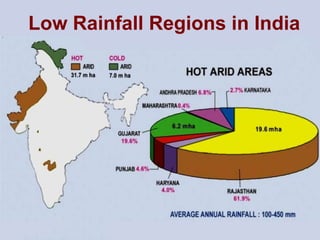
Low Rainfall Regions in India
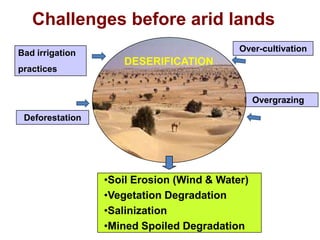
Challenges before arid lands
Bad irrigation
practices

Over-cultivation

DESERIFICATION

Overgrazing
Deforestation

•Soil Erosion (Wind & Water)
•Vegetation Degradation
•Salinization
•Mined Spoiled Degradation
THE CHALLENGES
Periodic droughts debilitate and destabilize poor
societies, and contribute to desertification by reducing
vegetative cover and water supplies, triggering a
desperate exploitation of the remaining resources in
order to survive
Bad irrigation practices

Over-cultivation

DESERIFICATION
Deforestation

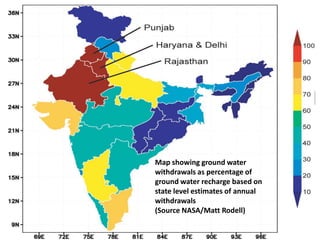
Map showing ground water
withdrawals as percentage ofOvergrazing
ground water recharge based on
state level estimates of annual
withdrawals
(Source NASA/Matt Rodell)
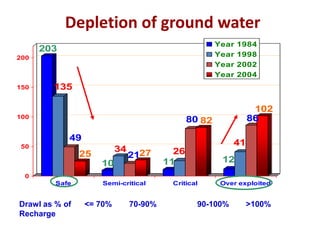
Depletion of ground water
Year
Year
Year
Year

203
200

150

1984
1998
2002
2004

135

100

102
86

80 82
49

50

34

25
10

41
2127

26
11

12

0
Safe

Drawl as % of
Recharge

Semi-critical

<= 70%

70-90%

Critical

Over exploited

90-100%

>100%
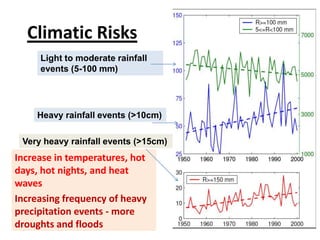
Climatic Risks
Light to moderate rainfall
events (5-100 mm)

Heavy rainfall events (>10cm)
Very heavy rainfall events (>15cm)

Increase in temperatures, hot
days, hot nights, and heat
waves
Increasing frequency of heavy
precipitation events - more
droughts and floods
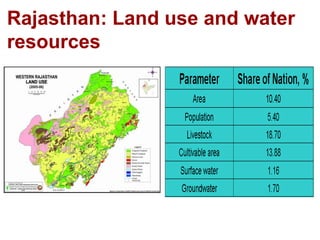
Rajasthan: Land use and water
resources
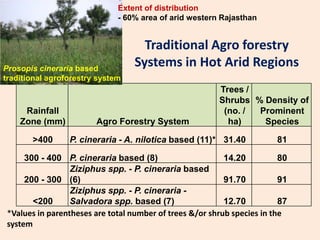
Extent of distribution
- 60% area of arid western Rajasthan

Prosopis cineraria based
traditional agroforestry system

Rainfall
Zone (mm)
>400

Traditional Agro forestry
Systems in Hot Arid Regions

Agro Forestry System

Trees /
Shrubs % Density of
(no. /
Prominent
ha)
Species

P. cineraria - A. nilotica based (11)* 31.40

81

300 - 400 P. cineraria based (8)
14.20
80
Ziziphus spp. - P. cineraria based
200 - 300 (6)
91.70
91
Ziziphus spp. - P. cineraria <200
Salvadora spp. based (7)
12.70
87
*Values in parentheses are total number of trees &/or shrub species in the
system
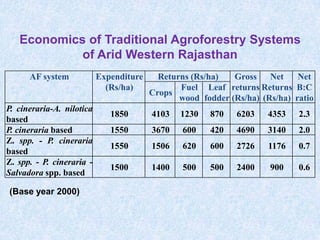
Economics of Traditional Agroforestry Systems
of Arid Western Rajasthan
AF system

P. cineraria-A. nilotica
based
P. cineraria based
Z. spp. - P. cineraria
based
Z. spp. - P. cineraria Salvadora spp. based
(Base year 2000)

Expenditure
(Rs/ha)

Returns (Rs/ha)
Gross
Net
Net
Fuel Leaf returns Returns B:C
Crops
wood fodder (Rs/ha) (Rs/ha) ratio

1850

4103

1230

870

6203

4353

2.3

1550

3670

600

420

4690

3140

2.0

1550

1506

620

600

2726

1176

0.7

1500

1400

500

500

2400

900

0.6
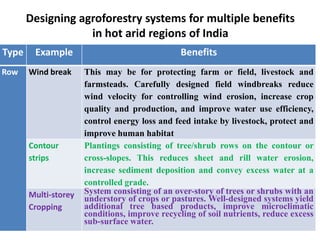
Designing agroforestry systems for multiple benefits
in hot arid regions of India
Type
Row

Example
Wind break

Contour
strips

Multi-storey
Cropping

Benefits
This may be for protecting farm or field, livestock and
farmsteads. Carefully designed field windbreaks reduce
wind velocity for controlling wind erosion, increase crop
quality and production, and improve water use efficiency,
control energy loss and feed intake by livestock, protect and
improve human habitat
Plantings consisting of tree/shrub rows on the contour or
cross-slopes. This reduces sheet and rill water erosion,
increase sediment deposition and convey excess water at a
controlled grade.
System consisting of an over-story of trees or shrubs with an
understory of crops or pastures. Well-designed systems yield
additional tree based products, improve microclimatic
conditions, improve recycling of soil nutrients, reduce excess
sub-surface water.
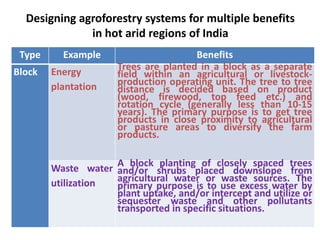
Designing agroforestry systems for multiple benefits
in hot arid regions of India
Type
Block

Example
Energy
plantation

Benefits
Trees are planted in a block as a separate
field within an agricultural or livestockproduction operating unit. The tree to tree
distance is decided based on product
(wood, firewood, top feed etc.) and
rotation cycle (generally less than 10-15
years). The primary purpose is to get tree
products in close proximity to agricultural
or pasture areas to diversify the farm
products.

A block planting of closely spaced trees
Waste water and/or shrubs placed downslope from
agricultural water or waste sources. The
utilization
primary purpose is to use excess water by
plant uptake, and/or intercept and utilize or
sequester waste and other pollutants
transported in specific situations.
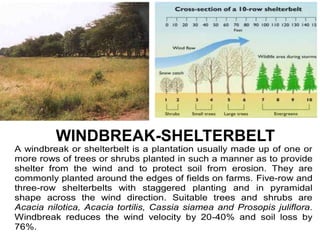
WINDBREAK-SHELTERBELT
A windbreak or shelterbelt is a plantation usually made up of one or
more rows of trees or shrubs planted in such a manner as to provide
shelter from the wind and to protect soil from erosion. They are
commonly planted around the edges of fields on farms. Five-row and
three-row shelterbelts with staggered planting and in pyramidal
shape across the wind direction. Suitable trees and shrubs are
Acacia nilotica, Acacia tortilis, Cassia siamea and Prosopis juliflora.
Windbreak reduces the wind velocity by 20-40% and soil loss by
76%.
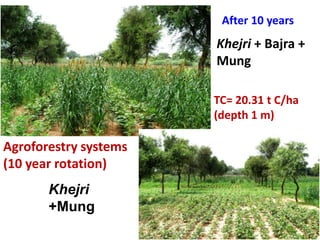
After 10 years

Khejri + Bajra +
Mung
TC= 20.31 t C/ha
(depth 1 m)

Agroforestry systems
(10 year rotation)

Khejri
+Mung
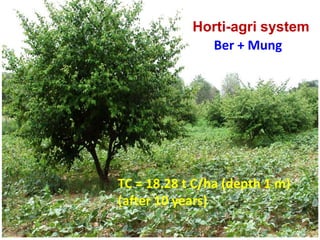
Horti-agri system
Ber + Mung

TC = 18.28 t C/ha (depth 1 m)
(after 10 years)
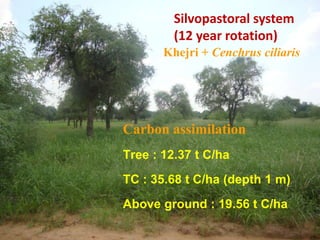
Silvopastoral system
(12 year rotation)
Khejri + Cenchrus ciliaris

Carbon assimilation
Tree : 12.37 t C/ha
TC : 35.68 t C/ha (depth 1 m)

Above ground : 19.56 t C/ha
Silvopastoral system
(12 year rotation)

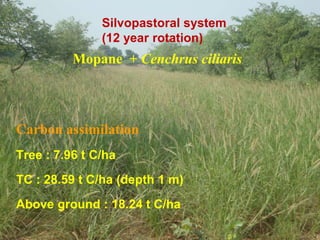
Mopane + Cenchrus ciliaris

Carbon assimilation
Tree : 7.96 t C/ha
TC : 28.59 t C/ha (depth 1 m)
Above ground : 18.24 t C/ha
Silvopastoral system
(12 year rotation)

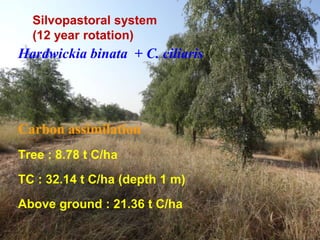
Hardwickia binata + C. ciliaris

Carbon assimilation
Tree : 8.78 t C/ha
TC : 32.14 t C/ha (depth 1 m)

Above ground : 21.36 t C/ha
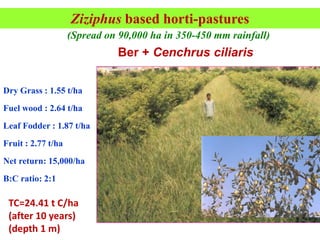
Ziziphus based horti-pastures
(Spread on 90,000 ha in 350-450 mm rainfall) )))

Ber + Cenchrus ciliaris
Dry Grass : 1.55 t/ha
Fuel wood : 2.64 t/ha
Leaf Fodder : 1.87 t/ha

Fruit : 2.77 t/ha
Net return: 15,000/ha
B:C ratio: 2:1

TC=24.41 t C/ha
(after 10 years)
(depth 1 m)
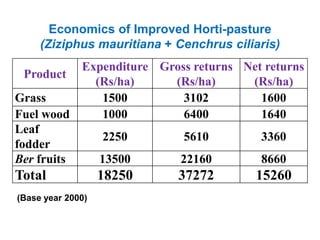
Economics of Improved Horti-pasture
(Ziziphus mauritiana + Cenchrus ciliaris)
Expenditure Gross returns Net returns
Product
(Rs/ha)
(Rs/ha)
(Rs/ha)
Grass
1500
3102
1600
Fuel wood
1000
6400
1640
Leaf
2250
5610
3360
fodder
Ber fruits
13500
22160
8660

Total
(Base year 2000)

18250

37272

15260
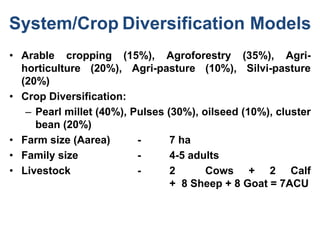
System/Crop Diversification Models
• Arable cropping (15%), Agroforestry (35%), Agrihorticulture (20%), Agri-pasture (10%), Silvi-pasture
(20%)
• Crop Diversification:
– Pearl millet (40%), Pulses (30%), oilseed (10%), cluster
bean (20%)
• Farm size (Aarea)
7 ha
• Family size
4-5 adults
• Livestock
2
Cows + 2 Calf
+ 8 Sheep + 8 Goat = 7ACU
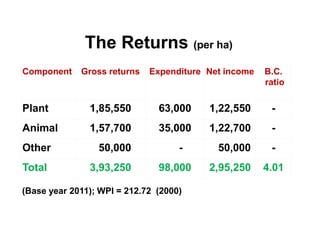
The Returns (per ha)
Component

Gross returns

Expenditure Net income

B.C.
ratio

Plant

1,85,550

63,000

1,22,550

-

Animal

1,57,700

35,000

1,22,700

-

50,000

-

Other
Total

50,000
3,93,250

98,000

(Base year 2011); WPI = 212.72 (2000)

2,95,250

4.01
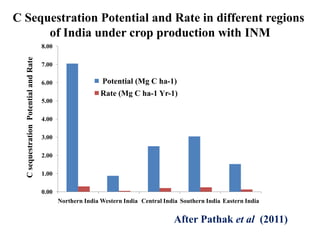
C Sequestration Potential and Rate in different regions
of India under crop production with INM
C sequestration Potential and Rate

8.00
7.00
6.00

Potential (Mg C ha-1)
Rate (Mg C ha-1 Yr-1)

5.00
4.00
3.00
2.00

1.00
0.00
Northern India Western India Central India Southern India Eastern India

After Pathak et al (2011)
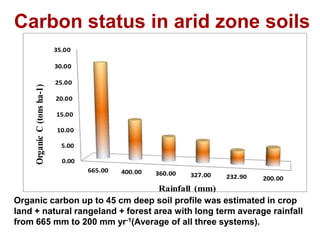
Carbon status in arid zone soils
35.00

Organic C (tons ha-1)

30.00
25.00
20.00
15.00
10.00
5.00
0.00
665.00

400.00

360.00

327.00

232.90

200.00

Rainfall (mm)
Organic carbon up to 45 cm deep soil profile was estimated in crop
land + natural rangeland + forest area with long term average rainfall
from 665 mm to 200 mm yr-1(Average of all three systems).
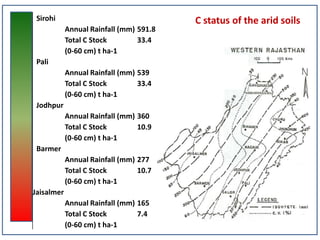
Sirohi
Annual Rainfall (mm) 591.8
Total C Stock
33.4
(0-60 cm) t ha-1
Pali

Annual Rainfall (mm) 539
Total C Stock
33.4
(0-60 cm) t ha-1
Jodhpur
Annual Rainfall (mm) 360
Total C Stock
10.9
(0-60 cm) t ha-1
Barmer
Annual Rainfall (mm) 277
Total C Stock
10.7
(0-60 cm) t ha-1
Jaisalmer
Annual Rainfall (mm) 165
Total C Stock
7.4
(0-60 cm) t ha-1

C status of the arid soils
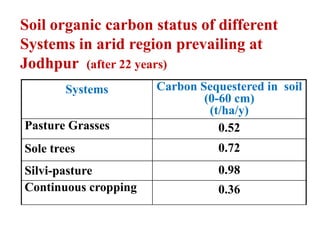
Soil organic carbon status of different
Systems in arid region prevailing at
Jodhpur (after 22 years)
Systems
Pasture Grasses

Carbon Sequestered in soil
(0-60 cm)
(t/ha/y)
0.52

Sole trees

0.72

Silvi-pasture
Continuous cropping

0.98
0.36
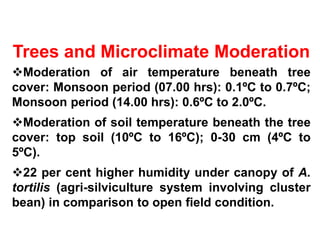
Trees and Microclimate Moderation
Moderation of air temperature beneath tree
cover: Monsoon period (07.00 hrs): 0.1ºC to 0.7ºC;
Monsoon period (14.00 hrs): 0.6ºC to 2.0ºC.
Moderation of soil temperature beneath the tree
cover: top soil (10ºC to 16ºC); 0-30 cm (4ºC to
5ºC).
22 per cent higher humidity under canopy of A.
tortilis (agri-silviculture system involving cluster
bean) in comparison to open field condition.
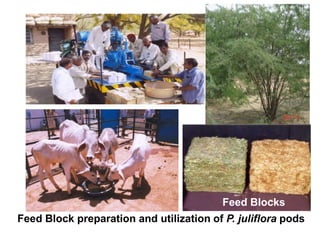
Feed Blocks
Feeding on Feed Blocks during Scarcity

Feed Block preparation and utilization of P. juliflora pods
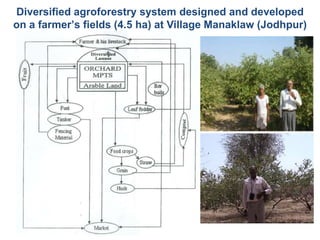
Diversified agroforestry system designed and developed
on a farmer’s fields (4.5 ha) at Village Manaklaw (Jodhpur)
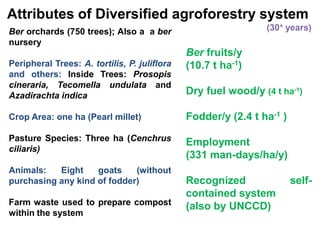
Attributes of Diversified agroforestry system
(30+ years)

Ber orchards (750 trees); Also a a ber
nursery
Peripheral Trees: A. tortilis, P. juliflora
and others: Inside Trees: Prosopis
cineraria, Tecomella undulata and
Azadirachta indica

Ber fruits/y
(10.7 t ha-1)
Dry fuel wood/y (4 t ha-1)

Crop Area: one ha (Pearl millet)

Fodder/y (2.4 t ha-1 )

Pasture Species: Three ha (Cenchrus
ciliaris)

Employment
(331 man-days/ha/y)

Animals:
Eight
goats
(without
purchasing any kind of fodder)

Farm waste used to prepare compost
within the system

Recognized
contained system
(also by UNCCD)

self-
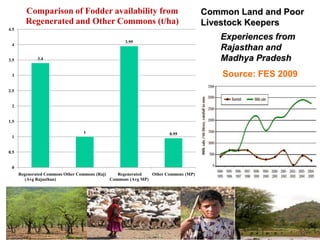
Comparison of Fodder availability from
Regenerated and Other Commons (t/ha)

Common Land and Poor
Livestock Keepers

4.5

3.5

Experiences from
Rajasthan and
Madhya Pradesh

3.95

4
3.4

Source: FES 2009

3

2.5

2

1.5
1
1

0.95

0.5

0
Regenerated Commons Other Commons (Raj)
Regenerated
Other Commons (MP)
(Avg Rajasthan)
Commons (Avg MP)
Conclusion
Agroforestry based interventions (low carbon
farming strategy) have promise in hot arid
regions of the country for providing consistent
economic returns along with and environmental
benefits, including carbon sequestration.
They need promotion through various
appropriate schemes in operation in this region.
Schemes & AF Systems
Schemes
• Wasteland
development
• Watershed
development
• Dry degraded soils
• Salt affected soils
• Water logged soils

AF Systems
Agroforestry/silvo-pasture
systems
Rehabilitation & restoration of
degraded lands/mine spoils
Afforestation & reforestation
through planting the nitrogen
fixing tree species
Plantation on field boundaries
Shelterbelts/Windbreaks
Future Thrusts
 Use of non-conventional sources of energy for
agriculture/agroforestry
 Effective
management
and
utilization
of
CPRs, degraded lands, grasslands/grazing lands and
agriculture lands
 Adequate incentives to farmers for the cause of their
environmental services
 A policy to facilitate establishment of carbon
markets for farmers/other stake holders for better
adoption of climate friendly management practices
Session 1.4 design & devp of agroforestry systems

Session 1.4 design & devp of agroforestry systems

  • 1.
    Design and Developmentof Agroforestry Systems in Low Rainfall Regions of India for Combating Climate Change M. M. Roy Central Arid Zone Research Institute, Jodhpur (Raj.) 342003 INDIA
  • 2.
  • 3.
    Challenges before aridlands Bad irrigation practices Over-cultivation DESERIFICATION Overgrazing Deforestation •Soil Erosion (Wind & Water) •Vegetation Degradation •Salinization •Mined Spoiled Degradation
  • 4.
    THE CHALLENGES Periodic droughtsdebilitate and destabilize poor societies, and contribute to desertification by reducing vegetative cover and water supplies, triggering a desperate exploitation of the remaining resources in order to survive Bad irrigation practices Over-cultivation DESERIFICATION Deforestation Map showing ground water withdrawals as percentage ofOvergrazing ground water recharge based on state level estimates of annual withdrawals (Source NASA/Matt Rodell)
  • 5.
    Depletion of groundwater Year Year Year Year 203 200 150 1984 1998 2002 2004 135 100 102 86 80 82 49 50 34 25 10 41 2127 26 11 12 0 Safe Drawl as % of Recharge Semi-critical <= 70% 70-90% Critical Over exploited 90-100% >100%
  • 6.
    Climatic Risks Light tomoderate rainfall events (5-100 mm) Heavy rainfall events (>10cm) Very heavy rainfall events (>15cm) Increase in temperatures, hot days, hot nights, and heat waves Increasing frequency of heavy precipitation events - more droughts and floods
  • 7.
    Rajasthan: Land useand water resources
  • 8.
    Extent of distribution -60% area of arid western Rajasthan Prosopis cineraria based traditional agroforestry system Rainfall Zone (mm) >400 Traditional Agro forestry Systems in Hot Arid Regions Agro Forestry System Trees / Shrubs % Density of (no. / Prominent ha) Species P. cineraria - A. nilotica based (11)* 31.40 81 300 - 400 P. cineraria based (8) 14.20 80 Ziziphus spp. - P. cineraria based 200 - 300 (6) 91.70 91 Ziziphus spp. - P. cineraria <200 Salvadora spp. based (7) 12.70 87 *Values in parentheses are total number of trees &/or shrub species in the system
  • 9.
    Economics of TraditionalAgroforestry Systems of Arid Western Rajasthan AF system P. cineraria-A. nilotica based P. cineraria based Z. spp. - P. cineraria based Z. spp. - P. cineraria Salvadora spp. based (Base year 2000) Expenditure (Rs/ha) Returns (Rs/ha) Gross Net Net Fuel Leaf returns Returns B:C Crops wood fodder (Rs/ha) (Rs/ha) ratio 1850 4103 1230 870 6203 4353 2.3 1550 3670 600 420 4690 3140 2.0 1550 1506 620 600 2726 1176 0.7 1500 1400 500 500 2400 900 0.6
  • 10.
    Designing agroforestry systemsfor multiple benefits in hot arid regions of India Type Row Example Wind break Contour strips Multi-storey Cropping Benefits This may be for protecting farm or field, livestock and farmsteads. Carefully designed field windbreaks reduce wind velocity for controlling wind erosion, increase crop quality and production, and improve water use efficiency, control energy loss and feed intake by livestock, protect and improve human habitat Plantings consisting of tree/shrub rows on the contour or cross-slopes. This reduces sheet and rill water erosion, increase sediment deposition and convey excess water at a controlled grade. System consisting of an over-story of trees or shrubs with an understory of crops or pastures. Well-designed systems yield additional tree based products, improve microclimatic conditions, improve recycling of soil nutrients, reduce excess sub-surface water.
  • 11.
    Designing agroforestry systemsfor multiple benefits in hot arid regions of India Type Block Example Energy plantation Benefits Trees are planted in a block as a separate field within an agricultural or livestockproduction operating unit. The tree to tree distance is decided based on product (wood, firewood, top feed etc.) and rotation cycle (generally less than 10-15 years). The primary purpose is to get tree products in close proximity to agricultural or pasture areas to diversify the farm products. A block planting of closely spaced trees Waste water and/or shrubs placed downslope from agricultural water or waste sources. The utilization primary purpose is to use excess water by plant uptake, and/or intercept and utilize or sequester waste and other pollutants transported in specific situations.
  • 12.
    WINDBREAK-SHELTERBELT A windbreak orshelterbelt is a plantation usually made up of one or more rows of trees or shrubs planted in such a manner as to provide shelter from the wind and to protect soil from erosion. They are commonly planted around the edges of fields on farms. Five-row and three-row shelterbelts with staggered planting and in pyramidal shape across the wind direction. Suitable trees and shrubs are Acacia nilotica, Acacia tortilis, Cassia siamea and Prosopis juliflora. Windbreak reduces the wind velocity by 20-40% and soil loss by 76%.
  • 13.
    After 10 years Khejri+ Bajra + Mung TC= 20.31 t C/ha (depth 1 m) Agroforestry systems (10 year rotation) Khejri +Mung
  • 14.
    Horti-agri system Ber +Mung TC = 18.28 t C/ha (depth 1 m) (after 10 years)
  • 15.
    Silvopastoral system (12 yearrotation) Khejri + Cenchrus ciliaris Carbon assimilation Tree : 12.37 t C/ha TC : 35.68 t C/ha (depth 1 m) Above ground : 19.56 t C/ha
  • 16.
    Silvopastoral system (12 yearrotation) Mopane + Cenchrus ciliaris Carbon assimilation Tree : 7.96 t C/ha TC : 28.59 t C/ha (depth 1 m) Above ground : 18.24 t C/ha
  • 17.
    Silvopastoral system (12 yearrotation) Hardwickia binata + C. ciliaris Carbon assimilation Tree : 8.78 t C/ha TC : 32.14 t C/ha (depth 1 m) Above ground : 21.36 t C/ha
  • 18.
    Ziziphus based horti-pastures (Spreadon 90,000 ha in 350-450 mm rainfall) ))) Ber + Cenchrus ciliaris Dry Grass : 1.55 t/ha Fuel wood : 2.64 t/ha Leaf Fodder : 1.87 t/ha Fruit : 2.77 t/ha Net return: 15,000/ha B:C ratio: 2:1 TC=24.41 t C/ha (after 10 years) (depth 1 m)
  • 19.
    Economics of ImprovedHorti-pasture (Ziziphus mauritiana + Cenchrus ciliaris) Expenditure Gross returns Net returns Product (Rs/ha) (Rs/ha) (Rs/ha) Grass 1500 3102 1600 Fuel wood 1000 6400 1640 Leaf 2250 5610 3360 fodder Ber fruits 13500 22160 8660 Total (Base year 2000) 18250 37272 15260
  • 20.
    System/Crop Diversification Models •Arable cropping (15%), Agroforestry (35%), Agrihorticulture (20%), Agri-pasture (10%), Silvi-pasture (20%) • Crop Diversification: – Pearl millet (40%), Pulses (30%), oilseed (10%), cluster bean (20%) • Farm size (Aarea) 7 ha • Family size 4-5 adults • Livestock 2 Cows + 2 Calf + 8 Sheep + 8 Goat = 7ACU
  • 21.
    The Returns (perha) Component Gross returns Expenditure Net income B.C. ratio Plant 1,85,550 63,000 1,22,550 - Animal 1,57,700 35,000 1,22,700 - 50,000 - Other Total 50,000 3,93,250 98,000 (Base year 2011); WPI = 212.72 (2000) 2,95,250 4.01
  • 22.
    C Sequestration Potentialand Rate in different regions of India under crop production with INM C sequestration Potential and Rate 8.00 7.00 6.00 Potential (Mg C ha-1) Rate (Mg C ha-1 Yr-1) 5.00 4.00 3.00 2.00 1.00 0.00 Northern India Western India Central India Southern India Eastern India After Pathak et al (2011)
  • 23.
    Carbon status inarid zone soils 35.00 Organic C (tons ha-1) 30.00 25.00 20.00 15.00 10.00 5.00 0.00 665.00 400.00 360.00 327.00 232.90 200.00 Rainfall (mm) Organic carbon up to 45 cm deep soil profile was estimated in crop land + natural rangeland + forest area with long term average rainfall from 665 mm to 200 mm yr-1(Average of all three systems).
  • 24.
    Sirohi Annual Rainfall (mm)591.8 Total C Stock 33.4 (0-60 cm) t ha-1 Pali Annual Rainfall (mm) 539 Total C Stock 33.4 (0-60 cm) t ha-1 Jodhpur Annual Rainfall (mm) 360 Total C Stock 10.9 (0-60 cm) t ha-1 Barmer Annual Rainfall (mm) 277 Total C Stock 10.7 (0-60 cm) t ha-1 Jaisalmer Annual Rainfall (mm) 165 Total C Stock 7.4 (0-60 cm) t ha-1 C status of the arid soils
  • 25.
    Soil organic carbonstatus of different Systems in arid region prevailing at Jodhpur (after 22 years) Systems Pasture Grasses Carbon Sequestered in soil (0-60 cm) (t/ha/y) 0.52 Sole trees 0.72 Silvi-pasture Continuous cropping 0.98 0.36
  • 26.
    Trees and MicroclimateModeration Moderation of air temperature beneath tree cover: Monsoon period (07.00 hrs): 0.1ºC to 0.7ºC; Monsoon period (14.00 hrs): 0.6ºC to 2.0ºC. Moderation of soil temperature beneath the tree cover: top soil (10ºC to 16ºC); 0-30 cm (4ºC to 5ºC). 22 per cent higher humidity under canopy of A. tortilis (agri-silviculture system involving cluster bean) in comparison to open field condition.
  • 28.
    Feed Blocks Feeding onFeed Blocks during Scarcity Feed Block preparation and utilization of P. juliflora pods
  • 29.
    Diversified agroforestry systemdesigned and developed on a farmer’s fields (4.5 ha) at Village Manaklaw (Jodhpur)
  • 30.
    Attributes of Diversifiedagroforestry system (30+ years) Ber orchards (750 trees); Also a a ber nursery Peripheral Trees: A. tortilis, P. juliflora and others: Inside Trees: Prosopis cineraria, Tecomella undulata and Azadirachta indica Ber fruits/y (10.7 t ha-1) Dry fuel wood/y (4 t ha-1) Crop Area: one ha (Pearl millet) Fodder/y (2.4 t ha-1 ) Pasture Species: Three ha (Cenchrus ciliaris) Employment (331 man-days/ha/y) Animals: Eight goats (without purchasing any kind of fodder) Farm waste used to prepare compost within the system Recognized contained system (also by UNCCD) self-
  • 31.
    Comparison of Fodderavailability from Regenerated and Other Commons (t/ha) Common Land and Poor Livestock Keepers 4.5 3.5 Experiences from Rajasthan and Madhya Pradesh 3.95 4 3.4 Source: FES 2009 3 2.5 2 1.5 1 1 0.95 0.5 0 Regenerated Commons Other Commons (Raj) Regenerated Other Commons (MP) (Avg Rajasthan) Commons (Avg MP)
  • 32.
    Conclusion Agroforestry based interventions(low carbon farming strategy) have promise in hot arid regions of the country for providing consistent economic returns along with and environmental benefits, including carbon sequestration. They need promotion through various appropriate schemes in operation in this region.
  • 33.
    Schemes & AFSystems Schemes • Wasteland development • Watershed development • Dry degraded soils • Salt affected soils • Water logged soils AF Systems Agroforestry/silvo-pasture systems Rehabilitation & restoration of degraded lands/mine spoils Afforestation & reforestation through planting the nitrogen fixing tree species Plantation on field boundaries Shelterbelts/Windbreaks
  • 34.
    Future Thrusts  Useof non-conventional sources of energy for agriculture/agroforestry  Effective management and utilization of CPRs, degraded lands, grasslands/grazing lands and agriculture lands  Adequate incentives to farmers for the cause of their environmental services  A policy to facilitate establishment of carbon markets for farmers/other stake holders for better adoption of climate friendly management practices