Gurunath Upparatti
PALB 5185
DEPT OF AGRONOMY
GKVK , BENGALURU
A shift of a crop or cropping system to
another crop or cropping system.
Use of resources in best possible way by
changing and modifying the spatial and
temporal crop/cropping activities.
A shift from less profitable and
sustainable crop or cropping system to
more profitable and sustainable
crop/cropping system.
CONCEPT OF CROP DIVERSIFICATIONCONCEPT OF CROP DIVERSIFICATION
Animal
Husbandry
Mixed
farming
Horticulture
Floriculture
Sericulture
Forestry
Low YieldingLow Yielding
Food grainFood grain
cropscrops
DIVERSIFIED AGRICULTUREDIVERSIFIED AGRICULTURE
APPROACHES OF CROP DIVERSIFICATIONAPPROACHES OF CROP DIVERSIFICATION
(A) Horizontal diversification:
(a) Crop substitution
(b) Crop intensification
(B) Vertical diversification:
(C) Other approaches:
► Land based approach
► Water based approach
► Varietal diversification
Diversity Index
• Diversification may be broadly defined as a
shift of resources from low value
agriculture to high value agriculture as
indicated by Hayami and Otsuka (1992) or
Vyas (1996).
• Few measures of diversification, important
ones include Herfindal Index, Simpson
Diversity Index, Ogive Index and Entropy
Index.
SDI
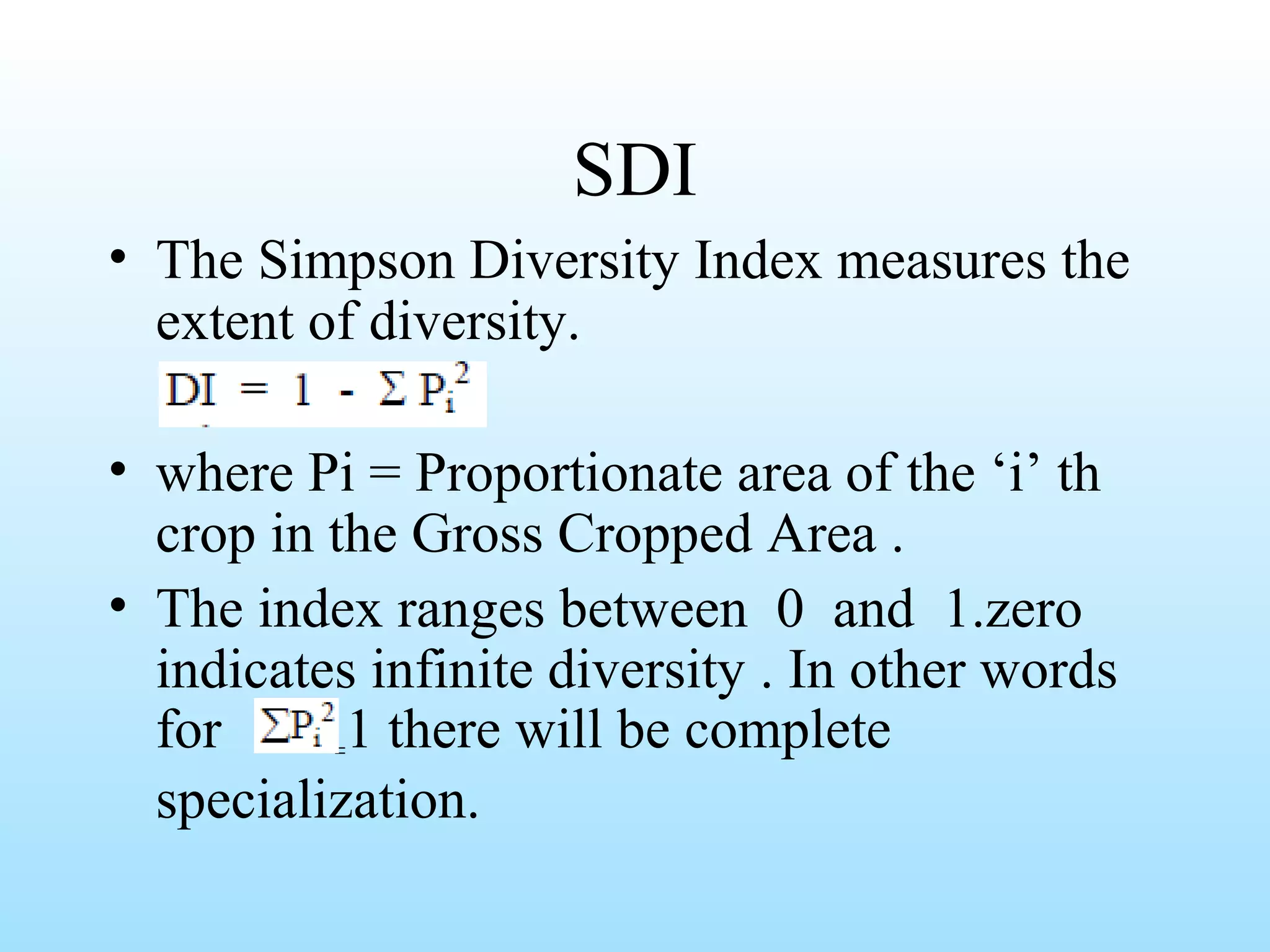
• The Simpson Diversity Index measures the
extent of diversity.
• where Pi = Proportionate area of the ‘i’ th
crop in the Gross Cropped Area .
• The index ranges between 0 and 1.zero
indicates infinite diversity . In other words
for =1 there will be complete
specialization.
Diversification areas
From Low value to High value crops;
From Water Loving crop to Water Saving crop (Aerobic
rice, SRI)
From Single crop to Multiple / Mixed crop
From Crop alone to crop with Crop-livestock-fish-
apiculture
From Agriculture Production to Production with
Processing and Value Addition
NICRA
Intercropping
Major Driving Forces for Crop
Diversification
1. Increasing income on small farm holdings.
2. Withstanding price fluctuation.
3. Mitigating ill-effects of aberrant weather.
4. Balancing food demand.
5. Improving fodder for livestock animals.
6. Conservation of natural resources (soil, water,
etc.).
7. Minimizing environmental pollution.
8. Reducing dependence on off-farm inputs.
9. Decreasing insect pests, diseases and weed
problems.
10. Increasing community Food security
NEED OF CROP DIVERSIFICATIONNEED OF CROP DIVERSIFICATION
Crop diversification has become an
important option to attain several
objectives Viz.
 Natural resources sustainability
 Ecological balance,
 Output growth,
 Employment generation,
 Risk coverage : Mono cropping
high risk, etc
Reducing risks associated with yield, market
and prices,
Arresting the degradation of natural
resources and environment and
Attaining the national goals like self-reliance
in critical crop products, earning foreign
exchange and employment generation.
Thus, the necessity for crop diversificationThus, the necessity for crop diversification
arises on account of the need for-arises on account of the need for-
 Environmental factors
rainfall, temperature, and soil fertility.
 Agro climatic conditions
 Soil
 Labor
 Facility of irrigation
 Technological factors
 House hold factors
 Institutional and infrastructural factors
 Price factors
DETERMINANTS OF CROP DIVERSIFICATIONDETERMINANTS OF CROP DIVERSIFICATION
For raising farm income.
Sustainable production and income.
Food and nutrient security.
Promotion of export.
Employment generation.
Poverty alleviation.
Judicious use of land and water
resources.
The important facts highlighting the needThe important facts highlighting the need
of crop diversification in India:of crop diversification in India:
The important facts highlighting the needThe important facts highlighting the need
of crop diversification in India:of crop diversification in India:
Priorities for crop diversification in IndiaPriorities for crop diversification in India
1) Changing of resource use efficiency
parameters.
2) Crop rotation effect.
3) Incorporation of crops and technologies.
4) Research on actual farm environment
through farmer participatory mode.
5) Assurance against the risk to farmers
under changing weather and sharp
fluctuation in prices.
6) National issues like nutritional and food
security.
Crop diversification under assured
irrigation situations.
Crop diversification under water
scarce conditions.
Crop diversification for nutrient
management.
The important crop diversification
approaches in rainfed areas of India
Delineate area : Scientific data base priorities and
target the area.
Choice of alternative crops and technology.
Priority Input / credit supply for alternative crops.
Share the risk of new system.
Market support - Rural uplinking.
Crop Diversification
REQUIRED STEPS FOR DIVERSIFICATIONREQUIRED STEPS FOR DIVERSIFICATION
Poudel Acharya et al.,
 diversification index during post-WTO
(1995-96 to 2007-08) than during pre-WTO
(1982-83 to 1994-95) period, except for
oilseeds and vegetable crops. There has
been a vast increase in diversification of
commercial crops after WTO.
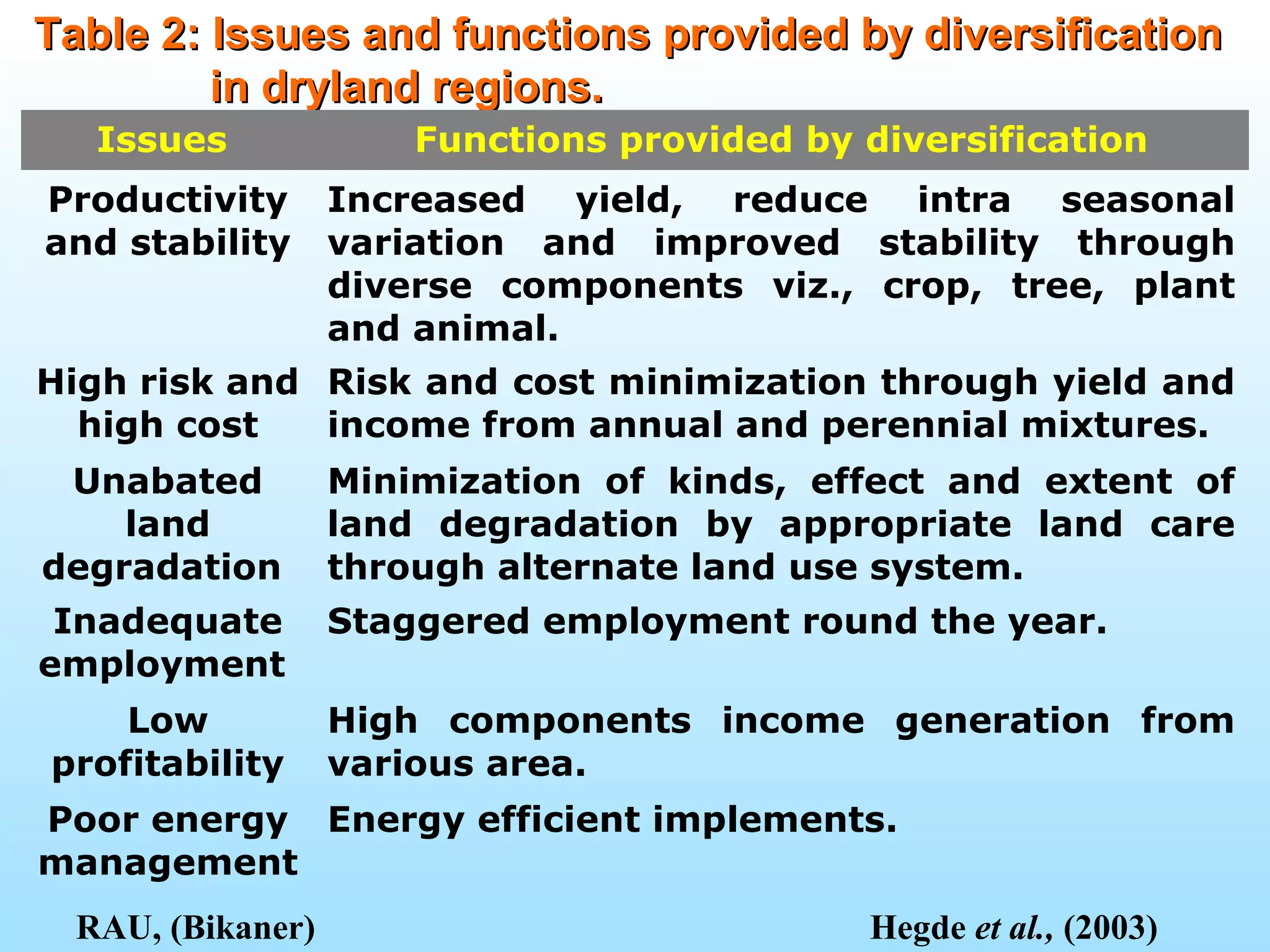
Table 2: Issues and functions provided by diversificationTable 2: Issues and functions provided by diversification
in dryland regions.in dryland regions.
Hegde et al., (2003)RAU, (Bikaner)
Issues Functions provided by diversification
Productivity
and stability
Increased yield, reduce intra seasonal
variation and improved stability through
diverse components viz., crop, tree, plant
and animal.
High risk and
high cost
Risk and cost minimization through yield and
income from annual and perennial mixtures.
Unabated
land
degradation
Minimization of kinds, effect and extent of
land degradation by appropriate land care
through alternate land use system.
Inadequate
employment
Staggered employment round the year.
Low
profitability
High components income generation from
various area.
Poor energy
management
Energy efficient implements.
Key determining factors:Key determining factors:
Farmers AngleFarmers Angle
 Profit margin of new system
 Availability of market for produce
 Ease of operation / cultivation /
storage
 Risk factor / technology available
 Other compelling reasons to shift for a
new system
 Incentive, if any.
Over all strategies for crop diversificationOver all strategies for crop diversification
Diversion of high water requiring crops to
less water intensive crops.
Diversion of cotton to pulses, oilseeds and
maize in light textured and shallow soils.
Replacement of low yielding low value
coarse cereals to high yielding high value
crops like pulses.
Inter cropping or mixed cropping be
promoted in dry areas.
Shift high risk crops with short duration
pulses and drought resistant oilseeds
crops.
Table 3. Extent of Diversification
in South Asian Countries
Table 4.Annual compound growth rates (%) of area, production
and yield of major commodity groups in South Asian countries
Joshi et al.,2003
2424
Sr.
no
State Main
crop
Kharif
alternate
crop
Main
crop
Rabi alternate
crop
1 Punjab Rice Maize,
moong/urad
Wheat Mustard, chick
pea, lentil, field
peas
2 Uttar
Pradesh
Rice Arhar (short
duration)
moong/urad
Wheat Mustard, chick
pea, lentil, field
peas
3 Bihar Rice Not
suggested
as most of
the rice area
is
waterlogged
Wheat Maize, mustard,
lentil.
Table 5: Suggested Alternate Crops In Place Of Rice
And Wheat In Major Growing States.
Hazra (2003)New Delhi
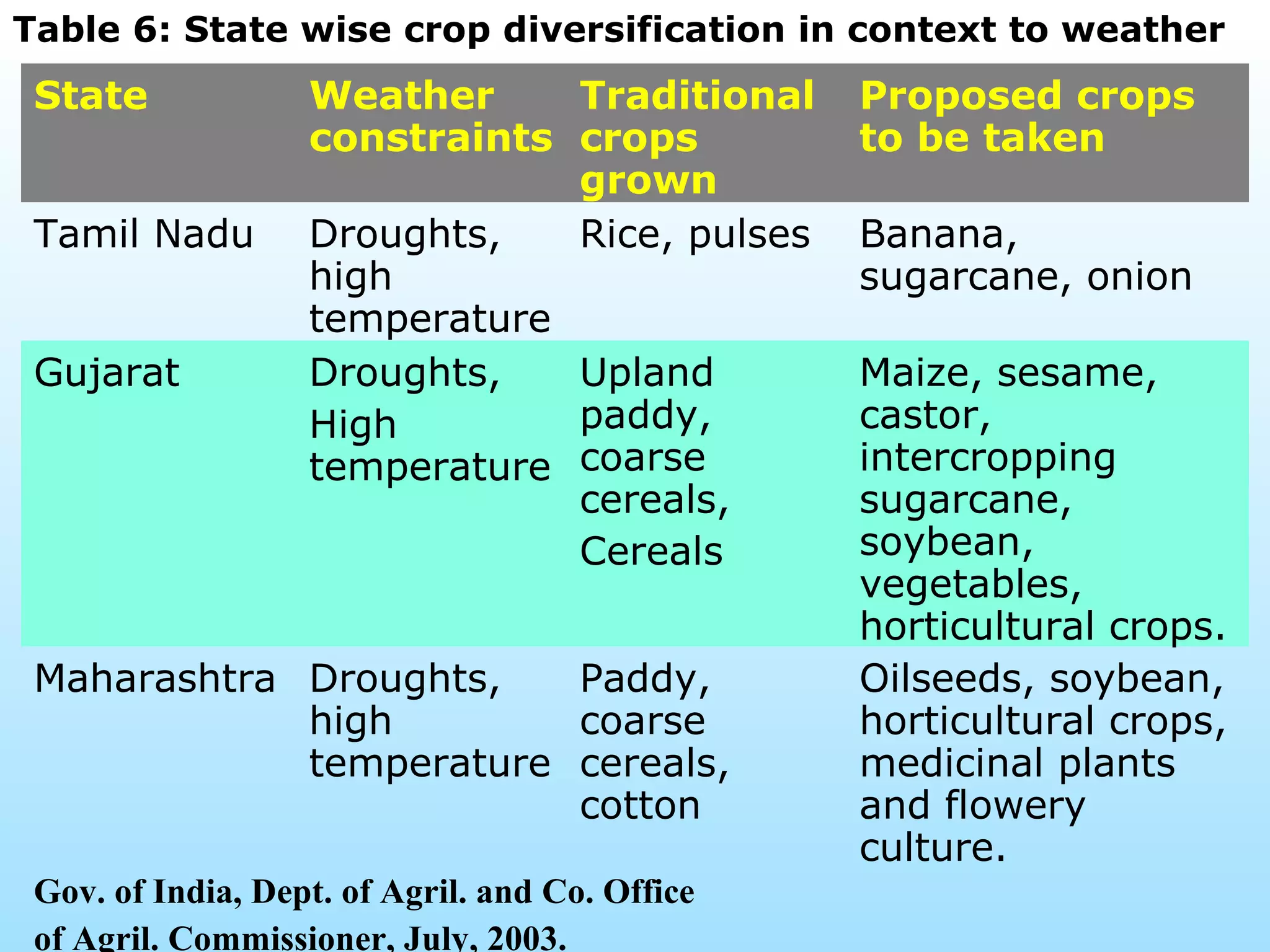
State Weather
constraints
Traditional
crops
grown
Proposed crops
to be taken
Tamil Nadu Droughts,
high
temperature
Rice, pulses Banana,
sugarcane, onion
Gujarat Droughts,
High
temperature
Upland
paddy,
coarse
cereals,
Cereals
Maize, sesame,
castor,
intercropping
sugarcane,
soybean,
vegetables,
horticultural crops.
Maharashtra Droughts,
high
temperature
Paddy,
coarse
cereals,
cotton
Oilseeds, soybean,
horticultural crops,
medicinal plants
and flowery
culture.
Table 6: State wise crop diversification in context to weather
Gov. of India, Dept. of Agril. and Co. Office
of Agril. Commissioner, July, 2003.
26
Farmers name Villages Yield(kg/ha) Diversified
crop –
Groundnut
Traditional -
Bajara
Increase in
income of
farmers
(Rs/ha)
Bhatol Manjibhai
Ramjibhai
Jalotra
(BK)
Main product yield
(kg/ha)
1800 2700
16725
By-product yield
(kg/ha)
2050 3450
Main product
(Rs/kg)
26 11
By product (Rs/kg) 1.5 1.0
Parmar
Rameshbhai
Nanjibhai
Bhudrada
(Patan)
Yield(kg/ha)
Cumin
Diversified
crop-Cumin
Traditional
crop-Wheat
10675
Main product yield 425 2150
By-product yield - 3400
Value of main
product (Rs/kg)
109 15
Value of by
product (Rs/kg)
- 1.0
Table:7 Crop diversification in FPARP site at farmer's field
S.K.Nagar FPARP – Report 2009-10
Treatment Return (Rs/ha) Gross
return
(Rs/ha)
REY
(t/ha)
Producti
vity
(kg/ha/d
ay)
Net
return
(Rs/ha)
Profitabi
lity
(Rs/ha/d
ay)
B:C
ratio
Main
product
yield
By
product
yield
Rice-wheat 58045 8400 66445 11.07 30.34 34719 95.32 1.10
Hybrid rice-vegetable pea-
green gram
70260 1300 71560 11.93 32.68 33733 92.42 0.89
Hybrid rice-vegetable pea-
wheat-vegetable cowpea
89940 8240 98180 16.36 44.83 55693 152.58 1.31
Maize+ vegetable cowpea
+ sesbania-lentil +
mustard-green gram
102000 4938 106938 17.82 48.83 64495 176.70 1.52
Maize+ cowpea-wheat –
green gram
84800 10629 95429 15.90 43.57 55886 153.11 1.41
Pigeon pea + black gram –
wheat- green gram
81600 10418 92018 15.34 42.02 53834 147.49 1.41
Sorghum+ cowpea – maize
+ black gram – onion
165000 1780 166780 27.80 76.16 106935 292.97 1.79
Table:8 Bio-intensive complimentary cropping systems for higher
productivity and profitability as alternative to rice-wheat
Table:8 Bio-intensive complimentary cropping systems for higher
productivity and profitability as alternative to rice-wheat
Modipuram (2008) Gangwar et al.
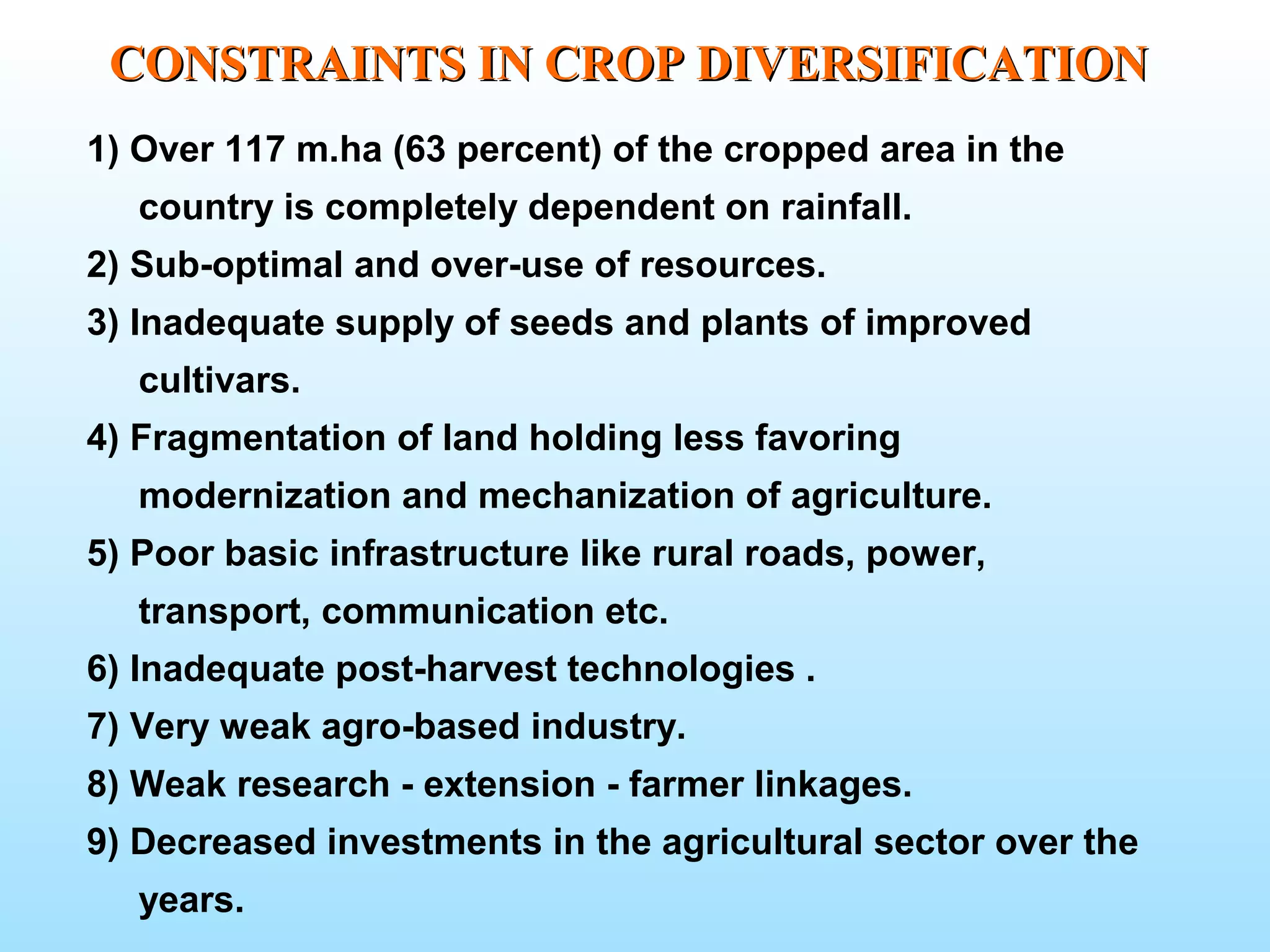
CONSTRAINTS IN CROP DIVERSIFICATIONCONSTRAINTS IN CROP DIVERSIFICATION
1) Over 117 m.ha (63 percent) of the cropped area in the
country is completely dependent on rainfall.
2) Sub-optimal and over-use of resources.
3) Inadequate supply of seeds and plants of improved
cultivars.
4) Fragmentation of land holding less favoring
modernization and mechanization of agriculture.
5) Poor basic infrastructure like rural roads, power,
transport, communication etc.
6) Inadequate post-harvest technologies .
7) Very weak agro-based industry.
8) Weak research - extension - farmer linkages.
9) Decreased investments in the agricultural sector over the
years.
GOVERNMENT POLICIES AND STRATEGIES FORGOVERNMENT POLICIES AND STRATEGIES FOR
CROP DIVERSIFICATIONCROP DIVERSIFICATION
Implementing National Agriculture Insurance Scheme.
 Operationalzing Technology Mission on Cotton.
 Provision of Capital Subsidy of 25 percent for
Construction / Modernization / Expansion of Cold
Storages and Storages for Horticultural Produce.
 Creation of Watershed Development Fund.
 Strengthening Agricultural Marketing.
 Seed Crop Insurance.
 Seed Bank Scheme.
 Cooperative Sector Reforms.
CONCLUSION
Crop diversification or crop shift is a new
paradigm of sustainable agriculture. Crop
diversification is not only a shift from traditional and
less remunerative crop (s) to more remunerative crop
(s) but it is a demand driven, need based situation
specific and national goal seeking continuous and
dynamic concept and involves spatial, temporal, value
addition and resource complementary approaches.
However, crop substitution and addition of more crops
in existing cropping system has been the major
approach of diversification in India. The nature of crop
diversification is has been mainly from low value
coarse cereals to high value oilseeds and other food
grains.
FUTURE THRUST:
 Inclusion of high value crops through horizontal and
vertical diversification approach.
 Need to synthesize high potential cropping systems and
evaluate both on station and on farm in farmers participatory
approach.
 The crop varieties short in duration with high potential yield
and most suited for the synthesized systems needs to be
identified.
 The location specific approaches and full packages need to
be prepared.
 For arid and semi arid areas the crops and cropping systems
for long term sustainability should be preferred.
3232
DETERMINANTS OF CROP
DIVERSIFICATION
1.
Crop intensification and crop diversification are the budge
words in agricultural scenario at the national and international
levels. During the period of green revolution when there was a
need of enhancing total food grain production, emphasis was
given on increasing the cropping intensity and crop productivity
but in long term, this approach digressed from the principles of
crop production, where the basics of crop rotation and crop
sequences played an important role.
Under such situations, approach of diversification has
been envisaged as a new strategy towards enhancing and
stabilizing productivity, making Indian agriculture export
competitive and increasing net farm income and economic
security. Agriculture and crop diversification is now almost a
normal feature of stable agriculture and progressive farm
management in most of the extensive agricultural parts of the
world (Joshi et al., 2004).
35
.

Crop diversification for Sustainable Agriculture

  • 1.
    Gurunath Upparatti PALB 5185 DEPTOF AGRONOMY GKVK , BENGALURU
  • 2.
    A shift ofa crop or cropping system to another crop or cropping system. Use of resources in best possible way by changing and modifying the spatial and temporal crop/cropping activities. A shift from less profitable and sustainable crop or cropping system to more profitable and sustainable crop/cropping system. CONCEPT OF CROP DIVERSIFICATIONCONCEPT OF CROP DIVERSIFICATION
  • 3.
    Animal Husbandry Mixed farming Horticulture Floriculture Sericulture Forestry Low YieldingLow Yielding FoodgrainFood grain cropscrops DIVERSIFIED AGRICULTUREDIVERSIFIED AGRICULTURE
  • 4.
    APPROACHES OF CROPDIVERSIFICATIONAPPROACHES OF CROP DIVERSIFICATION (A) Horizontal diversification: (a) Crop substitution (b) Crop intensification (B) Vertical diversification: (C) Other approaches: ► Land based approach ► Water based approach ► Varietal diversification
  • 5.
    Diversity Index • Diversificationmay be broadly defined as a shift of resources from low value agriculture to high value agriculture as indicated by Hayami and Otsuka (1992) or Vyas (1996). • Few measures of diversification, important ones include Herfindal Index, Simpson Diversity Index, Ogive Index and Entropy Index.
  • 6.
    SDI • The SimpsonDiversity Index measures the extent of diversity. • where Pi = Proportionate area of the ‘i’ th crop in the Gross Cropped Area . • The index ranges between 0 and 1.zero indicates infinite diversity . In other words for =1 there will be complete specialization.
  • 7.
    Diversification areas From Lowvalue to High value crops; From Water Loving crop to Water Saving crop (Aerobic rice, SRI) From Single crop to Multiple / Mixed crop From Crop alone to crop with Crop-livestock-fish- apiculture From Agriculture Production to Production with Processing and Value Addition
  • 8.
  • 9.
    Major Driving Forcesfor Crop Diversification 1. Increasing income on small farm holdings. 2. Withstanding price fluctuation. 3. Mitigating ill-effects of aberrant weather. 4. Balancing food demand. 5. Improving fodder for livestock animals. 6. Conservation of natural resources (soil, water, etc.). 7. Minimizing environmental pollution. 8. Reducing dependence on off-farm inputs. 9. Decreasing insect pests, diseases and weed problems. 10. Increasing community Food security
  • 10.
    NEED OF CROPDIVERSIFICATIONNEED OF CROP DIVERSIFICATION Crop diversification has become an important option to attain several objectives Viz.  Natural resources sustainability  Ecological balance,  Output growth,  Employment generation,  Risk coverage : Mono cropping high risk, etc
  • 11.
    Reducing risks associatedwith yield, market and prices, Arresting the degradation of natural resources and environment and Attaining the national goals like self-reliance in critical crop products, earning foreign exchange and employment generation. Thus, the necessity for crop diversificationThus, the necessity for crop diversification arises on account of the need for-arises on account of the need for-
  • 12.
     Environmental factors rainfall,temperature, and soil fertility.  Agro climatic conditions  Soil  Labor  Facility of irrigation  Technological factors  House hold factors  Institutional and infrastructural factors  Price factors DETERMINANTS OF CROP DIVERSIFICATIONDETERMINANTS OF CROP DIVERSIFICATION
  • 13.
    For raising farmincome. Sustainable production and income. Food and nutrient security. Promotion of export. Employment generation. Poverty alleviation. Judicious use of land and water resources. The important facts highlighting the needThe important facts highlighting the need of crop diversification in India:of crop diversification in India: The important facts highlighting the needThe important facts highlighting the need of crop diversification in India:of crop diversification in India:
  • 14.
    Priorities for cropdiversification in IndiaPriorities for crop diversification in India 1) Changing of resource use efficiency parameters. 2) Crop rotation effect. 3) Incorporation of crops and technologies. 4) Research on actual farm environment through farmer participatory mode. 5) Assurance against the risk to farmers under changing weather and sharp fluctuation in prices. 6) National issues like nutritional and food security.
  • 15.
    Crop diversification underassured irrigation situations. Crop diversification under water scarce conditions. Crop diversification for nutrient management. The important crop diversification approaches in rainfed areas of India
  • 16.
    Delineate area :Scientific data base priorities and target the area. Choice of alternative crops and technology. Priority Input / credit supply for alternative crops. Share the risk of new system. Market support - Rural uplinking. Crop Diversification REQUIRED STEPS FOR DIVERSIFICATIONREQUIRED STEPS FOR DIVERSIFICATION
  • 17.
  • 18.
     diversification indexduring post-WTO (1995-96 to 2007-08) than during pre-WTO (1982-83 to 1994-95) period, except for oilseeds and vegetable crops. There has been a vast increase in diversification of commercial crops after WTO.
  • 19.
    Table 2: Issuesand functions provided by diversificationTable 2: Issues and functions provided by diversification in dryland regions.in dryland regions. Hegde et al., (2003)RAU, (Bikaner) Issues Functions provided by diversification Productivity and stability Increased yield, reduce intra seasonal variation and improved stability through diverse components viz., crop, tree, plant and animal. High risk and high cost Risk and cost minimization through yield and income from annual and perennial mixtures. Unabated land degradation Minimization of kinds, effect and extent of land degradation by appropriate land care through alternate land use system. Inadequate employment Staggered employment round the year. Low profitability High components income generation from various area. Poor energy management Energy efficient implements.
  • 20.
    Key determining factors:Keydetermining factors: Farmers AngleFarmers Angle  Profit margin of new system  Availability of market for produce  Ease of operation / cultivation / storage  Risk factor / technology available  Other compelling reasons to shift for a new system  Incentive, if any.
  • 21.
    Over all strategiesfor crop diversificationOver all strategies for crop diversification Diversion of high water requiring crops to less water intensive crops. Diversion of cotton to pulses, oilseeds and maize in light textured and shallow soils. Replacement of low yielding low value coarse cereals to high yielding high value crops like pulses. Inter cropping or mixed cropping be promoted in dry areas. Shift high risk crops with short duration pulses and drought resistant oilseeds crops.
  • 22.
    Table 3. Extentof Diversification in South Asian Countries
  • 23.
    Table 4.Annual compoundgrowth rates (%) of area, production and yield of major commodity groups in South Asian countries Joshi et al.,2003
  • 24.
    2424 Sr. no State Main crop Kharif alternate crop Main crop Rabi alternate crop 1Punjab Rice Maize, moong/urad Wheat Mustard, chick pea, lentil, field peas 2 Uttar Pradesh Rice Arhar (short duration) moong/urad Wheat Mustard, chick pea, lentil, field peas 3 Bihar Rice Not suggested as most of the rice area is waterlogged Wheat Maize, mustard, lentil. Table 5: Suggested Alternate Crops In Place Of Rice And Wheat In Major Growing States. Hazra (2003)New Delhi
  • 25.
    State Weather constraints Traditional crops grown Proposed crops tobe taken Tamil Nadu Droughts, high temperature Rice, pulses Banana, sugarcane, onion Gujarat Droughts, High temperature Upland paddy, coarse cereals, Cereals Maize, sesame, castor, intercropping sugarcane, soybean, vegetables, horticultural crops. Maharashtra Droughts, high temperature Paddy, coarse cereals, cotton Oilseeds, soybean, horticultural crops, medicinal plants and flowery culture. Table 6: State wise crop diversification in context to weather Gov. of India, Dept. of Agril. and Co. Office of Agril. Commissioner, July, 2003.
  • 26.
    26 Farmers name VillagesYield(kg/ha) Diversified crop – Groundnut Traditional - Bajara Increase in income of farmers (Rs/ha) Bhatol Manjibhai Ramjibhai Jalotra (BK) Main product yield (kg/ha) 1800 2700 16725 By-product yield (kg/ha) 2050 3450 Main product (Rs/kg) 26 11 By product (Rs/kg) 1.5 1.0 Parmar Rameshbhai Nanjibhai Bhudrada (Patan) Yield(kg/ha) Cumin Diversified crop-Cumin Traditional crop-Wheat 10675 Main product yield 425 2150 By-product yield - 3400 Value of main product (Rs/kg) 109 15 Value of by product (Rs/kg) - 1.0 Table:7 Crop diversification in FPARP site at farmer's field S.K.Nagar FPARP – Report 2009-10
  • 27.
    Treatment Return (Rs/ha)Gross return (Rs/ha) REY (t/ha) Producti vity (kg/ha/d ay) Net return (Rs/ha) Profitabi lity (Rs/ha/d ay) B:C ratio Main product yield By product yield Rice-wheat 58045 8400 66445 11.07 30.34 34719 95.32 1.10 Hybrid rice-vegetable pea- green gram 70260 1300 71560 11.93 32.68 33733 92.42 0.89 Hybrid rice-vegetable pea- wheat-vegetable cowpea 89940 8240 98180 16.36 44.83 55693 152.58 1.31 Maize+ vegetable cowpea + sesbania-lentil + mustard-green gram 102000 4938 106938 17.82 48.83 64495 176.70 1.52 Maize+ cowpea-wheat – green gram 84800 10629 95429 15.90 43.57 55886 153.11 1.41 Pigeon pea + black gram – wheat- green gram 81600 10418 92018 15.34 42.02 53834 147.49 1.41 Sorghum+ cowpea – maize + black gram – onion 165000 1780 166780 27.80 76.16 106935 292.97 1.79 Table:8 Bio-intensive complimentary cropping systems for higher productivity and profitability as alternative to rice-wheat Table:8 Bio-intensive complimentary cropping systems for higher productivity and profitability as alternative to rice-wheat Modipuram (2008) Gangwar et al.
  • 28.
    CONSTRAINTS IN CROPDIVERSIFICATIONCONSTRAINTS IN CROP DIVERSIFICATION 1) Over 117 m.ha (63 percent) of the cropped area in the country is completely dependent on rainfall. 2) Sub-optimal and over-use of resources. 3) Inadequate supply of seeds and plants of improved cultivars. 4) Fragmentation of land holding less favoring modernization and mechanization of agriculture. 5) Poor basic infrastructure like rural roads, power, transport, communication etc. 6) Inadequate post-harvest technologies . 7) Very weak agro-based industry. 8) Weak research - extension - farmer linkages. 9) Decreased investments in the agricultural sector over the years.
  • 29.
    GOVERNMENT POLICIES ANDSTRATEGIES FORGOVERNMENT POLICIES AND STRATEGIES FOR CROP DIVERSIFICATIONCROP DIVERSIFICATION Implementing National Agriculture Insurance Scheme.  Operationalzing Technology Mission on Cotton.  Provision of Capital Subsidy of 25 percent for Construction / Modernization / Expansion of Cold Storages and Storages for Horticultural Produce.  Creation of Watershed Development Fund.  Strengthening Agricultural Marketing.  Seed Crop Insurance.  Seed Bank Scheme.  Cooperative Sector Reforms.
  • 30.
    CONCLUSION Crop diversification orcrop shift is a new paradigm of sustainable agriculture. Crop diversification is not only a shift from traditional and less remunerative crop (s) to more remunerative crop (s) but it is a demand driven, need based situation specific and national goal seeking continuous and dynamic concept and involves spatial, temporal, value addition and resource complementary approaches. However, crop substitution and addition of more crops in existing cropping system has been the major approach of diversification in India. The nature of crop diversification is has been mainly from low value coarse cereals to high value oilseeds and other food grains.
  • 31.
    FUTURE THRUST:  Inclusionof high value crops through horizontal and vertical diversification approach.  Need to synthesize high potential cropping systems and evaluate both on station and on farm in farmers participatory approach.  The crop varieties short in duration with high potential yield and most suited for the synthesized systems needs to be identified.  The location specific approaches and full packages need to be prepared.  For arid and semi arid areas the crops and cropping systems for long term sustainability should be preferred.
  • 32.
  • 33.
  • 34.
    Crop intensification andcrop diversification are the budge words in agricultural scenario at the national and international levels. During the period of green revolution when there was a need of enhancing total food grain production, emphasis was given on increasing the cropping intensity and crop productivity but in long term, this approach digressed from the principles of crop production, where the basics of crop rotation and crop sequences played an important role. Under such situations, approach of diversification has been envisaged as a new strategy towards enhancing and stabilizing productivity, making Indian agriculture export competitive and increasing net farm income and economic security. Agriculture and crop diversification is now almost a normal feature of stable agriculture and progressive farm management in most of the extensive agricultural parts of the world (Joshi et al., 2004).
  • 35.

Editor's Notes

  • #13 1 Environmental factors including irrigation, rainfall, temperature, and soil fertility. 2. Technology-related factors including seeds, fertilizers and water technologies, but also those related to marketing, harvest, storage, agro-processing, distribution, logistics, etc. 3. Household-related factors including regional food traditions, fodder and fuel as well as the labor and investment capacity of farm people and their communities. 4. Price-related factors including output and input prices as well as national and international trade policies and other economic policies that affect the prices either directly or indirectly. 5. Institutional and Infrastructure-related factors including farm size, location and tenancy arrangements, research, in-field technical support, marketing systems and government regulating policies, etc.
  • #27 FPARP. Farmers' Participatory Action Research. Programme