
Quantification of Ecosystem Services from Agro-forestry
Jayanta Thokdar
IARI
ff
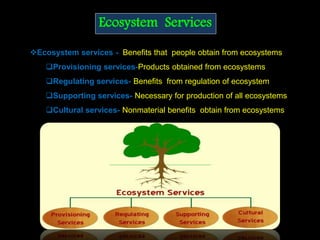
Ecosystem Services
Ecosystem services - Benefits that people obtain from ecosystems
Provisioning services-Products obtained from ecosystems
Regulating services- Benefits from regulation of ecosystem
Supporting services- Necessary for production of all ecosystems
Cultural services- Nonmaterial benefits obtain from ecosystems
Agro-forestry
Dynamic, ecologically based, natural resource management system
 Diversifies and sustains production
Increased social, economic and environmental benefits
Agro-forestry helps in-
Carbon sequestration
Bio diversity conservation
Improved air and water quality
Soil conservation and enrichment
Soil amelioration
Bio-fuel production
Fodder production
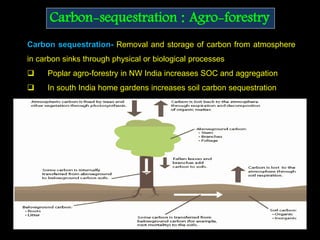
Carbon-sequestration : Agro-forestry
Carbon sequestration- Removal and storage of carbon from atmosphere
in carbon sinks through physical or biological processes
 Poplar agro-forestry in NW India increases SOC and aggregation
 In south India home gardens increases soil carbon sequestration
Bio-diversity Conservation : Agro-forestry
Provides habitat for species
Helps preserving germplasm of sensitive species
Helps by reducing conversion rate of natural habitat by
providing a more productive, sustainable systems
Provides conservation of area-sensitive floral and faunal
species
Helps to conserve biological diversity by providing ecosystem
Improved Air & Water Quality: Agro-forestry
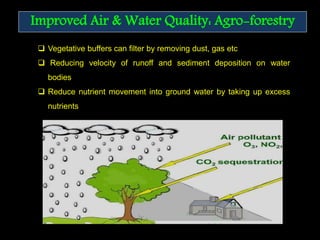
 Vegetative buffers can filter by removing dust, gas etc
 Reducing velocity of runoff and sediment deposition on water
bodies
 Reduce nutrient movement into ground water by taking up excess
nutrients
Soil conservation & Enrichment : Agro-forestry
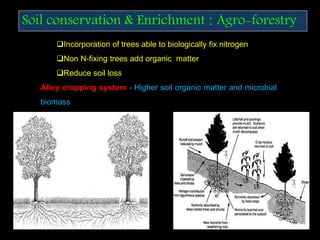
Incorporation of trees able to biologically fix nitrogen
Non N-fixing trees add organic matter
Reduce soil loss
Alley cropping system - Higher soil organic matter and microbial
biomass
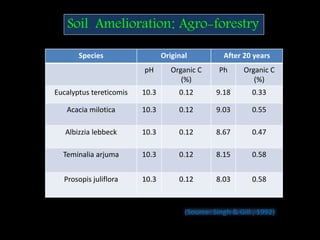
(Source: Singh & Gill , 1992)
Species Original After 20 years
pH Organic C
(%)
Ph Organic C
(%)
Eucalyptus tereticomis 10.3 0.12 9.18 0.33
Acacia milotica 10.3 0.12 9.03 0.55
Albizzia lebbeck 10.3 0.12 8.67 0.47
Teminalia arjuma 10.3 0.12 8.15 0.58
Prosopis juliflora 10.3 0.12 8.03 0.58
Soil Amelioration: Agro-forestry
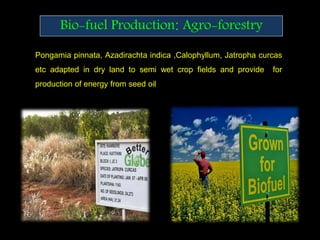
Pongamia pinnata, Azadirachta indica ,Calophyllum, Jatropha curcas
etc adapted in dry land to semi wet crop fields and provide for
production of energy from seed oil
Bio-fuel Production: Agro-forestry
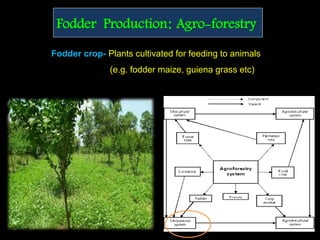
Fodder Production: Agro-forestry
Fodder crop- Plants cultivated for feeding to animals
(e.g. fodder maize, guiena grass etc)
Case Study
Methodology-
Conducted in 2 districts of Eastern UP- Aligarh and Saharanpur
Four blocks ,16 villages and 320 farmers formed sample units for study
Data taken from harvest and sale of tree for past three years
Data analyzed mainly using tabular analysis, benefit-cost analysis
Aligarh district was selected as traditional agro-forestry region
Saharanpur district as intensive/ commercial agro-forestry region
Result and Discussion
Farm size
category
No. of
trees/farm
family
Tree stock
density
(per ha)
Marginal 9.5 13.4
Small 17.0 12.7
Medium/large 27.2 7.9
Total 15.6 10.3
Contd..
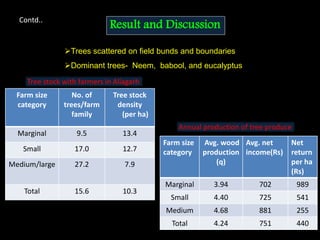
Trees scattered on field bunds and boundaries
Dominant trees- Neem, babool, and eucalyptus
Farm size
category
Avg. wood
production
(q)
Avg. net
income(Rs)
Net
return
per ha
(Rs)
Marginal 3.94 702 989
Small 4.40 725 541
Medium 4.68 881 255
Total 4.24 751 440
Annual production of tree produce
Tree stock with farmers in Aliagarh
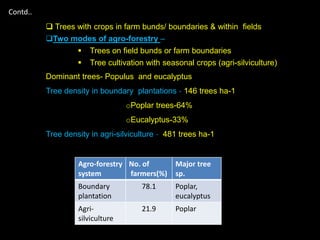
 Trees with crops in farm bunds/ boundaries & within fields
Two modes of agro-forestry –
 Trees on field bunds or farm boundaries
 Tree cultivation with seasonal crops (agri-silviculture)
Dominant trees- Populus and eucalyptus
Tree density in boundary plantations - 146 trees ha-1
oPoplar trees-64%
oEucalyptus-33%
Tree density in agri-silviculture - 481 trees ha-1
Agro-forestry
system
No. of
farmers(%)
Major tree
sp.
Boundary
plantation
78.1 Poplar,
eucalyptus
Agri-
silviculture
21.9 Poplar
Contd..
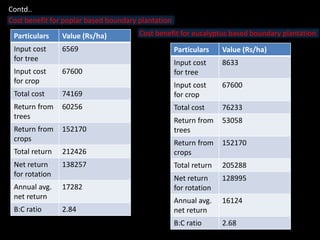
Particulars Value (Rs/ha)
Input cost
for tree
6569
Input cost
for crop
67600
Total cost 74169
Return from
trees
60256
Return from
crops
152170
Total return 212426
Net return
for rotation
138257
Annual avg.
net return
17282
B:C ratio 2.84
Cost benefit for poplar based boundary plantation
Contd..
Particulars Value (Rs/ha)
Input cost
for tree
8633
Input cost
for crop
67600
Total cost 76233
Return from
trees
53058
Return from
crops
152170
Total return 205288
Net return
for rotation
128995
Annual avg.
net return
16124
B:C ratio 2.68
Cost benefit for eucalyptus based boundary plantation
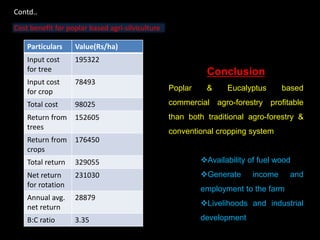
Conclusion
Poplar & Eucalyptus based
commercial agro-forestry profitable
than both traditional agro-forestry &
conventional cropping system
Availability of fuel wood
Generate income and
employment to the farm
Livelihoods and industrial
development
Contd..
Particulars Value(Rs/ha)
Input cost
for tree
195322
Input cost
for crop
78493
Total cost 98025
Return from
trees
152605
Return from
crops
176450
Total return 329055
Net return
for rotation
231030
Annual avg.
net return
28879
B:C ratio 3.35
Cost benefit for poplar based agri-silviculture
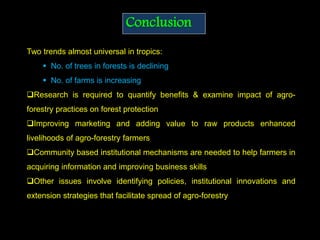
Conclusion
Two trends almost universal in tropics:
 No. of trees in forests is declining
 No. of farms is increasing
Research is required to quantify benefits & examine impact of agro-
forestry practices on forest protection
Improving marketing and adding value to raw products enhanced
livelihoods of agro-forestry farmers
Community based institutional mechanisms are needed to help farmers in
acquiring information and improving business skills
Other issues involve identifying policies, institutional innovations and
extension strategies that facilitate spread of agro-forestry
Thank You

Quantification of Ecosystem Services From Agro-forestry

  • 1.
    Quantification of EcosystemServices from Agro-forestry Jayanta Thokdar IARI ff
  • 2.
    Ecosystem Services Ecosystem services- Benefits that people obtain from ecosystems Provisioning services-Products obtained from ecosystems Regulating services- Benefits from regulation of ecosystem Supporting services- Necessary for production of all ecosystems Cultural services- Nonmaterial benefits obtain from ecosystems
  • 3.
    Agro-forestry Dynamic, ecologically based,natural resource management system  Diversifies and sustains production Increased social, economic and environmental benefits Agro-forestry helps in- Carbon sequestration Bio diversity conservation Improved air and water quality Soil conservation and enrichment Soil amelioration Bio-fuel production Fodder production
  • 4.
    Carbon-sequestration : Agro-forestry Carbonsequestration- Removal and storage of carbon from atmosphere in carbon sinks through physical or biological processes  Poplar agro-forestry in NW India increases SOC and aggregation  In south India home gardens increases soil carbon sequestration
  • 5.
    Bio-diversity Conservation :Agro-forestry Provides habitat for species Helps preserving germplasm of sensitive species Helps by reducing conversion rate of natural habitat by providing a more productive, sustainable systems Provides conservation of area-sensitive floral and faunal species Helps to conserve biological diversity by providing ecosystem
  • 6.
    Improved Air &Water Quality: Agro-forestry  Vegetative buffers can filter by removing dust, gas etc  Reducing velocity of runoff and sediment deposition on water bodies  Reduce nutrient movement into ground water by taking up excess nutrients
  • 7.
    Soil conservation &Enrichment : Agro-forestry Incorporation of trees able to biologically fix nitrogen Non N-fixing trees add organic matter Reduce soil loss Alley cropping system - Higher soil organic matter and microbial biomass
  • 8.
    (Source: Singh &Gill , 1992) Species Original After 20 years pH Organic C (%) Ph Organic C (%) Eucalyptus tereticomis 10.3 0.12 9.18 0.33 Acacia milotica 10.3 0.12 9.03 0.55 Albizzia lebbeck 10.3 0.12 8.67 0.47 Teminalia arjuma 10.3 0.12 8.15 0.58 Prosopis juliflora 10.3 0.12 8.03 0.58 Soil Amelioration: Agro-forestry
  • 9.
    Pongamia pinnata, Azadirachtaindica ,Calophyllum, Jatropha curcas etc adapted in dry land to semi wet crop fields and provide for production of energy from seed oil Bio-fuel Production: Agro-forestry
  • 10.
    Fodder Production: Agro-forestry Foddercrop- Plants cultivated for feeding to animals (e.g. fodder maize, guiena grass etc)
  • 11.
    Case Study Methodology- Conducted in2 districts of Eastern UP- Aligarh and Saharanpur Four blocks ,16 villages and 320 farmers formed sample units for study Data taken from harvest and sale of tree for past three years Data analyzed mainly using tabular analysis, benefit-cost analysis Aligarh district was selected as traditional agro-forestry region Saharanpur district as intensive/ commercial agro-forestry region
  • 12.
    Result and Discussion Farmsize category No. of trees/farm family Tree stock density (per ha) Marginal 9.5 13.4 Small 17.0 12.7 Medium/large 27.2 7.9 Total 15.6 10.3 Contd.. Trees scattered on field bunds and boundaries Dominant trees- Neem, babool, and eucalyptus Farm size category Avg. wood production (q) Avg. net income(Rs) Net return per ha (Rs) Marginal 3.94 702 989 Small 4.40 725 541 Medium 4.68 881 255 Total 4.24 751 440 Annual production of tree produce Tree stock with farmers in Aliagarh
  • 13.
     Trees withcrops in farm bunds/ boundaries & within fields Two modes of agro-forestry –  Trees on field bunds or farm boundaries  Tree cultivation with seasonal crops (agri-silviculture) Dominant trees- Populus and eucalyptus Tree density in boundary plantations - 146 trees ha-1 oPoplar trees-64% oEucalyptus-33% Tree density in agri-silviculture - 481 trees ha-1 Agro-forestry system No. of farmers(%) Major tree sp. Boundary plantation 78.1 Poplar, eucalyptus Agri- silviculture 21.9 Poplar Contd..
  • 14.
    Particulars Value (Rs/ha) Inputcost for tree 6569 Input cost for crop 67600 Total cost 74169 Return from trees 60256 Return from crops 152170 Total return 212426 Net return for rotation 138257 Annual avg. net return 17282 B:C ratio 2.84 Cost benefit for poplar based boundary plantation Contd.. Particulars Value (Rs/ha) Input cost for tree 8633 Input cost for crop 67600 Total cost 76233 Return from trees 53058 Return from crops 152170 Total return 205288 Net return for rotation 128995 Annual avg. net return 16124 B:C ratio 2.68 Cost benefit for eucalyptus based boundary plantation
  • 15.
    Conclusion Poplar & Eucalyptusbased commercial agro-forestry profitable than both traditional agro-forestry & conventional cropping system Availability of fuel wood Generate income and employment to the farm Livelihoods and industrial development Contd.. Particulars Value(Rs/ha) Input cost for tree 195322 Input cost for crop 78493 Total cost 98025 Return from trees 152605 Return from crops 176450 Total return 329055 Net return for rotation 231030 Annual avg. net return 28879 B:C ratio 3.35 Cost benefit for poplar based agri-silviculture
  • 16.
    Conclusion Two trends almostuniversal in tropics:  No. of trees in forests is declining  No. of farms is increasing Research is required to quantify benefits & examine impact of agro- forestry practices on forest protection Improving marketing and adding value to raw products enhanced livelihoods of agro-forestry farmers Community based institutional mechanisms are needed to help farmers in acquiring information and improving business skills Other issues involve identifying policies, institutional innovations and extension strategies that facilitate spread of agro-forestry
  • 17.