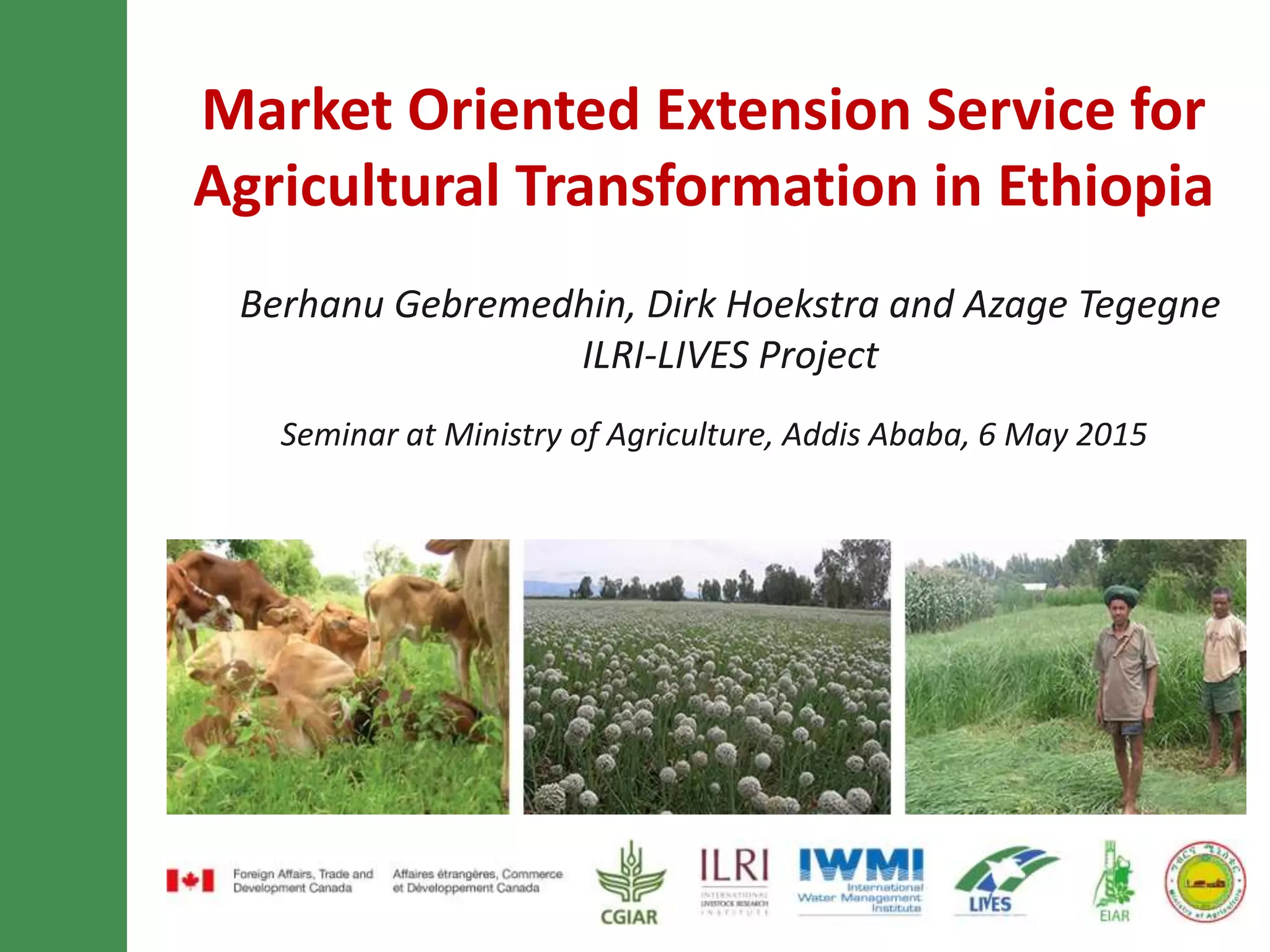
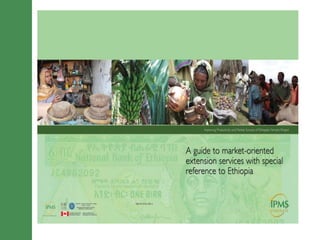
Market-oriented extension service for
agricultural transformation in Ethiopia
Berhanu Gebremedhin, Dirk Hoekstra and Azage Tegegne
ILRI-LIVES Project
Seminar at Ministry of Agriculture, Addis Ababa, 6 May 2015
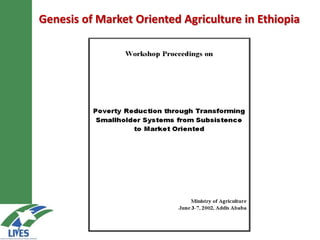
Genesis of Market-oriented Agriculture in Ethiopia
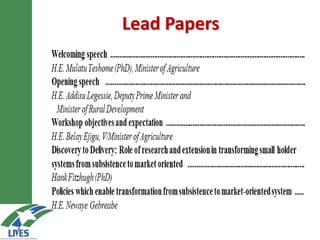
Lead Papers
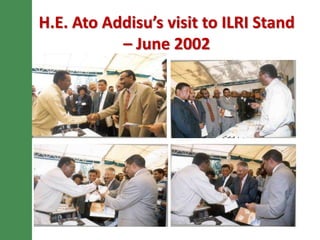
H.E. Ato Addisu’s visit to ILRI Stand
– June 2002
Concluding Remark
• Following the panel discussion, H.E. Ato Belay Ejigu, V/Minister of
Ministry of Agriculture in his concluding remarks stated that the
existence of diversified agro-ecological group arrangement in the
country will create wider opportunities to adopt the various
technologies identified and recommended by the workshop. He
added that the on-going civil service reform in the country is also
expected to lay fertile ground to put the recommended
interventions into practice. He further noted that the contribution of
CGIAR centres towards efforts to be exerted in the implementation
of workshop outputs would be enormous. He finally extended his
appreciation to national and international organizations or
institutions for displaying their technologies, to all the participants
for their active participation, valuable comments and fruitful
contributions, as well as to the organizing committee for their
unreserved efforts to make the workshop possible and successful.
Launched IPMS in 2004
IPMS Goal
• To contribute to improved agricultural
productivity and production through
– market-oriented agricultural development,
– as a means for achieving improved and
sustainable livelihoods for the rural
population.
Launched LIVES in Jan 2013
WHY LIVES?
• In line with GoE priorities for agriculture–led
industrialization
• In line with the GTP and AGP and other programs of the
GoE
• Livestock and irrigated agriculture are high value
commodities with huge potential and promise to
transform smallholders from subsistence to market-
orientation
• Piloting for learning and scaling up
Market-oriented Extension Service for
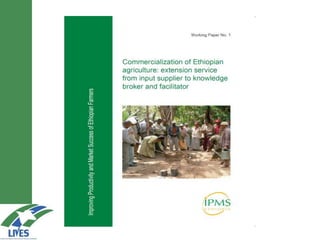
Agricultural Transformation in Ethiopia
Concepts and processes
Presentation Outline
• Implication of the smallholder
commercialization policy to the extension
service
• Value chain development approach and market
oriented extension
• Production oriented VS market oriented
extension
• Providers of market oriented extension
• Roles of the market oriented extension service
• Building capacity for market oriented extension
service
Implications of the smallholder commercial
policy for the extension service
• What is commercial transformation of agriculture?
– Market orientation in production planning
– Market participation in output markets
• Commercial transformation policy implies the extension
service provides support in market oriented production
planning, and in input and output market support
• Has the extension service adapted itself to serve
commercial transformation of smallholder agriculture?
– Production-oriented VS Market-oriented extension
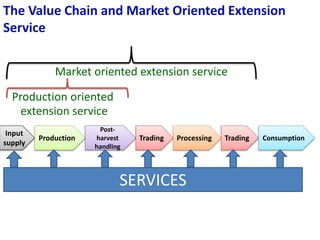
The Value Chain and Market-oriented Extension
Service
Input
supply
Production
Post-
harvest
handling
Trading Processing Trading Consumption
SERVICES
Market oriented extension service
Production oriented
extension service
The production-oriented extension Service
• Focus on technology promotion, and productivity and
production enhancement
– Training of DAs and SMSs oriented towards
production technologies and productivity (Crop,
Livestock, NRM)
– Marketing, agribusiness, farm management, market
oriented extension methods mainly missing
– Lack of awareness and capacity to provide market-
oriented extension (MOE)
From Production-oriented to Market-
oriented extension
• Shift towards commercialization implies attention to:
– market-oriented production planning
– input and output marketing support services
• Hence, commercial transformation requires expanded
mandate of the extension service
– aim is to support rural households and their
enterprises to earn better income
– need to combine technology promotion and
productivity enhancement with market support
What is market-oriented extension?
• Total effort of extension service to:
– Advise and support farmers to plan and produce
profitable commodities using appropriate
technologies and practices
– Collect and communicate market-related information
– Identify profitable markets and buyers
– Link farmers with buyers
– Facilitate and support collective marketing
– Build marketing capacity of producers
Key principles of market-oriented extension
• Business principles: Sustainable livelihoods and
welfare is based on income and wealth
accumulation.
• Resource-based: Market-oriented agricultural
development needs to be based on the comparative
advantages of a given area.
• Bottom-up and participatory: Market-oriented
agricultural development depends critically on the
knowledge, skills and experiences of producers and
agribusinesses
Key principles of market-oriented extension
• Based on the value chain framework: a market-
oriented extension service will be better placed to
identify the priority intervention points if he/she
follows the value chains framework in the analysis
and identification of constraints and interventions.
Who Provides MOE?
• Public extension system
• Producer and commodity organizations
• Processing and trading enterprises
• Non-governmental organizations
• Private extension service providers
• Input suppliers
Roles of the market-oriented extension service
• Facilitator of the identification of the production
and marketing possibilities and problems in the
area
• Promoter of the adoption of improved agricultural
technologies for market-oriented commodities
• Collector, processor and interpreter and
disseminator of market information
• Facilitator of linkages of farmers with service
providers , commodity buyers, and processors
Roles of the market-oriented extension
service(2)
• Facilitator of collective marketing of households
• provider of market information to farmers and
small-scale businesses
• Builder of marketing capacity of farmers
• Supporter and advisor of business plan
developments
Building capacity for market-oriented
extension
• In addition to technical production skills, knowledge and
skills required by market oriented extension service
providers include:
– Basic concepts in economics and agricultural marketing
– Understanding of the concept of value chains and the
value chain development approach
– Knowledge and skills in farm budgeting and planning
– Knowledge and skills in providing market information
service to farmers
– Knowledge and skills in the identification of profitable
markets and linking farmers with those markets
– Knowledge and skills in facilitating collective marketing
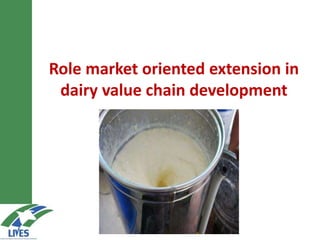
Role market-oriented extension in
dairy value chain development
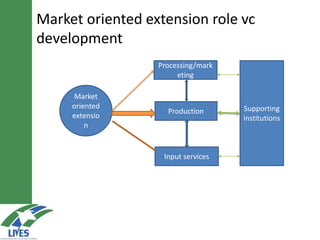
Market-oriented extension role vc
development
Processing/mark
eting
Production
Input services
Market
oriented
extensio
n
Supporting
institutions
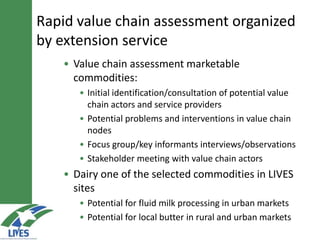
• Value chain assessment marketable
commodities:
• Initial identification/consultation of potential value
chain actors and service providers
• Potential problems and interventions in value chain
nodes
• Focus group/key informants interviews/observations
• Stakeholder meeting with value chain actors
• Dairy one of the selected commodities in LIVES
sites
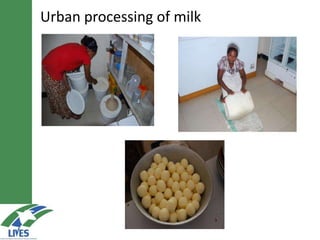
• Potential for fluid milk processing in urban markets
• Potential for local butter in rural and urban markets
Rapid value chain assessment organized
by extension service
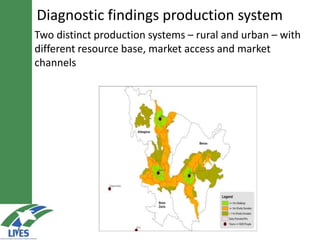
Two distinct production systems – rural and urban – with
different resource base, market access and market
channels
Diagnostic findings production system
Poor performance:
• Mostly small scale 2-3 cows
• Use of genetically improved cows limited
• Poor fertility management – long calving
interval
• Poor quality seasonal feeding/fodder
production
• Animal disease
Diagnostic findings production system
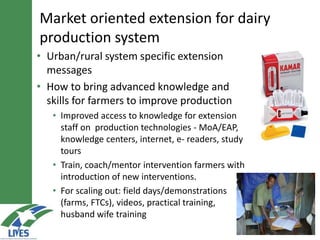
• Urban/rural system specific extension
messages
• How to bring advanced knowledge and
skills for farmers to improve production
• Improved access to knowledge for extension
staff on production technologies - MoA/EAP,
knowledge centers, internet, e- readers, study
tours
• Train, coach/mentor intervention farmers with
introduction of new interventions.
• For scaling out: field days/demonstrations
(farms, FTCs), videos, practical training,
husband wife training
Market-oriented extension for dairy
production system
• Delivery system improved dairy animals has limited
coverage and effectiveness
• Supply forage seeds/cuttings and fresh fodder limited
• AIB and concentrate feed production and delivery
limited in coverage – high prices?
• Veterinary system limited in coverage and
effectiveness
• Credit for dairy limited
Diagnostic findings dairy input/service
delivery system
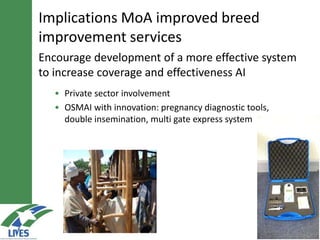
Encourage development of a more effective system
to increase coverage and effectiveness AI
• Private sector involvement
• OSMAI with innovation: pregnancy diagnostic tools,
double insemination, multi gate express system
Implications MoA improved breed
improvement services
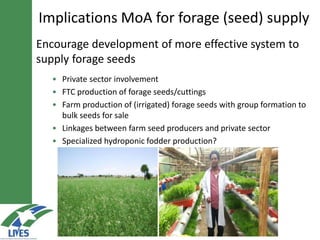
Encourage development of more effective system to
supply forage seeds
• Private sector involvement
• FTC production of forage seeds/cuttings
• Farm production of (irrigated) forage seeds with group formation to
bulk seeds for sale
• Linkages between farm seed producers and private sector
• Specialized hydroponic fodder production?
Implications MoA for forage (seed) supply
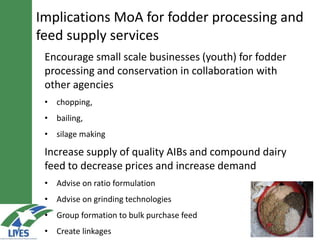
Encourage small scale businesses (youth) for fodder
processing and conservation in collaboration with
other agencies
• chopping,
• bailing,
• silage making
Increase supply of quality AIBs and compound dairy
feed to decrease prices and increase demand
• Advise on ratio formulation
• Advise on grinding technologies
• Group formation to bulk purchase feed
• Create linkages
Implications MoA for fodder processing and
feed supply services
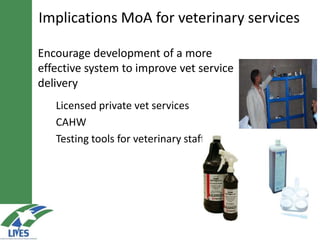
Encourage development of a more
effective system to improve vet service
delivery
Licensed private vet services
CAHW
Testing tools for veterinary staff
Implications MoA for veterinary services
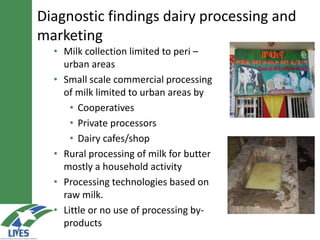
• Milk collection limited to peri –
urban areas
• Small scale commercial processing
of milk limited to urban areas by
• Cooperatives
• Private processors
• Dairy cafes/shop
• Rural processing of milk for butter
mostly a household activity
• Processing technologies based on
raw milk.
• Little or no use of processing by-
products
Diagnostic findings dairy processing and
marketing
• Enlarge milk shed area through
• milk marketing group formation
• Motorized collection agents
• Linkages producers/collectors and processors/cafes/shops .
• Introduce alternative, food safe processing technologies
for small scale commercial processing in urban areas
• Improve economic viability of small scale urban
businesses through product diversification and
commercial utilization of by-products (e.g. whey)
• Improve efficiency butter processing rural areas – group
formation, sour cream processing, churning technology
Implications MoA for processing and
marketing
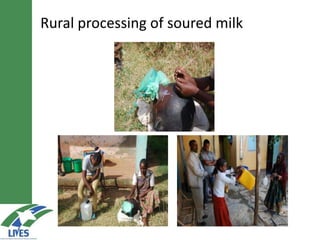
Rural processing of soured milk
Urban processing of milk
• Development is a continuous process which requires
a responsive and knowledgeable extension system.
• Knowledge required on the value chain, its actors,
public and private sector services providers
• to identify bottlenecks, opportunities
• create linkages between value chain actors
• apply agricultural knowledge for production,
supply of inputs and processing/marketing.
Summary
The presentation has a Creative Commons licence. You are free to re-use or distribute this work, provided credit is given to ILRI.
www.lives-ethiopia.orgwww.lives-ethiopia.org
Thank You Very Much!!

Market-oriented extension service for agricultural transformation in Ethiopia

  • 1.
    Market-oriented extension servicefor agricultural transformation in Ethiopia Berhanu Gebremedhin, Dirk Hoekstra and Azage Tegegne ILRI-LIVES Project Seminar at Ministry of Agriculture, Addis Ababa, 6 May 2015
  • 2.
    Genesis of Market-orientedAgriculture in Ethiopia
  • 3.
  • 4.
    H.E. Ato Addisu’svisit to ILRI Stand – June 2002
  • 5.
    Concluding Remark • Followingthe panel discussion, H.E. Ato Belay Ejigu, V/Minister of Ministry of Agriculture in his concluding remarks stated that the existence of diversified agro-ecological group arrangement in the country will create wider opportunities to adopt the various technologies identified and recommended by the workshop. He added that the on-going civil service reform in the country is also expected to lay fertile ground to put the recommended interventions into practice. He further noted that the contribution of CGIAR centres towards efforts to be exerted in the implementation of workshop outputs would be enormous. He finally extended his appreciation to national and international organizations or institutions for displaying their technologies, to all the participants for their active participation, valuable comments and fruitful contributions, as well as to the organizing committee for their unreserved efforts to make the workshop possible and successful.
  • 6.
  • 7.
    IPMS Goal • Tocontribute to improved agricultural productivity and production through – market-oriented agricultural development, – as a means for achieving improved and sustainable livelihoods for the rural population.
  • 10.
  • 11.
    WHY LIVES? • Inline with GoE priorities for agriculture–led industrialization • In line with the GTP and AGP and other programs of the GoE • Livestock and irrigated agriculture are high value commodities with huge potential and promise to transform smallholders from subsistence to market- orientation • Piloting for learning and scaling up
  • 12.
    Market-oriented Extension Servicefor Agricultural Transformation in Ethiopia Concepts and processes
  • 13.
    Presentation Outline • Implicationof the smallholder commercialization policy to the extension service • Value chain development approach and market oriented extension • Production oriented VS market oriented extension • Providers of market oriented extension • Roles of the market oriented extension service • Building capacity for market oriented extension service
  • 14.
    Implications of thesmallholder commercial policy for the extension service • What is commercial transformation of agriculture? – Market orientation in production planning – Market participation in output markets • Commercial transformation policy implies the extension service provides support in market oriented production planning, and in input and output market support • Has the extension service adapted itself to serve commercial transformation of smallholder agriculture? – Production-oriented VS Market-oriented extension
  • 15.
    The Value Chainand Market-oriented Extension Service Input supply Production Post- harvest handling Trading Processing Trading Consumption SERVICES Market oriented extension service Production oriented extension service
  • 16.
    The production-oriented extensionService • Focus on technology promotion, and productivity and production enhancement – Training of DAs and SMSs oriented towards production technologies and productivity (Crop, Livestock, NRM) – Marketing, agribusiness, farm management, market oriented extension methods mainly missing – Lack of awareness and capacity to provide market- oriented extension (MOE)
  • 17.
    From Production-oriented toMarket- oriented extension • Shift towards commercialization implies attention to: – market-oriented production planning – input and output marketing support services • Hence, commercial transformation requires expanded mandate of the extension service – aim is to support rural households and their enterprises to earn better income – need to combine technology promotion and productivity enhancement with market support
  • 18.
    What is market-orientedextension? • Total effort of extension service to: – Advise and support farmers to plan and produce profitable commodities using appropriate technologies and practices – Collect and communicate market-related information – Identify profitable markets and buyers – Link farmers with buyers – Facilitate and support collective marketing – Build marketing capacity of producers
  • 19.
    Key principles ofmarket-oriented extension • Business principles: Sustainable livelihoods and welfare is based on income and wealth accumulation. • Resource-based: Market-oriented agricultural development needs to be based on the comparative advantages of a given area. • Bottom-up and participatory: Market-oriented agricultural development depends critically on the knowledge, skills and experiences of producers and agribusinesses
  • 20.
    Key principles ofmarket-oriented extension • Based on the value chain framework: a market- oriented extension service will be better placed to identify the priority intervention points if he/she follows the value chains framework in the analysis and identification of constraints and interventions.
  • 21.
    Who Provides MOE? •Public extension system • Producer and commodity organizations • Processing and trading enterprises • Non-governmental organizations • Private extension service providers • Input suppliers
  • 22.
    Roles of themarket-oriented extension service • Facilitator of the identification of the production and marketing possibilities and problems in the area • Promoter of the adoption of improved agricultural technologies for market-oriented commodities • Collector, processor and interpreter and disseminator of market information • Facilitator of linkages of farmers with service providers , commodity buyers, and processors
  • 23.
    Roles of themarket-oriented extension service(2) • Facilitator of collective marketing of households • provider of market information to farmers and small-scale businesses • Builder of marketing capacity of farmers • Supporter and advisor of business plan developments
  • 24.
    Building capacity formarket-oriented extension • In addition to technical production skills, knowledge and skills required by market oriented extension service providers include: – Basic concepts in economics and agricultural marketing – Understanding of the concept of value chains and the value chain development approach – Knowledge and skills in farm budgeting and planning – Knowledge and skills in providing market information service to farmers – Knowledge and skills in the identification of profitable markets and linking farmers with those markets – Knowledge and skills in facilitating collective marketing
  • 25.
    Role market-oriented extensionin dairy value chain development
  • 26.
    Market-oriented extension rolevc development Processing/mark eting Production Input services Market oriented extensio n Supporting institutions
  • 27.
    • Value chainassessment marketable commodities: • Initial identification/consultation of potential value chain actors and service providers • Potential problems and interventions in value chain nodes • Focus group/key informants interviews/observations • Stakeholder meeting with value chain actors • Dairy one of the selected commodities in LIVES sites • Potential for fluid milk processing in urban markets • Potential for local butter in rural and urban markets Rapid value chain assessment organized by extension service
  • 28.
    Two distinct productionsystems – rural and urban – with different resource base, market access and market channels Diagnostic findings production system
  • 29.
    Poor performance: • Mostlysmall scale 2-3 cows • Use of genetically improved cows limited • Poor fertility management – long calving interval • Poor quality seasonal feeding/fodder production • Animal disease Diagnostic findings production system
  • 30.
    • Urban/rural systemspecific extension messages • How to bring advanced knowledge and skills for farmers to improve production • Improved access to knowledge for extension staff on production technologies - MoA/EAP, knowledge centers, internet, e- readers, study tours • Train, coach/mentor intervention farmers with introduction of new interventions. • For scaling out: field days/demonstrations (farms, FTCs), videos, practical training, husband wife training Market-oriented extension for dairy production system
  • 31.
    • Delivery systemimproved dairy animals has limited coverage and effectiveness • Supply forage seeds/cuttings and fresh fodder limited • AIB and concentrate feed production and delivery limited in coverage – high prices? • Veterinary system limited in coverage and effectiveness • Credit for dairy limited Diagnostic findings dairy input/service delivery system
  • 32.
    Encourage development ofa more effective system to increase coverage and effectiveness AI • Private sector involvement • OSMAI with innovation: pregnancy diagnostic tools, double insemination, multi gate express system Implications MoA improved breed improvement services
  • 33.
    Encourage development ofmore effective system to supply forage seeds • Private sector involvement • FTC production of forage seeds/cuttings • Farm production of (irrigated) forage seeds with group formation to bulk seeds for sale • Linkages between farm seed producers and private sector • Specialized hydroponic fodder production? Implications MoA for forage (seed) supply
  • 34.
    Encourage small scalebusinesses (youth) for fodder processing and conservation in collaboration with other agencies • chopping, • bailing, • silage making Increase supply of quality AIBs and compound dairy feed to decrease prices and increase demand • Advise on ratio formulation • Advise on grinding technologies • Group formation to bulk purchase feed • Create linkages Implications MoA for fodder processing and feed supply services
  • 35.
    Encourage development ofa more effective system to improve vet service delivery Licensed private vet services CAHW Testing tools for veterinary staff Implications MoA for veterinary services
  • 36.
    • Milk collectionlimited to peri – urban areas • Small scale commercial processing of milk limited to urban areas by • Cooperatives • Private processors • Dairy cafes/shop • Rural processing of milk for butter mostly a household activity • Processing technologies based on raw milk. • Little or no use of processing by- products Diagnostic findings dairy processing and marketing
  • 37.
    • Enlarge milkshed area through • milk marketing group formation • Motorized collection agents • Linkages producers/collectors and processors/cafes/shops . • Introduce alternative, food safe processing technologies for small scale commercial processing in urban areas • Improve economic viability of small scale urban businesses through product diversification and commercial utilization of by-products (e.g. whey) • Improve efficiency butter processing rural areas – group formation, sour cream processing, churning technology Implications MoA for processing and marketing
  • 38.
  • 39.
  • 40.
    • Development isa continuous process which requires a responsive and knowledgeable extension system. • Knowledge required on the value chain, its actors, public and private sector services providers • to identify bottlenecks, opportunities • create linkages between value chain actors • apply agricultural knowledge for production, supply of inputs and processing/marketing. Summary
  • 41.
    The presentation hasa Creative Commons licence. You are free to re-use or distribute this work, provided credit is given to ILRI. www.lives-ethiopia.orgwww.lives-ethiopia.org Thank You Very Much!!