Introductory Agroforestry
Dr. Shailendra Bhalawe
Assistant Professor-Agroforestry
College of Agriculture Balaghat
Jawaharlal Nehru Krashi Vishwavidyalaya Jabalpur
(M.P.)
Agro-forestry
Definition: Agroforestry is a collective name for land use systems
involving tree combined with arable crops and/or animals on the same
unit of land called agroforestry.
Agroforestry refers the sustainable land use system that combines
arable crops with tree crop and/or livestock on the same land
management unit, either spatially or temporally.
Agro-forestry
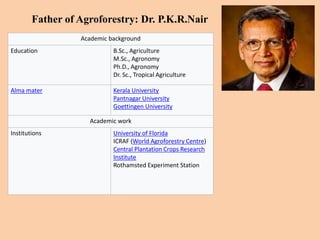
Father of Agroforestry: Dr. P.K.R.Nair
Academic background
Education B.Sc., Agriculture
M.Sc., Agronomy
Ph.D., Agronomy
Dr. Sc., Tropical Agriculture
Alma mater Kerala University
Pantnagar University
Goettingen University
Academic work
Institutions University of Florida
ICRAF (World Agroforestry Centre)
Central Plantation Crops Research
Institute
Rothamsted Experiment Station
Features of agroforestry system:
1.It has more than one crop at a time in which at least one crop
should be tree crops.
2. It produces multiple outputs such as food, fodder, fuel, timber etc.
3. This emphasis on the use of multipurpose trees and shrubs.
4. It is structurally and functionally more complex system.
5. crops are arranged in multi-storey in such a way that it reduces
the competition among plants for nutrient, air and light.
Criteria for good agroforestry system:
•Productivity:
•Sustainability:
•Adoptability:
(a) Productivity: Agroforestry systems mostly aim to maintain or
increase production as well as productivity of the land.
(b) Sustainability: Agroforestry can maintain and conserve fertility of
soil and sustain the production
© Adoptability: Traditional agroforestry practices already been
accepted and adopted by the farming community but improved
agroforestry system should be encouraged to adopt.
Agroforestry also has four traits, i.e. “4I”
1.Intentional
2. Intensive
3. Interactions
4. Integrated
Importance and Impact of Agroforestry:
1. Increased per unit production due to introductions of trees.
2. Growth of trees or woody perennials conserves soil and soil
moisture.
3. Agroforestry improve soil fertility and can improve productivity by
increase output of tree products, improved yield of associated crops,
reducing of cropping system inputs and increased labour efficiency.
4. Provides more diverse products and services.
5. Provides higher revenue due to sale of tree products.
6. Reduced pressure on remaining natural forests for wood, fuel wood
and other forest based produce and pressure of grazing.
7. Enhanced microclimates by increase in atmospheric humidity (10-20
percent)
8. Reduces wind velocity by 40%
Scope or benefit or importance of Agroforestry:
1. Economic benefits:
2. Social benefit:
3. Environmental benefit:
Economic benefits:
 Produce multiple products to meet growing demand of increasing
human population and livestock. These products are
food/vegetables/fruits, fodder and forage needed for livestock, fuel
wood, timber, leaf litter needed for organic manure production and
other NTFPs.
Agroforestry practice is needed to minimize total crop failure when
farm is attacked by insects, pests and diseases.
Improve and sustain the crop productivity which increases the level of
income of the farmers.
Improve the nutritive value of animal and human diet.
 Agroforestry is the best practice for soil nutrient recycling, which
also helps to reduce chemical fertilizer purchase.
Social benefit:
 Improving the living standard the farmers through sustained agroforestry yield,
income and employment.
 Access of health, education, and other social services of the farmers could be
improved due to the regular income and employment opportunities.
 Majority of the Indians farmers have less than 1 ha farmland and increasing
population requires more food, fuel wood, fodder and forage, and timber. To meet
these demands, agroforestry is the only one option for our country.
 Agroforestry farmer groups could be formed easily involving farmers practicing
agroforestry practices, and their capacity can be built up easily.
 This is a traditional practice in country. Therefore, farmers can be motivated and
empowered easily.
Environmental benefit:
 Agroforestry practice helps to stabilize shifting cultivation which leads the
protection of the remaining forests.
 Improve the farm site ecology by reducing surface run off, soil erosion and nutrient
loss, gully formation, landslides, and river bank erosion.
 Improve the local micro-climate and enhance the productive capacity of the farm.
 Reduce pressure of community forests and other natural forests for fodder, fuel
wood and timber.  Agroforestry helps for the beautification of the surrounding areas.
 Agroforestry works as carbon sequesters, which helps to reduce the effects of
climate change.
Disadvantages or limitation of agroforestry :
 Increase tree and agriculture crop competition for light, nutrient and
space.
 Plant nutrient deficiency due to the over absorption.
 Amount of plant nutrient needed for crop produced increased due to
the tree crop competition.
 Nutrient availability in under storey crops reduced due to the tree
shade.
 Habitat to wild animals
 Damage to trees and crops from wild animals.
 Allelopathy effects.
 Damage to trees and crops from cultivation and tree harvest.
Strategy to over come limitation/ disadvantages:
 Select legume trees with light crown covers to reduce tree crop
competition.
 Select deep rooted trees.
 Trees should be planted in wider space.
 Select appropriate under storey crops such as turmeric and ginger in
heavy trees shade, cardamom under Uttis trees etc.
 Manage trees adopting following practices:
 Singling, pruning and thinning for timber species
 Lopping, pollarding and coppicing for fodder species.
Criteria of selection of trees in Agroforestry: Or characteristics of
Trees for Agroforestry:
1. Tree species medium to fast growing
2. Straight, single stemmed with clear bole and tall
3. Low crown and less branching habits
4. Good survival and adaptability
5. Tap and deep rooted species with efficient nutrient pump
6. Preferably leguminous and nitrogen fixer and MPTs
7. Less competitive with associated crops for water, light and nutrient
8. Resistance to disease and pests.
9. Tree should not act as a common host for diseases and pests.
10. Tolerance to relatively higher incidences of pruning.
11. Drought resistance or capable of growing on a wet site.
12. Species adoptability and compatibility with the companion crop
Thank You

Agroforestry

  • 1.
    Introductory Agroforestry Dr. ShailendraBhalawe Assistant Professor-Agroforestry College of Agriculture Balaghat Jawaharlal Nehru Krashi Vishwavidyalaya Jabalpur (M.P.)
  • 2.
    Agro-forestry Definition: Agroforestry isa collective name for land use systems involving tree combined with arable crops and/or animals on the same unit of land called agroforestry. Agroforestry refers the sustainable land use system that combines arable crops with tree crop and/or livestock on the same land management unit, either spatially or temporally.
  • 3.
  • 4.
    Father of Agroforestry:Dr. P.K.R.Nair Academic background Education B.Sc., Agriculture M.Sc., Agronomy Ph.D., Agronomy Dr. Sc., Tropical Agriculture Alma mater Kerala University Pantnagar University Goettingen University Academic work Institutions University of Florida ICRAF (World Agroforestry Centre) Central Plantation Crops Research Institute Rothamsted Experiment Station
  • 5.
    Features of agroforestrysystem: 1.It has more than one crop at a time in which at least one crop should be tree crops. 2. It produces multiple outputs such as food, fodder, fuel, timber etc. 3. This emphasis on the use of multipurpose trees and shrubs. 4. It is structurally and functionally more complex system. 5. crops are arranged in multi-storey in such a way that it reduces the competition among plants for nutrient, air and light.
  • 6.
    Criteria for goodagroforestry system: •Productivity: •Sustainability: •Adoptability: (a) Productivity: Agroforestry systems mostly aim to maintain or increase production as well as productivity of the land. (b) Sustainability: Agroforestry can maintain and conserve fertility of soil and sustain the production © Adoptability: Traditional agroforestry practices already been accepted and adopted by the farming community but improved agroforestry system should be encouraged to adopt.
  • 7.
    Agroforestry also hasfour traits, i.e. “4I” 1.Intentional 2. Intensive 3. Interactions 4. Integrated
  • 8.
    Importance and Impactof Agroforestry: 1. Increased per unit production due to introductions of trees. 2. Growth of trees or woody perennials conserves soil and soil moisture. 3. Agroforestry improve soil fertility and can improve productivity by increase output of tree products, improved yield of associated crops, reducing of cropping system inputs and increased labour efficiency. 4. Provides more diverse products and services. 5. Provides higher revenue due to sale of tree products. 6. Reduced pressure on remaining natural forests for wood, fuel wood and other forest based produce and pressure of grazing. 7. Enhanced microclimates by increase in atmospheric humidity (10-20 percent) 8. Reduces wind velocity by 40%
  • 9.
    Scope or benefitor importance of Agroforestry: 1. Economic benefits: 2. Social benefit: 3. Environmental benefit:
  • 10.
    Economic benefits:  Producemultiple products to meet growing demand of increasing human population and livestock. These products are food/vegetables/fruits, fodder and forage needed for livestock, fuel wood, timber, leaf litter needed for organic manure production and other NTFPs. Agroforestry practice is needed to minimize total crop failure when farm is attacked by insects, pests and diseases. Improve and sustain the crop productivity which increases the level of income of the farmers. Improve the nutritive value of animal and human diet.  Agroforestry is the best practice for soil nutrient recycling, which also helps to reduce chemical fertilizer purchase.
  • 11.
    Social benefit:  Improvingthe living standard the farmers through sustained agroforestry yield, income and employment.  Access of health, education, and other social services of the farmers could be improved due to the regular income and employment opportunities.  Majority of the Indians farmers have less than 1 ha farmland and increasing population requires more food, fuel wood, fodder and forage, and timber. To meet these demands, agroforestry is the only one option for our country.  Agroforestry farmer groups could be formed easily involving farmers practicing agroforestry practices, and their capacity can be built up easily.  This is a traditional practice in country. Therefore, farmers can be motivated and empowered easily.
  • 12.
    Environmental benefit:  Agroforestrypractice helps to stabilize shifting cultivation which leads the protection of the remaining forests.  Improve the farm site ecology by reducing surface run off, soil erosion and nutrient loss, gully formation, landslides, and river bank erosion.  Improve the local micro-climate and enhance the productive capacity of the farm.  Reduce pressure of community forests and other natural forests for fodder, fuel wood and timber.  Agroforestry helps for the beautification of the surrounding areas.  Agroforestry works as carbon sequesters, which helps to reduce the effects of climate change.
  • 13.
    Disadvantages or limitationof agroforestry :  Increase tree and agriculture crop competition for light, nutrient and space.  Plant nutrient deficiency due to the over absorption.  Amount of plant nutrient needed for crop produced increased due to the tree crop competition.  Nutrient availability in under storey crops reduced due to the tree shade.  Habitat to wild animals  Damage to trees and crops from wild animals.  Allelopathy effects.  Damage to trees and crops from cultivation and tree harvest.
  • 14.
    Strategy to overcome limitation/ disadvantages:  Select legume trees with light crown covers to reduce tree crop competition.  Select deep rooted trees.  Trees should be planted in wider space.  Select appropriate under storey crops such as turmeric and ginger in heavy trees shade, cardamom under Uttis trees etc.  Manage trees adopting following practices:  Singling, pruning and thinning for timber species  Lopping, pollarding and coppicing for fodder species.
  • 15.
    Criteria of selectionof trees in Agroforestry: Or characteristics of Trees for Agroforestry: 1. Tree species medium to fast growing 2. Straight, single stemmed with clear bole and tall 3. Low crown and less branching habits 4. Good survival and adaptability 5. Tap and deep rooted species with efficient nutrient pump 6. Preferably leguminous and nitrogen fixer and MPTs 7. Less competitive with associated crops for water, light and nutrient
  • 16.
    8. Resistance todisease and pests. 9. Tree should not act as a common host for diseases and pests. 10. Tolerance to relatively higher incidences of pruning. 11. Drought resistance or capable of growing on a wet site. 12. Species adoptability and compatibility with the companion crop
  • 17.