Agroforestry and climate change
       Emmanuel Torquebiau
           FAO webinar
         5 February 2013
Agroforestry: well-known buffering and
                resilience effects

• Climate variability is well buffered by agroforestry
  because of permanent tree cover and varied
  ecological niches

• Resilience, or recovering after a disturbance (e.g.
  extreme weather events, or market failure) is well
  performed by agroforestry because of diversified
  temporal and spatial management options

   Many references, e.g. Sanchez (1995), Huxley (1996),
   Torquebiau (1992), Garrity et al. (2010)
Examples of criteria for the sustainability
           attributes of agroforestry
• Permanent tree cover protects and improves the soil, while
  increasing soil carbon stocks

• Varied ecological niches allow for the presence of different
  crops, e.g. shade-tolerant and light-demanding

• Diversification of commodities allows for adjustment to
  market needs

• Management flexibility is compatible with shifts in labour
  supply

• Non-harvested components play an important protective
  role
Today’s climate change context confirms the
             potential of agroforestry
• Climate-smart agriculture gives trees a large
  importance (see next slide)

• Conservation agriculture (no-till + cover crops) mimics
  the protective cover of trees (see next photo)

• Sustainability attributes of agroforestry are strong
  assets for climate change adaptation

• Carbon sequestration by trees contributes to climate
  change mitigation
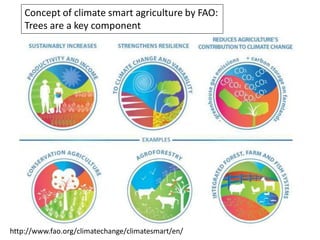
Concept of climate smart agriculture by FAO:
    Trees are a key component


http://www.fao.org/climatechange/climatesmart/en/
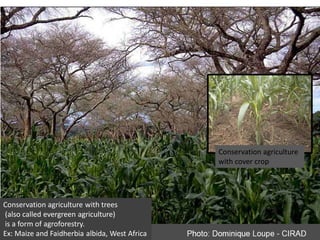
Conservation agriculture
                                               with cover crop


Conservation agriculture with trees
(also called evergreen agriculture)
is a form of agroforestry.
Ex: Maize and Faidherbia albida, West Africa
The double potential of agroforestry to address
            climate change issues
• Greenhouse gas–mitigation strategy through carbon
  sequestration because of greater efficiency of
  integrated systems in resource (nutrients, light, and
  water) capture and utilization than single-species
  systems (Nair et al. 2009)

• Sustainable adjustment to changing conditions
  because agroforestry systems can be called perennial
  farming systems. They maintain and develop their root
  and woody biomass throughout seasons while
  providing food, fibre, energy and vegetative cover for
  soils.
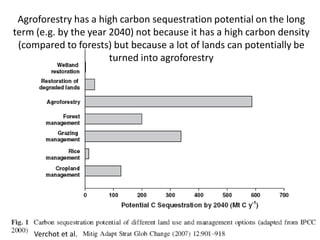
Agroforestry has a high carbon sequestration potential on the long
term (e.g. by the year 2040) not because it has a high carbon density
 (compared to forests) but because a lot of lands can potentially be
                       turned into agroforestry


    Verchot et al.
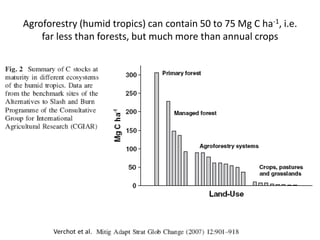
Agroforestry (humid tropics) can contain 50 to 75 Mg C ha-1, i.e.
    far less than forests, but much more than annual crops
Agroforestry can boost synergy between
 adapation to and mitigation of climate change
• Mitigation of climate change mainly takes the form of carbon
  sequestration, e.g. biomass, either above or below ground

• Adaptation to climate change is very much a function of soil organic
  matter content and diversified , multispecies cropping technologies

• Agroforestry perfoms well on the 2 above criteria and thus is a
  preferred approach to develop synergies between adaptation and
  mitigation

• High biodiversity and resulting ecosystem services in agroforestry
  also contribute to synergy between adaptation and mitigation

• Agroforestry improved fallows (see next slide) provide an example
  of such synergy
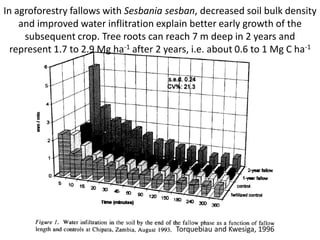
In agroforestry fallows with Sesbania sesban, decreased soil bulk density
    and improved water inflitration explain better early growth of the
     subsequent crop. Tree roots can reach 7 m deep in 2 years and
  represent 1.7 to 2.9 Mg ha-1 after 2 years, i.e. about 0.6 to 1 Mg C ha-1


                                         Torquebiau and Kwesiga, 1996
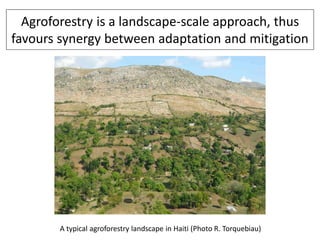
Agroforestry is a landscape-scale approach, thus
favours synergy between adaptation and mitigation


        A typical agroforestry landscape in Haiti (Photo R. Torquebiau)
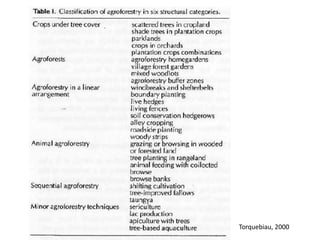
Torquebiau, 2000
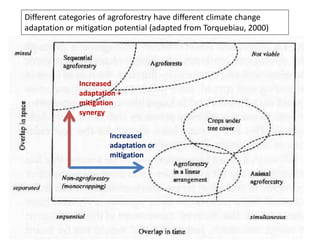
Different categories of agroforestry have different climate change
adaptation or mitigation potential (adapted from Torquebiau, 2000)


              Increased
              adaptation +
              mitigation
              synergy

                       Increased
                       adaptation or
                       mitigation
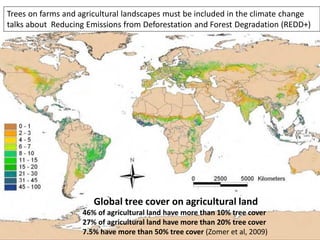
Trees on farms and agricultural landscapes must be included in the climate change
talks about Reducing Emissions from Deforestation and Forest Degradation (REDD+)


                       Global tree cover on agricultural land
                    46% of agricultural land have more than 10% tree cover
                    27% of agricultural land have more than 20% tree cover
                    7.5% have more than 50% tree cover (Zomer et al, 2009)
A new paradigm is required for designing climate-smart
                 agroforestry associations

• So far, agroforestry has mainly been a crop system and a
  tree system side by side

• A new agroforestry paradigm is required where trees and
  crops are selected and managed together

• Examples:
   – shade-tolerant crops adapted to particular tree species
   – Trees and crops with non-overlapping roots
   – Trees and crops with temporally differentiated ecological
     requirements (e.g. dry and wet season)

• Such innovative associations will be able to address food
  security and climate change issues in simultaneity
Warning!
• Agroforestry is not a recipe

• There are many possible tree / crop (and animal)
  associations

• Some work, some don’t

• While the presence of perrenial plants (trees / woodiness)
  is key towards addressing climate change problems, care
  should be taken to select the right tree / crop association
  and management practices for different places

• See here: http://www.worldagroforestrycentre.org/
Useful references
•   Garrity, D. et al. 2010. Evergreen agriculture: a robust approach to sustainable food security in
    Africa. Food Sec 2: 197-214
•   Huxley, P. 1996. Tropical agroforestry. Blackwell Science 371 pp.
•   Nair, P.K.R. et al. 2009. Agroforestry as a strategy for carbon sequestration. J. Plant Nutr. Soil Sci.
    172: 10–23
•   Sanchez, P.A. 1995. Science in agroforestry. Agroforestry Systems 30: 5-55
•   Torquebiau, E. 1992. Are tropical agroforestry homegardens sustainable? Agriculture, Ecosystems
    and Environment 41: 189-207
•   Torquebiau, E. 2000. A renewed perspective on agroforestry concepts and classification. Comptes
    rendus de l’Académie des Sciences / Life Sciences 323: 1009-1017
•   Torquebiau, E. and Kwesiga, F. 1996. Root development in a Sesbania sesban – maize system in
    Eastern Zambia. Agroforestry Systems 34: 193-211
•   Verchot, L. et al. 2007. Climate change: linking adaptation and mitigation through agroforestry.
    Mitig Adapt Strat Glob Change 12: 901-918
•   Zomer, R. J., Trabucco, A., Coe, R., Place, F. (2009). Trees on Farm: Analysis of Global Extent and
    Geographical Patterns of Agroforestry. Nairobi: World Agroforestry Centre, ICRAF: Working Paper
    No 89

For French speaking readers:
• Torquebiau, E. 2007. L’agroforesterie: Des arbres et des champs. Paris: L’Harmattan, 151 pp. (also
     available as e-book on http://www.editions-
     harmattan.fr/index.asp?navig=catalogue&obj=livre&no=23970

Fao webinar presentation

  • 1.
    Agroforestry and climatechange Emmanuel Torquebiau FAO webinar 5 February 2013
  • 2.
    Agroforestry: well-known bufferingand resilience effects • Climate variability is well buffered by agroforestry because of permanent tree cover and varied ecological niches • Resilience, or recovering after a disturbance (e.g. extreme weather events, or market failure) is well performed by agroforestry because of diversified temporal and spatial management options Many references, e.g. Sanchez (1995), Huxley (1996), Torquebiau (1992), Garrity et al. (2010)
  • 3.
    Examples of criteriafor the sustainability attributes of agroforestry • Permanent tree cover protects and improves the soil, while increasing soil carbon stocks • Varied ecological niches allow for the presence of different crops, e.g. shade-tolerant and light-demanding • Diversification of commodities allows for adjustment to market needs • Management flexibility is compatible with shifts in labour supply • Non-harvested components play an important protective role
  • 4.
    Today’s climate changecontext confirms the potential of agroforestry • Climate-smart agriculture gives trees a large importance (see next slide) • Conservation agriculture (no-till + cover crops) mimics the protective cover of trees (see next photo) • Sustainability attributes of agroforestry are strong assets for climate change adaptation • Carbon sequestration by trees contributes to climate change mitigation
  • 5.
    Concept of climatesmart agriculture by FAO: Trees are a key component http://www.fao.org/climatechange/climatesmart/en/
  • 6.
    Conservation agriculture with cover crop Conservation agriculture with trees (also called evergreen agriculture) is a form of agroforestry. Ex: Maize and Faidherbia albida, West Africa
  • 7.
    The double potentialof agroforestry to address climate change issues • Greenhouse gas–mitigation strategy through carbon sequestration because of greater efficiency of integrated systems in resource (nutrients, light, and water) capture and utilization than single-species systems (Nair et al. 2009) • Sustainable adjustment to changing conditions because agroforestry systems can be called perennial farming systems. They maintain and develop their root and woody biomass throughout seasons while providing food, fibre, energy and vegetative cover for soils.
  • 8.
    Agroforestry has ahigh carbon sequestration potential on the long term (e.g. by the year 2040) not because it has a high carbon density (compared to forests) but because a lot of lands can potentially be turned into agroforestry Verchot et al.
  • 9.
    Agroforestry (humid tropics)can contain 50 to 75 Mg C ha-1, i.e. far less than forests, but much more than annual crops
  • 10.
    Agroforestry can boostsynergy between adapation to and mitigation of climate change • Mitigation of climate change mainly takes the form of carbon sequestration, e.g. biomass, either above or below ground • Adaptation to climate change is very much a function of soil organic matter content and diversified , multispecies cropping technologies • Agroforestry perfoms well on the 2 above criteria and thus is a preferred approach to develop synergies between adaptation and mitigation • High biodiversity and resulting ecosystem services in agroforestry also contribute to synergy between adaptation and mitigation • Agroforestry improved fallows (see next slide) provide an example of such synergy
  • 11.
    In agroforestry fallowswith Sesbania sesban, decreased soil bulk density and improved water inflitration explain better early growth of the subsequent crop. Tree roots can reach 7 m deep in 2 years and represent 1.7 to 2.9 Mg ha-1 after 2 years, i.e. about 0.6 to 1 Mg C ha-1 Torquebiau and Kwesiga, 1996
  • 12.
    Agroforestry is alandscape-scale approach, thus favours synergy between adaptation and mitigation A typical agroforestry landscape in Haiti (Photo R. Torquebiau)
  • 13.
  • 14.
    Different categories ofagroforestry have different climate change adaptation or mitigation potential (adapted from Torquebiau, 2000) Increased adaptation + mitigation synergy Increased adaptation or mitigation
  • 15.
    Trees on farmsand agricultural landscapes must be included in the climate change talks about Reducing Emissions from Deforestation and Forest Degradation (REDD+) Global tree cover on agricultural land 46% of agricultural land have more than 10% tree cover 27% of agricultural land have more than 20% tree cover 7.5% have more than 50% tree cover (Zomer et al, 2009)
  • 16.
    A new paradigmis required for designing climate-smart agroforestry associations • So far, agroforestry has mainly been a crop system and a tree system side by side • A new agroforestry paradigm is required where trees and crops are selected and managed together • Examples: – shade-tolerant crops adapted to particular tree species – Trees and crops with non-overlapping roots – Trees and crops with temporally differentiated ecological requirements (e.g. dry and wet season) • Such innovative associations will be able to address food security and climate change issues in simultaneity
  • 17.
    Warning! • Agroforestry isnot a recipe • There are many possible tree / crop (and animal) associations • Some work, some don’t • While the presence of perrenial plants (trees / woodiness) is key towards addressing climate change problems, care should be taken to select the right tree / crop association and management practices for different places • See here: http://www.worldagroforestrycentre.org/
  • 18.
    Useful references • Garrity, D. et al. 2010. Evergreen agriculture: a robust approach to sustainable food security in Africa. Food Sec 2: 197-214 • Huxley, P. 1996. Tropical agroforestry. Blackwell Science 371 pp. • Nair, P.K.R. et al. 2009. Agroforestry as a strategy for carbon sequestration. J. Plant Nutr. Soil Sci. 172: 10–23 • Sanchez, P.A. 1995. Science in agroforestry. Agroforestry Systems 30: 5-55 • Torquebiau, E. 1992. Are tropical agroforestry homegardens sustainable? Agriculture, Ecosystems and Environment 41: 189-207 • Torquebiau, E. 2000. A renewed perspective on agroforestry concepts and classification. Comptes rendus de l’Académie des Sciences / Life Sciences 323: 1009-1017 • Torquebiau, E. and Kwesiga, F. 1996. Root development in a Sesbania sesban – maize system in Eastern Zambia. Agroforestry Systems 34: 193-211 • Verchot, L. et al. 2007. Climate change: linking adaptation and mitigation through agroforestry. Mitig Adapt Strat Glob Change 12: 901-918 • Zomer, R. J., Trabucco, A., Coe, R., Place, F. (2009). Trees on Farm: Analysis of Global Extent and Geographical Patterns of Agroforestry. Nairobi: World Agroforestry Centre, ICRAF: Working Paper No 89 For French speaking readers: • Torquebiau, E. 2007. L’agroforesterie: Des arbres et des champs. Paris: L’Harmattan, 151 pp. (also available as e-book on http://www.editions- harmattan.fr/index.asp?navig=catalogue&obj=livre&no=23970