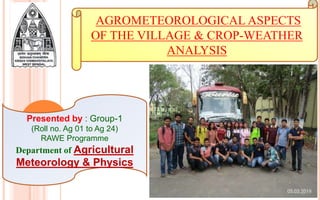



AGROMETEOROLOGICAL ASPECTS
OF THE VILLAGE & CROP-WEATHER
ANALYSIS
Presented by : Group-1
(Roll no. Ag 01 to Ag 24)
RAWE Programme
Department of Agricultural
Meteorology & Physics
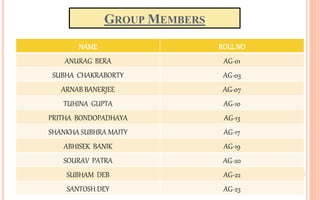
GROUP MEMBERS
NAME ROLLNO
ANURAG BERA AG-01
SUBHA CHAKRABORTY AG-03
ARNAB BANERJEE AG-07
TUHINA GUPTA AG-10
PRITHA BONDOPADHAYA AG-13
SHANKHA SUBHRA MAITY AG-17
ABHISEK BANIK AG-19
SOURAV PATRA AG-20
SUBHAM DEB AG-22
SANTOSH DEY AG-23
What is RAWE
Rural Agricultural Work Experience
(RAWE) is a programme in which the
students are exposed to reality in field or in
agro-based industrial situation.
This will improve student’s
organisational skill and refine them as
professional through sharing their
knowledge and screening.
Objectives
To develop a clear understanding & build an analytical
view about rural institution , enterprises , farm
resources and their limitations.
To carry out a participatory learning and action.
To find various ‘why’s behind some farm practices and
traditions with their impacts on farming societies.
To come out with some interventions strategies for
sustainable livelihood for sustainable agro ecosystem.
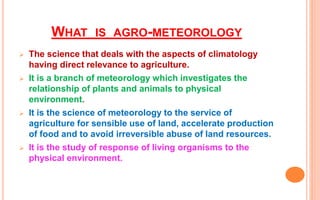
WHAT IS AGRO-METEOROLOGY
 The science that deals with the aspects of climatology
having direct relevance to agriculture.
 It is a branch of meteorology which investigates the
relationship of plants and animals to physical
environment.
 It is the science of meteorology to the service of
agriculture for sensible use of land, accelerate production
of food and to avoid irreversible abuse of land resources.
 It is the study of response of living organisms to the
physical environment.
 It deals with all the weather sensitive elements
of agricultural production.
 Weather forecast plays an essential part in
many farming operations.
 It helps in response farming applications.
 Agro-meteorology is very much useful in crop
planning for sustainable production.
 Crop management, crop planning, crop
monitoring, crop modeling and yield-climate
relationship are done by the Agro-meteorology.
Scope of agro-meteorology in Agriculture
 It helps in research in crop-climate relationship.
 Climate extremities and their effect on
agriculture are also associated with Agro-
meteorology.
 Climate as a tool to diagnosis the soil moisture
stress.
 Linking similar crop environments for crop
adaptability and productivity.
 It has an impact on livestock production.
SCOPE OF AGRO-METEOROLOGY IN AGRICULTURE
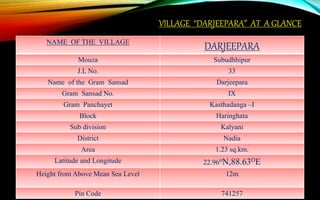
VILLAGE “DARJEEPARA” AT A GLANCE
NAME OF THE VILLAGE
DARJEEPARA
Mouza Subudhhipur
J.L No. 33
Name of the Gram Sansad Darjeepara
Gram Sansad No. IX
Gram Panchayet Kasthadanga –I
Block Haringhata
Sub division Kalyani
District Nadia
Area 1.23 sq.km.
Latitude and Longitude 22.96oN,88.63OE
Height from Above Mean Sea Level 12m
Pin Code 741257
ABOUT THE VILLAGE
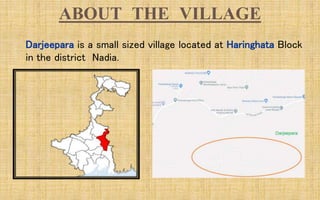
Darjeepara is a small sized village located at Haringhata Block
in the district Nadia.
Hydrological Map
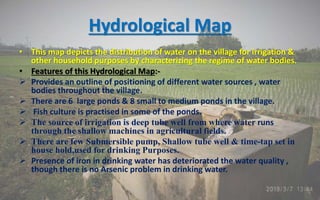
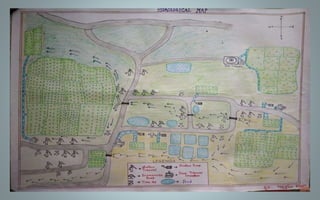
• This map depicts the distribution of water on the village for irrigation &
other household purposes by characterizing the regime of water bodies.
• Features of this Hydrological Map:-
 Provides an outline of positioning of different water sources , water
bodies throughout the village.
 There are 6 large ponds & 8 small to medium ponds in the village.
 Fish culture is practised in some of the ponds.
 The source of irrigation is deep tube well from where water runs
through the shallow machines in agricultural fields.
 There are few Submersible pump, Shallow tube well & time-tap set in
house hold,used for drinking Purposes.
 Presence of iron in drinking water has deteriorated the water quality ,
though there is no Arsenic problem in drinking water.
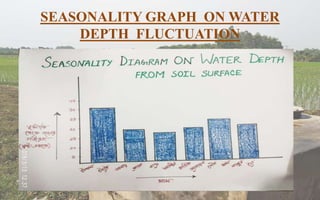
SEASONALITY GRAPH ON WATER
DEPTH FLUCTUATION
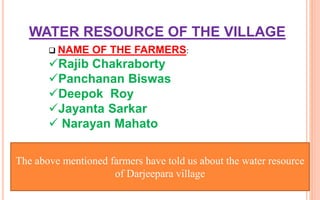
WATER RESOURCE OF THE VILLAGE
 NAME OF THE FARMERS:
Rajib Chakraborty
Panchanan Biswas
Deepok Roy
Jayanta Sarkar
 Narayan Mahato
The above mentioned farmers have told us about the water resource
of Darjeepara village
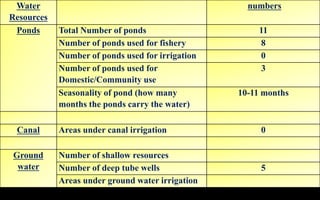
Water
Resources
numbers
Ponds Total Number of ponds 11
Number of ponds used for fishery 8
Number of ponds used for irrigation 0
Number of ponds used for
Domestic/Community use
3
Seasonality of pond (how many
months the ponds carry the water)
10-11 months
Canal Areas under canal irrigation 0
Ground
water
Number of shallow resources
Number of deep tube wells 5
Areas under ground water irrigation
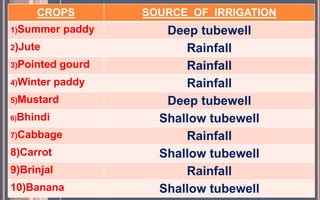
CROPS SOURCE OF IRRIGATION
1)Summer paddy Deep tubewell
2)Jute Rainfall
3)Pointed gourd Rainfall
4)Winter paddy Rainfall
5)Mustard Deep tubewell
6)Bhindi Shallow tubewell
7)Cabbage Rainfall
8)Carrot Shallow tubewell
9)Brinjal Rainfall
10)Banana Shallow tubewell
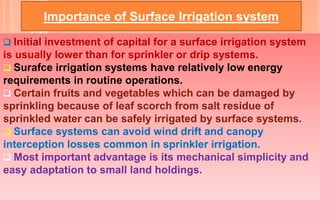
Importance of Surface Irrigation system
 Initial investment of capital for a surface irrigation system
is usually lower than for sprinkler or drip systems.
 Surafce irrigation systems have relatively low energy
requirements in routine operations.
 Certain fruits and vegetables which can be damaged by
sprinkling because of leaf scorch from salt residue of
sprinkled water can be safely irrigated by surface systems.
 Surface systems can avoid wind drift and canopy
interception losses common in sprinkler irrigation.
 Most important advantage is its mechanical simplicity and
easy adaptation to small land holdings.
USING OF SURFACE IRRIGATION SYSTEM
 The farmers mainly depends on ground water irrigation
systems and Rainfall for their cultivation practices.
 They are not interested on Surface water irrigation system.
 If the surface water is to be used for agriculture purpose
then there should be direct involvement of the concerned
authority, the Government.
 There is a scope of rain water harvesting but the main
problem is to make the structure of harvesting. There is
lack of land area to do the job. Nobody is interested to
provide their land for the establishment of such type of
structures.
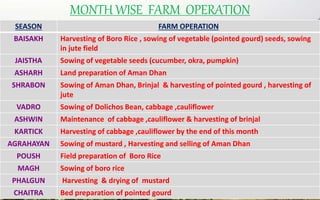
MONTH WISE FARM OPERATION
SEASON FARM OPERATION
BAISAKH Harvesting of Boro Rice , sowing of vegetable (pointed gourd) seeds, sowing
in jute field
JAISTHA Sowing of vegetable seeds (cucumber, okra, pumpkin)
ASHARH Land preparation of Aman Dhan
SHRABON Sowing of Aman Dhan, Brinjal & harvesting of pointed gourd , harvesting of
jute
VADRO Sowing of Dolichos Bean, cabbage ,cauliflower
ASHWIN Maintenance of cabbage ,cauliflower & harvesting of brinjal
KARTICK Harvesting of cabbage ,cauliflower by the end of this month
AGRAHAYAN Sowing of mustard , Harvesting and selling of Aman Dhan
POUSH Field preparation of Boro Rice
MAGH Sowing of boro rice
PHALGUN Harvesting & drying of mustard
CHAITRA Bed preparation of pointed gourd
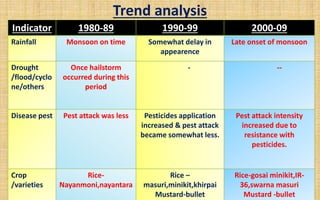
Trend analysis
Indicator 1980-89 1990-99 2000-09
Rainfall Monsoon on time Somewhat delay in
appearence
Late onset of monsoon
Drought
/flood/cyclo
ne/others
Once hailstorm
occurred during this
period
- --
Disease pest Pest attack was less Pesticides application
increased & pest attack
became somewhat less.
Pest attack intensity
increased due to
resistance with
pesticides.
Crop
/varieties
Rice-
Nayanmoni,nayantara
Rice –
masuri,minikit,khirpai
Mustard-bullet
Rice-gosai minikit,IR-
36,swarna masuri
Mustard -bullet
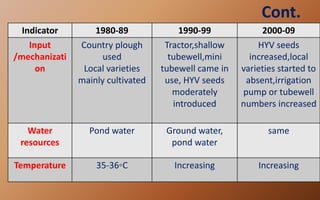
Cont.
Indicator 1980-89 1990-99 2000-09
Input
/mechanizati
on
Country plough
used
Local varieties
mainly cultivated
Tractor,shallow
tubewell,mini
tubewell came in
use, HYV seeds
moderately
introduced
HYV seeds
increased,local
varieties started to
absent,irrigation
pump or tubewell
numbers increased
Water
resources
Pond water Ground water,
pond water
same
Temperature 35-36◦C Increasing Increasing
REMARKS:-
• By the trend analysis,it is seen that for last 30 years rainfall
occurrence becomes delayed.
• In the year,1980-89 period,once severe hailstorm was occurred.
• Pest or disease attack became less due to pesticides
application,but,day by day it is icreasing due to resistance to that
of the pesticides.
• A huge input or mechanization is also adapted by the farmers in
present time.
• Temperature is increasing gradually.
• So, by the trend analysis of the climate in that particular
locality,dakshin panchpota,the effect on crops due to change of
climate is determined.
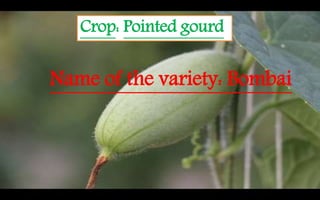
Crop: Pointed gourd
Name of the variety: Bombai
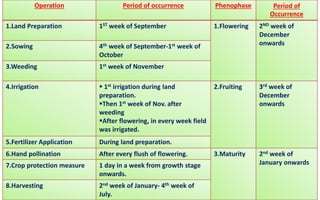
Operation Period of occurrence Phenophase Period of
Occurrence
1.Land Preparation 1ST week of September 1.Flowering 2ND week of
December
onwards2.Sowing 4th week of September-1st week of
October
3.Weeding 1st week of November
4.Irrigation  1st irrigation during land
preparation.
Then 1st week of Nov. after
weeding
After flowering, in every week field
was irrigated.
2.Fruiting 3rd week of
December
onwards
5.Fertilizer Application During land preparation.
6.Hand pollination After every flush of flowering. 3.Maturity 2nd week of
January onwards7.Crop protection measure 1 day in a week from growth stage
onwards.
8.Harvesting 2nd week of January- 4th week of
July.
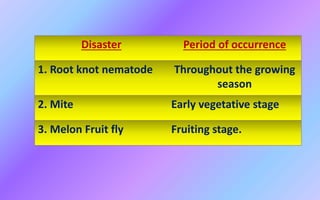
Disaster Period of occurrence
1. Root knot nematode Throughout the growing
season
2. Mite Early vegetative stage
3. Melon Fruit fly Fruiting stage.
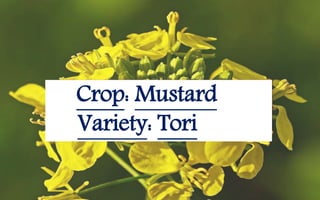
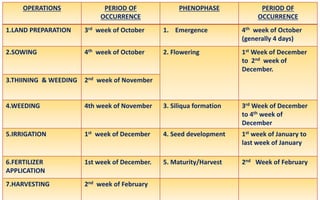
Crop: Mustard
Variety: Tori
OPERATIONS PERIOD OF
OCCURRENCE
PHENOPHASE PERIOD OF
OCCURRENCE
1.LAND PREPARATION 3rd week of October 1. Emergence 4th week of October
(generally 4 days)
2.SOWING 4th week of October 2. Flowering 1st Week of December
to 2nd week of
December.
3.THIINING & WEEDING 2nd week of November
4.WEEDING 4th week of November 3. Siliqua formation 3rd Week of December
to 4th week of
December
5.IRRIGATION 1st week of December 4. Seed development 1st week of January to
last week of January
6.FERTILIZER
APPLICATION
1st week of December. 5. Maturity/Harvest 2nd Week of February
7.HARVESTING 2nd week of February
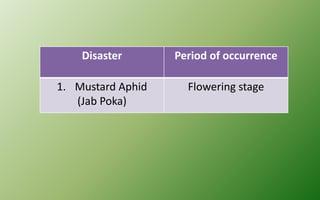
Disaster Period of occurrence
1. Mustard Aphid
(Jab Poka)
Flowering stage
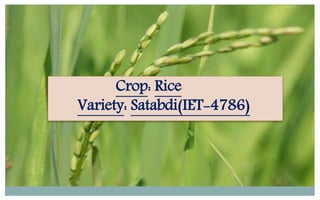
Crop: Rice
Variety: Satabdi(IET-4786)
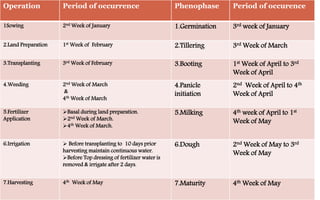
Operation Period of occurrence Phenophase Period of occurence
1Sowing 2nd Week of January 1.Germination 3rd week of January
2.Land Preparation 1st Week of February 2.Tillering 3rd Week of March
3.Transplanting 3rd Week of February 3.Booting 1st Week of April to 3rd
Week of April
4.Weeding 2nd Week of March
&
4th Week of March
4.Panicle
initiation
2nd Week of April to 4th
Week of April
5.Fertilizer
Application
Basal during land preparation.
2nd Week of March.
4th Week of March.
5.Milking 4th week of April to 1st
Week of May
6.Irrigation  Before transplanting to 10 days prior
harvesting maintain continuous water.
Before Top dressing of fertilizer water is
removed & irrigate after 2 days.
6.Dough 2nd Week of May to 3rd
Week of May
7.Harvesting 4th Week of May 7.Maturity 4th Week of May
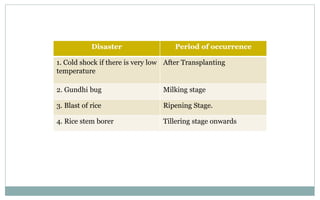
Disaster Period of occurrence
1. Cold shock if there is very low
temperature
After Transplanting
2. Gundhi bug Milking stage
3. Blast of rice Ripening Stage.
4. Rice stem borer Tillering stage onwards
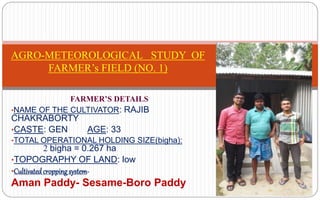
FARMER’S DETAILS
•NAME OF THE CULTIVATOR: RAJIB
CHAKRABORTY
•CASTE: GEN AGE: 33
•TOTAL OPERATIONAL HOLDING SIZE(bigha):
2 bigha = 0.267 ha
•TOPOGRAPHY OF LAND: low
•Cultivatedcroppingsystem-
Aman Paddy- Sesame-Boro Paddy
AGRO-METEOROLOGICAL STUDY OF
FARMER’s FIELD (NO. 1)
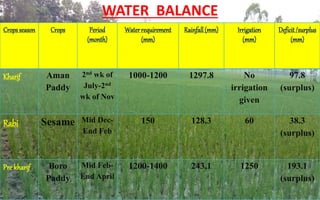
WATER BALANCE
Crops season Crops Period
(month)
Waterrequirement
(mm)
Rainfall(mm) Irrigation
(mm)
Deficit /surplus
(mm)
Kharif Aman
Paddy
2nd wk of
July-2nd
wk of Nov
1000-1200 1297.8 No
irrigation
given
97.8
(surplus)
Rabi Sesame Mid Dec-
End Feb
150 128.3 60 38.3
(surplus)
Prekharif Boro
Paddy
Mid Feb-
End April
1200-1400 243.1 1250 193.1
(surplus)
REMARKS
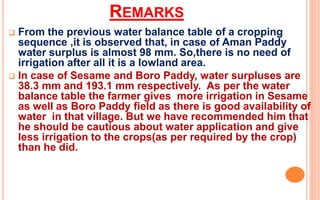
 From the previous water balance table of a cropping
sequence ,it is observed that, in case of Aman Paddy
water surplus is almost 98 mm. So,there is no need of
irrigation after all it is a lowland area.
 In case of Sesame and Boro Paddy, water surpluses are
38.3 mm and 193.1 mm respectively. As per the water
balance table the farmer gives more irrigation in Sesame
as well as Boro Paddy field as there is good availability of
water in that village. But we have recommended him that
he should be cautious about water application and give
less irrigation to the crops(as per required by the crop)
than he did.
111
AGRO-METEOROLOGICAL STUDY
OF FARMER’s FIELD (NO. 2)
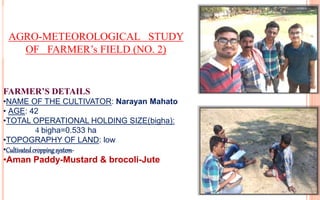
FARMER’S DETAILS
•NAME OF THE CULTIVATOR: Narayan Mahato
• AGE: 42
•TOTAL OPERATIONAL HOLDING SIZE(bigha):
4 bigha=0.533 ha
•TOPOGRAPHY OF LAND: low
•Cultivatedcropping system-
•Aman Paddy-Mustard & brocoli-Jute
Module 1:-WATER BALANCE
Crop
season
Crop Period (month) Water
requirement
(mm)
Rainfall
(mm)
Surplus
/deficit
(mm)
Irrigation
(mm)
Kharif Rice
(aman)
2.5
bigha
Mid week of
july to mid
week of nov.
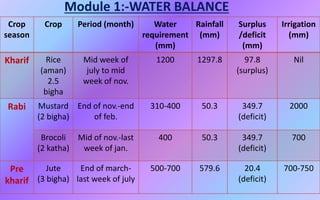
1200 1297.8 97.8
(surplus)
Nil
Rabi Mustard
(2 bigha)
End of nov.-end
of feb.
310-400 50.3 349.7
(deficit)
2000
Brocoli
(2 katha)
Mid of nov.-last
week of jan.
400 50.3 349.7
(deficit)
700
Pre
kharif
Jute
(3 bigha)
End of march-
last week of july
500-700 579.6 20.4
(deficit)
700-750
REMARKS
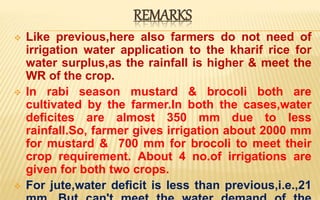
 Like previous,here also farmers do not need of
irrigation water application to the kharif rice for
water surplus,as the rainfall is higher & meet the
WR of the crop.
 In rabi season mustard & brocoli both are
cultivated by the farmer.In both the cases,water
deficites are almost 350 mm due to less
rainfall.So, farmer gives irrigation about 2000 mm
for mustard & 700 mm for brocoli to meet their
crop requirement. About 4 no.of irrigations are
given for both two crops.
 For jute,water deficit is less than previous,i.e.,21
FARMER’S INTRODUCTION
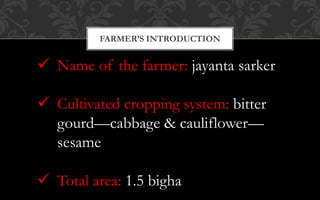
 Name of the farmer: jayanta sarker
 Cultivated cropping system: bitter
gourd—cabbage & cauliflower—
sesame
 Total area: 1.5 bigha
Crops(exam
ple)
Period(mont
h)
Water
requirement(m
m)
Rainfall(m
m)
Irrigation
(mm)
Deficit/surplus(mm)
Bitter gourd Mid april –
1st week of
july
400-500 323.6 240 63.6(surplus)
Cabbage &
cauliflower
End of
august – end
of nov.
380-500 163.8 150 66.2(deficit)
sesame Mid dec. –
mid to end of
march
150 148.3 60 58.3(surplus)
Conclusion & suggestion
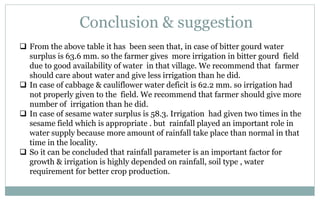
 From the above table it has been seen that, in case of bitter gourd water
surplus is 63.6 mm. so the farmer gives more irrigation in bitter gourd field
due to good availability of water in that village. We recommend that farmer
should care about water and give less irrigation than he did.
 In case of cabbage & cauliflower water deficit is 62.2 mm. so irrigation had
not properly given to the field. We recommend that farmer should give more
number of irrigation than he did.
 In case of sesame water surplus is 58.3. Irrigation had given two times in the
sesame field which is appropriate . but rainfall played an important role in
water supply because more amount of rainfall take place than normal in that
time in the locality.
 So it can be concluded that rainfall parameter is an important factor for
growth & irrigation is highly depended on rainfall, soil type , water
requirement for better crop production.
FARMER’S INTRODUCTION:
 Name of the farmer: mosirul mondal
 Cultivated cropping system: jute—
pumpkin—mustard—boro paddy
 Total area: 1 bigha
Crops(exam
ple)
Period(mont
h)
Water
requirement(m
m)
Rainfall(m
m)
Irrigation(m
m)
Deficit/surplus(m
m)
Jute 1st week of
may – end of
july
500-700 416.8 50 33.2 (deficit)
pumpkin 1st week of
aug. – mid of
nov.
500-600 350.1 120 29.9 (deficit)
mustard End of nov. –
1st week of feb.
310-400 13.8 60 236.2 (deficit)
Boro paddy 2nd week of feb
– end of april
1200-1400 243.1 1250 193.1(Surplus)
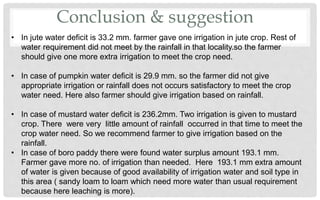
Conclusion & suggestion
• In jute water deficit is 33.2 mm. farmer gave one irrigation in jute crop. Rest of
water requirement did not meet by the rainfall in that locality.so the farmer
should give one more extra irrigation to meet the crop need.
• In case of pumpkin water deficit is 29.9 mm. so the farmer did not give
appropriate irrigation or rainfall does not occurs satisfactory to meet the crop
water need. Here also farmer should give irrigation based on rainfall.
• In case of mustard water deficit is 236.2mm. Two irrigation is given to mustard
crop. There were very little amount of rainfall occurred in that time to meet the
crop water need. So we recommend farmer to give irrigation based on the
rainfall.
• In case of boro paddy there were found water surplus amount 193.1 mm.
Farmer gave more no. of irrigation than needed. Here 193.1 mm extra amount
of water is given because of good availability of irrigation water and soil type in
this area ( sandy loam to loam which need more water than usual requirement
because here leaching is more).
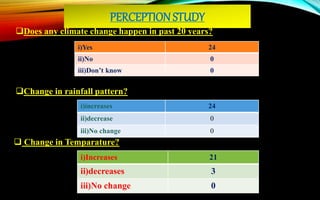
PERCEPTION STUDY
Does any climate change happen in past 20 years?
Change in rainfall pattern?
i)Yes 24
ii)No 0
iii)Don’t know 0
i)increases 24
ii)decrease 0
iii)No change 0
 Change in Temparature?
i)Increases 21
ii)decreases 3
iii)No change 0
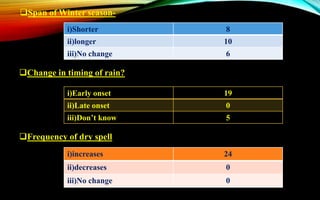
Span of Winter season-
i)Shorter 8
ii)longer 10
iii)No change 6
Change in timing of rain?
i)Early onset 19
ii)Late onset 0
iii)Don’t know 5
Frequency of dry spell
i)increases 24
ii)decreases 0
iii)No change 0
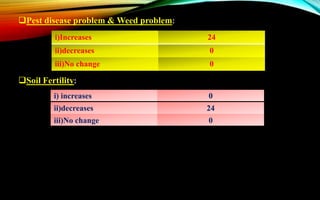
Pest disease problem & Weed problem:
Soil Fertility:
i)Increases 24
ii)decreases 0
iii)No change 0
i) increases 0
ii)decreases 24
iii)No change 0
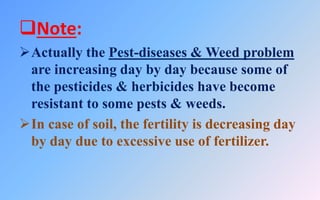
Note:
Actually the Pest-diseases & Weed problem
are increasing day by day because some of
the pesticides & herbicides have become
resistant to some pests & weeds.
In case of soil, the fertility is decreasing day
by day due to excessive use of fertilizer.
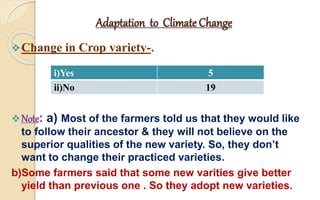
Adaptation to Climate Change
Change in Crop variety-.
Note: a) Most of the farmers told us that they would like
to follow their ancestor & they will not believe on the
superior qualities of the new variety. So, they don’t
want to change their practiced varieties.
b)Some farmers said that some new varities give better
yield than previous one . So they adopt new varieties.
i)Yes 5
ii)No 19
Change in planting time-
 Change in cropping system-
Note: Actually the village is situated in very low land.For this reason
they cannot take any alternative measure easily.
Irrigation frequency-
Ans.
i)Yes 0
ii)No 24
i)No 24
ii)Yes 0
i)increaes 11
ii)decreases 13
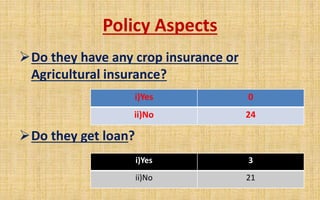
Do they have any crop insurance or
Agricultural insurance?
Do they get loan?
Policy Aspects
i)Yes 0
ii)No 24
i)Yes 3
ii)No 21
Note:
a)Some farmers told us that they don’t want to get
loan because they will not be able to repay it.
b)Some told that they are deprived from the
opportunity due to some political reasons.
Need Agro-met Advisory Services?
Ans. all said Yes.
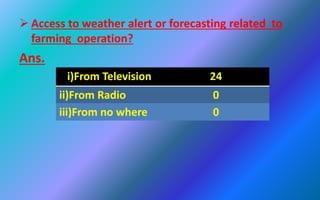
 Access to weather alert or forecasting related to
farming operation?
Ans.
i)From Television 24
ii)From Radio 0
iii)From no where 0
CROP WEATHER CALENDER
NAMEOF THE FARMER : BASUDEBSARKAR
CROP UNDERSTUDY: PUMPKIN(SC.NAME– (Cucurbita moschata )
PREPARED BY - TUHINA GUPTA
ROLL NO. - 10
CROP WEATHER CALENDER FOR PUMPKIN
CROP OPERATONAL INFORMATION
OPERATION PERIOD OF OCCURRENCE
SOWING 3rd week of JANUARY – 2nd
week of FEBRUARY
WEEDING 14 DAS
IRRIGATION From end of FEBRUARY in
every week
CROP PROTECTION
MEASURE
15-20 DAS
FERTILIZER APPLICATION During land preparation
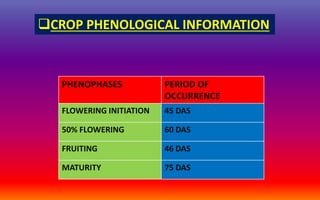
CROP PHENOLOGICAL INFORMATION
PHENOPHASES PERIOD OF
OCCURRENCE
FLOWERING INITIATION 45 DAS
50% FLOWERING 60 DAS
FRUITING 46 DAS
MATURITY 75 DAS
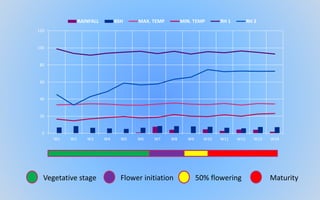
0
20
40
60
80
100
120
W1 W2 W3 W4 W5 W6 W7 W8 W9 W10 W11 W12 W13 W14
RAINFALL BSH MAX. TEMP MIN. TEMP RH 1 RH 2
Vegetative stage Flower initiation 50% flowering Maturity
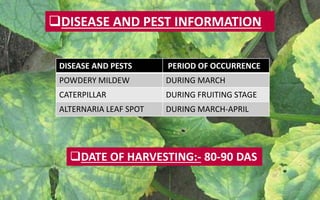
DISEASE AND PEST INFORMATION
DISEASE AND PESTS PERIOD OF OCCURRENCE
POWDERY MILDEW DURING MARCH
CATERPILLAR DURING FRUITING STAGE
ALTERNARIA LEAF SPOT DURING MARCH-APRIL
DATE OF HARVESTING:- 80-90 DAS
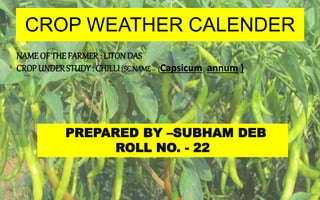
CROP WEATHER CALENDER
NAME OF THEFARMER : LITONDAS
CROP UNDERSTUDY: CHILLI (SC.NAME– (Capsicum annum )
PREPARED BY –SUBHAM DEB
ROLL NO. - 22
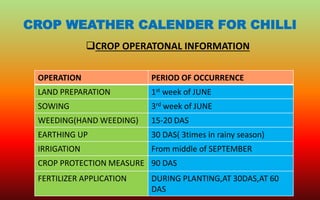
CROP WEATHER CALENDER FOR CHILLI
CROP OPERATONAL INFORMATION
OPERATION PERIOD OF OCCURRENCE
LAND PREPARATION 1st week of JUNE
SOWING 3rd week of JUNE
WEEDING(HAND WEEDING) 15-20 DAS
EARTHING UP 30 DAS( 3times in rainy season)
IRRIGATION From middle of SEPTEMBER
CROP PROTECTION MEASURE 90 DAS
FERTILIZER APPLICATION DURING PLANTING,AT 30DAS,AT 60
DAS
CROP PHENOLOGICAL INFORMATION
PHENOPHASES PERIOD OF OCCURRENCE
FLOWERING INITIATION 90-120 DAS
50% FLOWERING 120 DAS
FRUITING 105 DAS
HARVESTING STARTS
FROM
120 DAS
0
20
40
60
80
100
120
W1
W2
W3
W4
W5
W6
W7
W8
W9
W10
W11
W12
W13
W14
W15
W16
W17
W18
W19
W20
W21
W22
W23
W24
W25
W26
W27
W28
W29
W30
W31
W32
W33
W34
W35
W36
W37
W38
W39
W40
W41
W42
W43
W44
W45
W46
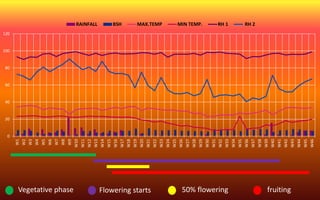
RAINFALL BSH MAX.TEMP MIN TEMP. RH 1 RH 2
Vegetative phase Flowering starts 50% flowering fruiting
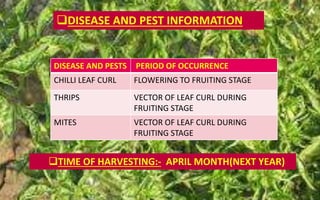
DISEASE AND PEST INFORMATION
DISEASE AND PESTS PERIOD OF OCCURRENCE
CHILLI LEAF CURL FLOWERING TO FRUITING STAGE
THRIPS VECTOR OF LEAF CURL DURING
FRUITING STAGE
MITES VECTOR OF LEAF CURL DURING
FRUITING STAGE
TIME OF HARVESTING:- APRIL MONTH(NEXT YEAR)
 We are very much thankful to the villagers of Darjeepara for
their wholehearted co-operation with us during our RAWE
programme, specially to SHREE JAYANTA SARKAR (OUR
CONTACT FARMER) ,who helped us a lot in this programme.
 SpecialThanks to :-
 PROF. DHANANJOY DUTTA (RAWE CO-ORDINATOR).
 PROF. SANKARACHARYA (RAWE ADVISOR).
 DR. MANOJ KUMAR NANDA.
Agrometeorology ppt rawe

Agrometeorology ppt rawe

  • 1.
    AGROMETEOROLOGICAL ASPECTS OF THEVILLAGE & CROP-WEATHER ANALYSIS Presented by : Group-1 (Roll no. Ag 01 to Ag 24) RAWE Programme Department of Agricultural Meteorology & Physics
  • 2.
    GROUP MEMBERS NAME ROLLNO ANURAGBERA AG-01 SUBHA CHAKRABORTY AG-03 ARNAB BANERJEE AG-07 TUHINA GUPTA AG-10 PRITHA BONDOPADHAYA AG-13 SHANKHA SUBHRA MAITY AG-17 ABHISEK BANIK AG-19 SOURAV PATRA AG-20 SUBHAM DEB AG-22 SANTOSH DEY AG-23
  • 3.
    What is RAWE RuralAgricultural Work Experience (RAWE) is a programme in which the students are exposed to reality in field or in agro-based industrial situation. This will improve student’s organisational skill and refine them as professional through sharing their knowledge and screening.
  • 4.
    Objectives To develop aclear understanding & build an analytical view about rural institution , enterprises , farm resources and their limitations. To carry out a participatory learning and action. To find various ‘why’s behind some farm practices and traditions with their impacts on farming societies. To come out with some interventions strategies for sustainable livelihood for sustainable agro ecosystem.
  • 5.
    WHAT IS AGRO-METEOROLOGY The science that deals with the aspects of climatology having direct relevance to agriculture.  It is a branch of meteorology which investigates the relationship of plants and animals to physical environment.  It is the science of meteorology to the service of agriculture for sensible use of land, accelerate production of food and to avoid irreversible abuse of land resources.  It is the study of response of living organisms to the physical environment.
  • 6.
     It dealswith all the weather sensitive elements of agricultural production.  Weather forecast plays an essential part in many farming operations.  It helps in response farming applications.  Agro-meteorology is very much useful in crop planning for sustainable production.  Crop management, crop planning, crop monitoring, crop modeling and yield-climate relationship are done by the Agro-meteorology. Scope of agro-meteorology in Agriculture
  • 7.
     It helpsin research in crop-climate relationship.  Climate extremities and their effect on agriculture are also associated with Agro- meteorology.  Climate as a tool to diagnosis the soil moisture stress.  Linking similar crop environments for crop adaptability and productivity.  It has an impact on livestock production. SCOPE OF AGRO-METEOROLOGY IN AGRICULTURE
  • 8.
    VILLAGE “DARJEEPARA” ATA GLANCE NAME OF THE VILLAGE DARJEEPARA Mouza Subudhhipur J.L No. 33 Name of the Gram Sansad Darjeepara Gram Sansad No. IX Gram Panchayet Kasthadanga –I Block Haringhata Sub division Kalyani District Nadia Area 1.23 sq.km. Latitude and Longitude 22.96oN,88.63OE Height from Above Mean Sea Level 12m Pin Code 741257
  • 9.
    ABOUT THE VILLAGE Darjeeparais a small sized village located at Haringhata Block in the district Nadia.
  • 10.
    Hydrological Map • Thismap depicts the distribution of water on the village for irrigation & other household purposes by characterizing the regime of water bodies. • Features of this Hydrological Map:-  Provides an outline of positioning of different water sources , water bodies throughout the village.  There are 6 large ponds & 8 small to medium ponds in the village.  Fish culture is practised in some of the ponds.  The source of irrigation is deep tube well from where water runs through the shallow machines in agricultural fields.  There are few Submersible pump, Shallow tube well & time-tap set in house hold,used for drinking Purposes.  Presence of iron in drinking water has deteriorated the water quality , though there is no Arsenic problem in drinking water.
  • 12.
    SEASONALITY GRAPH ONWATER DEPTH FLUCTUATION
  • 13.
    WATER RESOURCE OFTHE VILLAGE  NAME OF THE FARMERS: Rajib Chakraborty Panchanan Biswas Deepok Roy Jayanta Sarkar  Narayan Mahato The above mentioned farmers have told us about the water resource of Darjeepara village
  • 14.
    Water Resources numbers Ponds Total Numberof ponds 11 Number of ponds used for fishery 8 Number of ponds used for irrigation 0 Number of ponds used for Domestic/Community use 3 Seasonality of pond (how many months the ponds carry the water) 10-11 months Canal Areas under canal irrigation 0 Ground water Number of shallow resources Number of deep tube wells 5 Areas under ground water irrigation
  • 15.
    CROPS SOURCE OFIRRIGATION 1)Summer paddy Deep tubewell 2)Jute Rainfall 3)Pointed gourd Rainfall 4)Winter paddy Rainfall 5)Mustard Deep tubewell 6)Bhindi Shallow tubewell 7)Cabbage Rainfall 8)Carrot Shallow tubewell 9)Brinjal Rainfall 10)Banana Shallow tubewell
  • 16.
    Importance of SurfaceIrrigation system  Initial investment of capital for a surface irrigation system is usually lower than for sprinkler or drip systems.  Surafce irrigation systems have relatively low energy requirements in routine operations.  Certain fruits and vegetables which can be damaged by sprinkling because of leaf scorch from salt residue of sprinkled water can be safely irrigated by surface systems.  Surface systems can avoid wind drift and canopy interception losses common in sprinkler irrigation.  Most important advantage is its mechanical simplicity and easy adaptation to small land holdings.
  • 17.
    USING OF SURFACEIRRIGATION SYSTEM  The farmers mainly depends on ground water irrigation systems and Rainfall for their cultivation practices.  They are not interested on Surface water irrigation system.  If the surface water is to be used for agriculture purpose then there should be direct involvement of the concerned authority, the Government.  There is a scope of rain water harvesting but the main problem is to make the structure of harvesting. There is lack of land area to do the job. Nobody is interested to provide their land for the establishment of such type of structures.
  • 18.
    MONTH WISE FARMOPERATION SEASON FARM OPERATION BAISAKH Harvesting of Boro Rice , sowing of vegetable (pointed gourd) seeds, sowing in jute field JAISTHA Sowing of vegetable seeds (cucumber, okra, pumpkin) ASHARH Land preparation of Aman Dhan SHRABON Sowing of Aman Dhan, Brinjal & harvesting of pointed gourd , harvesting of jute VADRO Sowing of Dolichos Bean, cabbage ,cauliflower ASHWIN Maintenance of cabbage ,cauliflower & harvesting of brinjal KARTICK Harvesting of cabbage ,cauliflower by the end of this month AGRAHAYAN Sowing of mustard , Harvesting and selling of Aman Dhan POUSH Field preparation of Boro Rice MAGH Sowing of boro rice PHALGUN Harvesting & drying of mustard CHAITRA Bed preparation of pointed gourd
  • 19.
    Trend analysis Indicator 1980-891990-99 2000-09 Rainfall Monsoon on time Somewhat delay in appearence Late onset of monsoon Drought /flood/cyclo ne/others Once hailstorm occurred during this period - -- Disease pest Pest attack was less Pesticides application increased & pest attack became somewhat less. Pest attack intensity increased due to resistance with pesticides. Crop /varieties Rice- Nayanmoni,nayantara Rice – masuri,minikit,khirpai Mustard-bullet Rice-gosai minikit,IR- 36,swarna masuri Mustard -bullet
  • 20.
    Cont. Indicator 1980-89 1990-992000-09 Input /mechanizati on Country plough used Local varieties mainly cultivated Tractor,shallow tubewell,mini tubewell came in use, HYV seeds moderately introduced HYV seeds increased,local varieties started to absent,irrigation pump or tubewell numbers increased Water resources Pond water Ground water, pond water same Temperature 35-36◦C Increasing Increasing
  • 21.
    REMARKS:- • By thetrend analysis,it is seen that for last 30 years rainfall occurrence becomes delayed. • In the year,1980-89 period,once severe hailstorm was occurred. • Pest or disease attack became less due to pesticides application,but,day by day it is icreasing due to resistance to that of the pesticides. • A huge input or mechanization is also adapted by the farmers in present time. • Temperature is increasing gradually. • So, by the trend analysis of the climate in that particular locality,dakshin panchpota,the effect on crops due to change of climate is determined.
  • 22.
    Crop: Pointed gourd Nameof the variety: Bombai
  • 23.
    Operation Period ofoccurrence Phenophase Period of Occurrence 1.Land Preparation 1ST week of September 1.Flowering 2ND week of December onwards2.Sowing 4th week of September-1st week of October 3.Weeding 1st week of November 4.Irrigation  1st irrigation during land preparation. Then 1st week of Nov. after weeding After flowering, in every week field was irrigated. 2.Fruiting 3rd week of December onwards 5.Fertilizer Application During land preparation. 6.Hand pollination After every flush of flowering. 3.Maturity 2nd week of January onwards7.Crop protection measure 1 day in a week from growth stage onwards. 8.Harvesting 2nd week of January- 4th week of July.
  • 24.
    Disaster Period ofoccurrence 1. Root knot nematode Throughout the growing season 2. Mite Early vegetative stage 3. Melon Fruit fly Fruiting stage.
  • 25.
  • 26.
    OPERATIONS PERIOD OF OCCURRENCE PHENOPHASEPERIOD OF OCCURRENCE 1.LAND PREPARATION 3rd week of October 1. Emergence 4th week of October (generally 4 days) 2.SOWING 4th week of October 2. Flowering 1st Week of December to 2nd week of December. 3.THIINING & WEEDING 2nd week of November 4.WEEDING 4th week of November 3. Siliqua formation 3rd Week of December to 4th week of December 5.IRRIGATION 1st week of December 4. Seed development 1st week of January to last week of January 6.FERTILIZER APPLICATION 1st week of December. 5. Maturity/Harvest 2nd Week of February 7.HARVESTING 2nd week of February
  • 27.
    Disaster Period ofoccurrence 1. Mustard Aphid (Jab Poka) Flowering stage
  • 28.
  • 29.
    Operation Period ofoccurrence Phenophase Period of occurence 1Sowing 2nd Week of January 1.Germination 3rd week of January 2.Land Preparation 1st Week of February 2.Tillering 3rd Week of March 3.Transplanting 3rd Week of February 3.Booting 1st Week of April to 3rd Week of April 4.Weeding 2nd Week of March & 4th Week of March 4.Panicle initiation 2nd Week of April to 4th Week of April 5.Fertilizer Application Basal during land preparation. 2nd Week of March. 4th Week of March. 5.Milking 4th week of April to 1st Week of May 6.Irrigation  Before transplanting to 10 days prior harvesting maintain continuous water. Before Top dressing of fertilizer water is removed & irrigate after 2 days. 6.Dough 2nd Week of May to 3rd Week of May 7.Harvesting 4th Week of May 7.Maturity 4th Week of May
  • 30.
    Disaster Period ofoccurrence 1. Cold shock if there is very low temperature After Transplanting 2. Gundhi bug Milking stage 3. Blast of rice Ripening Stage. 4. Rice stem borer Tillering stage onwards
  • 31.
    FARMER’S DETAILS •NAME OFTHE CULTIVATOR: RAJIB CHAKRABORTY •CASTE: GEN AGE: 33 •TOTAL OPERATIONAL HOLDING SIZE(bigha): 2 bigha = 0.267 ha •TOPOGRAPHY OF LAND: low •Cultivatedcroppingsystem- Aman Paddy- Sesame-Boro Paddy AGRO-METEOROLOGICAL STUDY OF FARMER’s FIELD (NO. 1)
  • 32.
    WATER BALANCE Crops seasonCrops Period (month) Waterrequirement (mm) Rainfall(mm) Irrigation (mm) Deficit /surplus (mm) Kharif Aman Paddy 2nd wk of July-2nd wk of Nov 1000-1200 1297.8 No irrigation given 97.8 (surplus) Rabi Sesame Mid Dec- End Feb 150 128.3 60 38.3 (surplus) Prekharif Boro Paddy Mid Feb- End April 1200-1400 243.1 1250 193.1 (surplus)
  • 33.
    REMARKS  From theprevious water balance table of a cropping sequence ,it is observed that, in case of Aman Paddy water surplus is almost 98 mm. So,there is no need of irrigation after all it is a lowland area.  In case of Sesame and Boro Paddy, water surpluses are 38.3 mm and 193.1 mm respectively. As per the water balance table the farmer gives more irrigation in Sesame as well as Boro Paddy field as there is good availability of water in that village. But we have recommended him that he should be cautious about water application and give less irrigation to the crops(as per required by the crop) than he did.
  • 34.
    111 AGRO-METEOROLOGICAL STUDY OF FARMER’sFIELD (NO. 2) FARMER’S DETAILS •NAME OF THE CULTIVATOR: Narayan Mahato • AGE: 42 •TOTAL OPERATIONAL HOLDING SIZE(bigha): 4 bigha=0.533 ha •TOPOGRAPHY OF LAND: low •Cultivatedcropping system- •Aman Paddy-Mustard & brocoli-Jute
  • 35.
    Module 1:-WATER BALANCE Crop season CropPeriod (month) Water requirement (mm) Rainfall (mm) Surplus /deficit (mm) Irrigation (mm) Kharif Rice (aman) 2.5 bigha Mid week of july to mid week of nov. 1200 1297.8 97.8 (surplus) Nil Rabi Mustard (2 bigha) End of nov.-end of feb. 310-400 50.3 349.7 (deficit) 2000 Brocoli (2 katha) Mid of nov.-last week of jan. 400 50.3 349.7 (deficit) 700 Pre kharif Jute (3 bigha) End of march- last week of july 500-700 579.6 20.4 (deficit) 700-750
  • 36.
    REMARKS  Like previous,herealso farmers do not need of irrigation water application to the kharif rice for water surplus,as the rainfall is higher & meet the WR of the crop.  In rabi season mustard & brocoli both are cultivated by the farmer.In both the cases,water deficites are almost 350 mm due to less rainfall.So, farmer gives irrigation about 2000 mm for mustard & 700 mm for brocoli to meet their crop requirement. About 4 no.of irrigations are given for both two crops.  For jute,water deficit is less than previous,i.e.,21
  • 37.
    FARMER’S INTRODUCTION  Nameof the farmer: jayanta sarker  Cultivated cropping system: bitter gourd—cabbage & cauliflower— sesame  Total area: 1.5 bigha
  • 38.
    Crops(exam ple) Period(mont h) Water requirement(m m) Rainfall(m m) Irrigation (mm) Deficit/surplus(mm) Bitter gourd Midapril – 1st week of july 400-500 323.6 240 63.6(surplus) Cabbage & cauliflower End of august – end of nov. 380-500 163.8 150 66.2(deficit) sesame Mid dec. – mid to end of march 150 148.3 60 58.3(surplus)
  • 39.
    Conclusion & suggestion From the above table it has been seen that, in case of bitter gourd water surplus is 63.6 mm. so the farmer gives more irrigation in bitter gourd field due to good availability of water in that village. We recommend that farmer should care about water and give less irrigation than he did.  In case of cabbage & cauliflower water deficit is 62.2 mm. so irrigation had not properly given to the field. We recommend that farmer should give more number of irrigation than he did.  In case of sesame water surplus is 58.3. Irrigation had given two times in the sesame field which is appropriate . but rainfall played an important role in water supply because more amount of rainfall take place than normal in that time in the locality.  So it can be concluded that rainfall parameter is an important factor for growth & irrigation is highly depended on rainfall, soil type , water requirement for better crop production.
  • 40.
    FARMER’S INTRODUCTION:  Nameof the farmer: mosirul mondal  Cultivated cropping system: jute— pumpkin—mustard—boro paddy  Total area: 1 bigha
  • 41.
    Crops(exam ple) Period(mont h) Water requirement(m m) Rainfall(m m) Irrigation(m m) Deficit/surplus(m m) Jute 1st weekof may – end of july 500-700 416.8 50 33.2 (deficit) pumpkin 1st week of aug. – mid of nov. 500-600 350.1 120 29.9 (deficit) mustard End of nov. – 1st week of feb. 310-400 13.8 60 236.2 (deficit) Boro paddy 2nd week of feb – end of april 1200-1400 243.1 1250 193.1(Surplus)
  • 42.
    Conclusion & suggestion •In jute water deficit is 33.2 mm. farmer gave one irrigation in jute crop. Rest of water requirement did not meet by the rainfall in that locality.so the farmer should give one more extra irrigation to meet the crop need. • In case of pumpkin water deficit is 29.9 mm. so the farmer did not give appropriate irrigation or rainfall does not occurs satisfactory to meet the crop water need. Here also farmer should give irrigation based on rainfall. • In case of mustard water deficit is 236.2mm. Two irrigation is given to mustard crop. There were very little amount of rainfall occurred in that time to meet the crop water need. So we recommend farmer to give irrigation based on the rainfall. • In case of boro paddy there were found water surplus amount 193.1 mm. Farmer gave more no. of irrigation than needed. Here 193.1 mm extra amount of water is given because of good availability of irrigation water and soil type in this area ( sandy loam to loam which need more water than usual requirement because here leaching is more).
  • 43.
    PERCEPTION STUDY Does anyclimate change happen in past 20 years? Change in rainfall pattern? i)Yes 24 ii)No 0 iii)Don’t know 0 i)increases 24 ii)decrease 0 iii)No change 0  Change in Temparature? i)Increases 21 ii)decreases 3 iii)No change 0
  • 44.
    Span of Winterseason- i)Shorter 8 ii)longer 10 iii)No change 6 Change in timing of rain? i)Early onset 19 ii)Late onset 0 iii)Don’t know 5 Frequency of dry spell i)increases 24 ii)decreases 0 iii)No change 0
  • 45.
    Pest disease problem& Weed problem: Soil Fertility: i)Increases 24 ii)decreases 0 iii)No change 0 i) increases 0 ii)decreases 24 iii)No change 0
  • 46.
    Note: Actually the Pest-diseases& Weed problem are increasing day by day because some of the pesticides & herbicides have become resistant to some pests & weeds. In case of soil, the fertility is decreasing day by day due to excessive use of fertilizer.
  • 47.
    Adaptation to ClimateChange Change in Crop variety-. Note: a) Most of the farmers told us that they would like to follow their ancestor & they will not believe on the superior qualities of the new variety. So, they don’t want to change their practiced varieties. b)Some farmers said that some new varities give better yield than previous one . So they adopt new varieties. i)Yes 5 ii)No 19
  • 48.
    Change in plantingtime-  Change in cropping system- Note: Actually the village is situated in very low land.For this reason they cannot take any alternative measure easily. Irrigation frequency- Ans. i)Yes 0 ii)No 24 i)No 24 ii)Yes 0 i)increaes 11 ii)decreases 13
  • 49.
    Do they haveany crop insurance or Agricultural insurance? Do they get loan? Policy Aspects i)Yes 0 ii)No 24 i)Yes 3 ii)No 21
  • 50.
    Note: a)Some farmers toldus that they don’t want to get loan because they will not be able to repay it. b)Some told that they are deprived from the opportunity due to some political reasons. Need Agro-met Advisory Services? Ans. all said Yes.
  • 51.
     Access toweather alert or forecasting related to farming operation? Ans. i)From Television 24 ii)From Radio 0 iii)From no where 0
  • 52.
    CROP WEATHER CALENDER NAMEOFTHE FARMER : BASUDEBSARKAR CROP UNDERSTUDY: PUMPKIN(SC.NAME– (Cucurbita moschata ) PREPARED BY - TUHINA GUPTA ROLL NO. - 10
  • 53.
    CROP WEATHER CALENDERFOR PUMPKIN CROP OPERATONAL INFORMATION OPERATION PERIOD OF OCCURRENCE SOWING 3rd week of JANUARY – 2nd week of FEBRUARY WEEDING 14 DAS IRRIGATION From end of FEBRUARY in every week CROP PROTECTION MEASURE 15-20 DAS FERTILIZER APPLICATION During land preparation
  • 54.
    CROP PHENOLOGICAL INFORMATION PHENOPHASESPERIOD OF OCCURRENCE FLOWERING INITIATION 45 DAS 50% FLOWERING 60 DAS FRUITING 46 DAS MATURITY 75 DAS
  • 55.
    0 20 40 60 80 100 120 W1 W2 W3W4 W5 W6 W7 W8 W9 W10 W11 W12 W13 W14 RAINFALL BSH MAX. TEMP MIN. TEMP RH 1 RH 2 Vegetative stage Flower initiation 50% flowering Maturity
  • 56.
    DISEASE AND PESTINFORMATION DISEASE AND PESTS PERIOD OF OCCURRENCE POWDERY MILDEW DURING MARCH CATERPILLAR DURING FRUITING STAGE ALTERNARIA LEAF SPOT DURING MARCH-APRIL DATE OF HARVESTING:- 80-90 DAS
  • 57.
    CROP WEATHER CALENDER NAMEOF THEFARMER : LITONDAS CROP UNDERSTUDY: CHILLI (SC.NAME– (Capsicum annum ) PREPARED BY –SUBHAM DEB ROLL NO. - 22
  • 58.
    CROP WEATHER CALENDERFOR CHILLI CROP OPERATONAL INFORMATION OPERATION PERIOD OF OCCURRENCE LAND PREPARATION 1st week of JUNE SOWING 3rd week of JUNE WEEDING(HAND WEEDING) 15-20 DAS EARTHING UP 30 DAS( 3times in rainy season) IRRIGATION From middle of SEPTEMBER CROP PROTECTION MEASURE 90 DAS FERTILIZER APPLICATION DURING PLANTING,AT 30DAS,AT 60 DAS
  • 59.
    CROP PHENOLOGICAL INFORMATION PHENOPHASESPERIOD OF OCCURRENCE FLOWERING INITIATION 90-120 DAS 50% FLOWERING 120 DAS FRUITING 105 DAS HARVESTING STARTS FROM 120 DAS
  • 60.
  • 61.
    DISEASE AND PESTINFORMATION DISEASE AND PESTS PERIOD OF OCCURRENCE CHILLI LEAF CURL FLOWERING TO FRUITING STAGE THRIPS VECTOR OF LEAF CURL DURING FRUITING STAGE MITES VECTOR OF LEAF CURL DURING FRUITING STAGE TIME OF HARVESTING:- APRIL MONTH(NEXT YEAR)
  • 62.
     We arevery much thankful to the villagers of Darjeepara for their wholehearted co-operation with us during our RAWE programme, specially to SHREE JAYANTA SARKAR (OUR CONTACT FARMER) ,who helped us a lot in this programme.  SpecialThanks to :-  PROF. DHANANJOY DUTTA (RAWE CO-ORDINATOR).  PROF. SANKARACHARYA (RAWE ADVISOR).  DR. MANOJ KUMAR NANDA.