CROP DIVERSIFICATION
Presented by,
M. A. AMBIGA DEVI
III B.Sc., Agriculture
Adhiparasakthi Agricultural college
Introduction
• Modern agriculture - technology based
• Crop dominated land use
• Unsustainable production
• Soil degradation
• Loss of biodiversity
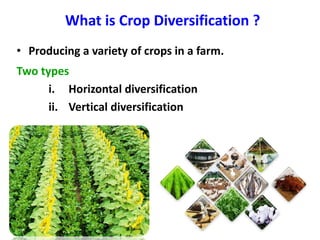
What is Crop Diversification ?
• Producing a variety of crops in a farm.
Two types
i. Horizontal diversification
ii. Vertical diversification
Need for Crop
Diversification
Sustainable
income
Ecological
balance
Employment
generation
Reducing
risk
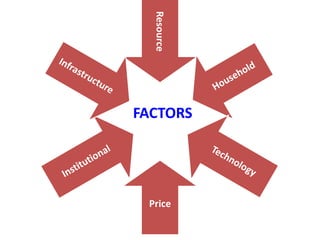
Price
Resource
FACTORS
Strategies for crop diversification
• From high water requiring to water saving crops.
• Replacing low yielding low value crops to high
yielding high value crops.
• Intercropping / mixed cropping
• Shift high risk crops with short duration and
drought resistant crops
Steps in crop diversification
Delineate area
Choice of alternatives
Input & credit supply
Share the risk
Market support
Crop Diversification for States
Karnataka Oilseeds, Jowar, Rice, Pulses, Maize
Kerala Fruits and Vegetables, Jowar/Oilseeds, Rice, Pulses
Maharashtra Jowar, Oilseeds, Cotton, Pulses, Fruits and Vegetables
Goa Rice, Pulses, Coconut, Fruits and Vegetables, Oilseeds
Rajasthan Bajra, Oilseeds, Pulses, Wheat, Maize
Gujarat Oilseeds, Cotton, Rice, Pulse, Wheat,
Tamil Nadu Rice, Fruits & Vegetables, Oilseeds, Pulse
Meghalaya Rice, Fruits & Vegetables, Maize, Oilseeds, Cotton
Andhra Pradesh Rice, Oilseeds, Pulses, Cotton, Fruits & Vegetables
Source: Statistical Aspect of India, 1991 & Dept. of Agri. &
cooperation, Govt. of India, 2008-09.
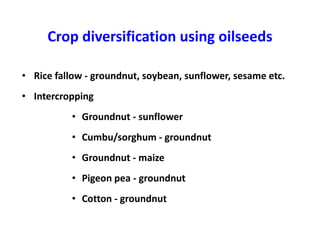
Crop diversification using oilseeds
• Rice fallow - groundnut, soybean, sunflower, sesame etc.
• Intercropping
• Groundnut - sunflower
• Cumbu/sorghum - groundnut
• Groundnut - maize
• Pigeon pea - groundnut
• Cotton - groundnut
Crop sequence
– Cotton - groundnut
– Rice - soybean
– Rice - mustard - brinjal
– Rice - linseed
– Sorghum - sunflower - groundnut
– Soybean - wheat
– Rice - mustard - mungbean
– Groundnut - Sunflower
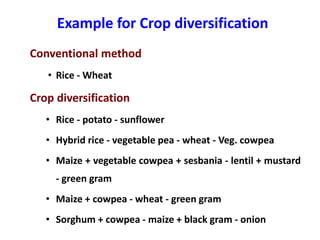
Example for Crop diversification
Conventional method
• Rice - Wheat
Crop diversification
• Rice - potato - sunflower
• Hybrid rice - vegetable pea - wheat - Veg. cowpea
• Maize + vegetable cowpea + sesbania - lentil + mustard
- green gram
• Maize + cowpea - wheat - green gram
• Sorghum + cowpea - maize + black gram - onion
Gangwar et. al, Modipuram (2008)
0
20000
40000
60000
80000
100000
120000
NETRETURN(Rs/ha)
CROPS
NET RETURN
Advantages
• Better use of inputs
• Less risk
• Maintenance of Soil fertility
• Buffering climate variability
• Pest suppression
Constraints
• Over 63 % of the cropped area - rainfed
• Inadequate resources
• Fragmentation of land holding
• Inadequate post-harvest technologies
• Weak extension linkages
• Poly phagous diseases and pests
• Decreased investments
Opportunities
• Due to Globalization
• Due to Emerging technologies
• Research and developmental support
• Institutional and infrastructure developments
Government Policies
• Implementing National Agriculture Insurance Scheme
• Creation of Watershed Development Fund
• Strengthening Agricultural Marketing
• Seed Crop Insurance
• Seed Bank Scheme
• Cooperative Sector Reforms
Thank you….!

Crop diversification

  • 1.
    CROP DIVERSIFICATION Presented by, M.A. AMBIGA DEVI III B.Sc., Agriculture Adhiparasakthi Agricultural college
  • 2.
    Introduction • Modern agriculture- technology based • Crop dominated land use • Unsustainable production • Soil degradation • Loss of biodiversity
  • 3.
    What is CropDiversification ? • Producing a variety of crops in a farm. Two types i. Horizontal diversification ii. Vertical diversification
  • 4.
  • 5.
  • 6.
    Strategies for cropdiversification • From high water requiring to water saving crops. • Replacing low yielding low value crops to high yielding high value crops. • Intercropping / mixed cropping • Shift high risk crops with short duration and drought resistant crops
  • 7.
    Steps in cropdiversification Delineate area Choice of alternatives Input & credit supply Share the risk Market support
  • 8.
    Crop Diversification forStates Karnataka Oilseeds, Jowar, Rice, Pulses, Maize Kerala Fruits and Vegetables, Jowar/Oilseeds, Rice, Pulses Maharashtra Jowar, Oilseeds, Cotton, Pulses, Fruits and Vegetables Goa Rice, Pulses, Coconut, Fruits and Vegetables, Oilseeds Rajasthan Bajra, Oilseeds, Pulses, Wheat, Maize Gujarat Oilseeds, Cotton, Rice, Pulse, Wheat, Tamil Nadu Rice, Fruits & Vegetables, Oilseeds, Pulse Meghalaya Rice, Fruits & Vegetables, Maize, Oilseeds, Cotton Andhra Pradesh Rice, Oilseeds, Pulses, Cotton, Fruits & Vegetables Source: Statistical Aspect of India, 1991 & Dept. of Agri. & cooperation, Govt. of India, 2008-09.
  • 9.
    Crop diversification usingoilseeds • Rice fallow - groundnut, soybean, sunflower, sesame etc. • Intercropping • Groundnut - sunflower • Cumbu/sorghum - groundnut • Groundnut - maize • Pigeon pea - groundnut • Cotton - groundnut
  • 10.
    Crop sequence – Cotton- groundnut – Rice - soybean – Rice - mustard - brinjal – Rice - linseed – Sorghum - sunflower - groundnut – Soybean - wheat – Rice - mustard - mungbean – Groundnut - Sunflower
  • 11.
    Example for Cropdiversification Conventional method • Rice - Wheat Crop diversification • Rice - potato - sunflower • Hybrid rice - vegetable pea - wheat - Veg. cowpea • Maize + vegetable cowpea + sesbania - lentil + mustard - green gram • Maize + cowpea - wheat - green gram • Sorghum + cowpea - maize + black gram - onion
  • 12.
    Gangwar et. al,Modipuram (2008) 0 20000 40000 60000 80000 100000 120000 NETRETURN(Rs/ha) CROPS NET RETURN
  • 13.
    Advantages • Better useof inputs • Less risk • Maintenance of Soil fertility • Buffering climate variability • Pest suppression
  • 14.
    Constraints • Over 63% of the cropped area - rainfed • Inadequate resources • Fragmentation of land holding • Inadequate post-harvest technologies • Weak extension linkages • Poly phagous diseases and pests • Decreased investments
  • 15.
    Opportunities • Due toGlobalization • Due to Emerging technologies • Research and developmental support • Institutional and infrastructure developments
  • 16.
    Government Policies • ImplementingNational Agriculture Insurance Scheme • Creation of Watershed Development Fund • Strengthening Agricultural Marketing • Seed Crop Insurance • Seed Bank Scheme • Cooperative Sector Reforms
  • 19.