AGRO FORESTRY
Nair (1979) defined agro forestry as a land use system that
integrates trees, crops and animal in a way that is scientifically
sound ecologically desirable, practically feasible and socially
acceptable to the farmers.
Lundgren and Rain tree (1982), who defined agro forestry as a
collective name for land use system and technologies where
woody perennials (trees, shrubs, bamboos, palm etc) are
deliberately used on the same land management units as
agricultural crops and / or animals.
.
Sanchez (1995), defined agro forestry as a
collective name for land use system and
practices in which woody perennials are
deliberately integrate with crops and / or
animals on the same land management unit.
A Scientific definition of agro forestry stresses on two characteristics common to all
forms of agro forestry.
 The deliberate growing of woody perennials in the same unit of land as
agricultural crops and / or animal either in same form of spatial mixture or
sequence
 There must be a significant interaction (positive and / or negative) between the
woody and non woody components of the system either ecological and / or
economical
All agro forestry systems possess theoretically three attributes which are
1. Productivity: Agro forestry systems mostly aim to maintain or increase production
as well as productivity of the land.
2. Sustainability: Agro forestry can maintain and conserve fertility of soil and sustain
the production
3. Adoptability: Traditional agro forestry practice already been accepted and adopted
by the farming community but improved agro forestry system should be encouraged
to adopt.
Important and Impact of Agro forestry:
 Increased per unit production due to introduction of trees
 Growth of trees or woody perennials conserve soil and soil moisture
 Agro forestry improves soil fertility and can improve productivity by
increased output of tree products, improved yields of associated
crops, reduction of cropping system input and increased labour
efficiency.
 Provides more diverse products and services provides higher revenue
due to sale of tree products.
 Provides higher revenue due to sale of tree productes.
 Reduced pressure on remaining natural forest for wood, fuel wood
and other forest based products and pressure of grazing.
 Enhanced microclimates by increase in atmospheric humidity (10-20
percent)
 Reduces wind velocity by 40%
 Protect field crops against the searching and desecrating conditions
 Trees supply cheap fuel wood, fodder, small timber, poles
 Helps in reducing carbon loss from soils by sequestrating Co2 from
atmosphere.
 Reduction of run-off nutrient leaching and soil erosion by tree roots and
stems
 Enhances recycling of nutrients and nutrient pump due to deep and tap
rooted trees
 Improves soil physical and chemical condition through the accumulation
and decomposition of organic matter
 Increase in farm incomes due to improved production and sustained
productivity
 Improvement in nutrition and health due to increased quality and
diversity of food out puts
 Help in improvement of rural living standard from sustained employment
and recurring incomes
 Better protection of ecological system.
Selection Criteria for suitable Agro forestry trees
Tree species that are chosen to be grown in conjunction with
Agricultural crops should have inter alia the following
characteristics.
 Identifying the proper species suited to the soil and site condition
 The selected species should be capable of providing the desirable
products and services
 Species adoptability and compatibility with the companion crop
 Tree species should be fast to medium growing
 High value that a slower growth rate is acceptable
 Single stemmed with clear bole and tall
 Amenable to early wide spacing
 Deep rooted with tap root system so the trees do not compete with
companion crops for moisture and nutrients
Drought resistance or capable of growing on wet site
 Trees should have a low crow diameter to bole diameter ratio
 Light branching in habit
 Produce a light rather than a heavy shade
 Phyllotaxis should permit the penetration of light to the
ground
 Tree phenology should be advantageous to the growth of the
annual crops
 Letter fall and litter decomposition rate should have positive
effect upon the soil
 Tree should have efficient nutrient pump system
 Preferably leguminous and nitrogen fixer and outputs
 Possess self pruning properties
 Tolerance to relatively high incident of pruning
 Marketability of products (wood, fruit, fodder, fuel etc)
To know about different agro forestry systems, subsystem, practices,
AFS classification, AFS on nature of components
Different types of agro forestry systems exist in different
parts of the world.
These systems are highly diverse and complex in character
and function.
Classification of agro forestry system is necessary in order to
provide a framework for evaluating the system and
developing action plan for their improvement.
• Several criteria can be used in classifying them
• but most common includes the system structure, function,
socioeconomic scale of management, ecological spread etc.
• According to the potential, there are many different systems of
agro forestry.
• In agro forestry the terms like system, sub-system and practices
are commonly used.
• Therefore, these terms require proper definitions in agro forestry
languages:
System:
 System refers to a group of physical components, i.e., an
assemblage of objects connected or related in such a
manner so as to form and/or act as a unit;
 e.g. ecosystem which consists of living organism and
their non living environment with which they are
inseparably interrelated.
 In land use terms, a system refers to a type of land use
specific to an area and described according to its
biotechnical composition and arrangement,
 level of technical management of socio-economic
features;
 e.g. rice production system, plantation crop systems.
Sub-system:
 Sub system indicates a lower order hierarchy of the system.
 It refers to a part of system, with more or less restricted role, content
and complexity than the system itself.
 A sub system produces a defined ‘basic needs’ as its major output, so
that there can be a food sub-system, an energy production sub system
and cash sub system.
Practices:
 Practices in agro forestry denote specific land management operations
of any nature, carried out on a farm or other management unit.
 Such practices are involved in the constitution and maintenance of an
agro forestry system;
 e.g. alley cropping, boundary plantations of trees and shrubs,
shelterbelts and windbreaks, etc.
Why classification:
 It include logical way of grouping the major factors on which
production of the system will depend
 It indicate how system is managed
 It offer flexibility for regrouping the information
 We usually understood and readily handled
Criteria / Basis for Agro Forestry system classification
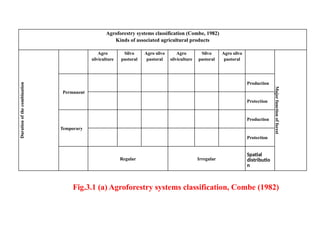
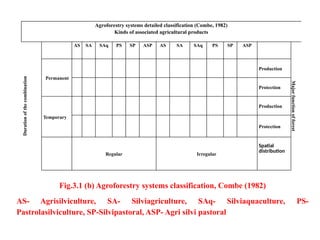
Combe (1982) proposed 24 agro forestry systems based on three
type of association of the trees with crops, with pastures and with both
crops and pastures);
two major functions of the tree components (production and
protection); two spatial arrangements (regular and irregular); and two
types of temporal association (temporary and permanent).
The most obvious and easy-to-use criteria for classifying agro
forestry systems are the spatial and temporal arrangement of
components,
The importance and role of components, thr production aims
or outputs from the system,
and the social and economic features.
They correspond to the systems structure, function (output),
socioeconomic nature, or ecological (environmental) spread.
• These characteristics also represent the main
purpose of a classification scheme.
• Therefore agro forestry systems can be
categorized according to these sets of criteria:
Structural basis
Functional basis
Socioeconomic basis
Ecological basis
Nair (1987) used four basis for classification of
different agro forestry system, these are
 Structure of the system (composition and
arrangement of components)
 Function of the system (Role and output of
components)
 Socio-economic scale and level of management
 Ecological spread (Ecological zones where the
system exists)
1. Structural basis: Refers to the composition and
arrangement of the components including spatial and
temporal arrangement of the different components.
2. Socio-economic: Refers to the level of inputs management
(low input, high input) or intensity or scale of management
and commercial goals (subsistence commercial and
intermediate)
3. Functional basis: Refers to the major function or role of
the components, usually furnished by the woody
components.
4. Ecological basis: Refers to the environment condition and
ecological suitability of system based on the assumption
that certain ecological conditions; i.e. there can be separate
sets of agro forestry system for arid and semi arid lands,
tropical highlands, low lands tropic etc.
Agroforestry systems classification (Combe, 1982)
Kinds of associated agricultural products
Duration
of
the
combination
Agro
silviculture
Silvo
pastoral
Agro silvo
pastoral
Agro
silviculture
Silvo
pastoral
Agro silvo
pastoral
Major
function
of
forest
Permanent
Production
Protection
Temporary
Production
Protection
Regular Irregular
Spatial
distributio
n
Fig.3.1 (a) Agroforestry systems classification, Combe (1982)
Agroforestry systems detailed classification (Combe, 1982)
Kinds of associated agricultural products
Duration
of
the
combination
AS SA SAq PS SP ASP AS SA SAq PS SP ASP
Major
function
of
forest
Permanent
Production
Protection
Temporary
Production
Protection
Regular Irregular
Spatial
distribution
Fig.3.1 (b) Agroforestry systems classification, Combe (1982)
AS- Agrisilviculture, SA- Silviagriculture, SAq- Silviaquaculture, PS-
Pastrolasilviculture, SP-Silvipastoral, ASP- Agri silvi pastoral
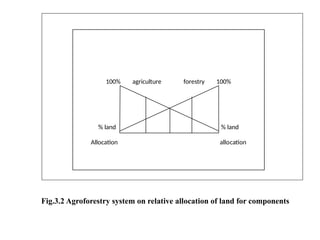
100% agriculture forestry 100%
% land % land
Allocation allocation
 Relative allocation of land under agricultural, forestry and
agroforestry production (after Vergera, 1982)
Fig.3.2 Agroforestry system on relative allocation of land for components
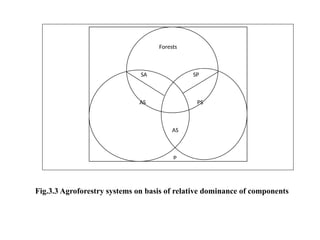
Forests
SA SP
AS PS
AS
P
Crops Animal husbandry
Fig.3.3 Agroforestry systems on basis of relative dominance of components
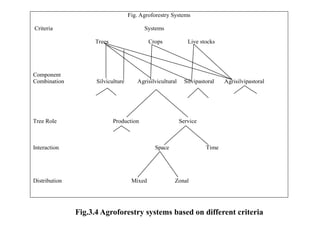
Fig. Agroforestry Systems
Criteria Systems
Trees Crops Live stocks
Component
Combination Silviculture Agrisilvicultural Silvipastoral Agrisilvipastoral
Tree Role Production Service
Interaction Space Time
Distribution Mixed Zonal
Fig.3.4 Agroforestry systems based on different criteria
CLASSIFICATION OF AGROFORESTRY SYSTEMS (NAIR,
1985)
 Structural basis: refers to the composition of the components,
including spatial arrangement of the woody component,
vertical stratification of all the components and temporal
arrangement of the different components.
 Hence on the basis of structure agroforestry system can be
grouped into two categories.
A)Nature of components
B)Arrangement of components
A) Nature of components: Based on nature of component agroforestry
systems can be classified into following categories
 Agrisilviculture systems/ silviagriculture/ agrosilviculture
 Silvopastoral systems/silvipastoral
 Agrosilvopastoral systems/agrisilvipastoral
 Other systems
 Note: Nomenclature of the system depends upon the prime
importance of the component and the component given lit of space
placed first in any agroforestry system for eg. Agrisilviculture in
which prime component is agriculture crop.
 Agrisilviculture has a wide applicability and it covers in its scope
integration of different components of farming system for eg.
Vegetables, Pulses, Oil seed crops, Cereals etc.
Whereas agrisilviculture restricted only to integration of cereals with the
tree crop
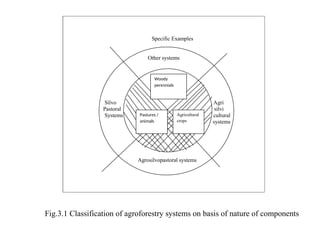
Specific Examples
Other systems
Silvo Agri
Pastoral silvi
Systems cultural
systems
Agrosilvopastoral systems
Woody
perennials
Pastures /
animals
Agricultural
crops
Fig.3.1 Classification of agroforestry systems on basis of nature of components
I. Agrisilviculture / Silviagriculture / Agrosilviculture
This system involves the conscious and deliberate use of land for
the concurrent production of agricultural crops including tree, crops
and forest crops. Based on the nature of the components this system
can be grouped into various forms:
a) Improved fallow species in shifting cultivation
b) The Taungya system
c) Multispecies tree gardens
d) Alley cropping (Hedgrow intercropping)
e) Multipurpose trees and shrubs on farmlands
f) Crop combinations with plantation crops
g) Agroforestry for fuelwood production
h) Shelter belts
i) Wind breaks
j) Soil conservation hedges etc.
a) Improved fallow species in shifting cultivation:
Shifting cultivation:
 It is prevalent in many parts of Africa, Latin America,
South-East Asia and Indian subcontinent.
 In India it is prevalent in Assam, Meghalaya, Jharkhand,
Manipur, Orissa, Nagaland, Chattisgarh, M.P., Arunachal
Pradesh, Andhra Pradesh, Mizoram, Tripura, Kerala, West
Bengal, Sikkim.
 It is known as jhuming in North-east, Khallu/kurwa in
Jharkhand and dahiya or podo in Orisaa, Andhra Pradesh.
 In this system, forest patch is selected and cleared
felled.
 The herbs, shrubs and twigs and branches (slashed
vegetation) are burnt
 .
 Cultivation of crops is done for a few years until soil
fertility declines.
 The site is than abandoned (fallow period) and new
patch is selected for cultivation of crops.
 The site is again cultivated after giving rest for few
years.
• Earlier the fallow cycle was of 20-30 year.
• However, due to increasing requirement for cultivation of
land due to population pressure, fallow period has reduced
from 25-30 years to 2-3 years
• which has broken down the resilience of ecosystem and the
land is increasingly deteriorating.
• Thus now shifting cultivation has become source of
ecological degradation, soil erosion and converting good
forests into wastelands
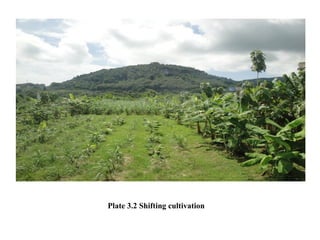
Plate 3.2 Shifting cultivation
Effect of shifting cultivation
 Deforestation and denudation of hill slopes in secondary
succession, area is occupied by weeds, useless shrubs etc.
 Soil erosion which leads to soil and nutrient losses, silting
of reservoirs and streams, reduction in water yield and
landslips and landslides
 Shifting cultivation adversely affects cation exchange
capacity and physical properties of oil. It leads to lowering
of organic matter and lowering the total quantity of iron,
aluminum, calcium, potassium, phosphorus, etc.
 Increases soil pH and reducing microbial activity
 More weed growth and lower crop yield
 No opportunity for infrastructural development
Controlling shifting cultivation
 Motivate public for permanent agriculture by opening
demonstration centers for improved agricultural
practices, good quality seed, manuring, irrigation,
weeding use of improved tools, terracing etc.
 Earning goodwill of local people: By engaging them in
forest work and training them to undertake shifting
cultivation on scientific lines.
 Arable land can be provided to the tribals for carrying
out agriculture and also to settle in the area; a few
schemes are being implemented under integrated tribal
development programme
 Legal measures: on steep slopes, near to roadside etc.
 Using land according to its capability
 Provision of alternative management
 Development of animal husbandry and dairy farming
 Training of artisans and development of handicrafts
 Employment in forest works and other industries
 Providing communication facilities
 Providing economic assistance for houses and
agriculture operations
Improved fallow species in shifting cultivation:
 Fallows are crop land left without crops for periods ranging
from one season to several years.
 The objective of improved fallow species in shifting
cultivation is to recover depleted soil nutrients.

 Once the soil has recovered, crops are reintroduced for one
or more season.
 The best species for the fallow system should induce good
nitrogen fixation in the soil.
 The main aim of the fallow is to maintain or restore soil
fertility and reduce erosion;
 some plants can be introduced primarily for their
economic value.
 Plants included in improved fallows should be compatible
with future crops, free of any negative physical or chemical
effects on the soil and not in competition with the crops to
be planted later on the same site.
b) Taungya system of cultivation:
 The taungya system was used primarily as an inexpensive means
of establishing timber plantations but is finally a recognized AF
system
 The taungya (taung= hill, ya= cultivation) is a Burmese word
coined in Burma in 1850.
 The system was introduced to India by Brandis in 1890 and the
first taungya plantations were raised in 1896 in North Bengal.
 It was introduced to S Africa in 1887 and was taken to Chittagong
and Sylhat (Now in Bangladesh) in 1870.
• In India it started in 1896 in North Bengal.
• In 1890, it was introduced to Coorg in Karnataka.
• Regular plantation however started in North Bengal in 1911 for
raising Sal plantations and in 1912, extended for raising Teak.
• In 1923 it was adopted in UP for raising Sal Plantations.
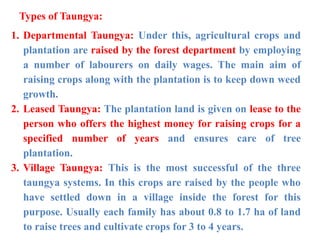
Types of Taungya:
1. Departmental Taungya: Under this, agricultural crops and
plantation are raised by the forest department by employing
a number of labourers on daily wages. The main aim of
raising crops along with the plantation is to keep down weed
growth.
2. Leased Taungya: The plantation land is given on lease to the
person who offers the highest money for raising crops for a
specified number of years and ensures care of tree
plantation.
3. Village Taungya: This is the most successful of the three
taungya systems. In this crops are raised by the people who
have settled down in a village inside the forest for this
purpose. Usually each family has about 0.8 to 1.7 ha of land
to raise trees and cultivate crops for 3 to 4 years.
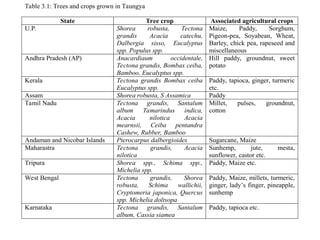
Table 3.1: Trees and crops grown in Taungya
State Tree crop Associated agricultural crops
U.P. Shorea robusta, Tectona
grandis Acacia catechu,
Dalbergia sisso, Eucalyptus
spp. Populus spp.
Maize, Paddy, Sorghum,
Pigeon-pea, Soyabean, Wheat,
Barley, chick pea, rapeseed and
miscellaneous
Andhra Pradesh (AP) Anacardiaum occidentale,
Tectona grandis, Bombax ceiba,
Bamboo, Eucalyptus spp.
Hill paddy, groundnut, sweet
potato
Kerala Tectona grandis Bombax ceiba
Eucalyptus spp.
Paddy, tapioca, ginger, turmeric
etc.
Assam Shorea robusta, S Assamica Paddy
Tamil Nadu Tectona grandis, Santalum
album Tamarindus indica,
Acacia nilotica Acacia
mearnsii, Ceiba pentandra
Cashew, Rubber, Bamboo
Millet, pulses, groundnut,
cotton
Andaman and Nicobar Islands Pterocarpus dalbergioides Sugarcane, Maize
Maharastra Tectona grandis, Acacia
nilotica
Sunhemp, jute, mesta,
sunflower, castor etc.
Tripura Shorea spp., Schima spp.,
Michelia spp.
Paddy, Maize etc.
West Bengal Tectona grandis, Shorea
robusta, Schima wallichii,
Cryptomeria japonica, Quercus
spp. Michelia doltsopa
Paddy, Maize, millets, turmeric,
ginger, lady’s finger, pineapple,
sunhemp
Karnataka Tectona grandis, Santalum
album, Cassia siamea
Paddy, tapioca etc.
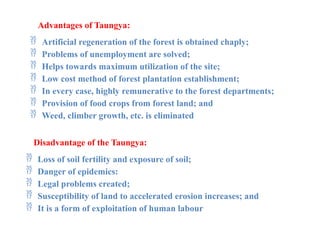
Advantages of Taungya:
 Artificial regeneration of the forest is obtained chaply;
 Problems of unemployment are solved;
 Helps towards maximum utilization of the site;
 Low cost method of forest plantation establishment;
 In every case, highly remunerative to the forest departments;
 Provision of food crops from forest land; and
 Weed, climber growth, etc. is eliminated
Disadvantage of the Taungya:
 Loss of soil fertility and exposure of soil;
 Danger of epidemics:
 Legal problems created;
 Susceptibility of land to accelerated erosion increases; and
 It is a form of exploitation of human labour
a) Multi-species tree gardens:
 In this system of agroforestry, various kinds of tree species are grown mixed.
 The major function of this system is production of food, fodder and wood
products for home consumption and sale.
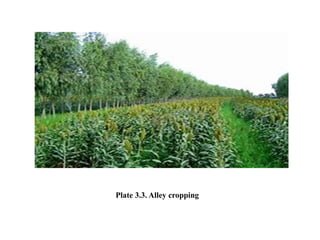
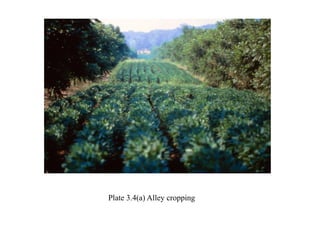
b) Alley cropping (Hedge row intercropping):
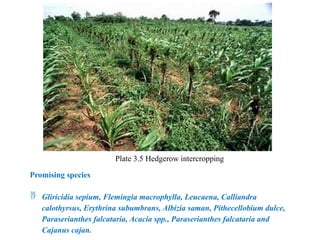
 Alley cropping, also known as hedgerow intercropping
 In this perennial, preferably leguminous trees or shrubs are grown
simultaneously with an arable crop
 The trees, managed as hedgerows, are grown in wide rows and the crop is
planted in the inter space or alley between the tree rows.
 During the cropping phase the trees are pruned and leaves and twigs are used
as much on the cropped alleys in order to reduce evaporation from the soil
surface, suppress weeds and or add nutrients and organic matter to the top soil.
 The primary purpose of alley cropping is to maintain or increase crop yields by
improvement of the soil and microclimate and weed control. Farmers may also
obtain tree products from the hedgerows, including fuelwood, building poles,
food, medicine and fodder etc.
Plate 3.3. Alley cropping
Layout of Alley:
 The position and spacing of hedgerow and crop plants in
an alley cropping system depend on plant species, climate,
slope, soil conditions and the space required for the
movement of people.
 Ideally, hedgerows should be positioned in an east to west
direction so that plants on both sides receive full sunlight
during the day.
 The spacing used in fields is usually 4 to 8 meters between
rows and 25 cm to 2 meters between trees within rows.
The closer spacing is generally used in humid areas and
the wider spacing in sub-humid or semi-arid regions.
Plate 3.4(a) Alley cropping
Plate 3.5 Hedgerow intercropping
Promising species
 Gliricidia sepium, Flemingia macrophylla, Leucaena, Calliandra
calothyrsus, Erythrina subumbrans, Albizia saman, Pithecellobium dulce,
Paraserianthes falcataria, Acacia spp., Paraserianthes falcataria and
Cajanus cajan.
Characteristics of species for hedgerow intercropping: Alley cropping
usually includes leguminous trees to improve soil fertility through nitrogen
fixation; hence an ideal alley cropping tree or shrub species should have
following characteristics:
 It should have a sparse, small crown to permit sunlight penetration into
the cropped area
 It should re-sprout rapidly after pruning, coppicing, pollarding or
opping
 It should form a deep taproot system so that it takes moisture and
nutrient from deeper layers and will not compete with agricultural
crops.
 It should have shallow lateral roots that are easily pruned by ploughing
along the hedgerow, without serious damage to the plants.
 Fast decomposition rate of leaf litter.
 Ideally, trees and shrubs used for alley cropping should fix nitrogen.
 Trees/shrubs should be non-exacting in nature.
Advantages
 Improved crop performance due to the addition of nutrients and organic
matter into the soil/plant system,
 Reduction of the use of chemical fertilizers,
 Improvement in the physical nature of the soil environment
 Reductions in erosion losses
 Provision of additional products such as forage, firewood or stakes when
a multipurpose tree legume is used as the hedgerow and
 Improvement in weed control
e) Multipurpose trees and shrubs on farmlands:
 In this system various multipurpose tree species are scattered haphazardly or
according to some systematic patterns on bunds.
 The major components of this system are multipurpose trees and other fruit
trees and common agricultural crops.
 The primary role of this system is production of various trees products and
the protective function is fencing and plot demarcation. Examples of
multipurpose trees employed in agroforestry are: Leucaena leucocephala,
acadia albida, Cassia siamea, Casuarina equisetifolia, Azadirachta indica,
Acacia Senegal, Cocos nucifera etc.
f) Crop combinations with plantation crops:
Perennial trees and shrubs such as coffee, tea,
coconut and cocoa are combined into intercropping
systems in numerous ways, including:
i. Integrated multistory mixture of plantation crops;
ii. Mixture of plantation crops in alternate or other crop
arrangement;
iii.Shade trees for plantation crops
iv. Intercropping with agricultural crops.
 Tea (Camilia sinensis) is grown under shade of A.
Chinensis, A. Odoratissium. A. Lebbek, A. procera, Acacia
lenticularis, Derris robusta, Grevillea robusta, Acacia spp.,
Erythrina lithosperma, Indigofera tesmanii.
 Coffee (Coffea Arabica) is brown under the shade of
Erythrina lithosperma as temporary shade while,
permanent shade trees include Ficus glomerata, F.
nervosa, Albizia chinensis, A. lebbek, A moluccana, A.
sumatrana, Dalbergia latifolia, Artocarpus integrifolius,
Bischofia javanica, Grevillea robusta.
 Cacao (Theobroma cacao) is grown under the shade of
coconut and areca nut and Dipterocarpus macrocarpa (in
forest).
 Black pepper (Piper nigrum) is grown with support
from Erithrina indica, Garuga pinnata, Spondias,
Mangifera, Gliricidia maculate and Grevillea robusta.
 Small cardamom (Elettaria cardamomum) and large
cardamom (Ammomum subulatum; A. aromaticum)
grow in forests under temporary shade tree of Mesopsis
emini.
 Large cardamom is grown under the shade of natural
forest as well under planted shade trees viz., Alnus
nepalensis, Schima wallichii; Cinchona spp;
Lagerstroemia spp., Albizia lebbek; Castanopsis
tribuloides; C. ystrix, C. India; Terminalia myriocarpa;
Bischofia javanica.
g) Agroforestry for fuelwood production:
 In this system, various multipurpose fuelwood/firewood
species are inter planted on or around agricultural lands.
 The protective role is to act as fencing, shelter belts and
boundary demarcation.
 Tree species commonly used as fuelwood are: Acacia
nilltica, Albiza lebbek, Cassia siamea, Casuarina
equisetifolia, Dalbergia sissoo, prosopis juliflora,
Eucalyptus tereticornis, etc.
h) Shelterbelt:
 Shelterbelt is a wide belt of trees, shrubs and grasses, planted in rows
which goes right across the land at right angle to the direction of the
prevailing winds to deflect air current, to reduce wind velocity and to give
general protection to cultivated areas against wind erosion and desiccating
effect of the hot winds in lee-ward side.
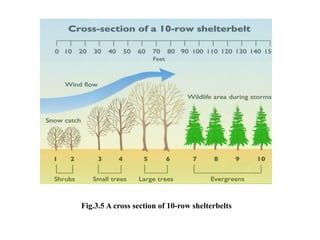
 A typical shelterbelt as a triangular cross section which can be achieved
by planting tall trees in the centre, flanked on both sides successively by
shorter trees, tall shrubs and then low spreading shrubs and grasses.
 A certain amount of penetrability is desirable in shelterbelts as a result of
which the zone of influence is very much greater and the velocity curve
shows a smooth, slowly declining trend.
 The width of shelterbelt depends upon local climatic conditions, wind
velocity and the soil type.
 Shelterbelt should be oriented as nearly as possible, at right angles to the
prevailing wind. In case, where winds blow from different directions,
shelterbelt should be raised in quadrangles.
Height and spacing:
 Height of shelterbelt is very important
 As it affects the distance to which protection will be afforded on the lee
ward side.
 Higher the trees forming the shelterbelt, the greater is the zone of
influence on the leeward side.
 This affects the spacing of the shelterbelts also. If wind erosion has to
be completely controlled the second belt should be located a little
before the place where the wind on the lee ward side often first
shelterbelt assumes damaging velocity.
 Taking 20% reduction in wind velocity as the basis of usefulness of a
shelterbelt, effective protection zone extends up to 15 to 2 times the
height of the belt.
 In Rajasthan, taking the height of shelterbelt to be about 7.5 m,
spacing recommended is 10 times the height, i.e. 75 meters.
Length:
 The length of shelterbelt is an important consideration
because at the ends of the shelterbelt eddies are produced
resulting in increasing the wind velocity at these places.
 It is because of this that road is not ordinarily allowed to
cross a shelterbelt.
 In some of the western countries, shelterbelts have been
raised right across the country for the protection they
afford
 For shorter shelterbelt the minimum length of shelterbelt
to be most effective is 24 times its height.
Soil Preparation:
 Soil preparation should be done at least a year in advance to
build up sufficient reserve of soil moisture
 It may be done either mechanically or by manual labour
 Leguminous crops may be raised for the first few years in
between the rows of trees and shrubs for improving the
fertility of the soil.
Choice of species:
 The choice of species to be raised in shelterbelt is governed
by the climate, soil and topography of the area.
 It is better to raise local species because of their easy
establishment.
 Exotics may also be used to improve the efficiency of the
shelterbelts.
Characteristics of tree spp. Used for shelterbelt:
 The species selected should be non exacting
 Fast-growing;
 Wind -firm;
 Drought-resistant;
 Unpalatable to animals;
 It should have a dense crown and low branching
habit;
 It should not be leafless at a time when protection
is required;
 It should be economically a multipurpose species,
i.e., fit for firewood, timber and fodder.
The following species are recommended for creation of shelter belt:
Grasses: Cenchrus barbatus, Saccharum spontaneum, Saccharum munja,
Panicum turgidum, Panicum antidotale.
Shrubs: Calotropis procera, Crotolaria burhia, Calligonum polygonoides,
Clerodendron phlomoides, Cassia auriculata, Dodonaea viscose, Jatropha
curcas, Leptadenia spartivm, Agave spp., Sesbania aculeate.
Small trees: Acadcia jacquemontii, Acacia leucophloea, Balanites aegyptiaca,
Capparis aphylla, Salvadora oleoides.
Trees: Acacia Arabica, Acacia Senegal, Acacia cyanophylla, Albizzia lebbek,
Azadirachta indica, Dalbergia sissoo, Lannea coromendelica, Parkinsonia
aculeate, Prosopis cineraria, Prosopis juliflora, Pongamia pinnata, Tecoma
undulate, Tamarix articulate, Eucalyptus spp., Acacia tortilis.
Fig.3.5 A cross section of 10-row shelterbelts
Method of raising the plants:
 It is better to sow the seeds in polythene bags and plant out the plants so
raised.
 For this purpose nurseries should be maintained at site.
 The plant should be regularly watered for one or two years.
 Properly fenced to protect them from browsing cattle.
Advantages of Shelterbelts:
 Very little research work has been done in our country
 To find out the benefits of the shelter belts on yields of agricultural crops,
horticultural crops and grasses.
 However, on the basis of research work done in CAZRI, TNAU and
abroad, the following advantages of the shelterbelts may be mentioned:
Moderating effect on temperature:
 Shelterbelt has a moderating effect on air and soil temperature by
lowering the maximum and raising the minimum.
 Temperature during day time inside the forest is lower evaporation.
 Temperature during night is higher inside the forest than open.
Increase in humidity:
 Shelterbelts increase relative humidity from 1 to 50%.
 There is distinctly perceptible increase in the average
relative humidity in the agricultural land protected by
shelterbelts
Reduction in evapo-transpiration:
 Shelterbelts reduce evapo-transpiration sufficiently in the
zone of their influence.
Increase in soil moisture:
 Shelterbelts increase the moisture content of the soil on
the leeward side and delay its drying up during summer.
 They also increase the underground water supplies by
promoting infiltration in the soil.
Reduction in wind velocity and wind
erosion:
 Shelterbelts deflect the wind upwards
 Cause considerable reduction in the wind
velocity on the leeward side upto a distance of 15
to 20 times the height on the trees forming the
shelterbelt.
 As there is considerable reduction in the wind
velocity on the leeward side of a shelterbelt, wind
erosion is very much reduced.
Increase in Agricultural and Horticultural
crops:
 Shelterbelts increase production of agricultural and
horticultural crops.
 Study made in 8 cotton fields in distinctly semi-arid
areas of U.S.A. revealed an increase of 17.4% in
cotton yield when protection against hot winds was
provided by shelterbelts.
 Similar increase in crop yields has been reported
from Russia where a shelterbelt of 5 rows increased
the oat yield by 25% to 28%.
 Protection of orchards by shelterbelt reduces
wind damage and increases fruit yield.
 Studies revealed that even if 0.4 hectare out of 4
hectare orchard is devoted to creation of
shelterbelt, the remaining protected 3.6 hectare
of orchard yielded about 13.00% more than the
unprotected 4 Hectare orchard.
 Similarly, the increase in fodder yield is reported
to be as high as 300-400%.
Protection of damage to public and private
property:
 The shelterbelts hold up the movement of shifting sand
 Save the roads and railway tracks from being covered and
otherwise damaged by moving sand dunes.
 They prevent deposition of silt in canals and agricultural
fields.
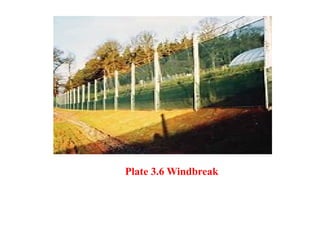
i. Windbreaks:
 Wind break is a protective planting around a garden, a
farm or a field to protect it against strong winds.
 It usually consists of 2-3 rows of trees or shrubs, spaced at
0.5 m to 2.5 m apart, depending on the species.
Plate 3.6 Windbreak
 It protect soil from erosion
 They are commonly planted in hedgerows around the edge of
the field on farms
 It designed properly wind breaks around the home can reduce
the cost of heating and cooling and save energy
 Windbreaks are also planted to help keep snow from drifting
on the roadways or yard
 Other benefits include contributing to a microclimate around
crops (with slightly less drying and chilling at might.
 It providing habitat for wild life
 In some regions providing wood if the tree are harvested
 Wind breaks and inter cropping can be combined in a farming
practice referred to as inter cropping
 These trees provide fruit, wood or protect the crops from the
wind.
Lecture-8
Learning Objective: To know about selection of tree crop
species for Agroforestry
Agroforestry is a deliberate integration of trees and
crops in general, in same unit of land. These trees and crops
compete with each other nutrients, moisture and light.
Therefore there are both +ve and -ve interaction among
different components. In order to have a positive interaction
among different components one must select a component so
that from a single unit of land a farmer/cultivator maximize
his production. While selecting tree species for agroforestry
three factors must taken into consideration such as…
 CLIMATE
 SOIL
 BIOTIC FACTOR
Climate: Tree species selected for Agroforestry taken into
account climate factor
Hot desert: Prosopis cineraria, P. chinensis, Acacia tortilis,
Capparis spp, Tecomella undulate
Cold desert: Populus nigra, P, cilita, P. alba, P. tremula, P.
euphretica, salix alba, S fragilis Juniperus
Tropical semi-arid : Prosopis spp, Acacia tortilis, A nilotica, A
Senegal, Albizia lebbeck, Eucalyptus camaldulensis,
Azadirachta indica, Salvadora persica, Tamarix spp
Sub tropical semi arid: Pinus roxburghii, Acacia modesta,
Albizia procera, Bauhinia variegate, Morus indica, Ficus spp
Temperate semi arid: Pinus gerardiana, Juniperus macropoda,
Corylus colurna
Humid tropical: Terminalia myriocarpa, Tectona grandis,
Terminalia alata, Schima wallichi, Gmelina arborea,
Dipterocarpus macrocarpus, Cocus nucifera, areca catechu,
Artocarpus, heterophyllus, pterocarpus santalinus, chukrasia
tubularis
Humid subtropical: Eucalyptus globules, Acer oblungum,
Acrocarpus fraxinifolius, Aesculus idica, Pinus kesiya, Prunus
spp. Quercus spp
Humid temperate: Acer campbelii, abies pindrow, quercus spp,
robinia psuedacacia, pinus alata, P. wallichiana, Almus nitida,
Populus ciliate, Cryptomeria japonica
Subtropical semi-humid: Albizia chinensis, Pinus roxburghiii,
P. kesiya, P. ellioti, Grewia optiva, Celtis australis, Eucalyptus
grandis, E globules, Toona ciliate
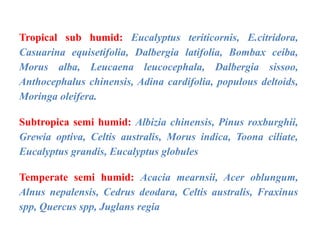
Tropical sub humid: Eucalyptus teriticornis, E.citridora,
Casuarina equisetifolia, Dalbergia latifolia, Bombax ceiba,
Morus alba, Leucaena leucocephala, Dalbergia sissoo,
Anthocephalus chinensis, Adina cardifolia, populous deltoids,
Moringa oleifera.
Subtropica semi humid: Albizia chinensis, Pinus roxburghii,
Grewia optiva, Celtis australis, Morus indica, Toona ciliate,
Eucalyptus grandis, Eucalyptus globules
Temperate semi humid: Acacia mearnsii, Acer oblungum,
Alnus nepalensis, Cedrus deodara, Celtis australis, Fraxinus
spp, Quercus spp, Juglans regia
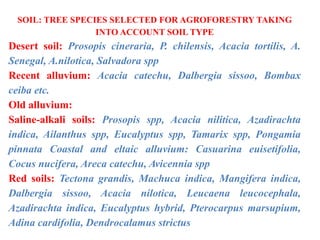
SOIL: TREE SPECIES SELECTED FOR AGROFORESTRY TAKING
INTO ACCOUNT SOIL TYPE
Desert soil: Prosopis cineraria, P. chilensis, Acacia tortilis, A.
Senegal, A.nilotica, Salvadora spp
Recent alluvium: Acacia catechu, Dalbergia sissoo, Bombax
ceiba etc.
Old alluvium:
Saline-alkali soils: Prosopis spp, Acacia nilitica, Azadirachta
indica, Ailanthus spp, Eucalyptus spp, Tamarix spp, Pongamia
pinnata Coastal and eltaic alluvium: Casuarina euisetifolia,
Cocus nucifera, Areca catechu, Avicennia spp
Red soils: Tectona grandis, Machuca indica, Mangifera indica,
Dalbergia sissoo, Acacia nilotica, Leucaena leucocephala,
Azadirachta indica, Eucalyptus hybrid, Pterocarpus marsupium,
Adina cardifolia, Dendrocalamus strictus
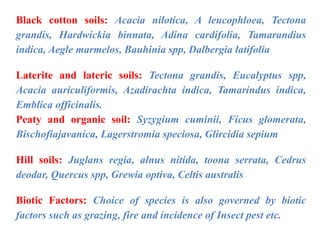
Black cotton soils: Acacia nilotica, A leucophloea, Tectona
grandis, Hardwickia binnata, Adina cardifolia, Tamarandius
indica, Aegle marmelos, Bauhinia spp, Dalbergia latifolia
Laterite and lateric soils: Tectona grandis, Eucalyptus spp,
Acacia auriculiformis, Azadirachta indica, Tamarindus indica,
Emblica officinalis.
Peaty and organic soil: Syzygium cuminii, Ficus glomerata,
Bischofiajavanica, Lagerstromia speciosa, Glircidia sepium
Hill soils: Juglans regia, alnus nitida, toona serrata, Cedrus
deodar, Quercus spp, Grewia optiva, Celtis australis
Biotic Factors: Choice of species is also governed by biotic
factors such as grazing, fire and incidence of Insect pest etc.
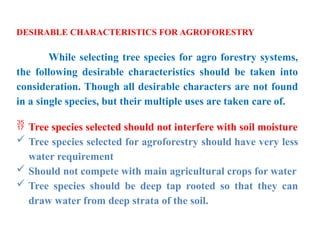
DESIRABLE CHARACTERISTICS FOR AGROFORESTRY
While selecting tree species for agro forestry systems,
the following desirable characteristics should be taken into
consideration. Though all desirable characters are not found
in a single species, but their multiple uses are taken care of.
 Tree species selected should not interfere with soil moisture
 Tree species selected for agroforestry should have very less
water requirement
 Should not compete with main agricultural crops for water
 Tree species should be deep tap rooted so that they can
draw water from deep strata of the soil.
 Tree species should not compete for plant
nutrients
Tree species should not utilize more plant
nutrients
They should help in building soil fertility
Leguminous tree species which fix atmospheric
nitrogen in their roots should be prefer
The root system and root growth characteristics
should ideally result in to exploration of soil
layers that are different to those being trapped by
agricultural crops.
 Tree species should not compete for sunlight
Tree species should not interrupt sunlight
falling on the crops.
Tree species should be light branching in their
habit
Trees permit the penetration of light into the
ground and promote better crop, pasture
growth and yield.
Tree species can withstand pruning operation
if it posses dense canopy.
 Tree species should have high survival rate and
easy establishment
Tree species should have high survival percentage
Leave little or no gaps after transplanting
Hardy tree species are easy to establish
They have less mortality percentage because they
can tolerate transplanting shocks easily
Trees should have the ability to regenerate lateral
roots within a short period of time after
transplanting.
 Tree species should have fast growing habit and easy
management
 Tree species for agroforestry system should be essentially
fast growing
 Rapid growth, especially in the early years,
 Tree should have short rotation (the period between
planting and final harvesting)
 Fast growing species such as Poplar, Casuriana, Leucaena
leucocephala etc. are important species which provide lot
of opportunities to be planted in AFS
 Tree species should have wider adaptability
 A tree species selected for agroforestry cominations must
have a wider adaptability
 Tree species should have high palatability as a fodder
 Most of the Indian farmers rear livestock separately and cut
and carry method of fodder production is quite prevalent.
 Therefore, in agroforestry, farmer must select those tree
species which are palatable to livestock and had a high
digestibility.
 Tree species should have shelter conferring and soil
stabilization attributes
 Some tree species, because of their inherent growth habit and
adaptability, are especially helpful in providing protection for
soils, crops and livestock. Poplars (Populus spp.), Willows
(Salix spp.), Casurina equisetifolia, etc. for example, have been
extensively used in soil erosion, control because of their
extensive root system and ability to grow in water logged soils.
 Tree species should have nutrient cycling and nitrogen fixation
attributes
 Within an agroforestry system, trees can play an important role
in recycling nutrients, leached down through the soil profile and
minerals released from weathering parent material such as
rocks and sediments.
 These nutrients are used in the growth and development of the
tree, many returning to the top-soil in form of dead leaves, twigs,
flowers and seeds which slowly decompose on the surface, or are
eaten by animals.
 Although all trees play some role in maintaining the nutrient
status of the soil through recycling.
 Deciduous trees drop most of their leaves in autumn leaving a
thick mat of leaves on the ground, whereas most ever green
species maintain some level of litter fall throughout the year.
 Another important factor is the ability of many tree species
to convert atmospheric nitrogen into organic nitrogen for
their own use through complex symbiotic relationship
between Rhizobium bacteria and their fine roots.
 The bacteria form nodules on the roots which can convert
nitrogen gas, as it is in the atmosphere, into usable
nitrogen for the plant.
 Most leguminous trees and some non leguminous ones,
such as Acacia, Leucaena and Prosopis as well as
Casuarinas pp. fix the atmospheric nitrogen.
 The litter of these nitrogen fixing trees is generally high in
nitrogen, thus increasing the nitrogen status of the soil.
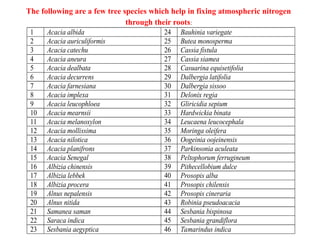
The following are a few tree species which help in fixing atmospheric nitrogen
through their roots:
1 Acacia albida 24 Bauhinia variegate
2 Acacia auriculiformis 25 Butea monosperma
3 Acacia catechu 26 Cassia fistula
4 Acacia aneura 27 Cassia siamea
5 Acacia dealbata 28 Casuarina equisetifolia
6 Acacia decurrens 29 Dalbergia latifolia
7 Acacia farnesiana 30 Dalbergia sissoo
8 Acacia implexa 31 Delonix regia
9 Acacia leucophloea 32 Gliricidia sepium
10 Acacia mearnsii 33 Hardwickia binata
11 Acacia melanoxylon 34 Leucaena leucocephala
12 Acacia mollissima 35 Moringa oleifera
13 Acacia nilotica 36 Oogeinia oojeinensis
14 Acacia planifrons 37 Parkinsonia aculeata
15 Acacia Senegal 38 Peltophorum ferrugineum
16 Albizia chinensis 39 Pithecellobium dulce
17 Albizia lebbek 40 Prosopis alba
18 Albizia procera 41 Prosopis chilensis
19 Alnus nepalensis 42 Prosopis cineraria
20 Alnus nitida 43 Robinia pseudoacacia
21 Samanea saman 44 Sesbania bispinosa
22 Saraca indica 45 Sesbania grandiflora
23 Sesbania aegyptica 46 Tamarindus indica
 Tree species should have thin bark
Species selected for agroforestry combinations
should not shed its bark regularly but it should
retain for longer period as bark shedding creates
unhygienic conditions for underground crop.
 Tree species should be free from chemical exudations
The species selected for agroforestry
combination must be free from allele-chemicals
as these allelo-chemicals affect the growth of
underground crops.
 Tree species should have easily decomposable leaves
 The suitable tree species for agroforestry will be that
one in which fallen leaves decompose with fast rate.
 The leaves of most of the legume tree species are small
in size, decompose quickly and easily and add a large
quantiy of organic matter and nutrients to the soil
 Tree species having broad leaves such as teak, mango
and banyan should not be preferred for agroforestry
system.
 They contain more fibre matter and also required
longer time for decomposition. Further, broad leaves
when fall on the tender crop plants, block their
photosynthetic activities.
 Tree species should have their multiple uses
 The selected tree species should have multiple uses.
 The tree should yield more than one of the main
produce like fuelwood, leaf fodder, edible fruit,
edible flower and fibre.
 Tree species should have high yield potential
 High yield potential is the most important criterion
of selection of tree species for agroforestry systems
as the main aim is to obtain overall more output per
unit area. Care should be taken before collection of
seeds and seedlings that they are being procured
from reliable source.
CHARACTERISTICS OF AGRICULTURAL CROPS FOR
AGROFORESTRY
a) Agricultural crops should be short duration and quick
growing.
b) They should be at least partially tolerant to shade.
c) Most of them should belong to leguminosae family.
d) They should respond well to high density tree planting.
e) They should bear some adverse conditions, like water stress
and/or excess of watering
f) Crops should return adequate organic matter to soil
through their fallen leaves, root system, stumps, etc.
g) Crops should appropriately be fitted in intensive or multiple
cropping system.
TECTONA GRANDIS
Botanical Name: Tectona grandis L.
Common Name: Teak, Sagwan
Family: Verbenaceae
Plate 16.2 Tectona grandis L. tree
Description
 Large deciduous tree up to 30 m high and 100 cm or more
dbh
 Long straight cylindrical bole up to 2/3 of the height of tree.
 Deep tap root system
 Bark pale brown, grey, striate, fibrous, peeling off in thin
strips
 Branch lets are quadrangular and channeled
Distribution
 Indigenous in peninsula of India, in North-Eastern drier
part of Java and other islands Indian Archipelago
 The Nilambur in Kerala, manmade teak forest are
known to foresters throughout world.
 Natural habitat is between 100N and 250N on Indian
subcontinent, in South East Asia especially in India,
Burma, Thailand, Laos, Combodia, Vitenam and
Indonesia.
 It does not occur naturally in Malaysia
Site factors
Climate
 Teak naturally occurs only in monsoon climate
 Temperature – Maxiumum 480C, Minimum 20C
 Rainfall-700 mm to 2200 mm
 Altitude- 600 m to 1200 msl.
Soil
 It grows on variety of geological formations notably trap,
limestone, granite, gneiss, mica schist, sandstone,
quartzite and clay
 Well drained, well ventilated soils with high oxygen
content are best
 Generally prefer soil between pH 6.0-8.5 H
Phenology
 Leaf-fall-Dry area- November to January, Wet Area
– March
 Leaf renewal – May
 Flowering – June to September
 Fruiting – November to January
 Seed collection – January/February
 Seed viability – more than 1 year
 Seed weight – 125 to 176 per 100 gm
 Germination- 60 to 80 percent
Silvicultural
 Strong light demander
 Frost tender
 Drought and wind sensitive
 Fire resistant
 Not browsed
 Good coppice

Agro forestry , definition and importance

  • 1.
    AGRO FORESTRY Nair (1979)defined agro forestry as a land use system that integrates trees, crops and animal in a way that is scientifically sound ecologically desirable, practically feasible and socially acceptable to the farmers. Lundgren and Rain tree (1982), who defined agro forestry as a collective name for land use system and technologies where woody perennials (trees, shrubs, bamboos, palm etc) are deliberately used on the same land management units as agricultural crops and / or animals. .
  • 2.
    Sanchez (1995), definedagro forestry as a collective name for land use system and practices in which woody perennials are deliberately integrate with crops and / or animals on the same land management unit.
  • 3.
    A Scientific definitionof agro forestry stresses on two characteristics common to all forms of agro forestry.  The deliberate growing of woody perennials in the same unit of land as agricultural crops and / or animal either in same form of spatial mixture or sequence  There must be a significant interaction (positive and / or negative) between the woody and non woody components of the system either ecological and / or economical All agro forestry systems possess theoretically three attributes which are 1. Productivity: Agro forestry systems mostly aim to maintain or increase production as well as productivity of the land. 2. Sustainability: Agro forestry can maintain and conserve fertility of soil and sustain the production 3. Adoptability: Traditional agro forestry practice already been accepted and adopted by the farming community but improved agro forestry system should be encouraged to adopt.
  • 4.
    Important and Impactof Agro forestry:  Increased per unit production due to introduction of trees  Growth of trees or woody perennials conserve soil and soil moisture  Agro forestry improves soil fertility and can improve productivity by increased output of tree products, improved yields of associated crops, reduction of cropping system input and increased labour efficiency.  Provides more diverse products and services provides higher revenue due to sale of tree products.  Provides higher revenue due to sale of tree productes.  Reduced pressure on remaining natural forest for wood, fuel wood and other forest based products and pressure of grazing.  Enhanced microclimates by increase in atmospheric humidity (10-20 percent)
  • 5.
     Reduces windvelocity by 40%  Protect field crops against the searching and desecrating conditions  Trees supply cheap fuel wood, fodder, small timber, poles  Helps in reducing carbon loss from soils by sequestrating Co2 from atmosphere.  Reduction of run-off nutrient leaching and soil erosion by tree roots and stems  Enhances recycling of nutrients and nutrient pump due to deep and tap rooted trees  Improves soil physical and chemical condition through the accumulation and decomposition of organic matter  Increase in farm incomes due to improved production and sustained productivity  Improvement in nutrition and health due to increased quality and diversity of food out puts  Help in improvement of rural living standard from sustained employment and recurring incomes  Better protection of ecological system.
  • 6.
    Selection Criteria forsuitable Agro forestry trees Tree species that are chosen to be grown in conjunction with Agricultural crops should have inter alia the following characteristics.  Identifying the proper species suited to the soil and site condition  The selected species should be capable of providing the desirable products and services  Species adoptability and compatibility with the companion crop  Tree species should be fast to medium growing  High value that a slower growth rate is acceptable  Single stemmed with clear bole and tall  Amenable to early wide spacing  Deep rooted with tap root system so the trees do not compete with companion crops for moisture and nutrients Drought resistance or capable of growing on wet site
  • 7.
     Trees shouldhave a low crow diameter to bole diameter ratio  Light branching in habit  Produce a light rather than a heavy shade  Phyllotaxis should permit the penetration of light to the ground  Tree phenology should be advantageous to the growth of the annual crops  Letter fall and litter decomposition rate should have positive effect upon the soil  Tree should have efficient nutrient pump system  Preferably leguminous and nitrogen fixer and outputs  Possess self pruning properties  Tolerance to relatively high incident of pruning  Marketability of products (wood, fruit, fodder, fuel etc)
  • 8.
    To know aboutdifferent agro forestry systems, subsystem, practices, AFS classification, AFS on nature of components Different types of agro forestry systems exist in different parts of the world. These systems are highly diverse and complex in character and function. Classification of agro forestry system is necessary in order to provide a framework for evaluating the system and developing action plan for their improvement.
  • 9.
    • Several criteriacan be used in classifying them • but most common includes the system structure, function, socioeconomic scale of management, ecological spread etc. • According to the potential, there are many different systems of agro forestry. • In agro forestry the terms like system, sub-system and practices are commonly used. • Therefore, these terms require proper definitions in agro forestry languages:
  • 10.
    System:  System refersto a group of physical components, i.e., an assemblage of objects connected or related in such a manner so as to form and/or act as a unit;  e.g. ecosystem which consists of living organism and their non living environment with which they are inseparably interrelated.  In land use terms, a system refers to a type of land use specific to an area and described according to its biotechnical composition and arrangement,  level of technical management of socio-economic features;  e.g. rice production system, plantation crop systems.
  • 11.
    Sub-system:  Sub systemindicates a lower order hierarchy of the system.  It refers to a part of system, with more or less restricted role, content and complexity than the system itself.  A sub system produces a defined ‘basic needs’ as its major output, so that there can be a food sub-system, an energy production sub system and cash sub system. Practices:  Practices in agro forestry denote specific land management operations of any nature, carried out on a farm or other management unit.  Such practices are involved in the constitution and maintenance of an agro forestry system;  e.g. alley cropping, boundary plantations of trees and shrubs, shelterbelts and windbreaks, etc.
  • 12.
    Why classification:  Itinclude logical way of grouping the major factors on which production of the system will depend  It indicate how system is managed  It offer flexibility for regrouping the information  We usually understood and readily handled Criteria / Basis for Agro Forestry system classification Combe (1982) proposed 24 agro forestry systems based on three type of association of the trees with crops, with pastures and with both crops and pastures); two major functions of the tree components (production and protection); two spatial arrangements (regular and irregular); and two types of temporal association (temporary and permanent).
  • 13.
    The most obviousand easy-to-use criteria for classifying agro forestry systems are the spatial and temporal arrangement of components, The importance and role of components, thr production aims or outputs from the system, and the social and economic features. They correspond to the systems structure, function (output), socioeconomic nature, or ecological (environmental) spread.
  • 14.
    • These characteristicsalso represent the main purpose of a classification scheme. • Therefore agro forestry systems can be categorized according to these sets of criteria: Structural basis Functional basis Socioeconomic basis Ecological basis
  • 15.
    Nair (1987) usedfour basis for classification of different agro forestry system, these are  Structure of the system (composition and arrangement of components)  Function of the system (Role and output of components)  Socio-economic scale and level of management  Ecological spread (Ecological zones where the system exists)
  • 16.
    1. Structural basis:Refers to the composition and arrangement of the components including spatial and temporal arrangement of the different components. 2. Socio-economic: Refers to the level of inputs management (low input, high input) or intensity or scale of management and commercial goals (subsistence commercial and intermediate) 3. Functional basis: Refers to the major function or role of the components, usually furnished by the woody components. 4. Ecological basis: Refers to the environment condition and ecological suitability of system based on the assumption that certain ecological conditions; i.e. there can be separate sets of agro forestry system for arid and semi arid lands, tropical highlands, low lands tropic etc.
  • 17.
    Agroforestry systems classification(Combe, 1982) Kinds of associated agricultural products Duration of the combination Agro silviculture Silvo pastoral Agro silvo pastoral Agro silviculture Silvo pastoral Agro silvo pastoral Major function of forest Permanent Production Protection Temporary Production Protection Regular Irregular Spatial distributio n Fig.3.1 (a) Agroforestry systems classification, Combe (1982)
  • 18.
    Agroforestry systems detailedclassification (Combe, 1982) Kinds of associated agricultural products Duration of the combination AS SA SAq PS SP ASP AS SA SAq PS SP ASP Major function of forest Permanent Production Protection Temporary Production Protection Regular Irregular Spatial distribution Fig.3.1 (b) Agroforestry systems classification, Combe (1982) AS- Agrisilviculture, SA- Silviagriculture, SAq- Silviaquaculture, PS- Pastrolasilviculture, SP-Silvipastoral, ASP- Agri silvi pastoral
  • 19.
    100% agriculture forestry100% % land % land Allocation allocation  Relative allocation of land under agricultural, forestry and agroforestry production (after Vergera, 1982) Fig.3.2 Agroforestry system on relative allocation of land for components
  • 20.
    Forests SA SP AS PS AS P CropsAnimal husbandry Fig.3.3 Agroforestry systems on basis of relative dominance of components
  • 21.
    Fig. Agroforestry Systems CriteriaSystems Trees Crops Live stocks Component Combination Silviculture Agrisilvicultural Silvipastoral Agrisilvipastoral Tree Role Production Service Interaction Space Time Distribution Mixed Zonal Fig.3.4 Agroforestry systems based on different criteria
  • 22.
    CLASSIFICATION OF AGROFORESTRYSYSTEMS (NAIR, 1985)  Structural basis: refers to the composition of the components, including spatial arrangement of the woody component, vertical stratification of all the components and temporal arrangement of the different components.  Hence on the basis of structure agroforestry system can be grouped into two categories. A)Nature of components B)Arrangement of components
  • 23.
    A) Nature ofcomponents: Based on nature of component agroforestry systems can be classified into following categories  Agrisilviculture systems/ silviagriculture/ agrosilviculture  Silvopastoral systems/silvipastoral  Agrosilvopastoral systems/agrisilvipastoral  Other systems  Note: Nomenclature of the system depends upon the prime importance of the component and the component given lit of space placed first in any agroforestry system for eg. Agrisilviculture in which prime component is agriculture crop.  Agrisilviculture has a wide applicability and it covers in its scope integration of different components of farming system for eg. Vegetables, Pulses, Oil seed crops, Cereals etc. Whereas agrisilviculture restricted only to integration of cereals with the tree crop
  • 24.
    Specific Examples Other systems SilvoAgri Pastoral silvi Systems cultural systems Agrosilvopastoral systems Woody perennials Pastures / animals Agricultural crops Fig.3.1 Classification of agroforestry systems on basis of nature of components
  • 25.
    I. Agrisilviculture /Silviagriculture / Agrosilviculture This system involves the conscious and deliberate use of land for the concurrent production of agricultural crops including tree, crops and forest crops. Based on the nature of the components this system can be grouped into various forms: a) Improved fallow species in shifting cultivation b) The Taungya system c) Multispecies tree gardens d) Alley cropping (Hedgrow intercropping) e) Multipurpose trees and shrubs on farmlands f) Crop combinations with plantation crops g) Agroforestry for fuelwood production h) Shelter belts i) Wind breaks j) Soil conservation hedges etc.
  • 26.
    a) Improved fallowspecies in shifting cultivation: Shifting cultivation:  It is prevalent in many parts of Africa, Latin America, South-East Asia and Indian subcontinent.  In India it is prevalent in Assam, Meghalaya, Jharkhand, Manipur, Orissa, Nagaland, Chattisgarh, M.P., Arunachal Pradesh, Andhra Pradesh, Mizoram, Tripura, Kerala, West Bengal, Sikkim.  It is known as jhuming in North-east, Khallu/kurwa in Jharkhand and dahiya or podo in Orisaa, Andhra Pradesh.
  • 27.
     In thissystem, forest patch is selected and cleared felled.  The herbs, shrubs and twigs and branches (slashed vegetation) are burnt  .  Cultivation of crops is done for a few years until soil fertility declines.  The site is than abandoned (fallow period) and new patch is selected for cultivation of crops.  The site is again cultivated after giving rest for few years.
  • 28.
    • Earlier thefallow cycle was of 20-30 year. • However, due to increasing requirement for cultivation of land due to population pressure, fallow period has reduced from 25-30 years to 2-3 years • which has broken down the resilience of ecosystem and the land is increasingly deteriorating. • Thus now shifting cultivation has become source of ecological degradation, soil erosion and converting good forests into wastelands
  • 29.
    Plate 3.2 Shiftingcultivation
  • 30.
    Effect of shiftingcultivation  Deforestation and denudation of hill slopes in secondary succession, area is occupied by weeds, useless shrubs etc.  Soil erosion which leads to soil and nutrient losses, silting of reservoirs and streams, reduction in water yield and landslips and landslides  Shifting cultivation adversely affects cation exchange capacity and physical properties of oil. It leads to lowering of organic matter and lowering the total quantity of iron, aluminum, calcium, potassium, phosphorus, etc.  Increases soil pH and reducing microbial activity  More weed growth and lower crop yield  No opportunity for infrastructural development
  • 31.
    Controlling shifting cultivation Motivate public for permanent agriculture by opening demonstration centers for improved agricultural practices, good quality seed, manuring, irrigation, weeding use of improved tools, terracing etc.  Earning goodwill of local people: By engaging them in forest work and training them to undertake shifting cultivation on scientific lines.  Arable land can be provided to the tribals for carrying out agriculture and also to settle in the area; a few schemes are being implemented under integrated tribal development programme
  • 32.
     Legal measures:on steep slopes, near to roadside etc.  Using land according to its capability  Provision of alternative management  Development of animal husbandry and dairy farming  Training of artisans and development of handicrafts  Employment in forest works and other industries  Providing communication facilities  Providing economic assistance for houses and agriculture operations
  • 33.
    Improved fallow speciesin shifting cultivation:  Fallows are crop land left without crops for periods ranging from one season to several years.  The objective of improved fallow species in shifting cultivation is to recover depleted soil nutrients.   Once the soil has recovered, crops are reintroduced for one or more season.  The best species for the fallow system should induce good nitrogen fixation in the soil.
  • 34.
     The mainaim of the fallow is to maintain or restore soil fertility and reduce erosion;  some plants can be introduced primarily for their economic value.  Plants included in improved fallows should be compatible with future crops, free of any negative physical or chemical effects on the soil and not in competition with the crops to be planted later on the same site.
  • 35.
    b) Taungya systemof cultivation:  The taungya system was used primarily as an inexpensive means of establishing timber plantations but is finally a recognized AF system  The taungya (taung= hill, ya= cultivation) is a Burmese word coined in Burma in 1850.  The system was introduced to India by Brandis in 1890 and the first taungya plantations were raised in 1896 in North Bengal.  It was introduced to S Africa in 1887 and was taken to Chittagong and Sylhat (Now in Bangladesh) in 1870. • In India it started in 1896 in North Bengal. • In 1890, it was introduced to Coorg in Karnataka. • Regular plantation however started in North Bengal in 1911 for raising Sal plantations and in 1912, extended for raising Teak. • In 1923 it was adopted in UP for raising Sal Plantations.
  • 36.
    Types of Taungya: 1.Departmental Taungya: Under this, agricultural crops and plantation are raised by the forest department by employing a number of labourers on daily wages. The main aim of raising crops along with the plantation is to keep down weed growth. 2. Leased Taungya: The plantation land is given on lease to the person who offers the highest money for raising crops for a specified number of years and ensures care of tree plantation. 3. Village Taungya: This is the most successful of the three taungya systems. In this crops are raised by the people who have settled down in a village inside the forest for this purpose. Usually each family has about 0.8 to 1.7 ha of land to raise trees and cultivate crops for 3 to 4 years.
  • 37.
    Table 3.1: Treesand crops grown in Taungya State Tree crop Associated agricultural crops U.P. Shorea robusta, Tectona grandis Acacia catechu, Dalbergia sisso, Eucalyptus spp. Populus spp. Maize, Paddy, Sorghum, Pigeon-pea, Soyabean, Wheat, Barley, chick pea, rapeseed and miscellaneous Andhra Pradesh (AP) Anacardiaum occidentale, Tectona grandis, Bombax ceiba, Bamboo, Eucalyptus spp. Hill paddy, groundnut, sweet potato Kerala Tectona grandis Bombax ceiba Eucalyptus spp. Paddy, tapioca, ginger, turmeric etc. Assam Shorea robusta, S Assamica Paddy Tamil Nadu Tectona grandis, Santalum album Tamarindus indica, Acacia nilotica Acacia mearnsii, Ceiba pentandra Cashew, Rubber, Bamboo Millet, pulses, groundnut, cotton Andaman and Nicobar Islands Pterocarpus dalbergioides Sugarcane, Maize Maharastra Tectona grandis, Acacia nilotica Sunhemp, jute, mesta, sunflower, castor etc. Tripura Shorea spp., Schima spp., Michelia spp. Paddy, Maize etc. West Bengal Tectona grandis, Shorea robusta, Schima wallichii, Cryptomeria japonica, Quercus spp. Michelia doltsopa Paddy, Maize, millets, turmeric, ginger, lady’s finger, pineapple, sunhemp Karnataka Tectona grandis, Santalum album, Cassia siamea Paddy, tapioca etc.
  • 38.
    Advantages of Taungya: Artificial regeneration of the forest is obtained chaply;  Problems of unemployment are solved;  Helps towards maximum utilization of the site;  Low cost method of forest plantation establishment;  In every case, highly remunerative to the forest departments;  Provision of food crops from forest land; and  Weed, climber growth, etc. is eliminated Disadvantage of the Taungya:  Loss of soil fertility and exposure of soil;  Danger of epidemics:  Legal problems created;  Susceptibility of land to accelerated erosion increases; and  It is a form of exploitation of human labour
  • 39.
    a) Multi-species treegardens:  In this system of agroforestry, various kinds of tree species are grown mixed.  The major function of this system is production of food, fodder and wood products for home consumption and sale. b) Alley cropping (Hedge row intercropping):  Alley cropping, also known as hedgerow intercropping  In this perennial, preferably leguminous trees or shrubs are grown simultaneously with an arable crop  The trees, managed as hedgerows, are grown in wide rows and the crop is planted in the inter space or alley between the tree rows.  During the cropping phase the trees are pruned and leaves and twigs are used as much on the cropped alleys in order to reduce evaporation from the soil surface, suppress weeds and or add nutrients and organic matter to the top soil.  The primary purpose of alley cropping is to maintain or increase crop yields by improvement of the soil and microclimate and weed control. Farmers may also obtain tree products from the hedgerows, including fuelwood, building poles, food, medicine and fodder etc.
  • 40.
  • 41.
    Layout of Alley: The position and spacing of hedgerow and crop plants in an alley cropping system depend on plant species, climate, slope, soil conditions and the space required for the movement of people.  Ideally, hedgerows should be positioned in an east to west direction so that plants on both sides receive full sunlight during the day.  The spacing used in fields is usually 4 to 8 meters between rows and 25 cm to 2 meters between trees within rows. The closer spacing is generally used in humid areas and the wider spacing in sub-humid or semi-arid regions.
  • 42.
  • 43.
    Plate 3.5 Hedgerowintercropping Promising species  Gliricidia sepium, Flemingia macrophylla, Leucaena, Calliandra calothyrsus, Erythrina subumbrans, Albizia saman, Pithecellobium dulce, Paraserianthes falcataria, Acacia spp., Paraserianthes falcataria and Cajanus cajan.
  • 44.
    Characteristics of speciesfor hedgerow intercropping: Alley cropping usually includes leguminous trees to improve soil fertility through nitrogen fixation; hence an ideal alley cropping tree or shrub species should have following characteristics:  It should have a sparse, small crown to permit sunlight penetration into the cropped area  It should re-sprout rapidly after pruning, coppicing, pollarding or opping  It should form a deep taproot system so that it takes moisture and nutrient from deeper layers and will not compete with agricultural crops.  It should have shallow lateral roots that are easily pruned by ploughing along the hedgerow, without serious damage to the plants.  Fast decomposition rate of leaf litter.  Ideally, trees and shrubs used for alley cropping should fix nitrogen.  Trees/shrubs should be non-exacting in nature.
  • 45.
    Advantages  Improved cropperformance due to the addition of nutrients and organic matter into the soil/plant system,  Reduction of the use of chemical fertilizers,  Improvement in the physical nature of the soil environment  Reductions in erosion losses  Provision of additional products such as forage, firewood or stakes when a multipurpose tree legume is used as the hedgerow and  Improvement in weed control e) Multipurpose trees and shrubs on farmlands:  In this system various multipurpose tree species are scattered haphazardly or according to some systematic patterns on bunds.  The major components of this system are multipurpose trees and other fruit trees and common agricultural crops.  The primary role of this system is production of various trees products and the protective function is fencing and plot demarcation. Examples of multipurpose trees employed in agroforestry are: Leucaena leucocephala, acadia albida, Cassia siamea, Casuarina equisetifolia, Azadirachta indica, Acacia Senegal, Cocos nucifera etc.
  • 46.
    f) Crop combinationswith plantation crops: Perennial trees and shrubs such as coffee, tea, coconut and cocoa are combined into intercropping systems in numerous ways, including: i. Integrated multistory mixture of plantation crops; ii. Mixture of plantation crops in alternate or other crop arrangement; iii.Shade trees for plantation crops iv. Intercropping with agricultural crops.
  • 47.
     Tea (Camiliasinensis) is grown under shade of A. Chinensis, A. Odoratissium. A. Lebbek, A. procera, Acacia lenticularis, Derris robusta, Grevillea robusta, Acacia spp., Erythrina lithosperma, Indigofera tesmanii.  Coffee (Coffea Arabica) is brown under the shade of Erythrina lithosperma as temporary shade while, permanent shade trees include Ficus glomerata, F. nervosa, Albizia chinensis, A. lebbek, A moluccana, A. sumatrana, Dalbergia latifolia, Artocarpus integrifolius, Bischofia javanica, Grevillea robusta.  Cacao (Theobroma cacao) is grown under the shade of coconut and areca nut and Dipterocarpus macrocarpa (in forest).
  • 48.
     Black pepper(Piper nigrum) is grown with support from Erithrina indica, Garuga pinnata, Spondias, Mangifera, Gliricidia maculate and Grevillea robusta.  Small cardamom (Elettaria cardamomum) and large cardamom (Ammomum subulatum; A. aromaticum) grow in forests under temporary shade tree of Mesopsis emini.  Large cardamom is grown under the shade of natural forest as well under planted shade trees viz., Alnus nepalensis, Schima wallichii; Cinchona spp; Lagerstroemia spp., Albizia lebbek; Castanopsis tribuloides; C. ystrix, C. India; Terminalia myriocarpa; Bischofia javanica.
  • 49.
    g) Agroforestry forfuelwood production:  In this system, various multipurpose fuelwood/firewood species are inter planted on or around agricultural lands.  The protective role is to act as fencing, shelter belts and boundary demarcation.  Tree species commonly used as fuelwood are: Acacia nilltica, Albiza lebbek, Cassia siamea, Casuarina equisetifolia, Dalbergia sissoo, prosopis juliflora, Eucalyptus tereticornis, etc.
  • 50.
    h) Shelterbelt:  Shelterbeltis a wide belt of trees, shrubs and grasses, planted in rows which goes right across the land at right angle to the direction of the prevailing winds to deflect air current, to reduce wind velocity and to give general protection to cultivated areas against wind erosion and desiccating effect of the hot winds in lee-ward side.  A typical shelterbelt as a triangular cross section which can be achieved by planting tall trees in the centre, flanked on both sides successively by shorter trees, tall shrubs and then low spreading shrubs and grasses.  A certain amount of penetrability is desirable in shelterbelts as a result of which the zone of influence is very much greater and the velocity curve shows a smooth, slowly declining trend.  The width of shelterbelt depends upon local climatic conditions, wind velocity and the soil type.  Shelterbelt should be oriented as nearly as possible, at right angles to the prevailing wind. In case, where winds blow from different directions, shelterbelt should be raised in quadrangles.
  • 51.
    Height and spacing: Height of shelterbelt is very important  As it affects the distance to which protection will be afforded on the lee ward side.  Higher the trees forming the shelterbelt, the greater is the zone of influence on the leeward side.  This affects the spacing of the shelterbelts also. If wind erosion has to be completely controlled the second belt should be located a little before the place where the wind on the lee ward side often first shelterbelt assumes damaging velocity.  Taking 20% reduction in wind velocity as the basis of usefulness of a shelterbelt, effective protection zone extends up to 15 to 2 times the height of the belt.  In Rajasthan, taking the height of shelterbelt to be about 7.5 m, spacing recommended is 10 times the height, i.e. 75 meters.
  • 52.
    Length:  The lengthof shelterbelt is an important consideration because at the ends of the shelterbelt eddies are produced resulting in increasing the wind velocity at these places.  It is because of this that road is not ordinarily allowed to cross a shelterbelt.  In some of the western countries, shelterbelts have been raised right across the country for the protection they afford  For shorter shelterbelt the minimum length of shelterbelt to be most effective is 24 times its height.
  • 53.
    Soil Preparation:  Soilpreparation should be done at least a year in advance to build up sufficient reserve of soil moisture  It may be done either mechanically or by manual labour  Leguminous crops may be raised for the first few years in between the rows of trees and shrubs for improving the fertility of the soil. Choice of species:  The choice of species to be raised in shelterbelt is governed by the climate, soil and topography of the area.  It is better to raise local species because of their easy establishment.  Exotics may also be used to improve the efficiency of the shelterbelts.
  • 54.
    Characteristics of treespp. Used for shelterbelt:  The species selected should be non exacting  Fast-growing;  Wind -firm;  Drought-resistant;  Unpalatable to animals;  It should have a dense crown and low branching habit;  It should not be leafless at a time when protection is required;  It should be economically a multipurpose species, i.e., fit for firewood, timber and fodder.
  • 55.
    The following speciesare recommended for creation of shelter belt: Grasses: Cenchrus barbatus, Saccharum spontaneum, Saccharum munja, Panicum turgidum, Panicum antidotale. Shrubs: Calotropis procera, Crotolaria burhia, Calligonum polygonoides, Clerodendron phlomoides, Cassia auriculata, Dodonaea viscose, Jatropha curcas, Leptadenia spartivm, Agave spp., Sesbania aculeate. Small trees: Acadcia jacquemontii, Acacia leucophloea, Balanites aegyptiaca, Capparis aphylla, Salvadora oleoides. Trees: Acacia Arabica, Acacia Senegal, Acacia cyanophylla, Albizzia lebbek, Azadirachta indica, Dalbergia sissoo, Lannea coromendelica, Parkinsonia aculeate, Prosopis cineraria, Prosopis juliflora, Pongamia pinnata, Tecoma undulate, Tamarix articulate, Eucalyptus spp., Acacia tortilis.
  • 56.
    Fig.3.5 A crosssection of 10-row shelterbelts
  • 57.
    Method of raisingthe plants:  It is better to sow the seeds in polythene bags and plant out the plants so raised.  For this purpose nurseries should be maintained at site.  The plant should be regularly watered for one or two years.  Properly fenced to protect them from browsing cattle. Advantages of Shelterbelts:  Very little research work has been done in our country  To find out the benefits of the shelter belts on yields of agricultural crops, horticultural crops and grasses.  However, on the basis of research work done in CAZRI, TNAU and abroad, the following advantages of the shelterbelts may be mentioned: Moderating effect on temperature:  Shelterbelt has a moderating effect on air and soil temperature by lowering the maximum and raising the minimum.  Temperature during day time inside the forest is lower evaporation.  Temperature during night is higher inside the forest than open.
  • 58.
    Increase in humidity: Shelterbelts increase relative humidity from 1 to 50%.  There is distinctly perceptible increase in the average relative humidity in the agricultural land protected by shelterbelts Reduction in evapo-transpiration:  Shelterbelts reduce evapo-transpiration sufficiently in the zone of their influence. Increase in soil moisture:  Shelterbelts increase the moisture content of the soil on the leeward side and delay its drying up during summer.  They also increase the underground water supplies by promoting infiltration in the soil.
  • 59.
    Reduction in windvelocity and wind erosion:  Shelterbelts deflect the wind upwards  Cause considerable reduction in the wind velocity on the leeward side upto a distance of 15 to 20 times the height on the trees forming the shelterbelt.  As there is considerable reduction in the wind velocity on the leeward side of a shelterbelt, wind erosion is very much reduced.
  • 60.
    Increase in Agriculturaland Horticultural crops:  Shelterbelts increase production of agricultural and horticultural crops.  Study made in 8 cotton fields in distinctly semi-arid areas of U.S.A. revealed an increase of 17.4% in cotton yield when protection against hot winds was provided by shelterbelts.  Similar increase in crop yields has been reported from Russia where a shelterbelt of 5 rows increased the oat yield by 25% to 28%.
  • 61.
     Protection oforchards by shelterbelt reduces wind damage and increases fruit yield.  Studies revealed that even if 0.4 hectare out of 4 hectare orchard is devoted to creation of shelterbelt, the remaining protected 3.6 hectare of orchard yielded about 13.00% more than the unprotected 4 Hectare orchard.  Similarly, the increase in fodder yield is reported to be as high as 300-400%.
  • 62.
    Protection of damageto public and private property:  The shelterbelts hold up the movement of shifting sand  Save the roads and railway tracks from being covered and otherwise damaged by moving sand dunes.  They prevent deposition of silt in canals and agricultural fields. i. Windbreaks:  Wind break is a protective planting around a garden, a farm or a field to protect it against strong winds.  It usually consists of 2-3 rows of trees or shrubs, spaced at 0.5 m to 2.5 m apart, depending on the species.
  • 63.
  • 64.
     It protectsoil from erosion  They are commonly planted in hedgerows around the edge of the field on farms  It designed properly wind breaks around the home can reduce the cost of heating and cooling and save energy  Windbreaks are also planted to help keep snow from drifting on the roadways or yard  Other benefits include contributing to a microclimate around crops (with slightly less drying and chilling at might.  It providing habitat for wild life  In some regions providing wood if the tree are harvested  Wind breaks and inter cropping can be combined in a farming practice referred to as inter cropping  These trees provide fruit, wood or protect the crops from the wind.
  • 65.
    Lecture-8 Learning Objective: Toknow about selection of tree crop species for Agroforestry Agroforestry is a deliberate integration of trees and crops in general, in same unit of land. These trees and crops compete with each other nutrients, moisture and light. Therefore there are both +ve and -ve interaction among different components. In order to have a positive interaction among different components one must select a component so that from a single unit of land a farmer/cultivator maximize his production. While selecting tree species for agroforestry three factors must taken into consideration such as…  CLIMATE  SOIL  BIOTIC FACTOR
  • 66.
    Climate: Tree speciesselected for Agroforestry taken into account climate factor Hot desert: Prosopis cineraria, P. chinensis, Acacia tortilis, Capparis spp, Tecomella undulate Cold desert: Populus nigra, P, cilita, P. alba, P. tremula, P. euphretica, salix alba, S fragilis Juniperus Tropical semi-arid : Prosopis spp, Acacia tortilis, A nilotica, A Senegal, Albizia lebbeck, Eucalyptus camaldulensis, Azadirachta indica, Salvadora persica, Tamarix spp Sub tropical semi arid: Pinus roxburghii, Acacia modesta, Albizia procera, Bauhinia variegate, Morus indica, Ficus spp Temperate semi arid: Pinus gerardiana, Juniperus macropoda, Corylus colurna
  • 67.
    Humid tropical: Terminaliamyriocarpa, Tectona grandis, Terminalia alata, Schima wallichi, Gmelina arborea, Dipterocarpus macrocarpus, Cocus nucifera, areca catechu, Artocarpus, heterophyllus, pterocarpus santalinus, chukrasia tubularis Humid subtropical: Eucalyptus globules, Acer oblungum, Acrocarpus fraxinifolius, Aesculus idica, Pinus kesiya, Prunus spp. Quercus spp Humid temperate: Acer campbelii, abies pindrow, quercus spp, robinia psuedacacia, pinus alata, P. wallichiana, Almus nitida, Populus ciliate, Cryptomeria japonica Subtropical semi-humid: Albizia chinensis, Pinus roxburghiii, P. kesiya, P. ellioti, Grewia optiva, Celtis australis, Eucalyptus grandis, E globules, Toona ciliate
  • 68.
    Tropical sub humid:Eucalyptus teriticornis, E.citridora, Casuarina equisetifolia, Dalbergia latifolia, Bombax ceiba, Morus alba, Leucaena leucocephala, Dalbergia sissoo, Anthocephalus chinensis, Adina cardifolia, populous deltoids, Moringa oleifera. Subtropica semi humid: Albizia chinensis, Pinus roxburghii, Grewia optiva, Celtis australis, Morus indica, Toona ciliate, Eucalyptus grandis, Eucalyptus globules Temperate semi humid: Acacia mearnsii, Acer oblungum, Alnus nepalensis, Cedrus deodara, Celtis australis, Fraxinus spp, Quercus spp, Juglans regia
  • 69.
    SOIL: TREE SPECIESSELECTED FOR AGROFORESTRY TAKING INTO ACCOUNT SOIL TYPE Desert soil: Prosopis cineraria, P. chilensis, Acacia tortilis, A. Senegal, A.nilotica, Salvadora spp Recent alluvium: Acacia catechu, Dalbergia sissoo, Bombax ceiba etc. Old alluvium: Saline-alkali soils: Prosopis spp, Acacia nilitica, Azadirachta indica, Ailanthus spp, Eucalyptus spp, Tamarix spp, Pongamia pinnata Coastal and eltaic alluvium: Casuarina euisetifolia, Cocus nucifera, Areca catechu, Avicennia spp Red soils: Tectona grandis, Machuca indica, Mangifera indica, Dalbergia sissoo, Acacia nilotica, Leucaena leucocephala, Azadirachta indica, Eucalyptus hybrid, Pterocarpus marsupium, Adina cardifolia, Dendrocalamus strictus
  • 70.
    Black cotton soils:Acacia nilotica, A leucophloea, Tectona grandis, Hardwickia binnata, Adina cardifolia, Tamarandius indica, Aegle marmelos, Bauhinia spp, Dalbergia latifolia Laterite and lateric soils: Tectona grandis, Eucalyptus spp, Acacia auriculiformis, Azadirachta indica, Tamarindus indica, Emblica officinalis. Peaty and organic soil: Syzygium cuminii, Ficus glomerata, Bischofiajavanica, Lagerstromia speciosa, Glircidia sepium Hill soils: Juglans regia, alnus nitida, toona serrata, Cedrus deodar, Quercus spp, Grewia optiva, Celtis australis Biotic Factors: Choice of species is also governed by biotic factors such as grazing, fire and incidence of Insect pest etc.
  • 71.
    DESIRABLE CHARACTERISTICS FORAGROFORESTRY While selecting tree species for agro forestry systems, the following desirable characteristics should be taken into consideration. Though all desirable characters are not found in a single species, but their multiple uses are taken care of.  Tree species selected should not interfere with soil moisture  Tree species selected for agroforestry should have very less water requirement  Should not compete with main agricultural crops for water  Tree species should be deep tap rooted so that they can draw water from deep strata of the soil.
  • 72.
     Tree speciesshould not compete for plant nutrients Tree species should not utilize more plant nutrients They should help in building soil fertility Leguminous tree species which fix atmospheric nitrogen in their roots should be prefer The root system and root growth characteristics should ideally result in to exploration of soil layers that are different to those being trapped by agricultural crops.
  • 73.
     Tree speciesshould not compete for sunlight Tree species should not interrupt sunlight falling on the crops. Tree species should be light branching in their habit Trees permit the penetration of light into the ground and promote better crop, pasture growth and yield. Tree species can withstand pruning operation if it posses dense canopy.
  • 74.
     Tree speciesshould have high survival rate and easy establishment Tree species should have high survival percentage Leave little or no gaps after transplanting Hardy tree species are easy to establish They have less mortality percentage because they can tolerate transplanting shocks easily Trees should have the ability to regenerate lateral roots within a short period of time after transplanting.
  • 75.
     Tree speciesshould have fast growing habit and easy management  Tree species for agroforestry system should be essentially fast growing  Rapid growth, especially in the early years,  Tree should have short rotation (the period between planting and final harvesting)  Fast growing species such as Poplar, Casuriana, Leucaena leucocephala etc. are important species which provide lot of opportunities to be planted in AFS  Tree species should have wider adaptability  A tree species selected for agroforestry cominations must have a wider adaptability
  • 76.
     Tree speciesshould have high palatability as a fodder  Most of the Indian farmers rear livestock separately and cut and carry method of fodder production is quite prevalent.  Therefore, in agroforestry, farmer must select those tree species which are palatable to livestock and had a high digestibility.  Tree species should have shelter conferring and soil stabilization attributes  Some tree species, because of their inherent growth habit and adaptability, are especially helpful in providing protection for soils, crops and livestock. Poplars (Populus spp.), Willows (Salix spp.), Casurina equisetifolia, etc. for example, have been extensively used in soil erosion, control because of their extensive root system and ability to grow in water logged soils.
  • 77.
     Tree speciesshould have nutrient cycling and nitrogen fixation attributes  Within an agroforestry system, trees can play an important role in recycling nutrients, leached down through the soil profile and minerals released from weathering parent material such as rocks and sediments.  These nutrients are used in the growth and development of the tree, many returning to the top-soil in form of dead leaves, twigs, flowers and seeds which slowly decompose on the surface, or are eaten by animals.  Although all trees play some role in maintaining the nutrient status of the soil through recycling.  Deciduous trees drop most of their leaves in autumn leaving a thick mat of leaves on the ground, whereas most ever green species maintain some level of litter fall throughout the year.
  • 78.
     Another importantfactor is the ability of many tree species to convert atmospheric nitrogen into organic nitrogen for their own use through complex symbiotic relationship between Rhizobium bacteria and their fine roots.  The bacteria form nodules on the roots which can convert nitrogen gas, as it is in the atmosphere, into usable nitrogen for the plant.  Most leguminous trees and some non leguminous ones, such as Acacia, Leucaena and Prosopis as well as Casuarinas pp. fix the atmospheric nitrogen.  The litter of these nitrogen fixing trees is generally high in nitrogen, thus increasing the nitrogen status of the soil.
  • 79.
    The following area few tree species which help in fixing atmospheric nitrogen through their roots: 1 Acacia albida 24 Bauhinia variegate 2 Acacia auriculiformis 25 Butea monosperma 3 Acacia catechu 26 Cassia fistula 4 Acacia aneura 27 Cassia siamea 5 Acacia dealbata 28 Casuarina equisetifolia 6 Acacia decurrens 29 Dalbergia latifolia 7 Acacia farnesiana 30 Dalbergia sissoo 8 Acacia implexa 31 Delonix regia 9 Acacia leucophloea 32 Gliricidia sepium 10 Acacia mearnsii 33 Hardwickia binata 11 Acacia melanoxylon 34 Leucaena leucocephala 12 Acacia mollissima 35 Moringa oleifera 13 Acacia nilotica 36 Oogeinia oojeinensis 14 Acacia planifrons 37 Parkinsonia aculeata 15 Acacia Senegal 38 Peltophorum ferrugineum 16 Albizia chinensis 39 Pithecellobium dulce 17 Albizia lebbek 40 Prosopis alba 18 Albizia procera 41 Prosopis chilensis 19 Alnus nepalensis 42 Prosopis cineraria 20 Alnus nitida 43 Robinia pseudoacacia 21 Samanea saman 44 Sesbania bispinosa 22 Saraca indica 45 Sesbania grandiflora 23 Sesbania aegyptica 46 Tamarindus indica
  • 80.
     Tree speciesshould have thin bark Species selected for agroforestry combinations should not shed its bark regularly but it should retain for longer period as bark shedding creates unhygienic conditions for underground crop.  Tree species should be free from chemical exudations The species selected for agroforestry combination must be free from allele-chemicals as these allelo-chemicals affect the growth of underground crops.
  • 81.
     Tree speciesshould have easily decomposable leaves  The suitable tree species for agroforestry will be that one in which fallen leaves decompose with fast rate.  The leaves of most of the legume tree species are small in size, decompose quickly and easily and add a large quantiy of organic matter and nutrients to the soil  Tree species having broad leaves such as teak, mango and banyan should not be preferred for agroforestry system.  They contain more fibre matter and also required longer time for decomposition. Further, broad leaves when fall on the tender crop plants, block their photosynthetic activities.
  • 82.
     Tree speciesshould have their multiple uses  The selected tree species should have multiple uses.  The tree should yield more than one of the main produce like fuelwood, leaf fodder, edible fruit, edible flower and fibre.  Tree species should have high yield potential  High yield potential is the most important criterion of selection of tree species for agroforestry systems as the main aim is to obtain overall more output per unit area. Care should be taken before collection of seeds and seedlings that they are being procured from reliable source.
  • 83.
    CHARACTERISTICS OF AGRICULTURALCROPS FOR AGROFORESTRY a) Agricultural crops should be short duration and quick growing. b) They should be at least partially tolerant to shade. c) Most of them should belong to leguminosae family. d) They should respond well to high density tree planting. e) They should bear some adverse conditions, like water stress and/or excess of watering f) Crops should return adequate organic matter to soil through their fallen leaves, root system, stumps, etc. g) Crops should appropriately be fitted in intensive or multiple cropping system.
  • 84.
    TECTONA GRANDIS Botanical Name:Tectona grandis L. Common Name: Teak, Sagwan Family: Verbenaceae Plate 16.2 Tectona grandis L. tree Description  Large deciduous tree up to 30 m high and 100 cm or more dbh  Long straight cylindrical bole up to 2/3 of the height of tree.  Deep tap root system  Bark pale brown, grey, striate, fibrous, peeling off in thin strips  Branch lets are quadrangular and channeled
  • 85.
    Distribution  Indigenous inpeninsula of India, in North-Eastern drier part of Java and other islands Indian Archipelago  The Nilambur in Kerala, manmade teak forest are known to foresters throughout world.  Natural habitat is between 100N and 250N on Indian subcontinent, in South East Asia especially in India, Burma, Thailand, Laos, Combodia, Vitenam and Indonesia.  It does not occur naturally in Malaysia
  • 86.
    Site factors Climate  Teaknaturally occurs only in monsoon climate  Temperature – Maxiumum 480C, Minimum 20C  Rainfall-700 mm to 2200 mm  Altitude- 600 m to 1200 msl. Soil  It grows on variety of geological formations notably trap, limestone, granite, gneiss, mica schist, sandstone, quartzite and clay  Well drained, well ventilated soils with high oxygen content are best  Generally prefer soil between pH 6.0-8.5 H
  • 87.
    Phenology  Leaf-fall-Dry area-November to January, Wet Area – March  Leaf renewal – May  Flowering – June to September  Fruiting – November to January  Seed collection – January/February  Seed viability – more than 1 year  Seed weight – 125 to 176 per 100 gm  Germination- 60 to 80 percent
  • 88.
    Silvicultural  Strong lightdemander  Frost tender  Drought and wind sensitive  Fire resistant  Not browsed  Good coppice