Modern Agroforestry
Systems
:Vivek Chauhan
(16091)
Contents:
1. Introduction
2. Impacts
3. Products
4. Types
5. Systems
6. Tree species
7. Case study
8. References
INTRODUCTION:
• Modern agroforestry systems can be defined as agroforestry
systems that involve the integration of modern farming and
forestry techniques to get more output from a unit area in
unit time.
• These cover the integral part of agroforestry as defined in its
definition i.e:
“TREES+CROPS+LIVESTOCK”
Due to these sytems agroforestry is also being known now a
days as :
“The Future Farming”
They are also known (MAS’s) as the artificial systems or the
scientific systems of agroforestry.
Impacts:
• Economic stability.
• Diversification of local products and economies.
• Diversification of rural skills.
• Improved food and fuel security.
• Improvements to the cultural and natural environment.
• Landscape diversification.
• Reduction in risk of total crop failure.
Products:
• Food
• Fuel
• Timber
• Fodder and forage
• Fibre
• Gums and resins
• Medicinal products
• Craft products
• Recreation
• Ecological services
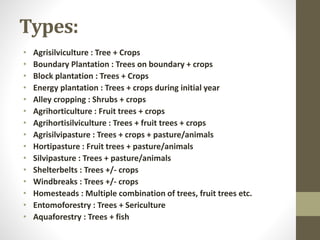
Types:
• Agrisilviculture : Tree + Crops
• Boundary Plantation : Trees on boundary + crops
• Block plantation : Trees + Crops
• Energy plantation : Trees + crops during initial year
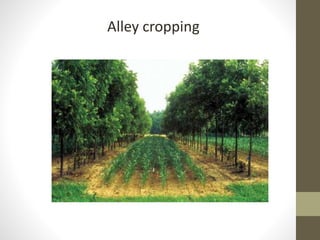
• Alley cropping : Shrubs + crops
• Agrihorticulture : Fruit trees + crops
• Agrihortisilviculture : Trees + fruit trees + crops
• Agrisilvipasture : Trees + crops + pasture/animals
• Hortipasture : Fruit trees + pasture/animals
• Silvipasture : Trees + pasture/animals
• Shelterbelts : Trees +/- crops
• Windbreaks : Trees +/- crops
• Homesteads : Multiple combination of trees, fruit trees etc.
• Entomoforestry : Trees + Sericulture
• Aquaforestry : Trees + fish
AGRISILVICULTURAL SYSTEM
Poplar plantations:
Species used:
Poplus deltoides
Variety:
• G48 (grown in the plains of
Punjab,Haryana, UP)
• w22 (grown in mountainous regions, e.g.,
Himachal Pradesh, Pathankot, Jammu)
Alley cropping
Trees along borders of crop fields Alternate strips or alley cropping
Random mixture Strip plantation
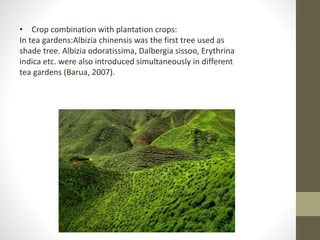
• Crop combination with plantation crops:
In tea gardens:Albizia chinensis was the first tree used as
shade tree. Albizia odoratissima, Dalbergia sissoo, Erythrina
indica etc. were also introduced simultaneously in different
tea gardens (Barua, 2007).
• Multipurpose trees and shrubs on
farmlands:
Species used:
Toona ciliata
Grewia optiva
Azadirachta indica
Melia dubia
Madhuca longifolia
Terminalia alata
Terminalia arjuna
Ficus auriculata
Bombex ceiba
Aegle marmelos
Alnus nepalensis etc.
Shelter-belts
Wind-breaks
Species used (windbreaks and shelterbelts):
Dodonaia viscosa, Cassia sp., Clerodendron, Acacia arabica, Dalbergia,
Eucalyptus, Parkinsonia, Prosopis etc.
Source:http://agriinfo.in
Soil conservation hedges
Multistory Agroforestry:
• Protein bank:
In this Silvipastoral system, various multipurpose trees (protein rich
trees) are planted in or around farmlands and range lands for cut and
carry fodder production to meet the feed requirement of livestock
during the fodder deficit period in winter.
Example: Acacia nilotica, Albizia lebbeck, Azadirachta indica, Leucaena
leucocephala, Gliricidia sepium, Sesbania grandiflora.
• Living fence of fodder trees and hedges:
In this system, various fodder trees and hedges are planted as live
fence to protect the property from stray animals or other biotic
influences.
Example: Gliricidia sepium, Sesbania grandiflora, Erythrina sp, Acacia
sp.
SILVOPASTORAL SYSTEM
• Trees and shrubs on pasture:
In this system, various tree and shrub species are scattered
irregularly or arranged according to some systemic pattern to
supplement forage production.
Example: Acacia nilotica, Acacia leucophloea ,Tamarindus indica,
Azadirachta indica
Other Agroforestry System
a) Horti-pastoral System:
Cultivation of Horticultural crops plus pastures.
b) Agri-Horti-Pastoral System:
In this system, in the marginal lands the fruit crops like Mango, Ber, Anona, Jamun, Tamrind,
Wood apple etc. are taken along with forest trees and the food grains like, Peas, Gram,
Wheat, Rice, Vegetables are taken.
c) Apiculture with Trees:
In this system, the flowering trees like Kanchan Jacaranda Spathodia, Erythrina, Krate sawar,
Palas are planted for producing the honey in addition to Jamun, Mahuha, Ecualyptus like trees
are also planted for honey collection.
d) Aqua Forestry:
Plants grown on the boundary around fish ponds like Casuriana, Coconut, Arecanut, Kokum,
Babhul, Bamboo, etc.
e) Multipurpose Wood Lots:
The specific multipurpose trees are grown mixed or separately on the farm like Australin
babhul, Euclayputs, Subabhul, Bakan, Bamboo etc.
Lycopersicon esculentum, Grewia optiva and Punica granatum in Agri-silvi-horticulture
system.
Source:
Agri-Silvi-Horticulture System:
Source:
Dr. Rajendra Prasad Central Agricultural
University
Pusa, Samastipur - 848 125, Bihar, India
Agri-Horticulture System:
“Litchi and turmeric”
Silvi- sericulture:
Species used:
Eri silkworm:castor leaves.
Tasar silkworms :trees of Terminalia species and on oak.
Mulberry Silk worms: mulberry leaves.
Muga silkworm :shrubs – Machilus bombycina and Litsae
polyantha.
Source:https://www.agrifarming.in/mulberry-cultivation/
And silk board of india.
Species used:
Willows
Oaks
Aponogeton etc.
Tree Species
FSIreport.
important
Nitrogen Fixing Species:
• Alnus nepalensis
• Leucaena leucocephala
• Albizia lebbeck
• Sesbania grandiflora
• Casuarina equestifolia etc.
Exotic tree species:
(most common)
• Poplar (Populus deltoides)
This tree was was introduced to India in the 1950s, from the United
States of America. It is now widely grown all over northern India and is
considered an agroforestry tree because of its desirable characteristics
and multiple uses. It is widely grown on a rotation of six to eight years.
• Eucalyptus tereticornis
This tree was introduced to India from Australia around
1790. Now, its cultivation has spread to nearly the whole of
the Indian subcontinent.
• Prosopis juliflora
• Introduced a century ago from South America, this tree (Fig. 4)
is locally known as "kabuli kikar." It has successfully
established itself on almost all the habitats including saline
lands, alkali lands, wastelands, road sides, field boundaries
and common lands. It is an evergreen tree
• Leucaena leucocephala
This tree is an exotic tree introduced from Hawaii, USA. Indians
perceived it as a miracle tree as it provides fodder, fuel,
pulpwood and timber.
CASE STUDY:
• Owner: Surinder Singh Harra
• Location : Yamunanagar district, haryan.
• Area- 100 acres.
• Agroforestry systems:
a) Agrihortisilviculture
b) Aquaforestry
c) Agrisilvipasture
• Dr.Norman Borlaug (first agricultural scientist to win a nobel prize)-
“Hara has taken farming a step beyond what I had thought”
Reference:
• http://www.organicresearchcentre.com/
• http://www.sunday-guardian.com/news/innovator-in-agro-forestry-
impresses-world
• http://www.worldagroforestry.org/Units/Library/Books/Book%2007
/agroforestry%20a%20decade%20of%20development/html/3_agrof
orestory%20in%20india.htm?n=16
• http://fsi.nic.in/cover_2013/treesinggroforestry.pdf
• https://www.slideshare.net/VivekSrivastava22/agroforestry-
systems-and-architecture
• http://www.fao.org/docrep/008/af338e/af338e06.htm
• http://bioresonline.org/article/tree-species-with-potential-of-
nitrogen-fixation-in-agroforestry-system-adopted-by-farmers-in-
semi-arid-region-of-southern-india/
• https://www.slideshare.net/SabariNathan64/integrated-farming-
system-61784067
• The Tribune(newspaper)
• https://www.rpcau.ac.in/litchi-based-agri-horticultural-
system/litchi-turmeric/
• Reports of FAO.
Thank You..!

Modern Agroforestry Systems

  • 1.
  • 2.
    Contents: 1. Introduction 2. Impacts 3.Products 4. Types 5. Systems 6. Tree species 7. Case study 8. References
  • 3.
    INTRODUCTION: • Modern agroforestrysystems can be defined as agroforestry systems that involve the integration of modern farming and forestry techniques to get more output from a unit area in unit time. • These cover the integral part of agroforestry as defined in its definition i.e: “TREES+CROPS+LIVESTOCK” Due to these sytems agroforestry is also being known now a days as : “The Future Farming” They are also known (MAS’s) as the artificial systems or the scientific systems of agroforestry.
  • 4.
    Impacts: • Economic stability. •Diversification of local products and economies. • Diversification of rural skills. • Improved food and fuel security. • Improvements to the cultural and natural environment. • Landscape diversification. • Reduction in risk of total crop failure.
  • 5.
    Products: • Food • Fuel •Timber • Fodder and forage • Fibre • Gums and resins • Medicinal products • Craft products • Recreation • Ecological services
  • 6.
    Types: • Agrisilviculture :Tree + Crops • Boundary Plantation : Trees on boundary + crops • Block plantation : Trees + Crops • Energy plantation : Trees + crops during initial year • Alley cropping : Shrubs + crops • Agrihorticulture : Fruit trees + crops • Agrihortisilviculture : Trees + fruit trees + crops • Agrisilvipasture : Trees + crops + pasture/animals • Hortipasture : Fruit trees + pasture/animals • Silvipasture : Trees + pasture/animals • Shelterbelts : Trees +/- crops • Windbreaks : Trees +/- crops • Homesteads : Multiple combination of trees, fruit trees etc. • Entomoforestry : Trees + Sericulture • Aquaforestry : Trees + fish
  • 8.
  • 9.
    Poplar plantations: Species used: Poplusdeltoides Variety: • G48 (grown in the plains of Punjab,Haryana, UP) • w22 (grown in mountainous regions, e.g., Himachal Pradesh, Pathankot, Jammu)
  • 10.
  • 11.
    Trees along bordersof crop fields Alternate strips or alley cropping Random mixture Strip plantation
  • 14.
    • Crop combinationwith plantation crops: In tea gardens:Albizia chinensis was the first tree used as shade tree. Albizia odoratissima, Dalbergia sissoo, Erythrina indica etc. were also introduced simultaneously in different tea gardens (Barua, 2007).
  • 15.
    • Multipurpose treesand shrubs on farmlands: Species used: Toona ciliata Grewia optiva Azadirachta indica Melia dubia Madhuca longifolia Terminalia alata Terminalia arjuna Ficus auriculata Bombex ceiba Aegle marmelos Alnus nepalensis etc.
  • 16.
  • 17.
    Wind-breaks Species used (windbreaksand shelterbelts): Dodonaia viscosa, Cassia sp., Clerodendron, Acacia arabica, Dalbergia, Eucalyptus, Parkinsonia, Prosopis etc. Source:http://agriinfo.in
  • 18.
  • 19.
  • 20.
    • Protein bank: Inthis Silvipastoral system, various multipurpose trees (protein rich trees) are planted in or around farmlands and range lands for cut and carry fodder production to meet the feed requirement of livestock during the fodder deficit period in winter. Example: Acacia nilotica, Albizia lebbeck, Azadirachta indica, Leucaena leucocephala, Gliricidia sepium, Sesbania grandiflora. • Living fence of fodder trees and hedges: In this system, various fodder trees and hedges are planted as live fence to protect the property from stray animals or other biotic influences. Example: Gliricidia sepium, Sesbania grandiflora, Erythrina sp, Acacia sp. SILVOPASTORAL SYSTEM
  • 21.
    • Trees andshrubs on pasture: In this system, various tree and shrub species are scattered irregularly or arranged according to some systemic pattern to supplement forage production. Example: Acacia nilotica, Acacia leucophloea ,Tamarindus indica, Azadirachta indica
  • 22.
    Other Agroforestry System a)Horti-pastoral System: Cultivation of Horticultural crops plus pastures. b) Agri-Horti-Pastoral System: In this system, in the marginal lands the fruit crops like Mango, Ber, Anona, Jamun, Tamrind, Wood apple etc. are taken along with forest trees and the food grains like, Peas, Gram, Wheat, Rice, Vegetables are taken. c) Apiculture with Trees: In this system, the flowering trees like Kanchan Jacaranda Spathodia, Erythrina, Krate sawar, Palas are planted for producing the honey in addition to Jamun, Mahuha, Ecualyptus like trees are also planted for honey collection. d) Aqua Forestry: Plants grown on the boundary around fish ponds like Casuriana, Coconut, Arecanut, Kokum, Babhul, Bamboo, etc. e) Multipurpose Wood Lots: The specific multipurpose trees are grown mixed or separately on the farm like Australin babhul, Euclayputs, Subabhul, Bakan, Bamboo etc.
  • 23.
    Lycopersicon esculentum, Grewiaoptiva and Punica granatum in Agri-silvi-horticulture system. Source: Agri-Silvi-Horticulture System:
  • 24.
    Source: Dr. Rajendra PrasadCentral Agricultural University Pusa, Samastipur - 848 125, Bihar, India Agri-Horticulture System: “Litchi and turmeric”
  • 25.
    Silvi- sericulture: Species used: Erisilkworm:castor leaves. Tasar silkworms :trees of Terminalia species and on oak. Mulberry Silk worms: mulberry leaves. Muga silkworm :shrubs – Machilus bombycina and Litsae polyantha. Source:https://www.agrifarming.in/mulberry-cultivation/ And silk board of india.
  • 26.
  • 28.
  • 29.
  • 31.
    Nitrogen Fixing Species: •Alnus nepalensis • Leucaena leucocephala • Albizia lebbeck • Sesbania grandiflora • Casuarina equestifolia etc.
  • 32.
    Exotic tree species: (mostcommon) • Poplar (Populus deltoides) This tree was was introduced to India in the 1950s, from the United States of America. It is now widely grown all over northern India and is considered an agroforestry tree because of its desirable characteristics and multiple uses. It is widely grown on a rotation of six to eight years.
  • 33.
    • Eucalyptus tereticornis Thistree was introduced to India from Australia around 1790. Now, its cultivation has spread to nearly the whole of the Indian subcontinent.
  • 34.
    • Prosopis juliflora •Introduced a century ago from South America, this tree (Fig. 4) is locally known as "kabuli kikar." It has successfully established itself on almost all the habitats including saline lands, alkali lands, wastelands, road sides, field boundaries and common lands. It is an evergreen tree
  • 35.
    • Leucaena leucocephala Thistree is an exotic tree introduced from Hawaii, USA. Indians perceived it as a miracle tree as it provides fodder, fuel, pulpwood and timber.
  • 36.
    CASE STUDY: • Owner:Surinder Singh Harra • Location : Yamunanagar district, haryan. • Area- 100 acres. • Agroforestry systems: a) Agrihortisilviculture b) Aquaforestry c) Agrisilvipasture • Dr.Norman Borlaug (first agricultural scientist to win a nobel prize)- “Hara has taken farming a step beyond what I had thought”
  • 38.
    Reference: • http://www.organicresearchcentre.com/ • http://www.sunday-guardian.com/news/innovator-in-agro-forestry- impresses-world •http://www.worldagroforestry.org/Units/Library/Books/Book%2007 /agroforestry%20a%20decade%20of%20development/html/3_agrof orestory%20in%20india.htm?n=16 • http://fsi.nic.in/cover_2013/treesinggroforestry.pdf • https://www.slideshare.net/VivekSrivastava22/agroforestry- systems-and-architecture • http://www.fao.org/docrep/008/af338e/af338e06.htm • http://bioresonline.org/article/tree-species-with-potential-of- nitrogen-fixation-in-agroforestry-system-adopted-by-farmers-in- semi-arid-region-of-southern-india/ • https://www.slideshare.net/SabariNathan64/integrated-farming- system-61784067 • The Tribune(newspaper) • https://www.rpcau.ac.in/litchi-based-agri-horticultural- system/litchi-turmeric/ • Reports of FAO.
  • 39.