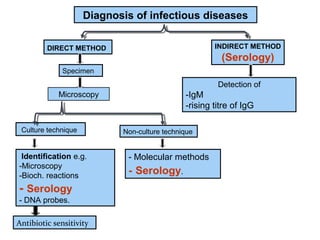
Diagnosis of infectious diseases
INDIRECT METHOD

DIRECT METHOD

(Serology)

Specimen

Detection of

-IgM
-rising titre of IgG

Microscopy

Culture technique

Identification e.g.
-Microscopy
-Bioch. reactions

- Serology
- DNA probes.
Antibiotic sensitivity

Non-culture technique

- Molecular methods

- Serology.
ANTIGENANTIBODY
INTERACTIONS
Antigen-Antibody reactions in vitro = Serology

Diagnosis of diseases
Identification

of Ag /Ab
Quantitation of Ag / Ab
METHODS OF DETECTION OF
ANTIGEN-ANTIBODY
REACTIONS

Reactions
Accompanied by
Visible Phenomena

Reactions
Detected by
Labeled Reagents
Reactions Accompanied by
Visible Phenomena
Resulting Ag-Ab complexes seen directly
• By naked eye
• By microscope
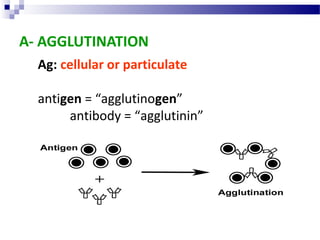
A- AGGLUTINATION
Ag: cellular or particulate
antigen = “agglutinogen”
antibody = “agglutinin”
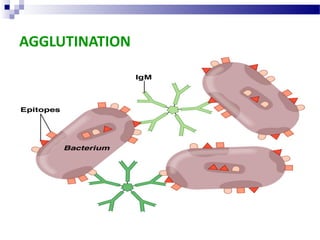
AGGLUTINATION
Agglutination

Slide Agglutination. 1

Tube Agglutination. 2
1. Slide agglutination
(Qualitative Test)

Unknown Ag
 Add known
antiserum (Ab)

2. Tube agglutination
(Quantitative Test)
Detection of Ab against a certain pathogen
= indirect evidence for diagnosis of disease
= serological diagnosis

Tube Agglutination

1/10

1/20

1/40

1/80

1/160

1/320

1/640
B- PASSIVE AGGLUTINATION
Soluble antigen + antibody → precipitation
Not very sensitive!!

How can we convert:
precipitation

agglutination ??
more sensitive !!!
Both Ag & Ab are soluble
One known!
The other not known!

+

↔

Soluble known reactant
is coated onto inert particles e.g. Latex particles
Known reactant becomes particulate (instead of soluble)
Reaction becomes Agglutination (instead of
precipitation)
Soluble known antigen coated on latex particle
+
Unknown antibody (IgM)
(Soluble) known antibody coated on latex particle
+
Unknown soluble antigen
Examples:


Rheumatoid arthritis:
(Patient produces Abs against IgG)
Latex-IgG (known Ag) + serum from patient (Ab?)



C-Reactive protein: (inflammatory conditions)
Latex-anti-CRP (known Ab) + serum (CRP?)



Pregnancy Test (Test for HCG)
Latex-anti-HCG (known Ab) + urine (HCG?)
C- COOMBS (ANTIGLOBULIN) TEST
Non-agglutinating
antibodies
Examples:



Anti-Rh antibodies
Abs in autoimmune
haemolytic anaemia
Direct

Coombs Test

Done for cases of:
- Newborn with erythroblastosis foetalis
- Patients with haemolytic anaemia
(RBCs have attached Abs already)
Indirect Coombs Test

Done to detect non-agglutinating antibodies in
serum of Rh-negative mother sensitized
with Rh antigen
D- HAEMAGGLUTINATION INHIBITION
Some viruses agglutinate RBCs in vitro.

Antibodies (if present) prevent haemagglutination
= Haemagglutination inhibition
E- PRECIPITATION
• Ag: soluble
Applications:
Agar gel diffusion
a. Double diffusion
b. Single radial immunodiffusion
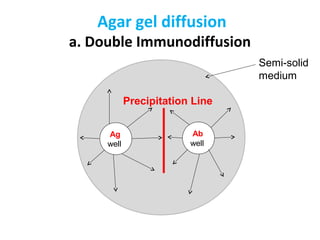
Agar gel diffusion

a. Double Immunodiffusion
Semi-solid
medium
Precipitation Line
Ag
well

Ab
well
Elek’s Test
(double diffusion)
Elek’s Test
b. Single radial immunodiffusion
• Method:
- Ab in media
- Ag in well

Antibody

Ag

Precipitation Ring
b-Single radial immunodiffusion
b. Single radial immunodiffusion

Interpretation:
Diameter of ring is proportional
to concentration of Ag in
sample.

1

2

3

Diameter2

Note: Standards (1-4)of known
concentrations are included
in the test to create a curve.

Ab in gel

Ag Concentration

4
• Used to quantitate
various immunoglobulin
classes
• Immunogloblin acts as an
Ag.

Standard 3

Standard 2

Pt. 2
Pt. 3

• In well: patient’s serum
(Ag?)
• In gel: anti-IgG, anti-IgM,
……etc

Pt. 1

Standard 1
F- FLOCCULATION
Antigen: Small insoluble particulate
Examples:
• Venereal Disease Research Laboratory (VDRL)
test
• Rapid plasma regain (RPR) test
VDRL: slide flocculation test for diagnosis of syphilis
Cardiolipin used as antigen instead of Treponema
antigen
Antibody detected is a heterophil Ab called Reagin
Negative

Positive
Microscopical aggregates
RPR rapid plasma reagin


Small carbon particles added → easier visibility
(by naked eye)

            
  -ve control

+ve control

+ve Test

-ve control

+ve control

-ve Test
H- Complement fixation:
• Test depends on the fact that:
Ag - Ab → complement fixation
• Sensitive
• Used to:
Detect and quantitate antibody
Detect and quantitate antigen (less commonly)
• Many applications in diagnosis of diseases caused by
bacteria, viruses, fungi, etc.
• Famous Test: Wassermann Test for serologic diagnosis of
syphilis
I- Viral Neutralization:

Certain viruses cause cytopathogenic (CPE) effect on
certain cell cultures

Uninfected cells

Viral-infected cells, showing 
cytopathic effect (CPE).  
 Fusion of infected cells→ 
multinucleated giant cells

CPE are inhibited by virus-neutralizing Abs.
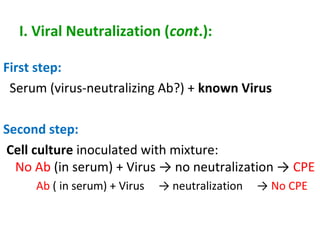
I. Viral Neutralization (cont.):
First step:
Serum (virus-neutralizing Ab?) + known Virus
Second step:
Cell culture inoculated with mixture:
No Ab (in serum) + Virus → no neutralization → CPE
Ab ( in serum) + Virus

→ neutralization

→ No CPE
ANTIGEN-ANTIBODY
REACTIONS

Reactions
Accompanied by
Visible Phenomena

Reactions
Detected by
Labeled Reagents
A. Immunofluorescence
B. ELISA
C. RIA
A. Immunofluorescent Techniques:
Principle:
Fluorescent substances (e.g. Fluorescein isothiocyanate)
attached to known Ab
→ seen by fluorescence microscope
using UV light
→ fluorescence = positive reaction
i) Direct Immunofluorescence
• Detects unknown Ag
e.g.: rabies virus in
brain of dead animal
• Tissue (Ag?)
+ labeled known Ab
→ binding
→ fluorescence
Positive test
ii) Indirect Immunofluorescence
• Detects Ab in serum
→ indirect diagnosis of
disease
e.g. Syphilis
• Known antigen
(Treponema pallidum)
bound to slide
+ serum (Ab against
Treponema?)
• Labeled antihuman
globulin added
→ fluorescence
B.Enzyme-Linked Immunosorbent Assay
(ELISA)
•
•
•
•
•

Very sensitive
Very specific
Used to detect Ag or Ab
Label used: Enzyme
Example: Horseraddish peroxidase or alkaline
phosphatase
• Enzyme can be conjugated to Ag or Ab
• Ag-enzyme or Ab-enzyme is called conjugate
• Enzyme acts on colorless substrate
→ colored product
• Colour change = +ve test.
• Colour intensity (by spectrophotometer)
is proportional to the amount of Ag or Ab
(quantitative).
• Many variations in test procedure.
Direct Method
(Double Antibody Technique)
For detection and quantitation of Ag
Indirect Method
For detection and quantitation of Ab in serum.
Unknown Ab in
test serum
Known Ag

Enzyme labeled
anti-human Ig

Substrate is
added
ELISA
ELISA
plates
C. Radioimmunoassay (RIA)
• Same idea as ELlSA but different label:
Radioactive isotope (instead of enzyme)
• Measurement of Degree of radioactivity
(instead of degree of colour change)

• As sensitive as ELISA
• Disadvantage: Hazards of radioactivity
• Applications:
– Measurement of biological substances (Ags)
(e.g. drugs, hormones, tumour markers)
– Measurement of antibodies
MCQs
1. If you mix bacteria with specific Abs, it
would result in:
a) Cell lysis
b) Agglutination
c) Haemagglutination
d) Precipitation
e) Fluorescence
2. In passive agglutination reaction, soluble
antigens or antibodies coat:
a) Latex particles
b) White blood cells
c) Platelets
d) Carbon particles
e) None of the above
3. Regarding direct Coomb's test:
a) Maternal RBCs are used
b) Group O Rh +ve RBCs are used
c) Anti-human globulins are added directly to
foetal RBCs
d) Mother's serum is used
e) Foetal serum is used
4. In Elek’s test:
a) The antigen is mixed with the agar gel.
b)Lines of precipitate will form in positive cases.
c) The antibody is incorporated in the agar.
d) A strip of filter paper is soaked with the antigen.
e) Agglutination can be observed.
5. Single radial immunodiffusion test:
a) Is an example of an agglutination reaction
b) Utilizes agar gel mixed with the antigen
c) Depends on complement fixation during Ag-Ab
reaction
d) Is used to detect non-agglutinating antibodies
e) Is a precipitation reaction
6. Direct ELISA requires:
a. Known Ab
b. Known Ag
c. Complement
d. Patient’s Ab
e. Sheep RBCs
Serology - Prac. Microbiology

Serology - Prac. Microbiology

  • 1.
    Diagnosis of infectiousdiseases INDIRECT METHOD DIRECT METHOD (Serology) Specimen Detection of -IgM -rising titre of IgG Microscopy Culture technique Identification e.g. -Microscopy -Bioch. reactions - Serology - DNA probes. Antibiotic sensitivity Non-culture technique - Molecular methods - Serology.
  • 2.
  • 3.
    Antigen-Antibody reactions invitro = Serology Diagnosis of diseases Identification of Ag /Ab Quantitation of Ag / Ab
  • 4.
    METHODS OF DETECTIONOF ANTIGEN-ANTIBODY REACTIONS Reactions Accompanied by Visible Phenomena Reactions Detected by Labeled Reagents
  • 5.
    Reactions Accompanied by VisiblePhenomena Resulting Ag-Ab complexes seen directly • By naked eye • By microscope
  • 6.
    A- AGGLUTINATION Ag: cellularor particulate antigen = “agglutinogen” antibody = “agglutinin”
  • 7.
  • 8.
  • 9.
    1. Slide agglutination (QualitativeTest) Unknown Ag  Add known antiserum (Ab) 
  • 13.
    2. Tube agglutination (QuantitativeTest) Detection of Ab against a certain pathogen = indirect evidence for diagnosis of disease = serological diagnosis 
  • 14.
  • 15.
    B- PASSIVE AGGLUTINATION Solubleantigen + antibody → precipitation Not very sensitive!! How can we convert: precipitation agglutination ?? more sensitive !!!
  • 16.
    Both Ag &Ab are soluble One known! The other not known! + ↔ Soluble known reactant is coated onto inert particles e.g. Latex particles Known reactant becomes particulate (instead of soluble) Reaction becomes Agglutination (instead of precipitation)
  • 17.
    Soluble known antigencoated on latex particle + Unknown antibody (IgM)
  • 18.
    (Soluble) known antibodycoated on latex particle + Unknown soluble antigen
  • 19.
    Examples:  Rheumatoid arthritis: (Patient producesAbs against IgG) Latex-IgG (known Ag) + serum from patient (Ab?)  C-Reactive protein: (inflammatory conditions) Latex-anti-CRP (known Ab) + serum (CRP?)  Pregnancy Test (Test for HCG) Latex-anti-HCG (known Ab) + urine (HCG?)
  • 20.
    C- COOMBS (ANTIGLOBULIN)TEST Non-agglutinating antibodies Examples:   Anti-Rh antibodies Abs in autoimmune haemolytic anaemia
  • 22.
    Direct Coombs Test Done forcases of: - Newborn with erythroblastosis foetalis - Patients with haemolytic anaemia (RBCs have attached Abs already)
  • 24.
    Indirect Coombs Test Doneto detect non-agglutinating antibodies in serum of Rh-negative mother sensitized with Rh antigen
  • 26.
    D- HAEMAGGLUTINATION INHIBITION Someviruses agglutinate RBCs in vitro. Antibodies (if present) prevent haemagglutination = Haemagglutination inhibition
  • 27.
    E- PRECIPITATION • Ag:soluble Applications: Agar gel diffusion a. Double diffusion b. Single radial immunodiffusion
  • 28.
    Agar gel diffusion a.Double Immunodiffusion Semi-solid medium Precipitation Line Ag well Ab well
  • 29.
  • 30.
  • 31.
    b. Single radialimmunodiffusion • Method: - Ab in media - Ag in well Antibody Ag Precipitation Ring
  • 32.
  • 33.
    b. Single radialimmunodiffusion Interpretation: Diameter of ring is proportional to concentration of Ag in sample. 1 2 3 Diameter2 Note: Standards (1-4)of known concentrations are included in the test to create a curve. Ab in gel Ag Concentration 4
  • 34.
    • Used toquantitate various immunoglobulin classes • Immunogloblin acts as an Ag. Standard 3 Standard 2 Pt. 2 Pt. 3 • In well: patient’s serum (Ag?) • In gel: anti-IgG, anti-IgM, ……etc Pt. 1 Standard 1
  • 35.
    F- FLOCCULATION Antigen: Smallinsoluble particulate Examples: • Venereal Disease Research Laboratory (VDRL) test • Rapid plasma regain (RPR) test
  • 36.
    VDRL: slide flocculationtest for diagnosis of syphilis Cardiolipin used as antigen instead of Treponema antigen Antibody detected is a heterophil Ab called Reagin Negative Positive Microscopical aggregates
  • 37.
    RPR rapid plasmareagin   Small carbon particles added → easier visibility (by naked eye)                -ve control +ve control +ve Test -ve control +ve control -ve Test
  • 38.
    H- Complement fixation: •Test depends on the fact that: Ag - Ab → complement fixation • Sensitive • Used to: Detect and quantitate antibody Detect and quantitate antigen (less commonly) • Many applications in diagnosis of diseases caused by bacteria, viruses, fungi, etc. • Famous Test: Wassermann Test for serologic diagnosis of syphilis
  • 39.
    I- Viral Neutralization: Certainviruses cause cytopathogenic (CPE) effect on certain cell cultures Uninfected cells Viral-infected cells, showing  cytopathic effect (CPE).    Fusion of infected cells→  multinucleated giant cells CPE are inhibited by virus-neutralizing Abs.
  • 40.
    I. Viral Neutralization(cont.): First step: Serum (virus-neutralizing Ab?) + known Virus Second step: Cell culture inoculated with mixture: No Ab (in serum) + Virus → no neutralization → CPE Ab ( in serum) + Virus → neutralization → No CPE
  • 41.
  • 42.
  • 43.
    A. Immunofluorescent Techniques: Principle: Fluorescentsubstances (e.g. Fluorescein isothiocyanate) attached to known Ab → seen by fluorescence microscope using UV light → fluorescence = positive reaction
  • 44.
    i) Direct Immunofluorescence •Detects unknown Ag e.g.: rabies virus in brain of dead animal • Tissue (Ag?) + labeled known Ab → binding → fluorescence
  • 45.
  • 46.
    ii) Indirect Immunofluorescence •Detects Ab in serum → indirect diagnosis of disease e.g. Syphilis • Known antigen (Treponema pallidum) bound to slide + serum (Ab against Treponema?) • Labeled antihuman globulin added → fluorescence
  • 47.
    B.Enzyme-Linked Immunosorbent Assay (ELISA) • • • • • Verysensitive Very specific Used to detect Ag or Ab Label used: Enzyme Example: Horseraddish peroxidase or alkaline phosphatase • Enzyme can be conjugated to Ag or Ab • Ag-enzyme or Ab-enzyme is called conjugate • Enzyme acts on colorless substrate → colored product
  • 48.
    • Colour change= +ve test. • Colour intensity (by spectrophotometer) is proportional to the amount of Ag or Ab (quantitative). • Many variations in test procedure.
  • 49.
    Direct Method (Double AntibodyTechnique) For detection and quantitation of Ag
  • 50.
    Indirect Method For detectionand quantitation of Ab in serum. Unknown Ab in test serum Known Ag Enzyme labeled anti-human Ig Substrate is added
  • 51.
  • 52.
  • 53.
    C. Radioimmunoassay (RIA) •Same idea as ELlSA but different label: Radioactive isotope (instead of enzyme) • Measurement of Degree of radioactivity (instead of degree of colour change) • As sensitive as ELISA • Disadvantage: Hazards of radioactivity • Applications: – Measurement of biological substances (Ags) (e.g. drugs, hormones, tumour markers) – Measurement of antibodies
  • 54.
  • 55.
    1. If youmix bacteria with specific Abs, it would result in: a) Cell lysis b) Agglutination c) Haemagglutination d) Precipitation e) Fluorescence
  • 56.
    2. In passiveagglutination reaction, soluble antigens or antibodies coat: a) Latex particles b) White blood cells c) Platelets d) Carbon particles e) None of the above
  • 57.
    3. Regarding directCoomb's test: a) Maternal RBCs are used b) Group O Rh +ve RBCs are used c) Anti-human globulins are added directly to foetal RBCs d) Mother's serum is used e) Foetal serum is used
  • 58.
    4. In Elek’stest: a) The antigen is mixed with the agar gel. b)Lines of precipitate will form in positive cases. c) The antibody is incorporated in the agar. d) A strip of filter paper is soaked with the antigen. e) Agglutination can be observed.
  • 59.
    5. Single radialimmunodiffusion test: a) Is an example of an agglutination reaction b) Utilizes agar gel mixed with the antigen c) Depends on complement fixation during Ag-Ab reaction d) Is used to detect non-agglutinating antibodies e) Is a precipitation reaction
  • 60.
    6. Direct ELISArequires: a. Known Ab b. Known Ag c. Complement d. Patient’s Ab e. Sheep RBCs