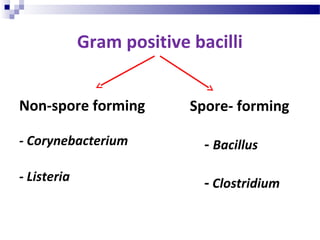
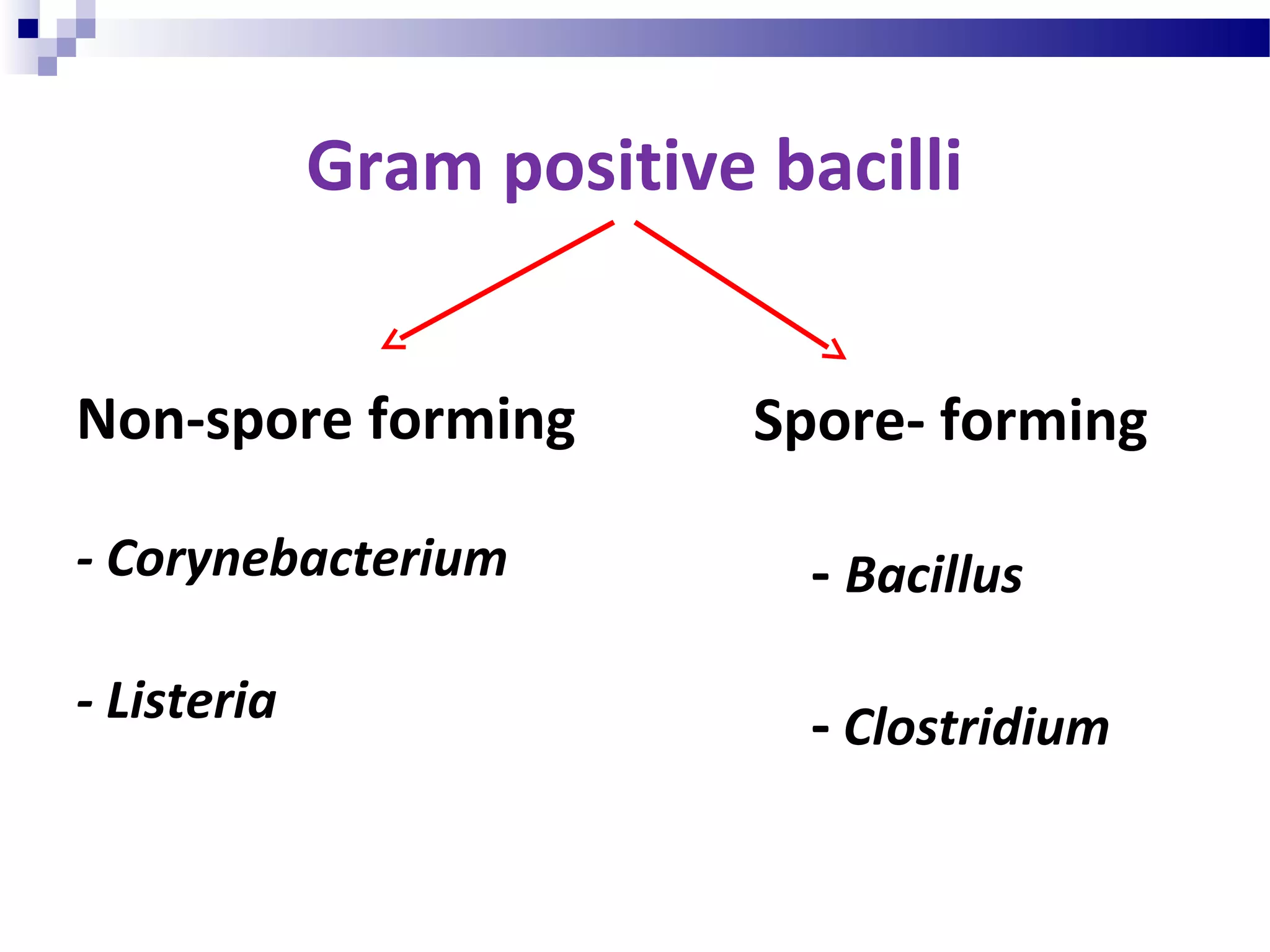
Gram positive bacilli
Non-spore forming
- Corynebacterium
- Listeria
Spore- forming
- Bacillus
- Clostridium
Non-spore forming
Corynebacterium
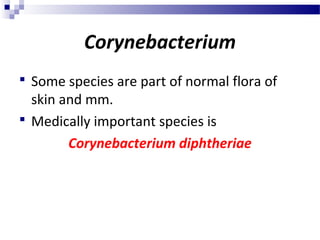
Corynebacterium
 Some species are part of normal flora of
skin and mm.
 Medically important species is
Corynebacterium diphtheriae
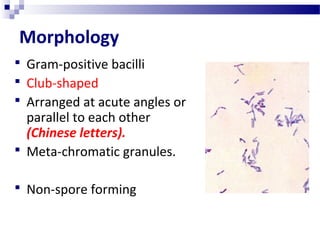
Morphology
 Gram-positive bacilli
 Club-shaped
 Arranged at acute angles or
parallel to each other
(Chinese letters).
 Meta-chromatic granules.
 Non-spore forming
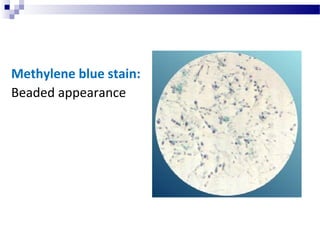
Methylene blue stain:
Beaded appearance
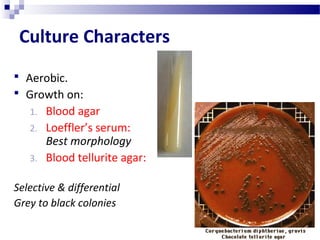
Culture Characters
 Aerobic.
 Growth on:
1. Blood agar
2. Loeffler’s serum:
Best morphology
3. Blood tellurite agar:
Selective & differential
Grey to black colonies
Virulence factors
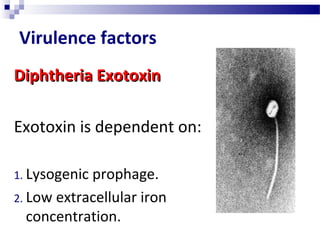
Diphtheria ExotoxinDiphtheria Exotoxin
Exotoxin is dependent on:
1. Lysogenic prophage.
2. Low extracellular iron
concentration.
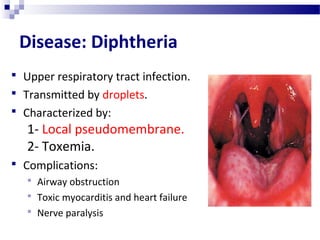
Disease: Diphtheria
 Upper respiratory tract infection.
 Transmitted by droplets.
 Characterized by:
1- Local pseudomembrane.
2- Toxemia.
 Complications:
 Airway obstruction
 Toxic myocarditis and heart failure
 Nerve paralysis
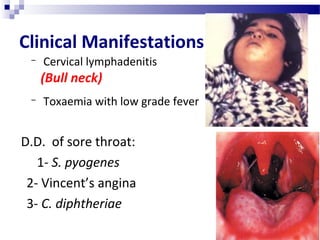
Clinical Manifestations
- Cervical lymphadenitis
(Bull neck)
- Toxaemia with low grade fever
D.D. of sore throat:
1- S. pyogenes
2- Vincent’s angina
3- C. diphtheriae
Diagnosis
Mainly clinical
Laboratory confirmation:
A- Specimen:
Throat swab from the
pseudomembrane.
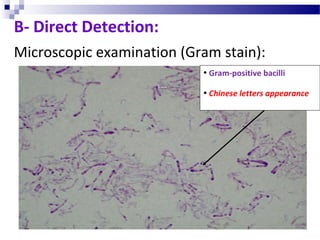
B- Direct Detection:
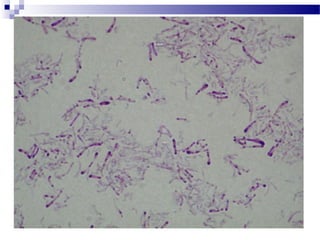
Microscopic examination (Gram stain):
• Gram-positive bacilli
• Chinese letters appearance
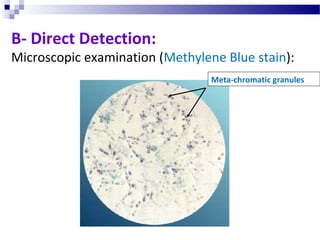
B- Direct Detection:
Microscopic examination (Methylene Blue stain):
Meta-chromatic granules
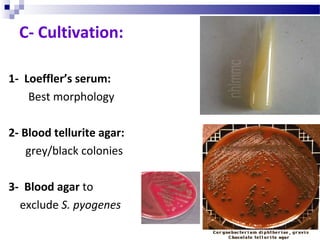
1- Loeffler’s serum:
Best morphology
2- Blood tellurite agar:
grey/black colonies
3- Blood agar to
exclude S. pyogenes
C- Cultivation:
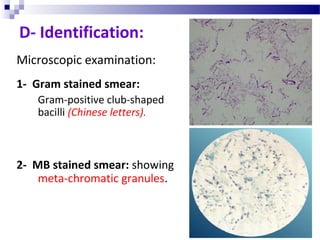
D- Identification:
Microscopic examination:
1- Gram stained smear:
Gram-positive club-shaped
bacilli (Chinese letters).
2- MB stained smear: showing
meta-chromatic granules.
The isolated organism is
Corynebacterium diphtheriae
Is it Toxigenic or Not?
E- Toxigenicity Tests:
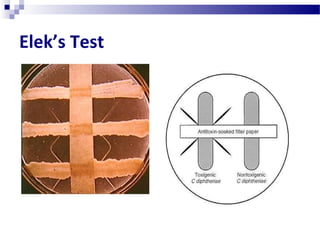
a) Elek’s test: most common assay.
b) PCR: detection of toxin gene.
c) ELISA: detection of toxin from culture.
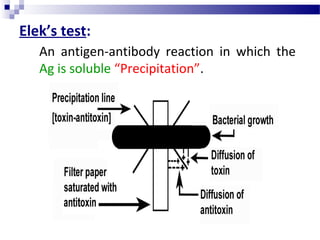
Elek’s test:
An antigen-antibody reaction in which the
Ag is soluble “Precipitation”.
Elek’s Test
Diagnosis of carriers
Throat or nasal swabs are subjected to
the same procedures:
Isolation
+
Toxigenicity tests
What treatment is prescribed?
 Treatment should be IMMEDIATELY started
if diphtheria is clinically suspected.
 Diphtheria antitoxin and antibiotics.
 Treatment of symptoms & complications
e.g. respiratory support.
How can we prevent this disease?
By Vaccination
Diphtheria toxoid + pertussis vaccine +
tetanus toxoid in a trivalent vaccine:
DPT
For close contacts of a case:
(booster of diphtheria toxoid + antibiotic
chemoprophylaxis)
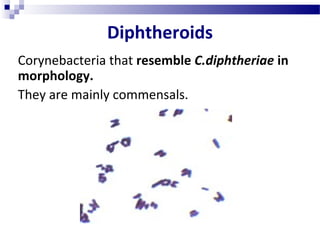
Diphtheroids
Corynebacteria that resemble C.diphtheriae in
morphology.
They are mainly commensals.
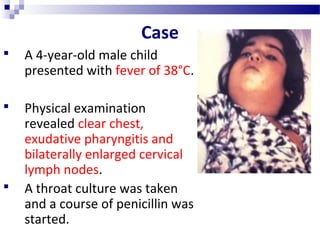
Case
 A 4-year-old male child
presented with fever of 38°C.
 Physical examination
revealed clear chest,
exudative pharyngitis and
bilaterally enlarged cervical
lymph nodes.
 A throat culture was taken
and a course of penicillin was
started.
Case (cont.)
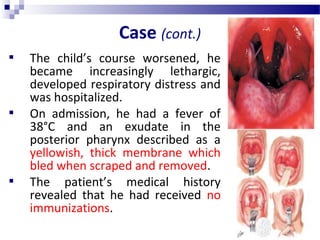
 The child’s course worsened, he
became increasingly lethargic,
developed respiratory distress and
was hospitalized.
 On admission, he had a fever of
38°C and an exudate in the
posterior pharynx described as a
yellowish, thick membrane which
bled when scraped and removed.
 The patient’s medical history
revealed that he had received no
immunizations.
Listeria
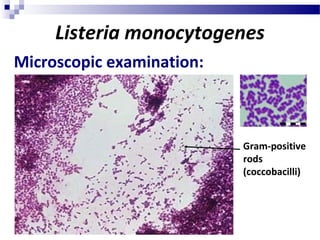
Listeria monocytogenes
Gram-positive
rods
(coccobacilli)
Microscopic examination:
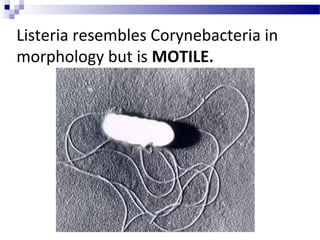
Listeria resembles Corynebacteria in
morphology but is MOTILE.
Diseases
 Abortion, premature delivery or sepsis
during the peripartum period.
 Neonatal meningitis
 Septicaemia and meningitis (in
immunocompromised adults).
 Food poisoning (dairy products or
undercooked meat)
Neonatal meningitis
 Meningitis caused by Listeria is almost
always seen in neonates.
 Causes of Neonatal Meningitis:
1. Group B Streptococci
2. E. coli K1
3. Listeria monocytogenes
Case
A one month old girl was admitted to hospital
with acute meningitis.
The Gram stain of CSF revealed Gram-positive
short rods.
What is the cause of neonatal meningitis?
a. N. meningitidis, group A
b. N. meningitidis, group C
c. Listeria monocytogenes
d. S. pneumoniae
How did the mother contract it?
 Listeriosis is a food-borne infection.
 Listeria resists drying, heating and freezing
without forming spores.
 Commonly contaminated food items:
1. Dairy products (esp. unpasteurized milk and
soft cheeses).
2. Undercooked meat (chicken, hot-dogs).
3. Refrigerated food.
Review Questions
1- C.diphtheriae is cultured on:
a- Nutrient agar.
b- Chocolate agar.
c- Loffler’s serum.
d- Lowenstein-Jensen medium.
e- MacConkey’s agar.
2- Blood tellurite agar is a(n):
a- Enriched medium
b- Enrichment medium
c- Simple medium
d- Selective and differential medium
e- Indicator medium only
3- Which of the following is a toxigenicity test
for C.diphtheriae ?
a- Elek’s test
b- Coagulase
c- Catalase test
d- Culture on blood tellurite
e- ELISA test for antibody detection
4- C. diphtheriae has the following morphology:
a- Gram negative cocci arranged in pairs
b- Gram positive cocci arranged in chains
c- Gram positive club-shaped bacilli
d- Gram positive cocci in clusters
e- Gram positive capsulated diplococci
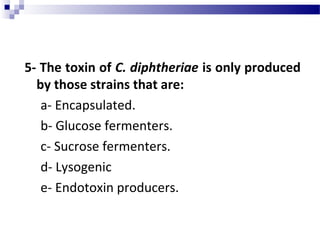
5- The toxin of C. diphtheriae is only produced
by those strains that are:
a- Encapsulated.
b- Glucose fermenters.
c- Sucrose fermenters.
d- Lysogenic
e- Endotoxin producers.
6- A 1-week old newborn develops meningitis.
Short gram-positive rods are isolated. The
mother had eaten unpasteurized cheese during
pregnancy. What is the most likely etiological
diagnosis?
a- C. diphtheriae.
b- S. pyogenes.
c- L. monocytogenes.
d- S. pneumoniae.
e- S. agalactiae
THANK YOU

Diphtheria - Prac. Microbiology

  • 1.
    Gram positive bacilli Non-sporeforming - Corynebacterium - Listeria Spore- forming - Bacillus - Clostridium
  • 2.
  • 3.
    Corynebacterium  Some speciesare part of normal flora of skin and mm.  Medically important species is Corynebacterium diphtheriae
  • 4.
    Morphology  Gram-positive bacilli Club-shaped  Arranged at acute angles or parallel to each other (Chinese letters).  Meta-chromatic granules.  Non-spore forming
  • 6.
  • 7.
    Culture Characters  Aerobic. Growth on: 1. Blood agar 2. Loeffler’s serum: Best morphology 3. Blood tellurite agar: Selective & differential Grey to black colonies
  • 8.
    Virulence factors Diphtheria ExotoxinDiphtheriaExotoxin Exotoxin is dependent on: 1. Lysogenic prophage. 2. Low extracellular iron concentration.
  • 9.
    Disease: Diphtheria  Upperrespiratory tract infection.  Transmitted by droplets.  Characterized by: 1- Local pseudomembrane. 2- Toxemia.  Complications:  Airway obstruction  Toxic myocarditis and heart failure  Nerve paralysis
  • 10.
    Clinical Manifestations - Cervicallymphadenitis (Bull neck) - Toxaemia with low grade fever D.D. of sore throat: 1- S. pyogenes 2- Vincent’s angina 3- C. diphtheriae
  • 11.
    Diagnosis Mainly clinical Laboratory confirmation: A-Specimen: Throat swab from the pseudomembrane.
  • 12.
    B- Direct Detection: Microscopicexamination (Gram stain): • Gram-positive bacilli • Chinese letters appearance
  • 13.
    B- Direct Detection: Microscopicexamination (Methylene Blue stain): Meta-chromatic granules
  • 14.
    1- Loeffler’s serum: Bestmorphology 2- Blood tellurite agar: grey/black colonies 3- Blood agar to exclude S. pyogenes C- Cultivation:
  • 15.
    D- Identification: Microscopic examination: 1-Gram stained smear: Gram-positive club-shaped bacilli (Chinese letters). 2- MB stained smear: showing meta-chromatic granules.
  • 16.
    The isolated organismis Corynebacterium diphtheriae Is it Toxigenic or Not?
  • 17.
    E- Toxigenicity Tests: a)Elek’s test: most common assay. b) PCR: detection of toxin gene. c) ELISA: detection of toxin from culture.
  • 18.
    Elek’s test: An antigen-antibodyreaction in which the Ag is soluble “Precipitation”.
  • 19.
  • 20.
    Diagnosis of carriers Throator nasal swabs are subjected to the same procedures: Isolation + Toxigenicity tests
  • 21.
    What treatment isprescribed?  Treatment should be IMMEDIATELY started if diphtheria is clinically suspected.  Diphtheria antitoxin and antibiotics.  Treatment of symptoms & complications e.g. respiratory support.
  • 22.
    How can weprevent this disease? By Vaccination Diphtheria toxoid + pertussis vaccine + tetanus toxoid in a trivalent vaccine: DPT For close contacts of a case: (booster of diphtheria toxoid + antibiotic chemoprophylaxis)
  • 23.
    Diphtheroids Corynebacteria that resembleC.diphtheriae in morphology. They are mainly commensals.
  • 24.
    Case  A 4-year-oldmale child presented with fever of 38°C.  Physical examination revealed clear chest, exudative pharyngitis and bilaterally enlarged cervical lymph nodes.  A throat culture was taken and a course of penicillin was started.
  • 25.
    Case (cont.)  Thechild’s course worsened, he became increasingly lethargic, developed respiratory distress and was hospitalized.  On admission, he had a fever of 38°C and an exudate in the posterior pharynx described as a yellowish, thick membrane which bled when scraped and removed.  The patient’s medical history revealed that he had received no immunizations.
  • 26.
  • 27.
  • 28.
    Listeria resembles Corynebacteriain morphology but is MOTILE.
  • 29.
    Diseases  Abortion, prematuredelivery or sepsis during the peripartum period.  Neonatal meningitis  Septicaemia and meningitis (in immunocompromised adults).  Food poisoning (dairy products or undercooked meat)
  • 30.
    Neonatal meningitis  Meningitiscaused by Listeria is almost always seen in neonates.  Causes of Neonatal Meningitis: 1. Group B Streptococci 2. E. coli K1 3. Listeria monocytogenes
  • 31.
    Case A one monthold girl was admitted to hospital with acute meningitis. The Gram stain of CSF revealed Gram-positive short rods. What is the cause of neonatal meningitis? a. N. meningitidis, group A b. N. meningitidis, group C c. Listeria monocytogenes d. S. pneumoniae
  • 32.
    How did themother contract it?  Listeriosis is a food-borne infection.  Listeria resists drying, heating and freezing without forming spores.  Commonly contaminated food items: 1. Dairy products (esp. unpasteurized milk and soft cheeses). 2. Undercooked meat (chicken, hot-dogs). 3. Refrigerated food.
  • 33.
  • 34.
    1- C.diphtheriae iscultured on: a- Nutrient agar. b- Chocolate agar. c- Loffler’s serum. d- Lowenstein-Jensen medium. e- MacConkey’s agar.
  • 35.
    2- Blood telluriteagar is a(n): a- Enriched medium b- Enrichment medium c- Simple medium d- Selective and differential medium e- Indicator medium only
  • 36.
    3- Which ofthe following is a toxigenicity test for C.diphtheriae ? a- Elek’s test b- Coagulase c- Catalase test d- Culture on blood tellurite e- ELISA test for antibody detection
  • 37.
    4- C. diphtheriaehas the following morphology: a- Gram negative cocci arranged in pairs b- Gram positive cocci arranged in chains c- Gram positive club-shaped bacilli d- Gram positive cocci in clusters e- Gram positive capsulated diplococci
  • 38.
    5- The toxinof C. diphtheriae is only produced by those strains that are: a- Encapsulated. b- Glucose fermenters. c- Sucrose fermenters. d- Lysogenic e- Endotoxin producers.
  • 39.
    6- A 1-weekold newborn develops meningitis. Short gram-positive rods are isolated. The mother had eaten unpasteurized cheese during pregnancy. What is the most likely etiological diagnosis? a- C. diphtheriae. b- S. pyogenes. c- L. monocytogenes. d- S. pneumoniae. e- S. agalactiae
  • 40.