Mandible at different ages
• Condyle process at the level of the upper border of mandible.
• Coronoid process at higher level than condyloid.
• Mental foramen near the lower border under the crypt of D
• Mandibular canal near lower border
• Sigmoid notch is shallow
• Mandible two half till the end of the first year.
• Angle of the mandible 170 degree.
Symphyseal
cartilage(Symphysis of mandibule
+mental ossicals)
2parts fuse at 1 year
Mental
foramen
Mandibular
canal
Condyloid
cartilage:
14WIUL-20Y
give condyle+
posterior part
of the ramus
Coronoid
cartilage :
14WIU---6MIU
give coronoid
process + anterior
part of the ramus
• Coronoid process higher than condyloid process.
• Mental foramen midway between upper& lower border.
• Mandibular canal slightly above mylohyoid line.
• Sigmoid notch more deeper.
• Angle of the mandible 140 degree.
• Chin is poorly developed.
Increase in length by bone
remodeling make room for
permanent molars
Increase in height by
eruption of teeth +alveolar bone
formation+ bone deposition at lower
border of the mandible
Growth
Condyle
cartilage
Alveolar
bone
Posterior
border of
ramus
Increase in
length of
ramus
Increase
in height
Increase
in length
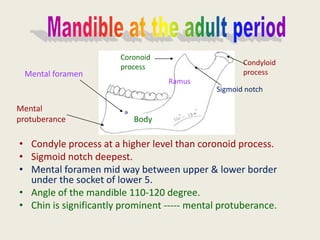
• Condyle process at a higher level than coronoid process.
• Sigmoid notch deepest.
• Mental foramen mid way between upper & lower border
under the socket of lower 5.
• Angle of the mandible 110-120 degree.
• Chin is significantly prominent ----- mental protuberance.
Condyloid
process
Coronoid
process
Sigmoid notch
Ramus
Body
Mental foramen
Mental
protuberance
• Condyloid process at a lower level than coronoid process
• Sigmoid notch is shallower.
• Mental foramen near the upper border of the mandibule.
• Mandibular canal near the upper border.
• Angle of the mandible 140 and the ramus inclined posterior.
• Body of the mandible has reduction in height due to loss of teeth and
alveolar process.
Condyloid process
Coronoid process
Mental foramen
Mental
protuberance
Mandibular canal
At birth
At childhood
At adult period
At old age
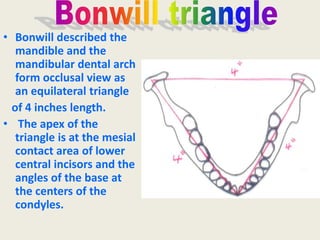
• Bonwill described the
mandible and the
mandibular dental arch
form occlusal view as
an equilateral triangle
of 4 inches length.
• The apex of the
triangle is at the mesial
contact area of lower
central incisors and the
angles of the base at
the centers of the
condyles.
1- These are the curved plane to which the teeth are
arranged in the dental arch.
2- They provide balance in all mandibular movement.
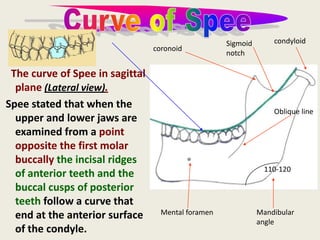
The curve of Spee in sagittal
plane (Lateral view).
Spee stated that when the
upper and lower jaws are
examined from a point
opposite the first molar
buccally the incisal ridges
of anterior teeth and the
buccal cusps of posterior
teeth follow a curve that
end at the anterior surface
of the condyle.
condyloid
coronoid
Sigmoid
notch
Oblique line
Mandibular
angle
Mental foramen
110-120
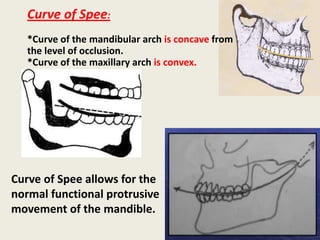
Curve of Spee allows for the
normal functional protrusive
movement of the mandible.
Curve of Spee:
*Curve of the mandibular arch is concave from
the level of occlusion.
*Curve of the maxillary arch is convex.
In coronal
Plane
(posterior view)
(transverse)
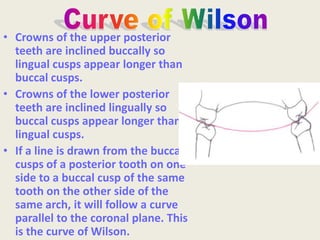
• Crowns of the upper posterior
teeth are inclined buccally so
lingual cusps appear longer than
buccal cusps.
• Crowns of the lower posterior
teeth are inclined lingually so
buccal cusps appear longer than
lingual cusps.
• If a line is drawn from the buccal
cusps of a posterior tooth on one
side to a buccal cusp of the same
tooth on the other side of the
same arch, it will follow a curve
parallel to the coronal plane. This
is the curve of Wilson.
Curve of Wilson
• The curve formed by an
imaginary line touching the
buccal and lingual cusp tips of
similar teeth on each side of the
mandibular arch.
• The inclination of the posterior
teeth increase in backward
direction so the curve of wilson
is more curved in backward
direction
• Typically, viewed in the frontal
plane (However, to improve
visibility, this image is viewed
from the posterior)
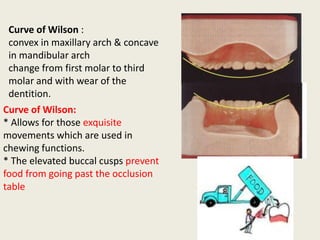
Curve of Wilson:
* Allows for those exquisite
movements which are used in
chewing functions.
* The elevated buccal cusps prevent
food from going past the occlusion
table
Curve of Wilson :
convex in maxillary arch & concave
in mandibular arch
change from first molar to third
molar and with wear of the
dentition.
What is the difference between the curve of Spee and the curve of Wilson?
The buccal cusp tips of posterior
teeth , seen in alignment from a
lateral view , conform to the curve
of Spee in an anterior to posterior
direction.
The curve of Wilson is a
transverse occlusal curve which
exists for posterior teeth in a
direction from right to left as
seen from a posterior view.
Curve of Spee:
Anteroposterior curvature
of the incisal &occlusal
surfaces
Buccal - Lingual Curvature.
For mastication. the Curve of Wilson.
Clinically, it relates to the anterior overbite:
the deeper the curve, the deeper the overbite.
4” radius
Curve of Monson: Curve of Monson is the curve of occlusion
in which each tooth cusp and incisal edge touches or conform
to a segment of a surface of a sphere 8 inches (20 cm) in
diameter, with its center in the region of the glabella.
• When teeth are properly aligned in the
dental arches, their incisal and occlusal
surfaces adapt themselves to curved
planes.
• The occlusal surfaces of the mandibular
teeth form a concave plane .Those of
maxillary teeth form a convex plane .In
centric occlusion these planes become
identical.
Monson stated that the curved occlusal surfaces of the
dental arches conform to a segment of a sphere of 4 inches
radius. The center of this sphere is in the glabella.
Curve of Monson is a combination of curve of Spee and
curve of Wilson.
The importance of these curved planes is to assist the path
of condyles of the mandible in its movement.
Sphere of Monson
It is a combination of Spee and Wilson curves , these curves are
studies in a three dimension occlusal model the cusps tips of posterior
teeth resting on a sphere. Sphere of Monson :sphere existed with a
radius of 4 inches
glabella
Center of Monson’s Sphere
( located in the gabella
above the condyles)
• The functional form of the crown at incisal and occlusal third, is
manifested by elevations and depressions. Elevations of the crown
in one dental arch occlude with depressions on the opposing teeth
during centric occlusion (self occluding design).
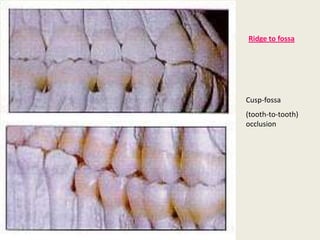
• Ridge to fossa : Incisal ridge of lower 1& 2 rest in the lingual fosse
• of upper 1& 2.
• Cusp to fossa: MLC of upper molars rest in central fossae of lower
• molars & DBC of lower molars rest in central fossae of
• upper molars.
• Cusp to ridge: BC of lower 4& 5 hits MMR of upper 4&5 in
centric occlusion.
• Cusp to sulcus: the triangular ridge of the MBC of upper molar are
• accommodated to the BG of the lower molars.
• Cusp to embrasure: the DBC of the maxillary molars lie in
the B. embrasure between lower molars.
• Escapement spaces : the rounded surfaces of teeth make
escapement of food during mastication.
Cusp-fossa
(tooth-to-tooth)
occlusion
Ridge to fossa
• It is the contact relation of upper and lower
teeth when they are in the maximum inter
cuspation and the condyles are in the most
retruded unstrained position in glenoid
fossa.
• The first permanent tooth to develop &
erupt.
• The largest of the permanent teeth.
• Their eruption is guided distal to the
deciduous teeth.
• Their eruption is not disturbed as they
have no deciduous predecessors.
• The upper 6 is more important as a key
of occlusion as it is attached to a fixed
bone (the maxilla).
6
6
1- each tooth contacts 2 teeth from the other arch except lower
1and upper 8.
2- All upper teeth overlap the lower teeth vertically and it called
overbite.
3- All upper teeth have a labial relation to the lower teeth in
centric occlusion and it called overjet.
• Guiding cusps:
cusps free of contact during centric occlusion (buccal
cusps of upper teeth & lingual cusps of lower).
• Supporting cusps:
cusps that occlude with fossae or marginal ridges of
opposing teeth in centric occlusion (palatal cusps of upper
teeth & buccal cusps of lower teeth).
• Centric stops:
points of occlusal contact made by supporting cusps
with opposing teeth in centric occlusion.
• Centric stops
• guiding cusps
• Supporting cusps
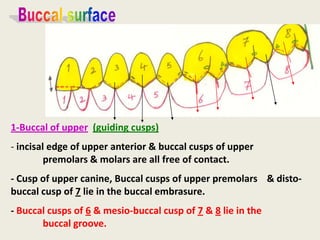
1-Buccal of upper (guiding cusps)
- incisal edge of upper anterior & buccal cusps of upper
premolars & molars are all free of contact.
- Cusp of upper canine, Buccal cusps of upper premolars & disto-
buccal cusp of 7 lie in the buccal embrasure.
- Buccal cusps of 6 & mesio-buccal cusp of 7 & 8 lie in the
buccal groove.
2- Buccal of lower: (supporting cusps)
-Buccal cusps of lower 4 & 5 hit the MMR of opposing teeth having
the same number.
- Mesio-buccal cusps of lower 6 & 7 hit the MMR of
upper teeth having the same number + the DMR of
the tooth before.
-Mesio-buccal cusp of lower 8 hits the mesial triangular fossa of the 8 .
- Disto- buccal cusps of lower molars hit the central fossae of upper
molars.
- distal cusp of lower 6 rest in the distal triangular fossa of 6.
MBC DBC
MBC
DBC
DBCMBC
D
C
(Guiding cusps):
- Cingulum of lower 2, 3 & lingual cusps of posterior teeth are free of
contact.
- Lingual cusps of lower premolars & mesio- lingual cusps of lower
molars lie lingual to the lingual embrasure.
- Disto-lingual cusps of lower molars lie lingual to the lingual
grooves of upper molars.
MLC
MLC
MLC
lingual surface (Supporting cusps):
- Lingual cusps of upper 4 & 5 hit the DMR of lower 4 & 5.
- In case of 3 cusp type lower 5 the lingual cusp of upper 5
contact the disto-occlusal cusp slope of the disto lingual
cusp.
- MLC of upper molars contact the central fossae of the lower
molars.
- DLC of upper 6 hits the MMR of lower 7.
- DLC of upper 7 & 8 hit the distal cusp ridge of lower 7 & DMR
of lower 8 respectively.
• Movements of the mandible:
*Bilaterally symmetrical *Bilaterally
asymmetrical
*Depression &Elevation. *Right lateral.
*Protrusion & Retrusion. *Left lateral.
• All mandibular movements start from and
terminate to centric occlusion.
1-The mandible is depressed.
2-Moves forward (Protrusive movement)
bring teeth together in the best position for incision
(the lower teeth are in anterior relation to centric
occlusion).
1- The mandible is depressed.
2- Retrusion of the mandible :
placement of the teeth posterior to centric
occlusion (non functioning occlusion).
3- Retrusive is limited by the compressibility of the
tissues posterior to the condyles.
*The mandible moves in downward and forward direction to
make lower anterior teeth in anterior relation to the upper
teeth.
* The functioning side is located at anterior teeth & balancing
side at posterior teeth.
* The incisal edge of lower teeth are in contact with lingual
third of upper teeth (working side)
*Posterior teeth in anterior relation of the lower teeth to
the upper teeth (balancing side)
Then the mandibule glides upward and backward
1-Tthe mandible is depressed (the dental arches
are free).
2-Moves to a right position to centric occlusion.
3-The right side is termed the working side
* The buccal cusp of maxillary & mandibular teeth
are in contact
*The lingual cusps of lower posterior teeth
contact the lingual cusps of upper posterior
teeth lingually.
4-The left side is termed the balancing side:
* The lingual cusps of maxillary teeth contact the
buccal cusps of mandibular teeth.
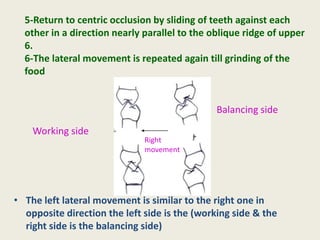
Right movement
Balancing side
Working side
• The left lateral movement is similar to the right one in
opposite direction the left side is the (working side & the
right side is the balancing side)
Working side
Balancing side
Right
movement
5-Return to centric occlusion by sliding of teeth against each
other in a direction nearly parallel to the oblique ridge of upper
6.
6-The lateral movement is repeated again till grinding of the
food
The cycle of occlusal movement
Initial occlusal
contact in right
lateral occlusal
relation
Centric
occlusion
relation
Final contact after leaving
centric relation before the
mandible drops away to
begin another cycle
• The lower anterior teeth strike the
upper anterior teeth lingually above
their incisal ridges.
• Upper A: lower A&m1/3 of lower B.
• Upper B: d 2/3 of lower B and
mesial part of lower C
(mesial to its cusp tip).
• Upper C: d part of lower C (distal
to cusp tip) and m part of
lower D.
• Upper D: d 2/3 of lower D and m
part of lower E.
• At the age of 4&5 years diastema due to
jaw growth and increase with further
growth.
• Occlusion is supported by eruption of
permanent first molar at 6 years.
Mandible at Different Ages - Dentition

Mandible at Different Ages - Dentition

  • 3.
  • 4.
    • Condyle processat the level of the upper border of mandible. • Coronoid process at higher level than condyloid. • Mental foramen near the lower border under the crypt of D • Mandibular canal near lower border • Sigmoid notch is shallow • Mandible two half till the end of the first year. • Angle of the mandible 170 degree. Symphyseal cartilage(Symphysis of mandibule +mental ossicals) 2parts fuse at 1 year Mental foramen Mandibular canal Condyloid cartilage: 14WIUL-20Y give condyle+ posterior part of the ramus Coronoid cartilage : 14WIU---6MIU give coronoid process + anterior part of the ramus
  • 5.
    • Coronoid processhigher than condyloid process. • Mental foramen midway between upper& lower border. • Mandibular canal slightly above mylohyoid line. • Sigmoid notch more deeper. • Angle of the mandible 140 degree. • Chin is poorly developed. Increase in length by bone remodeling make room for permanent molars Increase in height by eruption of teeth +alveolar bone formation+ bone deposition at lower border of the mandible Growth Condyle cartilage Alveolar bone Posterior border of ramus Increase in length of ramus Increase in height Increase in length
  • 6.
    • Condyle processat a higher level than coronoid process. • Sigmoid notch deepest. • Mental foramen mid way between upper & lower border under the socket of lower 5. • Angle of the mandible 110-120 degree. • Chin is significantly prominent ----- mental protuberance. Condyloid process Coronoid process Sigmoid notch Ramus Body Mental foramen Mental protuberance
  • 7.
    • Condyloid processat a lower level than coronoid process • Sigmoid notch is shallower. • Mental foramen near the upper border of the mandibule. • Mandibular canal near the upper border. • Angle of the mandible 140 and the ramus inclined posterior. • Body of the mandible has reduction in height due to loss of teeth and alveolar process. Condyloid process Coronoid process Mental foramen Mental protuberance Mandibular canal
  • 8.
    At birth At childhood Atadult period At old age
  • 9.
    • Bonwill describedthe mandible and the mandibular dental arch form occlusal view as an equilateral triangle of 4 inches length. • The apex of the triangle is at the mesial contact area of lower central incisors and the angles of the base at the centers of the condyles.
  • 10.
    1- These arethe curved plane to which the teeth are arranged in the dental arch. 2- They provide balance in all mandibular movement.
  • 12.
    The curve ofSpee in sagittal plane (Lateral view). Spee stated that when the upper and lower jaws are examined from a point opposite the first molar buccally the incisal ridges of anterior teeth and the buccal cusps of posterior teeth follow a curve that end at the anterior surface of the condyle. condyloid coronoid Sigmoid notch Oblique line Mandibular angle Mental foramen 110-120
  • 13.
    Curve of Speeallows for the normal functional protrusive movement of the mandible. Curve of Spee: *Curve of the mandibular arch is concave from the level of occlusion. *Curve of the maxillary arch is convex.
  • 14.
  • 15.
    • Crowns ofthe upper posterior teeth are inclined buccally so lingual cusps appear longer than buccal cusps. • Crowns of the lower posterior teeth are inclined lingually so buccal cusps appear longer than lingual cusps. • If a line is drawn from the buccal cusps of a posterior tooth on one side to a buccal cusp of the same tooth on the other side of the same arch, it will follow a curve parallel to the coronal plane. This is the curve of Wilson.
  • 16.
    Curve of Wilson •The curve formed by an imaginary line touching the buccal and lingual cusp tips of similar teeth on each side of the mandibular arch. • The inclination of the posterior teeth increase in backward direction so the curve of wilson is more curved in backward direction • Typically, viewed in the frontal plane (However, to improve visibility, this image is viewed from the posterior)
  • 17.
    Curve of Wilson: *Allows for those exquisite movements which are used in chewing functions. * The elevated buccal cusps prevent food from going past the occlusion table Curve of Wilson : convex in maxillary arch & concave in mandibular arch change from first molar to third molar and with wear of the dentition.
  • 18.
    What is thedifference between the curve of Spee and the curve of Wilson? The buccal cusp tips of posterior teeth , seen in alignment from a lateral view , conform to the curve of Spee in an anterior to posterior direction. The curve of Wilson is a transverse occlusal curve which exists for posterior teeth in a direction from right to left as seen from a posterior view. Curve of Spee: Anteroposterior curvature of the incisal &occlusal surfaces Buccal - Lingual Curvature. For mastication. the Curve of Wilson. Clinically, it relates to the anterior overbite: the deeper the curve, the deeper the overbite. 4” radius
  • 19.
    Curve of Monson:Curve of Monson is the curve of occlusion in which each tooth cusp and incisal edge touches or conform to a segment of a surface of a sphere 8 inches (20 cm) in diameter, with its center in the region of the glabella.
  • 20.
    • When teethare properly aligned in the dental arches, their incisal and occlusal surfaces adapt themselves to curved planes. • The occlusal surfaces of the mandibular teeth form a concave plane .Those of maxillary teeth form a convex plane .In centric occlusion these planes become identical. Monson stated that the curved occlusal surfaces of the dental arches conform to a segment of a sphere of 4 inches radius. The center of this sphere is in the glabella. Curve of Monson is a combination of curve of Spee and curve of Wilson. The importance of these curved planes is to assist the path of condyles of the mandible in its movement.
  • 21.
    Sphere of Monson Itis a combination of Spee and Wilson curves , these curves are studies in a three dimension occlusal model the cusps tips of posterior teeth resting on a sphere. Sphere of Monson :sphere existed with a radius of 4 inches glabella Center of Monson’s Sphere ( located in the gabella above the condyles)
  • 22.
    • The functionalform of the crown at incisal and occlusal third, is manifested by elevations and depressions. Elevations of the crown in one dental arch occlude with depressions on the opposing teeth during centric occlusion (self occluding design). • Ridge to fossa : Incisal ridge of lower 1& 2 rest in the lingual fosse • of upper 1& 2. • Cusp to fossa: MLC of upper molars rest in central fossae of lower • molars & DBC of lower molars rest in central fossae of • upper molars. • Cusp to ridge: BC of lower 4& 5 hits MMR of upper 4&5 in centric occlusion. • Cusp to sulcus: the triangular ridge of the MBC of upper molar are • accommodated to the BG of the lower molars. • Cusp to embrasure: the DBC of the maxillary molars lie in the B. embrasure between lower molars. • Escapement spaces : the rounded surfaces of teeth make escapement of food during mastication.
  • 23.
  • 24.
    • It isthe contact relation of upper and lower teeth when they are in the maximum inter cuspation and the condyles are in the most retruded unstrained position in glenoid fossa.
  • 25.
    • The firstpermanent tooth to develop & erupt. • The largest of the permanent teeth. • Their eruption is guided distal to the deciduous teeth. • Their eruption is not disturbed as they have no deciduous predecessors. • The upper 6 is more important as a key of occlusion as it is attached to a fixed bone (the maxilla). 6 6
  • 26.
    1- each toothcontacts 2 teeth from the other arch except lower 1and upper 8. 2- All upper teeth overlap the lower teeth vertically and it called overbite. 3- All upper teeth have a labial relation to the lower teeth in centric occlusion and it called overjet.
  • 27.
    • Guiding cusps: cuspsfree of contact during centric occlusion (buccal cusps of upper teeth & lingual cusps of lower). • Supporting cusps: cusps that occlude with fossae or marginal ridges of opposing teeth in centric occlusion (palatal cusps of upper teeth & buccal cusps of lower teeth). • Centric stops: points of occlusal contact made by supporting cusps with opposing teeth in centric occlusion.
  • 28.
    • Centric stops •guiding cusps • Supporting cusps
  • 29.
    1-Buccal of upper(guiding cusps) - incisal edge of upper anterior & buccal cusps of upper premolars & molars are all free of contact. - Cusp of upper canine, Buccal cusps of upper premolars & disto- buccal cusp of 7 lie in the buccal embrasure. - Buccal cusps of 6 & mesio-buccal cusp of 7 & 8 lie in the buccal groove.
  • 30.
    2- Buccal oflower: (supporting cusps) -Buccal cusps of lower 4 & 5 hit the MMR of opposing teeth having the same number. - Mesio-buccal cusps of lower 6 & 7 hit the MMR of upper teeth having the same number + the DMR of the tooth before. -Mesio-buccal cusp of lower 8 hits the mesial triangular fossa of the 8 . - Disto- buccal cusps of lower molars hit the central fossae of upper molars. - distal cusp of lower 6 rest in the distal triangular fossa of 6. MBC DBC MBC DBC DBCMBC D C
  • 31.
    (Guiding cusps): - Cingulumof lower 2, 3 & lingual cusps of posterior teeth are free of contact. - Lingual cusps of lower premolars & mesio- lingual cusps of lower molars lie lingual to the lingual embrasure. - Disto-lingual cusps of lower molars lie lingual to the lingual grooves of upper molars. MLC MLC MLC
  • 32.
    lingual surface (Supportingcusps): - Lingual cusps of upper 4 & 5 hit the DMR of lower 4 & 5. - In case of 3 cusp type lower 5 the lingual cusp of upper 5 contact the disto-occlusal cusp slope of the disto lingual cusp. - MLC of upper molars contact the central fossae of the lower molars. - DLC of upper 6 hits the MMR of lower 7. - DLC of upper 7 & 8 hit the distal cusp ridge of lower 7 & DMR of lower 8 respectively.
  • 33.
    • Movements ofthe mandible: *Bilaterally symmetrical *Bilaterally asymmetrical *Depression &Elevation. *Right lateral. *Protrusion & Retrusion. *Left lateral. • All mandibular movements start from and terminate to centric occlusion.
  • 34.
    1-The mandible isdepressed. 2-Moves forward (Protrusive movement) bring teeth together in the best position for incision (the lower teeth are in anterior relation to centric occlusion).
  • 35.
    1- The mandibleis depressed. 2- Retrusion of the mandible : placement of the teeth posterior to centric occlusion (non functioning occlusion). 3- Retrusive is limited by the compressibility of the tissues posterior to the condyles.
  • 36.
    *The mandible movesin downward and forward direction to make lower anterior teeth in anterior relation to the upper teeth. * The functioning side is located at anterior teeth & balancing side at posterior teeth. * The incisal edge of lower teeth are in contact with lingual third of upper teeth (working side) *Posterior teeth in anterior relation of the lower teeth to the upper teeth (balancing side) Then the mandibule glides upward and backward
  • 37.
    1-Tthe mandible isdepressed (the dental arches are free). 2-Moves to a right position to centric occlusion. 3-The right side is termed the working side * The buccal cusp of maxillary & mandibular teeth are in contact *The lingual cusps of lower posterior teeth contact the lingual cusps of upper posterior teeth lingually. 4-The left side is termed the balancing side: * The lingual cusps of maxillary teeth contact the buccal cusps of mandibular teeth. Right movement Balancing side Working side
  • 38.
    • The leftlateral movement is similar to the right one in opposite direction the left side is the (working side & the right side is the balancing side) Working side Balancing side Right movement 5-Return to centric occlusion by sliding of teeth against each other in a direction nearly parallel to the oblique ridge of upper 6. 6-The lateral movement is repeated again till grinding of the food
  • 39.
    The cycle ofocclusal movement Initial occlusal contact in right lateral occlusal relation Centric occlusion relation Final contact after leaving centric relation before the mandible drops away to begin another cycle
  • 40.
    • The loweranterior teeth strike the upper anterior teeth lingually above their incisal ridges. • Upper A: lower A&m1/3 of lower B. • Upper B: d 2/3 of lower B and mesial part of lower C (mesial to its cusp tip). • Upper C: d part of lower C (distal to cusp tip) and m part of lower D. • Upper D: d 2/3 of lower D and m part of lower E. • At the age of 4&5 years diastema due to jaw growth and increase with further growth. • Occlusion is supported by eruption of permanent first molar at 6 years.