Lesson 7:
Parallel and
Series Circuits
Learning Goals
We will be learning to…
Success Criteria
By the end of this class, I will be able to…
Series
Circuit
01
You can enter a subtitle here if you need it
Series Circuits
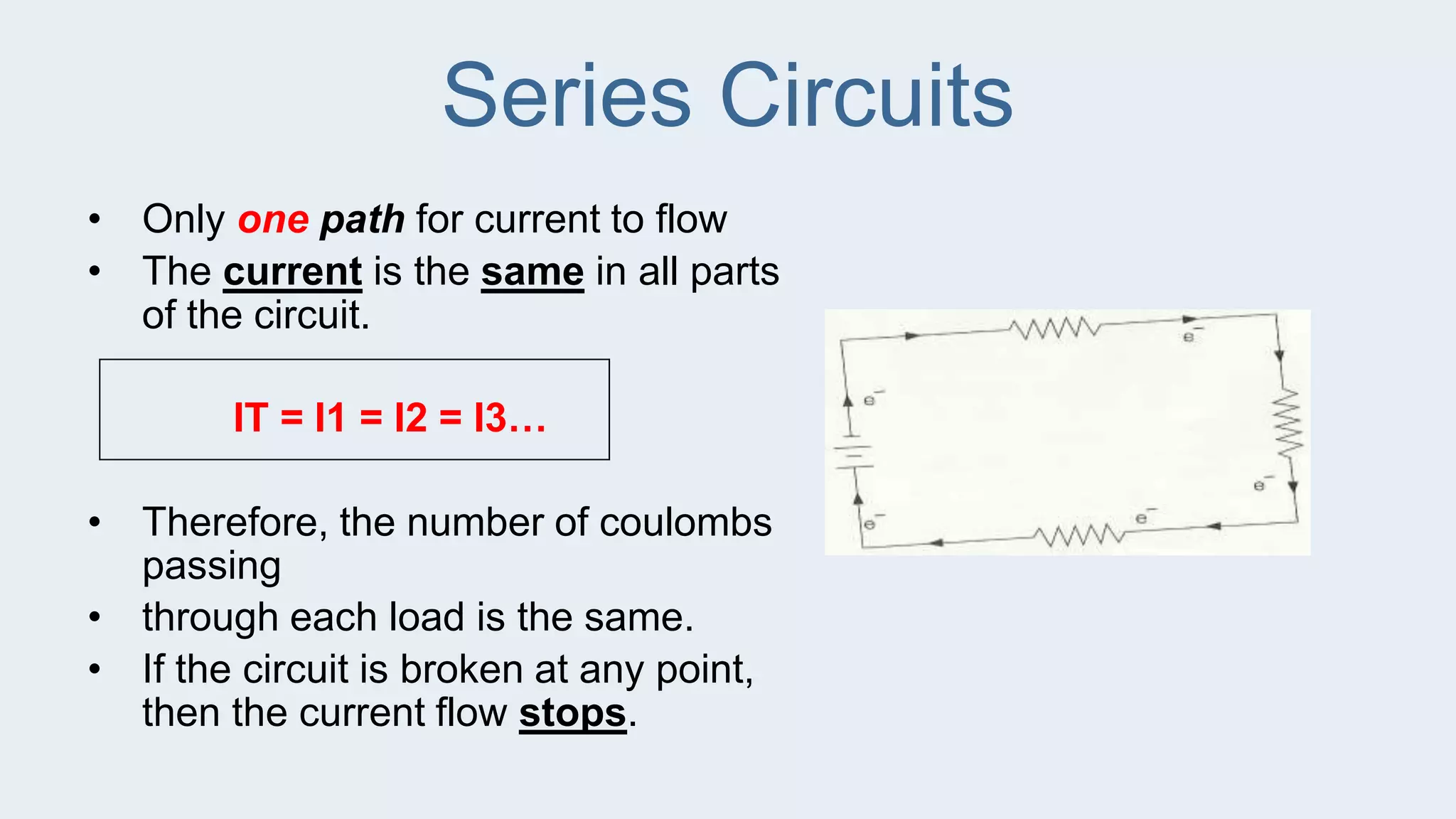
• Only one path for current to flow
• The current is the same in all parts
of the circuit.
IT = I1 = I2 = I3…
• Therefore, the number of coulombs
passing
• through each load is the same.
• If the circuit is broken at any point,
then the current flow stops.
Series Circuits
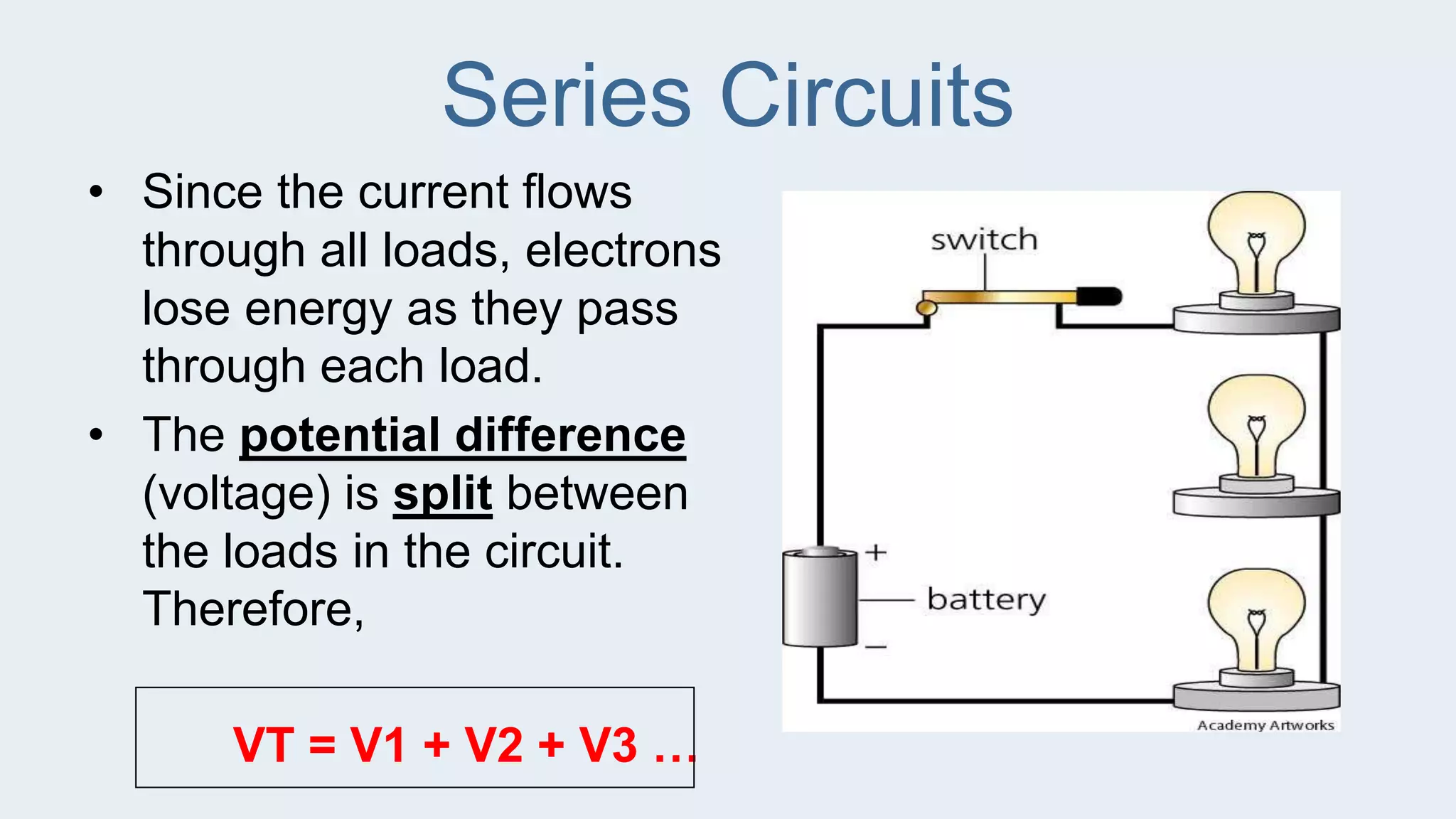
• Since the current flows
through all loads, electrons
lose energy as they pass
through each load.
• The potential difference
(voltage) is split between
the loads in the circuit.
Therefore,
VT = V1 + V2 + V3 …
Series Circuit
• The resistance increases with each load.
RT = R1 + R2 + R3 …
• The power increases with each load
PT = P1 + P2 + P3 …
(same as in parallel)
Parallel
Circuit
02
You can enter a subtitle here if you need it
Parallel Circuits
• There is more than one path for the current to flow through
• Current is NOT the same at different points. The current (the
electrons) is shared by as many paths as there exist.
• Current flowing from the energy source equals the sum of all the
separate branch currents in the circuits.
IT = I1 + I2 + I3 …
• I, in each path, depends on the size of the resistor.
• The more resistors, there are in the circuit, the more “pull” for
energy and the greater the current.*
Parallel Circuit
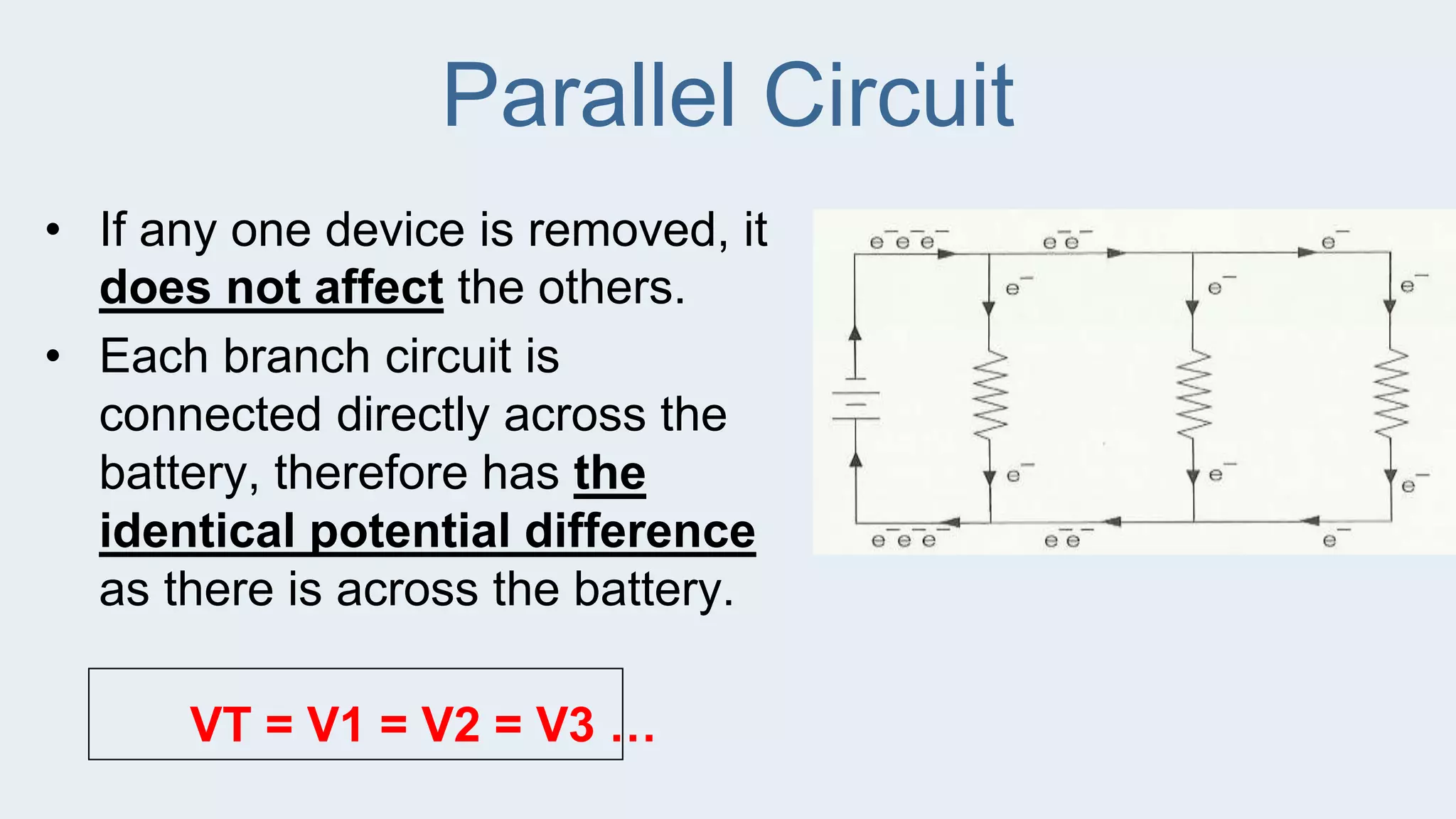
• If any one device is removed, it
does not affect the others.
• Each branch circuit is
connected directly across the
battery, therefore has the
identical potential difference
as there is across the battery.
VT = V1 = V2 = V3 …
Parallel Circuit
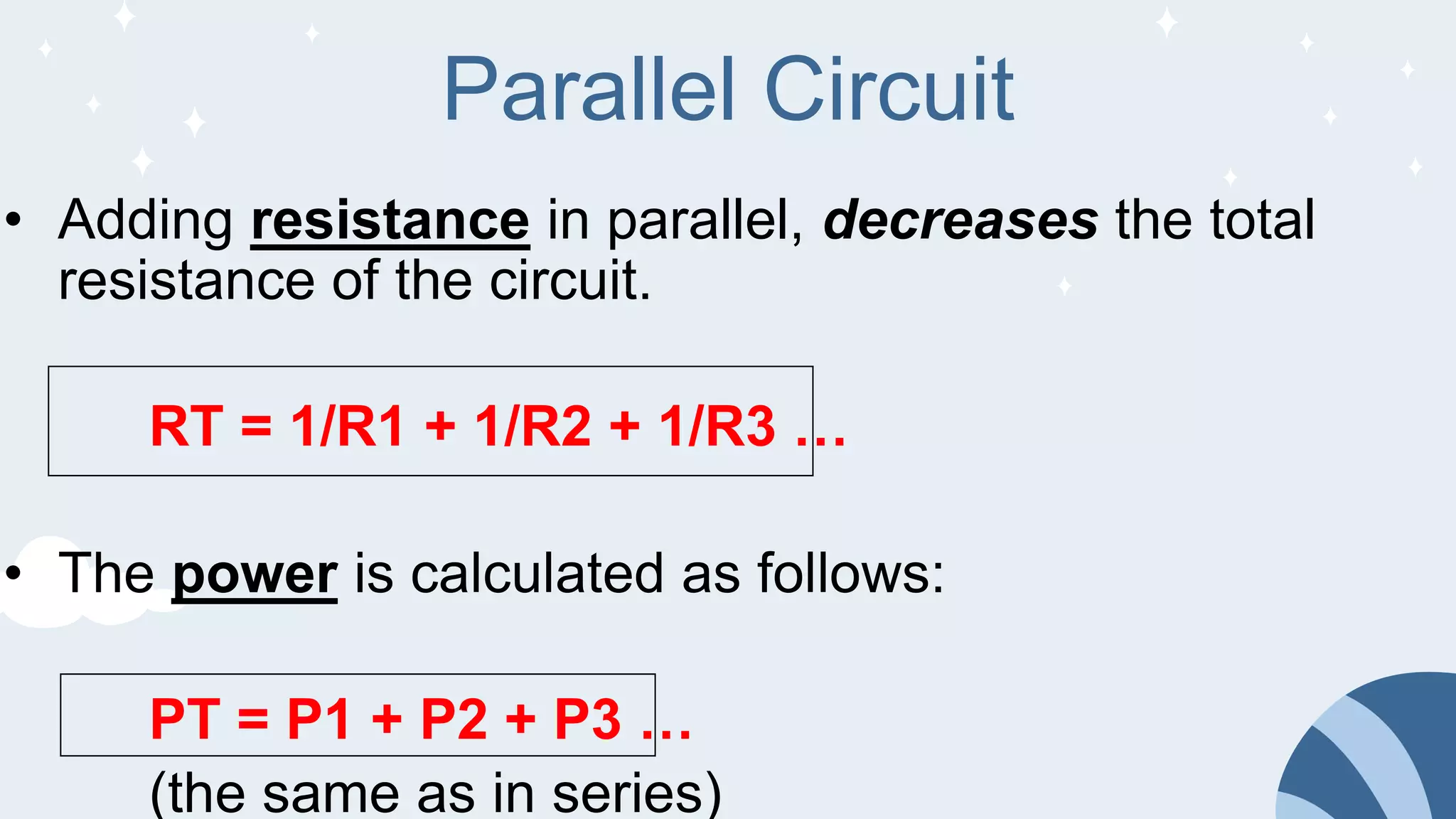
• Adding resistance in parallel, decreases the total
resistance of the circuit.
RT = 1/R1 + 1/R2 + 1/R3 …
• The power is calculated as follows:
PT = P1 + P2 + P3 …
(the same as in series)
Electricity in
the home
03
Two Types of Current
●Direct current – electrons always travel in one direction as in batteries and cells.
●Alternating current – electrons go back and forth rapidly sixty times per second.
●This allows for efficient distribution of high voltage electricity via transformers
that increase (step up) or decrease (step down) the potential difference of power
lines as it gets closer to your home or school
Fun Fact
● Do you know who invented
alternating current?
● Nikola Tesla
Electricity in the home
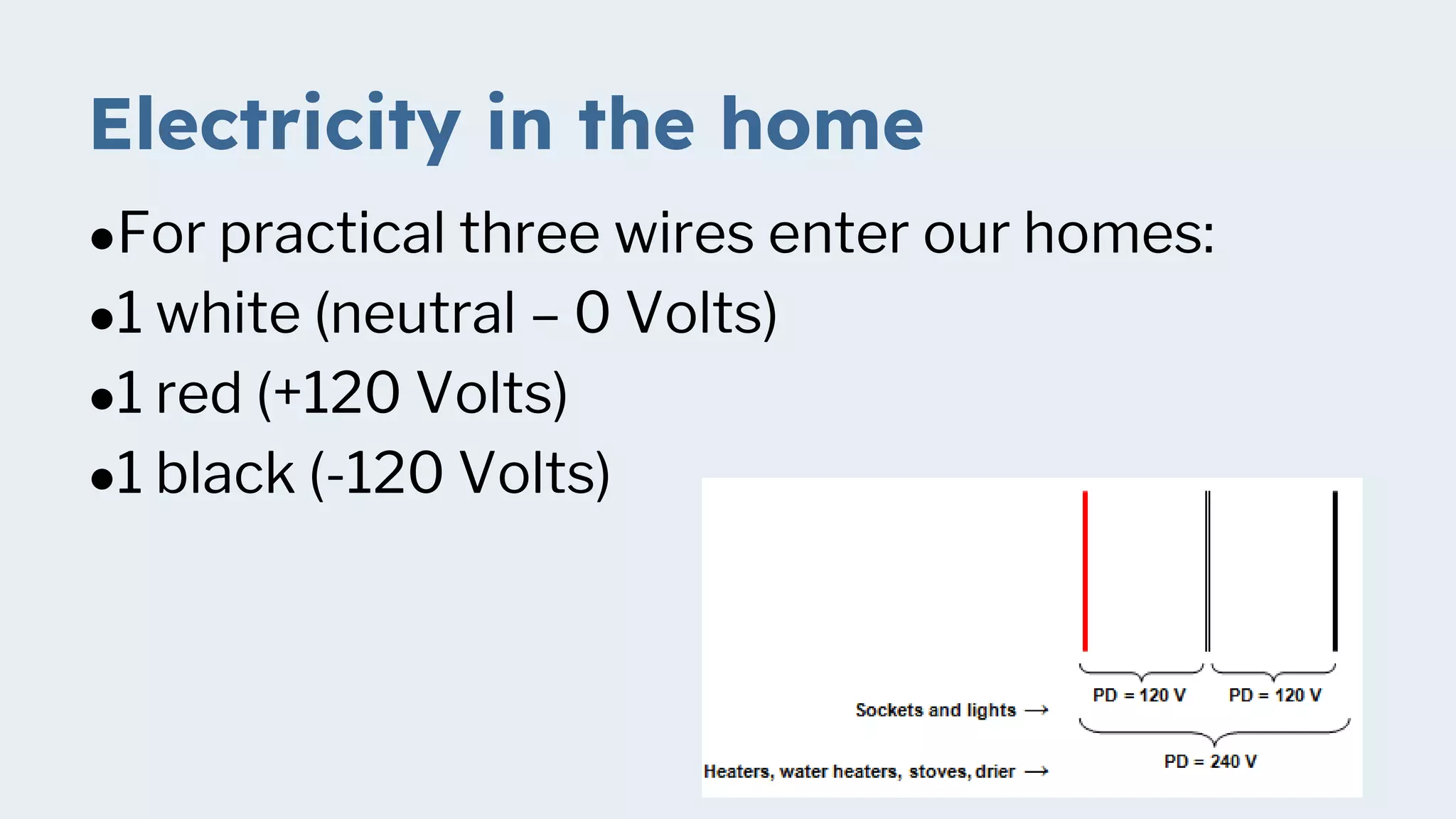
●For practical three wires enter our homes:
●1 white (neutral – 0 Volts)
●1 red (+120 Volts)
●1 black (-120 Volts)
Electricity in the home
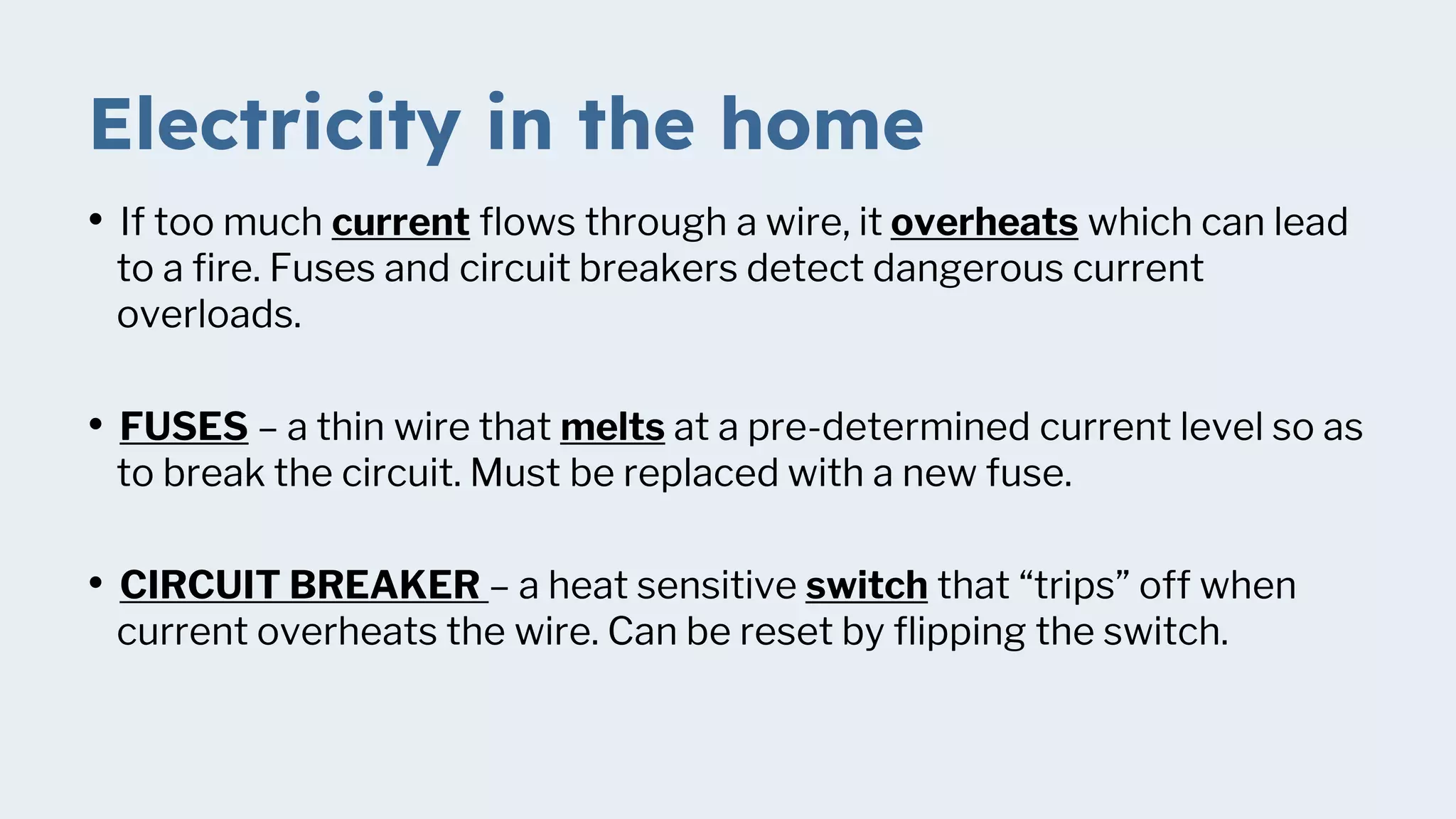
• If too much current flows through a wire, it overheats which can lead
to a fire. Fuses and circuit breakers detect dangerous current
overloads.
• FUSES – a thin wire that melts at a pre-determined current level so as
to break the circuit. Must be replaced with a new fuse.
• CIRCUIT BREAKER – a heat sensitive switch that “trips” off when
current overheats the wire. Can be reset by flipping the switch.
Electricity in the home
• In your home, a digital or dial meter reads the electric
current used in kilowatt-hours
(1 kW•h = 1000 watt hours).
Measurements
●WHAT’S A JOULE?? A JOULE (J) is the unit for ENERGY
●WHAT’S A WATT?? A WATT (W) is the unit for power - a kilowatt (kW) is one
thousand watts
( 1.0 kW = 1000 W)
●POWER POWER MEASURES “HOW FAST” YOU USE ENERGY – THE
EQUATION FOR POWER IS
OR
Unit of energy
●THE kWh as a UNIT OF ENERGY ( hint: get “E” by itself in the power equation)
Find the total cost of this sample
electricity bill and answer the
questions

Parallel and Series Circuits.pptx

  • 1.
  • 2.
    Learning Goals We willbe learning to…
  • 3.
    Success Criteria By theend of this class, I will be able to…
  • 4.
    Series Circuit 01 You can entera subtitle here if you need it
  • 5.
    Series Circuits • Onlyone path for current to flow • The current is the same in all parts of the circuit. IT = I1 = I2 = I3… • Therefore, the number of coulombs passing • through each load is the same. • If the circuit is broken at any point, then the current flow stops.
  • 6.
    Series Circuits • Sincethe current flows through all loads, electrons lose energy as they pass through each load. • The potential difference (voltage) is split between the loads in the circuit. Therefore, VT = V1 + V2 + V3 …
  • 7.
    Series Circuit • Theresistance increases with each load. RT = R1 + R2 + R3 … • The power increases with each load PT = P1 + P2 + P3 … (same as in parallel)
  • 8.
    Parallel Circuit 02 You can entera subtitle here if you need it
  • 9.
    Parallel Circuits • Thereis more than one path for the current to flow through • Current is NOT the same at different points. The current (the electrons) is shared by as many paths as there exist. • Current flowing from the energy source equals the sum of all the separate branch currents in the circuits. IT = I1 + I2 + I3 … • I, in each path, depends on the size of the resistor. • The more resistors, there are in the circuit, the more “pull” for energy and the greater the current.*
  • 10.
    Parallel Circuit • Ifany one device is removed, it does not affect the others. • Each branch circuit is connected directly across the battery, therefore has the identical potential difference as there is across the battery. VT = V1 = V2 = V3 …
  • 11.
    Parallel Circuit • Addingresistance in parallel, decreases the total resistance of the circuit. RT = 1/R1 + 1/R2 + 1/R3 … • The power is calculated as follows: PT = P1 + P2 + P3 … (the same as in series)
  • 12.
  • 13.
    Two Types ofCurrent ●Direct current – electrons always travel in one direction as in batteries and cells. ●Alternating current – electrons go back and forth rapidly sixty times per second. ●This allows for efficient distribution of high voltage electricity via transformers that increase (step up) or decrease (step down) the potential difference of power lines as it gets closer to your home or school
  • 14.
    Fun Fact ● Doyou know who invented alternating current? ● Nikola Tesla
  • 15.
    Electricity in thehome ●For practical three wires enter our homes: ●1 white (neutral – 0 Volts) ●1 red (+120 Volts) ●1 black (-120 Volts)
  • 16.
    Electricity in thehome • If too much current flows through a wire, it overheats which can lead to a fire. Fuses and circuit breakers detect dangerous current overloads. • FUSES – a thin wire that melts at a pre-determined current level so as to break the circuit. Must be replaced with a new fuse. • CIRCUIT BREAKER – a heat sensitive switch that “trips” off when current overheats the wire. Can be reset by flipping the switch.
  • 17.
    Electricity in thehome • In your home, a digital or dial meter reads the electric current used in kilowatt-hours (1 kW•h = 1000 watt hours).
  • 18.
    Measurements ●WHAT’S A JOULE??A JOULE (J) is the unit for ENERGY ●WHAT’S A WATT?? A WATT (W) is the unit for power - a kilowatt (kW) is one thousand watts ( 1.0 kW = 1000 W) ●POWER POWER MEASURES “HOW FAST” YOU USE ENERGY – THE EQUATION FOR POWER IS OR
  • 19.
    Unit of energy ●THEkWh as a UNIT OF ENERGY ( hint: get “E” by itself in the power equation)
  • 20.
    Find the totalcost of this sample electricity bill and answer the questions