CIRCUITS
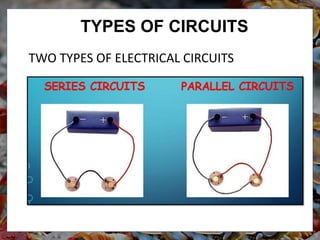
TWO TYPES OF ELECTRICAL CIRCUITS
TYPES OF CIRCUITS
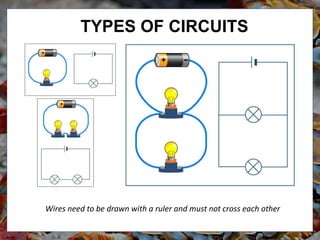
Wires need to be drawn with a ruler and must not cross each other
TYPES OF CIRCUITS
•The components are connected end-to-end, one after
the other.
•They make a simple loop for the current to flow round.
•If one bulb ‘blows’ it breaks the whole circuit and all
the bulbs go out.
SERIES CIRCUITS
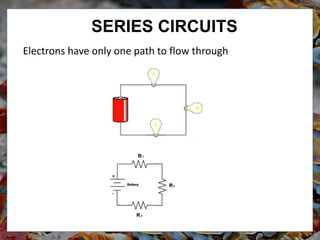
Electrons have only one path to flow through
SERIES CIRCUITS
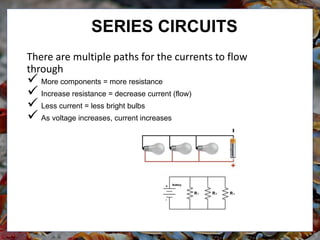
There are multiple paths for the currents to flow
through
 More components = more resistance
 Increase resistance = decrease current (flow)
 Less current = less bright bulbs
 As voltage increases, current increases
SERIES CIRCUITS
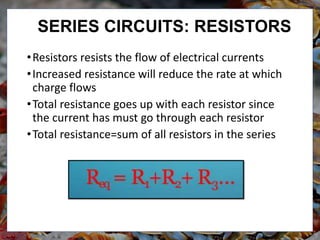
•Resistors resists the flow of electrical currents
•Increased resistance will reduce the rate at which
charge flows
•Total resistance goes up with each resistor since
the current has must go through each resistor
•Total resistance=sum of all resistors in the series
SERIES CIRCUITS: RESISTORS
SERIES CIRCUITS: CURRENTS
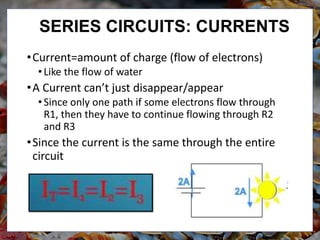
•Current=amount of charge (flow of electrons)
• Like the flow of water
•A Current can’t just disappear/appear
• Since only one path if some electrons flow through
R1, then they have to continue flowing through R2
and R3
•Since the current is the same through the entire
circuit
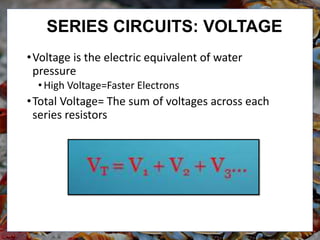
SERIES CIRCUITS: VOLTAGE
•Voltage is the electric equivalent of water
pressure
•High Voltage=Faster Electrons
•Total Voltage= The sum of voltages across each
series resistors
PARALLEL CIRCUITS
•Most things are wired in parallel
•The more you plug in, the intensity
doesn’t decrease
•Increases the risk of fire
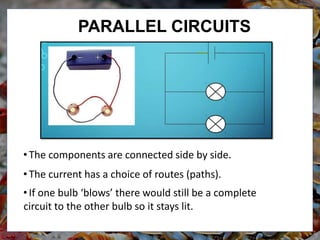
• The components are connected side by side.
• The current has a choice of routes (paths).
• If one bulb ‘blows’ there would still be a complete
circuit to the other bulb so it stays lit.
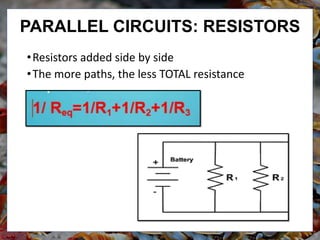
PARALLEL CIRCUITS
•Resistors added side by side
•The more paths, the less TOTAL resistance
PARALLEL CIRCUITS: RESISTORS
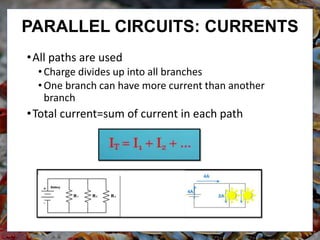
•All paths are used
• Charge divides up into all branches
•One branch can have more current than another
branch
•Total current=sum of current in each path
PARALLEL CIRCUITS: CURRENTS
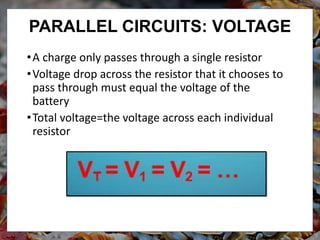
•A charge only passes through a single resistor
•Voltage drop across the resistor that it chooses to
pass through must equal the voltage of the
battery
•Total voltage=the voltage across each individual
resistor
PARALLEL CIRCUITS: VOLTAGE
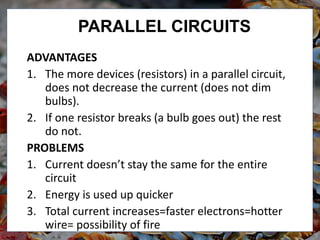
PARALLEL CIRCUITS
ADVANTAGES
1. The more devices (resistors) in a parallel circuit,
does not decrease the current (does not dim
bulbs).
2. If one resistor breaks (a bulb goes out) the rest
do not.
PROBLEMS
1. Current doesn’t stay the same for the entire
circuit
2. Energy is used up quicker
3. Total current increases=faster electrons=hotter
wire= possibility of fire
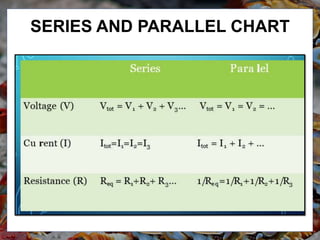
SERIES AND PARALLEL CHART
TWO TYPES OF CURRENTS
•Direct Current
•Solar cells and batteries
•Current only flows in one direction
•Alternating Current
•Current flows back and forth (alternates)
•Found in homes
•Generators

Circuits.ppt

  • 1.
  • 2.
    TWO TYPES OFELECTRICAL CIRCUITS TYPES OF CIRCUITS
  • 3.
    Wires need tobe drawn with a ruler and must not cross each other TYPES OF CIRCUITS
  • 4.
    •The components areconnected end-to-end, one after the other. •They make a simple loop for the current to flow round. •If one bulb ‘blows’ it breaks the whole circuit and all the bulbs go out. SERIES CIRCUITS
  • 5.
    Electrons have onlyone path to flow through SERIES CIRCUITS
  • 6.
    There are multiplepaths for the currents to flow through  More components = more resistance  Increase resistance = decrease current (flow)  Less current = less bright bulbs  As voltage increases, current increases SERIES CIRCUITS
  • 7.
    •Resistors resists theflow of electrical currents •Increased resistance will reduce the rate at which charge flows •Total resistance goes up with each resistor since the current has must go through each resistor •Total resistance=sum of all resistors in the series SERIES CIRCUITS: RESISTORS
  • 8.
    SERIES CIRCUITS: CURRENTS •Current=amountof charge (flow of electrons) • Like the flow of water •A Current can’t just disappear/appear • Since only one path if some electrons flow through R1, then they have to continue flowing through R2 and R3 •Since the current is the same through the entire circuit
  • 9.
    SERIES CIRCUITS: VOLTAGE •Voltageis the electric equivalent of water pressure •High Voltage=Faster Electrons •Total Voltage= The sum of voltages across each series resistors
  • 10.
    PARALLEL CIRCUITS •Most thingsare wired in parallel •The more you plug in, the intensity doesn’t decrease •Increases the risk of fire
  • 11.
    • The componentsare connected side by side. • The current has a choice of routes (paths). • If one bulb ‘blows’ there would still be a complete circuit to the other bulb so it stays lit. PARALLEL CIRCUITS
  • 12.
    •Resistors added sideby side •The more paths, the less TOTAL resistance PARALLEL CIRCUITS: RESISTORS
  • 13.
    •All paths areused • Charge divides up into all branches •One branch can have more current than another branch •Total current=sum of current in each path PARALLEL CIRCUITS: CURRENTS
  • 14.
    •A charge onlypasses through a single resistor •Voltage drop across the resistor that it chooses to pass through must equal the voltage of the battery •Total voltage=the voltage across each individual resistor PARALLEL CIRCUITS: VOLTAGE
  • 15.
    PARALLEL CIRCUITS ADVANTAGES 1. Themore devices (resistors) in a parallel circuit, does not decrease the current (does not dim bulbs). 2. If one resistor breaks (a bulb goes out) the rest do not. PROBLEMS 1. Current doesn’t stay the same for the entire circuit 2. Energy is used up quicker 3. Total current increases=faster electrons=hotter wire= possibility of fire
  • 16.
  • 17.
    TWO TYPES OFCURRENTS •Direct Current •Solar cells and batteries •Current only flows in one direction •Alternating Current •Current flows back and forth (alternates) •Found in homes •Generators