Chapter 17 D.C Electric Circuit Part 1 – Resistance in Series & Parallel Circuits
At the end of the lesson, you should  be able to: Calculate the combined resistance of two or more resistors in series. Calculate the combined resistance of two or three resistors in parallel. Learning Objectives
Electric circuits can be classified into two categories:  Electric Circuits Series Circuits Parallel Circuits
Electric Circuit Resistors Arrangement
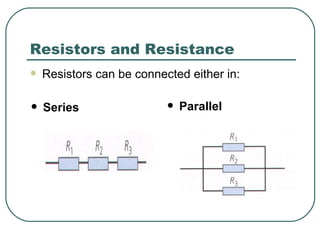
Resistors and Resistance Series Parallel Resistors can be connected either in:
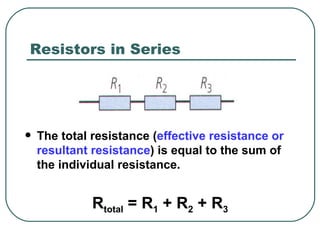
Resistors in Series The total resistance ( effective resistance or resultant resistance ) is equal to the sum of the individual resistance. R total  = R 1  + R 2  + R 3
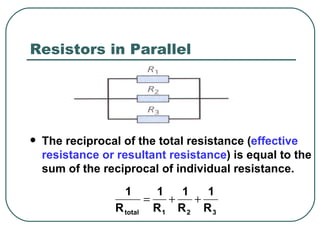
Resistors in Parallel The reciprocal of the total resistance ( effective resistance or resultant resistance ) is equal to the sum of the reciprocal of individual resistance.
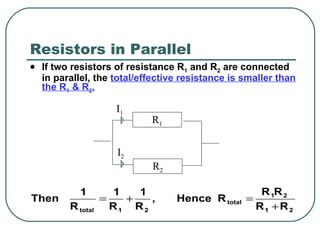
Resistors in Parallel If two resistors of resistance R 1  and R 2  are connected in parallel, the  total/effective resistance is smaller than the R 1  & R 2 . R 2 R 1 I 1 I 2
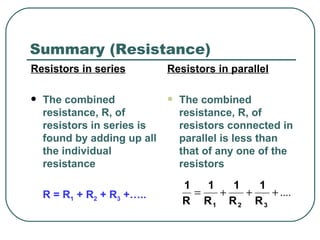
Summary (Resistance) Resistors in series The combined resistance, R, of resistors in series is found by adding up all the individual resistance R = R 1  + R 2  + R 3  +….. Resistors in parallel The combined resistance, R, of resistors connected in parallel is less than that of any one of the resistors
Chapter 17: D.C Circuit Part 2 :  Current in Series  & Parallel Circuits
At the end of the lesson, you should be able to: Show understanding that current at every point in the series circuit is the same. use the fact that the current from the source is the sum of the currents in the separate branches of a parallel circuit. Learning Objectives
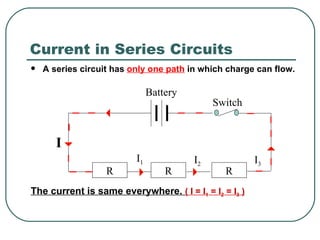
A series circuit has  only one path  in which charge can flow. The current is same everywhere.  ( I = I 1  = I 2  = I 3  ) Current in Series Circuits R R R Battery Switch I I 1 I 2 I 3
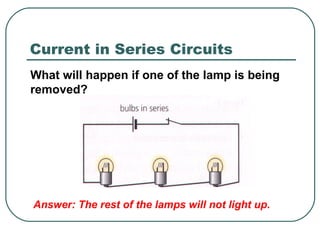
What will happen if one of the lamp is being removed? Current in Series Circuits Answer: The rest of the lamps will not light up.
What about the lighting circuits in your house, do you think they are connected in series? Pause and Think …  What will happen if they are connected in series? How then do you think the lights should be connected? WHY?
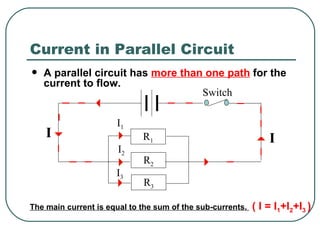
Current in Parallel Circuit A parallel circuit has  more than one path  for the current to flow. R 1 R 2 R 3 Switch I I 1 I 2 I 3 I The main current is equal to the sum of the sub-currents.  ( I = I 1 +I 2 +I 3  )
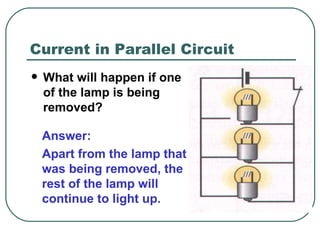
Current in Parallel Circuit What will happen if one of the lamp is being removed? Answer:  Apart from the lamp that was being removed, the rest of the lamp will continue to light up.
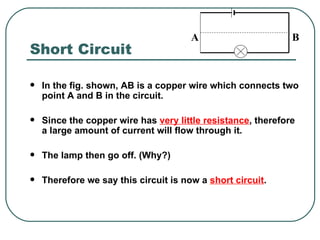
Short Circuit In the fig. shown, AB is a copper wire which connects two point A and B in the circuit. Since the copper wire has  very little resistance , therefore a large amount of current will flow through it. The lamp then go off. (Why?) Therefore we say this circuit is now a  short circuit . A  B
A series circuit has only one path for the current to flow. The current is the same throughout the circuit in a series circuit. A parallel circuit has more than one path for the current to flow. The current, in general is different  at different points for a parallel circuit. Summary
Chapter 17: D.C Circuit Part 3 :  P.D/Voltage in Series  & Parallel Circuits
Learning Objectives At the end of the lesson, you should be able to: Use the fact that the sum of the p.d.’s in a series circuit is equal to the p.d. across the whole circuit. use the fact that the p.d. across all the  components in a parallel circuit is the same.
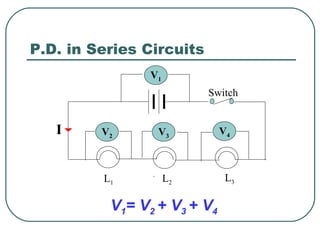
V 1 = V 2  + V 3  + V 4 P.D. in Series Circuits Switch I V 1 V 2 V 3 V 4 L 1 L 2 L 3
The sum of the p.d across individual components in a series circuit, is equal to the p.d across the whole circuit.  The component with the largest resistance has the highest potential difference across it (i.e. V = I x R) P.D. in Series Circuits
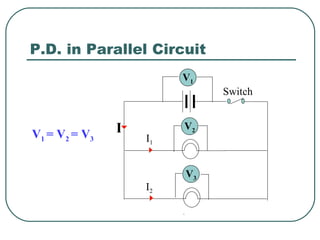
P.D. in Parallel Circuit V 1  = V 2  = V 3   I 1 I 2 V 3 Switch I V 1 V 2
Summary The p.d. across all the  components in a parallel circuit is the same. The sum of the p.d. across individual components in a series circuit, is equal to the p.d. across the whole circuit.
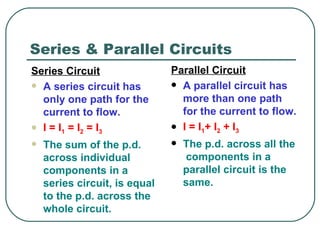
Series & Parallel Circuits Parallel Circuit A parallel circuit has more than one path for the current to flow. I = I 1 + I 2  + I 3   The p.d. across all the  components in a parallel circuit is the same.   Series Circuit A series circuit has only one path for the current to flow. I = I 1  = I 2  = I 3 The sum of the p.d. across individual components in a series circuit, is equal to the p.d. across the whole circuit.
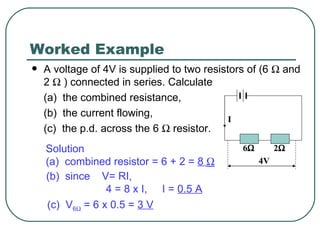
Worked Example A voltage of 4V is supplied to two resistors of (6    and 2    ) connected in series. Calculate (a)  the combined resistance, (b)  the current flowing, (c)  the p.d. across the 6    resistor. Solution (a)  combined resistor = 6 + 2 =  8   (b)  since  V= RI,  4 = 8 x I,  I =  0.5 A (c)  V 6   = 6 x 0.5 =  3 V I 6  2  4V
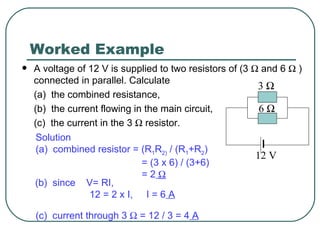
Worked Example A voltage of 12 V is supplied to two resistors of (3    and 6    ) connected in parallel. Calculate (a)  the combined resistance, (b)  the current flowing in the main circuit, (c)  the current in the 3    resistor. Solution (a)  combined resistor = (R 1 R 2)  / (R 1 +R 2 ) = (3 x 6) / (3+6)  = 2    (b)  since  V= RI,  12 = 2 x I,  I = 6  A (c)  current through 3    = 12 / 3 = 4  A 3   6   12 V
Worked Example The battery in the circuit illustrated has an e.m.f. of 16 V and negligible internal resistance. Calculate (a)  the combined resistance, (b)  the current flowing through the   8    resistor. Solution (a)  combined resistor = [(R 1 R 2)  / (R 1 +R 2 )] + R 3   = [(36x18) / (36+18)] + 8 = 20    (b)  since  V= RI,  16 = 20 x I,  I = 0.8  A hence, current through 8    resistor is 0.8 A R2 R1 R3 16V 8    36    18 

Electric Circuits Ppt Slides

  • 1.
    Chapter 17 D.CElectric Circuit Part 1 – Resistance in Series & Parallel Circuits
  • 2.
    At the endof the lesson, you should be able to: Calculate the combined resistance of two or more resistors in series. Calculate the combined resistance of two or three resistors in parallel. Learning Objectives
  • 3.
    Electric circuits canbe classified into two categories: Electric Circuits Series Circuits Parallel Circuits
  • 4.
  • 5.
    Resistors and ResistanceSeries Parallel Resistors can be connected either in:
  • 6.
    Resistors in SeriesThe total resistance ( effective resistance or resultant resistance ) is equal to the sum of the individual resistance. R total = R 1 + R 2 + R 3
  • 7.
    Resistors in ParallelThe reciprocal of the total resistance ( effective resistance or resultant resistance ) is equal to the sum of the reciprocal of individual resistance.
  • 8.
    Resistors in ParallelIf two resistors of resistance R 1 and R 2 are connected in parallel, the total/effective resistance is smaller than the R 1 & R 2 . R 2 R 1 I 1 I 2
  • 9.
    Summary (Resistance) Resistorsin series The combined resistance, R, of resistors in series is found by adding up all the individual resistance R = R 1 + R 2 + R 3 +….. Resistors in parallel The combined resistance, R, of resistors connected in parallel is less than that of any one of the resistors
  • 10.
    Chapter 17: D.CCircuit Part 2 : Current in Series & Parallel Circuits
  • 11.
    At the endof the lesson, you should be able to: Show understanding that current at every point in the series circuit is the same. use the fact that the current from the source is the sum of the currents in the separate branches of a parallel circuit. Learning Objectives
  • 12.
    A series circuithas only one path in which charge can flow. The current is same everywhere. ( I = I 1 = I 2 = I 3 ) Current in Series Circuits R R R Battery Switch I I 1 I 2 I 3
  • 13.
    What will happenif one of the lamp is being removed? Current in Series Circuits Answer: The rest of the lamps will not light up.
  • 14.
    What about thelighting circuits in your house, do you think they are connected in series? Pause and Think … What will happen if they are connected in series? How then do you think the lights should be connected? WHY?
  • 15.
    Current in ParallelCircuit A parallel circuit has more than one path for the current to flow. R 1 R 2 R 3 Switch I I 1 I 2 I 3 I The main current is equal to the sum of the sub-currents. ( I = I 1 +I 2 +I 3 )
  • 16.
    Current in ParallelCircuit What will happen if one of the lamp is being removed? Answer: Apart from the lamp that was being removed, the rest of the lamp will continue to light up.
  • 17.
    Short Circuit Inthe fig. shown, AB is a copper wire which connects two point A and B in the circuit. Since the copper wire has very little resistance , therefore a large amount of current will flow through it. The lamp then go off. (Why?) Therefore we say this circuit is now a short circuit . A B
  • 18.
    A series circuithas only one path for the current to flow. The current is the same throughout the circuit in a series circuit. A parallel circuit has more than one path for the current to flow. The current, in general is different at different points for a parallel circuit. Summary
  • 19.
    Chapter 17: D.CCircuit Part 3 : P.D/Voltage in Series & Parallel Circuits
  • 20.
    Learning Objectives Atthe end of the lesson, you should be able to: Use the fact that the sum of the p.d.’s in a series circuit is equal to the p.d. across the whole circuit. use the fact that the p.d. across all the components in a parallel circuit is the same.
  • 21.
    V 1 =V 2 + V 3 + V 4 P.D. in Series Circuits Switch I V 1 V 2 V 3 V 4 L 1 L 2 L 3
  • 22.
    The sum ofthe p.d across individual components in a series circuit, is equal to the p.d across the whole circuit. The component with the largest resistance has the highest potential difference across it (i.e. V = I x R) P.D. in Series Circuits
  • 23.
    P.D. in ParallelCircuit V 1 = V 2 = V 3 I 1 I 2 V 3 Switch I V 1 V 2
  • 24.
    Summary The p.d.across all the components in a parallel circuit is the same. The sum of the p.d. across individual components in a series circuit, is equal to the p.d. across the whole circuit.
  • 25.
    Series & ParallelCircuits Parallel Circuit A parallel circuit has more than one path for the current to flow. I = I 1 + I 2 + I 3 The p.d. across all the components in a parallel circuit is the same. Series Circuit A series circuit has only one path for the current to flow. I = I 1 = I 2 = I 3 The sum of the p.d. across individual components in a series circuit, is equal to the p.d. across the whole circuit.
  • 26.
    Worked Example Avoltage of 4V is supplied to two resistors of (6  and 2  ) connected in series. Calculate (a) the combined resistance, (b) the current flowing, (c) the p.d. across the 6  resistor. Solution (a) combined resistor = 6 + 2 = 8  (b) since V= RI, 4 = 8 x I, I = 0.5 A (c) V 6  = 6 x 0.5 = 3 V I 6  2  4V
  • 27.
    Worked Example Avoltage of 12 V is supplied to two resistors of (3  and 6  ) connected in parallel. Calculate (a) the combined resistance, (b) the current flowing in the main circuit, (c) the current in the 3  resistor. Solution (a) combined resistor = (R 1 R 2) / (R 1 +R 2 ) = (3 x 6) / (3+6) = 2  (b) since V= RI, 12 = 2 x I, I = 6 A (c) current through 3  = 12 / 3 = 4 A 3  6  12 V
  • 28.
    Worked Example Thebattery in the circuit illustrated has an e.m.f. of 16 V and negligible internal resistance. Calculate (a) the combined resistance, (b) the current flowing through the 8  resistor. Solution (a) combined resistor = [(R 1 R 2) / (R 1 +R 2 )] + R 3 = [(36x18) / (36+18)] + 8 = 20  (b) since V= RI, 16 = 20 x I, I = 0.8 A hence, current through 8  resistor is 0.8 A R2 R1 R3 16V 8  36  18 