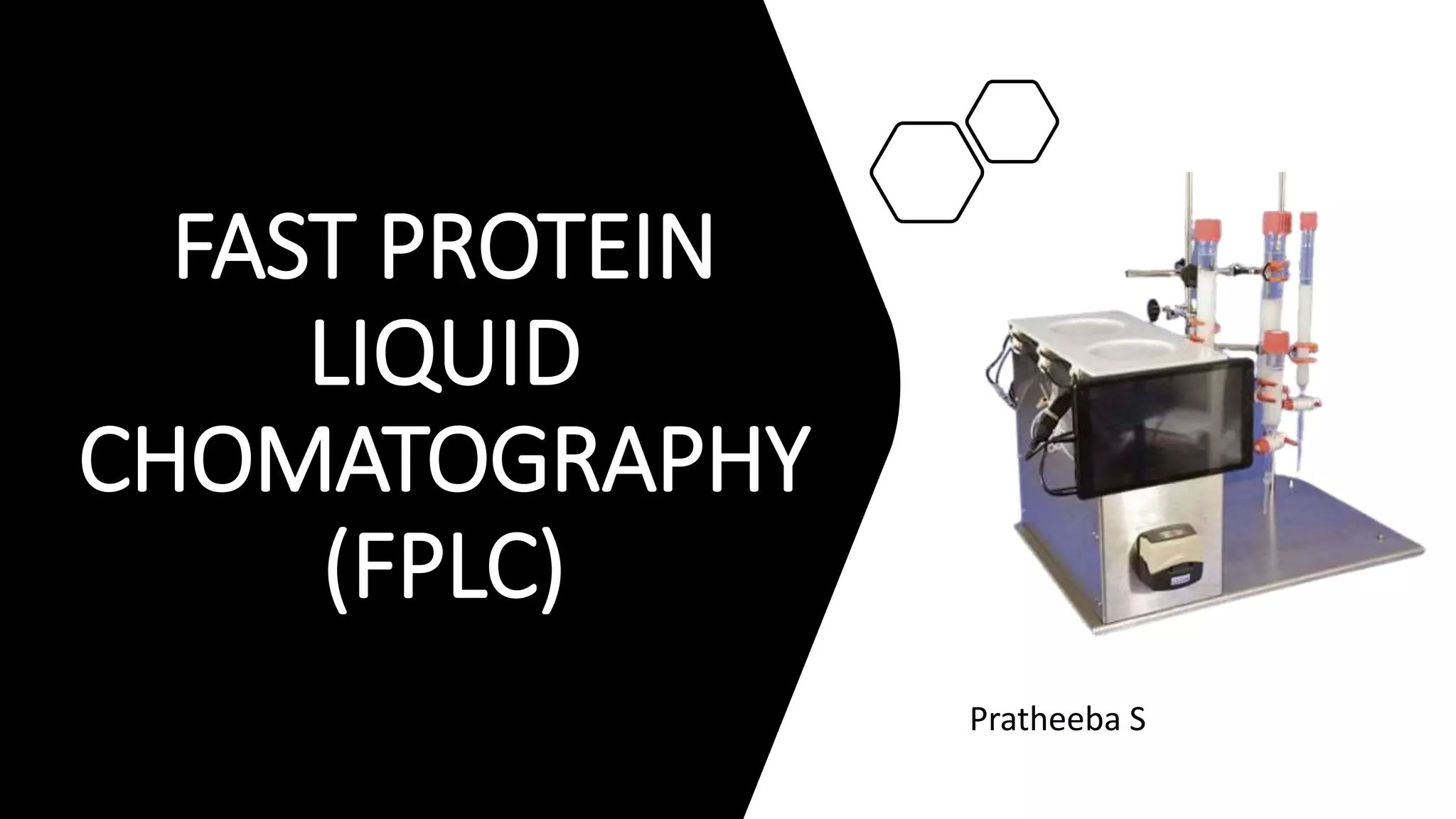
FAST PROTEIN
LIQUID
CHOMATOGRAPHY
(FPLC)
Pratheeba S
INTRODUCTION
• A form of liquid chromatography
• Introduced by Pharmacia in 1982.
• Used to analyse or purify proteins from a mixture of proteins.
• Separation – different components of mixture has different affinities to two materials i.e Stationary and
mobile phase.
• FPLC provides a full range of chromatography modes, such as ion exchange, chromatofocusing, gel filtration,
hydrophobic interaction, and reverse phase.
WHY FPLC?
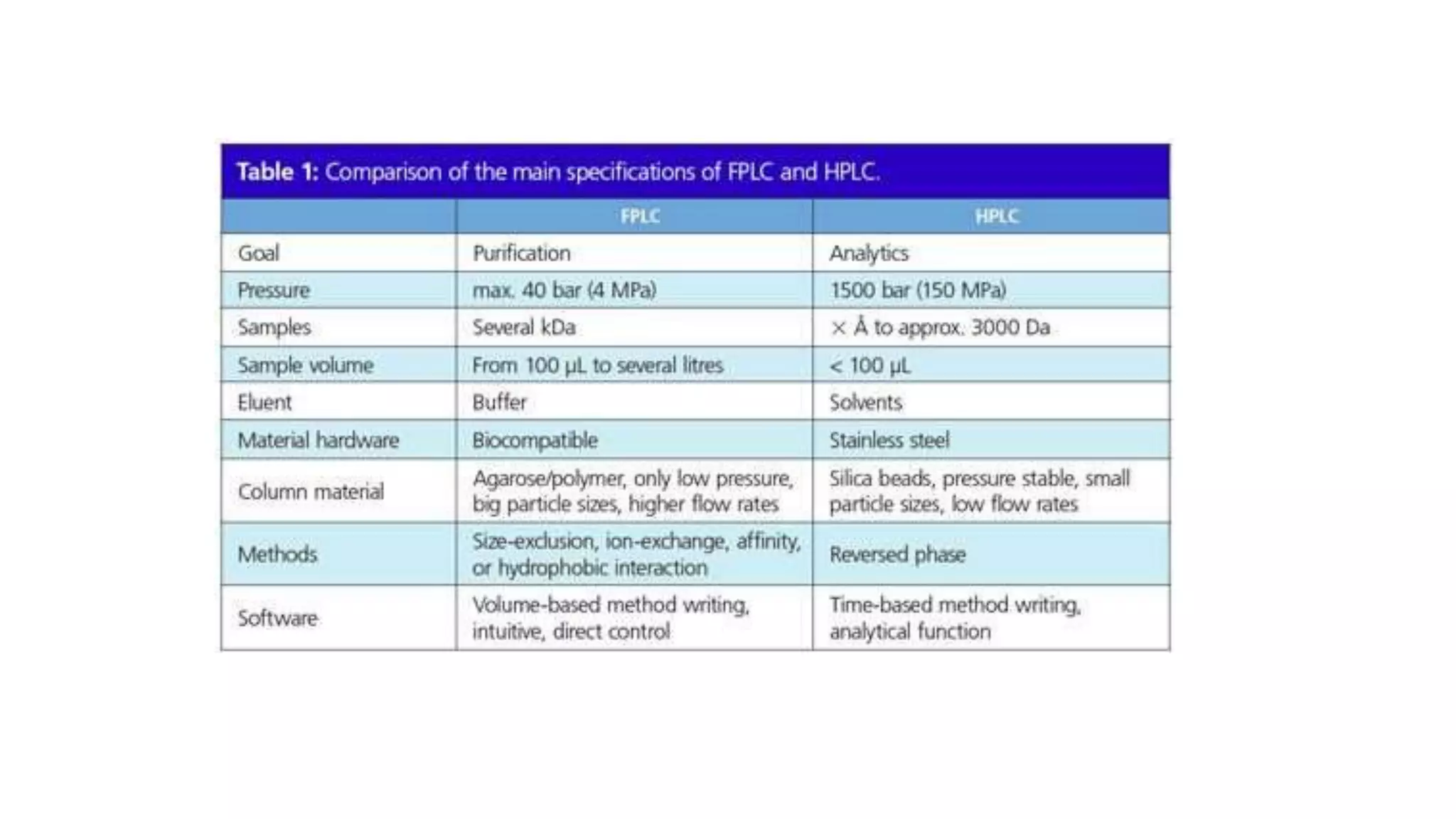
• HPLC is common method of separation of small molecules.
• Extraction and Purification of biomolecules cannot tolerate high
Temperature.
• Lose structre & functionality in HPLC
• The whole FLP chromatography apparatus is often used in a cold
room (or at 4°C) so that structure of the protein being purified is not
disturbed.
PRINCIPLE
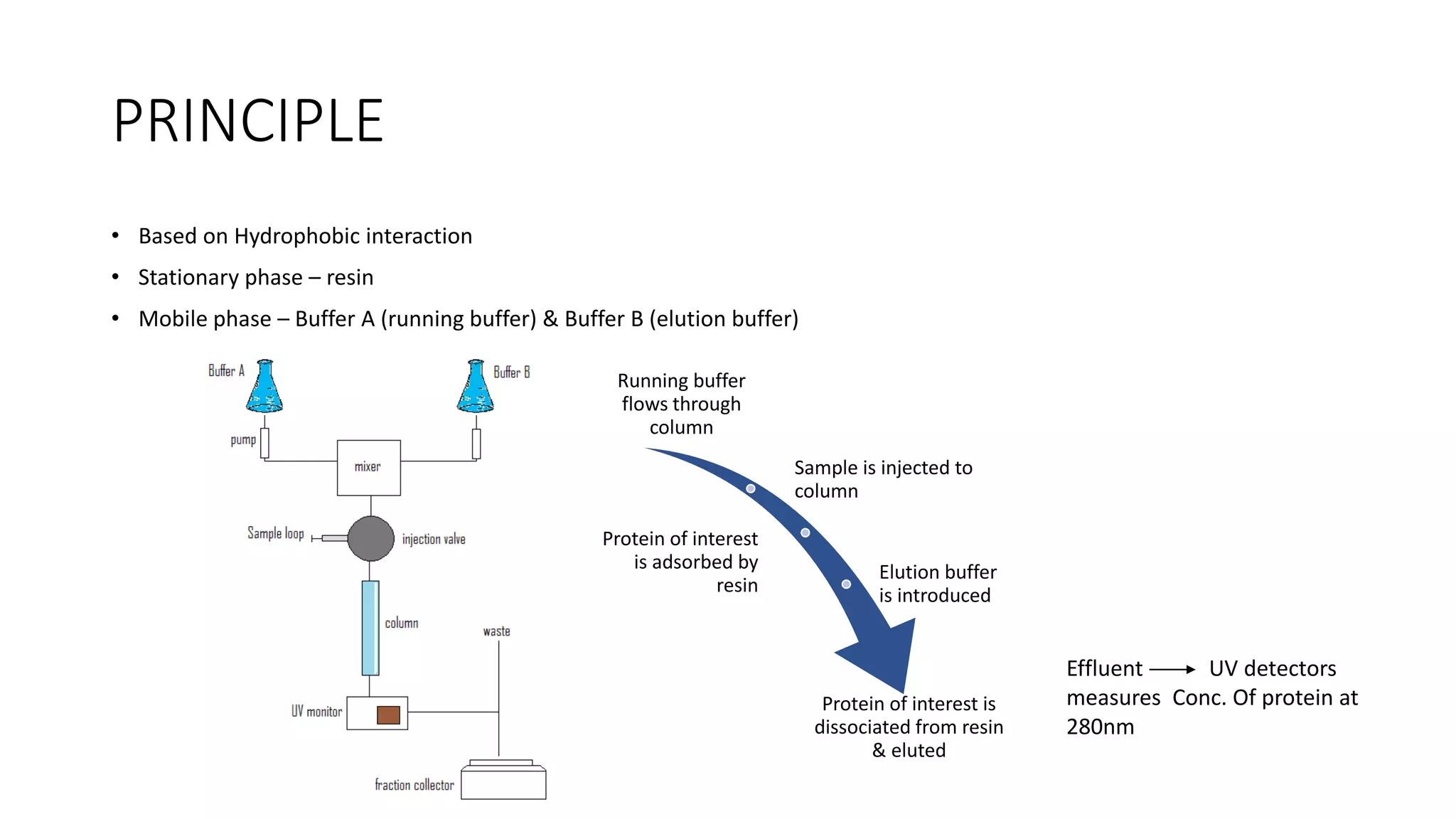
• Based on Hydrophobic interaction
• Stationary phase – resin
• Mobile phase – Buffer A (running buffer) & Buffer B (elution buffer)
Running buffer
flows through
column
Sample is injected to
column
Protein of interest
is adsorbed by
resin
Elution buffer
is introduced
Protein of interest is
dissociated from resin
& eluted
Effluent UV detectors
measures Conc. Of protein at
280nm
INSTRUMENTATION
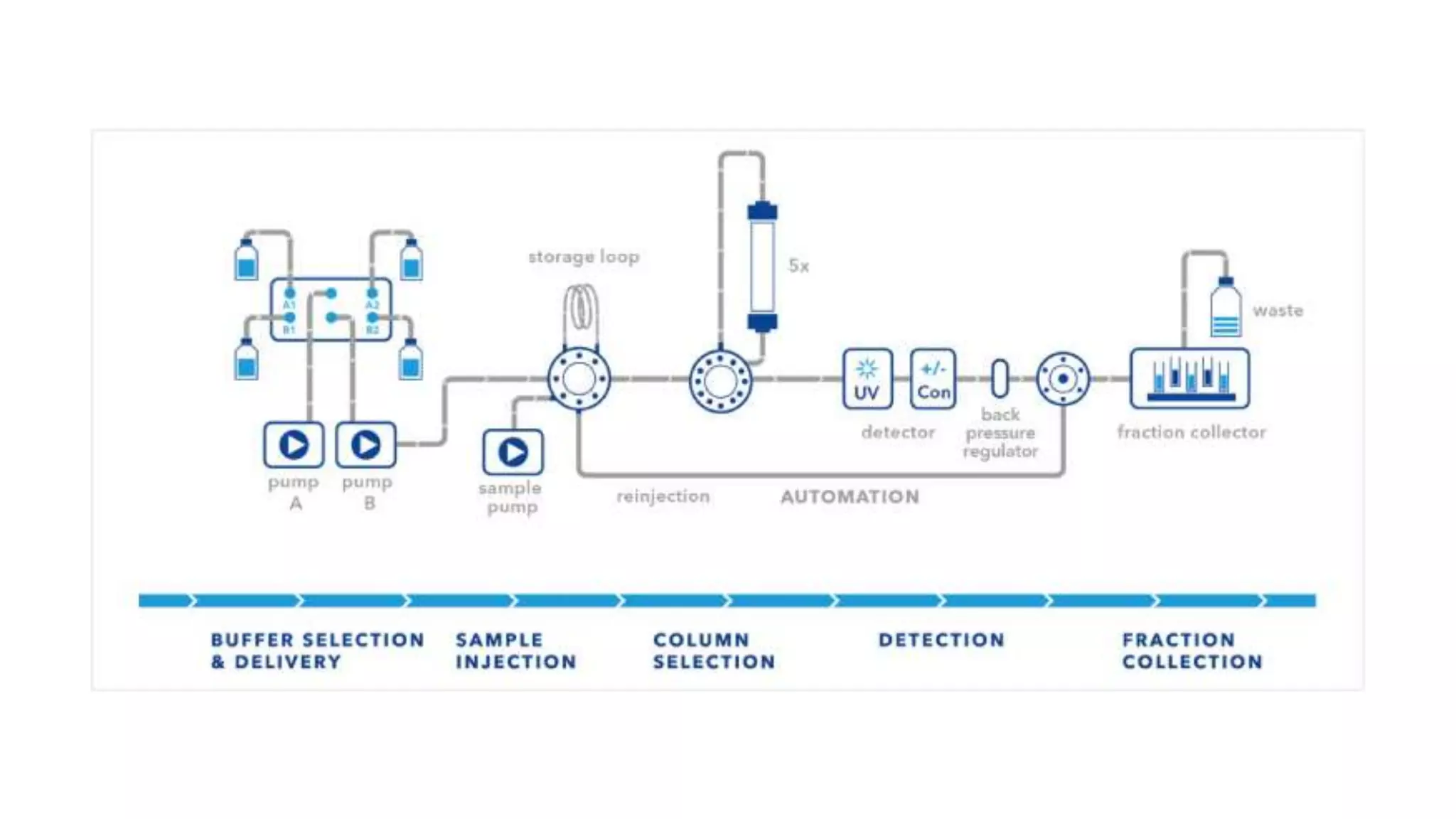
• PUMP
• 2 piston pump for each buffer
• water system uses single peristaltic pump to draw buffer
• INJECTION LOOP
• inject sample into column
• INJECTION VALVE
• A motorized valve which links the mixer and sample loop to the column.
• Three positions - for loading the sample loop, for injecting the sample from the loop into the column, and for
connecting the pumps directly to the waste line to wash them or change bufier solutions.
• COLUMN
• The column is a glass or plastic cylinder packed with stationary phase -beads of resin - agarose.
• mounted vertically with the buffer flowing downward from top to bottom.
• A glass frit at the bottom of the column retains the resin beads in the column while allowing the buffer and dissolved
proteins to exit.
• Mono Q HR5/5 anion-exchange
• Mono S HR5/5 cation exchange
• HR10/10 rapid desalting,
• Superose 12 HR 10/30 gel filtration columns
• Sephadex G-25
• BUFFER
• Phosphate, MOPS, HEPES
• Buffer A: 10 mM Tris-HCl, pH 7.0.
• Buffer B: 10 mM Tris-HCl, pH 7.0, 1 M NaCl.
• Buffer C: 50 mM Tris-HCl, pH 7.0, 100 mM KCl
• FLOW CELLS
• The effluent from the column passes through one or more flow cells to measure the concentration of protein (by UV light absorption
at 280nm). T
• The conductivity cell measures the buffer conductivity, usually in milli siemens/cm, which indicates the concentration of salt in the
buffer.
• A flow cell which measures pf of the butier
• MONITOR / RECORDER
• The flow cells are connected to a display and recorder.
• to identify when peaks in protein concentration occur, indicating that specific components of the mixture are being eluted.
• FRACTION COLLECTOR
• Rotating rack that can be filled with test tubes or similar containers.
• It allows samples to be collected in fixed volumes.
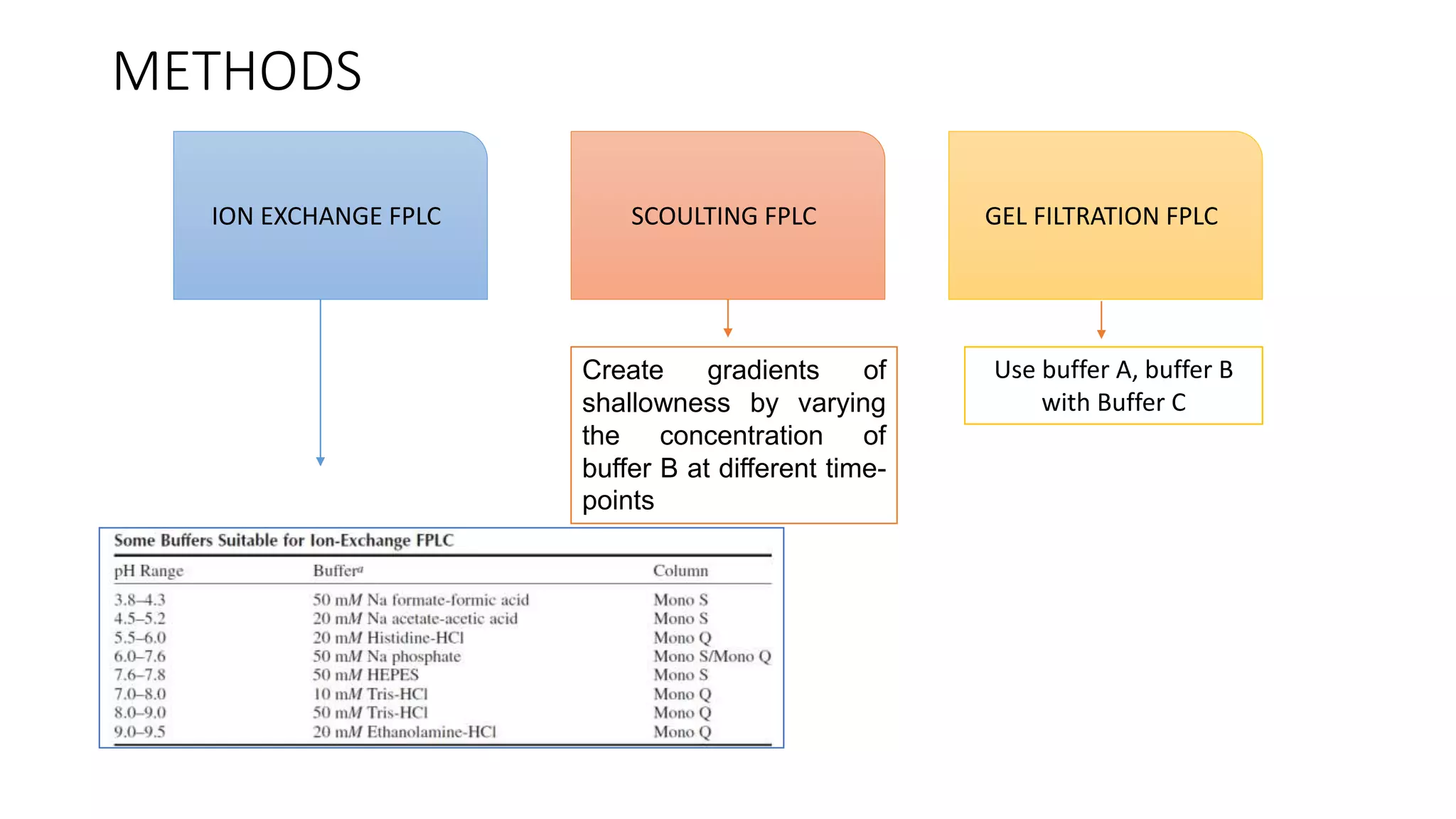
METHODS
ION EXCHANGE FPLC SCOULTING FPLC GEL FILTRATION FPLC
Create gradients of
shallowness by varying
the concentration of
buffer B at different time-
points
Use buffer A, buffer B
with Buffer C
APPLICATION
Separation of
biomolecules &
heat labile
compounds
Mostly applied
to proteins -
wide range of
resin & buffer
Purification of
RNA and plasmid
DNA
Study of markers
in body fluids
FPLC protein profiling -
purification of animal
venoms
•Diagnosis of beta-
thalassemia
•Identifying
microvariability within
a single protein
Purification of
porphobilinogen
deaminase from
human
erythrocytes,
Purification of
antibodies and
vaccines
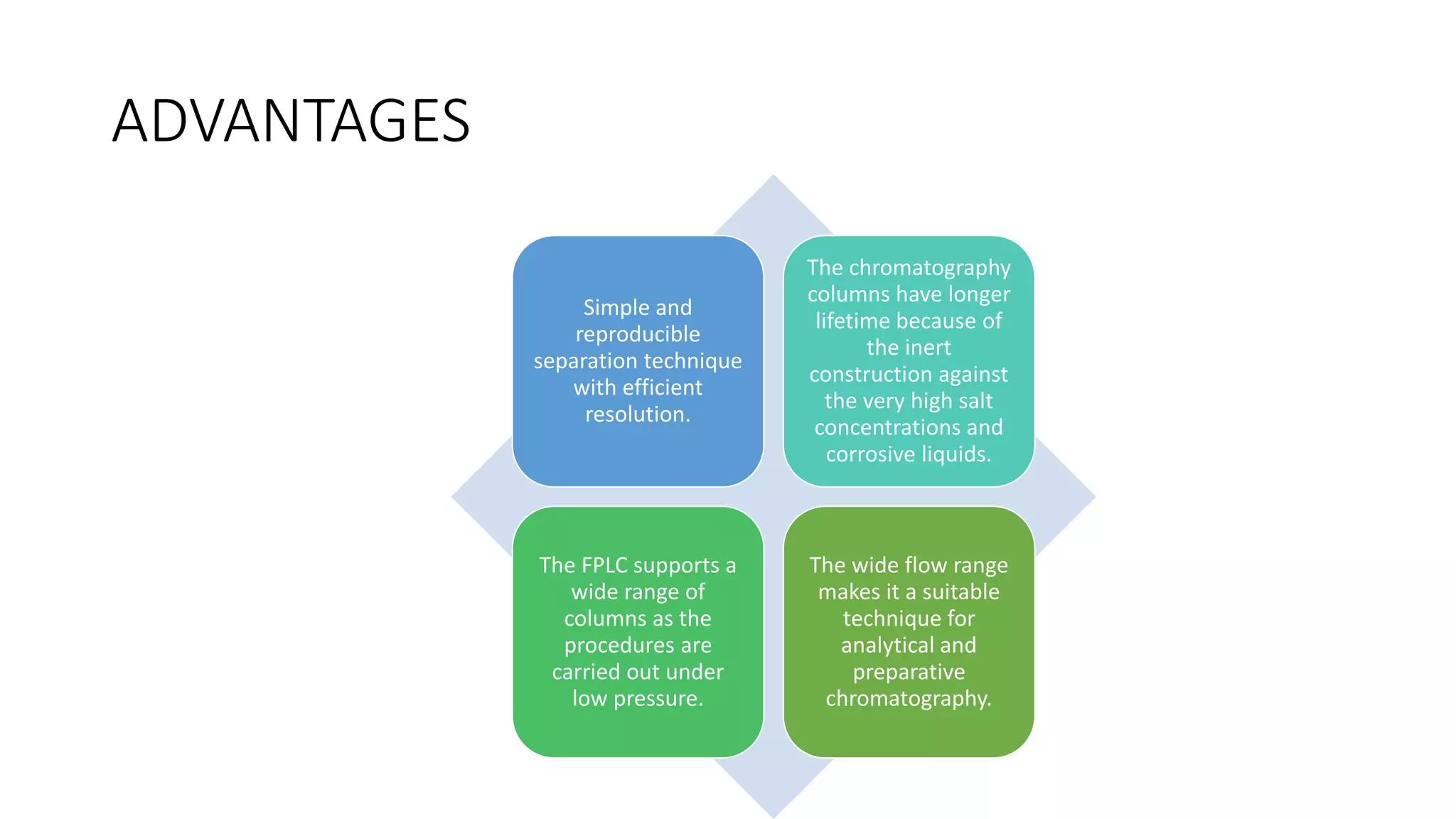
ADVANTAGES
Simple and
reproducible
separation technique
with efficient
resolution.
The chromatography
columns have longer
lifetime because of
the inert
construction against
the very high salt
concentrations and
corrosive liquids.
The FPLC supports a
wide range of
columns as the
procedures are
carried out under
low pressure.
The wide flow range
makes it a suitable
technique for
analytical and
preparative
chromatography.
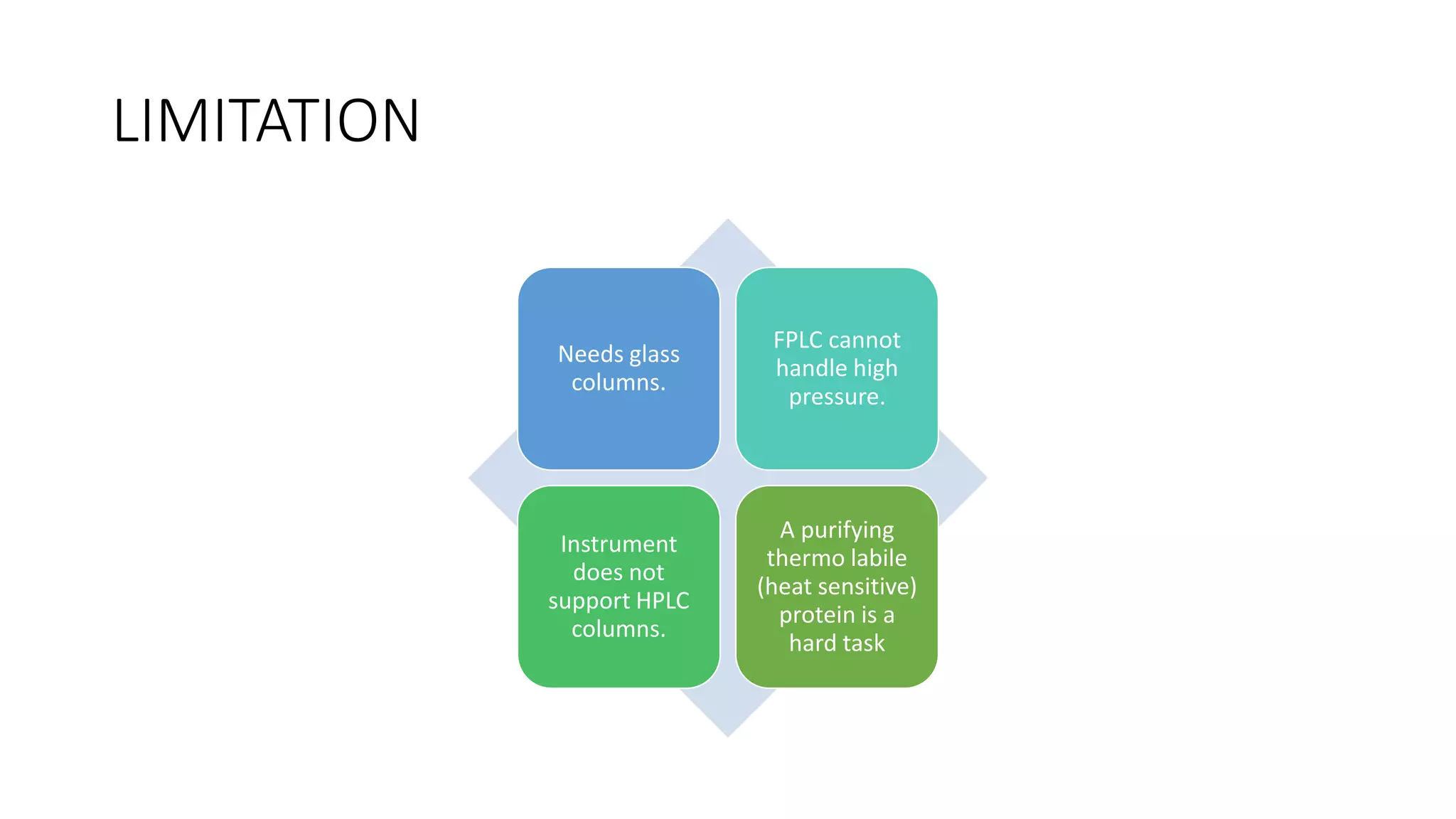
LIMITATION
Needs glass
columns.
FPLC cannot
handle high
pressure.
Instrument
does not
support HPLC
columns.
A purifying
thermo labile
(heat sensitive)
protein is a
hard task
REFERENCE
• Nagamani,B “Bioinstrumentation”, Margham Publications, 2016.
• Cutler, Paul, ed. Protein purification protocols. Vol. 244. Springer
Science & Business Media, 2004.
• https://www.news-medical.net/life-sciences/Fast-Protein-Liquid-
Chromatography.aspx
• https://conductscience.com/fast-protein-liquid-chromatography-fplc-
protocol/

FPLC - Fast Protein Liquid Chromatography

  • 1.
  • 2.
    INTRODUCTION • A formof liquid chromatography • Introduced by Pharmacia in 1982. • Used to analyse or purify proteins from a mixture of proteins. • Separation – different components of mixture has different affinities to two materials i.e Stationary and mobile phase. • FPLC provides a full range of chromatography modes, such as ion exchange, chromatofocusing, gel filtration, hydrophobic interaction, and reverse phase.
  • 3.
    WHY FPLC? • HPLCis common method of separation of small molecules. • Extraction and Purification of biomolecules cannot tolerate high Temperature. • Lose structre & functionality in HPLC • The whole FLP chromatography apparatus is often used in a cold room (or at 4°C) so that structure of the protein being purified is not disturbed.
  • 4.
    PRINCIPLE • Based onHydrophobic interaction • Stationary phase – resin • Mobile phase – Buffer A (running buffer) & Buffer B (elution buffer) Running buffer flows through column Sample is injected to column Protein of interest is adsorbed by resin Elution buffer is introduced Protein of interest is dissociated from resin & eluted Effluent UV detectors measures Conc. Of protein at 280nm
  • 5.
    INSTRUMENTATION • PUMP • 2piston pump for each buffer • water system uses single peristaltic pump to draw buffer • INJECTION LOOP • inject sample into column • INJECTION VALVE • A motorized valve which links the mixer and sample loop to the column. • Three positions - for loading the sample loop, for injecting the sample from the loop into the column, and for connecting the pumps directly to the waste line to wash them or change bufier solutions. • COLUMN • The column is a glass or plastic cylinder packed with stationary phase -beads of resin - agarose. • mounted vertically with the buffer flowing downward from top to bottom. • A glass frit at the bottom of the column retains the resin beads in the column while allowing the buffer and dissolved proteins to exit. • Mono Q HR5/5 anion-exchange • Mono S HR5/5 cation exchange • HR10/10 rapid desalting, • Superose 12 HR 10/30 gel filtration columns • Sephadex G-25
  • 7.
    • BUFFER • Phosphate,MOPS, HEPES • Buffer A: 10 mM Tris-HCl, pH 7.0. • Buffer B: 10 mM Tris-HCl, pH 7.0, 1 M NaCl. • Buffer C: 50 mM Tris-HCl, pH 7.0, 100 mM KCl • FLOW CELLS • The effluent from the column passes through one or more flow cells to measure the concentration of protein (by UV light absorption at 280nm). T • The conductivity cell measures the buffer conductivity, usually in milli siemens/cm, which indicates the concentration of salt in the buffer. • A flow cell which measures pf of the butier • MONITOR / RECORDER • The flow cells are connected to a display and recorder. • to identify when peaks in protein concentration occur, indicating that specific components of the mixture are being eluted. • FRACTION COLLECTOR • Rotating rack that can be filled with test tubes or similar containers. • It allows samples to be collected in fixed volumes.
  • 9.
    METHODS ION EXCHANGE FPLCSCOULTING FPLC GEL FILTRATION FPLC Create gradients of shallowness by varying the concentration of buffer B at different time- points Use buffer A, buffer B with Buffer C
  • 10.
    APPLICATION Separation of biomolecules & heatlabile compounds Mostly applied to proteins - wide range of resin & buffer Purification of RNA and plasmid DNA Study of markers in body fluids FPLC protein profiling - purification of animal venoms •Diagnosis of beta- thalassemia •Identifying microvariability within a single protein Purification of porphobilinogen deaminase from human erythrocytes, Purification of antibodies and vaccines
  • 11.
    ADVANTAGES Simple and reproducible separation technique withefficient resolution. The chromatography columns have longer lifetime because of the inert construction against the very high salt concentrations and corrosive liquids. The FPLC supports a wide range of columns as the procedures are carried out under low pressure. The wide flow range makes it a suitable technique for analytical and preparative chromatography.
  • 12.
    LIMITATION Needs glass columns. FPLC cannot handlehigh pressure. Instrument does not support HPLC columns. A purifying thermo labile (heat sensitive) protein is a hard task
  • 13.
    REFERENCE • Nagamani,B “Bioinstrumentation”,Margham Publications, 2016. • Cutler, Paul, ed. Protein purification protocols. Vol. 244. Springer Science & Business Media, 2004. • https://www.news-medical.net/life-sciences/Fast-Protein-Liquid- Chromatography.aspx • https://conductscience.com/fast-protein-liquid-chromatography-fplc- protocol/