 Introduction
 Principle
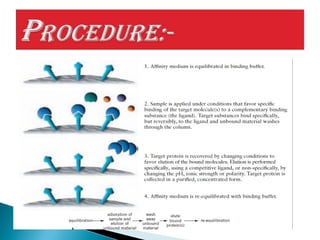
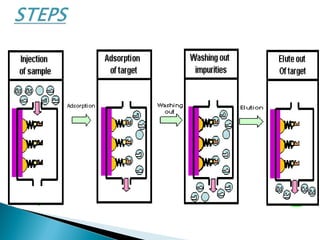
 Procedure
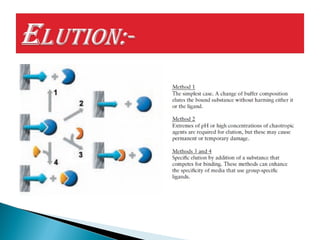
 Elution
 Types
 Application
 Limitation
 Conclusion
Chromatography:
Chromatography is a collective term for a set of laboratory
techniques for the separation of mixtures.
Affinity chromatography:
Discovered by Pedro Cuatrecasas and Meir Wilcheck.
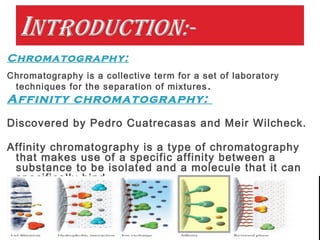
Affinity chromatography is a type of chromatography
that makes use of a specific affinity between a
substance to be isolated and a molecule that it can
specifically bind.
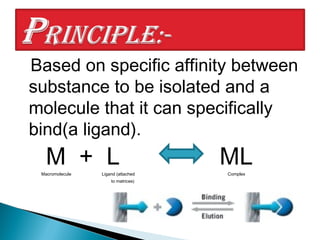
Based on specific affinity between
substance to be isolated and a
molecule that it can specifically
bind(a ligand).
M + L MLMacromolecule Ligand (attached Complex
to matrices)
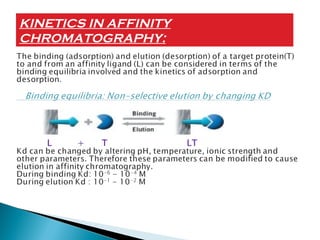
KINETICS IN AFFINITY
CHROMATOGRAPHY:
.
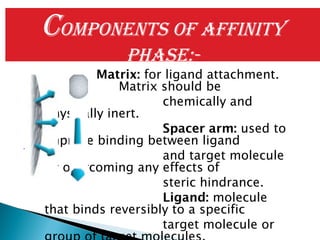
COMPONENTS OF AFFINITY
PHASE:-
Matrix: for ligand attachment.
Matrix should be
chemically and
physically inert.
Spacer arm: used to
improve binding between ligand
and target molecule
by overcoming any effects of
steric hindrance.
Ligand: molecule
that binds reversibly to a specific
target molecule or
 The matrix is an inert support to which a ligand can
be directly or indirectly coupled.
 It has some peculiar qualities like:-
a. Does not itself adsorb molecules to a significant
amount.
b. Ligand must be coupled without altering its binding
properties.
c. Stability under a wide range of experimental
conditions such as high and low pH, detergent and
dissociating conditions.
The most useful matrix materials are agarose and
polyacrylamide .
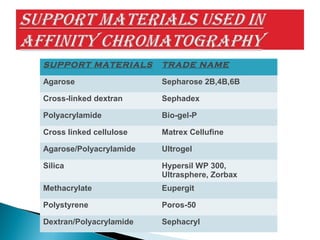
SUPPORT MATERIALS TRADE NAME
Agarose Sepharose 2B,4B,6B
Cross-linked dextran Sephadex
Polyacrylamide Bio-gel-P
Cross linked cellulose Matrex Cellufine
Agarose/Polyacrylamide Ultrogel
Silica Hypersil WP 300,
Ultrasphere, Zorbax
Methacrylate Eupergit
Polystyrene Poros-50
Dextran/Polyacrylamide Sephacryl
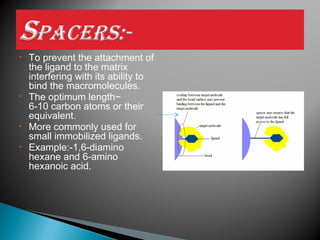
• To prevent the attachment of
the ligand to the matrix
interfering with its ability to
bind the macromolecules.
• The optimum length~
6-10 carbon atoms or their
equivalent.
• More commonly used for
small immobilized ligands.
• Example:-1,6-diamino
hexane and 6-amino
hexanoic acid.
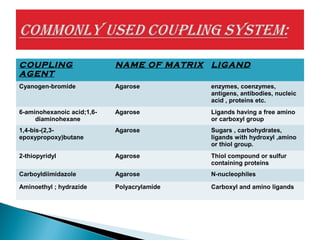
COUPLING
AGENT
NAME OF MATRIX LIGAND
Cyanogen-bromide Agarose enzymes, coenzymes,
antigens, antibodies, nucleic
acid , proteins etc.
6-aminohexanoic acid;1,6-
diaminohexane
Agarose Ligands having a free amino
or carboxyl group
1,4-bis-(2,3-
epoxypropoxy)butane
Agarose Sugars , carbohydrates,
ligands with hydroxyl ,amino
or thiol group.
2-thiopyridyl Agarose Thiol compound or sulfur
containing proteins
Carboyldiimidazole Agarose N-nucleophiles
Aminoethyl ; hydrazide Polyacrylamide Carboxyl and amino ligands
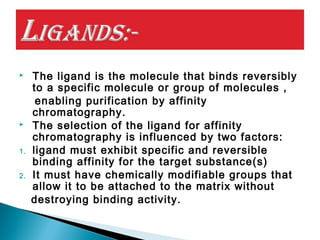
 The ligand is the molecule that binds reversibly
to a specific molecule or group of molecules ,
enabling purification by affinity
chromatography.
 The selection of the ligand for affinity
chromatography is influenced by two factors:
1. ligand must exhibit specific and reversible
binding affinity for the target substance(s)
2. It must have chemically modifiable groups that
allow it to be attached to the matrix without
destroying binding activity.
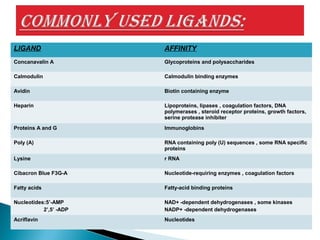
LIGAND AFFINITY
Concanavalin A Glycoproteins and polysaccharides
Calmodulin Calmodulin binding enzymes
Avidin Biotin containing enzyme
Heparin Lipoproteins, lipases , coagulation factors, DNA
polymerases , steroid receptor proteins, growth factors,
serine protease inhibiter
Proteins A and G Immunoglobins
Poly (A) RNA containing poly (U) sequences , some RNA specific
proteins
Lysine r RNA
Cibacron Blue F3G-A Nucleotide-requiring enzymes , coagulation factors
Fatty acids Fatty-acid binding proteins
Nucleotides:5’-AMP
2’,5’ -ADP
NAD+ -dependent dehydrogenases , some kinases
NADP+ -dependent dehydrogenases
Acriflavin Nucleotides
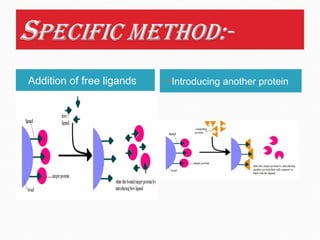
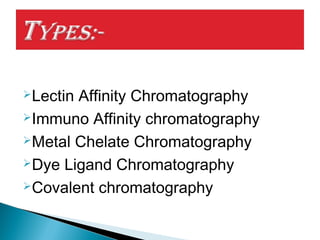
Addition of free ligands Introducing another protein
Lectin Affinity Chromatography
Immuno Affinity chromatography
Metal Chelate Chromatography
Dye Ligand Chromatography
Covalent chromatography
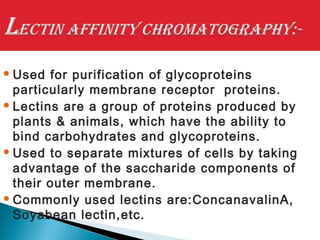
Used for purification of glycoproteins
particularly membrane receptor proteins.
Lectins are a group of proteins produced by
plants & animals, which have the ability to
bind carbohydrates and glycoproteins.
Used to separate mixtures of cells by taking
advantage of the saccharide components of
their outer membrane.
Commonly used lectins are:ConcanavalinA,
Soyabean lectin,etc.
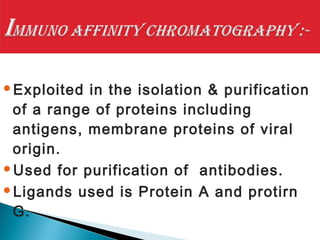
Exploited in the isolation & purification
of a range of proteins including
antigens, membrane proteins of viral
origin.
Used for purification of antibodies.
Ligands used is Protein A and protirn
G.
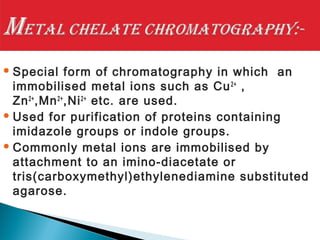
 Special form of chromatography in which an
immobilised metal ions such as Cu2+
,
Zn2+
,Mn2+
,Ni2+
etc. are used.
 Used for purification of proteins containing
imidazole groups or indole groups.
 Commonly metal ions are immobilised by
attachment to an imino-diacetate or
tris(carboxymethyl)ethylenediamine substituted
agarose.
 Uses a number of triazine dyes as ligands.
 Most widely used dye is Cibracron Blue
F3G-A.
 Used for purification of lipoproteins,
interferons, coagulation factors etc.
Developed specifically to separate thiol
containing proteins.
Most commonly used ligand is a
disulphide 2’-pyridyl group.
Used for purification of a number of
proteins but its use is limited by its cost
and rather difficult regeneration stage.
 Purification of substances from biological mixture.
 Separation of native from the denatured form of
protein.
 Purify and concentrate an enzyme in a solution.
 Purification of immunoglobulin.
 Purification of small amount of biological
materials from high levels of contaminating
substances
 Single step purification.
 The matrix can be reused rapidly.
 The matrix is a solid, can be easily washed and
dried.
 Give purified product with high yield.
 Affinity chromatography can also be used to
remove specific contaminants, such as
proteases.
 Non-specific adsorption can not be totally
eliminated, it can only be minimized.
 Limited availability and high cost of immobilized
ligands.
 Proteins get denatured if required pH is not
adjusted.
 Affinity chromatography is one of the most
reliable chromatographic techniques.
 This technique offers high selectivity,
hence high resolution & usually high
capacity for proteins of interest.
 It is theoretically capable of giving
absolute purifications even from complex
mixtures in a single process.
 Hand book of Affinity chromatography, principles
and Method from GE Healthcare
 Practical Biochemistry, Principles and techniques
by Keith Wilson and John Walker, Cambridge
University Press
 Affinity Chromatography: A Review ,Journal of
Pharmacy Research;May2011, Vol. 4 Issue 5,
p1567
Affinity chromatography

Affinity chromatography

  • 2.
     Introduction  Principle Procedure  Elution  Types  Application  Limitation  Conclusion
  • 3.
    Chromatography: Chromatography is acollective term for a set of laboratory techniques for the separation of mixtures. Affinity chromatography: Discovered by Pedro Cuatrecasas and Meir Wilcheck. Affinity chromatography is a type of chromatography that makes use of a specific affinity between a substance to be isolated and a molecule that it can specifically bind.
  • 4.
    Based on specificaffinity between substance to be isolated and a molecule that it can specifically bind(a ligand). M + L MLMacromolecule Ligand (attached Complex to matrices)
  • 5.
  • 6.
    . COMPONENTS OF AFFINITY PHASE:- Matrix:for ligand attachment. Matrix should be chemically and physically inert. Spacer arm: used to improve binding between ligand and target molecule by overcoming any effects of steric hindrance. Ligand: molecule that binds reversibly to a specific target molecule or
  • 7.
     The matrixis an inert support to which a ligand can be directly or indirectly coupled.  It has some peculiar qualities like:- a. Does not itself adsorb molecules to a significant amount. b. Ligand must be coupled without altering its binding properties. c. Stability under a wide range of experimental conditions such as high and low pH, detergent and dissociating conditions. The most useful matrix materials are agarose and polyacrylamide .
  • 8.
    SUPPORT MATERIALS TRADENAME Agarose Sepharose 2B,4B,6B Cross-linked dextran Sephadex Polyacrylamide Bio-gel-P Cross linked cellulose Matrex Cellufine Agarose/Polyacrylamide Ultrogel Silica Hypersil WP 300, Ultrasphere, Zorbax Methacrylate Eupergit Polystyrene Poros-50 Dextran/Polyacrylamide Sephacryl
  • 9.
    • To preventthe attachment of the ligand to the matrix interfering with its ability to bind the macromolecules. • The optimum length~ 6-10 carbon atoms or their equivalent. • More commonly used for small immobilized ligands. • Example:-1,6-diamino hexane and 6-amino hexanoic acid.
  • 10.
    COUPLING AGENT NAME OF MATRIXLIGAND Cyanogen-bromide Agarose enzymes, coenzymes, antigens, antibodies, nucleic acid , proteins etc. 6-aminohexanoic acid;1,6- diaminohexane Agarose Ligands having a free amino or carboxyl group 1,4-bis-(2,3- epoxypropoxy)butane Agarose Sugars , carbohydrates, ligands with hydroxyl ,amino or thiol group. 2-thiopyridyl Agarose Thiol compound or sulfur containing proteins Carboyldiimidazole Agarose N-nucleophiles Aminoethyl ; hydrazide Polyacrylamide Carboxyl and amino ligands
  • 11.
     The ligandis the molecule that binds reversibly to a specific molecule or group of molecules , enabling purification by affinity chromatography.  The selection of the ligand for affinity chromatography is influenced by two factors: 1. ligand must exhibit specific and reversible binding affinity for the target substance(s) 2. It must have chemically modifiable groups that allow it to be attached to the matrix without destroying binding activity.
  • 12.
    LIGAND AFFINITY Concanavalin AGlycoproteins and polysaccharides Calmodulin Calmodulin binding enzymes Avidin Biotin containing enzyme Heparin Lipoproteins, lipases , coagulation factors, DNA polymerases , steroid receptor proteins, growth factors, serine protease inhibiter Proteins A and G Immunoglobins Poly (A) RNA containing poly (U) sequences , some RNA specific proteins Lysine r RNA Cibacron Blue F3G-A Nucleotide-requiring enzymes , coagulation factors Fatty acids Fatty-acid binding proteins Nucleotides:5’-AMP 2’,5’ -ADP NAD+ -dependent dehydrogenases , some kinases NADP+ -dependent dehydrogenases Acriflavin Nucleotides
  • 16.
    Addition of freeligands Introducing another protein
  • 17.
    Lectin Affinity Chromatography ImmunoAffinity chromatography Metal Chelate Chromatography Dye Ligand Chromatography Covalent chromatography
  • 18.
    Used for purificationof glycoproteins particularly membrane receptor proteins. Lectins are a group of proteins produced by plants & animals, which have the ability to bind carbohydrates and glycoproteins. Used to separate mixtures of cells by taking advantage of the saccharide components of their outer membrane. Commonly used lectins are:ConcanavalinA, Soyabean lectin,etc.
  • 19.
    Exploited in theisolation & purification of a range of proteins including antigens, membrane proteins of viral origin. Used for purification of antibodies. Ligands used is Protein A and protirn G.
  • 20.
     Special formof chromatography in which an immobilised metal ions such as Cu2+ , Zn2+ ,Mn2+ ,Ni2+ etc. are used.  Used for purification of proteins containing imidazole groups or indole groups.  Commonly metal ions are immobilised by attachment to an imino-diacetate or tris(carboxymethyl)ethylenediamine substituted agarose.
  • 21.
     Uses anumber of triazine dyes as ligands.  Most widely used dye is Cibracron Blue F3G-A.  Used for purification of lipoproteins, interferons, coagulation factors etc.
  • 22.
    Developed specifically toseparate thiol containing proteins. Most commonly used ligand is a disulphide 2’-pyridyl group. Used for purification of a number of proteins but its use is limited by its cost and rather difficult regeneration stage.
  • 23.
     Purification ofsubstances from biological mixture.  Separation of native from the denatured form of protein.  Purify and concentrate an enzyme in a solution.  Purification of immunoglobulin.  Purification of small amount of biological materials from high levels of contaminating substances
  • 24.
     Single steppurification.  The matrix can be reused rapidly.  The matrix is a solid, can be easily washed and dried.  Give purified product with high yield.  Affinity chromatography can also be used to remove specific contaminants, such as proteases.
  • 25.
     Non-specific adsorptioncan not be totally eliminated, it can only be minimized.  Limited availability and high cost of immobilized ligands.  Proteins get denatured if required pH is not adjusted.
  • 26.
     Affinity chromatographyis one of the most reliable chromatographic techniques.  This technique offers high selectivity, hence high resolution & usually high capacity for proteins of interest.  It is theoretically capable of giving absolute purifications even from complex mixtures in a single process.
  • 27.
     Hand bookof Affinity chromatography, principles and Method from GE Healthcare  Practical Biochemistry, Principles and techniques by Keith Wilson and John Walker, Cambridge University Press  Affinity Chromatography: A Review ,Journal of Pharmacy Research;May2011, Vol. 4 Issue 5, p1567