REVERSE
PHASE HPLC
AND ITS
APPLICATION
Background:
 Discovery and Development of HPLC
• Early Chromatography: In 1903, Russian botanist Mikhail
Tsvet introduced column chromatography to separate plant
pigments, laying the groundwork for modern
chromatographic techniques.
• Advances in the 1950s-60s: Researchers sought to improve
the efficiency and speed of liquid chromatography. They
experimented with smaller particle sizes and higher
pressures.
• Csaba Horváth: In the late 1960s and early 1970s,
Hungarian-American chemist Csaba Horváth at Yale
University significantly advanced HPLC, developing methods
that increased resolution and speed. He is often called the
"father of HPLC."
 Why HPLC Was Developed
• Efficiency: Needed to improve the separation efficiency of
complex mixtures.
• Speed: Required faster analysis times for expanding
scientific and industrial demands.
• Sensitivity: Essential for detecting and quantifying minute
amounts of substances accurately.
 Impact
 HPLC quickly became a staple in analytical laboratories,
revolutionizing fields like pharmaceuticals, environmental
science, and biochemistry with its high precision and speed.
stationary phase: a layer or coating on the supporting medium that
interacts with the analytes
supporting medium; a solid surface on which the stationary phase is bound
or coated
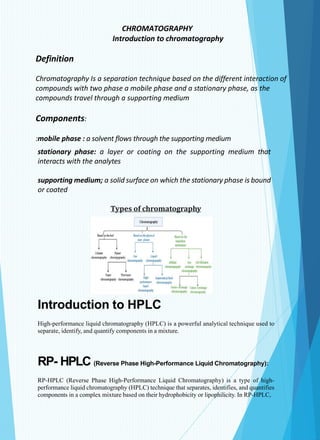
Types of chromatography
Introduction to HPLC
High-performance liquid chromatography (HPLC) is a powerful analytical technique used to
separate, identify, and quantify components in a mixture.
RP- HPLC (Reverse Phase High-Performance Liquid Chromatography):
RP-HPLC (Reverse Phase High-Performance Liquid Chromatography) is a type of high-
performance liquid chromatography (HPLC) technique that separates, identifies, and quantifies
components in a complex mixture based on their hydrophobicity or lipophilicity. In RP-HPLC,
CHROMATOGRAPHY
Introduction to chromatography
Definition
Chromatography Is a separation technique based on the different interaction of
compounds with two phase a mobile phase and a stationary phase, as the
compounds travel through a supporting medium
Components:
:mobile phase : a solvent flows through the supporting medium
the stationary phase is non-polar, and the mobile phase is a polar solvent, allowing for the
separation of non-polar or moderately polar compounds.
1.Separation Mechanism:
- RP-HPLC separates analytes based on their hydrophobicity or lipophilicity.
- The stationary phase is non-polar and typically consists of silica particles with long-chain
alkyl (e.g., C18, C8) or aryl (e.g., phenyl) functional groups bonded to the surface.
- The mobile phase is a polar solvent, such as water, methanol, or acetonitrile, often with the
addition of a polar modifier (e.g., formic acid, trifluoroacetic acid) to control the pH and
improve separation.
- More non-polar (or less polar) analytes interact more strongly with the non-polar stationary
phase and are retained longer, while more polar analytes elute faster.
2.Stationary Phase:
- The most common stationary phases in RP-HPLC are C18 (octadecylsilane) and C8
(octylsilane) bonded silica particles.
- Other stationary phases, such as phenyl, cyano, or pentafluorophenyl, can also be used for
specific applications.
- The particle size of the stationary phase typically ranges from 3 to 5 micrometers, providing
high efficiency and resolution.
3.Mobile Phase:
- The mobile phase in RP-HPLC is usually a mixture of a polar solvent (e.g., water, methanol,
acetonitrile) and a polar modifier (e.g., formic acid, trifluoroacetic acid).
- The composition of the mobile phase can be adjusted (isocratic or gradient elution) to
optimize the separation of the target analytes.
- The mobile phase flow rate is typically in the range of 0.5 to 2 mL/min, depending on the
column dimensions and the complexity of the sample.
4.Instrumentation:
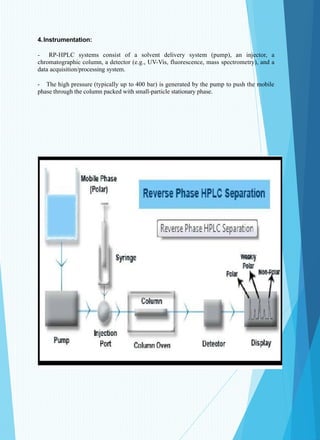
- RP-HPLC systems consist of a solvent delivery system (pump), an injector, a
chromatographic column, a detector (e.g., UV-Vis, fluorescence, mass spectrometry), and a
data acquisition/processing system.
- The high pressure (typically up to 400 bar) is generated by the pump to push the mobile
phase through the column packed with small-particle stationary phase.
YEAR 1 (2019-2020):
RESEARCHERS: DR. NORA HAMID, DR. LIAM ZHAO
•Investigated the use of core-shell silica particles as a novel stationary phase for RP-HPLC,
demonstrating improved efficiency and reduced back-pressure compared to traditional porous
particles.
•Explored the potential of hybrid organic-inorganic materials as RP-HPLC stationary phases, focusing
on their tunable selectivity and enhanced stability.
•Optimized mobile phase conditions, such as pH and organic modifier concentration, to achieve
better separation of challenging analyte mixtures.
YEAR 2 (2020-2021):
RESEARCHERS: DR. SAMANTHA PATEL, DR. AMIR ABBASI
•Developed a systematic approach using experimental design to rapidly optimize RP-HPLC methods
for the analysis of pharmaceutical compounds, leading to significant improvements in resolution and
analysis time.
• Coupled RP-HPLC with mass spectrometry to enhance the structural elucidation and identification
of unknown compounds in complex samples.
•Investigated the use of multi-dimensional chromatography techniques, such as comprehensive two-
dimensional liquid chromatography (LC×LC), to achieve higher peak capacity and resolve co-eluting
analytes.
YEAR 3 (2021-2022):
RESEARCHERS: DR. FATIMA KHALID, DR. JIAN WANG
•Evaluated the performance of novel polymeric-based stationary phases for the analysis of large
biomolecules, such as proteins and peptides, demonstrating improved selectivity and chemical stability.
•Explored the application of RP-HPLC for the characterization of biopharmaceuticals, including the
separation and quantification of monoclonal antibodies and their variants.
• Studied the use of RP-HPLC coupled with advanced detection techniques, such as fluorescence and
electrochemical detection, to enhance the sensitivity and selectivity for the analysis of trace-level
analytes.
YEAR 4 (2022-2023):
RESEARCHERS: DR. OLIVIA CHUNG, DR. RAVI SHARMA
•Investigated the potential of RP-HPLC for the analysis of complex biological matrices, such as cell
lysates and biofluids, to support metabolomics and proteomics research.
•Evaluated the use of RP-HPLC for the separation and quantification of emerging contaminants, such
as pharmaceuticals, personal care products, and micro plastics, in environmental sample.
•Developed data processing and chemometric tools to facilitate the interpretation of complex RP-HPLC
data, enabling more efficient and comprehensive analysis of analytical results.
REFERENCE:
https://www.researchgate.net/publication/343289869_RP-
HPLC_Method_for_the_Determination_and_Quantification_of_Artesunate
Application of Reverse phase HPLC
Reverse-phase high-performance liquid chromatography (RP-HPLC) is a powerful
analytical technique widely used in various fields for the separation, identification, and
quantification of compounds. Here are some common applications of RP-HPLC:
 Pharmaceutical industry
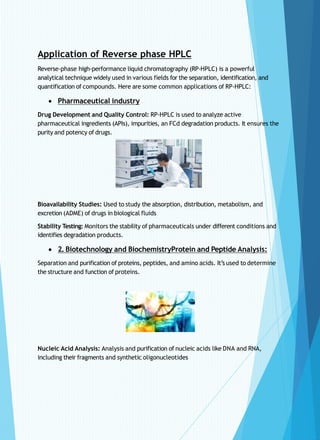
Drug Development and Quality Control: RP-HPLC is used to analyze active
pharmaceutical ingredients (APIs), impurities, an FCd degradation products. It ensures the
purity and potency of drugs.
Bioavailability Studies: Used to study the absorption, distribution, metabolism, and
excretion (ADME) of drugs in biological fluids
Stability Testing: Monitors the stability of pharmaceuticals under different conditions and
identifies degradation products.
 2. Biotechnology and BiochemistryProtein and Peptide Analysis:
Separation and purification of proteins, peptides, and amino acids. It’s used to determine
the structure and function of proteins.
Nucleic Acid Analysis: Analysis and purification of nucleic acids like DNA and RNA,
including their fragments and synthetic oligonucleotides
 Food and Beverage Industry
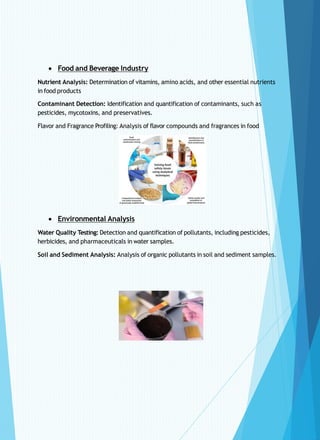
Nutrient Analysis: Determination of vitamins, amino acids, and other essential nutrients
in food products
Contaminant Detection: Identification and quantification of contaminants, such as
pesticides, mycotoxins, and preservatives.
Flavor and Fragrance Profiling: Analysis of flavor compounds and fragrances in food
 Environmental Analysis
Water Quality Testing: Detection and quantification of pollutants, including pesticides,
herbicides, and pharmaceuticals in water samples.
Soil and Sediment Analysis: Analysis of organic pollutants in soil and sediment samples.
 Cosmetics and Personal Care
Ingredient Analysis: Analysis of active ingredients, preservatives, and contaminants in
cosmetics and personal care products.
Formulation Development: Ensures the stability and efficacy of cosmetic formulations.
 Agriculture
Pesticide Residue Analysis: Detection and quantification of pesticide residues in
agricultural products.
Plant Metabolite Analysis: Study of plant metabolites, including phytohormones,
alkaloids, and flavonoids.
Modifications in RP-HPLC :
There are some modifications that can be made according to produce requirement, these
modifications are given below and its also ensure the quality and accuracy of the analysis.
 Change the Solvents:
Mix Different Liquids: Adjust the amounts of water and chemicals like methanol or
acetonitrile to see which mixture works best.
Adjust the Acidity: Change the pH level of the liquid mixture to help separate
different substances.
 Change the Column:
Use Different Columns: Choose columns of different sizes or those with different
chemical coatings (like C18 or C8) to see which one gives the best separation.
Use Special Columns: Some columns have special features that help separate specific
types of chemicals better.
 Change the Temperature:
Heat the Column: Increasing or decreasing the temperature of the column can make the
separation process faster and more efficient.
 Change the Flow Pattern:
Vary the Liquid Flow: Use a constant mix of solvents or gradually change the mix over time
to better separate complex mixtures.
 Change the Flow Speed:
Adjust the Speed: Changing how fast the liquid moves through the column can affect how
well the substances separate.
These modifications help optimize the HPLC process for different types of samples and
improve the accuracy of the analysis.
.
Conclusion and Future Direction
Reverse phase HPLC remains a powerful analytical technique
with numerous applications. Future research focuses on
developing new stationary phases, mobile phase compositions,
and detectors for enhanced sensitivity, selectivity, and speed.
REFERENCE:
https://www.sciencedirect.com/topics/chemistry/reversed-
phase-
hplc#:~:text=Reversed%2Dphase%20HPLC%20(RP%2DHP
LC)%20is%20the%20most,non
polar%20than%20the%20eluting%20solvent.

Reverse Phase High-Performance Liquid Chromatography

  • 1.
  • 2.
    Background:  Discovery andDevelopment of HPLC • Early Chromatography: In 1903, Russian botanist Mikhail Tsvet introduced column chromatography to separate plant pigments, laying the groundwork for modern chromatographic techniques. • Advances in the 1950s-60s: Researchers sought to improve the efficiency and speed of liquid chromatography. They experimented with smaller particle sizes and higher pressures. • Csaba Horváth: In the late 1960s and early 1970s, Hungarian-American chemist Csaba Horváth at Yale University significantly advanced HPLC, developing methods that increased resolution and speed. He is often called the "father of HPLC."  Why HPLC Was Developed • Efficiency: Needed to improve the separation efficiency of complex mixtures. • Speed: Required faster analysis times for expanding scientific and industrial demands. • Sensitivity: Essential for detecting and quantifying minute amounts of substances accurately.  Impact  HPLC quickly became a staple in analytical laboratories, revolutionizing fields like pharmaceuticals, environmental science, and biochemistry with its high precision and speed.
  • 3.
    stationary phase: alayer or coating on the supporting medium that interacts with the analytes supporting medium; a solid surface on which the stationary phase is bound or coated Types of chromatography Introduction to HPLC High-performance liquid chromatography (HPLC) is a powerful analytical technique used to separate, identify, and quantify components in a mixture. RP- HPLC (Reverse Phase High-Performance Liquid Chromatography): RP-HPLC (Reverse Phase High-Performance Liquid Chromatography) is a type of high- performance liquid chromatography (HPLC) technique that separates, identifies, and quantifies components in a complex mixture based on their hydrophobicity or lipophilicity. In RP-HPLC, CHROMATOGRAPHY Introduction to chromatography Definition Chromatography Is a separation technique based on the different interaction of compounds with two phase a mobile phase and a stationary phase, as the compounds travel through a supporting medium Components: :mobile phase : a solvent flows through the supporting medium
  • 4.
    the stationary phaseis non-polar, and the mobile phase is a polar solvent, allowing for the separation of non-polar or moderately polar compounds. 1.Separation Mechanism: - RP-HPLC separates analytes based on their hydrophobicity or lipophilicity. - The stationary phase is non-polar and typically consists of silica particles with long-chain alkyl (e.g., C18, C8) or aryl (e.g., phenyl) functional groups bonded to the surface. - The mobile phase is a polar solvent, such as water, methanol, or acetonitrile, often with the addition of a polar modifier (e.g., formic acid, trifluoroacetic acid) to control the pH and improve separation. - More non-polar (or less polar) analytes interact more strongly with the non-polar stationary phase and are retained longer, while more polar analytes elute faster. 2.Stationary Phase: - The most common stationary phases in RP-HPLC are C18 (octadecylsilane) and C8 (octylsilane) bonded silica particles. - Other stationary phases, such as phenyl, cyano, or pentafluorophenyl, can also be used for specific applications. - The particle size of the stationary phase typically ranges from 3 to 5 micrometers, providing high efficiency and resolution. 3.Mobile Phase: - The mobile phase in RP-HPLC is usually a mixture of a polar solvent (e.g., water, methanol, acetonitrile) and a polar modifier (e.g., formic acid, trifluoroacetic acid). - The composition of the mobile phase can be adjusted (isocratic or gradient elution) to optimize the separation of the target analytes. - The mobile phase flow rate is typically in the range of 0.5 to 2 mL/min, depending on the column dimensions and the complexity of the sample.
  • 5.
    4.Instrumentation: - RP-HPLC systemsconsist of a solvent delivery system (pump), an injector, a chromatographic column, a detector (e.g., UV-Vis, fluorescence, mass spectrometry), and a data acquisition/processing system. - The high pressure (typically up to 400 bar) is generated by the pump to push the mobile phase through the column packed with small-particle stationary phase.
  • 6.
    YEAR 1 (2019-2020): RESEARCHERS:DR. NORA HAMID, DR. LIAM ZHAO •Investigated the use of core-shell silica particles as a novel stationary phase for RP-HPLC, demonstrating improved efficiency and reduced back-pressure compared to traditional porous particles. •Explored the potential of hybrid organic-inorganic materials as RP-HPLC stationary phases, focusing on their tunable selectivity and enhanced stability. •Optimized mobile phase conditions, such as pH and organic modifier concentration, to achieve better separation of challenging analyte mixtures. YEAR 2 (2020-2021): RESEARCHERS: DR. SAMANTHA PATEL, DR. AMIR ABBASI •Developed a systematic approach using experimental design to rapidly optimize RP-HPLC methods for the analysis of pharmaceutical compounds, leading to significant improvements in resolution and analysis time. • Coupled RP-HPLC with mass spectrometry to enhance the structural elucidation and identification of unknown compounds in complex samples. •Investigated the use of multi-dimensional chromatography techniques, such as comprehensive two- dimensional liquid chromatography (LC×LC), to achieve higher peak capacity and resolve co-eluting analytes. YEAR 3 (2021-2022): RESEARCHERS: DR. FATIMA KHALID, DR. JIAN WANG •Evaluated the performance of novel polymeric-based stationary phases for the analysis of large biomolecules, such as proteins and peptides, demonstrating improved selectivity and chemical stability. •Explored the application of RP-HPLC for the characterization of biopharmaceuticals, including the separation and quantification of monoclonal antibodies and their variants. • Studied the use of RP-HPLC coupled with advanced detection techniques, such as fluorescence and electrochemical detection, to enhance the sensitivity and selectivity for the analysis of trace-level analytes.
  • 7.
    YEAR 4 (2022-2023): RESEARCHERS:DR. OLIVIA CHUNG, DR. RAVI SHARMA •Investigated the potential of RP-HPLC for the analysis of complex biological matrices, such as cell lysates and biofluids, to support metabolomics and proteomics research. •Evaluated the use of RP-HPLC for the separation and quantification of emerging contaminants, such as pharmaceuticals, personal care products, and micro plastics, in environmental sample. •Developed data processing and chemometric tools to facilitate the interpretation of complex RP-HPLC data, enabling more efficient and comprehensive analysis of analytical results. REFERENCE: https://www.researchgate.net/publication/343289869_RP- HPLC_Method_for_the_Determination_and_Quantification_of_Artesunate
  • 8.
    Application of Reversephase HPLC Reverse-phase high-performance liquid chromatography (RP-HPLC) is a powerful analytical technique widely used in various fields for the separation, identification, and quantification of compounds. Here are some common applications of RP-HPLC:  Pharmaceutical industry Drug Development and Quality Control: RP-HPLC is used to analyze active pharmaceutical ingredients (APIs), impurities, an FCd degradation products. It ensures the purity and potency of drugs. Bioavailability Studies: Used to study the absorption, distribution, metabolism, and excretion (ADME) of drugs in biological fluids Stability Testing: Monitors the stability of pharmaceuticals under different conditions and identifies degradation products.  2. Biotechnology and BiochemistryProtein and Peptide Analysis: Separation and purification of proteins, peptides, and amino acids. It’s used to determine the structure and function of proteins. Nucleic Acid Analysis: Analysis and purification of nucleic acids like DNA and RNA, including their fragments and synthetic oligonucleotides
  • 9.
     Food andBeverage Industry Nutrient Analysis: Determination of vitamins, amino acids, and other essential nutrients in food products Contaminant Detection: Identification and quantification of contaminants, such as pesticides, mycotoxins, and preservatives. Flavor and Fragrance Profiling: Analysis of flavor compounds and fragrances in food  Environmental Analysis Water Quality Testing: Detection and quantification of pollutants, including pesticides, herbicides, and pharmaceuticals in water samples. Soil and Sediment Analysis: Analysis of organic pollutants in soil and sediment samples.
  • 10.
     Cosmetics andPersonal Care Ingredient Analysis: Analysis of active ingredients, preservatives, and contaminants in cosmetics and personal care products. Formulation Development: Ensures the stability and efficacy of cosmetic formulations.  Agriculture Pesticide Residue Analysis: Detection and quantification of pesticide residues in agricultural products. Plant Metabolite Analysis: Study of plant metabolites, including phytohormones, alkaloids, and flavonoids.
  • 11.
    Modifications in RP-HPLC: There are some modifications that can be made according to produce requirement, these modifications are given below and its also ensure the quality and accuracy of the analysis.  Change the Solvents: Mix Different Liquids: Adjust the amounts of water and chemicals like methanol or acetonitrile to see which mixture works best. Adjust the Acidity: Change the pH level of the liquid mixture to help separate different substances.  Change the Column: Use Different Columns: Choose columns of different sizes or those with different chemical coatings (like C18 or C8) to see which one gives the best separation. Use Special Columns: Some columns have special features that help separate specific types of chemicals better.  Change the Temperature: Heat the Column: Increasing or decreasing the temperature of the column can make the separation process faster and more efficient.  Change the Flow Pattern: Vary the Liquid Flow: Use a constant mix of solvents or gradually change the mix over time to better separate complex mixtures.  Change the Flow Speed: Adjust the Speed: Changing how fast the liquid moves through the column can affect how well the substances separate. These modifications help optimize the HPLC process for different types of samples and improve the accuracy of the analysis.
  • 12.
    . Conclusion and FutureDirection Reverse phase HPLC remains a powerful analytical technique with numerous applications. Future research focuses on developing new stationary phases, mobile phase compositions, and detectors for enhanced sensitivity, selectivity, and speed. REFERENCE: https://www.sciencedirect.com/topics/chemistry/reversed- phase- hplc#:~:text=Reversed%2Dphase%20HPLC%20(RP%2DHP LC)%20is%20the%20most,non polar%20than%20the%20eluting%20solvent.