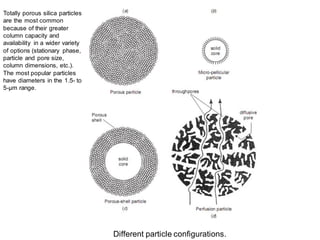
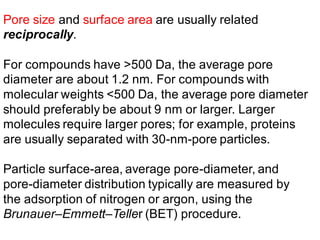
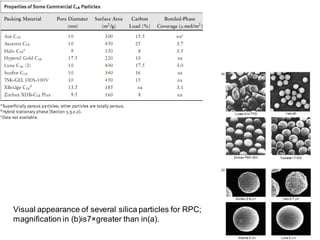
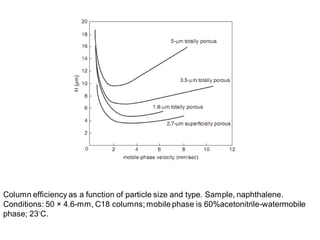
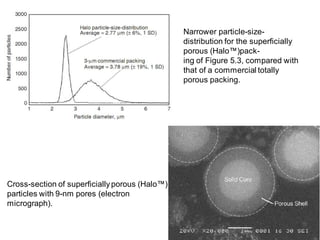
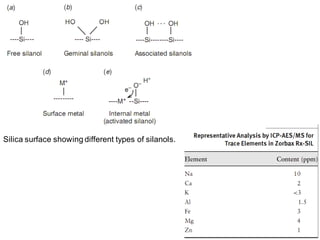
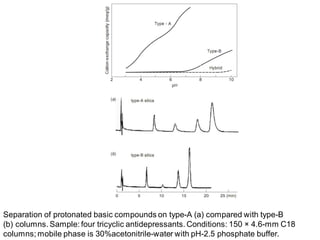
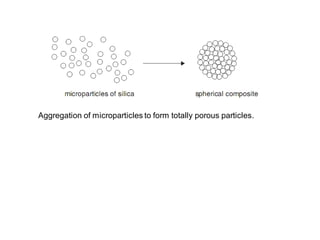
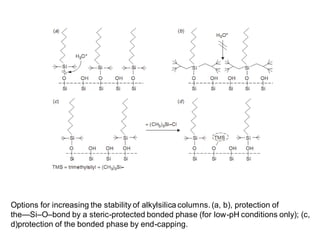
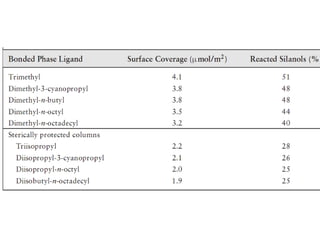
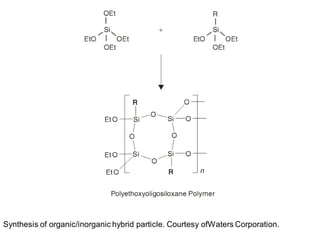
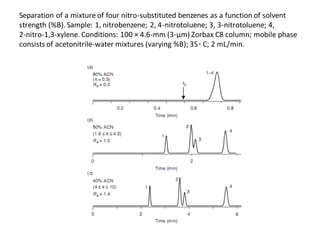
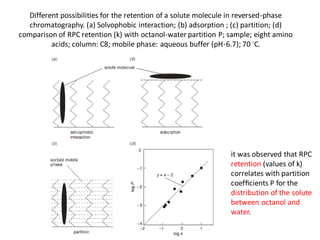
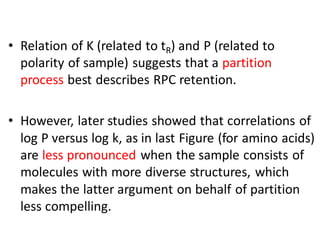
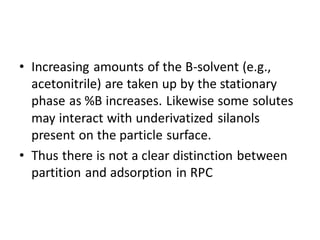
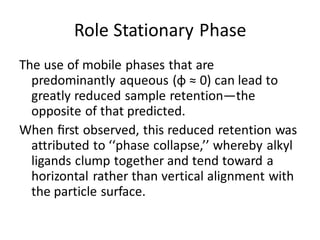
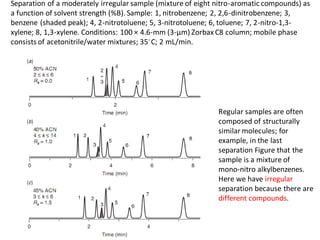
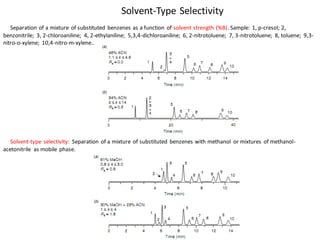
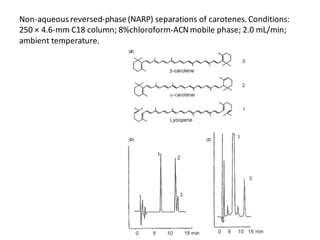
The document discusses reversed-phase chromatography columns. It describes how totally porous silica particles are most commonly used due to their greater capacity and variety of options. Pore size is usually related to the molecular weight of compounds, with larger pores needed to separate larger molecules like proteins. Particle properties like surface area and pore size are typically measured using the BET procedure. Column efficiency depends on factors like particle size and type. Superficially porous particles have a narrower size distribution than totally porous particles. The stationary phase is usually made by bonding an organosilane to silica particles. Options can provide increased stability. Selectivity is influenced by solvent strength and type as well as solute properties.

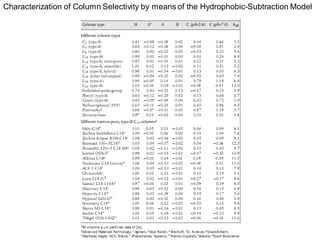
![RPC columns classified according to the ligand (figures omit the connecting silane
group [–Si(CH3)2–]).](https://image.slidesharecdn.com/hplccolumn-230128114131-205e2f68/85/HPLC-COLUMN-pdf-17-320.jpg)
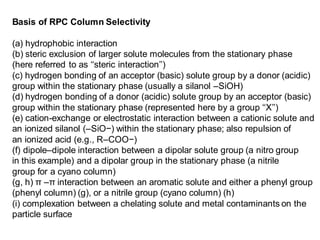
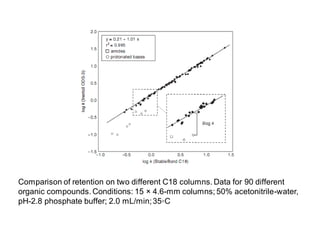
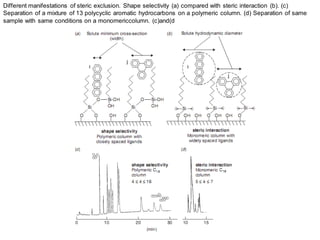
![Solute-column interactions that determine column selectivity (figures omit the
connecting silane group [–Si(CH3)2–]).](https://image.slidesharecdn.com/hplccolumn-230128114131-205e2f68/85/HPLC-COLUMN-pdf-21-320.jpg)
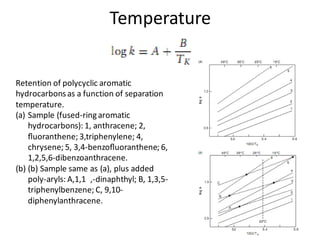
![Retention in RPC as a function of temperature and the polarity of the solute, mobile phase and
column. Sample: as indicated in figure. Conditions: (a-c) 150 × 4.0-mm 5-μm) Symmetry C18
column, and (d) 150 × 4.6-mm (5-μm) Zorbax Stable Bond cyano column; 2.0 mL/min; mobile
phase is acetonitrile/water, with mobile-phase composition (%B) and temperature indicated in
figure (bolded values represent changes from [a]).](https://image.slidesharecdn.com/hplccolumn-230128114131-205e2f68/85/HPLC-COLUMN-pdf-27-320.jpg)
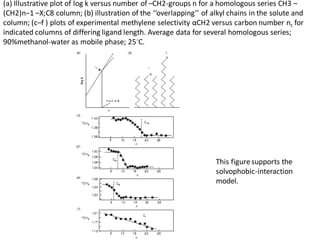
![A surprising observation was made for the RPC retention of various
homologousseries (CH3–[CH2]n − 1 –X), where X representsa functional
group such as –OH or –CO2CH3.
The plot of log k versusn for a homologousseries and a C8 column; a
discontinuity in the expected linear plot (dashed line) is observed (arrow)
when n equals 8 for the solute (CH3 –[CH2]7 –X). It was concluded from
this observation that the contribution to retention for successive –CH2-
groupsin the solute becomes slightly smaller when the length of the
solute molecule just exceeds the length of the alkyl ligand.
Presumably there is a decreased interaction with the column for solute
molecules that are too long to penetrate fully into the stationary phase (or
attach to a single column ligand), with a correspondingdecrease in the
retention of –CH2-groupsthat ‘‘stick out of’’ the stationary phase.](https://image.slidesharecdn.com/hplccolumn-230128114131-205e2f68/85/HPLC-COLUMN-pdf-32-320.jpg)

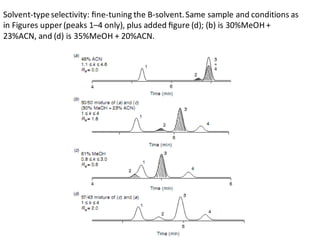
![Solvent-strength nomograph for reversed-phase HPLC (adapted from [28]).Two
mobile phases of equal strength (46%ACN and 57%MeOH) marked by •,asanexample](https://image.slidesharecdn.com/hplccolumn-230128114131-205e2f68/85/HPLC-COLUMN-pdf-40-320.jpg)
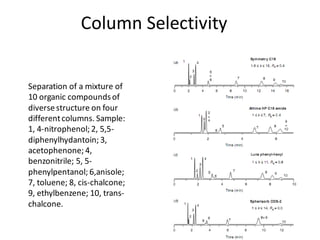
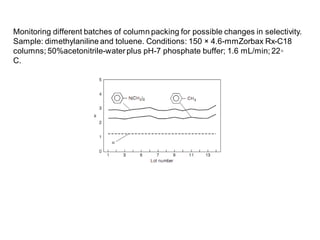
![A change in column source
Example of the use of values of Fs to
select columns of similar selectivity
for possible replacement in a routine
HPLC assay. Gradient separations
where only the column is changed for
the separations of a–d. Asterisks mark
peaks of interest, values of Fs
calculated from Equation (5.5) (ionic
[not neutral] sample).](https://image.slidesharecdn.com/hplccolumn-230128114131-205e2f68/85/HPLC-COLUMN-pdf-45-320.jpg)
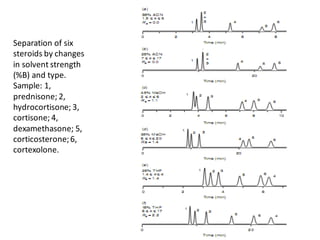
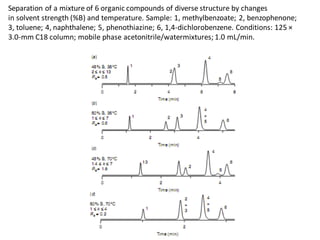
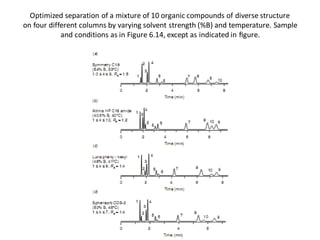
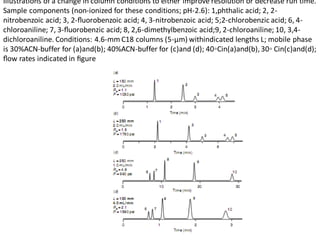

![mono-substituted benzenes (substituents indicated for each peak; e.g., –H is benzene, –Cl is
chlorobenzene). Conditions: 150 × 4.6-mm silica (5-μm particles); 20%CHCl3-hexane mobile
phase; ambient temperature; 2.0 mL/min. (a) Chromatogram is recreated from data of [1]; (b)
retention of (a) compared with RPC retention from Figure 2.7c for benzenes substituted by the
same functional group (50%acetonitrile-water as RPC mobile phase).](https://image.slidesharecdn.com/hplccolumn-230128114131-205e2f68/85/HPLC-COLUMN-pdf-64-320.jpg)
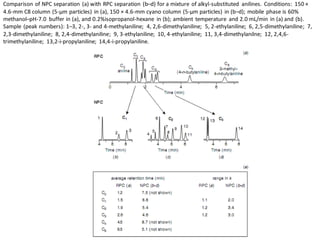
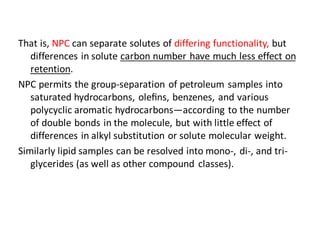
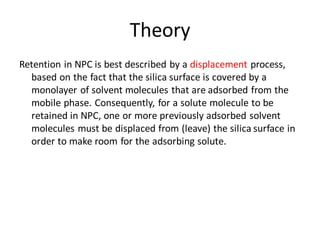
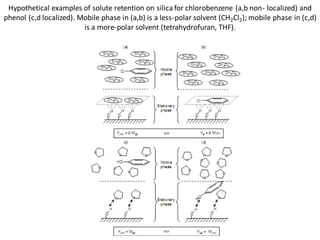
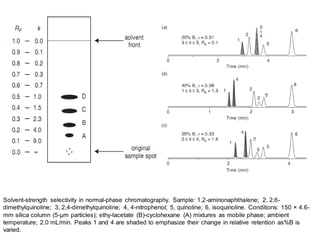
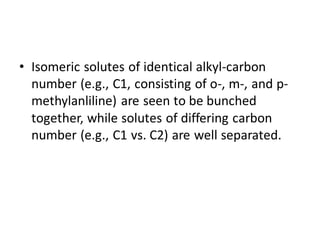
![Column Selectivity
Comparison of retention and
selectivity among different NPC
columns. Sample: 1, chrysene; 2,
perylene; 3, 1-nitronaphthalene;
4, 1-cyanonaphthalene; 5,2-
acetonaphthalene; 6,
naphthalene-2,7-
dimethylcarboxylate; 7, benzyl
alcohol. Conditions: 150 × 4.6-mm
columns (column type indicated in
figure); hexane mobile phase; 35◦
C; 2.0 mL/min. Chromatograms (a
− c) reconstructed from data of
[26]; (d) estimated from data of
[1] (note extreme change in
retention range for silica column d
vs. polar-bonded columns a–c).](https://image.slidesharecdn.com/hplccolumn-230128114131-205e2f68/85/HPLC-COLUMN-pdf-80-320.jpg)


![[DSC Europe 25] Josip Saban - Career building for data professionals.pptx](https://cdn.slidesharecdn.com/ss_thumbnails/zroflcttkm1vmli0txea-josip-saban-career-building-for-data-professionals-260123083019-587cdb8c-thumbnail.jpg?width=640&height=640&fit=bounds)


