SUBMITTED BY: RAVI KUMAR AND JOBAN
M PHARMACY(1ST SEM)
DEPARTMENT PHARMACOLOGY
G H G KHALSA COLLEGE OF PHARMACY
AFFINITY CHROMATOGRAPHY
CHROMATOGRAPHY: Chromatography is a laboratory
technique for the separation of a mixture.
 The mixture is dissolved in a fluid called the mobile
phase, which carries it through a structure holding
another material called the stationary phase.
 The various constituents of the mixture travel at
different speeds, causing them to separate.
 The separation is based on differential partitioning
between the mobile and stationary phases.
 Chromatography is an important biophysical technique that
enables the separation, identification, and purification of the
components of a mixture for qualitative and quantitative
analysis.
 It is a separation technique in which a mobile phase
carrying a mixture is caused to move in contact with a
selectively absorbent stationary phase.
 Affinity chromatography is a type of
liquid chromatography for the separation, purification or
specific analysis of sample components.
 It utilizes the reversible biological interaction or molecular
recognition called affinity which refers to the attracting
forced exerted in different degrees between atoms which
cause them to remain in combination.
 Example: Enzyme with and inhibitor, antigen with an
antibody etc.
Matrix
 The matrix is an inert support to which a ligand can be directly or
indirectly coupled.
 In order to for the matrix to be effective it must have certain characters:
 Matrix should be chemically and physically inert.
 It must be insoluble in solvents and buffers employed in the process
 It must be chemically and mechanically stable.
 It must be easily coupled to a ligand or spacer arm onto which the
ligand can be attached.
 It must exhibit good flow properties and have a relatively large surface
area for attachment.
 The most useful matrix materials are agarose and polyacrylamide.
Spacer arm
 It is used to improve binding between ligand and target molecule by
overcoming any effects of steric hindrance.
 The stationary phase consists of a support medium, on
which the substrate (ligand) is bound covalently, in such a
way that the reactive groups that are essential for binding of
the target molecule are exposed.
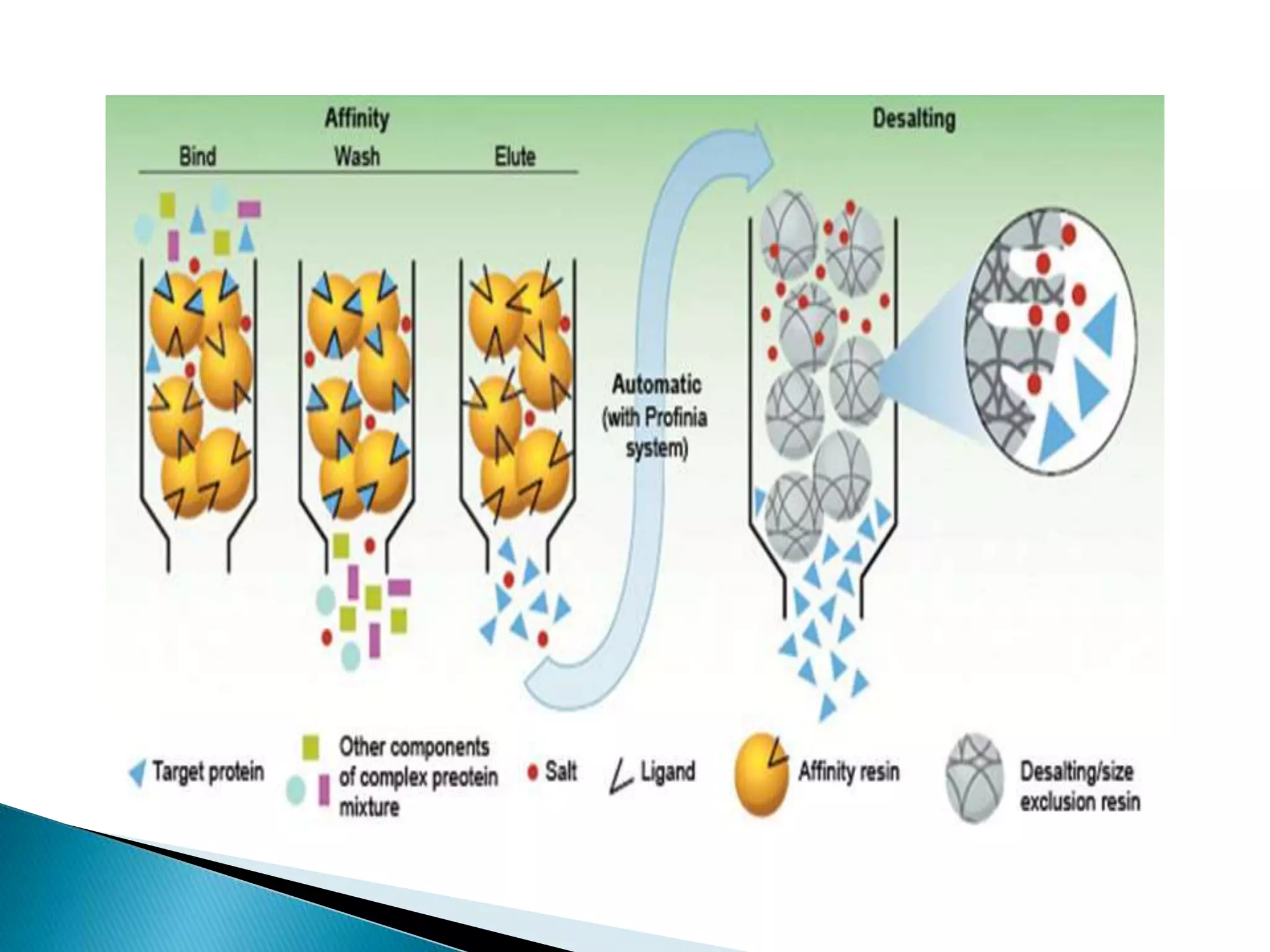
 As the crude mixture of the substances is passed through
the chromatography column, substances with binding site
for the immobilized substrate bind to the stationary phase,
while all other substances is eluted in the void volume of
the column.
 Once the other substances are eluted, the bound target
molecules can be eluted by methods such as including a
competing ligand in the mobile phase or changing the pH,
ionic strength or polarity conditions.
Ligand
 It refers to the molecule that binds reversibly to a specific target molecule.
 The ligand can be selected only after the nature of the macromolecule to be
isolated is known.
 When a hormone receptor protein is to be purified by affinity
chromatography, the hormone itself is an ideal candidate for the ligand.
 For antibody isolation, an antigen or hapten may be used as ligand.
 If an enzyme is to be purified,a substrate analog, inhibitor, cofactor, or
effector may be used as a the immobilized ligand.
 The sample is injected into the equilibrated affinity
chromatography
 Only the substance with affinity for the ligand are
retained on the column
 The substance with no affinity to the ligand will elute
off
 The substances retained in column can be eluted off by
changing the pH of salt or organic solvent
concentration of the eluent
 Affinity Chromatography is used to study enzymes and
other proteins.
 Affinity chromatography is used in genetic
engineering.
 Also used during production of vaccines.
 Protein or Enzyme purification by affinity
chromatography.
 Very high degree of purity can be seen with affinity
chromatography.
 High specificity with affinity chromatography.
 Ligands used in affinity chromatography are expensive.
 Leakage of ligands is also observed sometimes.
 Low productivity with affinity chromatography.
 Non-specific adsorption in affinity chromatography.
 Immunoglobulin purification (antibody
immobilization)
 Recombinant tagged proteins
 Protein A, G, and L purification
 Biotin and biotinylated molecules purification
 Affinity purification of albumin and macroglobulin
contamination
 Purify and concentrate an enzyme in a solution
 To reduce the amount of substance in a mixture

Affinity chromatography

  • 1.
    SUBMITTED BY: RAVIKUMAR AND JOBAN M PHARMACY(1ST SEM) DEPARTMENT PHARMACOLOGY G H G KHALSA COLLEGE OF PHARMACY AFFINITY CHROMATOGRAPHY
  • 2.
    CHROMATOGRAPHY: Chromatography isa laboratory technique for the separation of a mixture.  The mixture is dissolved in a fluid called the mobile phase, which carries it through a structure holding another material called the stationary phase.  The various constituents of the mixture travel at different speeds, causing them to separate.  The separation is based on differential partitioning between the mobile and stationary phases.
  • 3.
     Chromatography isan important biophysical technique that enables the separation, identification, and purification of the components of a mixture for qualitative and quantitative analysis.  It is a separation technique in which a mobile phase carrying a mixture is caused to move in contact with a selectively absorbent stationary phase.  Affinity chromatography is a type of liquid chromatography for the separation, purification or specific analysis of sample components.  It utilizes the reversible biological interaction or molecular recognition called affinity which refers to the attracting forced exerted in different degrees between atoms which cause them to remain in combination.  Example: Enzyme with and inhibitor, antigen with an antibody etc.
  • 5.
    Matrix  The matrixis an inert support to which a ligand can be directly or indirectly coupled.  In order to for the matrix to be effective it must have certain characters:  Matrix should be chemically and physically inert.  It must be insoluble in solvents and buffers employed in the process  It must be chemically and mechanically stable.  It must be easily coupled to a ligand or spacer arm onto which the ligand can be attached.  It must exhibit good flow properties and have a relatively large surface area for attachment.  The most useful matrix materials are agarose and polyacrylamide. Spacer arm  It is used to improve binding between ligand and target molecule by overcoming any effects of steric hindrance.
  • 6.
     The stationaryphase consists of a support medium, on which the substrate (ligand) is bound covalently, in such a way that the reactive groups that are essential for binding of the target molecule are exposed.  As the crude mixture of the substances is passed through the chromatography column, substances with binding site for the immobilized substrate bind to the stationary phase, while all other substances is eluted in the void volume of the column.  Once the other substances are eluted, the bound target molecules can be eluted by methods such as including a competing ligand in the mobile phase or changing the pH, ionic strength or polarity conditions.
  • 7.
    Ligand  It refersto the molecule that binds reversibly to a specific target molecule.  The ligand can be selected only after the nature of the macromolecule to be isolated is known.  When a hormone receptor protein is to be purified by affinity chromatography, the hormone itself is an ideal candidate for the ligand.  For antibody isolation, an antigen or hapten may be used as ligand.  If an enzyme is to be purified,a substrate analog, inhibitor, cofactor, or effector may be used as a the immobilized ligand.
  • 8.
     The sampleis injected into the equilibrated affinity chromatography  Only the substance with affinity for the ligand are retained on the column  The substance with no affinity to the ligand will elute off  The substances retained in column can be eluted off by changing the pH of salt or organic solvent concentration of the eluent
  • 9.
     Affinity Chromatographyis used to study enzymes and other proteins.  Affinity chromatography is used in genetic engineering.  Also used during production of vaccines.  Protein or Enzyme purification by affinity chromatography.  Very high degree of purity can be seen with affinity chromatography.  High specificity with affinity chromatography.
  • 10.
     Ligands usedin affinity chromatography are expensive.  Leakage of ligands is also observed sometimes.  Low productivity with affinity chromatography.  Non-specific adsorption in affinity chromatography.
  • 11.
     Immunoglobulin purification(antibody immobilization)  Recombinant tagged proteins  Protein A, G, and L purification  Biotin and biotinylated molecules purification  Affinity purification of albumin and macroglobulin contamination  Purify and concentrate an enzyme in a solution  To reduce the amount of substance in a mixture