NUPOOR NEOLE
INSITUTE OF FORENSIC SCIENCE
NAGPUR
B . Sc part 1
 Discovered by Tswett in 1906.
 First used to separate the coloured substance i.e, plant
pigments.
“Different
coloured dyes
together
appears as
black coloured
dye.”
DEFINATION
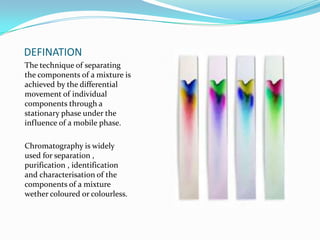
The technique of separating
the components of a mixture is
achieved by the differential
movement of individual
components through a
stationary phase under the
influence of a mobile phase.
Chromatography is widely
used for separation ,
purification , identification
and characterisation of the
components of a mixture
wether coloured or colourless.
Principles of chromatography
 Chromatography is a physical process.
 Any chromatography system is composed of mainly
three things:
1) Stationary phase
2) Mobile phase
3) Mixture to be separated
 Chromatography is an dynamic process in which
mobile phase moves in definite direction.
 In chromatography process we can only control
stationary &mobile phase as mixture is the problem we
have to deal with.
TERMINOLOGIES
 Differential: showing a difference.
 Affinity: natural force of attraction between the
substances.
 Adsorption :phenomenon of higher concentration of
molecular species(liquid or gas) on the surface of solid in
bulk.
 Adsorbent: the substance’s surface on which adsorption
took place.
 Adsorbate : substance which get adsorbed on adsorbent.
 Stationary phase : part of apparatus that does not move
with the sample.
 Mobile phase : gas or liquid that carries the sample with
it.
WORKING OF CHROMATOGRAPHY
 The substance which has to be separated has many
components, some of them has affinity to mobile
phase & some has affinity to stationary phase.
 The substance having affinity to mobile phase get
dissolved in it and travels large distance it.
 While substance having affinity to stationary phase get
adsorbed on it and travels very short distance.
Uses of chromatography
 Analyze: examine of mixture, it’s components & there
relation with one another.
 Identify : determine the identy of mixture or
components based on known components.
 Purify: separates components in order to isolate
components for further studies.
 Quantify : dertimens the amount of substances
present in the sample.
TYPES OF CHROMATOGRAPHY
 SOLID-LIQUID chromatography
 LIQUID-LIQUID chromatography
 LIQUID-GAS chromatography
LIQUID-SOLID chromatography
SOLID-LIQUID CHROMATOGRAPHY
 Stationary phase- SOLID
 Mobile phase- LIQUID
TECHNIQUE:
column chromatography
thin layer chromatography
high pressure liquid chromatography
LIQUID-LIQUID
CHROMATOGRAPHY
stationary phase – LIQUID
mobile phase – LIQUID
TECHNIQUES
paper chromatography
GAS-LIQUID OR GAS-SOLID
CHROMATOGRAPHY
 Stationary phase – LIQUID/SOLID
 Mobile phase – GAS
TECHNIQUE
gas chromatography
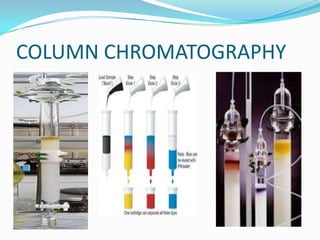
COLUMN CHROMATOGRAPHY
STATIONARY PHASE
The stationary phase or adsorbent in column
chromatography is a solid.

 The most common stationary phase for column
chromatography is silica gel, followed
by alumina. Cellulose powder has often been used in the
past.
 The stationary phases are usually finely ground powders
or gels and/or are micro porous for an increased surface.
MOBILE PHASE
•The mobile phase or eluent is either a
pure solvent or a mixture of different
solvents.
• The eluent has also been chosen so that
the different compounds can be separated
effectively
Column chromatography
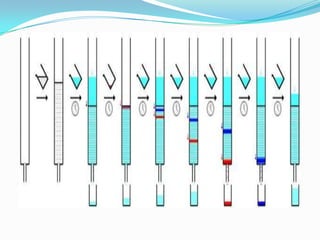
 Column chromatography in chemistry is a method used
to purify individual chemical compounds from mixtures of
compounds.
 The main advantage of column chromatography is the
relatively low cost and disposability of the stationary
phase used in the process. The latter prevents cross-
contamination and stationary phase degradation due to
recycling
 We can’t separate different amino acid’s &sugars. We
can’t also do quantitative analyses accurately.
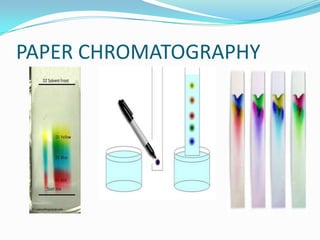
PAPER CHROMATOGRAPHY
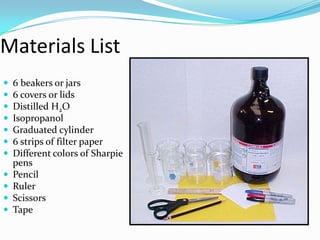
 6 beakers or jars
 6 covers or lids
 Distilled H2O
 Isopropanol
 Graduated cylinder
 6 strips of filter paper
 Different colors of Sharpie
pens
 Pencil
 Ruler
 Scissors
 Tape
Materials List
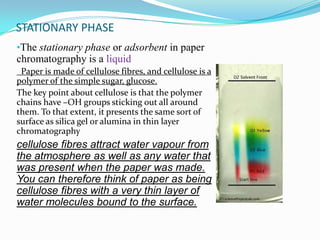
STATIONARY PHASE
•The stationary phase or adsorbent in paper
chromatography is a liquid
Paper is made of cellulose fibres, and cellulose is a
polymer of the simple sugar, glucose.
The key point about cellulose is that the polymer
chains have –OH groups sticking out all around
them. To that extent, it presents the same sort of
surface as silica gel or alumina in thin layer
chromatography
cellulose fibres attract water vapour from
the atmosphere as well as any water that
was present when the paper was made.
You can therefore think of paper as being
cellulose fibres with a very thin layer of
water molecules bound to the surface.
MOBILE PHASE
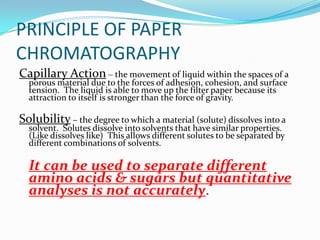
 The mobile phase used in paper chromatography is liquid
 . non-polar solvent such as hexane, Acetone,etc, Polar
solvents water, alcohols,etc as the solvent
 The solvent has also been chosen so that the different
compounds can be separated effectively
PRINCIPLE OF PAPER
CHROMATOGRAPHY
Capillary Action – the movement of liquid within the spaces of a
porous material due to the forces of adhesion, cohesion, and surface
tension. The liquid is able to move up the filter paper because its
attraction to itself is stronger than the force of gravity.
Solubility – the degree to which a material (solute) dissolves into a
solvent. Solutes dissolve into solvents that have similar properties.
(Like dissolves like) This allows different solutes to be separated by
different combinations of solvents.
It can be used to separate different
amino acids & sugars but quantitative
analyses is not accurately.
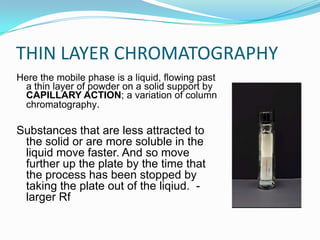
THIN LAYER CHROMATOGRAPHY
Here the mobile phase is a liquid, flowing past
a thin layer of powder on a solid support by
CAPILLARY ACTION; a variation of column
chromatography.
Substances that are less attracted to
the solid or are more soluble in the
liquid move faster. And so move
further up the plate by the time that
the process has been stopped by
taking the plate out of the liqiud. -
larger Rf
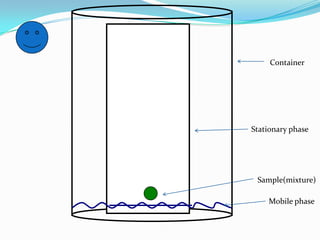
Container
Stationary phase
Mobile phase
Sample(mixture)
. Detection
 If the spots are not colored and can’t be seen by the
eye, use:
• UV lamp for UV-active compounds; most aromatics
are UV-active
• If compounds are not UV-active, use an iodine .
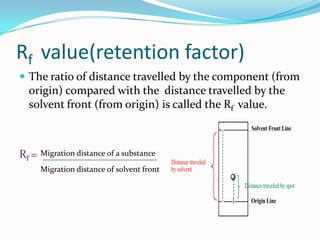
Rf value(retention factor)
 The ratio of distance travelled by the component (from
origin) compared with the distance travelled by the
solvent front (from origin) is called the Rf value.
Rf = Migration distance of a substance
Migration distance of solvent front
Origin Line
Solvent Front Line
Distance traveled
by solvent
Distance traveled by spot
28
••
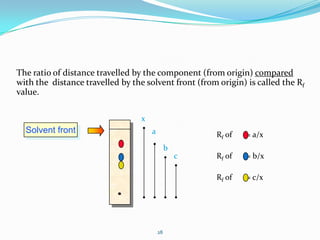
The ratio of distance travelled by the component (from origin) compared
with the distance travelled by the solvent front (from origin) is called the Rf
value.
Solvent front
x
a
b
c
Rf of = a/x
Rf of = b/x
Rf of = c/x
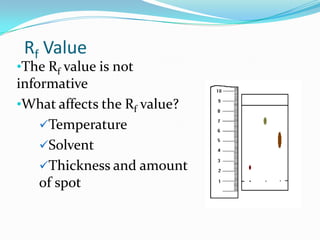
Rf Value
•The Rf value is not
informative
•What affects the Rf value?
Temperature
Solvent
Thickness and amount
of spot
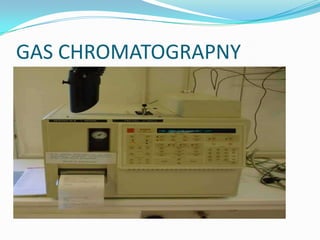
GAS CHROMATOGRAPNY
?
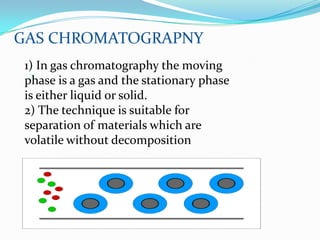
GAS CHROMATOGRAPNY
1) In gas chromatography the moving
phase is a gas and the stationary phase
is either liquid or solid.
2) The technique is suitable for
separation of materials which are
volatile without decomposition
It can be used for qualitative as well
as quantitative analyses of
substances.
It can’t be used to separate non-
volatile substances.
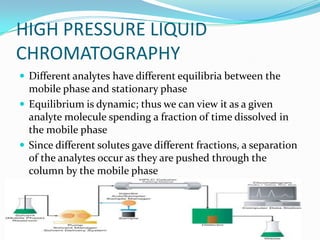
HIGH PRESSURE LIQUID
CHROMATOGRAPHY
 Different analytes have different equilibria between the
mobile phase and stationary phase
 Equilibrium is dynamic; thus we can view it as a given
analyte molecule spending a fraction of time dissolved in
the mobile phase
 Since different solutes gave different fractions, a separation
of the analytes occur as they are pushed through the
column by the mobile phase
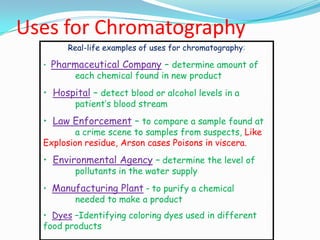
Uses for Chromatography
Real-life examples of uses for chromatography:
• Pharmaceutical Company – determine amount of
each chemical found in new product
• Hospital – detect blood or alcohol levels in a
patient’s blood stream
• Law Enforcement – to compare a sample found at
a crime scene to samples from suspects, Like
Explosion residue, Arson cases Poisons in viscera.
• Environmental Agency – determine the level of
pollutants in the water supply
• Manufacturing Plant – to purify a chemical
needed to make a product
• Dyes –Identifying coloring dyes used in different
food products
Chromatography

Chromatography

  • 1.
    NUPOOR NEOLE INSITUTE OFFORENSIC SCIENCE NAGPUR B . Sc part 1
  • 2.
     Discovered byTswett in 1906.  First used to separate the coloured substance i.e, plant pigments.
  • 3.
  • 4.
    DEFINATION The technique ofseparating the components of a mixture is achieved by the differential movement of individual components through a stationary phase under the influence of a mobile phase. Chromatography is widely used for separation , purification , identification and characterisation of the components of a mixture wether coloured or colourless.
  • 5.
    Principles of chromatography Chromatography is a physical process.  Any chromatography system is composed of mainly three things: 1) Stationary phase 2) Mobile phase 3) Mixture to be separated
  • 6.
     Chromatography isan dynamic process in which mobile phase moves in definite direction.  In chromatography process we can only control stationary &mobile phase as mixture is the problem we have to deal with.
  • 7.
    TERMINOLOGIES  Differential: showinga difference.  Affinity: natural force of attraction between the substances.  Adsorption :phenomenon of higher concentration of molecular species(liquid or gas) on the surface of solid in bulk.  Adsorbent: the substance’s surface on which adsorption took place.  Adsorbate : substance which get adsorbed on adsorbent.  Stationary phase : part of apparatus that does not move with the sample.  Mobile phase : gas or liquid that carries the sample with it.
  • 8.
    WORKING OF CHROMATOGRAPHY The substance which has to be separated has many components, some of them has affinity to mobile phase & some has affinity to stationary phase.  The substance having affinity to mobile phase get dissolved in it and travels large distance it.  While substance having affinity to stationary phase get adsorbed on it and travels very short distance.
  • 9.
    Uses of chromatography Analyze: examine of mixture, it’s components & there relation with one another.  Identify : determine the identy of mixture or components based on known components.  Purify: separates components in order to isolate components for further studies.  Quantify : dertimens the amount of substances present in the sample.
  • 10.
    TYPES OF CHROMATOGRAPHY SOLID-LIQUID chromatography  LIQUID-LIQUID chromatography  LIQUID-GAS chromatography LIQUID-SOLID chromatography
  • 11.
    SOLID-LIQUID CHROMATOGRAPHY  Stationaryphase- SOLID  Mobile phase- LIQUID TECHNIQUE: column chromatography thin layer chromatography high pressure liquid chromatography
  • 12.
    LIQUID-LIQUID CHROMATOGRAPHY stationary phase –LIQUID mobile phase – LIQUID TECHNIQUES paper chromatography
  • 13.
    GAS-LIQUID OR GAS-SOLID CHROMATOGRAPHY Stationary phase – LIQUID/SOLID  Mobile phase – GAS TECHNIQUE gas chromatography
  • 14.
  • 15.
    STATIONARY PHASE The stationaryphase or adsorbent in column chromatography is a solid.   The most common stationary phase for column chromatography is silica gel, followed by alumina. Cellulose powder has often been used in the past.  The stationary phases are usually finely ground powders or gels and/or are micro porous for an increased surface.
  • 16.
    MOBILE PHASE •The mobilephase or eluent is either a pure solvent or a mixture of different solvents. • The eluent has also been chosen so that the different compounds can be separated effectively
  • 18.
    Column chromatography  Columnchromatography in chemistry is a method used to purify individual chemical compounds from mixtures of compounds.  The main advantage of column chromatography is the relatively low cost and disposability of the stationary phase used in the process. The latter prevents cross- contamination and stationary phase degradation due to recycling  We can’t separate different amino acid’s &sugars. We can’t also do quantitative analyses accurately.
  • 19.
  • 20.
     6 beakersor jars  6 covers or lids  Distilled H2O  Isopropanol  Graduated cylinder  6 strips of filter paper  Different colors of Sharpie pens  Pencil  Ruler  Scissors  Tape Materials List
  • 21.
    STATIONARY PHASE •The stationaryphase or adsorbent in paper chromatography is a liquid Paper is made of cellulose fibres, and cellulose is a polymer of the simple sugar, glucose. The key point about cellulose is that the polymer chains have –OH groups sticking out all around them. To that extent, it presents the same sort of surface as silica gel or alumina in thin layer chromatography cellulose fibres attract water vapour from the atmosphere as well as any water that was present when the paper was made. You can therefore think of paper as being cellulose fibres with a very thin layer of water molecules bound to the surface.
  • 22.
    MOBILE PHASE  Themobile phase used in paper chromatography is liquid  . non-polar solvent such as hexane, Acetone,etc, Polar solvents water, alcohols,etc as the solvent  The solvent has also been chosen so that the different compounds can be separated effectively
  • 23.
    PRINCIPLE OF PAPER CHROMATOGRAPHY CapillaryAction – the movement of liquid within the spaces of a porous material due to the forces of adhesion, cohesion, and surface tension. The liquid is able to move up the filter paper because its attraction to itself is stronger than the force of gravity. Solubility – the degree to which a material (solute) dissolves into a solvent. Solutes dissolve into solvents that have similar properties. (Like dissolves like) This allows different solutes to be separated by different combinations of solvents. It can be used to separate different amino acids & sugars but quantitative analyses is not accurately.
  • 24.
    THIN LAYER CHROMATOGRAPHY Herethe mobile phase is a liquid, flowing past a thin layer of powder on a solid support by CAPILLARY ACTION; a variation of column chromatography. Substances that are less attracted to the solid or are more soluble in the liquid move faster. And so move further up the plate by the time that the process has been stopped by taking the plate out of the liqiud. - larger Rf
  • 25.
  • 26.
    . Detection  Ifthe spots are not colored and can’t be seen by the eye, use: • UV lamp for UV-active compounds; most aromatics are UV-active • If compounds are not UV-active, use an iodine .
  • 27.
    Rf value(retention factor) The ratio of distance travelled by the component (from origin) compared with the distance travelled by the solvent front (from origin) is called the Rf value. Rf = Migration distance of a substance Migration distance of solvent front Origin Line Solvent Front Line Distance traveled by solvent Distance traveled by spot
  • 28.
    28 •• The ratio ofdistance travelled by the component (from origin) compared with the distance travelled by the solvent front (from origin) is called the Rf value. Solvent front x a b c Rf of = a/x Rf of = b/x Rf of = c/x
  • 29.
    Rf Value •The Rfvalue is not informative •What affects the Rf value? Temperature Solvent Thickness and amount of spot
  • 30.
  • 31.
    ? GAS CHROMATOGRAPNY 1) Ingas chromatography the moving phase is a gas and the stationary phase is either liquid or solid. 2) The technique is suitable for separation of materials which are volatile without decomposition
  • 32.
    It can beused for qualitative as well as quantitative analyses of substances. It can’t be used to separate non- volatile substances.
  • 33.
    HIGH PRESSURE LIQUID CHROMATOGRAPHY Different analytes have different equilibria between the mobile phase and stationary phase  Equilibrium is dynamic; thus we can view it as a given analyte molecule spending a fraction of time dissolved in the mobile phase  Since different solutes gave different fractions, a separation of the analytes occur as they are pushed through the column by the mobile phase
  • 34.
    Uses for Chromatography Real-lifeexamples of uses for chromatography: • Pharmaceutical Company – determine amount of each chemical found in new product • Hospital – detect blood or alcohol levels in a patient’s blood stream • Law Enforcement – to compare a sample found at a crime scene to samples from suspects, Like Explosion residue, Arson cases Poisons in viscera. • Environmental Agency – determine the level of pollutants in the water supply • Manufacturing Plant – to purify a chemical needed to make a product • Dyes –Identifying coloring dyes used in different food products