Presented by
Debashish bose
Reg no- 1101298278
Branch- mechanical
Roll no- 14
GUIDED BY
AYUSHMAN NAYAK
LECTURER
DEPT. MECH ENGG.
CONTENT
 Introduction
 Literature Review
 History
 Types Of Fuel Injection
 Components Of Electronic Injection System
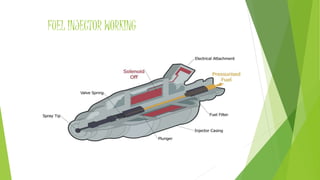
 Fuel Injector Working
 How The Injector Fires
 Injector Testing
 Injector Cleaning
 Digital Twin Spark Swirl Induction (Dts-si)
 Advantages
 Disadvantages
 References
INTRODUCTION
 Fuel injection is a system for mixing fuel with air in an Internal Combustion Engine.
 It has become the primary fuel delivery system used in gasoline automotive engines,
having almost completely replaced carburetors in the late 1980s.
 With the advent of electronic fuel injection (EFI), the diesel and gasoline hardware
has become similar.
 Strict emission standards require precise fuel delivery
 Computers used to calculate fuel needs
 EFI very precise, reliable & cost effective
 EFI provide correct A/F ratio for all loads, speeds, & temp ranges
LITERATURE REVIEW
 Automobile Electrical and Electronic Systems(Third edition) by Tom Denton BA, AMSAE,
MITRE, Cert.Ed.Associate Lecturer, Open University on Development of the automobile
electrical system.
 Gasoline Fuel-Injection System K-Jetronic by Dipl.-Ing. (FH) Ulrich Adler, Joachim Kaiser,
Berthold Gauder, Leinfelden-Echterdingen targeting to achieve higher fuel economy and
lower toxic emissions.
 Service Procedures 2379-03-02-02 Copper Sleeve, Unit Injector, Replacement(One) by Volvo
Trucks North America Greensboro, NC USA covering the propoer procedure for replacing
the copper sleeves for the unit injectors on the Volvo D16F engine.
 Service Procedures 2379-03-02-01 Unit Injector, Replacement D16 Engines by Volvo Trucks
North America Greensboro, NC USA covering information regarding replacing operation for
the engine unit injectors on the Volvo D16 engine.
HISTORY
 Frederic joined Forward gas engine in 1889 and do experiments in fuel injection.
 Fuel injection was in widespread commercial use in diesel engines by mid 1920s. The
direct injection was in employed in some notable designs like Benz, BMW.
 First gasoline injection system was developed by Bosch and introduced in 1955 in
Mercedes Benz-300 SL.
 The first commercial electronic fuel injection (EFI) system was Electrojector,
developed by the Bendix Corporation and was to be offered by American Motors
(AMC) in 1957 .
HISTORY(CONT..)
 In 1957, Chevrolet introduced a mechanical fuel injection option, made by
General Motors‘.
 Chrysler offered Electro injector on specific high performance 1958
models…the 300D, the D500 Arguably the first series cars equipped with an
EFI system, but the early electronic components were too slow.
 Bosch developed an electronic fuel injection system, called D-Jetronic (D for
Druck, the German word for pressure), which was first used on the VW
1600TL in 1967.
Types of Fuel Injection
 Direct Injection
 Throttle Body Injection
 Multi point Fuel Injection
 Continuous Injection
 Central Port Injection
 Central Multi-Port Injection
 Low Pressure Injection
Direct Injection(TDI):
 In direct injection the fuel injector sprays atomised fuel directly into the main
combustion chamber of each cylinder, rather than the pre-combustion chamber
prevalent in older diesels which used indirect injection.
 The engine is coupled with a turbocharger to increase the amount of air going
into the engine cylinders, and an intercooler to lower the temperature (and
therefore increase the density) of the air from the turbo, thereby increasing the
amount of fuel that can be injected and combusted
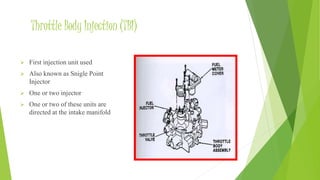
Throttle Body Injection (TBI)
 First injection unit used
 Also known as Snigle Point
Injector
 One or two injector
 One or two of these units are
directed at the intake manifold
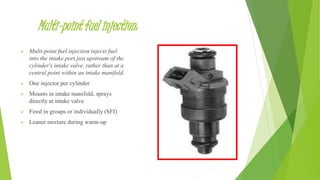
Multi-point fuel injection:
 Multi-point fuel injection injects fuel
into the intake port just upstream of the
cylinder's intake valve, rather than at a
central point within an intake manifold.
 One injector per cylinder
 Mounts in intake manifold, sprays
directly at intake valve
 Fired in groups or individually (SFI)
 Leaner mixture during warm-up
Continuous injection
 In a continuous injection system, fuel flows at all times from the fuel injectors, but at a

variable flow rate.
 This is in contrast to most fuel injection systems, which provide fuel during short pulses
of varying duration, with a constant rate of flow during each pulse.
 Continuous injection systems can be multi-point or single-point, but not direct.
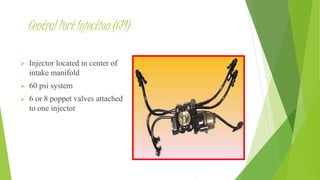
Central Port Injection (CPI)
 Injector located in center of
intake manifold
 60 psi system
 6 or 8 poppet valves attached
to one injector
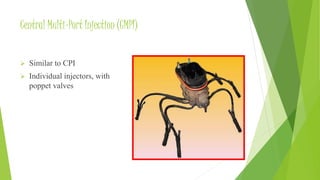
Central Multi-Port Injection (CMPI)
 Similar to CPI
 Individual injectors, with
poppet valves
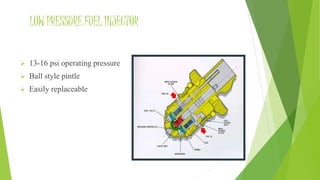
LOW PRESSURE FUEL INJECTOR
 13-16 psi operating pressure
 Ball style pintle
 Easily replaceable
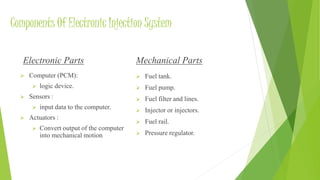
Components Of Electronic Injection System
Electronic Parts
 Computer (PCM):
 logic device.
 Sensors :
 input data to the computer.
 Actuators :
 Convert output of the computer
into mechanical motion
Mechanical Parts
 Fuel tank.
 Fuel pump.
 Fuel filter and lines.
 Injector or injectors.
 Fuel rail.
 Pressure regulator.
Types of Engine Sensors
 Mass airflow sensor
 Oxygen sensor
 Throttle position sensor
 Coolant temperature sensor
 Voltage sensor
 Manifold absolute pressure sensor
 Engine speed sensor
 Crank Position Sensor
 Cam Angle Sensor
Computer Actuators (Outputs)
 Fuel Injectors
 Idle Air Control
 Fuel Pump Relay
 Cooling Fan Relay
 Torque Converter
 Malfunction Indicator Lamp
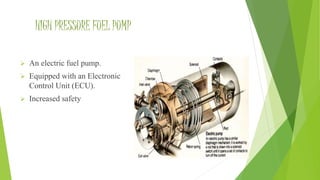
HIGH PRESSURE FUEL PUMP
 An electric fuel pump.
 Equipped with an Electronic
Control Unit (ECU).
 Increased safety
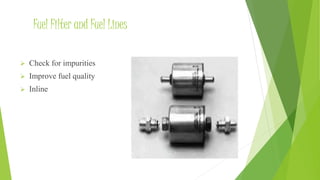
Fuel Filter and Fuel Lines
 Check for impurities
 Improve fuel quality
 Inline
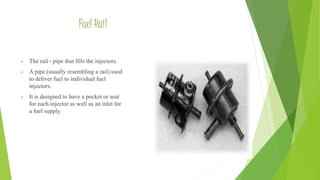
Fuel Rail
 The rail - pipe that fills the injectors.
 A pipe (usually resembling a rail) used
to deliver fuel to individual fuel
injectors.
 It is designed to have a pocket or seat
for each injector as well as an inlet for
a fuel supply.
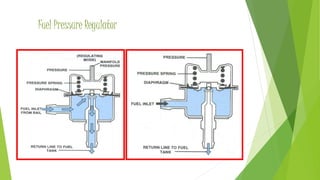
Fuel Pressure Regulator
 Located at end of fuel rail
 Maintains constant pressure at injectors
 Pressure adjusted for changes in intake manifold vacuum.
 Some are mechanical but newer cars use an electronic system
Fuel Pressure Regulator
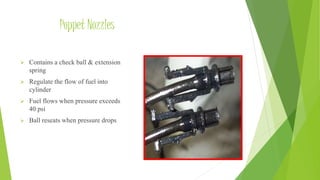
Poppet Nozzles
 Contains a check ball & extension
spring
 Regulate the flow of fuel into
cylinder
 Fuel flows when pressure exceeds
40 psi
 Ball reseats when pressure drops
ELECTRONIC CONTROL UNIT
 ECU determines precisely how much fuel needs to be delivered by the injector by
monitoring the engine sensors.
 ECU monitors engine operating parameters via various sensors.
 The optimum amount of injected fuel depends on conditions such as engine and
ambient temperatures, engine speed and workload, and exhaust gas composition.
 Monitoring temperature and other sensors etc.
FUEL INJECTOR WORKING
 Electronic Control System
 Fuel Delivery System
 Air Induction System
Electronic Control System
 Comprises of various electronic parts including sensor.
 The sensor sends sgnal to the Electronic Control Unit.
 The ECU processes all these signal and send appropriate commands to the
injectors.
 The injector inject fuel as per the command.
Fuel Delivery System
 It consist of fuel tank, fuel pump, fuel filter, fuel delivery pipe, fuel
injector, fuel pressure regulator and fuel return pipe.
 Fuel is delivered from the tank to the injector by means of an electric fuel
pump. The pump is typically located in or near the fuel tank.
 Fuel is maintained at a constant pressure by means of a fuel pressure
regulator.
Air Induction System
 The air induction system consists of the air cleaner, air flow meter, throttle
valve, air intake chamber, intake manifold runner, and intake valve.
 When the throttle valve is opened, air flows through the air cleaner, through the
air flow meter (on L type systems), past the throttle valve, and through a well
tuned intake manifold runner to the intake valve.
How the Injector Fires
 The computer grounds the injector to turn it “pulse” -- “Pulse width”
 Pulses timed by crankshaft sensor (CKPS). And/or camshaft sensor (CPS).
 Three ways to fire the injectors:
1. Group
2. Gang injection
3. Sequential injection
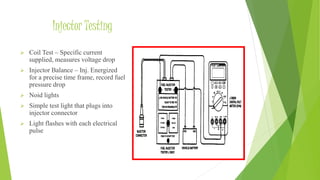
Injector Testing
 Coil Test – Specific current
supplied, measures voltage drop
 Injector Balance – Inj. Energized
for a precise time frame, record fuel
pressure drop
 Noid lights
 Simple test light that plugs into
injector connector
 Light flashes with each electrical
pulse
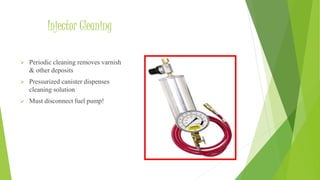
 Periodic cleaning removes varnish
& other deposits
 Pressurized canister dispenses
cleaning solution
 Must disconnect fuel pump!
Injector Cleaning
Digital Twin Spark Swirl Induction (DTS-Si):
 Like the DTS-i engine, the DTS-Si engine also has 2 Spark Plugs, the timing of
which is controlled by a Digital Microprocessor.
 The difference between these two engines is the offset position of the inlet and
outlet ports of the DTS-Si engine.
 This offset position creates turbulence of the air-fuel mixture inside the engine.
 Benefits of DTS-Si Technology: This enhances the fuel efficiency of the engine
even further.
Advantages
 Uniform Air/Fuel Mixture Distribution.
 Highly Accurate Air/Fuel Ratio Control Throughout All Engine Operating
Conditions.
 Excellent Fuel Economy With Improved Emission Control.
 Improved Cold Engine Start ability.
 Simpler Mechanics, Reduced Adjustment Sensitivity
DISADVANTAGES
 Costly.
 Need regular maintenance.
 ECU can be hacked.
REFERENCES
 “Automobile Electrical and Electronic Systems(Third edition)” by Tom Denton BA,
AMSAE, MITRE, Cert.Ed.Associate Lecturer, Open University.
 “Gasoline Fuel-Injection System K-Jetronic” by Dipl.-Ing. (FH) Ulrich Adler, Joachim
Kaiser, Berthold Gauder, Leinfelden-Echterdingen.
 “Service Procedures 2379-03-02-02 Copper Sleeve, Unit Injector,
Replacement(One)” by Volvo Trucks North America Greensboro, NC USA.
 “Service Procedures 2379-03-02-01 Unit Injector, Replacement D16 Engines” by
Volvo Trucks North America Greensboro, NC USA.
ELECTRONIC FUEL INJECTOR

ELECTRONIC FUEL INJECTOR

  • 1.
    Presented by Debashish bose Regno- 1101298278 Branch- mechanical Roll no- 14 GUIDED BY AYUSHMAN NAYAK LECTURER DEPT. MECH ENGG.
  • 2.
    CONTENT  Introduction  LiteratureReview  History  Types Of Fuel Injection  Components Of Electronic Injection System  Fuel Injector Working  How The Injector Fires  Injector Testing  Injector Cleaning  Digital Twin Spark Swirl Induction (Dts-si)  Advantages  Disadvantages  References
  • 3.
    INTRODUCTION  Fuel injectionis a system for mixing fuel with air in an Internal Combustion Engine.  It has become the primary fuel delivery system used in gasoline automotive engines, having almost completely replaced carburetors in the late 1980s.  With the advent of electronic fuel injection (EFI), the diesel and gasoline hardware has become similar.  Strict emission standards require precise fuel delivery  Computers used to calculate fuel needs  EFI very precise, reliable & cost effective  EFI provide correct A/F ratio for all loads, speeds, & temp ranges
  • 4.
    LITERATURE REVIEW  AutomobileElectrical and Electronic Systems(Third edition) by Tom Denton BA, AMSAE, MITRE, Cert.Ed.Associate Lecturer, Open University on Development of the automobile electrical system.  Gasoline Fuel-Injection System K-Jetronic by Dipl.-Ing. (FH) Ulrich Adler, Joachim Kaiser, Berthold Gauder, Leinfelden-Echterdingen targeting to achieve higher fuel economy and lower toxic emissions.  Service Procedures 2379-03-02-02 Copper Sleeve, Unit Injector, Replacement(One) by Volvo Trucks North America Greensboro, NC USA covering the propoer procedure for replacing the copper sleeves for the unit injectors on the Volvo D16F engine.  Service Procedures 2379-03-02-01 Unit Injector, Replacement D16 Engines by Volvo Trucks North America Greensboro, NC USA covering information regarding replacing operation for the engine unit injectors on the Volvo D16 engine.
  • 5.
    HISTORY  Frederic joinedForward gas engine in 1889 and do experiments in fuel injection.  Fuel injection was in widespread commercial use in diesel engines by mid 1920s. The direct injection was in employed in some notable designs like Benz, BMW.  First gasoline injection system was developed by Bosch and introduced in 1955 in Mercedes Benz-300 SL.  The first commercial electronic fuel injection (EFI) system was Electrojector, developed by the Bendix Corporation and was to be offered by American Motors (AMC) in 1957 .
  • 6.
    HISTORY(CONT..)  In 1957,Chevrolet introduced a mechanical fuel injection option, made by General Motors‘.  Chrysler offered Electro injector on specific high performance 1958 models…the 300D, the D500 Arguably the first series cars equipped with an EFI system, but the early electronic components were too slow.  Bosch developed an electronic fuel injection system, called D-Jetronic (D for Druck, the German word for pressure), which was first used on the VW 1600TL in 1967.
  • 7.
    Types of FuelInjection  Direct Injection  Throttle Body Injection  Multi point Fuel Injection  Continuous Injection  Central Port Injection  Central Multi-Port Injection  Low Pressure Injection
  • 8.
    Direct Injection(TDI):  Indirect injection the fuel injector sprays atomised fuel directly into the main combustion chamber of each cylinder, rather than the pre-combustion chamber prevalent in older diesels which used indirect injection.  The engine is coupled with a turbocharger to increase the amount of air going into the engine cylinders, and an intercooler to lower the temperature (and therefore increase the density) of the air from the turbo, thereby increasing the amount of fuel that can be injected and combusted
  • 9.
    Throttle Body Injection(TBI)  First injection unit used  Also known as Snigle Point Injector  One or two injector  One or two of these units are directed at the intake manifold
  • 10.
    Multi-point fuel injection: Multi-point fuel injection injects fuel into the intake port just upstream of the cylinder's intake valve, rather than at a central point within an intake manifold.  One injector per cylinder  Mounts in intake manifold, sprays directly at intake valve  Fired in groups or individually (SFI)  Leaner mixture during warm-up
  • 11.
    Continuous injection  Ina continuous injection system, fuel flows at all times from the fuel injectors, but at a variable flow rate.  This is in contrast to most fuel injection systems, which provide fuel during short pulses of varying duration, with a constant rate of flow during each pulse.  Continuous injection systems can be multi-point or single-point, but not direct.


  • 12.
    Central Port Injection(CPI)  Injector located in center of intake manifold  60 psi system  6 or 8 poppet valves attached to one injector
  • 13.
    Central Multi-Port Injection(CMPI)  Similar to CPI  Individual injectors, with poppet valves
  • 14.
    LOW PRESSURE FUELINJECTOR  13-16 psi operating pressure  Ball style pintle  Easily replaceable
  • 15.
    Components Of ElectronicInjection System Electronic Parts  Computer (PCM):  logic device.  Sensors :  input data to the computer.  Actuators :  Convert output of the computer into mechanical motion Mechanical Parts  Fuel tank.  Fuel pump.  Fuel filter and lines.  Injector or injectors.  Fuel rail.  Pressure regulator.
  • 16.
    Types of EngineSensors  Mass airflow sensor  Oxygen sensor  Throttle position sensor  Coolant temperature sensor  Voltage sensor  Manifold absolute pressure sensor  Engine speed sensor  Crank Position Sensor  Cam Angle Sensor
  • 17.
    Computer Actuators (Outputs) Fuel Injectors  Idle Air Control  Fuel Pump Relay  Cooling Fan Relay  Torque Converter  Malfunction Indicator Lamp
  • 18.
    HIGH PRESSURE FUELPUMP  An electric fuel pump.  Equipped with an Electronic Control Unit (ECU).  Increased safety
  • 19.
    Fuel Filter andFuel Lines  Check for impurities  Improve fuel quality  Inline
  • 20.
    Fuel Rail  Therail - pipe that fills the injectors.  A pipe (usually resembling a rail) used to deliver fuel to individual fuel injectors.  It is designed to have a pocket or seat for each injector as well as an inlet for a fuel supply.
  • 21.
    Fuel Pressure Regulator Located at end of fuel rail  Maintains constant pressure at injectors  Pressure adjusted for changes in intake manifold vacuum.  Some are mechanical but newer cars use an electronic system
  • 22.
  • 23.
    Poppet Nozzles  Containsa check ball & extension spring  Regulate the flow of fuel into cylinder  Fuel flows when pressure exceeds 40 psi  Ball reseats when pressure drops
  • 24.
    ELECTRONIC CONTROL UNIT ECU determines precisely how much fuel needs to be delivered by the injector by monitoring the engine sensors.  ECU monitors engine operating parameters via various sensors.  The optimum amount of injected fuel depends on conditions such as engine and ambient temperatures, engine speed and workload, and exhaust gas composition.  Monitoring temperature and other sensors etc.
  • 25.
  • 26.
    FUEL INJECTOR WORKING Electronic Control System  Fuel Delivery System  Air Induction System
  • 27.
    Electronic Control System Comprises of various electronic parts including sensor.  The sensor sends sgnal to the Electronic Control Unit.  The ECU processes all these signal and send appropriate commands to the injectors.  The injector inject fuel as per the command.
  • 28.
    Fuel Delivery System It consist of fuel tank, fuel pump, fuel filter, fuel delivery pipe, fuel injector, fuel pressure regulator and fuel return pipe.  Fuel is delivered from the tank to the injector by means of an electric fuel pump. The pump is typically located in or near the fuel tank.  Fuel is maintained at a constant pressure by means of a fuel pressure regulator.
  • 29.
    Air Induction System The air induction system consists of the air cleaner, air flow meter, throttle valve, air intake chamber, intake manifold runner, and intake valve.  When the throttle valve is opened, air flows through the air cleaner, through the air flow meter (on L type systems), past the throttle valve, and through a well tuned intake manifold runner to the intake valve.
  • 30.
    How the InjectorFires  The computer grounds the injector to turn it “pulse” -- “Pulse width”  Pulses timed by crankshaft sensor (CKPS). And/or camshaft sensor (CPS).  Three ways to fire the injectors: 1. Group 2. Gang injection 3. Sequential injection
  • 31.
    Injector Testing  CoilTest – Specific current supplied, measures voltage drop  Injector Balance – Inj. Energized for a precise time frame, record fuel pressure drop  Noid lights  Simple test light that plugs into injector connector  Light flashes with each electrical pulse
  • 32.
     Periodic cleaningremoves varnish & other deposits  Pressurized canister dispenses cleaning solution  Must disconnect fuel pump! Injector Cleaning
  • 33.
    Digital Twin SparkSwirl Induction (DTS-Si):  Like the DTS-i engine, the DTS-Si engine also has 2 Spark Plugs, the timing of which is controlled by a Digital Microprocessor.  The difference between these two engines is the offset position of the inlet and outlet ports of the DTS-Si engine.  This offset position creates turbulence of the air-fuel mixture inside the engine.  Benefits of DTS-Si Technology: This enhances the fuel efficiency of the engine even further.
  • 34.
    Advantages  Uniform Air/FuelMixture Distribution.  Highly Accurate Air/Fuel Ratio Control Throughout All Engine Operating Conditions.  Excellent Fuel Economy With Improved Emission Control.  Improved Cold Engine Start ability.  Simpler Mechanics, Reduced Adjustment Sensitivity
  • 35.
    DISADVANTAGES  Costly.  Needregular maintenance.  ECU can be hacked.
  • 36.
    REFERENCES  “Automobile Electricaland Electronic Systems(Third edition)” by Tom Denton BA, AMSAE, MITRE, Cert.Ed.Associate Lecturer, Open University.  “Gasoline Fuel-Injection System K-Jetronic” by Dipl.-Ing. (FH) Ulrich Adler, Joachim Kaiser, Berthold Gauder, Leinfelden-Echterdingen.  “Service Procedures 2379-03-02-02 Copper Sleeve, Unit Injector, Replacement(One)” by Volvo Trucks North America Greensboro, NC USA.  “Service Procedures 2379-03-02-01 Unit Injector, Replacement D16 Engines” by Volvo Trucks North America Greensboro, NC USA.